
Aniracetam Summary
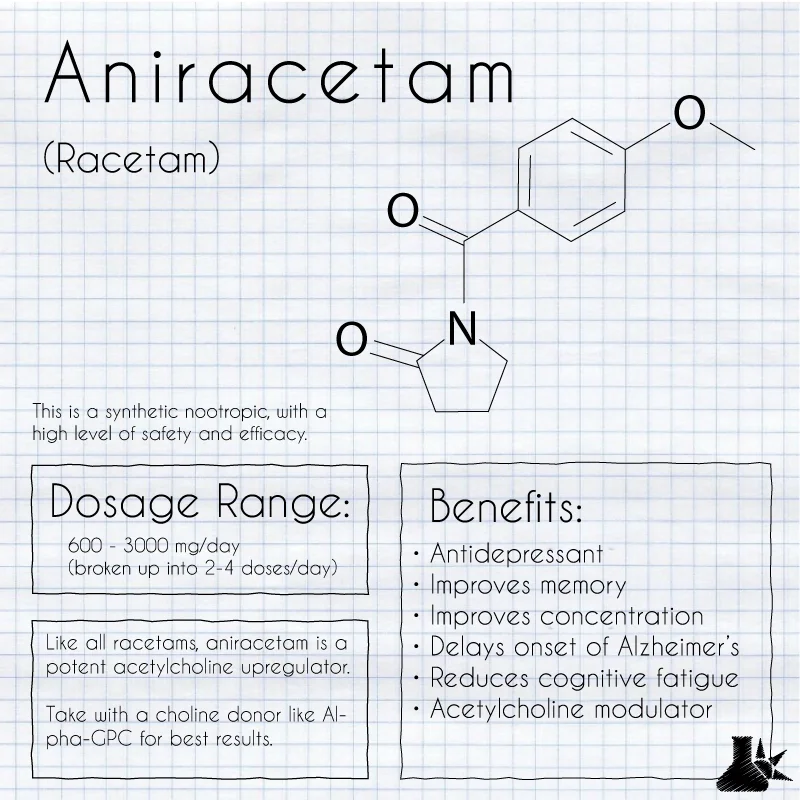
Aniracetam is a potent nootropic based on the racetam structure. These molecules were first created in the 1960s when piracetam was created.
Aniracetam is a slight improvement to this original molecule allowing for higher potency. It’s most commonly used to improve memory, concentration, cognitive fatigue, and to delay the onset of Alzheimer’s disease.
It works through the neurotransmitter acetylcholine, increasing its production in the brain. This popular nootropic substance is one of the safest, and most effective on the market. Recommended taking with a choline donor such as Alpha-GPC for best results.
Where Does It Come From?
Synthetic substance.
Indications
- Post stroke depression 1Reference 1AnimalAntidepressant-like effects of aniracetam in aged rats and its mode of actionView study →
- Depression
- To prolong the onset of Alzheimer’s
- For mild-strong cognitive enhancement
- To improve memory
- Sleep disturbances
- Parkinson’s disease
- Anxiety
Contraindications
- Pregnancy and breastfeeding (insufficient safety data)
- Combine cautiously with serotonergic or cholinergic medications
Mechanisms
- Glutamatergic modulator
- Cholinergic modulator
- Serotonergic (mild)
- Dopaminergic (mild)
Chemical Description:
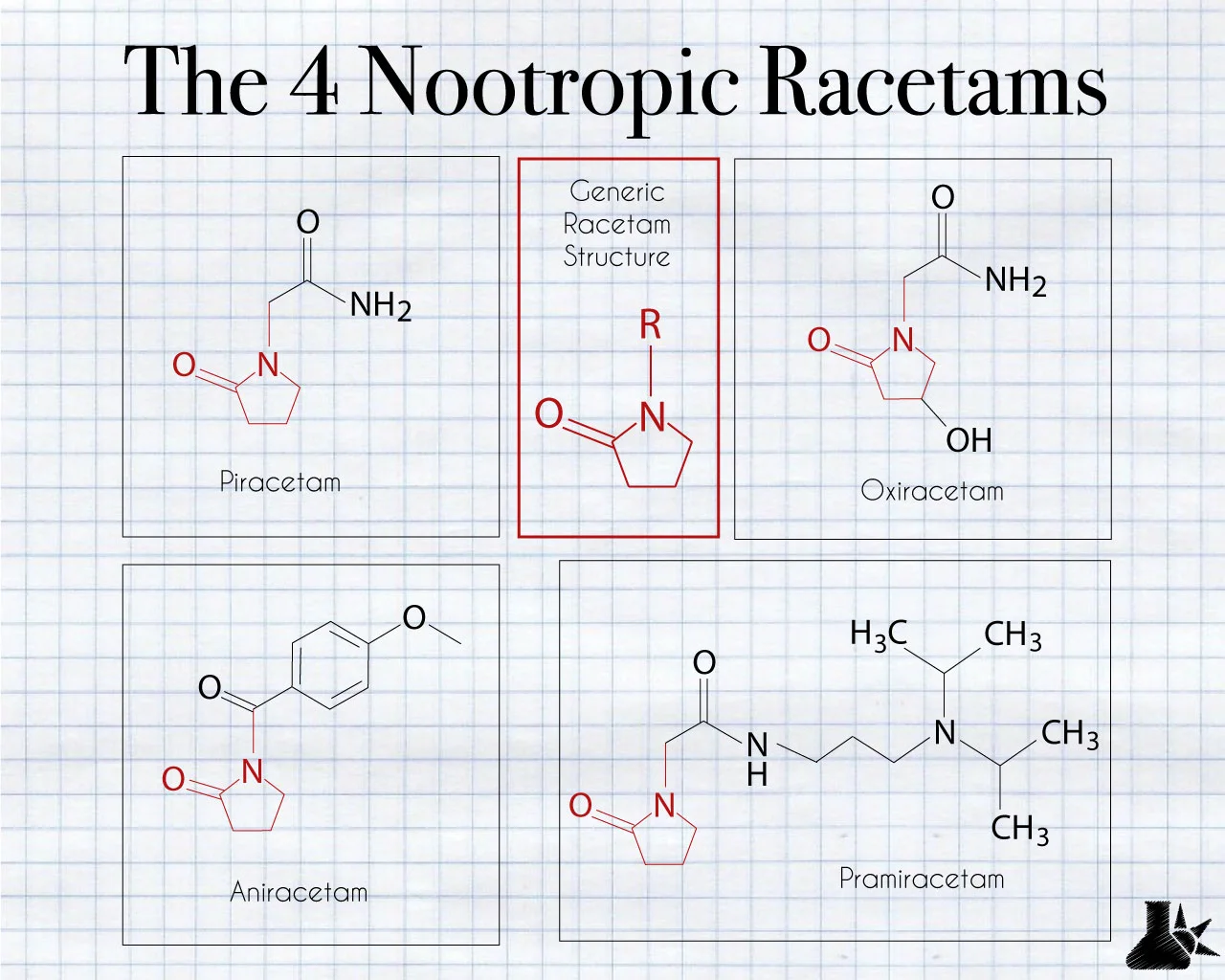
The IUPAC name for aniracetam is (1-(4-methoxybenzoyl)-2-pyrrolidinone, CAS
72432-10-1). 2Reference 2AnimalThe effect of aniracetam on cerebral glucose metabolism in rats after lesioning of the basal forebrain measured by PET.
As with all racetams, aniracetam has a 2-pyrrolidone nucleus made up of oxygen, nitrogen, and hydrogen.
Metabolism/Pharmacokinetics:
The bioavailability of aniracetam is fairly high. From there, it is metabolised into 2 main species. 70% N-anisoyl-γ-amino-butyric acid, and 30% p-anisic acid and 2-pyrrolidinone 3,4,5,6Reference 3Pharmacokinetics and bioequivalence study of aniracetam after single-dose administration in healthy Chinese male volunteersReference 4Determination of aniracetam and its main metabolite, N-anisoyl-GABA, in human plasma by high-performance liquid chromatographyReference 5Aniracetam enhances cortical dopamine and serotonin release via cholinergic and glutamatergic mechanisms in SHRSPReference 6AnimalPharmacokinetics of aniracetam and its metabolites in rats.
Pharmacology And Medical Research
Acetylcholine Modulator
Aniracetam has been shown to increase the release of acetylcholine from the hippocampus 3Reference 3Pharmacokinetics and bioequivalence study of aniracetam after single-dose administration in healthy Chinese male volunteers.
Antidepressant
The antidepressant effects of aniracetam were shown in mice during a forced swim test. The results of this study showed a significantly enhanced effect on aged mice than healthy adult mice. The effects were suggested to be due to the combined effects of 2-pyrrolidinone and N-anisoyl-GABA (not individually, however). The mechanism involves the facilitation of dopaminergic transmission (D2 receptor activation) through nicotinic acetylcholine receptor stimulation 1Reference 1AnimalAntidepressant-like effects of aniracetam in aged rats and its mode of actionView study →. The dosage range in this study was 30 and 100 mg/kg. No significant difference was noted between these doses.
Aniracetam was also shown to selectively enhance 5-HT release in mesocorticolimbic serotonergic terminals (prefrontal cortex, basolateral amygdala, and dorsal hippocampus) 1Reference 1AnimalAntidepressant-like effects of aniracetam in aged rats and its mode of actionView study →. These are well-known sites of stress response and emotional memory.
Glutaminergic Modulation
Aniracetam was found to increase glutamatergic transmission via the quisqualate or α-amino-3-hydroxy-5-methyl-4-isoxazolepropionate (AMPA) receptor 2Reference 2AnimalThe effect of aniracetam on cerebral glucose metabolism in rats after lesioning of the basal forebrain measured by PET.
Synergy
Aniracetam, as with all racetams are synergistic with choline donors. Due to the stimulation of acetylcholine production, having an excess of choline donor support improves the synthesis of acetylcholine.
Aniracetam is also synergistic with acetylcholinesterase inhibitors due to a combined effect on acetylcholine levels. Combining the two in formula allows both substances to be taken in smaller doses.
References:
- Nakamura, K., & Tanaka, Y. (2001). Antidepressant-like effects of aniracetam in aged rats and its mode of action. Psychopharmacology, 158(2), 205-212. doi:10.1007/s00213010084
- Yasuomi O, Takeharu K, Hiroyuki O, Shingo N, Hideo T. The effect of aniracetam on cerebral glucose metabolism in rats after lesioning of the basal forebrain measured by PET. J Neuro Sci.1999;164:7–12.
- Tian Y., Zhang J.-J., Feng S.-D., Zhang Z.-J., & Chen Y. (2008). Pharmacokinetics and bioequivalence study of aniracetam after single-dose administration in healthy Chinese male volunteers. Arzneimittel-Forschung/Drug Research, 58(10), 497-500.
- Guenzi A, Zanetti M. Determination of aniracetam and its main metabolite, N-anisoyl-GABA, in human plasma by high-performance liquid chromatography. J Chromatogr. 1990;530:397–406.
- Masatoshi S, Kazuo N. Aniracetam enhances cortical dopamine and serotonin release via cholinergic and glutamatergic mechanisms in SHRSP. Brain Res. 2001;916:211–221.
- Oqiso T, Iwaki M, Tanino T, Ikede K, Paku T, Horibe Y, et al. Pharmacokinetics of aniracetam and its metabolites in rats. J Pharm Sci. 1998;87(5):594–598