
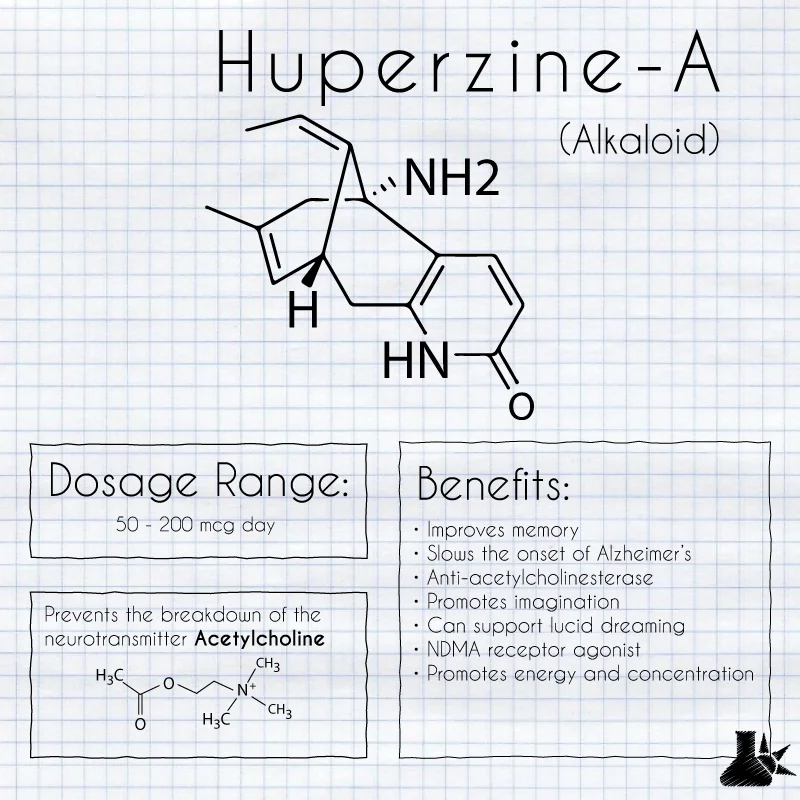
Supplement Monograph
Huperzine-A
A club-moss alkaloid and potent reversible acetylcholinesterase inhibitor, used as a memory-support nootropic and studied in Alzheimer's disease — where the independent Western trial was negative.
Where Does It Come From? (1)
Pharmacology & Research
Huperzine A is a plant alkaloid — specifically a Lycopodium (club moss) alkaloid, not the “sesquiterpene alkaloid” sometimes stated — that acts as a potent, reversible, selective inhibitor of acetylcholinesterase (AChE), the enzyme that clears the neurotransmitter acetylcholine from the synapse. Almost all of its human evidence sits in dementia and cognition, and almost all of it comes from China: a Cochrane review and several meta-analyses report cognitive benefit in Alzheimer’s disease, but repeatedly flag that the underlying trials are small, of poor methodological quality, and at high risk of bias 1,2,3Reference 1Meta-analysisHuperzine A for Alzheimer’s disease — [systematic review / meta-analysis]View study →Reference 2Meta-analysisHuperzine A for Alzheimer’s disease: a systematic review and meta-analysis of randomized clinical trials — [meta-analysis]View study →Reference 3Meta-analysisEfficacy and safety of natural acetylcholinesterase inhibitor huperzine A in the treatment of Alzheimer’s disease: an updated meta-analysis — [meta-analysis]View study →. The single independent, well-controlled Western trial — a US multicentre Phase II run by the Alzheimer’s Disease Cooperative Study — found no cognitive benefit at its primary dose, which is the most important fact the older monograph omits 4Reference 4RCTA phase II trial of huperzine A in mild to moderate Alzheimer disease — [randomized controlled trial, negative at primary dose]View study →. As a supplement, Huperzine A is a genuinely pharmacologically active drug rather than a nutrient: there is no dietary source, no RDA and no established upper limit, and its narrow effective window (micrograms) plus cholinergic side-effect profile make dose and product quality the decision-relevant variables.
- Best-supported: symptomatic cognitive improvement in Alzheimer’s disease in Chinese RCTs and their meta-analyses (MMSE/ADAS-Cog/ADL), though the quality bar is low 1,2,3Reference 1Meta-analysisHuperzine A for Alzheimer’s disease — [systematic review / meta-analysis]View study →Reference 2Meta-analysisHuperzine A for Alzheimer’s disease: a systematic review and meta-analysis of randomized clinical trials — [meta-analysis]View study →Reference 3Meta-analysisEfficacy and safety of natural acetylcholinesterase inhibitor huperzine A in the treatment of Alzheimer’s disease: an updated meta-analysis — [meta-analysis]View study →.
- Emerging / cautiously endorsed: adjunctive use for cognitive deficits in schizophrenia (meta-analysis of 12 China-only RCTs) 7Reference 7Meta-analysisAdjunctive huperzine A for cognitive deficits in schizophrenia: a systematic review and meta-analysis — [meta-analysis]View study →; a small matched-pairs signal in healthy adolescent students 8Reference 8RCTHuperzine-A capsules enhance memory and learning performance in 34 pairs of matched adolescent students — [randomized double-blind trial]View study →.
- Popular but thin / overhyped: general “nootropic” memory enhancement in healthy adults — resting on one 1999 student trial and mechanism, not replicated modern data; vascular dementia and MCI, where Cochrane found essentially no usable evidence 5,6Reference 5Systematic reviewHuperzine A for vascular dementia — [systematic review]View study →Reference 6Systematic reviewHuperzine A for mild cognitive impairment — [systematic review]View study →.
- The honest miss / caveat: the one independent, industry-free Western Alzheimer’s trial was negative at its primary dose 4Reference 4RCTA phase II trial of huperzine A in mild to moderate Alzheimer disease — [randomized controlled trial, negative at primary dose]View study →, and a well-controlled TBI trial found the apparent benefit was a placebo effect 10Reference 10RCTHuperzine A for the treatment of cognitive, mood, and functional deficits after moderate-severe TBI (HUP-TBI): Phase II randomized controlled trial — [RCT, negative]View study →. The China-vs-elsewhere efficacy gap is the central caveat for the whole compound.
1. Alzheimer’s disease (symptomatic)
This is Huperzine A’s core claim and its best-evidenced one, but “best” is relative. A 2008 Cochrane review of 6 RCTs (454 patients) found benefit on general cognition (MMSE and ADAS-Cog), global clinical status and daily function, with only mild cholinergic adverse events — but judged only one trial adequate in quality and concluded the evidence was insufficient to recommend use 1Reference 1Meta-analysisHuperzine A for Alzheimer’s disease — [systematic review / meta-analysis]View study →. A 2013 systematic review/meta-analysis of 20 RCTs (1,823 patients) reached the same shape of conclusion: significant benefit on MMSE and ADL, undercut by a high risk of bias across most trials 2Reference 2Meta-analysisHuperzine A for Alzheimer’s disease: a systematic review and meta-analysis of randomized clinical trials — [meta-analysis]View study →. An earlier meta-analysis of 4 trials found oral dosing of 300–500 mcg/day for 8–24 weeks improved MMSE and ADL, with effect size growing over treatment time 3Reference 3Meta-analysisEfficacy and safety of natural acetylcholinesterase inhibitor huperzine A in the treatment of Alzheimer’s disease: an updated meta-analysis — [meta-analysis]View study →. The decisive counterweight: the US ADCS Phase II trial (210 patients, mild-to-moderate AD) found 200 mcg twice daily produced no change in the primary ADAS-Cog outcome; a signal at the higher 400 mcg twice-daily dose appeared at week 11 but was no longer significant by week 16 4Reference 4RCTA phase II trial of huperzine A in mild to moderate Alzheimer disease — [randomized controlled trial, negative at primary dose]View study →. Standard oral form; effect is symptomatic, not disease-modifying, and not deficiency-related.
Gap: nearly all positive data are short, low-quality, China-based trials; the one independent Western trial was negative at its primary dose, so the true effect size in a rigorously controlled setting is probably much smaller than the meta-analyses suggest.
2. Schizophrenia cognition (adjunctive)
Added on top of antipsychotics, Huperzine A has a meta-analysis behind it: 12 RCTs (n=1,117, mean ~11.7 weeks) reported improvements in memory (Wechsler Memory Scale), IQ measures, executive function (Wisconsin Card Sorting Test) and even total symptom scores, with adverse events and dropout similar to control 7Reference 7Meta-analysisAdjunctive huperzine A for cognitive deficits in schizophrenia: a systematic review and meta-analysis — [meta-analysis]View study →. Discontinuation was not increased, suggesting reasonable tolerability as an adjunct. Standard oral dosing; benefit is in replete (non-deficient) patients, so it reflects a genuine pharmacological effect rather than repletion.
Gap: every included trial was conducted in China, durations were short, and the field’s characteristic risk of bias applies — no independent replication outside China exists.
3. Memory in healthy people (nootropic)
The popular “study aid” reputation rests largely on a single 1999 double-blind trial in 34 matched pairs of adolescent students with memory complaints: 4 weeks of 100 mcg/day raised memory quotient versus placebo and reportedly improved language-lesson scores 8Reference 8RCTHuperzine-A capsules enhance memory and learning performance in 34 pairs of matched adolescent students — [randomized double-blind trial]View study →. It is a real placebo-controlled result, but small, decades old, in adolescents with subjective complaints, and not replicated in modern healthy-adult cohorts. Mechanistically the AChE-inhibition rationale is sound, but a moderate/severe-TBI Phase II trial is a cautionary example: both arms improved and the apparent drug benefit was attributed to a placebo effect 10Reference 10RCTHuperzine A for the treatment of cognitive, mood, and functional deficits after moderate-severe TBI (HUP-TBI): Phase II randomized controlled trial — [RCT, negative]View study →. Standard oral capsules, 50–200 mcg range in practice.
Gap: the healthy-enhancement claim is essentially one old small trial plus mechanism; there is no robust, replicated modern evidence that it improves memory in already-healthy adults.
4. Vascular dementia
Signals here are weak and conflicting. One randomized, placebo-controlled trial in 78 patients with mild-to-moderate vascular dementia reported improved MMSE, CDR and ADL over 12 weeks at 100 mcg twice daily with no serious adverse events 9Reference 9RCTTreatment with Huperzine A improves cognition in vascular dementia patients — [randomized controlled trial]View study →. But the 2009 Cochrane review of Huperzine A for vascular dementia could include only one small trial with just 14 evaluable participants and found no significant benefit, with confidence intervals wide enough to include both meaningful benefit and harm 5Reference 5Systematic reviewHuperzine A for vascular dementia — [systematic review]View study →. Standard oral dosing.
Gap: the evidence base is essentially one or two tiny trials; Cochrane rates it inadequate to draw any conclusion, and the separate Cochrane MCI review found no eligible trials at all 6Reference 6Systematic reviewHuperzine A for mild cognitive impairment — [systematic review]View study →.
Mechanisms
| Target / pathway | Effect | Relevant to |
|---|---|---|
| Acetylcholinesterase (AChE) | Reversible, selective, competitive inhibition → raises synaptic acetylcholine | All cognitive applications 1,3Reference 1Meta-analysisHuperzine A for Alzheimer’s disease — [systematic review / meta-analysis]View study →Reference 3Meta-analysisEfficacy and safety of natural acetylcholinesterase inhibitor huperzine A in the treatment of Alzheimer’s disease: an updated meta-analysis — [meta-analysis]View study → |
| NMDA (glutamate) receptor | Antagonism → reduces excitotoxic glutamate signalling | Neuroprotection, nerve-agent models 11Reference 11ReviewProgress in studies of huperzine A, a natural cholinesterase inhibitor from Chinese herbal medicine — [review]View study → |
| β-amyloid processing / APP | Interferes with AChE–Aβ interaction; may reduce Aβ neurotoxicity (preclinical) | Alzheimer’s (mechanistic, animal) 11,12Reference 11ReviewProgress in studies of huperzine A, a natural cholinesterase inhibitor from Chinese herbal medicine — [review]View study →Reference 12ReviewNon-cholinergic effects of huperzine A: beyond inhibition of acetylcholinesterase — [review]View study → |
| NGF signalling | Enhanced neurotrophic support (preclinical) | Neuroprotection (animal) 12Reference 12ReviewNon-cholinergic effects of huperzine A: beyond inhibition of acetylcholinesterase — [review]View study → |
Pharmacokinetics
Huperzine A is orally active and absorbed rapidly: in human volunteers it appears in plasma within 5–10 minutes and reaches peak concentration around 60–80 minutes after a single 0.4–1 mg tablet dose 13,14Reference 13Clinical trialPharmacokinetics of huperzine A following oral administration to human volunteers — [clinical PK]View study →Reference 14Pharmacokinetics of tablet huperzine A in six volunteers — [clinical PK]View study →. Human PK studies describe a biphasic profile with rapid distribution followed by slower elimination; the effective elimination half-life is on the order of several hours (reported terminal half-life ≈ 5 hours in early single-dose work, with population models in the elderly showing slower clearance) 13,14Reference 13Clinical trialPharmacokinetics of huperzine A following oral administration to human volunteers — [clinical PK]View study →Reference 14Pharmacokinetics of tablet huperzine A in six volunteers — [clinical PK]View study →. Clearance is age-dependent — it falls markedly in elderly subjects — which is one reason dosing in older AD patients is delicate 15Reference 15Population pharmacokinetic modeling and simulation of huperzine A in elderly Chinese subjects — [Phase I PK]View study →. It crosses the blood–brain barrier well, consistent with its central activity. The commonly cited “~10–14 hour half-life” is at the high end of the human data and likely reflects the slowest population estimates rather than a typical young-adult value; realistically it supports once- or twice-daily dosing.
Clinical trials
Registered-trial activity is modest and heavily concentrated in China; because Huperzine A is a naturally sourced, off-patent compound, there is little pharmaceutical-industry incentive for large independent Phase III programmes. The most rigorous non-Chinese trials (the US Alzheimer’s ADCS Phase II; a US TBI Phase II) were essentially negative 4,10Reference 4RCTA phase II trial of huperzine A in mild to moderate Alzheimer disease — [randomized controlled trial, negative at primary dose]View study →Reference 10RCTHuperzine A for the treatment of cognitive, mood, and functional deficits after moderate-severe TBI (HUP-TBI): Phase II randomized controlled trial — [RCT, negative]View study →. Interest persists in schizophrenia adjunct therapy and, historically, in [+]-Huperzine A as a military nerve-agent prophylactic.
| Completed | Planned | Terminated | Preclinical |
|---|---|---|---|
| ~30+(mostly China, small) | few | few | ~hundreds |
Last checked: July 2026.
Dietary Sources
Huperzine A is not a dietary nutrient — there is no food source and no daily requirement. It is a secondary-metabolite alkaloid found naturally only in club mosses of the genus Huperzia (notably Chinese club moss, Huperzia serrata, and related Lycopodium species), where it occurs in tiny quantities. Commercial supplements are made by solvent extraction and concentration from Huperzia serrata biomass, or by semi-synthesis; the plant contains too little to obtain a meaningful dose by consuming the moss itself. Because supplements are a concentrated extract of a scarce plant, label accuracy and standardisation (the actual mcg per capsule) vary between products and are a real quality concern.
Isomer note: the natural, therapeutically active form is (−)-Huperzine A, the potent AChE inhibitor. A synthetic (+)-Huperzine A stereoisomer has much weaker AChE activity and has been studied only in high-dose animal models of nerve-agent (soman) and NMDA-induced seizure protection — it is not what is sold as a nootropic supplement.
Dosage & Intake
These are doses studied in research, not a personal recommendation.
- Nootropic / general use (marketed): 50–200 mcg (micrograms, not milligrams) once daily. Note the unit — this is one of the most potent supplements sold by weight, and the difference between 100 mcg and 1 mg is large.
- Alzheimer’s disease (trials): 300–500 mcg/day, and up to 400 mcg twice daily in the US Phase II trial; cognitive-benefit meta-analyses used 8–24 week courses 3,4Reference 3Meta-analysisEfficacy and safety of natural acetylcholinesterase inhibitor huperzine A in the treatment of Alzheimer’s disease: an updated meta-analysis — [meta-analysis]View study →Reference 4RCTA phase II trial of huperzine A in mild to moderate Alzheimer disease — [randomized controlled trial, negative at primary dose]View study →.
- Timing: rapidly absorbed (peak ~1 hour); can be taken with or without food. The multi-hour half-life means once- or twice-daily dosing is sufficient.
- Cycling: because it inhibits an enzyme rather than supplying a nutrient, many users cycle it (e.g. several days on / off) to limit cholinergic tolerance and side effects; this is common practice rather than trial-established.
- No RDA and no UL exist — it is a drug-like alkaloid, not a vitamin or mineral, so there is no “recommended intake” and no official safe ceiling.
Safety
Huperzine A’s adverse effects are the predictable consequence of its mechanism: excess cholinergic activity. Reported effects — generally mild and dose-related in trials — include nausea, GI upset, diarrhoea, sweating, dizziness, blurred vision, vivid dreams/insomnia, and, at higher doses, slowed heart rate (bradycardia) and muscle twitching. The dose-limiting effect is cholinergic overstimulation, which is why the microgram dosing window matters.
- Interactions: Do not combine with other acetylcholinesterase inhibitors (donepezil, rivastigmine, galantamine) or other cholinergic drugs — effects are additive and can become dangerous. Caution with anticholinergic medications (they oppose it), beta-blockers or other agents that slow heart rate (additive bradycardia), and drugs that lower seizure threshold. Anyone on prescription medication for dementia, heart rhythm, or neurological conditions should not add it without medical supervision.
- Who should be cautious: people with asthma or COPD (increased bronchial secretions/bronchoconstriction), bradycardia or other cardiac conduction problems, epilepsy/seizure disorders, peptic ulcer disease (increased gastric acid), or urinary/GI obstruction — all can be aggravated by cholinergic activity.
Pregnancy & lactation
Verdict: avoid. There are no adequate human safety data in pregnancy or breastfeeding, and Huperzine A is a centrally active, blood–brain-barrier-crossing drug. In the absence of safety evidence, it should not be used during pregnancy or lactation.
Scope of this safety review (for honesty, not a claim):
- Interactions assessed? Yes — cholinesterase inhibitors, cholinergic/anticholinergic drugs, heart-rate-lowering agents, and seizure-threshold considerations reviewed from the compound’s mechanism and trial adverse-event reports.
- Pregnancy/lactation assessed? Yes, and found insufficient — no adequate human data exist; the recommendation is precautionary avoidance.
- Upper Limit? No UL set. Absence of a UL does not imply that high or unlimited intake is safe; the microgram effective window and cholinergic toxicity profile argue for conservative dosing.
References
- Li, J., Wu, H. M., Zhou, R. L., Liu, G. J., & Dong, B. R. (2008). Huperzine A for Alzheimer’s disease — [systematic review / meta-analysis]. Cochrane Database of Systematic Reviews. https://pubmed.ncbi.nlm.nih.gov/18425924/
- Yang, G., Wang, Y., Tian, J., & Liu, J. P. (2013). Huperzine A for Alzheimer’s disease: a systematic review and meta-analysis of randomized clinical trials — [meta-analysis]. PLoS One. https://pubmed.ncbi.nlm.nih.gov/24086396/
- Wang, B. S., Wang, H., Wei, Z. H., Song, Y. Y., Zhang, L., & Chen, H. Z. (2009). Efficacy and safety of natural acetylcholinesterase inhibitor huperzine A in the treatment of Alzheimer’s disease: an updated meta-analysis — [meta-analysis]. Journal of Neural Transmission. https://pubmed.ncbi.nlm.nih.gov/19221692/
- Rafii, M. S., Walsh, S., Little, J. T., et al.; Alzheimer’s Disease Cooperative Study. (2011). A phase II trial of huperzine A in mild to moderate Alzheimer disease — [randomized controlled trial, negative at primary dose]. Neurology. https://pubmed.ncbi.nlm.nih.gov/21502597/
- Hao, Z., Liu, M., Liu, Z., & Lv, D. (2009). Huperzine A for vascular dementia — [systematic review]. Cochrane Database of Systematic Reviews. https://pubmed.ncbi.nlm.nih.gov/19370686/
- Yue, J., Dong, B. R., Lin, X., Yang, M., Wu, H. M., & Wu, T. (2012). Huperzine A for mild cognitive impairment — [systematic review]. Cochrane Database of Systematic Reviews. https://pubmed.ncbi.nlm.nih.gov/23235666/
- Zheng, W., Xiang, Y. Q., Li, X. B., et al. (2016). Adjunctive huperzine A for cognitive deficits in schizophrenia: a systematic review and meta-analysis — [meta-analysis]. Human Psychopharmacology. https://pubmed.ncbi.nlm.nih.gov/27302211/
- Sun, Q. Q., Xu, S. S., Pan, J. L., Guo, H. M., & Cao, W. Q. (1999). Huperzine-A capsules enhance memory and learning performance in 34 pairs of matched adolescent students — [randomized double-blind trial]. Zhongguo Yao Li Xue Bao. https://pubmed.ncbi.nlm.nih.gov/10678121/
- Xu, Z. Q., Liang, X. M., Wu, J., Zhang, Y. F., Zhu, C. X., & Jiang, X. J. (2012). Treatment with Huperzine A improves cognition in vascular dementia patients — [randomized controlled trial]. Cell Biochemistry and Biophysics. https://pubmed.ncbi.nlm.nih.gov/21833673/
- Zafonte, R. D., Fregni, F., Bergin, M. J. G., et al. (2020). Huperzine A for the treatment of cognitive, mood, and functional deficits after moderate-severe TBI (HUP-TBI): Phase II randomized controlled trial — [RCT, negative]. Brain Injury. https://pubmed.ncbi.nlm.nih.gov/31638455/
- Wang, R., Yan, H., & Tang, X. C. (2006). Progress in studies of huperzine A, a natural cholinesterase inhibitor from Chinese herbal medicine — [review]. Acta Pharmacologica Sinica. https://pubmed.ncbi.nlm.nih.gov/16364207/
- Zhang, H. Y., Yan, H., & Tang, X. C. (2008). Non-cholinergic effects of huperzine A: beyond inhibition of acetylcholinesterase — [review]. Cellular and Molecular Neurobiology. https://pubmed.ncbi.nlm.nih.gov/17657601/
- Li, Y. X., Zhang, R. Q., Li, C. R., & Jiang, X. H. (2007). Pharmacokinetics of huperzine A following oral administration to human volunteers — [clinical PK]. European Journal of Drug Metabolism and Pharmacokinetics. https://pubmed.ncbi.nlm.nih.gov/18348466/
- Qian, B. C., Wang, M., Zhou, Z. F., et al. (1995). Pharmacokinetics of tablet huperzine A in six volunteers — [clinical PK]. Zhongguo Yao Li Xue Bao. https://pubmed.ncbi.nlm.nih.gov/8701751/
- Sheng, L., Qu, Y., Yan, J., et al. (2016). Population pharmacokinetic modeling and simulation of huperzine A in elderly Chinese subjects — [Phase I PK]. Acta Pharmacologica Sinica. https://pubmed.ncbi.nlm.nih.gov/27180987/