
Supplement Monograph
L-Tyrosine
Amino-acid precursor to dopamine and noradrenaline; buffers cognition under acute stress, cold and sleep loss.
Pharmacology & Research
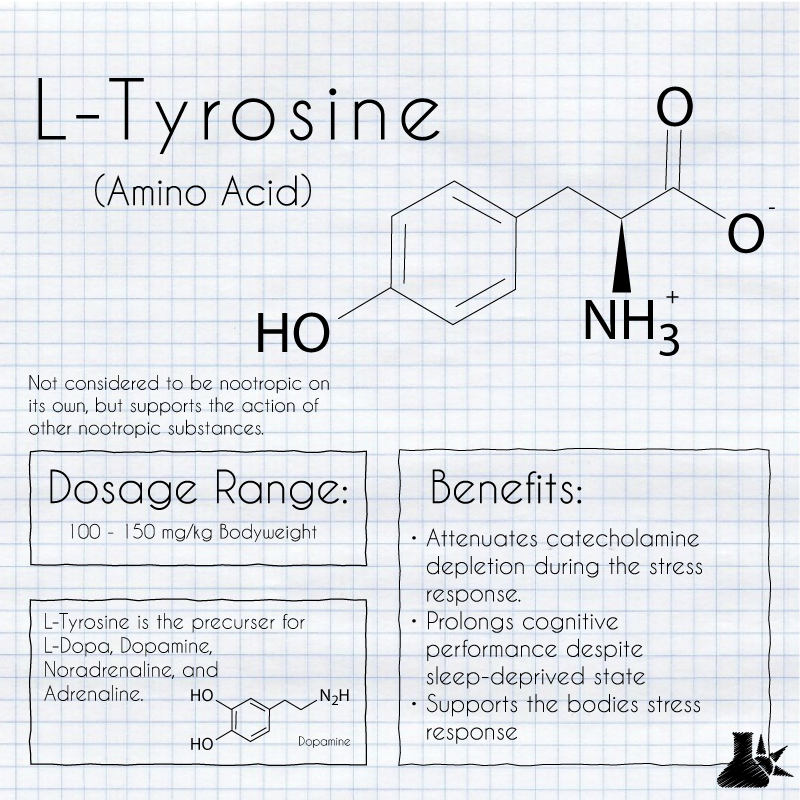
L-Tyrosine is a conditionally essential aromatic amino acid and the metabolic precursor to the catecholamines — L-DOPA, dopamine, noradrenaline and adrenaline — as well as to thyroid hormone. Its evidence posture is unusual for a popular nootropic: the human data are genuinely decent, but they point almost entirely in one direction. Tyrosine reliably supports cognition when catecholamine neurotransmitters are being acutely depleted — by cold, noise, sleep loss or heavy multitasking — and does very little when they are not. This is a repletion effect, not a stimulant one: tyrosine is a building block, so it helps most precisely when the raw material is running short and does almost nothing on top of an already-adequate supply. The studied doses are also high (typically 100–150 mg/kg, i.e. 7–15 g for many adults — far above the 500–2,000 mg on most labels), which is the single most important caveat when reading marketing claims.
- Best-supported: buffering cognitive performance (working memory, vigilance, tracking) under acute physical/psychological stressors — cold 3,4,5Reference 3Clinical trialTyrosine reverses a cold-induced working memory deficit in humans — controlled clinical trialView study →Reference 4Clinical trialTyrosine supplementation mitigates working memory decrements during cold exposure — controlled clinical trialView study →Reference 5Clinical trialDietary tyrosine benefits cognitive and psychomotor performance during body cooling — controlled clinical trialView study →, noise 15Reference 15RCTEffect of tyrosine on cognitive function and blood pressure under stress — randomized controlled trialView study →, and military field stress 16Reference 16Tyrosine improves cognitive performance and reduces blood pressure in cadets after one week of a combat training course — controlled trialView study → — in healthy adults. Two reviews agree the effect is real but conditional on catecholamine depletion 1,2Reference 1ReviewEffect of tyrosine supplementation on clinical and healthy populations under stress or cognitive demands — a reviewView study →Reference 2Tyrosine for mitigating stress and enhancing performance in healthy adult humans — a rapid evidence assessment of the literatureView study →.
- Emerging / cautiously endorsed: short-lived protection of psychomotor and vigilance performance during sleep deprivation / sustained overnight work 6,7Reference 6The effects of tyrosine on cognitive performance during extended wakefulness — controlled trialView study →Reference 7ReviewNutrition, brain function and cognitive performance — reviewView study →; improved cognitive flexibility / task-switching under high load, though genotype-dependent and not seen in every trial 8,9Reference 8RCTTyrosine promotes cognitive flexibility: evidence from proactive vs. reactive control during task switching — randomized controlled trialView study →Reference 9RCTEffects of l-tyrosine on working memory and inhibitory control are determined by DRD2 genotypes — randomized controlled trialView study →; and a signal in a depletion-like clinical state, anorexia nervosa, where tyrosine shortened reaction time and improved depressive mood (crossover RCT, n=19) 11Reference 11RCTA double-blind, randomized cross-over trial of tyrosine treatment on cognitive function and psychological parameters in severe hospitalized anorexia nervosa patients — randomized controlled trialView study →.
- Popular but thin / overhyped: everyday “focus” or “motivation” dosing in rested, well-fed people. The mechanism predicts — and the trials show — little benefit without depletion, and typical label doses sit below what studies used 1,10Reference 1ReviewEffect of tyrosine supplementation on clinical and healthy populations under stress or cognitive demands — a reviewView study →Reference 10RCTGABA supplementation negatively affects cognitive flexibility independent of tyrosine — randomized controlled trialView study →.
- The honest miss / caveat: tyrosine has not beaten placebo for depression (RCT, n=65) 13Reference 13RCTTyrosine for depression: a double-blind trial — randomized controlled trialView study →, for endurance/physical performance (meta-analysis of 8 studies; individual RCTs null) 12,18,19,20Reference 12RCTEffects of L-tyrosine and carbohydrate ingestion on endurance exercise performance — randomized controlled trialView study →Reference 18RCTFailure of oral tyrosine supplementation to improve exercise performance in the heat — randomized controlled trialView study →Reference 19RCTIngestion of tyrosine: effects on endurance, muscle strength, and anaerobic performance — randomized controlled trialView study →Reference 20Meta-analysisThe effect of tyrosine supplementation on whole-body endurance performance in physically active populations — systematic review and meta-analysis with GRADEView study →, or — despite being the deficiency case — for clinical outcomes in phenylketonuria (Cochrane: raises blood tyrosine but no measurable neuropsychological benefit) 14Reference 14Meta-analysisTyrosine supplementation for phenylketonuria — Cochrane systematic review and meta-analysisView study →.
1. Cognition under acute stress
This is tyrosine’s strongest use case. In double-blind, within-subject trials, a single dose taken ~1–2 h before an acute stressor protected cognitive performance that otherwise degraded. Cold: 150 mg/kg reversed a cold-induced working-memory deficit on a delayed matching-to-sample task (n=8) 3Reference 3Clinical trialTyrosine reverses a cold-induced working memory deficit in humans — controlled clinical trialView study →, replicated during cold-water immersion (300 mg/kg total, n=19) 4Reference 4Clinical trialTyrosine supplementation mitigates working memory decrements during cold exposure — controlled clinical trialView study → and body cooling, where a placebo match-to-sample decrement of ~18% was abolished by tyrosine 5Reference 5Clinical trialDietary tyrosine benefits cognitive and psychomotor performance during body cooling — controlled clinical trialView study →. Noise: 100 mg/kg improved performance on two stress-sensitive tasks and lowered diastolic blood pressure (n=16) 15Reference 15RCTEffect of tyrosine on cognitive function and blood pressure under stress — randomized controlled trialView study →. Military field stress: cadets given ~2 g/day across a week of combat training outperformed a calorie-matched control on memory and tracking tasks and had lower blood pressure (n=21) 16Reference 16Tyrosine improves cognitive performance and reduces blood pressure in cadets after one week of a combat training course — controlled trialView study →. Multitasking: 150 mg/kg improved working-memory accuracy specifically when a demanding multiple-task battery degraded it, with no effect on the simple battery (n=20) 17Reference 17Tyrosine improves working memory in a multitasking environment — controlled trialView study →. Two reviews converge on the same reading — tyrosine enhances cognition, but essentially only when dopamine/noradrenaline are temporarily depleted 1,2Reference 1ReviewEffect of tyrosine supplementation on clinical and healthy populations under stress or cognitive demands — a reviewView study →Reference 2Tyrosine for mitigating stress and enhancing performance in healthy adult humans — a rapid evidence assessment of the literatureView study →.
Gap: the benefit is depletion-dependent (little to nothing in unstressed, rested people), effects are acute rather than cumulative, and effective doses (100–150 mg/kg) are far above typical supplement labels.
2. Sleep deprivation & sustained wakefulness
During a single night of continuous overnight work (>24 h awake), a split 150 mg/kg dose given ~6 h in significantly reduced the usual decline on a psychomotor task and lowered lapse probability on a high-event-rate vigilance task; the benefit lasted on the order of 3 hours before fading 6Reference 6The effects of tyrosine on cognitive performance during extended wakefulness — controlled trialView study →. Military-nutrition reviews list tyrosine among the few food constituents with an acute anti-fatigue signal in this setting, while noting caffeine is the far better-studied option 7Reference 7ReviewNutrition, brain function and cognitive performance — reviewView study →.
Gap: small samples, a short (~3 h) window of benefit, and effects confined to the sleep-deprived state — this is fatigue-buffering, not a general alertness aid, and it does not replace sleep.
3. Cognitive flexibility & working memory under load
Under high cognitive demand, 2 g of tyrosine reduced task-switching costs (improved cognitive flexibility) in a placebo-controlled crossover (n=22) 8Reference 8RCTTyrosine promotes cognitive flexibility: evidence from proactive vs. reactive control during task switching — randomized controlled trialView study →. A follow-up showed the working-memory/inhibition benefit is modulated by DRD2 (dopamine D2 receptor) genotype — carriers presumed to have lower striatal dopamine gained more 9Reference 9RCTEffects of l-tyrosine on working memory and inhibitory control are determined by DRD2 genotypes — randomized controlled trialView study →. However, the picture is genuinely mixed: a four-arm RCT (n=48) found tyrosine alone had no effect on either response inhibition or task-switching 10Reference 10RCTGABA supplementation negatively affects cognitive flexibility independent of tyrosine — randomized controlled trialView study →, consistent with the reviews’ conclusion that benefit tracks the degree of dopaminergic demand/depletion 1Reference 1ReviewEffect of tyrosine supplementation on clinical and healthy populations under stress or cognitive demands — a reviewView study →.
Gap: effects are inconsistent across trials, appear genotype-dependent, and vanish in at least one well-designed null — so this is better read as “sometimes, in the right person under load” than a dependable cognitive enhancer.
4. Anorexia nervosa
In severely ill, hospitalised anorexia nervosa patients — a state marked by low precursor availability and blunted catecholamine tone — a double-blind crossover RCT (n=19) reported that tyrosine shortened reaction time and improved depressive mood versus placebo 11Reference 11RCTA double-blind, randomized cross-over trial of tyrosine treatment on cognitive function and psychological parameters in severe hospitalized anorexia nervosa patients — randomized controlled trialView study →. This fits tyrosine’s core mechanism (benefit where catecholamine synthesis is substrate-limited) and is the clearest clinical-population signal in the literature.
Gap: a single small crossover in one specialised inpatient population, not independently replicated, and the effect on core eating-disorder outcomes (rather than reaction time and mood) is untested — promising as a mechanism-consistent lead, not established therapy.
Mechanisms
| Target / pathway | Effect | Relevant to |
|---|---|---|
| Tyrosine hydroxylase → L-DOPA → dopamine | Substrate supply for catecholamine synthesis | All cognitive applications |
| Dopamine β-hydroxylase → noradrenaline → adrenaline | Precursor for noradrenergic/adrenergic transmission | Acute stress, wakefulness |
| Mesoprefrontal dopamine neurons | Precursor-dependent only when firing is elevated and synthesis is uncoupled from feedback control | Explains the depletion/stress-dependence of benefit 21Reference 21ReviewMesoprefrontal dopaminergic neurons: can tyrosine availability influence their functions? — reviewView study → |
| Thyroid hormone (T3/T4) synthesis | Iodinated tyrosine residues form thyroid hormone | Basis of the hyperthyroidism caution (safety) |
The load-bearing mechanistic point: tyrosine hydroxylase is normally saturated, so extra tyrosine does not raise catecholamine output at rest. It only becomes rate-limiting when neurons fire rapidly and synthesis outpaces feedback regulation — exactly the acute-stress condition where tyrosine helps 21Reference 21ReviewMesoprefrontal dopaminergic neurons: can tyrosine availability influence their functions? — reviewView study →. (Tyrosine neurotoxicity is a real phenomenon, but only at the grossly elevated tissue levels of the metabolic disease tyrosinemia — not at supplemental doses in people with normal tyrosine metabolism 22Reference 22ReviewExperimental evidence of tyrosine neurotoxicity: focus on mitochondrial dysfunction — reviewView study →.)
Pharmacokinetics
Orally administered L-tyrosine is well absorbed; plasma tyrosine rises within ~30–60 min, and the tyrosine-to-competing-large-neutral-amino-acid ratio (which governs brain uptake across the shared LAT1 transporter) can climb roughly 2–3-fold and stay elevated through several hours of activity 12,18Reference 12RCTEffects of L-tyrosine and carbohydrate ingestion on endurance exercise performance — randomized controlled trialView study →Reference 18RCTFailure of oral tyrosine supplementation to improve exercise performance in the heat — randomized controlled trialView study →. Peak effects in the cognitive trials cluster ~1–2 h post-dose, and behavioural benefits during wakefulness lasted on the order of 3 h 6Reference 6The effects of tyrosine on cognitive performance during extended wakefulness — controlled trialView study → — consistent with a plasma half-life in the low single-digit hours. Taking it with a high-protein meal blunts the effect, because other large neutral amino acids compete for the same transporter; away-from-protein dosing is why studies used isolated crystalline tyrosine. Co-ingested carbohydrate does not meaningfully add to the endurance-relevant PK 12Reference 12RCTEffects of L-tyrosine and carbohydrate ingestion on endurance exercise performance — randomized controlled trialView study →.
Clinical trials
Tyrosine is an off-patent commodity amino acid, so there is little industry-sponsored trial activity; the human literature is dominated by small, investigator- and military-funded crossover studies (often n < 25), which is a large part of why effect estimates remain imprecise. Registered activity is modest and skewed toward metabolic/PKU and dopamine-challenge paradigms rather than nootropic dosing.
| Completed | Planned | Terminated | Preclinical |
|---|---|---|---|
| ~15–20(cognition/stress) | few | few | ~many(rodent catecholamine-depletion models) |
Last checked: July 2026.
Dietary Sources
Tyrosine is abundant in ordinary dietary protein and is also made in the body from the essential amino acid phenylalanine (via phenylalanine hydroxylase), which is why it is termed conditionally essential — dietary tyrosine only becomes strictly required when phenylalanine is limited or that enzyme is deficient (as in phenylketonuria). A normal mixed diet supplies several grams per day. Crucially, food tyrosine arrives with competing large neutral amino acids that blunt its entry into the brain, which is why research uses isolated crystalline tyrosine on an empty stomach rather than food.
| Food (per ~100 g) | Approx. tyrosine |
|---|---|
| Hard cheeses (parmesan) | ~1.6–1.9 g |
| Soybeans / soy protein | ~1.0–1.5 g |
| Nuts and seeds (pumpkin, sesame, peanuts) | ~0.8–1.4 g |
| Beef, lamb, pork | ~0.7–1.0 g |
| Poultry, fish | ~0.7–0.9 g |
| Eggs | ~0.5 g |
| Dairy (milk, yoghurt) | ~0.2–0.5 g |
Foods high in phenylalanine (the same protein-rich groups) also raise tyrosine indirectly. Amounts are approximate, drawn from food-composition databases; see the NIH ODS / USDA FoodData Central entries for specifics.
Dosage
These are doses studied in research, not a personal recommendation.
There is no separate RDA for tyrosine — dietary requirements are set jointly for phenylalanine + tyrosine as an aromatic-amino-acid pool, and a typical adult easily meets this from food. Supplemental dosing is therefore about acute pharmacological use, not correcting a dietary shortfall.
- Studied cognitive/stress doses: 100–150 mg/kg as a single dose (≈7–11 g for a 70 kg adult), taken 1–2 hours before the demanding task or stressor; some cold-exposure protocols used up to 300 mg/kg split across the session 3,4,5,6,17Reference 3Clinical trialTyrosine reverses a cold-induced working memory deficit in humans — controlled clinical trialView study →Reference 4Clinical trialTyrosine supplementation mitigates working memory decrements during cold exposure — controlled clinical trialView study →Reference 5Clinical trialDietary tyrosine benefits cognitive and psychomotor performance during body cooling — controlled clinical trialView study →Reference 6The effects of tyrosine on cognitive performance during extended wakefulness — controlled trialView study →Reference 17Tyrosine improves working memory in a multitasking environment — controlled trialView study →.
- Typical product labels: 500–2,000 mg — comfortably safe but usually below the doses that produced measured cognitive effects in trials.
- Timing/food: take away from high-protein meals, because other large neutral amino acids compete with tyrosine for the same brain transporter and blunt the effect.
- Form note: N-acetyl-L-tyrosine (NALT) is marketed as “more bioavailable,” but a substantial fraction is excreted unchanged in urine and it raises plasma tyrosine less efficiently than plain L-tyrosine — the free-form amino acid is the better-evidenced choice.
Safety
L-Tyrosine is well tolerated in healthy adults at the doses studied; the most common complaints at multi-gram doses are mild gastrointestinal upset, headache, or (rarely) feeling jittery. No Tolerable Upper Intake Level has been set, which reflects limited long-term dosing data rather than a demonstration that any dose is safe. Because tyrosine is a precursor to both catecholamines and thyroid hormone, the meaningful cautions are pharmacological:
- Hyperthyroidism / Graves’ disease: tyrosine is an iodination substrate for thyroid-hormone synthesis; supplementing is best avoided or medically supervised.
- MAOI antidepressants: combining a catecholamine precursor with monoamine-oxidase inhibition risks raised blood pressure (a hypertensive response) — avoid.
- Levodopa (Parkinson’s): tyrosine and levodopa compete for the same intestinal and blood-brain amino-acid transporter; separate dosing by several hours so tyrosine does not blunt levodopa absorption.
- Thyroid medication (levothyroxine): separate dosing; monitor if hyperthyroid.
- Neurotoxicity: documented only in the inborn metabolic disease tyrosinemia, where tissue tyrosine is grossly elevated — not a concern at supplemental doses with normal tyrosine metabolism 22Reference 22ReviewExperimental evidence of tyrosine neurotoxicity: focus on mitochondrial dysfunction — reviewView study →.
Pregnancy & lactation
Verdict: not established — avoid supplemental doses. Dietary tyrosine from food is normal and necessary, but there are no trials establishing the safety of gram-level supplemental tyrosine in pregnancy or lactation. Default to food sources and defer to an obstetric clinician.
References
- Jongkees, B. J., Hommel, B., Kühn, S., & Colzato, L. S. (2015). Effect of tyrosine supplementation on clinical and healthy populations under stress or cognitive demands — a review. Journal of Psychiatric Research. https://pubmed.ncbi.nlm.nih.gov/26424423/
- Attipoe, S., Zeno, S. A., Lee, C., et al. (2015). Tyrosine for mitigating stress and enhancing performance in healthy adult humans — a rapid evidence assessment of the literature. Military Medicine. https://pubmed.ncbi.nlm.nih.gov/26126245/
- Shurtleff, D., Thomas, J. R., Schrot, J., Kowalski, K., & Harford, R. (1994). Tyrosine reverses a cold-induced working memory deficit in humans — controlled clinical trial. Pharmacology, Biochemistry, and Behavior. https://pubmed.ncbi.nlm.nih.gov/8029265/
- Mahoney, C. R., Castellani, J., Kramer, F. M., Young, A., & Lieberman, H. R. (2007). Tyrosine supplementation mitigates working memory decrements during cold exposure — controlled clinical trial. Physiology & Behavior. https://pubmed.ncbi.nlm.nih.gov/17585971/
- O’Brien, C., Mahoney, C., Tharion, W. J., Sils, I. V., & Castellani, J. W. (2007). Dietary tyrosine benefits cognitive and psychomotor performance during body cooling — controlled clinical trial. Physiology & Behavior. https://pubmed.ncbi.nlm.nih.gov/17078981/
- Neri, D. F., Wiegmann, D., Stanny, R. R., Shappell, S. A., McCardie, A., & McKay, D. L. (1995). The effects of tyrosine on cognitive performance during extended wakefulness — controlled trial. Aviation, Space, and Environmental Medicine. https://pubmed.ncbi.nlm.nih.gov/7794222/
- Lieberman, H. R. (2003). Nutrition, brain function and cognitive performance — review. Appetite. https://pubmed.ncbi.nlm.nih.gov/12798782/
- Steenbergen, L., Sellaro, R., Hommel, B., & Colzato, L. S. (2015). Tyrosine promotes cognitive flexibility: evidence from proactive vs. reactive control during task switching — randomized controlled trial. Neuropsychologia. https://pubmed.ncbi.nlm.nih.gov/25598314/
- Colzato, L. S., Steenbergen, L., de Kwaadsteniet, E. W., Sellaro, R., Liepelt, R., & Hommel, B. (2016). Effects of l-tyrosine on working memory and inhibitory control are determined by DRD2 genotypes — randomized controlled trial. Cortex. https://pubmed.ncbi.nlm.nih.gov/27403851/
- Lim, L. W., & Aquili, L. (2021). GABA supplementation negatively affects cognitive flexibility independent of tyrosine — randomized controlled trial. Journal of Clinical Medicine. https://pubmed.ncbi.nlm.nih.gov/33919136/
- Israely, M., Ram, A., Brandeis, R., et al. (2017). A double-blind, randomized cross-over trial of tyrosine treatment on cognitive function and psychological parameters in severe hospitalized anorexia nervosa patients — randomized controlled trial. Israel Journal of Psychiatry. https://pubmed.ncbi.nlm.nih.gov/29735813/
- Chinevere, T. D., Sawyer, R. D., Creer, A. R., Conlee, R. K., & Parcell, A. C. (2002). Effects of L-tyrosine and carbohydrate ingestion on endurance exercise performance — randomized controlled trial. Journal of Applied Physiology. https://pubmed.ncbi.nlm.nih.gov/12381742/
- Gelenberg, A. J., Wojcik, J. D., Falk, W. E., et al. (1990). Tyrosine for depression: a double-blind trial — randomized controlled trial. Journal of Affective Disorders. https://pubmed.ncbi.nlm.nih.gov/2142699/
- Remmington, T., & Smith, S. (2021). Tyrosine supplementation for phenylketonuria — Cochrane systematic review and meta-analysis. Cochrane Database of Systematic Reviews. https://pubmed.ncbi.nlm.nih.gov/33427303/
- Deijen, J. B., & Orlebeke, J. F. (1994). Effect of tyrosine on cognitive function and blood pressure under stress — randomized controlled trial. Brain Research Bulletin. https://pubmed.ncbi.nlm.nih.gov/8293316/
- Deijen, J. B., Wientjes, C. J., Vullinghs, H. F., Cloin, P. A., & Langefeld, J. J. (1999). Tyrosine improves cognitive performance and reduces blood pressure in cadets after one week of a combat training course — controlled trial. Brain Research Bulletin. https://pubmed.ncbi.nlm.nih.gov/10230711/
- Thomas, J. R., Lockwood, P. A., Singh, A., & Deuster, P. A. (1999). Tyrosine improves working memory in a multitasking environment — controlled trial. Pharmacology, Biochemistry, and Behavior. https://pubmed.ncbi.nlm.nih.gov/10548261/
- Tumilty, L., Davison, G., Beckmann, M., & Thatcher, R. (2014). Failure of oral tyrosine supplementation to improve exercise performance in the heat — randomized controlled trial. Medicine and Science in Sports and Exercise. https://pubmed.ncbi.nlm.nih.gov/24389518/
- Sutton, E. E., Coill, M. R., & Deuster, P. A. (2005). Ingestion of tyrosine: effects on endurance, muscle strength, and anaerobic performance — randomized controlled trial. International Journal of Sport Nutrition and Exercise Metabolism. https://pubmed.ncbi.nlm.nih.gov/16089275/
- Solon-Júnior, L. J. F., et al. (2023). The effect of tyrosine supplementation on whole-body endurance performance in physically active populations — systematic review and meta-analysis with GRADE. Journal of Sports Sciences. https://pubmed.ncbi.nlm.nih.gov/38290812/
- Tam, S. Y., & Roth, R. H. (1997). Mesoprefrontal dopaminergic neurons: can tyrosine availability influence their functions? — review. Biochemical Pharmacology. https://pubmed.ncbi.nlm.nih.gov/9105394/
- de Oliveira, J., et al. (2021). Experimental evidence of tyrosine neurotoxicity: focus on mitochondrial dysfunction — review. Metabolic Brain Disease. https://pubmed.ncbi.nlm.nih.gov/34212298/