
Supplement Monograph
Noopept
A potent synthetic dipeptide nootropic (active at ~10–40 mg) with strong rodent data but only small, open-label human trials, and unapproved in most Western markets.
Pharmacology & Research
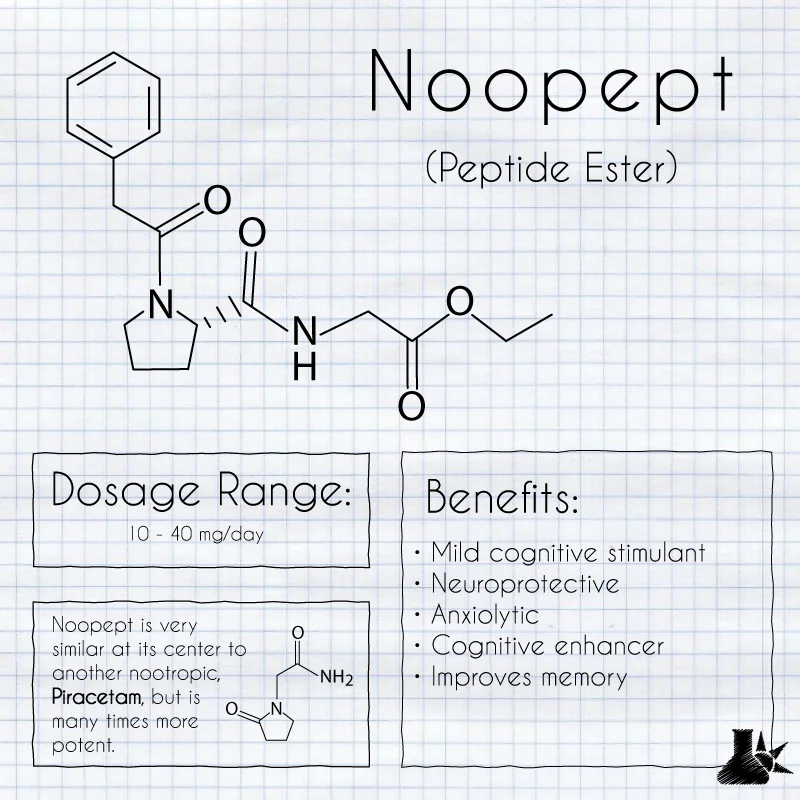
Noopept (N-phenylacetyl-L-prolylglycine ethyl ester; GVS-111, omberacetam) is a synthetic proline-containing dipeptide developed at the Zakusov Institute of Pharmacology in Moscow in the 1990s, and is usually grouped with the racetams although it lacks their 2-oxo-pyrrolidine ring. It is a prodrug: after oral dosing it is rapidly metabolised to the endogenous neuropeptide cycloprolylglycine (CPG), which appears to carry much of the activity as a positive modulator of AMPA receptors and by raising NGF/BDNF 5,6Reference 5AnimalNoopept stimulates the expression of NGF and BDNF in rat hippocampus — [animal]View study →Reference 6In vitroNeuropeptide cycloprolylglycine is an endogenous positive modulator of AMPA receptors — [in vitro/animal]View study →. The evidence base is unusual — large and internally consistent in rodents, but the human data amount to a handful of small, open-label (non-placebo) studies conducted almost entirely by the drug’s developers, with no published randomised placebo-controlled trial and no trial in healthy adults. There is now a first trickle of independent (non-originator) preclinical replication 21Reference 21AnimalNoopept attenuates diabetes-mediated neuropathic pain and oxidative hippocampal neurotoxicity via inhibition of TRPV1 channel in rats — [animal, independent group]View study →, which strengthens the mechanistic story without changing the human picture. Read the animal work as promising mechanism, and treat the human claims as preliminary rather than established.
- Best-supported: Modest cognitive improvement in people with organic mild cognitive impairment (vascular/post-traumatic), where an 8-week open comparison roughly matched piracetam and added an anxiolytic effect 1,2Reference 1Clinical trialComparative studies of Noopept and piracetam in the treatment of patients with mild cognitive disorders in organic brain diseases of vascular and traumatic origin — [open comparative clinical study]View study →Reference 2Clinical trialA comparative study of noopept and piracetam in the treatment of mild and moderate cognitive impairment of vascular and traumatic origin — [clinical study]View study →.
- Emerging / cautiously endorsed: An anxiolytic/anti-asthenic signal, seen in patient EEG work and reproduced mechanistically for the CPG metabolite in animals 3,19Reference 3Clinical trialClinical and electroencephalographic characteristics of noopept in patients with mild cognitive impairment — [clinical/EEG study]View study →Reference 19The anxiolytic effect of the neuropeptide cycloprolylglycine is mediated by AMPA and TrkB receptors — [animal/mechanistic]View study →; broad preclinical neuroprotection across ischaemia and β-amyloid models, now with early independent replication 11,12,21Reference 11AnimalNoopept efficiency in experimental Alzheimer disease (β-amyloid25-35 into Meynert basal nuclei of rats) — [animal]View study →Reference 12AnimalNoopept improves spatial memory and stimulates prefibrillar β-amyloid(25-35) antibody production in mice — [animal]View study →Reference 21AnimalNoopept attenuates diabetes-mediated neuropathic pain and oxidative hippocampal neurotoxicity via inhibition of TRPV1 channel in rats — [animal, independent group]View study →.
- Popular but thin / overhyped: “Memory and focus” in healthy people — the headline use online — rests on rodent studies and marketing; there is no controlled trial in healthy adults 15Reference 15Clinical trialMeteoadaptogenic properties of peptide drugs in healthy volunteers — [small human study]View study →.
- The honest miss / caveat: Almost every human study is open-label, small, and authored by the originating institute; there is no placebo-controlled trial. Potency is real (active at ~10–30 mg), which also means product mislabelling can deliver several-fold overdoses 16Reference 16Five unapproved drugs found in cognitive enhancement supplements — [analytical surveillance]View study →.
1. Mild cognitive impairment (organic)
The strongest human data come from an open comparative study of patients with mild cognitive disorders due to vascular or traumatic organic brain disease, given noopept 20 mg/day versus piracetam over roughly eight weeks 1Reference 1Clinical trialComparative studies of Noopept and piracetam in the treatment of patients with mild cognitive disorders in organic brain diseases of vascular and traumatic origin — [open comparative clinical study]View study →. Both drugs improved cognitive and asthenic symptoms to a similar degree, and noopept produced an additional anxiolytic and mild mood-lifting effect with good tolerability; the Russian-language report of the same programme reached the same conclusion 2Reference 2Clinical trialA comparative study of noopept and piracetam in the treatment of mild and moderate cognitive impairment of vascular and traumatic origin — [clinical study]View study →. Supporting open studies describe benefit in post-stroke MCI (60 patients, 20 mg/day for 2 months, improved MMSE) 4Reference 4Clinical trialNoopept in the treatment of mild cognitive impairment in patients with stroke — [open prospective study]View study → and characteristic nootropic EEG shifts in patients with post-traumatic/vascular cognitive-asthenic syndromes 3Reference 3Clinical trialClinical and electroencephalographic characteristics of noopept in patients with mild cognitive impairment — [clinical/EEG study]View study →. All of these are open-label, un-blinded, without placebo controls, and were run by or around the developing institute, so the effect size is not securely quantified.
Gap: No randomised, placebo-controlled, independently-run trial exists — the central limitation for every human claim about noopept.
2. Anxiety & asthenia
An anxiolytic/anti-asthenic effect is one of the more reproducible signals. In the human MCI comparison, the anxiolytic action distinguished noopept from piracetam 1Reference 1Clinical trialComparative studies of Noopept and piracetam in the treatment of patients with mild cognitive disorders in organic brain diseases of vascular and traumatic origin — [open comparative clinical study]View study →, and quantitative EEG in patients showed a “non-specific activation and anxiolytic” pattern 3Reference 3Clinical trialClinical and electroencephalographic characteristics of noopept in patients with mild cognitive impairment — [clinical/EEG study]View study →. Mechanistically this tracks with the active metabolite CPG, which is anxiolytic in rodent models and behaves as a positive AMPA-receptor modulator; a dedicated study shows the CPG anxiolytic effect is mediated by AMPA and TrkB receptors 6,19Reference 6In vitroNeuropeptide cycloprolylglycine is an endogenous positive modulator of AMPA receptors — [in vitro/animal]View study →Reference 19The anxiolytic effect of the neuropeptide cycloprolylglycine is mediated by AMPA and TrkB receptors — [animal/mechanistic]View study →, and a related dipeptide-drug programme reports antidepressant-like activity for CPG in mice, though that has not been tested in people 13Reference 13AnimalThe neuropeptide cycloprolylglycine produces antidepressant-like effect and enhances BDNF gene expression in the mice cortex — [animal]View study →.
Gap: Human anxiety data are secondary observations within cognitive trials, not a dedicated placebo-controlled anxiety study.
3. Neuroprotection
Preclinically this is the deepest part of the file. Noopept protects neurons in models of global and focal cerebral ischaemia, oxidative and glutamate excitotoxic injury, and Alzheimer-type pathology — for example preventing β-amyloid(25-35)-induced memory deficits after injection into rat basal nucleus of Meynert 11Reference 11AnimalNoopept efficiency in experimental Alzheimer disease (β-amyloid25-35 into Meynert basal nuclei of rats) — [animal]View study → and improving spatial memory while raising anti-β-amyloid antibodies in bulbectomised mice 12Reference 12AnimalNoopept improves spatial memory and stimulates prefibrillar β-amyloid(25-35) antibody production in mice — [animal]View study →. Proposed mechanisms include induction of NGF and BDNF in the hippocampus 5Reference 5AnimalNoopept stimulates the expression of NGF and BDNF in rat hippocampus — [animal]View study →, activation of the hypoxia-response factor HIF-1 via inhibition of prolyl hydroxylase 7Reference 7In vitroMolecular mechanism underlying the action of substituted Pro-Gly dipeptide Noopept — [in vitro mechanistic]View study →, and a cholinergic action — including engagement of α7 nicotinic receptors on hippocampal interneurons 10,20Reference 10AnimalDipeptide preparation Noopept prevents scopolamine-induced deficit of spatial memory in BALB/c mice — [animal]View study →Reference 20In vitroEffect of nootropic dipeptide noopept on CA1 pyramidal neurons involves α7AChRs on interneurons in hippocampal slices from rat — [in vitro electrophysiology]View study →. Importantly, an independent group outside the originating institute has replicated neuroprotective/analgesic effects in a diabetic rat model (via TRPV1-channel inhibition), the first such external confirmation 21Reference 21AnimalNoopept attenuates diabetes-mediated neuropathic pain and oxidative hippocampal neurotoxicity via inhibition of TRPV1 channel in rats — [animal, independent group]View study →.
Gap: Entirely animal and cell-culture; no human neuroprotection or dementia-prevention outcome has been tested.
4. Memory & learning in healthy adults
The everyday marketing claim — sharper memory and focus in healthy users — is supported by rodent learning-and-memory models (passive avoidance, Morris water maze, scopolamine reversal) but not by any controlled study in cognitively healthy people 10,12Reference 10AnimalDipeptide preparation Noopept prevents scopolamine-induced deficit of spatial memory in BALB/c mice — [animal]View study →Reference 12AnimalNoopept improves spatial memory and stimulates prefibrillar β-amyloid(25-35) antibody production in mice — [animal]View study →. The only human work outside patient populations is a small “meteoadaptogenic” study in healthy volunteers, which reported improved psychological adaptation to environmental stress rather than measured cognitive gains 15Reference 15Clinical trialMeteoadaptogenic properties of peptide drugs in healthy volunteers — [small human study]View study →.
Gap: No trial has measured memory, attention, or learning in healthy adults against placebo; the popular use is an extrapolation from animals.
Mechanisms
| Target / pathway | Effect | Relevant to |
|---|---|---|
| AMPA receptors (via metabolite CPG) | Positive modulation → enhanced glutamatergic transmission | Cognition, anxiety, memory |
| TrkB / BDNF signalling | CPG anxiolytic and neurotrophic effect is TrkB-dependent | Anxiety, neuroprotection |
| NGF & BDNF expression (hippocampus) | Increased mRNA, no tolerance on chronic dosing | Neuroprotection, memory |
| HIF-1 / prolyl hydroxylase | HIF-1 stabilisation (hypoxia-adaptive genes) | Neuroprotection |
| Cholinergic signalling (incl. α7-nAChR) | Choline-sensitising; reverses scopolamine deficit; acts via α7 nicotinic receptors on interneurons | Memory, anti-amnesic |
| NMDA signalling | Modulation (context-dependent) | Cognition, neuroprotection |
Pharmacokinetics
Noopept is a peptide and behaves like a rapidly-cleared prodrug. In rats it is absorbed quickly (Tmax ≈ 7 min), crosses the blood–brain barrier with near-identical brain and plasma levels, and has a very short parent half-life of ~15–25 minutes 8Reference 8Pharmacokinetics of new nootropic acylprolyldipeptide and its penetration across the blood-brain barrier after oral administration — [animal PK]View study →. Its behavioural and EEG effects outlast the parent by well over an hour, which is attributed to the active endogenous metabolite cycloprolylglycine (CPG), a proline-glycine diketopiperazine with its own distinct, longer pharmacokinetics and a similar memory-active profile 9,14Reference 9AnimalPharmacokinetics of noopept and its active metabolite cycloprolylglycine in rats — [animal PK]View study →Reference 14AnimalThe major metabolite of dipeptide piracetam analogue GVS-111 in rat brain and its similarity to endogenous neuropeptide cyclo-L-prolylglycine — [animal]View study →. Human PK is not well characterised in the public literature; the commonly quoted ~30–60 min parent half-life should be read against the fact that activity is metabolite-driven. The practical implication is that because the parent clears fast and the metabolite does the work, noopept is typically dosed two to three times daily rather than once.
Clinical trials
Registered-trial activity is minimal. Noopept is an approved OTC/prescription drug in Russia and a few neighbouring markets but is not approved as a medicine or dietary supplement in the US, EU, UK, or Australia; there is essentially no Western industry-sponsored trial programme, and the human evidence is confined to older single-institute studies. Recent regulatory-laboratory surveillance instead focuses on its unapproved presence in cognitive-enhancement supplements 16,17Reference 16Five unapproved drugs found in cognitive enhancement supplements — [analytical surveillance]View study →Reference 17The occurrence of illicit smart drugs or nootropics in Europe and Australia and their associated dangers — [market surveillance]View study →.
| Completed | Planned | Terminated | Preclinical |
|---|---|---|---|
| ~5(small, open-label) | 0known | 0 | ~100+ |
Last checked: July 2026.
Intake & Dosage
These are doses studied in research, not a personal recommendation.
Because noopept is not a nutrient, there is no RDA, AI, or Tolerable Upper Intake Level. Doses studied in the human cognitive-impairment trials were 20 mg/day, usually split as 10 mg two or three times daily 1,4Reference 1Clinical trialComparative studies of Noopept and piracetam in the treatment of patients with mild cognitive disorders in organic brain diseases of vascular and traumatic origin — [open comparative clinical study]View study →Reference 4Clinical trialNoopept in the treatment of mild cognitive impairment in patients with stroke — [open prospective study]View study →; the commonly used range online is 10–30 mg/day, with 40 mg/day at the upper edge of what has been examined. Noopept is also not approved as a medicine or dietary supplement in the US, EU, UK, or Australia, so any use is off-label self-experimentation. Key practical points:
- Split dosing is rational. The parent compound clears within minutes and the effect is carried by a metabolite 8,9Reference 8Pharmacokinetics of new nootropic acylprolyldipeptide and its penetration across the blood-brain barrier after oral administration — [animal PK]View study →Reference 9AnimalPharmacokinetics of noopept and its active metabolite cycloprolylglycine in rats — [animal PK]View study →, so 2–3 daily doses fit the pharmacology better than a single dose.
- Milligram potency demands accuracy. Noopept is on the order of a hundred times more potent by weight than piracetam (active at ~10–40 mg vs piracetam’s gram-scale doses), so small measurement errors matter; analytical surveys have found marketed products delivering up to ~40 mg per serving against a typical 10 mg dose, and most declared quantities inaccurate 16Reference 16Five unapproved drugs found in cognitive enhancement supplements — [analytical surveillance]View study →.
- Choline pairing is the usual practical adjustment to blunt the “racetam headache,” though this rests on user practice and the cholinergic mechanism rather than a dedicated trial.
Safety
Preclinical toxicity is genuinely low: a 6-month rat study at 100 mg/kg (well over 100× a human dose) reported no allergenic, immunotoxic, mutagenic, or reproductive effects 18Reference 18Clinical trialPreclinical study of noopept toxicity — [animal toxicology]View study →. The dose-limiting complaint in practice is headache/irritability, commonly managed by adding a choline source. The more important safety issues are regulatory and pharmacological rather than toxicological:
- Regulatory status: Noopept is a prescription/OTC medicine in Russia and some neighbouring countries but is not approved as a medicine or dietary supplement in the US, EU, UK, Canada, or Australia. It is repeatedly flagged by medicines-control laboratories as an unapproved drug found in “cognitive enhancement” supplements, often undeclared and combined with other unapproved compounds 16,17Reference 16Five unapproved drugs found in cognitive enhancement supplements — [analytical surveillance]View study →Reference 17The occurrence of illicit smart drugs or nootropics in Europe and Australia and their associated dangers — [market surveillance]View study →.
- Interactions: No formal human drug-interaction studies exist. Given cholinergic and glutamatergic (AMPA/NMDA) mechanisms, caution is reasonable with other cholinergics, other racetams/nootropics, and any drug lowering seizure threshold — but this is precautionary inference, not documented interaction data.
- Who should be cautious: People who are pregnant or breastfeeding, those with a seizure history, and anyone on CNS-active medication. Long-term human safety beyond a few months is essentially unstudied.
Pregnancy & lactation
Verdict: avoid. There are no human pregnancy or lactation safety data. Although animal reproductive-toxicity studies were reassuring at very high doses 18Reference 18Clinical trialPreclinical study of noopept toxicity — [animal toxicology]View study →, animal safety does not establish human safety, and noopept is an unapproved synthetic drug in this context — the appropriate default is to avoid it in pregnancy and breastfeeding.
References
- Neznamov, G. G., & Teleshova, E. S. (2009). Comparative studies of Noopept and piracetam in the treatment of patients with mild cognitive disorders in organic brain diseases of vascular and traumatic origin — [open comparative clinical study]. Neuroscience and Behavioral Physiology. https://pubmed.ncbi.nlm.nih.gov/19234797/
- Neznamov, G. G., & Teleshova, E. S. (2008). A comparative study of noopept and piracetam in the treatment of mild and moderate cognitive impairment of vascular and traumatic origin — [clinical study]. Zhurnal Nevrologii i Psikhiatrii im. S.S. Korsakova. https://pubmed.ncbi.nlm.nih.gov/18697252/
- Bochkarev, V. K., et al. (2008). Clinical and electroencephalographic characteristics of noopept in patients with mild cognitive impairment — [clinical/EEG study]. Zhurnal Nevrologii i Psikhiatrii im. S.S. Korsakova. https://pubmed.ncbi.nlm.nih.gov/19008801/
- Amelin, A. V., et al. (2011). Noopept in the treatment of mild cognitive impairment in patients with stroke — [open prospective study]. Zhurnal Nevrologii i Psikhiatrii im. S.S. Korsakova. https://pubmed.ncbi.nlm.nih.gov/22500312/
- Ostrovskaya, R. U., et al. (2008). Noopept stimulates the expression of NGF and BDNF in rat hippocampus — [animal]. Bulletin of Experimental Biology and Medicine. https://pubmed.ncbi.nlm.nih.gov/19240853/
- Gudasheva, T. A., et al. (2016). Neuropeptide cycloprolylglycine is an endogenous positive modulator of AMPA receptors — [in vitro/animal]. Doklady Biochemistry and Biophysics. https://pubmed.ncbi.nlm.nih.gov/28058675/
- Vakhitova, Y. V., et al. (2016). Molecular mechanism underlying the action of substituted Pro-Gly dipeptide Noopept — [in vitro mechanistic]. Acta Naturae. https://pubmed.ncbi.nlm.nih.gov/27099787/
- Boiko, S. S., et al. (2000). Pharmacokinetics of new nootropic acylprolyldipeptide and its penetration across the blood-brain barrier after oral administration — [animal PK]. Bulletin of Experimental Biology and Medicine. https://pubmed.ncbi.nlm.nih.gov/10977920/
- Boyko, S. S., et al. (2018). Pharmacokinetics of noopept and its active metabolite cycloprolylglycine in rats — [animal PK]. Biomeditsinskaya Khimiya. https://pubmed.ncbi.nlm.nih.gov/30378564/
- Belnik, A. P., et al. (2007). Dipeptide preparation Noopept prevents scopolamine-induced deficit of spatial memory in BALB/c mice — [animal]. Bulletin of Experimental Biology and Medicine. https://pubmed.ncbi.nlm.nih.gov/18214292/
- Ostrovskaya, R. U., et al. (2008). Noopept efficiency in experimental Alzheimer disease (β-amyloid25-35 into Meynert basal nuclei of rats) — [animal]. Bulletin of Experimental Biology and Medicine. https://pubmed.ncbi.nlm.nih.gov/19145356/
- Bobkova, N. V., et al. (2005). Noopept improves spatial memory and stimulates prefibrillar β-amyloid(25-35) antibody production in mice — [animal]. Eksperimental’naia i Klinicheskaia Farmakologiia. https://pubmed.ncbi.nlm.nih.gov/16277202/
- Abdullina, A. A., et al. (2022). The neuropeptide cycloprolylglycine produces antidepressant-like effect and enhances BDNF gene expression in the mice cortex — [animal]. Journal of Psychopharmacology. https://pubmed.ncbi.nlm.nih.gov/35102783/
- Gudasheva, T. A., et al. (1997). The major metabolite of dipeptide piracetam analogue GVS-111 in rat brain and its similarity to endogenous neuropeptide cyclo-L-prolylglycine — [animal]. European Journal of Drug Metabolism and Pharmacokinetics. https://pubmed.ncbi.nlm.nih.gov/9358206/
- Shabanov, P. D., et al. (2007). Meteoadaptogenic properties of peptide drugs in healthy volunteers — [small human study]. Eksperimental’naia i Klinicheskaia Farmakologiia. https://pubmed.ncbi.nlm.nih.gov/18318195/
- Cohen, P. A., et al. (2021). Five unapproved drugs found in cognitive enhancement supplements — [analytical surveillance]. Neurology: Clinical Practice. https://pubmed.ncbi.nlm.nih.gov/34484905/
- Vanhee, C., et al. (2025). The occurrence of illicit smart drugs or nootropics in Europe and Australia and their associated dangers — [market surveillance]. Journal of Xenobiotics. https://pubmed.ncbi.nlm.nih.gov/40558871/
- Kovalenko, L. P., et al. (2002). Preclinical study of noopept toxicity — [animal toxicology]. Eksperimental’naia i Klinicheskaia Farmakologiia. https://pubmed.ncbi.nlm.nih.gov/12025790/
- Gudasheva, T. A., et al. (2020). The anxiolytic effect of the neuropeptide cycloprolylglycine is mediated by AMPA and TrkB receptors — [animal/mechanistic]. Doklady Biochemistry and Biophysics. https://pubmed.ncbi.nlm.nih.gov/32894462/
- Kondratenko, R. V., et al. (2022). Effect of nootropic dipeptide noopept on CA1 pyramidal neurons involves α7AChRs on interneurons in hippocampal slices from rat — [in vitro electrophysiology]. Neuroscience Letters. https://pubmed.ncbi.nlm.nih.gov/36195298/
- Düzova, H., Nazıroğlu, M., & Çiğ, B. (2021). Noopept attenuates diabetes-mediated neuropathic pain and oxidative hippocampal neurotoxicity via inhibition of TRPV1 channel in rats — [animal, independent group]. Molecular Neurobiology. https://pubmed.ncbi.nlm.nih.gov/34241806/