
Supplement Monograph
Phosphatidylserine
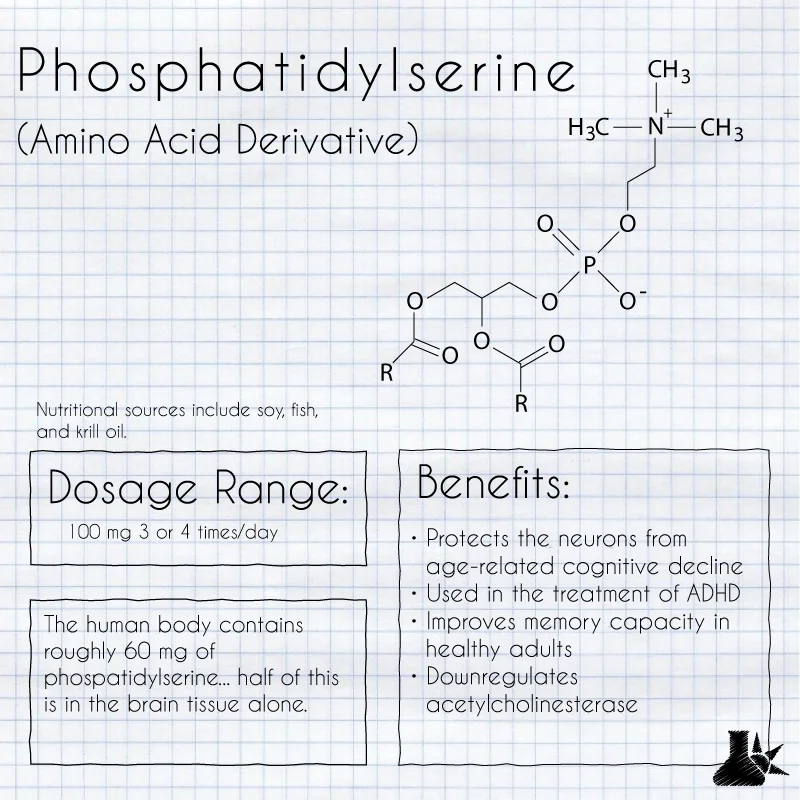
A phospholipid building block of neuronal cell membranes — supplemented to support memory, focus and the stress response, especially with age. The pivotal older data used bovine-cortex PS; the modern soy/sunflower product has weaker evidence.
Pharmacology & Research
Phosphatidylserine (PS) is an aminophospholipid that sits on the inner leaflet of neuronal cell membranes, where it supports membrane fluidity, ion-pump activity and neurotransmitter release. The evidence posture is best described as “old positive data, newer flat data”: the pivotal memory and stress trials of the 1980s–90s used bovine-cortex PS (BC-PS), which is no longer sold because of prion (BSE) risk, and the soy- and sunflower-derived PS on shelves today has not cleanly reproduced those benefits. The strongest signal remains age-related memory complaints and childhood ADHD — but effects are modest, most trials are small or industry-linked, and much of the benefit concentrates in people who start out impaired rather than healthy adults seeking a cognitive edge. Because the brain synthesises PS endogenously, this is a case of supplementing on top of adequacy rather than correcting a dietary deficiency, so the burden of proof for a real effect is high. The U.S. FDA allows only a qualified health claim, explicitly stating that the supporting science is very limited and largely inconclusive.
- Best-supported: modest improvement in memory and daily cognitive function in older adults with age-associated memory impairment — but chiefly in the older bovine-PS trials 1,2Reference 1RCTEffects of phosphatidylserine in age-associated memory impairment — [RCT]View study →Reference 2RCTCognitive decline in the elderly: a double-blind, placebo-controlled multicenter study on efficacy of phosphatidylserine administration — [RCT]View study →.
- Emerging / cautiously endorsed: a small reduction in ADHD symptoms in children (soy-PS and PS-omega-3), pooled in a systematic review 7,8,9Reference 7RCTThe effect of phosphatidylserine administration on memory and symptoms of attention-deficit hyperactivity disorder — [RCT]View study →Reference 8RCTThe effect of phosphatidylserine containing omega-3 fatty acids on ADHD symptoms in children — [RCT with open-label extension]View study →Reference 9Meta-analysisPhosphatidylserine for the treatment of pediatric attention-deficit/hyperactivity disorder: a systematic review and meta-analysis — [meta-analysis]View study →; blunting of the exercise-induced cortisol/ACTH response at high doses 10,11Reference 10Effects of phosphatidylserine on the neuroendocrine response to physical stress in humans — [controlled trial]View study →Reference 11Blunting by chronic phosphatidylserine administration of the stress-induced activation of the hypothalamo-pituitary-adrenal axis in healthy men — [controlled trial]View study →.
- Popular but thin / overhyped: cognitive enhancement in healthy young adults, Alzheimer’s treatment, and ergogenic/anti-fatigue claims — all rest on small, short, or equivocal trials 4,12,13Reference 4Soybean-derived phosphatidylserine improves memory function of the elderly Japanese subjects with memory complaints — [trial]View study →Reference 12RCTThe effects of phosphatidylserine on endocrine response to moderate intensity exercise — [RCT]View study →Reference 13RCTEffects of phosphatidylserine on exercise capacity during cycling in active males — [RCT]View study →.
- The honest miss / caveat: the modern soy-derived PS that replaced bovine PS failed to beat placebo for age-associated memory impairment in a well-run trial 3Reference 3The influence of soy-derived phosphatidylserine on cognition in age-associated memory impairment — [controlled trial, null]View study →; the classic positive results may not transfer to the product you can actually buy.
2. ADHD in children
Hirayama et al. gave 200 mg/day soy-PS to 36 children (4–14 y) for 2 months and reported significant improvement in ADHD symptoms and short-term auditory memory, with no adverse effects 7Reference 7RCTThe effect of phosphatidylserine administration on memory and symptoms of attention-deficit hyperactivity disorder — [RCT]View study →. A larger trial of PS conjugated to omega-3 (PS-Omega3) in 200 children showed benefit mainly in a hyperactive-impulsive, emotionally dysregulated subgroup during the double-blind phase, with broader gains during open-label extension 8Reference 8RCTThe effect of phosphatidylserine containing omega-3 fatty acids on ADHD symptoms in children — [RCT with open-label extension]View study →. An earlier RCT of n-3 fatty acids delivered as phospholipids in inattentive children also linked improved blood fatty-acid status to better visual sustained attention 20Reference 20RCTCorrelation between changes in blood fatty acid composition and visual sustained attention performance in children with inattention: effect of dietary n−3 fatty acids containing phospholipids — [RCT]View study →, consistent with the omega-3-conjugated results. A 2021 systematic review and meta-analysis concluded that PS produced a small, statistically detectable reduction in ADHD symptoms but flagged the small number of trials, small samples, and short duration as limiting confidence 9Reference 9Meta-analysisPhosphatidylserine for the treatment of pediatric attention-deficit/hyperactivity disorder: a systematic review and meta-analysis — [meta-analysis]View study →.
Gap: only a handful of small, short RCTs — some manufacturer-funded — and the omega-3 co-formulation makes it hard to isolate PS’s own contribution.
3. Stress & cortisol response
High-dose PS blunts the neuroendocrine stress response. Monteleone et al. showed that intravenous bovine PS (50–75 mg) reduced the ACTH and cortisol rise after exercise 10Reference 10Effects of phosphatidylserine on the neuroendocrine response to physical stress in humans — [controlled trial]View study →, and that 800 mg/day orally for 10 days blunted the ACTH/cortisol response to physical stress in healthy men 11Reference 11Blunting by chronic phosphatidylserine administration of the stress-induced activation of the hypothalamo-pituitary-adrenal axis in healthy men — [controlled trial]View study →. Oral results at lower, supplement-realistic doses are weaker and dose-dependent: 600 mg/day attenuated cortisol in one exercise study 12Reference 12RCTThe effects of phosphatidylserine on endocrine response to moderate intensity exercise — [RCT]View study →, while other trials at 300–750 mg/day found effects on mood or capacity but not a clear cortisol change 13,18,21Reference 13RCTEffects of phosphatidylserine on exercise capacity during cycling in active males — [RCT]View study →Reference 18RCTThe effects of IQPLUS Focus on cognitive function, mood and endocrine response before and following acute exercise — [RCT, industry]View study →Reference 21The influence of phosphatidylserine supplementation on mood and heart rate when faced with an acute stressor — [trial]View study →.
Gap: the clearest effects used high or intravenous doses of bovine PS; benefit at typical 100–300 mg/day oral soy-PS doses is inconsistent.
4. Alzheimer’s & dementia treatment
Several 1980s–90s double-blind trials of bovine PS (usually 300 mg/day) in Alzheimer’s and senile dementia reported short-term improvement on cognitive and behavioural scales, most apparent in milder cases 14,15,16Reference 14RCTDouble-blind randomized controlled study of phosphatidylserine in senile demented patients — [RCT]View study →Reference 15RCTDouble-blind cross-over study of phosphatidylserine vs. placebo in patients with early dementia of the Alzheimer type — [RCT]View study →Reference 16RCTPhosphatidylserine in the treatment of Alzheimer’s disease: results of a multicenter study — [RCT]View study →. These effects were modest and tended to fade over months, and PS is not disease-modifying — it does not alter the underlying course of Alzheimer’s.
Gap: short, dated trials with bovine PS; no evidence that modern PS treats or slows dementia, and the FDA health claim explicitly excludes a treatment claim.
5. Exercise capacity & recovery
Soy-PS at 750 mg/day for 10 days improved exercise capacity (time to exhaustion) in active men in a small crossover trial 13Reference 13RCTEffects of phosphatidylserine on exercise capacity during cycling in active males — [RCT]View study → and altered markers of oxidative stress/soreness after intermittent running 17Reference 17RCTEffects of phosphatidylserine on oxidative stress following intermittent running — [RCT]View study →. Endocrine effects across exercise studies are equivocal, and sample sizes are small (10–16 subjects).
Gap: small, short crossover studies with inconsistent endocrine findings; ergogenic benefit is not well established.
6. Healthy adult cognition
Evidence that PS sharpens cognition in healthy, non-impaired adults is thin. A manufacturer-run acute study reported faster processing speed and better accuracy after 400 mg PS before exercise 18Reference 18RCTThe effects of IQPLUS Focus on cognitive function, mood and endocrine response before and following acute exercise — [RCT, industry]View study →, but replication in healthy people is limited, and a 2025 RCT of sunflower-PS in healthy children aged 8–12 showed only narrow cognitive effects 23Reference 23RCTThe cognitive effects of supplementation with sunflower phosphatidylserine in healthy children aged 8 to 12 years: a randomized controlled trial — [RCT]View study →.
Gap: almost no independent, adequately powered data in healthy adults; most positive signals come from impaired populations or industry studies.
Mechanisms
| Target / pathway | Effect | Relevant to |
|---|---|---|
| Neuronal membrane phospholipid | Structural component; supports membrane fluidity | All cognitive applications |
| Na⁺/K⁺-ATPase | Upregulated (via PKC activation) | Neuronal excitability, memory |
| Acetylcholinesterase | Downregulated → higher synaptic acetylcholine (mostly aged-animal data) | Memory, ADHD |
| Protein kinase C (PKC) | Cofactor / activator | Signal transduction |
| Hypothalamic-pituitary-adrenal (HPA) axis | Blunts ACTH/cortisol rise to stress | Stress, cortisol |
| Acetylcholine / dopamine / noradrenaline release | Modulated | Cognition, mood |
Pharmacokinetics
Oral PS is well absorbed (animal data suggest >90% bioavailability) and is lipophilic enough to cross the blood-brain barrier. It is incorporated into membranes or hydrolysed and re-synthesised; the serine head-group and fatty-acid tails are metabolised through normal lipid pathways. Plasma half-life is short (hours), but the relevant pharmacodynamic effect is membrane incorporation, not plasma level — so dosing is typically split (e.g. 100 mg three times daily). Bovine-cortex PS and soy/sunflower PS differ in their fatty-acid composition (bovine PS is richer in DHA-type long-chain fatty acids), which is one proposed reason the older bovine trials looked stronger; modern products are sometimes conjugated to DHA to mimic this. There is no established dietary deficiency state.
Clinical trials
PS has been studied in registered trials for cognitive decline, ADHD, and exercise performance, but it is an off-patent nutraceutical with limited large-scale industry-funded trial activity; most human data are small and older, and recent trials increasingly test PS combined with omega-3 or other nutrients rather than PS alone.
| Completed | Planned | Terminated | Preclinical |
|---|---|---|---|
| ~20(mostly small) | few | few | ~50+ |
Last checked: July 2026.
Dietary Sources
Phosphatidylserine is present in most foods but concentrated in a few. The body also synthesises it endogenously (by exchanging the head-group of phosphatidylcholine/ethanolamine for serine), so there is no dietary requirement and no deficiency state — dietary intake is a top-up, not a necessity. Average Western intake is estimated at roughly 75–185 mg/day.
| Food | Approx. PS content |
|---|---|
| Bovine brain (historical; not recommended) | very high (~700+ mg/100 g) |
| Fish (mackerel, herring, eel) | moderate–high (~50–480 mg/100 g) |
| Organ meats (chicken/pork offal) | moderate |
| Soy lecithin | moderate (main commercial source) |
| White beans, egg | low–moderate |
| Dairy, most vegetables/fruit | low |
Because organ and brain tissue are the richest natural sources and are no longer recommended for consumption (BSE and general food-safety reasons), commercial PS is now manufactured enzymatically from soy or sunflower lecithin. Intake estimates per Jäger et al. (2007) and the NIH ODS / IOM lipid references.
Dosage
- No RDA/AI and no Tolerable Upper Intake Level — PS is not an essential nutrient.
- Studied supplemental range: 100–300 mg/day for cognition (usually split, e.g. 100 mg three times daily), which is the standard label dose. Stress/exercise studies used 300–800 mg/day, and the strongest cortisol-blunting used 800 mg/day of bovine PS.
- Form matters more than dose here: the pivotal cognitive and stress trials used bovine-cortex PS, which is no longer sold. Modern soy- and sunflower-derived PS is what you can buy; it is safe and chemically similar but has weaker, less consistent efficacy data, partly because of a different fatty-acid profile. Some products conjugate PS to DHA (PS-omega-3) to mimic the bovine composition.
- Take with food (it is fat-soluble). Benefits in trials typically emerged over 6–12 weeks, not acutely.
Doses reflect ranges studied in research, not a personal recommendation.
Safety
PS has a good tolerability record. Soy-derived PS was formally shown to be safe at 200 and 300 mg/day for 12 weeks in elderly subjects, with no adverse effect on clinical chemistry, haematology or vital signs 19Reference 19Safety of soy-derived phosphatidylserine in elderly people — [safety study]View study →, and cognition trials to 300 mg/day for 6 months reported no treatment-related harm 4Reference 4Soybean-derived phosphatidylserine improves memory function of the elderly Japanese subjects with memory complaints — [trial]View study →. The most common complaints are mild gastrointestinal upset and, occasionally, insomnia, more likely at higher doses (>300 mg/day) or when taken late in the day.
- Prion note: the historical safety concern was bovine-cortex PS (theoretical BSE/prion transmission). This is why the source switched; soy/sunflower PS carries no such risk.
- Blood thinners / anticoagulants: PS is often co-formulated with fish oil, which has antiplatelet effects — the combination could theoretically add to bleeding risk with warfarin/antiplatelet drugs. PS alone has no strong documented interaction.
- Cholinergic drugs: by raising acetylcholine, PS could in theory interact with anticholinergic or cholinergic medications (e.g. donepezil); this is mechanistic, not well documented clinically.
- Pediatric ADHD signal: an isolated 2025 case report described recurrent suicidality on rechallenge with a phosphatidylserine + citicoline product in a child with ADHD — a single anecdote, not established causation, but worth noting for pediatric use.
Pregnancy & lactation
Verdict: not established — avoid supplemental doses. There are no adequate trials of supplemental PS in pregnancy or lactation. Absence of reported harm is not evidence of safety; pregnant or breastfeeding people should not take PS supplements without clinician guidance.
Scope of this safety review (for honesty, not a claim):
- Interactions assessed? Partially — reviewed anticoagulant/antiplatelet (mainly via co-formulated fish oil) and cholinergic drug classes; no large formal interaction studies exist for PS alone.
- Pregnancy/lactation assessed? Yes — no adequate data found; treated as not established.
- Upper Limit? No UL set. This does not imply unlimited intake is safe; it reflects that no authority has evaluated one.
References
- Crook, T. H., Tinklenberg, J., Yesavage, J., Petrie, W., Nunzi, M. G., & Massari, D. C. (1991). Effects of phosphatidylserine in age-associated memory impairment — [RCT]. Neurology. https://pubmed.ncbi.nlm.nih.gov/2027477/
- Cenacchi, T., Bertoldin, T., Farina, C., Fiori, M. G., & Crepaldi, G. (1993). Cognitive decline in the elderly: a double-blind, placebo-controlled multicenter study on efficacy of phosphatidylserine administration — [RCT]. Aging (Milano). https://pubmed.ncbi.nlm.nih.gov/8323999/
- Jorissen, B. L., Brouns, F., Van Boxtel, M. P. J., Ponds, R. W., Verhey, F. R., Jolles, J., & Riedel, W. J. (2001). The influence of soy-derived phosphatidylserine on cognition in age-associated memory impairment — [controlled trial, null]. Nutritional Neuroscience. https://pubmed.ncbi.nlm.nih.gov/11842880/
- Kato-Kataoka, A., Sakai, M., Ebina, R., Nonaka, C., Asano, T., & Miyamori, T. (2010). Soybean-derived phosphatidylserine improves memory function of the elderly Japanese subjects with memory complaints — [trial]. Journal of Clinical Biochemistry and Nutrition. https://pubmed.ncbi.nlm.nih.gov/21103034/
- Vakhapova, V., Cohen, T., Richter, Y., Herzog, Y., & Korczyn, A. D. (2010). Phosphatidylserine containing omega-3 fatty acids may improve memory abilities in non-demented elderly with memory complaints — [RCT]. Dementia and Geriatric Cognitive Disorders. https://pubmed.ncbi.nlm.nih.gov/20523044/
- Vakhapova, V., Richter, Y., Cohen, T., Herzog, Y., & Korczyn, A. D. (2014). Phosphatidylserine containing omega-3 fatty acids may improve memory abilities in non-demented elderly: open-label extension — [RCT extension]. Dementia and Geriatric Cognitive Disorders. https://pubmed.ncbi.nlm.nih.gov/24577097/
- Hirayama, S., Terasawa, K., Rabeler, R., et al. (2014). The effect of phosphatidylserine administration on memory and symptoms of attention-deficit hyperactivity disorder — [RCT]. Journal of Human Nutrition and Dietetics. https://pubmed.ncbi.nlm.nih.gov/23495677/
- Manor, I., Magen, A., Keidar, D., et al. (2012). The effect of phosphatidylserine containing omega-3 fatty acids on ADHD symptoms in children — [RCT with open-label extension]. European Psychiatry. https://pubmed.ncbi.nlm.nih.gov/21807480/
- Bruton, A., Nauman, J., Hanes, D. A., Gard, M., & Senders, A. (2021). Phosphatidylserine for the treatment of pediatric attention-deficit/hyperactivity disorder: a systematic review and meta-analysis — [meta-analysis]. Journal of Alternative and Complementary Medicine. https://pubmed.ncbi.nlm.nih.gov/33539192/
- Monteleone, P., Beinat, L., Tanzillo, C., Maj, M., & Kemali, D. (1990). Effects of phosphatidylserine on the neuroendocrine response to physical stress in humans — [controlled trial]. Neuroendocrinology. https://pubmed.ncbi.nlm.nih.gov/2170852/
- Monteleone, P., Maj, M., Beinat, L., Natale, M., & Kemali, D. (1992). Blunting by chronic phosphatidylserine administration of the stress-induced activation of the hypothalamo-pituitary-adrenal axis in healthy men — [controlled trial]. European Journal of Clinical Pharmacology. https://pubmed.ncbi.nlm.nih.gov/1325348/
- Starks, M. A., Starks, S. L., Kingsley, M., Purpura, M., & Jäger, R. (2008). The effects of phosphatidylserine on endocrine response to moderate intensity exercise — [RCT]. Journal of the International Society of Sports Nutrition. https://pubmed.ncbi.nlm.nih.gov/18662395/
- Kingsley, M. I., Miller, M., Kilduff, L. P., McEneny, J., & Benton, D. (2006). Effects of phosphatidylserine on exercise capacity during cycling in active males — [RCT]. Medicine & Science in Sports & Exercise. https://pubmed.ncbi.nlm.nih.gov/16394955/
- Delwaide, P. J., Gyselynck-Mambourg, A. M., Hurlet, A., & Ylieff, M. (1986). Double-blind randomized controlled study of phosphatidylserine in senile demented patients — [RCT]. Acta Neurologica Scandinavica. https://pubmed.ncbi.nlm.nih.gov/3518329/
- Engel, R. R., Satzger, W., Günther, W., et al. (1992). Double-blind cross-over study of phosphatidylserine vs. placebo in patients with early dementia of the Alzheimer type — [RCT]. European Neuropsychopharmacology. https://pubmed.ncbi.nlm.nih.gov/1633433/
- Amaducci, L. (1988). Phosphatidylserine in the treatment of Alzheimer’s disease: results of a multicenter study — [RCT]. Psychopharmacology Bulletin. https://pubmed.ncbi.nlm.nih.gov/3290936/
- Kingsley, M. I., Wadsworth, D., Kilduff, L. P., McEneny, J., & Benton, D. (2005). Effects of phosphatidylserine on oxidative stress following intermittent running — [RCT]. Medicine & Science in Sports & Exercise. https://pubmed.ncbi.nlm.nih.gov/16118575/
- Parker, A. G., Gordon, J., Thornton, A., et al. (2011). The effects of IQPLUS Focus on cognitive function, mood and endocrine response before and following acute exercise — [RCT, industry]. Journal of the International Society of Sports Nutrition. https://pubmed.ncbi.nlm.nih.gov/22017963/
- Jorissen, B. L., Brouns, F., Van Boxtel, M. P. J., & Riedel, W. J. (2002). Safety of soy-derived phosphatidylserine in elderly people — [safety study]. Nutritional Neuroscience. https://pubmed.ncbi.nlm.nih.gov/12385596/
- Vaisman, N., Kaysar, N., Zaruk-Adasha, Y., et al. (2008). Correlation between changes in blood fatty acid composition and visual sustained attention performance in children with inattention: effect of dietary n−3 fatty acids containing phospholipids — [RCT]. American Journal of Clinical Nutrition. https://pubmed.ncbi.nlm.nih.gov/18469236/
- Benton, D., Donohoe, R. T., Sillance, B., & Nabb, S. (2001). The influence of phosphatidylserine supplementation on mood and heart rate when faced with an acute stressor — [trial]. Nutritional Neuroscience. https://pubmed.ncbi.nlm.nih.gov/11842886/
- Zhang, Y., et al. (2025). Effects of a food supplement containing phosphatidylserine on cognitive function in Chinese older adults with mild cognitive impairment: a randomized double-blind, placebo-controlled trial — [RCT]. Journal of Affective Disorders. https://pubmed.ncbi.nlm.nih.gov/39317299/
- Research team (2025). The cognitive effects of supplementation with sunflower phosphatidylserine in healthy children aged 8 to 12 years: a randomized controlled trial — [RCT]. Nutrition Journal. https://pubmed.ncbi.nlm.nih.gov/41318468/