
Supplement Monograph
Vinpocetine
A semi-synthetic periwinkle alkaloid that dilates cerebral arteries — a prescription drug abroad (Cavinton) and a contested OTC nootropic in the US, where the FDA warns it may cause fetal harm.
Pharmacology & Research
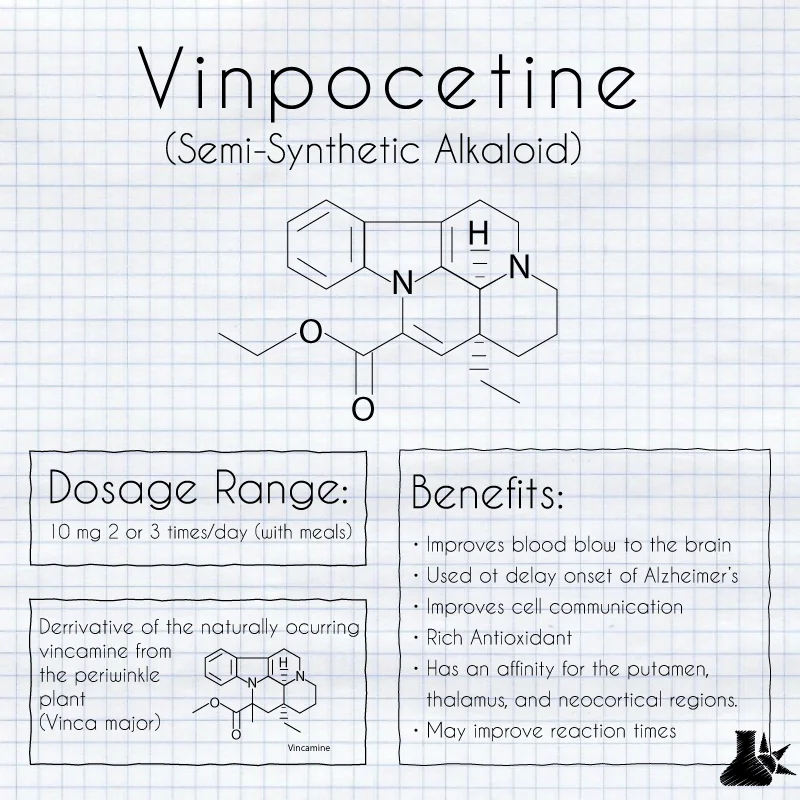
Vinpocetine is a semi-synthetic vinca alkaloid — the ethyl ester of apovincamine, made in a lab from vincamine (itself extracted from Vinca minor, the lesser periwinkle). It is a genuine pharmaceutical: licensed as a prescription drug (Cavinton) for cerebrovascular and cognitive disorders in parts of Europe and Asia, but sold as an over-the-counter “nootropic” in the US, where it is neither FDA-approved as a drug nor recognised as a legal dietary ingredient. The evidence posture is unusual — the mechanism (cerebral vasodilation, PDE1 inhibition, sodium-channel blockade) is well characterised and the drug clearly reaches the brain, but the clinical payoff is modest: the best-designed reviews for its headline uses (dementia, stroke) land on “promising but inconclusive.” Because it is not a nutrient, there is no deficiency to correct — every effect here is pharmacological, dose-dependent, and heavily gated by the fact that oral absorption is poor (~7%) unless taken with food.
- Best-supported: it demonstrably increases cerebral blood flow and brain glucose uptake in imaging studies, and as an adjuvant in acute ischaemic stroke a 2022 meta-analysis found reduced disability (though not reduced death) 1,2Reference 1Meta-analysisSafety and efficacy of vinpocetine as a neuroprotective agent in acute ischemic stroke: a systematic review and meta-analysis — [meta-analysis]View study →Reference 2Systematic reviewVinpocetine for acute ischaemic stroke — [systematic review]View study →.
- Emerging / cautiously endorsed: a single good randomised trial of extended-release vinpocetine cut focal seizure frequency as an add-on therapy; the anti-inflammatory (NF-κB/IKK) biology is real but preclinical 3,4Reference 3RCTExtended-release vinpocetine: a possible adjuvant treatment for focal onset epileptic seizures — [randomised controlled trial]View study →Reference 4In vitroVinpocetine inhibits NF-κB-dependent inflammation via an IKK-dependent but PDE-independent mechanism — [in vitro/animal]View study →.
- Popular but thin / overhyped: the “study aid for healthy brains” positioning rests on one small 1985 crossover study; memory-boosting and anti-ageing marketing outruns the human data.
- The honest miss / caveat: the Cochrane review of vinpocetine for cognitive impairment and dementia concluded the evidence does not support clinical use — and the US FDA warns it may cause miscarriage or fetal harm 5Reference 5Meta-analysisVinpocetine for cognitive impairment and dementia — [meta-analysis]View study →.
1. Cerebral blood flow & vasodilation
This is vinpocetine’s most reliably demonstrated effect and the basis for everything else. It selectively dilates cerebral arteries and, in a single-dose intravenous PET study in chronic stroke patients, increased blood flow and glucose uptake in the peri-infarct cortex 6Reference 6Cerebral effects of a single dose of intravenous vinpocetine in chronic stroke patients: a PET study — [imaging]View study →. Mechanistically it raises cyclic nucleotide tone (PDE1 inhibition → ↑cGMP/cAMP), improves red-cell deformability, and increases the brain’s tolerance to low oxygen 7Reference 7ReviewRole of vinpocetine in ischemic stroke and poststroke outcomes: a critical review — [review]View study →. The important caveat: increased blood flow is a surrogate measurement, not a clinical outcome — “more perfusion” has not translated into large, durable improvements in how patients feel or function.
Gap: the effect is real and imaging-confirmed, but it is a pharmacodynamic marker; better perfusion has not reliably delivered better patient outcomes.
2. Acute ischaemic stroke (adjuvant)
Vinpocetine has been used as a vasoactive/neuroprotective add-on to standard stroke care in some countries. Two successive Cochrane reviews (2000, 2008) found too few good trials to judge it 2,8Reference 2Systematic reviewVinpocetine for acute ischaemic stroke — [systematic review]View study →Reference 8Systematic reviewVinpocetine for acute ischaemic stroke — [systematic review]View study →. A 2022 systematic review and meta-analysis (Panda et al., Neurocritical Care) pooling newer RCTs reported less disability at 1 and 3 months (standardised mean difference ~0.49 and ~1.22) and a small improvement in mini-mental-state score, but no reduction in case fatality 1Reference 1Meta-analysisSafety and efficacy of vinpocetine as a neuroprotective agent in acute ischemic stroke: a systematic review and meta-analysis — [meta-analysis]View study →. All effects are as an adjuvant, in the acute window, on small samples.
Gap: disability signal only, no mortality benefit, and the authors explicitly say the trials are too small to recommend routine use.
3. Cognitive impairment & dementia
The most-studied claim and the clearest disappointment relative to the hype. The Cochrane review (Szatmári & Whitehouse, 2003) found benefit associated with 30 mg/day and 60 mg/day versus placebo, but very few patients were treated for six months or longer and only one trial ran a year 5Reference 5Meta-analysisVinpocetine for cognitive impairment and dementia — [meta-analysis]View study →. Its verdict: the evidence “is inconclusive and does not support clinical use,” while noting the drug has few adverse effects at studied doses. An earlier US trial (Thal et al., 1989) specifically found a lack of efficacy in Alzheimer’s disease. Later Chinese post-stroke-cognition trials exist but are of mixed quality.
Gap: short, underpowered trials with a possible signal but no adequately sized, long-duration RCT to confirm it, against at least one clearly negative Alzheimer’s trial.
4. Focal epilepsy (adjuvant)
The most interesting newer signal. A double-blind, parallel-group RCT (Garza-Morales et al., 2019; n=87) tested extended-release vinpocetine as an add-on to 1–3 existing antiseizure drugs in focal epilepsy and reported effective seizure control with a low adverse-event rate 3Reference 3RCTExtended-release vinpocetine: a possible adjuvant treatment for focal onset epileptic seizures — [randomised controlled trial]View study →. This fits its sodium-channel-blocking mechanism, and case reports describe benefit in specific GABA-receptor genetic epilepsies. It remains a single controlled trial plus preclinical and anecdotal support.
Gap: one RCT, adjuvant use only; needs independent replication before it is more than promising.
5. Memory in healthy adults
The “smart drug for students” use is the weakest-evidenced. In a randomised, double-blind crossover study in 12 healthy female volunteers (Subhan & Hindmarch, 1985), vinpocetine 40 mg three-times-daily improved memory on a Sternberg scanning task, but produced no change in critical flicker fusion, choice reaction time, or subjective drug effects 9Reference 9RCTPsychopharmacological effects of vinpocetine in normal healthy volunteers — [randomised crossover trial]View study →. That is one small, short, single-endpoint result — nowhere near enough to support routine cognitive-enhancement use in healthy people.
Gap: a single tiny crossover trial with one positive endpoint; no replication in healthy adults.
6. Tinnitus & acoustic trauma
Vinpocetine (Cavinton) has been used intravenously for acute acoustic trauma and sudden hearing problems, typically alongside other vasoactive drugs. A small Polish case series (Konopka et al., 1997; ~20 patients) reported hearing improvement in ~79% and tinnitus improvement in ~67%, but it was uncontrolled, combined-therapy, and decades old 10Reference 10Case reportTreatment results of acoustic trauma — [uncontrolled case series]View study →.
Gap: no controlled trials; old, small, combination-therapy data that cannot isolate vinpocetine’s contribution.
Mechanisms
| Target / pathway | Effect | Relevant to |
|---|---|---|
| Cerebral arterial smooth muscle | Vasodilation → ↑ cerebral blood flow | Blood flow, stroke, dementia |
| Phosphodiesterase-1 (PDE1) | Inhibition → ↑ cGMP/cAMP | Vasodilation, anti-inflammatory tone |
| Voltage-gated Na⁺ channels | Blockade → ↓ neuronal Ca²⁺ influx | Neuroprotection, epilepsy |
| IKK / NF-κB signalling | Inhibition (PDE-independent) → ↓ inflammatory gene expression | Anti-inflammatory (preclinical) |
| Oxidative stress | Free-radical scavenging | Neuroprotection |
Pharmacokinetics
Oral bioavailability is the decision-relevant fact: absorption is only about 7% on an empty stomach, rising to roughly 60–80% when taken with food — so vinpocetine should always be taken with meals, and split across the day. Peak plasma levels occur ~1–2 hours after dosing, and the elimination half-life is short (~1–2 hours), which is why dosing is divided and why an extended-release form was developed for epilepsy. It is rapidly metabolised to apovincaminic acid (the main, largely inactive metabolite) and cleared renally 11Reference 11Vinpocetine pharmacokinetics in elderly subjects — [clinical PK]View study →. Imaging shows preferential uptake in the thalamus, basal ganglia (putamen) and neocortex.
Clinical trials
Vinpocetine is off-patent and has been marketed for decades, so there is little modern industry-funded trial activity in the US; most high-quality RCTs are older or come from Europe, Russia, and China, and trial quality is a recurring limitation flagged by every systematic review.
| Completed | Planned | Terminated | Preclinical |
|---|---|---|---|
| ~15–25(mostly small/older) | Few | Few | Many(dozens) |
Last checked: July 2026.
Dietary Sources
Vinpocetine is not a nutrient and is not found in food. It does not occur naturally in any meaningful amount — it is a semi-synthetic molecule, produced in a laboratory by chemically modifying vincamine, an alkaloid extracted from the leaves of the lesser periwinkle (Vinca minor). Vincamine itself occurs in the periwinkle plant, but eating periwinkle is neither a source of vinpocetine nor safe. Because there is no dietary source and no deficiency state, the entire rationale for taking vinpocetine is pharmacological, not nutritional.
Regulatory note (US): In 2016 the FDA tentatively concluded vinpocetine does not fit the statutory definition of a dietary ingredient, and in 2019 it issued a specific warning that vinpocetine may cause miscarriage or fetal harm. It remains widely sold online regardless. In several European and Asian countries it is instead a prescription pharmaceutical (Cavinton), not a supplement.
Dosage & Intake
Vinpocetine has no RDA, AI, or Upper Limit because it is not an essential nutrient. Doses studied in research, not a personal recommendation, are typically:
| Use | Studied dose | Notes |
|---|---|---|
| Cognitive/cerebrovascular | 15–30 mg/day (up to 60 mg) | Split into 2–3 doses, taken with food |
| Acute stroke (clinical) | Often IV in trials | Hospital setting only |
| Focal epilepsy (adjuvant) | Extended-release formulation | Under medical supervision |
Take with food. This is the single most important intake fact: oral absorption is only ~7% fasting but ~60–80% with a meal. The short half-life (~1–2 h) is why doses are split through the day. There is no established safe long-term dose in supplement use because long, adequately sized trials have not been done.
Safety
At the oral doses studied, vinpocetine is generally well tolerated over short periods; systematic reviews consistently note few adverse effects at trial doses. Reported effects are usually mild: nausea, stomach upset, headache, dizziness, flushing, and sleep disturbance. Two pharmacological cautions matter: it can lower blood pressure (additive with antihypertensives) and has mild antiplatelet/blood-thinning activity (theoretical additive bleeding risk with warfarin, DOACs, aspirin, clopidogrel, and other anticoagulant/antiplatelet drugs — separate use and consult a clinician). People with low blood pressure or bleeding disorders, and anyone scheduled for surgery, should be cautious.
Pregnancy & lactation
Verdict: avoid entirely. The US FDA issued a 2019 safety alert warning that vinpocetine may cause a miscarriage or harm fetal development, and advised that women who are pregnant or could become pregnant should not take it. There is no safety data in lactation; avoid.
Scope of this safety review (for honesty, not a claim):
- Interactions assessed? Yes — antihypertensives (additive hypotension) and anticoagulant/antiplatelet agents (additive bleeding risk) were checked; immunosuppressant and warfarin interactions are plausible but not well quantified in humans.
- Pregnancy/lactation assessed? Yes — contraindicated in pregnancy per FDA; no lactation data, so avoid.
- Upper Limit? No UL set — vinpocetine is not a nutrient; absence of a UL does not imply that high or long-term doses are safe.
References
- Panda, P. K., Ramachandran, A., Panda, P., et al. (2022). Safety and efficacy of vinpocetine as a neuroprotective agent in acute ischemic stroke: a systematic review and meta-analysis — [meta-analysis]. Neurocritical Care. https://pubmed.ncbi.nlm.nih.gov/35488169/
- Bereczki, D., & Fekete, I. (2008). Vinpocetine for acute ischaemic stroke — [systematic review]. Cochrane Database of Systematic Reviews. https://pubmed.ncbi.nlm.nih.gov/18253980/
- Garza-Morales, S., Briceño-González, E., Ceja-Moreno, H., et al. (2019). Extended-release vinpocetine: a possible adjuvant treatment for focal onset epileptic seizures — [randomised controlled trial]. Boletín Médico del Hospital Infantil de México. https://pubmed.ncbi.nlm.nih.gov/31536041/
- Jeon, K. I., Xu, X., Aizawa, T., et al. (2010). Vinpocetine inhibits NF-κB-dependent inflammation via an IKK-dependent but PDE-independent mechanism — [in vitro/animal]. Proceedings of the National Academy of Sciences USA. https://pubmed.ncbi.nlm.nih.gov/20448200/
- Szatmári, S. Z., & Whitehouse, P. J. (2003). Vinpocetine for cognitive impairment and dementia — [meta-analysis]. Cochrane Database of Systematic Reviews. https://pubmed.ncbi.nlm.nih.gov/12535455/
- Szakáll, S., Boros, I., Balkay, L., et al. (1998). Cerebral effects of a single dose of intravenous vinpocetine in chronic stroke patients: a PET study — [imaging]. Journal of Neuroimaging. https://pubmed.ncbi.nlm.nih.gov/9780850/
- Al-Kuraishy, H. M., Al-Gareeb, A. I., Naji, M. T., et al. (2020). Role of vinpocetine in ischemic stroke and poststroke outcomes: a critical review — [review]. Brain Circulation. https://pubmed.ncbi.nlm.nih.gov/32166194/
- Bereczki, D., & Fekete, I. (2000). Vinpocetine for acute ischaemic stroke — [systematic review]. Cochrane Database of Systematic Reviews. https://pubmed.ncbi.nlm.nih.gov/10796369/
- Subhan, Z., & Hindmarch, I. (1985). Psychopharmacological effects of vinpocetine in normal healthy volunteers — [randomised crossover trial]. European Journal of Clinical Pharmacology. https://pubmed.ncbi.nlm.nih.gov/3899677/
- Konopka, W., Zalewski, P., Olszewski, J., et al. (1997). Treatment results of acoustic trauma — [uncontrolled case series]. Otolaryngologia Polska. https://pubmed.ncbi.nlm.nih.gov/9757711/
- Grandt, R., Beitinger, H., Schaltenbrand, R., et al. (1989). Vinpocetine pharmacokinetics in elderly subjects — [clinical PK]. Arzneimittel-Forschung. https://pubmed.ncbi.nlm.nih.gov/2624613/