
Supplement Monograph
Alpha-GPC
A choline-dense phospholipid used to raise acetylcholine — the best evidence is in dementia and stroke recovery, and it is much thinner for healthy-brain enhancement.
Pharmacology & Research
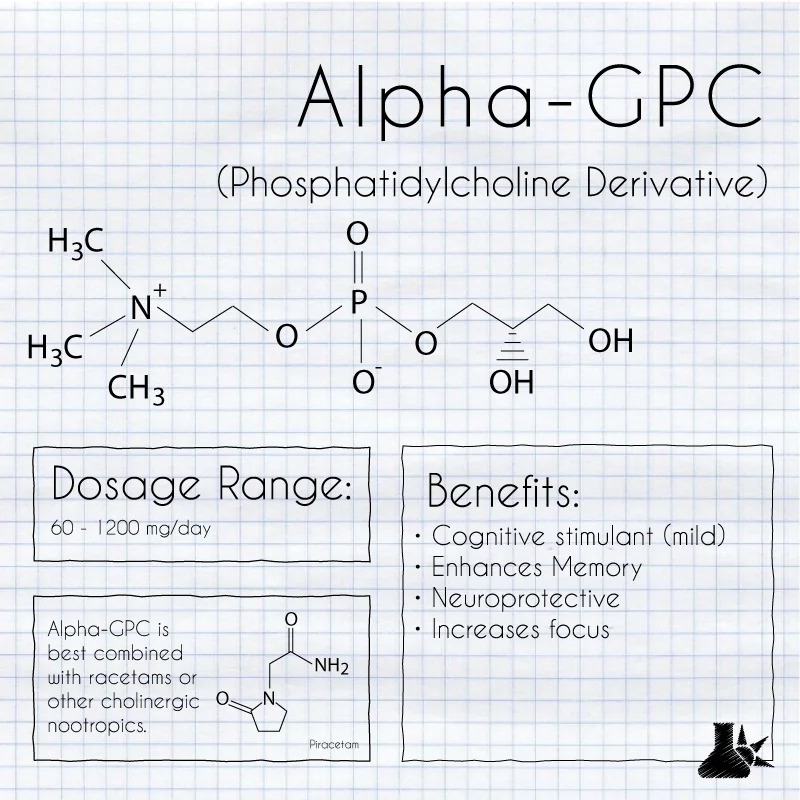
Alpha-GPC (L-alpha-glycerylphosphorylcholine, choline alfoscerate) is a choline-containing phospholipid — a semisynthetic, water-soluble breakdown product of phosphatidylcholine that carries roughly 40% choline by weight and crosses the blood–brain barrier readily. Its evidence base is unusual for a nootropic: the strongest data are older clinical trials in dementia and stroke populations, run in the 1990s–2010s where it is a licensed drug (marketed as Gliatilin in Italy and elsewhere), while its modern popularity rests on a much thinner set of small, often industry-funded studies in healthy adults and athletes. The key distinction throughout is repletion versus enhancement: alpha-GPC reliably raises circulating choline and shows measurable cognitive benefit in people with cholinergic deficits (Alzheimer’s, vascular cognitive decline), but the case that it meaningfully sharpens an already-healthy, well-nourished brain is modest and short-lived. Two cautions temper the whole picture — much of the clinical trial base comes from the manufacturer, and a large observational study has linked prescription use to elevated stroke risk via the TMAO pathway.
- Best-supported: slowing cognitive decline in Alzheimer’s/vascular dementia, both as monotherapy and — more consistently — as an add-on to donepezil, backed by a randomized trial and a meta-analysis of RCTs 1,2,3Reference 1RCTCognitive improvement in mild to moderate Alzheimer’s dementia after treatment with the acetylcholine precursor choline alfoscerate: a multicenter, double-blind, randomized, placebo-controlled trial — [RCT]View study →Reference 2Meta-analysisActivity of choline alphoscerate on adult-onset cognitive dysfunctions: a systematic review and meta-analysis — [meta-analysis]View study →Reference 3RCTThe ASCOMALVA trial: association between the cholinesterase inhibitor donepezil and the cholinergic precursor choline alphoscerate in Alzheimer’s disease with cerebrovascular injury — interim results — [RCT]View study →.
- Emerging / cautiously endorsed: a single modern RCT in mild cognitive impairment 5Reference 5RCTEfficacy and safety of choline alphoscerate for amnestic mild cognitive impairment: a randomized double-blind placebo-controlled trial — [RCT]View study →, functional recovery after ischemic stroke 6,7Reference 6Clinical trialAlpha-glycerophosphocholine in the mental recovery of cerebral ischemic attacksView study →Reference 7Meta-analysisCholine-containing phospholipids in stroke treatment: a systematic review and meta-analysis — [meta-analysis]View study →, and acute Stroop-task gains in healthy men 8Reference 8RCTAcute alpha-glycerylphosphorylcholine supplementation enhances cognitive performance in healthy men — [RCT, crossover]View study →.
- Popular but thin / overhyped: the growth-hormone and athletic-power claims rest on tiny (n=8), acute, or combination-product studies that can’t isolate alpha-GPC, several of them industry-funded 9,10,11Reference 9RCTGlycerophosphocholine enhances growth hormone secretion and fat oxidation in young adults — [RCT, crossover]View study →Reference 10RCTEffects of branched chain amino acids, L-citrulline, and alpha-glycerylphosphorylcholine supplementation on exercise performance in trained cyclists: a randomized crossover trial — [RCT, combination]View study →Reference 11RCTAcute ingestion of neuromuscular enhancement supplements do not improve power output, work capacity, and cognition — [RCT, null]View study →.
- The honest miss / caveat: acute alpha-GPC did not improve power output or reaction time in controlled tests 11Reference 11RCTAcute ingestion of neuromuscular enhancement supplements do not improve power output, work capacity, and cognition — [RCT, null]View study →, the GH spike is transient and unproven for body composition, and a 12-million-person cohort links prescription use to a ~1.4× higher 10-year stroke risk 12Reference 12ObservationalAssociation of L-α glycerylphosphorylcholine with subsequent stroke risk after 10 years — [cohort]View study → — an unresolved safety signal for a choline donor.
0. Evidence by application
Support is an experimental score I’m building — a composite weighted by study type (human > animal > in vitro > review) and study volume. It’s a beta: a fast way to rank strength of evidence at a glance, not a validated metric. Each application links down to its write-up.
| Application | Support | Rests on |
|---|---|---|
| Alzheimer’s & vascular dementia | ███████░░░ 72% | One 261-patient RCT + a meta-analysis of 7 RCTs; strongest as a donepezil add-on; mostly manufacturer-linked 1,2,3Reference 1RCTCognitive improvement in mild to moderate Alzheimer’s dementia after treatment with the acetylcholine precursor choline alfoscerate: a multicenter, double-blind, randomized, placebo-controlled trial — [RCT]View study →Reference 2Meta-analysisActivity of choline alphoscerate on adult-onset cognitive dysfunctions: a systematic review and meta-analysis — [meta-analysis]View study →Reference 3RCTThe ASCOMALVA trial: association between the cholinesterase inhibitor donepezil and the cholinergic precursor choline alphoscerate in Alzheimer’s disease with cerebrovascular injury — interim results — [RCT]View study →. |
| Mild cognitive impairment | ██████░░░░ 58% | One good modern RCT (n=100), ADAS-cog −2.34 vs placebo over 12 weeks 5Reference 5RCTEfficacy and safety of choline alphoscerate for amnestic mild cognitive impairment: a randomized double-blind placebo-controlled trial — [RCT]View study →. |
| Stroke & cerebrovascular recovery | █████░░░░░ 50% | Large but uncontrolled multicentre trial + a meta-analysis showing functional recovery 6,7Reference 6Clinical trialAlpha-glycerophosphocholine in the mental recovery of cerebral ischemic attacksView study →Reference 7Meta-analysisCholine-containing phospholipids in stroke treatment: a systematic review and meta-analysis — [meta-analysis]View study →. |
| Acute cognition in healthy adults | ████░░░░░░ 40% | One small crossover RCT (n=20): Stroop improved, but Flanker/N-back null; industry-funded 8Reference 8RCTAcute alpha-glycerylphosphorylcholine supplementation enhances cognitive performance in healthy men — [RCT, crossover]View study →. |
| Growth hormone | ███░░░░░░░ 30% | A single n=8 acute crossover showing a transient GH rise 9Reference 9RCTGlycerophosphocholine enhances growth hormone secretion and fat oxidation in young adults — [RCT, crossover]View study →. |
| Athletic power & performance | ███░░░░░░░ 28% | Confounded combination products and a controlled null for isolated acute dosing 10,11Reference 10RCTEffects of branched chain amino acids, L-citrulline, and alpha-glycerylphosphorylcholine supplementation on exercise performance in trained cyclists: a randomized crossover trial — [RCT, combination]View study →Reference 11RCTAcute ingestion of neuromuscular enhancement supplements do not improve power output, work capacity, and cognition — [RCT, null]View study →. |
1. Alzheimer’s & vascular dementia
The anchor trial is a multicenter, double-blind, randomized, placebo-controlled study of 261 patients with mild-to-moderate Alzheimer’s dementia given choline alfoscerate 1,200 mg/day (400 mg three times daily) or placebo for 180 days: the treated group improved on ADAS-Cog while placebo worsened, with consistent separation on MMSE, GDS and CGI 1Reference 1RCTCognitive improvement in mild to moderate Alzheimer’s dementia after treatment with the acetylcholine precursor choline alfoscerate: a multicenter, double-blind, randomized, placebo-controlled trial — [RCT]View study →. A 2023 systematic review and meta-analysis pooled seven RCTs and one cohort and found alpha-GPC combined with donepezil significantly improved cognition (mean difference 1.72 on ADAS-cog, 95% CI 0.20–3.25), function, and behavior, and that alpha-GPC beat placebo/other drugs on cognition (MD 3.50, 95% CI 0.36–6.63) 2Reference 2Meta-analysisActivity of choline alphoscerate on adult-onset cognitive dysfunctions: a systematic review and meta-analysis — [meta-analysis]View study →. The ASCOMALVA trial specifically tested donepezil + alpha-GPC versus donepezil alone in Alzheimer’s with cerebrovascular injury and reported the combination slowed decline across cognitive, functional and behavioral measures over 12–24 months 3,4Reference 3RCTThe ASCOMALVA trial: association between the cholinesterase inhibitor donepezil and the cholinergic precursor choline alphoscerate in Alzheimer’s disease with cerebrovascular injury — interim results — [RCT]View study →Reference 4RCTThe ASCOMALVA trial: interim results after two years of treatment — [RCT]View study →. This is a deficiency/disease effect — the benefit is correcting impaired cholinergic transmission, not boosting a healthy brain.
Gap: the effect is most robust as a donepezil add-on in cerebrovascular-injury dementia; much of the trial base is older and linked to the manufacturer, and no large independent trial has replicated monotherapy benefit against modern standards.
2. Mild cognitive impairment
A 2024 multicenter, randomized, double-blind, placebo-controlled trial gave 600 mg/day of soy-lecithin-derived alpha-GPC or placebo to 100 people with amnestic mild cognitive impairment for 12 weeks; the treated group’s ADAS-cog fell by 2.34 points more than placebo, with no serious adverse events and no excess dropouts 5Reference 5RCTEfficacy and safety of choline alphoscerate for amnestic mild cognitive impairment: a randomized double-blind placebo-controlled trial — [RCT]View study →. This is the cleanest modern efficacy signal in a non-dementia clinical population, though the follow-up is short and the population is already cognitively impaired.
Gap: a single 12-week trial in one country; durability beyond three months and generalizability to cognitively normal adults are untested.
3. Stroke & cerebrovascular recovery
An Italian multicenter trial treated 2,044 patients after ischemic stroke or TIA with alpha-GPC (1,000 mg/day intramuscular for 28 days, then 400 mg three times daily orally for five months); Mathew Scale, MMSE and Crichton scores all improved significantly and adverse events were rare (2.1%) 6Reference 6Clinical trialAlpha-glycerophosphocholine in the mental recovery of cerebral ischemic attacksView study →. A 2023 meta-analysis of choline-containing phospholipids in stroke found that, unlike citicoline, choline alphoscerate improved neurological function and functional recovery and reduced dependency 7Reference 7Meta-analysisCholine-containing phospholipids in stroke treatment: a systematic review and meta-analysis — [meta-analysis]View study →. The catch is that the large trial was open-label and uncontrolled, so placebo and natural-recovery effects cannot be separated.
Gap: the headline recovery data come from uncontrolled trials; the modern meta-analysis is favorable but built on the same older, mostly unblinded literature.
4. Acute cognition in healthy adults
A 2024 randomized, double-blind, placebo-controlled crossover study in 20 resistance-trained men tested 315 mg and 630 mg of alpha-GPC against placebo: both doses significantly improved Stroop test scores (high dose d = 0.61) and the high dose sped Stroop completion time, but there were no benefits on the Flanker or N-back tasks and none on physical performance or growth hormone 8Reference 8RCTAcute alpha-glycerylphosphorylcholine supplementation enhances cognitive performance in healthy men — [RCT, crossover]View study →. So the acute cognitive effect in healthy people is real but narrow — it showed up on one of three tests — and the study was funded by a supplement maker.
Gap: one small acute crossover with a selective, single-domain effect and a manufacturer conflict of interest; no evidence that repeated dosing produces lasting cognitive gains in healthy adults.
5. Growth hormone
The entire popular GH claim traces to a single crossover study in eight healthy young men: a 1,000 mg oral dose transiently raised plasma growth hormone at 60 minutes (and increased free fatty acids and markers of fat oxidation at 120 minutes) versus placebo 9Reference 9RCTGlycerophosphocholine enhances growth hormone secretion and fat oxidation in young adults — [RCT, crossover]View study →. The rise is acute and short-lived, and the much larger 2024 healthy-adult trial found no GH effect at 315–630 mg 8Reference 8RCTAcute alpha-glycerylphosphorylcholine supplementation enhances cognitive performance in healthy men — [RCT, crossover]View study →. A brief GH pulse has never been shown to translate into muscle or fat-mass changes.
Gap: n=8, single acute dose, transient spike, not replicated at common supplemental doses — and no downstream body-composition outcome.
6. Athletic power & performance
Sports claims rest largely on combination products that make alpha-GPC’s contribution impossible to isolate: a 2023 trial in 30 cyclists reported ~11% higher peak power and longer time-to-fatigue, but the supplement bundled 8 g BCAAs, 6 g L-citrulline and only 300 mg alpha-GPC 10Reference 10RCTEffects of branched chain amino acids, L-citrulline, and alpha-glycerylphosphorylcholine supplementation on exercise performance in trained cyclists: a randomized crossover trial — [RCT, combination]View study →. When acute alpha-GPC (as part of a choline/uridine/DHA blend) was tested against placebo for power output, work capacity and cognition, there was no benefit 11Reference 11RCTAcute ingestion of neuromuscular enhancement supplements do not improve power output, work capacity, and cognition — [RCT, null]View study →, and the isolated-dose 2024 study also found no physical-performance effect 8Reference 8RCTAcute alpha-glycerylphosphorylcholine supplementation enhances cognitive performance in healthy men — [RCT, crossover]View study →.
Gap: no adequately powered trial isolates alpha-GPC’s ergogenic effect; the controlled acute data are null, and the positive results come from multi-ingredient formulas.
Mechanisms
| Target / pathway | Effect | Relevant to |
|---|---|---|
| Free choline supply | ↑ plasma choline, substrate for acetylcholine synthesis | All cognitive & GH applications 9Reference 9RCTGlycerophosphocholine enhances growth hormone secretion and fat oxidation in young adults — [RCT, crossover]View study → |
| Cholinergic neurotransmission | ↑ acetylcholine release; enhances ChE-inhibitor effect | Dementia, MCI, stroke 2,3Reference 2Meta-analysisActivity of choline alphoscerate on adult-onset cognitive dysfunctions: a systematic review and meta-analysis — [meta-analysis]View study →Reference 3RCTThe ASCOMALVA trial: association between the cholinesterase inhibitor donepezil and the cholinergic precursor choline alphoscerate in Alzheimer’s disease with cerebrovascular injury — interim results — [RCT]View study → |
| Membrane phospholipids | Choline incorporated into brain phosphatidylcholine | Neuroprotection, membrane repair |
| Hypothalamic–pituitary (ACh→catecholamine) | Transient ↑ growth hormone secretion | Growth hormone 9Reference 9RCTGlycerophosphocholine enhances growth hormone secretion and fat oxidation in young adults — [RCT, crossover]View study → |
| Gut microbiota → TMA → TMAO | ↑ trimethylamine-N-oxide, a pro-atherogenic metabolite | Cardiovascular/stroke risk 12,13Reference 12ObservationalAssociation of L-α glycerylphosphorylcholine with subsequent stroke risk after 10 years — [cohort]View study →Reference 13In vitroThe nutritional supplement L-alpha glycerylphosphorylcholine promotes atherosclerosis — [animal/in vitro]View study → |
Pharmacokinetics
Alpha-GPC is water-soluble and rapidly absorbed after oral dosing. Radiolabel work in rats shows it is hydrolyzed by phosphodiesterases in the gut mucosa, distributes widely (liver, kidney, lung, spleen), and delivers choline that is incorporated into brain phospholipids within 24 hours; most of the glycerol backbone is ultimately exhaled as CO₂ 15Reference 15AnimalAbsorption, tissue distribution and excretion of radiolabelled compounds in rats after administration of [14C]-L-alpha-glycerylphosphorylcholine — [rat]View study →. In humans, plasma free choline rises significantly within 60 minutes of a 1,000 mg dose 9Reference 9RCTGlycerophosphocholine enhances growth hormone secretion and fat oxidation in young adults — [RCT, crossover]View study →. The molecule is ~40% choline by weight, making it one of the more choline-dense oral sources 20Reference 20ReviewL-alpha-glycerylphosphorylcholine (L-α-GPC): a comprehensive review of its preparation techniques and versatile biological effects — [review]View study →. There is no established elimination half-life for the intact molecule in humans — it functions essentially as a rapid choline-delivery vehicle rather than a persistent circulating drug.
Clinical trials
ClinicalTrials.gov lists 45 registered studies mentioning alpha-GPC or choline alphoscerate, the majority already completed. As an off-patent compound that is a licensed drug in some countries and a supplement in others, it attracts little large-scale industry trial investment; much of the pivotal efficacy literature predates the registry era.
| Completed | Recruiting | Not yet recruiting | Terminated | Withdrawn | Unknown status |
|---|---|---|---|---|---|
| 27 | 2 | 2 | 2 | 3 | 9 |
Last checked: July 2026.
Dietary Sources
Alpha-GPC occurs naturally as an intermediate in phosphatidylcholine metabolism and is present in small amounts in the body and in choline-rich foods. It is not consumed in supplemental quantities from diet — food supplies choline mostly as phosphatidylcholine and free choline, with only trace intact alpha-GPC. The practical dietary point is total choline intake, since alpha-GPC is essentially a concentrated, rapidly absorbed choline source (~40% choline by weight) 20Reference 20ReviewL-alpha-glycerylphosphorylcholine (L-α-GPC): a comprehensive review of its preparation techniques and versatile biological effects — [review]View study →.
| Food (choline source) | Approx. choline per serving |
|---|---|
| Beef liver (3 oz) | ~350 mg |
| Egg (1 large, with yolk) | ~147 mg |
| Soybeans / soy lecithin | moderate (also the industrial feedstock for alpha-GPC) |
| Chicken breast (3 oz) | ~72 mg |
| Milk / dairy | small amounts of free GPC |
Most supplemental alpha-GPC is manufactured from soy or sunflower lecithin (phosphatidylcholine) by enzymatic or chemical hydrolysis — it is not extracted at scale from food. Refining and low-egg/low-organ-meat diets reduce dietary choline, which is why many populations fall below the choline Adequate Intake (food values per the NIH ODS Choline fact sheet).
Dosage & Intake
Alpha-GPC is dosed as the whole compound, not as elemental choline; a 300 mg capsule delivers roughly 120 mg of choline. Studied ranges:
- Cognitive enhancement (healthy adults): 300–600 mg acutely; the controlled healthy-adult data used 315–630 mg 8Reference 8RCTAcute alpha-glycerylphosphorylcholine supplementation enhances cognitive performance in healthy men — [RCT, crossover]View study →.
- Mild cognitive impairment: 600 mg/day for 12 weeks 5Reference 5RCTEfficacy and safety of choline alphoscerate for amnestic mild cognitive impairment: a randomized double-blind placebo-controlled trial — [RCT]View study →.
- Alzheimer’s / vascular dementia: 1,200 mg/day in three divided doses (the pivotal RCT dose) 1Reference 1RCTCognitive improvement in mild to moderate Alzheimer’s dementia after treatment with the acetylcholine precursor choline alfoscerate: a multicenter, double-blind, randomized, placebo-controlled trial — [RCT]View study →.
- Stroke recovery (clinical, supervised): 1,000 mg/day intramuscular then 1,200 mg/day oral 6Reference 6Clinical trialAlpha-glycerophosphocholine in the mental recovery of cerebral ischemic attacksView study →.
These are doses studied in research, not a personal recommendation. Divide daily amounts (typically 2–3 doses) to smooth absorption and reduce GI upset; alpha-GPC can be taken with or without food. Because it is choline-dense, count it toward your total daily choline and stay well under the choline Tolerable Upper Intake Level of 3,500 mg/day when combining with other choline sources (citicoline, phosphatidylcholine, eggs).
Safety
In controlled trials alpha-GPC is well tolerated: the large stroke trial reported adverse events in only 2.1% of 2,044 patients, most commonly heartburn, nausea, insomnia and headache 6Reference 6Clinical trialAlpha-glycerophosphocholine in the mental recovery of cerebral ischemic attacksView study →, and the MCI RCT reported no serious adverse events and no excess dropouts 5Reference 5RCTEfficacy and safety of choline alphoscerate for amnestic mild cognitive impairment: a randomized double-blind placebo-controlled trial — [RCT]View study →. Animal toxicology supports a wide margin — a novel-food safety evaluation found no genotoxicity and a NOAEL of 1,000 mg/kg body weight (female rats) to 2,000 mg/kg (male rats) over 90 days 16Reference 16Safety evaluation of alpha-glycerylphosphorylcholine as a novel food — [animal toxicology]View study →, and EFSA derived an acceptable margin of exposure for use in food supplements up to ~204 mg/day 17Reference 17Safety of L-alpha-glycerylphosphorylcholine (L-alpha-GPC) from soya phospholipids (lecithin) as a novel food — [regulatory opinion]View study →.
The important caveat is cardiovascular. A retrospective cohort of over 12 million South Koreans aged ≥50 found that alpha-GPC prescription was associated with a higher 10-year risk of total stroke (adjusted HR 1.43), ischemic stroke (1.34) and hemorrhagic stroke (1.37), in a dose–response manner, after adjusting for cerebrovascular risk factors 12Reference 12ObservationalAssociation of L-α glycerylphosphorylcholine with subsequent stroke risk after 10 years — [cohort]View study →. A mechanistic study showed alpha-GPC is metabolized by gut bacteria to trimethylamine-N-oxide (TMAO), a pro-atherogenic metabolite, and promotes atherosclerosis in hyperlipidemic mice 13Reference 13In vitroThe nutritional supplement L-alpha glycerylphosphorylcholine promotes atherosclerosis — [animal/in vitro]View study →. This is observational (confounding by indication is possible — it is prescribed to older, higher-risk people) and not confirmed by randomized data, but it is a genuine, unresolved signal. A separate 2026 cohort found no association with kidney cancer 14Reference 14ObservationalAssociation between L-α-glycerylphosphorylcholine use and risk of kidney cancer: a nationwide representative retrospective cohort study — [cohort]View study →.
- Interactions: As a cholinergic, alpha-GPC is additive with cholinesterase inhibitors (donepezil, rivastigmine) — intended in the ASCOMALVA combination but a consideration for cumulative cholinergic load — and with other choline donors. Anticholinergic drugs would be expected to oppose it.
- Who should be cautious: anyone with significant cardiovascular or cerebrovascular risk (prior stroke, atherosclerosis, hyperlipidemia), given the TMAO/stroke signal.
Pregnancy & lactation
Verdict: not established as safe — avoid supplemental use without medical advice. Animal teratogenicity studies showed no malformations but reduced maternal weight gain at high doses (NOAEL 1,000 mg/kg) 16,17Reference 16Safety evaluation of alpha-glycerylphosphorylcholine as a novel food — [animal toxicology]View study →Reference 17Safety of L-alpha-glycerylphosphorylcholine (L-alpha-GPC) from soya phospholipids (lecithin) as a novel food — [regulatory opinion]View study →, and there are no human pregnancy trials of supplemental alpha-GPC. Adequate dietary choline is important in pregnancy, but that is not a basis for high-dose alpha-GPC supplementation.
Scope of this safety review (for honesty, not a claim):
- Interactions assessed? Yes — cholinergic drugs (cholinesterase inhibitors), other choline donors, and anticholinergics. Not an exhaustive prescription-interaction screen.
- Pregnancy/lactation assessed? Yes — animal teratogenicity data reviewed; no human supplemental-use data exist.
- Upper Limit? No UL exists for alpha-GPC itself. Choline (the delivered nutrient) has a UL of 3,500 mg/day. The absence of an alpha-GPC UL does not imply unlimited intake is safe.
References
- De Jesus Moreno Moreno, M. (2003). Cognitive improvement in mild to moderate Alzheimer’s dementia after treatment with the acetylcholine precursor choline alfoscerate: a multicenter, double-blind, randomized, placebo-controlled trial — [RCT]. Clinical Therapeutics. https://pubmed.ncbi.nlm.nih.gov/12637119/
- Sagaro, G. G., Traini, E., & Amenta, F. (2023). Activity of choline alphoscerate on adult-onset cognitive dysfunctions: a systematic review and meta-analysis — [meta-analysis]. Journal of Alzheimer’s Disease. https://pubmed.ncbi.nlm.nih.gov/36683513/
- Amenta, F., Carotenuto, A., Fasanaro, A. M., Rea, R., & Traini, E. (2012). The ASCOMALVA trial: association between the cholinesterase inhibitor donepezil and the cholinergic precursor choline alphoscerate in Alzheimer’s disease with cerebrovascular injury — interim results — [RCT]. Journal of the Neurological Sciences. https://pubmed.ncbi.nlm.nih.gov/22959283/
- Amenta, F., Carotenuto, A., Fasanaro, A. M., Rea, R., & Traini, E. (2014). The ASCOMALVA trial: interim results after two years of treatment — [RCT]. Journal of Alzheimer’s Disease. https://pubmed.ncbi.nlm.nih.gov/24898643/
- Jeon, J., Lee, S. Y., Lee, S., et al. (2024). Efficacy and safety of choline alphoscerate for amnestic mild cognitive impairment: a randomized double-blind placebo-controlled trial — [RCT]. BMC Geriatrics. https://pubmed.ncbi.nlm.nih.gov/39300341/
- Barbagallo Sangiorgi, G., Barbagallo, M., Giordano, M., Meli, M., & Panzarasa, R. (1994). Alpha-glycerophosphocholine in the mental recovery of cerebral ischemic attacks. An Italian multicenter clinical trial — [uncontrolled trial]. Annals of the New York Academy of Sciences. https://pubmed.ncbi.nlm.nih.gov/8030842/
- Sagaro, G. G., & Amenta, F. (2023). Choline-containing phospholipids in stroke treatment: a systematic review and meta-analysis — [meta-analysis]. Journal of Clinical Medicine. https://pubmed.ncbi.nlm.nih.gov/37109211/
- Kerksick, C. M. (2024). Acute alpha-glycerylphosphorylcholine supplementation enhances cognitive performance in healthy men — [RCT, crossover]. Nutrients. https://pubmed.ncbi.nlm.nih.gov/39683633/
- Kawamura, T., Okubo, T., Sato, K., et al. (2012). Glycerophosphocholine enhances growth hormone secretion and fat oxidation in young adults — [RCT, crossover]. Nutrition. https://pubmed.ncbi.nlm.nih.gov/22673596/
- Harrington, R. N. (2023). Effects of branched chain amino acids, L-citrulline, and alpha-glycerylphosphorylcholine supplementation on exercise performance in trained cyclists: a randomized crossover trial — [RCT, combination]. Journal of the International Society of Sports Nutrition. https://pubmed.ncbi.nlm.nih.gov/37229544/
- Bunn, J. A., Crossley, A., & Timiney, M. D. (2018). Acute ingestion of neuromuscular enhancement supplements do not improve power output, work capacity, and cognition — [RCT, null]. Journal of Sports Medicine and Physical Fitness. https://pubmed.ncbi.nlm.nih.gov/28222577/
- Lee, G., Choi, S., Chang, J., et al. (2021). Association of L-α glycerylphosphorylcholine with subsequent stroke risk after 10 years — [cohort]. JAMA Network Open. https://pubmed.ncbi.nlm.nih.gov/34817582/
- Wang, Z., Hazen, J., Jia, X., et al. (2021). The nutritional supplement L-alpha glycerylphosphorylcholine promotes atherosclerosis — [animal/in vitro]. International Journal of Molecular Sciences. https://pubmed.ncbi.nlm.nih.gov/34948275/
- Park, Y. J., Yu, J., Kang, J. H., et al. (2026). Association between L-α-glycerylphosphorylcholine use and risk of kidney cancer: a nationwide representative retrospective cohort study — [cohort]. Cancer Epidemiology. https://pubmed.ncbi.nlm.nih.gov/42361543/
- Abbiati, G., Fossati, T., Lachmann, G., Bergamaschi, M., & Castiglioni, C. (1993). Absorption, tissue distribution and excretion of radiolabelled compounds in rats after administration of [14C]-L-alpha-glycerylphosphorylcholine — [rat]. European Journal of Drug Metabolism and Pharmacokinetics. https://pubmed.ncbi.nlm.nih.gov/8243501/
- Tian, J., Ke, X., Zhang, Y., et al. (2025). Safety evaluation of alpha-glycerylphosphorylcholine as a novel food — [animal toxicology]. Food and Chemical Toxicology. https://pubmed.ncbi.nlm.nih.gov/39577616/
- EFSA Panel on Nutrition, Novel Foods and Food Allergens (2026). Safety of L-alpha-glycerylphosphorylcholine (L-alpha-GPC) from soya phospholipids (lecithin) as a novel food — [regulatory opinion]. EFSA Journal. https://pubmed.ncbi.nlm.nih.gov/42131868/
- Parnetti, L., Amenta, F., & Gallai, V. (2001). Choline alphoscerate in cognitive decline and in acute cerebrovascular disease: an analysis of published clinical data — [review]. Mechanisms of Ageing and Development. https://pubmed.ncbi.nlm.nih.gov/11589921/
- Granata, N., Vercesi, M., Bonfanti, A., et al. (2025). Choline alphoscerate: a therapeutic option for the management of subthreshold depression in the older population — [review]. Geriatrics (Basel). https://pubmed.ncbi.nlm.nih.gov/40126282/
- Li, J., Zhang, J., Wang, Y., et al. (2025). L-alpha-glycerylphosphorylcholine (L-α-GPC): a comprehensive review of its preparation techniques and versatile biological effects — [review]. Journal of Food Science. https://pubmed.ncbi.nlm.nih.gov/40556032/