
Osteo-Arthritis affects more than 50% of people over the age of 65 1Reference 1Principles and Practice of Phytotherapy (2nd ed.). It is characterized by low-grade inflammation and eventual degradation of the joint (especially the cartilage). This will ultimately lead to reduced movement, and pain in the joint. Interestingly, arthritis has been noted in nearly all vertebrates (organisms with a backbone), and indications of arthritic conditions have even been found in dinosaur skeletons.
The pain from arthritis can be debilitating to many individuals, and modern treatments involving pharmaceutical painkillers can bring with them a series of unfortunate and uncomfortable side effects. This is why it is important to find natural, effective treatments for this condition with the least amount of side effects possible.
The causes of arthritis can vary greatly, but generally, come with the normal degeneration of age. Heavy use of the joint as with many athletes is common as well. Genetic factors, injury, obesity, and poor nutrition can all contribute to the development of arthritis.
The pathology of arthritis
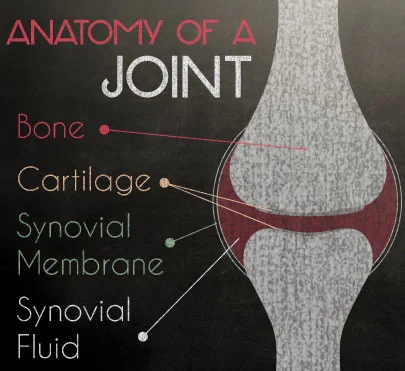
The first stage of osteoarthritis involves inflammation and damage to cells called chondrocytes. These cells are located in the joints and are responsible for maintaining the cartilage. This cartilage is what allows the joints to move without allowing the bone to rub directly against other bones.
Damage also occurs to the synovial cells, which are responsible for the synovial fluid that lubricates the joint. Without either of these cells, the joints simply would not be able to move freely and painlessly as is necessary for movement! In the presence of inflammatory factors, both the chondrocytes and synovial cells begin releasing even more inflammatory cytokines subsequently furthering the process. Factors such as IL-1, TNF-alpha, iNOS, PGE2, 5-LOX, NF-kB, and increased catabolic activity in the joint work off each other in a highly complex process resulting in osteoarthritis as we know it. Free radical damage produced as byproducts of this inflammation damages the cartilage and synovial cells further. This is why treating these inflammatory pathways as well as directly improving the chondrocytes and synovial cells are the most effective in the long term and preventative treatment of arthritis. It actually treats the cause of the arthritis, and only reduces pain as a sort of beneficial “side effect”. 1Reference 1Principles and Practice of Phytotherapy (2nd ed.).
Topical Treatments
One of the oldest methods of relieving arthritis was with the use of “rubefacient” botanicals. A rubefacient is a topical substance that causes mild reddening and warming of the skin by increasing local blood flow — the same mechanism behind the warm, tingling feel of a mustard plaster or a menthol rub. That extra local circulation is thought to help clear inflammatory byproducts from the area and ease the sensation of joint pain, though the effect is local and short-lived rather than disease-modifying. This approach is really only appropriate for osteoarthritis; it should not be relied on for rheumatoid arthritis, which is a distinct autoimmune condition.
Rubefacient Herbs to Use Topically
Evidence note: capsaicin cream is the one rubefacient here with genuine randomised-trial support — a 2024 systematic review and meta-analysis of eight double-blind RCTs (498 patients) found topical capsaicin (0.0125–5%) modestly reduced osteoarthritis pain versus placebo, though the certainty of evidence was rated low-to-very-low and burning at the application site was common 5Reference 5Meta-analysisEfficacy and safety of topical capsaicin in the treatment of osteoarthritis pain: a systematic review and meta-analysis. The others below (mustard, wintergreen) are traditional rubefacients with far less direct clinical testing for arthritis specifically.
Cayenne (Capsaicin)
Cayenne pepper (Capsicum annuum) owes its heat, and its rubefacient effect, to capsaicin. Applied repeatedly to the skin, capsaicin first stimulates and then desensitises the local pain-signalling nerve fibres (TRPV1 receptors), which is the likely mechanism behind its pain-relieving effect in osteoarthritis. It’s sold as an over-the-counter cream in concentrations from 0.025% up to the prescription-strength 8% patch, and is generally applied several times a day for at least a week before benefits are noticed. Expect a burning or stinging sensation, especially with the first few applications — wash hands thoroughly after use and keep it away from eyes and mucous membranes.
Wintergreen
Wintergreen (Gaultheria procumbens) essential oil is rich in methyl salicylate, a compound closely related to the salicylates in willow bark (see below). Rubbed into the skin, it produces a warming, penetrating sensation and has long been used in liniments for sore joints and muscles. It should always be diluted in a carrier oil, and — because it’s chemically related to aspirin — avoided by anyone with a salicylate allergy or who is already taking blood thinners or aspirin.
Mustard
Mustard seed (Brassica spp.), ground and made into a paste or plaster, is one of the oldest folk rubefacients, traditionally applied to sore joints and chests to draw blood to the area and ease stiffness. The heat comes from allyl isothiocyanate, released when the seed is crushed and moistened. It’s a strong traditional remedy but a poorly studied one in modern clinical terms, and can blister the skin if left on too long.
Other Herbs to use Topically for Arthritis:
Birch
Regarding topical pain relievers, essential oils are often the most effective, especially in stubborn arthritic pain. Birch essential oil is my personal favourite, which contains the powerful pain killing salicylates. This is the chemical that aspirin was derived from. The best way to apply birch essential oil is mixed in with a carrier oil or in the form of a salve. Other essential oils such as peppermint, eucalyptus, and citrus oils can also help relieve pain from arthritic joints. See willow below for a deeper discussion on the effects of salycilates.
Frankincense
Frankincense (Boswellia serrata) is one of the more promising herbs for the specific inflammatory cascade associated with osteoarthritis, and unlike many herbs in this article it has real clinical-trial backing.
It inhibits 5-LOX, while only delivering a minor inhibition of PGE2 production. It down regulates TNF-Alpha through an inhibition of NF-kB, and Inhibits IL-1.
Evidence note: this isn’t just a plausible mechanism — several small randomised, placebo-controlled trials in knee osteoarthritis have found standardised Boswellia extracts reduce pain and improve function, and a pooled analysis of seven trials (545 patients) reported a positive effect on pain, stiffness, and joint function 6Reference 6RCTA pilot, randomized, double-blind, placebo-controlled trial to assess the safety and efficacy of a novel Boswellia serrata extract in the management of osteoarthritis of the knee. This puts frankincense among the better-supported herbs here, though sample sizes remain modest and standardisation between products varies. 1Reference 1Principles and Practice of Phytotherapy (2nd ed.)
You may also take frankincense extracts (I do not mean essential oils!) internally for a similar result.
Stinging Nettle
Stinging nettle (Urtica dioica) is used topically for arthritis in a process referred to as “urtication”. This basically involves rubbing the leaves over the joint, which allows the stinging hairs on the leaves to penetrate the skin.
Evidence note: this has actually been tested — a randomised, double-blind crossover trial in 27 people with osteoarthritis of the thumb or index finger found that a week of daily nettle-leaf application significantly reduced pain and disability scores compared with a placebo leaf 7Reference 7RCTRandomized controlled trial of nettle sting for treatment of base-of-thumb pain. It’s a small trial, but a genuine controlled human result rather than folklore alone.
Some people even grow a small nettle plant in their house and pluck a leaf from it from time to time to run over the joint. Nettle leaf is also traditionally used for the inflammation of arthritis when taken daily as a tea, though the tea itself hasn’t been tested the way the leaf-sting application has. Read more about stinging nettle.
Cannabis
Cannabis, and specifically cannabidiol (CBD), is widely marketed for arthritic pain, and topical cannabis salves and infused oils are popular for this use. The oils and waxes in a salve base help the cannabinoids stay in contact with the skin longer, which may extend how long an application lasts.
Evidence note: this is one of the weaker-supported entries in this article despite the popularity. Good-quality human trials of topical CBD specifically for osteoarthritis are still scarce, and much of the mechanistic and analgesic evidence comes from animal models or from oral/systemic cannabinoid studies in other pain conditions, not topical arthritis-specific human trials. Treat topical cannabis as a traditional and popular option with a plausible mechanism, not yet a proven one.
Cannabis extracts, especially those high in CBD, are also used internally via liquid extracts, tablets, or capsules — again with the same caveat about the current state of the human evidence.
Internal Treatments
Along with the topical treatments, it is highly beneficial to treat alongside with internal treatments. This way, the pain relieving, and anti-arthritis chemicals can circulate throughout the body, and reach deeper levels than the topical treatments can reach alone. Not only that, but it may be difficult or unreasonable to apply topical treatments every couple of hours throughout the day. Things like work, sleep, application issues may prevent one from being able to apply the topical treatment at any given time. Using internal anti-inflammatory, and pain relieving botanicals can help to stretch the length of time one is able to wait in between treatments topically.
Try these herbs internally alongside the topical treatments:
Turmeric
Turmeric (Curcuma longa) is one of the main ingredients in curry. It is a systemic anti-inflammatory with a long history of traditional use for joint pain, and — unusually for herbs on this list — that traditional reputation is now backed by a genuine body of clinical trial evidence. This herb should be taken in supplemental form over the long term to really reap its pain-relieving benefits, and it’s worth noting curcumin is poorly absorbed on its own, so look for formulations paired with piperine (black pepper extract) or a bioavailability-enhanced form.
It appears to work mainly through the constituent curcumin, which has been shown to inhibit the activation of the inflammatory transcription factor NF-kB. It also reduces the activity of COX-2, LOX, and iNOS through direct transcription pathways rather than by inhibiting the enzyme after it has been produced 2Reference 2In vitroCurcumin as a therapeutic agent: the evidence from in vitro, animal and human studies.
Evidence note: a 2021 systematic review and meta-analysis pooling roughly eight randomised controlled trials (800+ participants, mostly knee osteoarthritis) found turmeric/curcumin extract (around 1000 mg/day of curcumin) reduced pain and improved function versus placebo, with a good short-term safety profile — though it’s generally less effective than standard NSAIDs like ibuprofen 8Reference 8Meta-analysisThe efficacy of high- and low-dose curcumin in knee osteoarthritis: a systematic review and meta-analysis.
Willow Bark
Willow (Salix alba) bark contains the chemical salicylic acid. This molecule is often referred to as “natural aspirin” because it is in fact the chemical that led to the creation of aspirin (acetyl-salicylic acid).
In a similar fashion to aspirin, the naturally formed salicylic acid is proposed to reduce the inflammatory molecule PGE2 by inhibiting the expression of COX-2 at the level of gene transcription 3Reference 3Transcription-based COX-2 inhibition: a therapeutic strategy. This would make it more targeted than inhibition of the enzyme after it has already been formed.
Salicylic acid from willow bark differs from aspirin in that it does not have quite the same effect on the COX-1 pathway, which has been associated with the development of gastric ulcers, one of the major side effects of aspirin 1Reference 1Principles and Practice of Phytotherapy (2nd ed.).
Evidence note: the human data are genuinely mixed. A meta-analysis pooling five RCTs (229 arthritis patients) found willow bark extract modestly outperformed placebo for pain, but rated the evidence quality “very low” 9Reference 9Meta-analysisWillow bark (Salix spp.) used for pain relief in arthritis: a meta-analysis of randomized controlled trials. Individual trials disagree even more sharply — one small 2-week trial showed a real benefit over placebo, while a larger, more rigorous 6-week trial found willow bark extract no better than placebo, with the diclofenac comparison arm the only one to show a clear effect 9Reference 9Meta-analysisWillow bark (Salix spp.) used for pain relief in arthritis: a meta-analysis of randomized controlled trials. Read willow bark as “possibly helpful, weakly supported” rather than a proven analgesic.
St. Johns Wort
St. Johns Wort (Hypericum perforatum) has many uses, namely depression and anxiety or neuralgic pain. It contains two main compounds of interest, and it’s worth being precise about which does what: hyperforin is the constituent most linked to the herb’s antidepressant activity, largely through inhibiting the reuptake of serotonin and other monoamines, while hypericin is better known for its photosensitizing effect (it can make skin more reactive to sunlight) and has separately drawn research interest for antiviral and anti-inflammatory activity.
When it comes to managing osteoarthritis, the compound implicated is hyperforin, not hypericin.
Hyperforin has been found to inhibit 5-LOX — a novel, non-redox mechanism distinct from older 5-LOX inhibitors — which, as mentioned earlier, is a primary pathway implicated in osteoarthritic inflammation. This has so far been demonstrated in animal and lab studies, not confirmed in human osteoarthritis trials 4Reference 4AnimalHyperforin is a novel type of 5-lipoxygenase inhibitor with high efficacy in vivo.
A whole-plant extract of St. Johns wort has also been reported to inhibit COX-2, which would reduce the inflammatory molecule PGE2 — again, evidence here is preclinical rather than from clinical trials in arthritis patients 1Reference 1Principles and Practice of Phytotherapy (2nd ed.).
Devils Claw
Devils claw (Harpagophytum procumbens) is native to the African savannah, specifically the Kalahari region of South Africa, Namibia, and Botswana 1Reference 1Principles and Practice of Phytotherapy (2nd ed.).
This plant is traditionally used for osteoarthritic pain and inflammation, and is reported to be useful both internally and applied externally.
Similarly to many of the other herbs useful for osteoarthritis, it is proposed to inhibit COX-2 through a distinct mechanism from aspirin, with a comparable analgesic effect reported in some trials 1Reference 1Principles and Practice of Phytotherapy (2nd ed.).
Evidence note: devil’s claw has a reasonably supportive trial record for a herbal analgesic — systematic reviews report moderate evidence of benefit for osteoarthritic pain at doses delivering 50–100 mg of harpagoside per day, with several trials showing effects comparable to low-dose NSAID comparators and a good short-term safety profile relative to NSAIDs 10Reference 10Systematic reviewDevil’s claw (Harpagophytum procumbens) for osteoarthritis and low back pain: a systematic review. As with most of the herbs here, individual trial quality varies and larger confirmatory studies would help.
Summary
Managing osteoarthritis can be tough, but is not impossible. Most of the treatment will involve pain management, and reducing the inflammatory factors 5-LOX and COX-2.
Improving the health of the chondrocytes, and synovial fluid by consuming a healthy intake of omega-3 and omega-6 fatty acids, as well as sufficient but not excessive exercise will also go a long way in treating and preventing this condition successfully.
References
- Bone, K., & Mills, S. (2013). Principles and Practice of Phytotherapy (2nd ed.). Elsevier. (pp. 557–565).
- Epstein, J., Sanderson, I. R., & MacDonald, T. T. (2010). Curcumin as a therapeutic agent: the evidence from in vitro, animal and human studies. British Journal of Nutrition, 103(11), 1545–1557. Link
- Wu, K. K. (2006). Transcription-based COX-2 inhibition: a therapeutic strategy. Thrombosis and Haemostasis, 95(4), 417–422. Link
- Feißt, C., Pergola, C., Rakonjac, M., Rossi, A., Koeberle, A., Dodt, G., et al. (2009). Hyperforin is a novel type of 5-lipoxygenase inhibitor with high efficacy in vivo. Cellular and Molecular Life Sciences, 66(16), 2759–2771. Link
- Persson, M. S. M., et al. (2024). Efficacy and safety of topical capsaicin in the treatment of osteoarthritis pain: a systematic review and meta-analysis. Phytotherapy Research. Link
- Yu, G., et al. (2019). A pilot, randomized, double-blind, placebo-controlled trial to assess the safety and efficacy of a novel Boswellia serrata extract in the management of osteoarthritis of the knee. Phytotherapy Research. Link
- Randall, C., Randall, H., Dobbs, F., Hutton, C., & Sanders, H. (2000). Randomized controlled trial of nettle sting for treatment of base-of-thumb pain. Journal of the Royal Society of Medicine, 93(6), 305–309. Link
- Wang, Z., et al. (2021). The efficacy of high- and low-dose curcumin in knee osteoarthritis: a systematic review and meta-analysis. Advances in Nutrition. Link
- Bonaterra, G. A., et al. (2023). Willow bark (Salix spp.) used for pain relief in arthritis: a meta-analysis of randomized controlled trials. Link
- Gagnier, J. J., et al. (2007). Devil’s claw (Harpagophytum procumbens) for osteoarthritis and low back pain: a systematic review. BMC Complementary and Alternative Medicine, 7, 11. Link
Justin Cooke
Clinical herbalist and the writer behind The Sunlight Experiment — an evidence-based pharmacopoeia of herbs, supplements, and the chemistry behind them.