
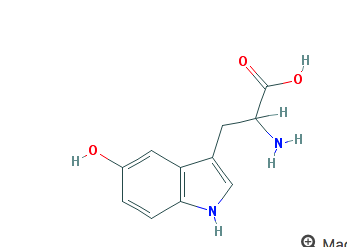
Supplement Monograph
5-HTP
The direct precursor to serotonin — a serotonergic amino acid supplement used for mood, appetite and sleep, usually extracted from Griffonia simplicifolia seeds.
Where Does It Come From? (3)
Pharmacology & Research
5-HTP (5-hydroxy-L-tryptophan, oxitriptan) is a non-proteinogenic amino acid that sits one enzymatic step downstream of tryptophan and one step upstream of serotonin. Because it bypasses tryptophan hydroxylase — the rate-limiting enzyme in serotonin synthesis — and is not diverted into protein or niacin, oral 5-HTP raises central serotonin more reliably than tryptophan does 1,10Reference 1ReviewMaffei, M. E. (2020). 5-Hydroxytryptophan (5-HTP): Natural Occurrence, Analysis, Biosynthesis, Biotechnology, Physiology and Toxicology — review. Int J Mol Sci. https://pubmed.ncbi.nlm.nih.gov/33375373/View study →Reference 10ReviewBirdsall, T. C. (1998). 5-Hydroxytryptophan: a clinically-effective serotonin precursor — review. Altern Med Rev. https://pubmed.ncbi.nlm.nih.gov/9727088/View study →. The evidence posture is best described as promising but thin: several small randomised trials point the right way for mood, appetite and fibromyalgia, but almost none are large, independently replicated, or long. Unlike a vitamin or mineral, 5-HTP corrects no dietary deficiency — it is a pharmacologically active serotonergic agent taken on top of a normal diet, so the relevant question is efficacy and safety, not repletion. Two practical caveats dominate: nausea is dose-limiting, and 5-HTP must never be combined with SSRIs, SNRIs, MAOIs, triptans or other serotonergic drugs because of serotonin-syndrome risk.
- Best-supported: Short-term antidepressant effect in small RCTs — a Cochrane review found 5-HTP/tryptophan beat placebo (pooled OR 4.10) but judged the evidence too low-quality to recommend 2Reference 2Systematic reviewTryptophan and 5-hydroxytryptophan for depression — systematic review (Cochrane)View study →; a 2025 RCT in older adults also improved depression scores 7Reference 7RCTThe Impact of 5-Hydroxytryptophan Supplementation on Cognitive Function and Mood in Singapore Older Adults — randomised controlled trialView study →.
- Emerging / cautiously endorsed: Appetite suppression and modest weight loss in obese subjects 3,4Reference 3RCTEating behavior and adherence to dietary prescriptions in obese adult subjects treated with 5-hydroxytryptophan — randomised controlled trialView study →Reference 4RCTEffects of 5-hydroxytryptophan on eating behavior and adherence to dietary prescriptions in obese adult subjects — randomised controlled trialView study →, and symptom relief in primary fibromyalgia from a single 50-patient trial 5Reference 5RCTDouble-blind study of 5-hydroxytryptophan versus placebo in the treatment of primary fibromyalgia syndrome — randomised controlled trialView study →.
- Popular but thin / overhyped: Sleep and cognitive-enhancement claims rest largely on mechanism and one small single-blind study 7Reference 7RCTThe Impact of 5-Hydroxytryptophan Supplementation on Cognitive Function and Mood in Singapore Older Adults — randomised controlled trialView study →; direct sleep RCTs are scarce, and most consumer marketing outruns the trial evidence.
- The honest miss / caveat: A well-powered multicentre RCT (n=166) found 5-HTP no better than placebo for fatigue in inflammatory bowel disease despite clearly raising serum serotonin — a reminder that raising serotonin does not guarantee a clinical effect 8Reference 8RCTEffect of 5-Hydroxytryptophan on Fatigue in Quiescent Inflammatory Bowel Disease — multicentre randomised controlled trialView study →.
1. Depression & low mood
5-HTP is the most-studied use. A Cochrane systematic review screened 108 trials of 5-HTP and tryptophan but found only two of sufficient quality (combined n=64); pooled, the compounds beat placebo at relieving depression (Peto OR 4.10, 95% CI 1.28–13.15; NNT ≈ 2.8), yet the reviewers judged the evidence too weak to support routine use given that proven antidepressants exist 2Reference 2Systematic reviewTryptophan and 5-hydroxytryptophan for depression — systematic review (Cochrane)View study →. Pöldinger’s 1991 paper, framed around a “serotonin-deficiency” model of depression, compared 5-HTP with the SSRI fluvoxamine; it is cited as reporting broadly comparable outcomes, though the published abstract reads as a conceptual essay rather than a fully reported trial 6Reference 6RCTA functional-dimensional approach to depression: serotonin deficiency as a target syndrome in a comparison of 5-hydroxytryptophan and fluvoxamine — randomised trialView study →. Most recently, a 2025 single-blind RCT in Singaporean older adults (n=30, 100 mg/day, 12 weeks) reported improved Geriatric Depression Scale scores alongside rising serum serotonin 7Reference 7RCTThe Impact of 5-Hydroxytryptophan Supplementation on Cognitive Function and Mood in Singapore Older Adults — randomised controlled trialView study →. All trials are small, short, and several are decades old.
Gap: No large, modern, independently replicated RCT; efficacy relative to standard antidepressants and durability beyond a few months remain unproven.
2. Appetite & weight loss
In a double-blind crossover trial, 20 obese adults given 900 mg/day 5-HTP lost significant weight over two 6-week periods, ate less carbohydrate and reported early satiety, both with and without a prescribed diet 3Reference 3RCTEating behavior and adherence to dietary prescriptions in obese adult subjects treated with 5-hydroxytryptophan — randomised controlled trialView study →; an earlier trial from the same Rome group showed similar anorectic effects 4Reference 4RCTEffects of 5-hydroxytryptophan on eating behavior and adherence to dietary prescriptions in obese adult subjects — randomised controlled trialView study →. A small fMRI study later linked 5-HTP to shifts in food selection 15Reference 15Preliminary fMRI findings concerning the influence of 5-HTP on food selectionView study →. The effect is biologically plausible (serotonin signals satiety), but the human data come almost entirely from one laboratory, use high doses that provoke nausea, and are short.
Gap: Independent replication and longer trials are lacking; the doses studied (up to 900 mg/day) sit well above typical supplement labels and frequently cause GI side effects.
3. Fibromyalgia
A 1990 double-blind, placebo-controlled trial in 50 patients with primary fibromyalgia found that 5-HTP significantly improved all measured clinical parameters (pain, tender points, sleep, anxiety, fatigue) with only mild, transient side effects 5Reference 5RCTDouble-blind study of 5-hydroxytryptophan versus placebo in the treatment of primary fibromyalgia syndrome — randomised controlled trialView study →. The rationale — low serotonergic tone in fibromyalgia — is consistent with the broader serotonin-pathway literature. This remains a single small trial, and later Cochrane work on combination pharmacotherapy for fibromyalgia treated the evidence base as insufficient 16Reference 16Systematic reviewCombination pharmacotherapy for the treatment of fibromyalgia in adults — systematic review (Cochrane)View study →.
Gap: One unreplicated 50-patient study cannot establish efficacy; no modern trial has confirmed it.
4. Migraine & headache
5-HTP has been trialled as a headache/migraine preventive since the 1970s, and it still appears in evidence-based reviews of migraine prophylaxis 14Reference 14ReviewEvidence-based medicine in migraine prevention — reviewView study →. The results are mixed and less consistent than for depression, and much of the supporting literature predates modern trial standards; in paediatric migraine, systematic-review evidence for prophylactic agents in general is weak 17Reference 17Systematic reviewDrugs for preventing migraine headaches in children — systematic review (Cochrane)View study →. This application rests on dated, heterogeneous data rather than a clear modern signal.
Gap: Evidence is dated and heterogeneous; no recent placebo-controlled trial supports 5-HTP as a first-line migraine preventive.
5. Sleep & insomnia
The rationale is strong on paper — serotonin is the metabolic precursor of melatonin, so raising 5-HTP could support sleep onset 1,10Reference 1ReviewMaffei, M. E. (2020). 5-Hydroxytryptophan (5-HTP): Natural Occurrence, Analysis, Biosynthesis, Biotechnology, Physiology and Toxicology — review. Int J Mol Sci. https://pubmed.ncbi.nlm.nih.gov/33375373/View study →Reference 10ReviewBirdsall, T. C. (1998). 5-Hydroxytryptophan: a clinically-effective serotonin precursor — review. Altern Med Rev. https://pubmed.ncbi.nlm.nih.gov/9727088/View study →. In practice, direct randomised sleep-outcome trials of 5-HTP alone are scarce, and most consumer sleep products combine it with GABA, melatonin or magnesium, making the independent contribution of 5-HTP hard to isolate.
Gap: Almost no rigorous stand-alone RCT data on sleep latency or quality; the claim is mechanistic more than demonstrated.
6. Cognitive function
The 2025 Singapore RCT (n=30, 100 mg/day, 12 weeks, single-blind, no-treatment control) found a significant within-group rise in Montreal Cognitive Assessment (MoCA) score in the 5-HTP arm, alongside increased serum serotonin 7Reference 7RCTThe Impact of 5-Hydroxytryptophan Supplementation on Cognitive Function and Mood in Singapore Older Adults — randomised controlled trialView study →. The study is small, single-blind, unblinded-control, and the authors explicitly urge cautious interpretation.
Gap: A single small preliminary trial; blinding and control design are weak, and no replication exists.
Mechanisms
| Target / pathway | Effect | Relevant to |
|---|---|---|
| Tryptophan hydroxylase (TPH1/TPH2) rate-limiting step | Bypassed — 5-HTP is downstream, so it lifts serotonin synthesis without this bottleneck | All applications 1Reference 1ReviewMaffei, M. E. (2020). 5-Hydroxytryptophan (5-HTP): Natural Occurrence, Analysis, Biosynthesis, Biotechnology, Physiology and Toxicology — review. Int J Mol Sci. https://pubmed.ncbi.nlm.nih.gov/33375373/View study → |
| Aromatic L-amino acid decarboxylase (AADC) | Converts 5-HTP → serotonin (vitamin B6/PLP-dependent) | Serotonin production; B6 as cofactor 1Reference 1ReviewMaffei, M. E. (2020). 5-Hydroxytryptophan (5-HTP): Natural Occurrence, Analysis, Biosynthesis, Biotechnology, Physiology and Toxicology — review. Int J Mol Sci. https://pubmed.ncbi.nlm.nih.gov/33375373/View study → |
| Blood–brain barrier | Crosses without a transporter; not competed by other amino acids | CNS serotonin, mood, sleep 10Reference 10ReviewBirdsall, T. C. (1998). 5-Hydroxytryptophan: a clinically-effective serotonin precursor — review. Altern Med Rev. https://pubmed.ncbi.nlm.nih.gov/9727088/View study → |
| Serotonin → melatonin pathway | Downstream conversion in pineal gland | Sleep 1Reference 1ReviewMaffei, M. E. (2020). 5-Hydroxytryptophan (5-HTP): Natural Occurrence, Analysis, Biosynthesis, Biotechnology, Physiology and Toxicology — review. Int J Mol Sci. https://pubmed.ncbi.nlm.nih.gov/33375373/View study → |
| Peripheral decarboxylation | Serotonin formed in gut/periphery drives nausea; blocked by carbidopa | Side effects, tolerability 11Reference 11RCTPharmacology of rising oral doses of 5-hydroxytryptophan with carbidopa — randomised crossover trialView study → |
Pharmacokinetics
5-HTP is well absorbed orally — roughly 70% reaches the bloodstream — and absorption does not depend on an amino-acid transporter, so it can be taken with food without losing effect 10Reference 10ReviewBirdsall, T. C. (1998). 5-Hydroxytryptophan: a clinically-effective serotonin precursor — review. Altern Med Rev. https://pubmed.ncbi.nlm.nih.gov/9727088/View study →. It crosses the blood–brain barrier freely. The plasma half-life is short, on the order of ~2–4 hours, and pharmacokinetics follow a one-compartment model with a mean oral clearance near 28 L/h and substantial between-person variability 11Reference 11RCTPharmacology of rising oral doses of 5-hydroxytryptophan with carbidopa — randomised crossover trialView study →. Much of an oral dose is decarboxylated to serotonin in the periphery before reaching the brain; co-administering a peripheral decarboxylase inhibitor (carbidopa) raises central delivery and cuts nausea, and is standard in research challenge tests 11Reference 11RCTPharmacology of rising oral doses of 5-hydroxytryptophan with carbidopa — randomised crossover trialView study →. Because peripheral conversion drives GI side effects, dropout climbs steeply with dose — roughly 7% at 100 mg but ~46% at 300 mg in one challenge study 11Reference 11RCTPharmacology of rising oral doses of 5-hydroxytryptophan with carbidopa — randomised crossover trialView study → — which is the practical case for starting low, splitting doses, and taking with food.
Clinical trials
A ClinicalTrials.gov search on the intervention “5-hydroxytryptophan / 5-HTP” returns 42 registered studies, mostly small and investigator-initiated; as an old, off-patent, low-cost molecule, 5-HTP attracts little industry-funded trial investment, and no large phase-III programme exists. Recent registered work includes mood/cognition and body-composition trials.
| Completed | Recruiting / planned | Terminated | Other (unknown/suspended) |
|---|---|---|---|
| 30 | 6 | 3 | 3 |
Counts from ClinicalTrials.gov intervention search; last checked: July 2026.
Dietary Sources
5-HTP is an intermediate metabolite, not a dietary nutrient, so it is essentially absent from food in meaningful amounts — the body makes its own from tryptophan, and there is no “eat more of X to get 5-HTP” analogue. What food can supply is its precursor, tryptophan, found in protein-rich foods (poultry, eggs, dairy, fish, soy, nuts and seeds), but dietary tryptophan is heavily diverted into protein synthesis and the kynurenine pathway, and only a small fraction becomes serotonin.
The one notable natural source of 5-HTP itself is the seed of the West African legume Griffonia simplicifolia, whose seeds contain roughly 1–3% 5-HTP by weight — this is where nearly all commercial supplement material is extracted from 1Reference 1ReviewMaffei, M. E. (2020). 5-Hydroxytryptophan (5-HTP): Natural Occurrence, Analysis, Biosynthesis, Biotechnology, Physiology and Toxicology — review. Int J Mol Sci. https://pubmed.ncbi.nlm.nih.gov/33375373/View study →. Some 5-HTP is also produced by chemical or enzymatic/microbial synthesis. Because 5-HTP is not obtainable from a normal diet, supplementation is the only practical way to raise intake, which is precisely why it is sold as a supplement rather than recommended as a food component.
Dosage
These are doses studied in research, not a personal recommendation. 5-HTP is not an essential nutrient, so there is no RDA/AI and no established Tolerable Upper Intake Level.
- Typical supplemental range: 50–300 mg/day, often divided. Mood and cognition trials have commonly used 100 mg/day 7Reference 7RCTThe Impact of 5-Hydroxytryptophan Supplementation on Cognitive Function and Mood in Singapore Older Adults — randomised controlled trialView study →, while older appetite/weight trials used much higher doses — up to 900 mg/day — which more often provoke nausea 3Reference 3RCTEating behavior and adherence to dietary prescriptions in obese adult subjects treated with 5-hydroxytryptophan — randomised controlled trialView study →.
- Titration: Because peripheral conversion to serotonin drives GI upset, dropout rises sharply with dose (≈7% at 100 mg vs ≈46% at 300 mg in a challenge study) 11Reference 11RCTPharmacology of rising oral doses of 5-hydroxytryptophan with carbidopa — randomised crossover trialView study →. Starting low (50–100 mg), splitting doses, and taking with food improves tolerability.
- Timing: For sleep, doses are usually taken in the evening; unlike tryptophan, absorption is not blocked by dietary amino acids, so it can be taken with meals 10Reference 10ReviewBirdsall, T. C. (1998). 5-Hydroxytryptophan: a clinically-effective serotonin precursor — review. Altern Med Rev. https://pubmed.ncbi.nlm.nih.gov/9727088/View study →.
- Cofactors: Vitamin B6 (as pyridoxal-5-phosphate) is the cofactor for the decarboxylation of 5-HTP to serotonin and is often co-supplemented; magnesium is frequently paired for sleep formulas.
Safety
At typical supplemental doses 5-HTP is usually well tolerated, and decades of widespread use have produced no clear pattern of serious organ toxicity 9Reference 9ReviewSafety of 5-hydroxy-L-tryptophan — reviewView study →. The most common adverse effects are gastrointestinal — nausea, and less often vomiting, diarrhoea and abdominal discomfort — which are dose-dependent and are the main reason people stop 11Reference 11RCTPharmacology of rising oral doses of 5-hydroxytryptophan with carbidopa — randomised crossover trialView study →. Drowsiness can also occur.
- Serotonin syndrome (the key interaction): 5-HTP raises serotonin, so combining it with SSRIs, SNRIs, MAOIs, tricyclics, triptans, tramadol, dextromethorphan, St John’s Wort or other serotonergic agents can cause potentially dangerous serotonin excess (agitation, tremor, hyperthermia, autonomic instability). These combinations should be avoided unless supervised by a clinician.
- Peri-operative caution: Because of serotonergic interactions with some anaesthetic agents, 5-HTP is generally stopped before scheduled surgery.
- The EMS / “Peak X” question: In 1989 an epidemic of eosinophilia-myalgia syndrome (EMS) was traced to a contaminated batch of synthetic L-tryptophan from a single manufacturer — not to tryptophan itself. Trace contaminants (“Peak X”) have subsequently been detected in some commercial 5-HTP samples, raising theoretical concern 12,13Reference 12Structural characterization of a case-implicated contaminant, “Peak X,” in commercial preparations of 5-hydroxytryptophanView study →Reference 13Eosinophilia-myalgia syndrome case-associated contaminants in commercially available 5-hydroxytryptophanView study →. However, no confirmed EMS epidemic has been attributed to 5-HTP despite decades of use, and detailed safety analyses have found the contaminant levels to be minute and of doubtful clinical significance 9Reference 9ReviewSafety of 5-hydroxy-L-tryptophan — reviewView study →. The prudent reading: buy from reputable, tested sources, but the historical alarm is largely a tryptophan story, not a 5-HTP one.
Pregnancy & lactation
Verdict: avoid unless directed by a clinician. There is insufficient safety data on 5-HTP in pregnancy or breastfeeding, and its serotonergic activity plus theoretical contaminant concerns make caution the responsible default. This should not be used during pregnancy or lactation without medical supervision.
References
- Maffei, M. E. (2020). 5-Hydroxytryptophan (5-HTP): Natural Occurrence, Analysis, Biosynthesis, Biotechnology, Physiology and Toxicology — review. Int J Mol Sci. https://pubmed.ncbi.nlm.nih.gov/33375373/
- Shaw, K., Turner, J., & Del Mar, C. (2002). Tryptophan and 5-hydroxytryptophan for depression — systematic review (Cochrane). Cochrane Database Syst Rev. https://pubmed.ncbi.nlm.nih.gov/11869656/
- Cangiano, C., et al. (1992). Eating behavior and adherence to dietary prescriptions in obese adult subjects treated with 5-hydroxytryptophan — randomised controlled trial. Am J Clin Nutr. https://pubmed.ncbi.nlm.nih.gov/1384305/
- Cangiano, C., et al. (1991). Effects of 5-hydroxytryptophan on eating behavior and adherence to dietary prescriptions in obese adult subjects — randomised controlled trial. Adv Exp Med Biol. https://pubmed.ncbi.nlm.nih.gov/1722953/
- Caruso, I., Sarzi Puttini, P., Cazzola, M., & Azzolini, V. (1990). Double-blind study of 5-hydroxytryptophan versus placebo in the treatment of primary fibromyalgia syndrome — randomised controlled trial. J Int Med Res. https://pubmed.ncbi.nlm.nih.gov/2193835/
- Pöldinger, W., Calanchini, B., & Schwarz, W. (1991). A functional-dimensional approach to depression: serotonin deficiency as a target syndrome in a comparison of 5-hydroxytryptophan and fluvoxamine — randomised trial. Psychopathology. https://pubmed.ncbi.nlm.nih.gov/1909444/
- Li, S., Sutanto, C. N., Xia, X., & Kim, J. E. (2025). The Impact of 5-Hydroxytryptophan Supplementation on Cognitive Function and Mood in Singapore Older Adults — randomised controlled trial. Nutrients. https://pubmed.ncbi.nlm.nih.gov/40944161/
- Truyens, M., et al. (2022). Effect of 5-Hydroxytryptophan on Fatigue in Quiescent Inflammatory Bowel Disease — multicentre randomised controlled trial. Gastroenterology. https://pubmed.ncbi.nlm.nih.gov/35940251/
- Das, Y. T., Bagchi, M., Bagchi, D., & Preuss, H. G. (2004). Safety of 5-hydroxy-L-tryptophan — review. Toxicol Lett. https://pubmed.ncbi.nlm.nih.gov/15068828/
- Birdsall, T. C. (1998). 5-Hydroxytryptophan: a clinically-effective serotonin precursor — review. Altern Med Rev. https://pubmed.ncbi.nlm.nih.gov/9727088/
- Smarius, L. J., et al. (2008). Pharmacology of rising oral doses of 5-hydroxytryptophan with carbidopa — randomised crossover trial. J Psychopharmacol. https://pubmed.ncbi.nlm.nih.gov/18308795/
- Williamson, B. L., et al. (2003). Structural characterization of a case-implicated contaminant, “Peak X,” in commercial preparations of 5-hydroxytryptophan. J Rheumatol. https://pubmed.ncbi.nlm.nih.gov/12508395/
- Klein-Schwartz, W. (1999). Eosinophilia-myalgia syndrome case-associated contaminants in commercially available 5-hydroxytryptophan. Adv Exp Med Biol. https://pubmed.ncbi.nlm.nih.gov/10721089/
- Yoon, M. S., Savidou, I., Diener, H. C., & Limmroth, V. (2005). Evidence-based medicine in migraine prevention — review. Expert Rev Neurother. https://pubmed.ncbi.nlm.nih.gov/15938666/
- Wyckoff, E. P., et al. (2017). Preliminary fMRI findings concerning the influence of 5-HTP on food selection. Brain Behav. https://pubmed.ncbi.nlm.nih.gov/28127513/
- Thorpe, J., et al. (2018). Combination pharmacotherapy for the treatment of fibromyalgia in adults — systematic review (Cochrane). Cochrane Database Syst Rev. https://pubmed.ncbi.nlm.nih.gov/29457627/
- Victor, S., & Ryan, S. W. (2003). Drugs for preventing migraine headaches in children — systematic review (Cochrane). Cochrane Database Syst Rev. https://pubmed.ncbi.nlm.nih.gov/14583952/