
Supplement Monograph
Caffeine
Caffeine is perhaps the most popular stimulant in the world. It's contained within 3 of the most popular beverages the world has ever seen; coffee, tea, and yerba maté.
Where Does It Come From? (8)
Pharmacology & Research
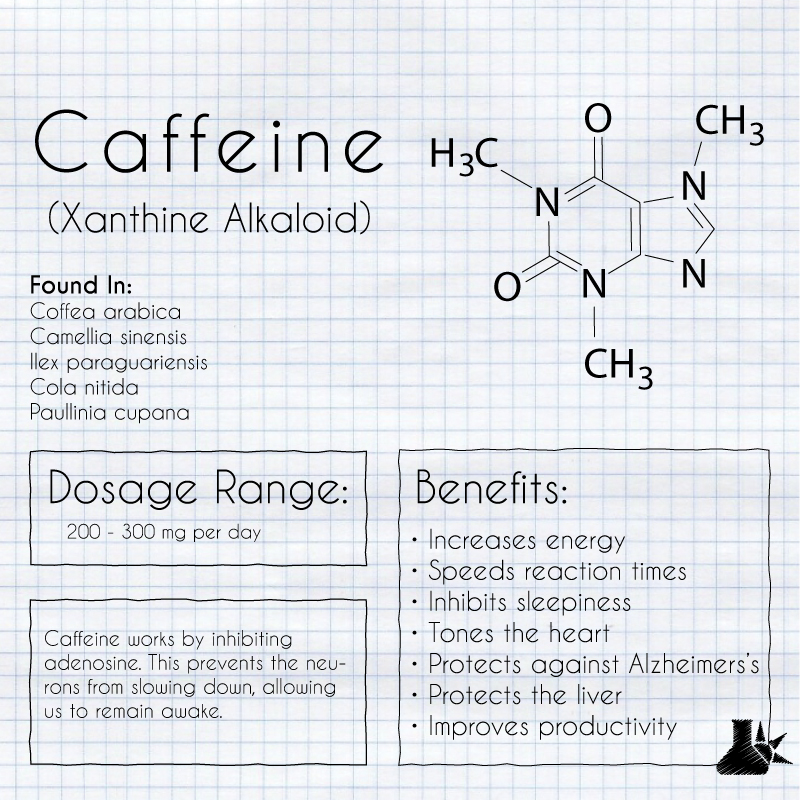
Caffeine (1,3,7-trimethylxanthine) is a purine alkaloid of the methylxanthine class and the most widely consumed psychoactive substance in the world. Unlike most supplements, its core effects are not in dispute — competitive antagonism of adenosine receptors reliably raises alertness, blunts fatigue, and improves physical performance — so the evidence question is less “does it work” than “for what, how much, and at what cost.” The clearest wins are in exercise (endurance and, to a lesser degree, strength/power) and in restoring performance degraded by sleep loss; several widely marketed uses (fat loss, cognitive enhancement in already-rested people) are real but small. Two caveats run through everything below: much of caffeine’s apparent daily “boost” in habitual users is partly reversal of overnight withdrawal rather than a net gain, and individual response varies with genetics (CYP1A2 metabolism), habituation, and dose.
- Best-supported: endurance exercise performance (~2–4% improvement, replicated across dozens of trials) 1,2,3Reference 1Meta-analysisThe Effect of Acute Caffeine Ingestion on Endurance Performance: A Systematic Review and Meta-Analysis — [meta-analysis]View study →Reference 2Meta-analysisWake up and smell the coffee: caffeine supplementation and exercise performance — an umbrella review of 21 published meta-analysesView study →Reference 3Meta-analysisEffects of Caffeine Intake on Endurance Running Performance and Time to Exhaustion: A Systematic Review and Meta-AnalysisView study → and restoration of alertness and vigilance after sleep deprivation or during night shifts 7,8Reference 7Meta-analysisEffects of acute caffeine consumption following sleep loss on cognitive, physical, occupational and driving performance: A systematic review and meta-analysisView study →Reference 8Systematic reviewCaffeine for the prevention of injuries and errors in shift workers — [Cochrane review]View study →.
- Emerging / cautiously endorsed: small gains in muscle strength and power 4,5Reference 4Meta-analysisEffects of caffeine intake on muscle strength and power: a systematic review and meta-analysisView study →Reference 5Meta-analysisThe effects of caffeine ingestion on isokinetic muscular strength: A meta-analysisView study →, acute attention and reaction time 10,11Reference 10Meta-analysisA systematic review and meta-analysis of the acute effect of caffeine on attentionView study →Reference 11Meta-analysisCaffeine and Cognitive Functions in Sports: A Systematic Review and Meta-AnalysisView study →, modest analgesic boosting when added to painkillers 12Reference 12Systematic reviewCaffeine as an analgesic adjuvant for acute pain in adults — [Cochrane review]View study →, and lower long-term Parkinson’s risk in coffee/caffeine consumers 19,20Reference 19Meta-analysisDose-response meta-analysis on coffee, tea and caffeine consumption with risk of Parkinson’s diseaseView study →Reference 20Meta-analysisThe Effect of Caffeine on the Risk and Progression of Parkinson’s Disease: A Meta-AnalysisView study →.
- Popular but thin / overhyped: “fat burner” claims — caffeine measurably raises fat oxidation and metabolic rate acutely, but weight-loss effects in trials are marginal and fade with tolerance 14,15,16Reference 14Meta-analysisDoes Caffeine Increase Fat Metabolism? A Systematic Review and Meta-AnalysisView study →Reference 15Meta-analysisEffect of Acute Caffeine Intake on Fat Oxidation Rate during Fed-State Exercise: A Systematic Review and Meta-AnalysisView study →Reference 16RCTBioactive food stimulants of sympathetic activity: effect on 24-h energy expenditure and fat oxidation — [RCT]View study →.
- The honest miss / caveat: in habitual daily users, much of the morning lift is reversal of overnight withdrawal, not a true net enhancement — tolerance to many effects develops within days 26Reference 26Clinical trialCaffeine withdrawal, acute effects, tolerance, and absence of net beneficial effects of chronic administration — [clinical trial]View study →.
1. Endurance exercise performance
Caffeine is one of the few supplements with A-grade sports-nutrition evidence. An umbrella review of 21 meta-analyses concluded caffeine reliably improves aerobic endurance, muscular endurance, and movement velocity 2Reference 2Meta-analysisWake up and smell the coffee: caffeine supplementation and exercise performance — an umbrella review of 21 published meta-analysesView study →. Pooled analyses put the endurance gain at roughly 2–4% in time-trial and time-to-exhaustion protocols, typically at doses of 3–6 mg/kg taken ~60 minutes before exercise 1,3Reference 1Meta-analysisThe Effect of Acute Caffeine Ingestion on Endurance Performance: A Systematic Review and Meta-Analysis — [meta-analysis]View study →Reference 3Meta-analysisEffects of Caffeine Intake on Endurance Running Performance and Time to Exhaustion: A Systematic Review and Meta-AnalysisView study →. The effect is genuine (not deficiency-related — everyone starts “replete”) and shows up as reduced perceived exertion as much as raised power output. Caffeinated chewing gum and lower doses (~3 mg/kg) capture most of the benefit with fewer side effects.
Gap: effect size is modest and varies with habitual intake and CYP1A2 genotype; most trials are in trained men, so generalisation to women and untrained people is weaker.
2. Alertness during sleep loss / shift work
This is where caffeine is most clearly a net enhancer rather than withdrawal-reversal. A systematic review and meta-analysis found caffeine restores cognitive, physical, and driving performance degraded by sleep loss 7Reference 7Meta-analysisEffects of acute caffeine consumption following sleep loss on cognitive, physical, occupational and driving performance: A systematic review and meta-analysisView study →. A Cochrane review concluded caffeine reduces errors and may prevent injuries in shift workers, performing at least as well as napping and comparably to modafinil for maintaining vigilance 8Reference 8Systematic reviewCaffeine for the prevention of injuries and errors in shift workers — [Cochrane review]View study →. Classic dosing studies show a single 200–300 mg dose reverses much of the alertness and mood decline from a night of sleep deprivation 18Reference 18RCTCaffeine reversal of sleep deprivation effects on alertness and mood — [RCT]View study →.
Gap: benefit is against a sleep-deprived baseline — it does not raise performance above a well-rested state, and repeated use to mask chronic sleep debt carries its own risks.
3. Attention & reaction time
A 2025 meta-analysis of acute caffeine dosing found a small but statistically robust improvement in attention 10Reference 10Meta-analysisA systematic review and meta-analysis of the acute effect of caffeine on attentionView study →, and in athletes a meta-analysis reported faster reaction time and better accuracy 11Reference 11Meta-analysisCaffeine and Cognitive Functions in Sports: A Systematic Review and Meta-AnalysisView study →. Effects are most reliable at ~40–300 mg and are clearest in vigilance/sustained-attention tasks rather than complex reasoning. Nehlig’s review frames caffeine as an enhancer of alertness and simple performance rather than a true “smart drug” that improves learning or higher cognition 9Reference 9ReviewIs caffeine a cognitive enhancer? — [review]View study →.
Gap: hard to separate genuine enhancement from reversal of caffeine withdrawal in habitual users; complex/executive cognition shows little benefit.
4. Muscle strength & power
Meta-analyses show small but consistent improvements. A systematic review found caffeine increased maximal muscle strength (overall SMD ~0.20) and muscular power 4Reference 4Meta-analysisEffects of caffeine intake on muscle strength and power: a systematic review and meta-analysisView study →; a separate meta-analysis confirmed a modest effect on isokinetic strength 5Reference 5Meta-analysisThe effects of caffeine ingestion on isokinetic muscular strength: A meta-analysisView study →, and a combat-sports meta-analysis found acute performance benefits 6Reference 6Meta-analysisAcute Effects of Caffeine Supplementation on Physical Performance in Combat Sports: A Systematic Review and Meta-AnalysisView study →. Doses of 3–6 mg/kg pre-exercise are typical.
Gap: effect sizes are smaller and less consistent than for endurance; upper-body strength shows clearer gains than lower-body, and trial quality varies.
5. Analgesic adjuvant (headache/pain)
Caffeine is not a standalone painkiller but boosts other analgesics. A Cochrane review of over 10,000 patients found adding ≥100 mg caffeine to paracetamol or ibuprofen produced a small increase in the number of people getting good pain relief (roughly one extra responder per 14–15 treated) 12,13Reference 12Systematic reviewCaffeine as an analgesic adjuvant for acute pain in adults — [Cochrane review]View study →Reference 13Systematic reviewCaffeine as an analgesic adjuvant for acute pain in adults — [Cochrane review]View study →. This underpins its inclusion in combination headache and migraine products.
Gap: the incremental benefit is small; caffeine also causes medication-overuse and rebound headaches with frequent use, complicating the risk-benefit picture.
6. Parkinson’s disease risk reduction
Observational data are strikingly consistent: a dose-response meta-analysis found higher coffee/tea/caffeine intake associated with lower Parkinson’s risk 19Reference 19Meta-analysisDose-response meta-analysis on coffee, tea and caffeine consumption with risk of Parkinson’s diseaseView study →, and a later meta-analysis reported both reduced risk and possible slowing of progression 20Reference 20Meta-analysisThe Effect of Caffeine on the Risk and Progression of Parkinson’s Disease: A Meta-AnalysisView study →. Mechanistically plausible via adenosine A2A receptor antagonism.
Gap: entirely observational — no randomised trial has shown caffeine prevents Parkinson’s, and reverse causation (early Parkinson’s reducing caffeine appetite) cannot be excluded. This is an association, not a demonstrated protective effect.
7. Fat oxidation & metabolic rate
Caffeine acutely raises fat oxidation and energy expenditure. A meta-analysis confirmed caffeine increases fat metabolism 14Reference 14Meta-analysisDoes Caffeine Increase Fat Metabolism? A Systematic Review and Meta-AnalysisView study →, another found higher fat-oxidation rates during exercise 15Reference 15Meta-analysisEffect of Acute Caffeine Intake on Fat Oxidation Rate during Fed-State Exercise: A Systematic Review and Meta-AnalysisView study →, and controlled feeding studies show measurable rises in 24-h energy expenditure 16Reference 16RCTBioactive food stimulants of sympathetic activity: effect on 24-h energy expenditure and fat oxidation — [RCT]View study →. But translating this to meaningful fat loss is where the claim thins out: increases are small, partly offset by compensatory appetite and tolerance, and long-term weight outcomes are marginal.
Gap: acute metabolic effects do not reliably produce clinically meaningful weight loss; tolerance blunts the thermogenic response, and most “fat burner” marketing overstates the evidence.
Mechanisms
| Target / pathway | Effect | Relevant to |
|---|---|---|
| Adenosine A1 / A2A receptors | Competitive antagonism → blocks fatigue signalling, disinhibits dopamine | Alertness, endurance, Parkinson’s, mood |
| Central nervous system | Net stimulation; lowers perceived exertion | Exercise performance, vigilance |
| Phosphodiesterase | Inhibition (only at high, supra-physiological doses) → ↑ cyclic AMP | Minor contributor at normal doses |
| Ryanodine receptors / calcium handling | ↑ intracellular Ca²⁺ release in muscle (high doses) | Muscle contractility |
| Sympathetic nervous system | ↑ catecholamines → lipolysis, thermogenesis | Fat oxidation, metabolic rate |
At the doses people actually consume, adenosine-receptor antagonism is the dominant mechanism; the phosphodiesterase and calcium effects textbooks cite require concentrations well above normal intake 27Reference 27ReviewAdenosine, adenosine receptors and the actions of caffeine — [review]View study →.
Pharmacokinetics
Caffeine is rapidly and almost completely absorbed, reaching peak blood levels 30–120 minutes after ingestion. It is highly lipophilic, crosses the blood-brain and placental barriers freely, and distributes throughout body water. Metabolism is overwhelmingly hepatic via CYP1A2 (~90–95% of clearance), which is why the enzyme’s wide genetic and environmental variability drives individual response 31Reference 31AnimalRole of CYP1A2 in caffeine pharmacokinetics and metabolism: studies using mice deficient in CYP1A2View study →. The half-life averages ~5 hours (range 3–7 h) in healthy adults but is highly variable: it roughly doubles in pregnancy (up to ~10–15 h in late pregnancy) and with oral contraceptives, is prolonged by CYP1A2 inhibitors (fluvoxamine, ciprofloxacin), and is shortened by smoking, which induces CYP1A2. This variability — not dose alone — explains why the same coffee leaves one person wired at bedtime and another unaffected. Because of the ~5-hour half-life, an afternoon dose still leaves roughly a quarter of the caffeine circulating near bedtime.
Clinical trials
Caffeine is off-patent and ubiquitous, so trial activity is driven by sports-science and academic groups rather than industry; there is an unusually deep evidence base for a substance no company can monopolise. Hundreds of randomised crossover trials exist for exercise and cognition, dozens of meta-analyses and several Cochrane reviews synthesise them, and large observational cohorts cover long-term health outcomes.
| Completed | Planned | Terminated | Preclinical |
|---|---|---|---|
| Hundreds(RCTs + dozens of meta-analyses) | Ongoing(sports/cognition) | Few | Extensive |
Last checked: July 2026.
Dietary Sources
Caffeine occurs naturally in the seeds, leaves, and fruit of more than 60 plant species, where it acts as a natural pesticide. Nearly all human intake comes from a handful of beverages and foods rather than supplements. Content varies widely with preparation, brew strength, and serving size, so the figures below are typical ranges, not fixed values.
| Source | Typical serving | Caffeine (approx.) |
|---|---|---|
| Brewed coffee | 240 ml (8 oz) | 80–120 mg |
| Espresso | 30 ml (1 shot) | 60–75 mg |
| Instant coffee | 240 ml | 60–80 mg |
| Black tea | 240 ml | 40–50 mg |
| Green tea | 240 ml | 25–40 mg |
| Yerba maté | 240 ml | 40–80 mg |
| Cola soft drink | 355 ml (12 oz) | 30–40 mg |
| Energy drink | 250 ml | 75–110 mg |
| Dark chocolate | 30 g (1 oz) | 20–30 mg |
| Decaf coffee | 240 ml | 2–5 mg |
Because caffeine is water-soluble and extracted during brewing, longer steeping and hotter water pull more of it out. Decaffeination removes most but not all — “decaf” is low-caffeine, not caffeine-free. There is no dietary requirement for caffeine; it is a non-essential plant xanthine, so “sources” describe habitual exposure rather than nutritional adequacy. (Beverage figures per USDA and FDA reference data; safety framing per NIH and EFSA.)
Dosage
Caffeine is not an essential nutrient, so there is no RDA, AI, or IOM Tolerable Upper Intake Level. Regulatory bodies instead define a customary “safe” ceiling: the US FDA and EFSA both identify ~400 mg/day as not associated with adverse effects in most healthy non-pregnant adults, with single doses up to ~200 mg considered safe 28,29Reference 28ReviewCoffee, Caffeine, and Health Outcomes: An Umbrella ReviewView study →Reference 29Systematic reviewSystematic review of the potential adverse effects of caffeine consumption in healthy adults, pregnant women, adolescents, and childrenView study →. These are population safety benchmarks, not personal recommendations.
These are doses studied in research, not a personal recommendation:
- General alertness / mood: 50–200 mg per dose; benefits plateau and side effects rise above ~300 mg acutely.
- Ergogenic (exercise): 3–6 mg/kg body weight (~200–400 mg for a 70 kg adult) taken ~60 minutes before exercise; lower doses (~3 mg/kg) capture most of the benefit with fewer side effects 1,2Reference 1Meta-analysisThe Effect of Acute Caffeine Ingestion on Endurance Performance: A Systematic Review and Meta-Analysis — [meta-analysis]View study →Reference 2Meta-analysisWake up and smell the coffee: caffeine supplementation and exercise performance — an umbrella review of 21 published meta-analysesView study →.
- Analgesic adjuvant: ≥100 mg added to a standard painkiller dose 12Reference 12Systematic reviewCaffeine as an analgesic adjuvant for acute pain in adults — [Cochrane review]View study →.
- Pregnancy: major bodies advise limiting to ≤200 mg/day given the doubled half-life and dose-related birth-outcome associations 24Reference 24Meta-analysisCaffeine intake during pregnancy and adverse birth outcomes: a systematic review and dose-response meta-analysisView study →.
Because caffeine is sold as a single molecule (anhydrous), compound weight equals active weight — a “200 mg caffeine” tablet delivers 200 mg of caffeine, with none of the elemental-vs-salt discrepancy that complicates mineral dosing. The practical variables are timing (afternoon doses linger near bedtime because of the ~5-hour half-life) and habituation (tolerance to many effects builds within days). Anhydrous powder is extremely concentrated — a level teaspoon is roughly a toxic dose — and should never be measured by eye.
Safety
At customary intakes (≤400 mg/day) caffeine is well tolerated by most healthy adults, but it is a genuine stimulant drug with a clear dose-toxicity curve. Common, dose-related adverse effects are jitteriness, anxiety, palpitations, gastrointestinal upset, and — most reliably — disrupted sleep. Sleep disruption is the dose-limiting effect for most people: caffeine taken even 6 hours before bed measurably reduces sleep quality. A randomised trial found a single 150 mg dose acutely increased subjective and physiological anxiety, with a larger effect in people with panic disorder 25Reference 25RCTAcute effects of 150 mg caffeine on subjective, physiological, and behavioral components of anxiety in panic disorder and healthy controls — [RCT]View study →.
Blood pressure and heart rhythm: caffeine causes a small acute rise in blood pressure that partly attenuates with habitual use; meta-analyses of chronic intake show only a minor net effect 21,22Reference 21Meta-analysisBlood pressure response to chronic intake of coffee and caffeine: a meta-analysis of randomized controlled trialsView study →Reference 22Meta-analysisThe effects of caffeine supplementation on blood pressure in adults: A systematic review and dose-response meta-analysisView study →. Reassuringly, pooled cohort data find caffeine does not increase the risk of atrial fibrillation and may be mildly protective 23Reference 23Meta-analysisCaffeine intake and atrial fibrillation incidence: dose response meta-analysis of prospective cohort studiesView study →, and dose-response analyses of coffee intake find moderate consumption associated with slightly lower all-cause mortality rather than higher 30Reference 30Meta-analysisCaffeinated and decaffeinated coffee consumption and risk of all-cause mortality: a dose-response meta-analysis of cohort studiesView study →. Nonetheless, people with uncontrolled hypertension or a known arrhythmia should be cautious.
Dependence and withdrawal: regular use produces physical dependence. Abrupt cessation causes a recognised withdrawal syndrome — headache, fatigue, low mood, difficulty concentrating — peaking at 1–2 days 26Reference 26Clinical trialCaffeine withdrawal, acute effects, tolerance, and absence of net beneficial effects of chronic administration — [clinical trial]View study →. Much of the “boost” habitual users feel is partly reversal of this overnight withdrawal rather than net enhancement.
Overdose: although toxicity is low at dietary doses, concentrated anhydrous caffeine powders and high-dose pills have caused fatalities from arrhythmia and seizures. Acutely toxic effects begin around 1 g and doses near ~10 g can be lethal; the margin is far smaller than the beverage experience suggests.
Interactions (drug class + timing):
- CYP1A2 inhibitors (fluvoxamine and some other SSRIs, ciprofloxacin and other fluoroquinolones, cimetidine) markedly slow caffeine clearance and amplify its effects.
- CYP1A2 inducers (tobacco smoke) speed clearance — smokers often need more; quitting can raise caffeine levels.
- Stimulants / sympathomimetics (ephedrine, pseudoephedrine, some ADHD medications) add cardiovascular stimulation.
- Theophylline (a related methylxanthine) — additive toxicity.
- Adenosine used for cardiac stress testing — caffeine antagonises it; hold caffeine ~24 h before the test.
- Oral contraceptives roughly double caffeine’s half-life.
Pregnancy & lactation
Verdict: limit, do not eliminate. Caffeine crosses the placenta freely and its half-life roughly doubles in pregnancy, so the fetus is exposed for longer. A dose-response meta-analysis found maternal caffeine intake associated with increased risk of low birth weight, small-for-gestational-age, and pregnancy loss, with risk rising across the intake range 24Reference 24Meta-analysisCaffeine intake during pregnancy and adverse birth outcomes: a systematic review and dose-response meta-analysisView study →. Major bodies (ACOG, EFSA, WHO) advise ≤200 mg/day during pregnancy. During lactation, caffeine passes into breast milk in small amounts; moderate intake (≤200–300 mg/day) is generally considered compatible, though very high intake may make some infants irritable or wakeful. This is general information, not personalised medical advice — pregnant or breastfeeding individuals should confirm their own limit with their clinician.
References
- Southward K et al. (2018). The Effect of Acute Caffeine Ingestion on Endurance Performance: A Systematic Review and Meta-Analysis — [meta-analysis]. Sports Medicine. https://pubmed.ncbi.nlm.nih.gov/29876876/
- Grgic J et al. (2020). Wake up and smell the coffee: caffeine supplementation and exercise performance — an umbrella review of 21 published meta-analyses. British Journal of Sports Medicine. https://pubmed.ncbi.nlm.nih.gov/30926628/
- Wang Z et al. (2022). Effects of Caffeine Intake on Endurance Running Performance and Time to Exhaustion: A Systematic Review and Meta-Analysis. Nutrients. https://pubmed.ncbi.nlm.nih.gov/36615805/
- Grgic J et al. (2018). Effects of caffeine intake on muscle strength and power: a systematic review and meta-analysis. Journal of the International Society of Sports Nutrition. https://pubmed.ncbi.nlm.nih.gov/29527137/
- Grgic J et al. (2019). The effects of caffeine ingestion on isokinetic muscular strength: A meta-analysis. Journal of Science and Medicine in Sport. https://pubmed.ncbi.nlm.nih.gov/30217692/
- Delleli S et al. (2022). Acute Effects of Caffeine Supplementation on Physical Performance in Combat Sports: A Systematic Review and Meta-Analysis. Nutrients. https://pubmed.ncbi.nlm.nih.gov/35889953/
- Irwin C et al. (2020). Effects of acute caffeine consumption following sleep loss on cognitive, physical, occupational and driving performance: A systematic review and meta-analysis. Neuroscience & Biobehavioral Reviews. https://pubmed.ncbi.nlm.nih.gov/31837359/
- Ker K et al. (2010). Caffeine for the prevention of injuries and errors in shift workers — [Cochrane review]. Cochrane Database of Systematic Reviews. https://pubmed.ncbi.nlm.nih.gov/20464765/
- Nehlig A (2010). Is caffeine a cognitive enhancer? — [review]. Journal of Alzheimer’s Disease. https://pubmed.ncbi.nlm.nih.gov/20182035/
- Kløve K et al. (2025). A systematic review and meta-analysis of the acute effect of caffeine on attention. Psychopharmacology. https://pubmed.ncbi.nlm.nih.gov/40335666/
- Lorenzo Calvo J et al. (2021). Caffeine and Cognitive Functions in Sports: A Systematic Review and Meta-Analysis. Nutrients. https://pubmed.ncbi.nlm.nih.gov/33800853/
- Derry CJ et al. (2014). Caffeine as an analgesic adjuvant for acute pain in adults — [Cochrane review]. Cochrane Database of Systematic Reviews. https://pubmed.ncbi.nlm.nih.gov/25502052/
- Derry CJ et al. (2012). Caffeine as an analgesic adjuvant for acute pain in adults — [Cochrane review]. Cochrane Database of Systematic Reviews. https://pubmed.ncbi.nlm.nih.gov/22419343/
- Conger SA et al. (2023). Does Caffeine Increase Fat Metabolism? A Systematic Review and Meta-Analysis. International Journal of Sport Nutrition and Exercise Metabolism. https://pubmed.ncbi.nlm.nih.gov/36495873/
- Fernández-Sánchez J et al. (2024). Effect of Acute Caffeine Intake on Fat Oxidation Rate during Fed-State Exercise: A Systematic Review and Meta-Analysis. Nutrients. https://pubmed.ncbi.nlm.nih.gov/38257100/
- Belza A et al. (2005). Bioactive food stimulants of sympathetic activity: effect on 24-h energy expenditure and fat oxidation — [RCT]. European Journal of Clinical Nutrition. https://pubmed.ncbi.nlm.nih.gov/15870822/
- Giesbrecht T et al. (2010). The combination of L-theanine and caffeine improves cognitive performance and increases subjective alertness — [RCT]. Nutritional Neuroscience. https://pubmed.ncbi.nlm.nih.gov/21040626/
- Penetar D et al. (1993). Caffeine reversal of sleep deprivation effects on alertness and mood — [RCT]. Psychopharmacology. https://pubmed.ncbi.nlm.nih.gov/7871042/
- Qi H et al. (2014). Dose-response meta-analysis on coffee, tea and caffeine consumption with risk of Parkinson’s disease. Geriatrics & Gerontology International. https://pubmed.ncbi.nlm.nih.gov/23879665/
- Hong CT et al. (2020). The Effect of Caffeine on the Risk and Progression of Parkinson’s Disease: A Meta-Analysis. Nutrients. https://pubmed.ncbi.nlm.nih.gov/32580456/
- Noordzij M et al. (2005). Blood pressure response to chronic intake of coffee and caffeine: a meta-analysis of randomized controlled trials. Journal of Hypertension. https://pubmed.ncbi.nlm.nih.gov/15834273/
- Abbas-Hashemi SA et al. (2023). The effects of caffeine supplementation on blood pressure in adults: A systematic review and dose-response meta-analysis. Clinical Nutrition ESPEN. https://pubmed.ncbi.nlm.nih.gov/38057002/
- Cheng M et al. (2014). Caffeine intake and atrial fibrillation incidence: dose response meta-analysis of prospective cohort studies. Canadian Journal of Cardiology. https://pubmed.ncbi.nlm.nih.gov/24680173/
- Greenwood DC et al. (2014). Caffeine intake during pregnancy and adverse birth outcomes: a systematic review and dose-response meta-analysis. European Journal of Epidemiology. https://pubmed.ncbi.nlm.nih.gov/25179792/
- Hoppe JM et al. (2025). Acute effects of 150 mg caffeine on subjective, physiological, and behavioral components of anxiety in panic disorder and healthy controls — [RCT]. Journal of Psychopharmacology. https://pubmed.ncbi.nlm.nih.gov/40577029/
- Sigmon SC et al. (2009). Caffeine withdrawal, acute effects, tolerance, and absence of net beneficial effects of chronic administration — [clinical trial]. Psychopharmacology. https://pubmed.ncbi.nlm.nih.gov/19241060/
- Fredholm BB (1995). Adenosine, adenosine receptors and the actions of caffeine — [review]. Pharmacology & Toxicology. https://pubmed.ncbi.nlm.nih.gov/7746802/
- Grosso G et al. (2017). Coffee, Caffeine, and Health Outcomes: An Umbrella Review. Annual Review of Nutrition. https://pubmed.ncbi.nlm.nih.gov/28826374/
- Wikoff D et al. (2017). Systematic review of the potential adverse effects of caffeine consumption in healthy adults, pregnant women, adolescents, and children. Food and Chemical Toxicology. https://pubmed.ncbi.nlm.nih.gov/28438661/
- Li Q et al. (2019). Caffeinated and decaffeinated coffee consumption and risk of all-cause mortality: a dose-response meta-analysis of cohort studies. Journal of Human Nutrition and Dietetics. https://pubmed.ncbi.nlm.nih.gov/30786114/
- Buters JT et al. (1996). Role of CYP1A2 in caffeine pharmacokinetics and metabolism: studies using mice deficient in CYP1A2. Pharmacogenetics. https://pubmed.ncbi.nlm.nih.gov/8873215/