Materia Medica
Butterfly Bush
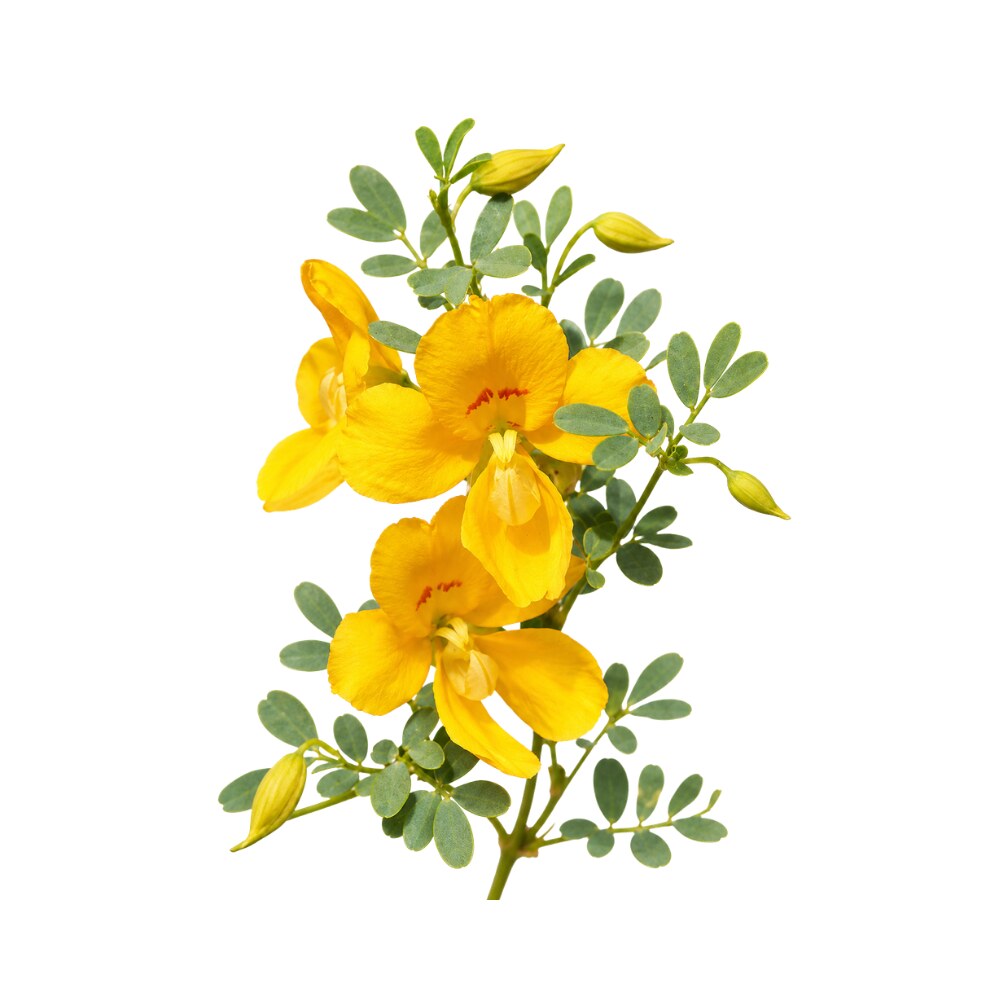
Petalostylis cassioides
Butterfly Bush (Petalostylis cassioides) is a little-studied Australian legume shrub about which very little reliable pharmacological information exists.
What is Butterfly Bush?
Butterfly Bush (Petalostylis cassioides) is an Australian shrub in the legume family, native to arid and semi-arid inland regions. It is a poorly studied plant, and the common name “butterfly bush” is more often applied to the unrelated ornamental Buddleja, so care is needed not to confuse the two.
Traditional & Modern Uses
There is little documented traditional or contemporary use of Petalostylis cassioides. The genus has occasionally been examined for alkaloid content, which is the source of any interest in it, but it has no established place in herbal practice and very little is recorded about its effects.
Botany
Butterfly bush (not to be confused with the unrelated ornamental Buddleja, which shares the common name) is a shrub in the legume family (Fabaceae), native to Australia’s arid interior.
Distribution
Petalostylis cassioides is native to central Australia, occurring mainly in the Northern Territory and Western Australia, where it grows in desert and dry-shrubland habitat. No invasive or weedy behavior has been documented for the species.
Growing Conditions
- Arid-adapted shrub, full sun; drought-tolerant, well-drained soil. Roughly USDA zone 9-11.
- Full cultivation detail lives on the companion farm-wiki grow guide for Petalostylis cassioides (link to be added once that project’s public URL is confirmed).
Phytochemistry
The best-documented chemistry of Petalostylis cassioides (treated in the older literature as Petalostylis labicheoides var. cassioides) is a group of indole alkaloids of the tryptamine type. Reported constituents of the leaves and stems include N,N-dimethyltryptamine, N-methyltryptamine, tryptamine and the β-carboline tetrahydroharman, reported together at roughly 0.4–0.5% of the dried aerial material. The genus has historically been examined for exactly this alkaloid content, which is the source of what little interest exists in the plant. (Names such as “petacassinin E/F/G” sometimes attached to this species could not be corroborated in the published literature and are not treated as established here.) Quantitative data remain sparse and the figures below should be read as an order-of-magnitude total rather than a precise assay.
Constituent Summary
Indole (tryptamine) alkaloids reported from leaf and stem material; the single quantitative figure is an approximate combined total for the alkaloid fraction and varies with plant part, provenance and season. No individual-compound breakdown is available, so each is marked No Data with the total given in the caption. Reported total alkaloids ≈ 0.4–0.5% dry weight 1Reference 1Alkaloids of the Australian LeguminosaeView study →.
Indole alkaloids4 compoundsno data
Pharmacology & Research
Petalostylis cassioides (historically Petalostylis labicheoides var. cassioides) has effectively no pharmacological literature: a search of the biomedical databases returns only a handful of records for the entire genus, all of them botanical — floral morphology, plastid phylogenomics and arid-zone population genetics — and not one efficacy, activity or clinical study of the plant or its extracts 1,6,7Reference 1Alkaloids of the Australian LeguminosaeView study →Reference 6Plastid phylogenomic insights into the evolution of subfamily Dialioideae (Leguminosae)View study →Reference 7The nuanced nature of mesic refugia in arid landscapes: a tale of two peasView study →. The single piece of chemistry is a 1966 isolation paper reporting a small fraction of tryptamine-type indole alkaloids from leaf and stem 1Reference 1Alkaloids of the Australian LeguminosaeView study →. What interest the plant attracts is entirely at the constituent level: it contains N,N-dimethyltryptamine (a serotonergic psychedelic) and the β-carboline tetrahydroharman (a monoamine-oxidase–inhibiting class), molecules whose pharmacology is well described in isolation but has never been studied in this herb 2,3Reference 2Short- and Long-Acting Psychedelics: Structure–Activity Relationships, Pharmacology, and Implications for Neuropsychiatric TherapeuticsView study →Reference 3Herraiz T. β-Carboline Alkaloids in Soy Sauce and Inhibition of Monoamine Oxidase (MAO). Molecules. 2023;28(6):2723. https://doi.org/10.3390/molecules28062723View study →. No indication meets the bar for a Support score, because there is no whole-herb evidence — preclinical or human — for any therapeutic effect. This section therefore documents what is known about the plant’s chemistry and the flagged pharmacology of those constituents, not efficacy.
- Best-supported: nothing at the whole-herb level — there are no efficacy studies of Petalostylis cassioides in any model, so no indication is scored.
- Emerging, worth watching: the plant’s DMT content sits adjacent to active isolated-molecule and ayahuasca research (depression, substance-use disorder), but that work uses purified DMT or defined brews, not this shrub 2Reference 2Short- and Long-Acting Psychedelics: Structure–Activity Relationships, Pharmacology, and Implications for Neuropsychiatric TherapeuticsView study →.
- Mechanistically thin: every pharmacological property attributable to the plant is inferred from its isolated alkaloids 1,2,3Reference 1Alkaloids of the Australian LeguminosaeView study →Reference 2Short- and Long-Acting Psychedelics: Structure–Activity Relationships, Pharmacology, and Implications for Neuropsychiatric TherapeuticsView study →Reference 3Herraiz T. β-Carboline Alkaloids in Soy Sauce and Inhibition of Monoamine Oxidase (MAO). Molecules. 2023;28(6):2723. https://doi.org/10.3390/molecules28062723View study → — no extract of the herb has been tested.
- The caveat: this is a safety monograph, not an efficacy one. The alkaloid fraction includes a controlled psychedelic (DMT) and an MAO-inhibiting β-carboline; the relevant literature is about drug interaction and toxicity, not benefit 3,4Reference 3Herraiz T. β-Carboline Alkaloids in Soy Sauce and Inhibition of Monoamine Oxidase (MAO). Molecules. 2023;28(6):2723. https://doi.org/10.3390/molecules28062723View study →Reference 4Predicting Drug–Drug Interactions Between Ayahuasca Alkaloids and SSRIs Using Physiologically Based Pharmacokinetic ModelingView study →.
No scored indications: there is no credible whole-herb evidence for any therapeutic use, so per the scoring rules none is listed. The constituent pharmacology below is documented under Mechanisms, not scored as herb indications.
Mechanisms
The entries below describe the pharmacology of the plant’s isolated constituents as reported in the general literature. None has been demonstrated for a Petalostylis cassioides extract or preparation; they are listed to explain why the alkaloid fraction matters for safety, not to imply herb-level activity.
| Mechanism | Drives | Key compounds |
|---|---|---|
| 5-HT2A receptor agonism (serotonergic psychedelic) | psychoactivity; basis of isolated-DMT/ayahuasca research | N,N-dimethyltryptamine |
| Reversible MAO-A inhibition (β-carboline class) | blocks amine breakdown; enables oral DMT activity; drug-interaction risk | tetrahydroharman |
| Substrate/partial agonist at trace-amine and serotonin receptors | minor aminergic activity | N-methyltryptamine, tryptamine |
Clinical trials
No registered clinical trials of Petalostylis cassioides or its extracts were identified — the plant has never been evaluated in humans, and there is no preclinical efficacy work either. (Trials of isolated DMT and of ayahuasca exist but concern purified molecules and defined brews, not this herb.)
| Completed | Planned | Terminated | Preclinical |
|---|---|---|---|
| 0 | 0 | 0 | 0 |
Last checked: July 2026.
Safety & Pregnancy
This is a safety monograph, not an efficacy one: Petalostylis cassioides is an unstudied plant whose foliage carries tryptamine alkaloids — including the psychedelic DMT and an MAO-inhibiting β-carboline. It should not be ingested.
- Do not ingest. An unstudied alkaloid-bearing plant with no toxicological, dosing or human-use data — no safe amount can be established.
- DMT plus an MAOI. Foliage carries a serotonergic psychedelic (DMT) alongside the β-carboline tetrahydroharman — the same logic that makes oral ayahuasca active.
- Serotonergic interaction risk. MAO-A inhibition underlies potentially serious interactions with SSRIs, other serotonergic drugs and tyramine-rich foods.
- Avoid in pregnancy and lactation. Centrally-active alkaloids, no data — read the absence as “do not use.”
- Legal status. DMT is a controlled psychedelic in most jurisdictions.
Full safety & interactions detail
Petalostylis cassioides has no toxicological, dosing or human-use data of its own, so no empirical safety profile can be given — and that absence is itself the reason for caution. The concrete concern is chemical: the leaf and stem carry a small fraction of tryptamine-type indole alkaloids, reported at roughly 0.4–0.5% of dried aerial material, that includes N,N-dimethyltryptamine (DMT) alongside the β-carboline tetrahydroharman 1Reference 1Alkaloids of the Australian LeguminosaeView study →. DMT is a serotonergic 5-HT2A agonist and a controlled psychedelic in most jurisdictions 2Reference 2Short- and Long-Acting Psychedelics: Structure–Activity Relationships, Pharmacology, and Implications for Neuropsychiatric TherapeuticsView study →, while β-carbolines of this class are reversible monoamine-oxidase-A inhibitors 3Reference 3Herraiz T. β-Carboline Alkaloids in Soy Sauce and Inhibition of Monoamine Oxidase (MAO). Molecules. 2023;28(6):2723. https://doi.org/10.3390/molecules28062723View study →; the combination is pharmacologically the same logic that makes orally-taken ayahuasca active, and MAO-A inhibition is the basis of documented, potentially serious interactions with SSRIs, other serotonergic drugs and tyramine-rich foods 3,4Reference 3Herraiz T. β-Carboline Alkaloids in Soy Sauce and Inhibition of Monoamine Oxidase (MAO). Molecules. 2023;28(6):2723. https://doi.org/10.3390/molecules28062723View study →Reference 4Predicting Drug–Drug Interactions Between Ayahuasca Alkaloids and SSRIs Using Physiologically Based Pharmacokinetic ModelingView study →. Because alkaloid content varies with plant part, provenance and season and no assay of a given sample can be assumed, an unstudied alkaloid-bearing plant of this type should not be ingested.
Scope: no herb–drug interaction or pregnancy study exists for Petalostylis cassioides itself; the cautions above are inferred from its constituent chemistry and from ayahuasca-alkaloid pharmacology, not measured for this plant. Absence of reports is not evidence of safety.
Avoid — not researched, and biologically implausible to consider safe. No study has examined Petalostylis cassioides in pregnancy or lactation. Independent of that gap, the plant contains a serotonergic psychedelic (DMT) and an MAO-inhibiting β-carboline 1,3Reference 1Alkaloids of the Australian LeguminosaeView study →Reference 3Herraiz T. β-Carboline Alkaloids in Soy Sauce and Inhibition of Monoamine Oxidase (MAO). Molecules. 2023;28(6):2723. https://doi.org/10.3390/molecules28062723View study →; centrally-active alkaloids of this kind have no established safe use in pregnancy, and the absence of data should be read as “do not use,” not as reassurance.
References
- Johns SR, Lamberton JA, Sioumis AA. Alkaloids of the Australian Leguminosae. VI. Alkaloids of Petalostylis labicheoides var. casseoides Benth. Australian Journal of Chemistry. 1966;19:893. https://doi.org/10.1071/CH9660893
- Bhat A, Zolali E, Sakib MA, et al. Short- and Long-Acting Psychedelics: Structure–Activity Relationships, Pharmacology, and Implications for Neuropsychiatric Therapeutics. ACS Chemical Neuroscience. 2026;17(12):2278–2301. https://doi.org/10.1021/acschemneuro.6c00202
- Herraiz T. β-Carboline Alkaloids in Soy Sauce and Inhibition of Monoamine Oxidase (MAO). Molecules. 2023;28(6):2723. https://doi.org/10.3390/molecules28062723
- Ribeiro GSG, et al. Predicting Drug–Drug Interactions Between Ayahuasca Alkaloids and SSRIs Using Physiologically Based Pharmacokinetic Modeling. Frontiers in Molecular Biosciences. 2026. https://doi.org/10.3389/fmolb.2026.1768402
- Wittayakarn N, et al. Development of a Physiologically Based Pharmacokinetic Model of N,N-Dimethyltryptamine, Harmine, and Their Interactions from Ayahuasca in Rats and Humans. Toxicological Sciences. 2025;208(1):48. https://doi.org/10.1093/toxsci/kfaf118
- Bai HR, Oyebanji O, Zhang R, Yi TS. Plastid phylogenomic insights into the evolution of subfamily Dialioideae (Leguminosae). Plant Diversity. 2021;43(1):27–34. https://doi.org/10.1016/j.pld.2020.06.008
- Bradbury D, et al. The nuanced nature of mesic refugia in arid landscapes: a tale of two peas. Annals of Botany. 2022;130(6):901. https://doi.org/10.1093/aob/mcac126