Materia Medica
Goat's Rue
Galega officinalis
Goat's rue (Galega officinalis) — a traditional herb used to support blood sugar and lactation, and a historical source of metformin's chemistry.
What Is Goat’s Rue?
Overview — what Goat’s Rue is and why it matters.
How Is Goat’s Rue Used?
Goat’s rue is used almost exclusively as a liquid extract of the dried aerial parts, taken as a 1:2 extract at 15–30 mL per week — a low, weekly-dosed regimen rather than a daily tea or capsule, reflecting its narrow margin and the fact that its active alkaloid, galegine, is potent and variable in concentration 19Reference 19Galegine content in goatsrue (Galega officinalis) varies by plant part and phenological growth stage — analytical / toxicologyView study →. Practitioners reach for it mainly for blood-sugar support, a use that traces directly back to galegine’s role as the chemical starting point for the biguanide drugs and, eventually, metformin 8Reference 8ReviewGoat’s rue — French lilac — Italian fitch — Spanish sainfoin: Galega officinalis and metformin: the Edinburgh connection — historical reviewView study → — though no clinical dose for glycaemic control has ever been established for the herb itself (see Dosage). It is also used, usually in combination products rather than alone, to support milk supply during lactation 10,11Reference 10RCTEfficacy of a galactogogue containing silymarin-phosphatidylserine and galega in mothers of preterm infants: a randomised controlled trial — RCTView study →Reference 11RCTThe long-term efficacy of a galactagogue containing silymarin-phosphatidylserine and galega on milk production of mothers of preterm infants — RCT follow-upView study →.
Because there is no validated human dose beyond the traditional liquid-extract figure, and because potency varies with which part of the plant and growth stage the extract was made from 19Reference 19Galegine content in goatsrue (Galega officinalis) varies by plant part and phenological growth stage — analytical / toxicologyView study →, goat’s rue is a herb best used under practitioner guidance rather than self-dosed — and, given the interaction and pregnancy risks below, not a first-choice self-care option for blood sugar.
Traditional Uses
Western Herbal Medicine
Goat’s rue is a European folk herb with a long-standing reputation as a galactagogue (milk-promoter) and, later, as a blood-sugar-lowering plant — the latter use eventually leading to its investigation as the source of galegine and, from there, to metformin 8Reference 8ReviewGoat’s rue — French lilac — Italian fitch — Spanish sainfoin: Galega officinalis and metformin: the Edinburgh connection — historical reviewView study →. It also carries a traditional reputation as a diuretic and emmenagogue, though these uses have no primary experimental support in the modern literature.
Traditional Chinese Medicine
Goat’s rue has no history of use in Traditional Chinese Medicine. Galega officinalis is a European plant with no documented role in the Chinese materia medica, and it should not be presented as a TCM herb.
Ayurvedic Medicine
Goat’s rue has no history of use in Ayurvedic medicine. It does not appear in classical Ayurvedic texts and has no documented traditional use on the Indian subcontinent; any “Ayurvedic” framing of the herb is not historically grounded.
Indications
- Blood sugar support — the herb’s historical and best-known use, and the origin of metformin’s chemistry; supported only by preclinical (rodent/cell) and mechanistic data, with no human trial of the herb itself 1,2,3,6,7Reference 1AnimalNovel weight-reducing activity of Galega officinalis in mice — animal modelView study →Reference 2In vitroMechanisms underlying the metabolic actions of galegine that contribute to weight loss in mice — animal model / in vitroView study →Reference 3In vitroIn vitro antidiabetic and antioxidant activities of Galega officinalis extracts — in vitroView study →Reference 6In vitroActivation of imidazoline I2B receptors is linked with AMP kinase pathway to increase glucose uptake in cultured C2C12 cells — in vitroView study →Reference 7In vitroMetformin, phenformin, and galegine inhibit complex IV activity and reduce glycerol-derived gluconeogenesis — in vitro / in vivoView study →. Use as an adjunct under practitioner supervision, never as a substitute for prescribed antidiabetic medication.
- Weight management — a well-replicated preclinical signal (whole herb and isolated galegine) in normal and obese mice, via AMPK activation and reduced lipogenesis 1,2,9Reference 1AnimalNovel weight-reducing activity of Galega officinalis in mice — animal modelView study →Reference 2In vitroMechanisms underlying the metabolic actions of galegine that contribute to weight loss in mice — animal model / in vitroView study →Reference 9AnimalBenzylguanidines and other galegine analogues inducing weight loss in mice — animal modelView study →; not tested in humans.
- Lactation support (galactagogue) — traditional use with some human trial support, but only ever tested as part of a silymarin–phosphatidylserine–galega combination, so goat’s rue’s independent contribution is unproven 10,11,12,13Reference 10RCTEfficacy of a galactogogue containing silymarin-phosphatidylserine and galega in mothers of preterm infants: a randomised controlled trial — RCTView study →Reference 11RCTThe long-term efficacy of a galactagogue containing silymarin-phosphatidylserine and galega on milk production of mothers of preterm infants — RCT follow-upView study →Reference 12ObservationalSilymarin/galega administration in term and preterm mothers to sustain breast feeding: an observational study — observationalView study →Reference 13Systematic reviewHerbal galactagogues to improve breastmilk production and lactation in mothers of preterm babies: a systematic review of clinical trials — systematic reviewView study →.
- Not indicated as a stand-alone treatment for hypertension or fever — the supporting data come from galegine sourced from other plants entirely, not from goat’s rue 17,18Reference 17AnimalAntihypertensive effect of galegine from Biebersteinia heterostemon in rats — animal modelView study →Reference 18AnimalGalegine, a bioprivileged alkaloid from Tithonia tubaeformis: antipyretic activity insights — animal modelView study →.
Botany
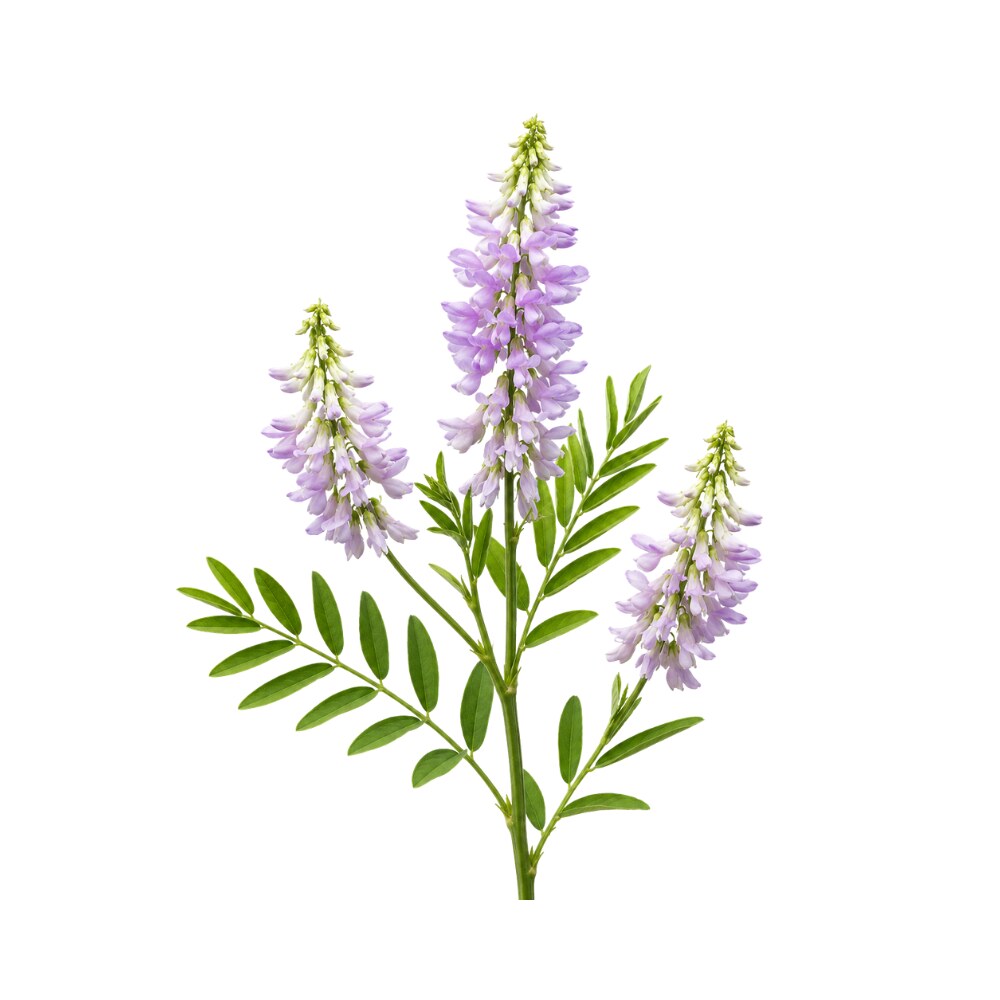
Goat’s rue — also met under the older name French lilac — is Galega officinalis, an upright perennial member of the pea family. From a persistent crown it sends up bushy, hollow-stemmed growth to around waist or chest height each season, clothed in pinnate leaves whose many small leaflets are arranged in neat opposite pairs along a central stalk. Through summer the stems are topped by crowded, spike-like clusters of little pea flowers in soft lilac-blue fading to white, followed by narrow cylindrical pods.
In herbal use it is the aerial parts — the leafy flowering tops gathered in bloom — that are taken, historically as a galactagogue and in folk treatment of high blood sugar. The plant owes its antidiabetic reputation to the guanidine compound galegine, which served as the chemical starting point for the drug metformin.
A word of caution belongs in the identity section itself: this is not a benign garden herb. In the United States goat’s rue is a regulated Federal Noxious Weed, and the same alkaloids behind its folk reputation make it genuinely poisonous to grazing livestock, sheep especially. It is a plant to know and respect, not to naturalise.
Distribution
Goat’s rue is native to Europe, western Asia and the Middle East, and has spread through cultivation into the Americas and New Zealand. Where it has escaped — notably across parts of the United States — it behaves invasively along damp, disturbed ground, and it carries formal noxious-weed status there.
Growing Conditions
- Thrives in full sun on moist to wet, even waterlogged ground — streamsides, ditches and low pastures are its natural niche.
- A hardy clump-forming perennial, cold-tolerant through roughly USDA zones 3–8, dying back each winter and regrowing from the crown.
- As a legume it fixes its own nitrogen and asks little of soil fertility; it self-seeds freely and spreads readily once established.
- Regulated as a Federal Noxious Weed in the United States (and toxic to livestock) — do not plant it where prohibited, and check local rules first.
- Full cultivation detail lives on the companion farm-wiki grow guide for Galega officinalis (link to be added once that project’s public URL is confirmed).
Pharmacology & Research
Goat’s rue occupies a singular place in pharmacology: its guanidine alkaloid galegine was the chemical lead that produced the biguanides and, ultimately, metformin — so the molecule is among the best-characterised in all of phytotherapy, even though the herb is not. The literature splits along exactly that seam. Whole-herb and galegine studies in rodents and cell systems give a coherent, mechanistically deep account of glucose-lowering and weight-reducing activity through AMP-activated protein kinase (AMPK) and mitochondrial respiratory-chain inhibition 1,2,7Reference 1AnimalNovel weight-reducing activity of Galega officinalis in mice — animal modelView study →Reference 2In vitroMechanisms underlying the metabolic actions of galegine that contribute to weight loss in mice — animal model / in vitroView study →Reference 7In vitroMetformin, phenformin, and galegine inhibit complex IV activity and reduce glycerol-derived gluconeogenesis — in vitro / in vivoView study →, but there is no randomised trial of goat’s rue for any metabolic endpoint — the one human RCT signal concerns lactation, and there the herb is always co-formulated with silymarin, so its own contribution cannot be isolated 10,13Reference 10RCTEfficacy of a galactogogue containing silymarin-phosphatidylserine and galega in mothers of preterm infants: a randomised controlled trial — RCTView study →Reference 13Systematic reviewHerbal galactagogues to improve breastmilk production and lactation in mothers of preterm babies: a systematic review of clinical trials — systematic reviewView study →. Galegine content also swings by an order of magnitude with plant part and growth stage 19Reference 19Galegine content in goatsrue (Galega officinalis) varies by plant part and phenological growth stage — analytical / toxicologyView study →, so a result from one preparation does not transfer to a tea, tincture, or powder of unknown alkaloid load. Read the scores below as strength of preclinical signal, not clinical proof.
- Best-supported: glucose-lowering and weight-reducing activity of the herb and of galegine in rodents and cell lines, driven by AMPK activation and respiratory-chain inhibition 1,2,7Reference 1AnimalNovel weight-reducing activity of Galega officinalis in mice — animal modelView study →Reference 2In vitroMechanisms underlying the metabolic actions of galegine that contribute to weight loss in mice — animal model / in vitroView study →Reference 7In vitroMetformin, phenformin, and galegine inhibit complex IV activity and reduce glycerol-derived gluconeogenesis — in vitro / in vivoView study →; in-vitro inhibition of carbohydrate-digesting enzymes by herb extracts 3Reference 3In vitroIn vitro antidiabetic and antioxidant activities of Galega officinalis extracts — in vitroView study →.
- Emerging, worth watching: amelioration of hepatic mitochondrial dysfunction and oxidative stress in diabetic rats by an alkaloid-free (polyphenol) fraction 5Reference 5AnimalAmelioration of oxidative stress and hepatocellular mitochondrial dysfunction by bioactive compounds isolated from Galega officinalis in streptozotocin-induced diabetic rats — animal modelView study →; consistent in-vitro antiplatelet activity of a polysaccharide fraction 15,16Reference 15In vitroAnti-platelet fraction from Galega officinalis L. inhibits platelet aggregation — in vitroView study →Reference 16In vitroInhibiting effect of desalted extract from Galega officinalis L. on platelet aggregation — in vitroView study →.
- Mechanistically thin: antihypertensive and antipyretic effects rest on galegine tested from other plants, not from goat’s rue 17,18Reference 17AnimalAntihypertensive effect of galegine from Biebersteinia heterostemon in rats — animal modelView study →Reference 18AnimalGalegine, a bioprivileged alkaloid from Tithonia tubaeformis: antipyretic activity insights — animal modelView study →; the herb’s traditional diuretic and emmenagogue actions have no primary experimental support.
- The caveat: everything metabolic is preclinical; there is no standardised human dose, and the diagnostic alkaloid galegine varies several-fold between preparations 19Reference 19Galegine content in goatsrue (Galega officinalis) varies by plant part and phenological growth stage — analytical / toxicologyView study →.
1. Antidiabetic
Goat’s rue is the ancestral antidiabetic herb — its guanidine alkaloid galegine led directly to the biguanides and to metformin 8Reference 8ReviewGoat’s rue — French lilac — Italian fitch — Spanish sainfoin: Galega officinalis and metformin: the Edinburgh connection — historical reviewView study →. The mechanism is well-resolved at the molecule level: galegine activates AMPK and stimulates glucose uptake in adipocytes and myotubes 2Reference 2In vitroMechanisms underlying the metabolic actions of galegine that contribute to weight loss in mice — animal model / in vitroView study →, acts through imidazoline I2 receptors to drive glucose uptake into skeletal muscle 6Reference 6In vitroActivation of imidazoline I2B receptors is linked with AMP kinase pathway to increase glucose uptake in cultured C2C12 cells — in vitroView study →, and — like metformin — inhibits mitochondrial respiratory-chain complex IV, suppressing glycerol-derived gluconeogenesis at clinically relevant concentrations 7Reference 7In vitroMetformin, phenformin, and galegine inhibit complex IV activity and reduce glycerol-derived gluconeogenesis — in vitro / in vivoView study →. For the herb specifically, acetone–water and aqueous extracts inhibit the carbohydrate-digesting enzymes α-amylase, α-glucosidase, maltase, and sucrase in vitro (up to ~91% sucrase inhibition for the acetone–water extract) 3Reference 3In vitroIn vitro antidiabetic and antioxidant activities of Galega officinalis extracts — in vitroView study →. What is missing is the top of the pyramid: no human trial has tested goat’s rue itself for glycaemic control, and because galegine is a potent, narrow-margin compound whose concentration varies several-fold between preparations 19Reference 19Galegine content in goatsrue (Galega officinalis) varies by plant part and phenological growth stage — analytical / toxicologyView study →, extrapolating from extract data to a herbal dose is genuinely uncertain.
Gap: Zero human trials of the herb; the strongest data are for galegine as an isolated molecule or as metformin, not for standardised goat’s rue at a herbal dose.
2. Weight reduction
This is one of the more robust preclinical signals. Goat’s rue herb at 10% of the diet produced significant, sustained weight loss in both normal and genetically obese (ob/ob) mice over 28 days; pair-feeding showed the effect was at least partly independent of reduced food intake 1Reference 1AnimalNovel weight-reducing activity of Galega officinalis in mice — animal modelView study →. The mechanism was subsequently pinned to galegine: it activates AMPK across hepatoma, adipocyte, and myotube lines, inhibits acetyl-CoA carboxylase, reduces isoprenaline-driven lipolysis, and down-regulates fatty-acid synthase and its regulator SREBP 2Reference 2In vitroMechanisms underlying the metabolic actions of galegine that contribute to weight loss in mice — animal model / in vitroView study →. Structure–activity work on benzylguanidine analogues confirmed the guanidine group is required for the weight-reducing effect 9Reference 9AnimalBenzylguanidines and other galegine analogues inducing weight loss in mice — animal modelView study →. The whole story remains rodent-and-cell only.
Gap: No human weight-loss data for the herb, and the effective murine dose (10% of diet) is far above any realistic human herbal exposure.
3. Antioxidant
Goat’s rue extracts show consistent, if unremarkable, free-radical scavenging. Acetone–water extracts gave the strongest ABTS, hydroxyl-radical, and FRAP activity, with DPPH and metal-chelating activity highest in a second solvent fraction 3Reference 3In vitroIn vitro antidiabetic and antioxidant activities of Galega officinalis extracts — in vitroView study →. A detailed UHPLC-ESI-MS study attributed the activity to a polyphenol fraction dominated by mono-, di-, and triglycosylated flavonols (quercetin and luteolin glycosides) and hydroxycinnamic acids, and additionally demonstrated methylglyoxal-trapping — potentially relevant to diabetic glycation 4Reference 4In vitroInvestigation of the phytochemical composition, antioxidant activity, and methylglyoxal trapping effect of Galega officinalis L. herb — in vitroView study →. In a streptozotocin diabetic-rat model, an alkaloid-free fraction reduced hepatic oxidative stress 5Reference 5AnimalAmelioration of oxidative stress and hepatocellular mitochondrial dysfunction by bioactive compounds isolated from Galega officinalis in streptozotocin-induced diabetic rats — animal modelView study →.
Gap: Activity is generic to polyphenol-rich botanicals and demonstrated chiefly in vitro; no evidence it produces a measurable antioxidant effect in humans.
4. Galactagogue
This is the only indication with human trial data — and the data cannot be attributed to goat’s rue alone. A double-blind RCT in mothers of preterm infants (n=50 per group) found a fixed combination of silymarin–phosphatidylserine plus galega significantly increased milk production at days 7 and 30 10Reference 10RCTEfficacy of a galactogogue containing silymarin-phosphatidylserine and galega in mothers of preterm infants: a randomised controlled trial — RCTView study →; a follow-up reported maintained production at 3–6 months 11Reference 11RCTThe long-term efficacy of a galactagogue containing silymarin-phosphatidylserine and galega on milk production of mothers of preterm infants — RCT follow-upView study →, and an earlier observational study pointed the same way 12Reference 12ObservationalSilymarin/galega administration in term and preterm mothers to sustain breast feeding: an observational study — observationalView study →. But galega is never isolated in these products, so silymarin may be doing the work. A 2026 systematic review of herbal galactagogues in preterm mothers concluded that efficacy and safety remain unclear 13Reference 13Systematic reviewHerbal galactagogues to improve breastmilk production and lactation in mothers of preterm babies: a systematic review of clinical trials — systematic reviewView study →. Traditional European use as a milk-promoter is long-standing but is not, by itself, evidence of an isolable effect.
Gap: Galega is always co-formulated with silymarin–phosphatidylserine; no trial isolates goat’s rue, so its independent galactagogue effect is unproven.
5. Hepatoprotective
A single 2026 study in streptozotocin-induced diabetic rats gave an alkaloid-free (polyphenol) fraction of goat’s rue at 600 mg/kg/day for 14 days and reported restored mitochondrial respiration and oxidative phosphorylation in liver cells, with recovered activity of respiratory-chain complexes and reduced oxidative stress 5Reference 5AnimalAmelioration of oxidative stress and hepatocellular mitochondrial dysfunction by bioactive compounds isolated from Galega officinalis in streptozotocin-induced diabetic rats — animal modelView study →. The effect is plausible and mechanistically coherent with the herb’s polyphenol content, but rests on one animal model with no replication.
Gap: One rodent study only; no dose-ranging, no replication, and no human liver-outcome data.
6. Antiplatelet
Across several in-vitro reports from one research group, a purified fraction of goat’s rue — a 100–140 kDa polysaccharide–protein complex — inhibited platelet aggregation triggered by ADP, collagen, and thrombin, with IC50 values in the low µg/mL range, and could partly disaggregate already-clumped platelets 15,16Reference 15In vitroAnti-platelet fraction from Galega officinalis L. inhibits platelet aggregation — in vitroView study →Reference 16In vitroInhibiting effect of desalted extract from Galega officinalis L. on platelet aggregation — in vitroView study →. The activity is consistent and dose-dependent but has never been confirmed in vivo or in humans. Its main practical significance is as a drug-interaction signal: additive risk with anticoagulant or antiplatelet medication (see Safety).
Gap: In-vitro and single-laboratory only; no in-vivo or human confirmation, and the active fraction is not a form delivered by ordinary herbal preparations.
7. Antihypertensive
Galegine produced an immediate, dose-dependent fall in mean arterial pressure (~40% at 2.5–10 mg/kg i.p.) with a rise in heart rate in anaesthetised hypertensive rats 17Reference 17AnimalAntihypertensive effect of galegine from Biebersteinia heterostemon in rats — animal modelView study →. The important caveat: the galegine in this study was extracted from Biebersteinia heterostemon, a Tibetan medicinal plant, not from goat’s rue. Because galegine is the diagnostic alkaloid of Galega officinalis, the finding is suggestive by constituent inference — but the herb itself was never tested, and its galegine content is variable 19Reference 19Galegine content in goatsrue (Galega officinalis) varies by plant part and phenological growth stage — analytical / toxicologyView study →.
Gap: No study tested goat’s rue; the effect is inferred from galegine sourced from a different plant, by injection, in anaesthetised animals.
8. Antipyretic
Galegine and a galegine-containing extract produced a progressive, dose-dependent reduction of body temperature in a rodent hyperthermia model, supported by molecular-docking work 18Reference 18AnimalGalegine, a bioprivileged alkaloid from Tithonia tubaeformis: antipyretic activity insights — animal modelView study →. As with the antihypertensive data, the galegine here was isolated from Tithonia tubaeformis, not from goat’s rue, so this is constituent-level inference rather than direct evidence for the herb.
Gap: Single study; galegine sourced from a different plant; no goat’s-rue extract tested and no human data.
Mechanisms
| Mechanism | Drives | Key compounds |
|---|---|---|
| AMPK activation; acetyl-CoA carboxylase ↓; FAS/SREBP ↓; respiratory-chain complex IV ↓ → gluconeogenesis ↓; imidazoline I2R–mediated glucose uptake ↑ | antidiabeticweight reductionantihypertensive | galegine, 4-hydroxygalegine |
| bronchodilator / uterotonic class activity (minor component; not quantified in goat’s rue) | traditional respiratory / uterine use | vasicine |
| radical scavenging (DPPH/ABTS); methylglyoxal trapping; metal chelation | antioxidanthepatoprotective | luteolin, quercetin, galuteolin |
| free-radical scavenging; contributes to anti-glycation | antioxidant | monocaffeoylhexaric acids |
| inhibits ADP/collagen/thrombin-induced platelet aggregation | antiplatelet | 100–140 kDa polysaccharide–protein fraction |
Clinical trials
No registered trial targets any glycaemic, weight, or lipid endpoint for goat’s rue; the only relevant registration is a silymarin–galega galactagogue combination (status unknown), and every other “Galega” hit is a metformin or goat-milk study. The metabolic evidence base is preclinical.
| Completed | Planned | Terminated | Preclinical |
|---|---|---|---|
| 0 | 1(status unknown — NCT02233439, silymarin/galega galactagogue) | 0 | ~20 |
Last checked: February 2026.
Phytochemistry
The signature constituent of goat’s rue is galegine, a guanidine alkaloid (isoamylene guanidine) that gave the chemical lead for the biguanide drug metformin. It is accompanied by the related 4-hydroxygalegine and by small amounts of the quinazoline alkaloid vasicine (peganine). The herb also carries a flavonoid fraction — including the luteolin glycoside galuteolin along with free luteolin and quercetin glycosides — plus saponins and tannins.
Constituent Summary
Amounts mix two scales: a percentage of dry herb for the total flavonoids and the average galegine figure, and mg per gram of dry weight (mg/g) for the tissue-specific alkaloid maxima. Galegine concentration varies sharply with plant part and growth stage, peaking in reproductive (seed-forming) tissue and around the immature-pod stage. A dagger (†) marks galegine, the guanidine alkaloid diagnostic of Galega officinalis.
Other alkaloids3 compounds2 with data
Flavonoids4 compounds1 with data
Dosage
There is no validated human dose for goat’s rue. The figures below are the doses used in the experimental literature — almost all rodent or isolated-galegine studies — and do not translate to a human herbal dose. Because galegine content varies several-fold with plant part and growth stage 19Reference 19Galegine content in goatsrue (Galega officinalis) varies by plant part and phenological growth stage — analytical / toxicologyView study →, a dried-herb equivalent cannot be calculated reliably; equivalents are left blank where no marker percentage anchors them.
| Indication | Preparation | Dose | Est. dried-herb equivalent | Source |
|---|---|---|---|---|
| Weight reduction (mice) | Whole dried herb in diet | 10% of diet, 28 days | — (murine; not human-translatable) | 1Reference 1AnimalNovel weight-reducing activity of Galega officinalis in mice — animal modelView study → |
| Antidiabetic / weight (mechanism) | Isolated galegine | in-vitro / animal, various | — (isolated molecule) | 2,7Reference 2In vitroMechanisms underlying the metabolic actions of galegine that contribute to weight loss in mice — animal model / in vitroView study →Reference 7In vitroMetformin, phenformin, and galegine inhibit complex IV activity and reduce glycerol-derived gluconeogenesis — in vitro / in vivoView study → |
| Hepatoprotection (diabetic rats) | Alkaloid-free polyphenol fraction | 600 mg/kg/day, 14 days | — (fraction, not whole herb) | 5Reference 5AnimalAmelioration of oxidative stress and hepatocellular mitochondrial dysfunction by bioactive compounds isolated from Galega officinalis in streptozotocin-induced diabetic rats — animal modelView study → |
| Antihypertensive (rats) | Isolated galegine (from Biebersteinia) | 2.5–10 mg/kg i.p. | — (isolated molecule, other plant) | 17Reference 17AnimalAntihypertensive effect of galegine from Biebersteinia heterostemon in rats — animal modelView study → |
| Galactagogue (preterm mothers) | Silymarin–phosphatidylserine–galega combination | fixed combination product | — (galega not isolated) | 10,11Reference 10RCTEfficacy of a galactogogue containing silymarin-phosphatidylserine and galega in mothers of preterm infants: a randomised controlled trial — RCTView study →Reference 11RCTThe long-term efficacy of a galactagogue containing silymarin-phosphatidylserine and galega on milk production of mothers of preterm infants — RCT follow-upView study → |
These are research doses for context, not dosing guidance; none is a human herbal dose for goat’s rue, and the metabolic figures are rodent or isolated-compound studies.
Traditional Dosage
| System | Preparation | Dose |
|---|---|---|
| Western herbal medicine | 1:2 liquid extract | 15–30 mL / week |
The traditional liquid-extract figure is a long-standing herbal-practice dose, not a clinically validated one — no dosing study for goat’s rue exists.
Safety & Pregnancy
Goat’s rue’s active alkaloid galegine is glucose-lowering with a narrow, unpredictable margin; the main concerns are additive hypoglycaemia with diabetes drugs, an in-vitro bleeding signal, and potency that swings with plant part.
- Additive hypoglycaemia. Galegine lowers blood glucose and can add to insulin and antidiabetic drugs — including sulfonylureas and metformin itself.
- Potent, variable alkaloid. Galegine content varies several-fold by plant part and growth stage; the fresh plant is a documented, sometimes-fatal livestock poison.
- Organ effects on sustained dosing. Acute toxicity is low, but 90-day feeding raised cholesterol, CPK, LDH and bilirubin with hepatic sinusoidal congestion.
- Bleeding signal. An in-vitro antiplatelet fraction gives a plausible additive-bleeding concern with anticoagulant / antiplatelet drugs and peri-operatively.
- Little human data. No dedicated human interaction or safety study exists — absence of reported problems is not evidence of safety.
Full safety & interactions detail
Goat’s rue’s active guanidine alkaloid, galegine, is glucose-lowering, so the plant can add to the effect of insulin and other antidiabetic drugs — including sulfonylureas and metformin itself — and may cause hypoglycaemia 2,7Reference 2In vitroMechanisms underlying the metabolic actions of galegine that contribute to weight loss in mice — animal model / in vitroView study →Reference 7In vitroMetformin, phenformin, and galegine inhibit complex IV activity and reduce glycerol-derived gluconeogenesis — in vitro / in vivoView study →; this is the single most important interaction and is pharmacodynamic, not CYP-mediated. A polysaccharide–protein fraction of the herb inhibits platelet aggregation in vitro 15,16Reference 15In vitroAnti-platelet fraction from Galega officinalis L. inhibits platelet aggregation — in vitroView study →Reference 16In vitroInhibiting effect of desalted extract from Galega officinalis L. on platelet aggregation — in vitroView study →, giving a plausible additive-bleeding concern alongside anticoagulant or antiplatelet medication (and a reason for peri-operative caution), though this has not been confirmed in people. The fresh plant is a documented livestock poison — fatal “galega poisoning” in sheep is well recorded, and is why the plant is a regulated noxious weed in parts of the US. Galegine content varies several-fold with plant part and growth stage, peaking in seed-forming (reproductive) tissue 19Reference 19Galegine content in goatsrue (Galega officinalis) varies by plant part and phenological growth stage — analytical / toxicologyView study →, so a preparation made from flowering or seeding tops can be markedly more potent and overall potency is unpredictable across preparations. In a rat study the LD50 of the aerial parts exceeded 5 g/kg 14Reference 14AnimalAcute and subchronic oral toxicity of Galega officinalis in rats — animal modelView study →, indicating low acute toxicity for the dried herb; however, 90-day subchronic feeding (0.15–3% of diet) raised serum cholesterol, CPK, LDH, and bilirubin and produced hepatic sinusoidal congestion 14Reference 14AnimalAcute and subchronic oral toxicity of Galega officinalis in rats — animal modelView study →, so it is not free of organ effects at sustained doses.
No named CYP450 interaction has been demonstrated for goat’s rue, and none should be inferred. Herb–drug interactions have only been partly assessed: the additive-hypoglycaemia and additive-antiplatelet concerns rest on mechanism and in-vitro data, with no dedicated human interaction study. Human safety data for the herb are essentially absent — the low rat LD50 covers acute dried-herb toxicity only, and absence of reported problems should not be read as evidence of safety.
Goat’s rue is traditionally contraindicated in pregnancy on account of its emmenagogue reputation, and there are no controlled human data to overturn that precaution — treat it as unstudied and avoid in pregnancy. For lactation, the only human trials used a fixed silymarin–phosphatidylserine–galega combination in mothers of preterm infants 10,11Reference 10RCTEfficacy of a galactogogue containing silymarin-phosphatidylserine and galega in mothers of preterm infants: a randomised controlled trial — RCTView study →Reference 11RCTThe long-term efficacy of a galactagogue containing silymarin-phosphatidylserine and galega on milk production of mothers of preterm infants — RCT follow-upView study →, so goat’s rue has never been evaluated on its own; a 2026 systematic review judged the efficacy and safety of herbal galactagogues in this setting unclear 13Reference 13Systematic reviewHerbal galactagogues to improve breastmilk production and lactation in mothers of preterm babies: a systematic review of clinical trials — systematic reviewView study →. Treat isolated goat’s-rue use in lactation as not formally assessed.
References
- Palit, P., Furman, B. L., & Gray, A. I. (1999). Novel weight-reducing activity of Galega officinalis in mice — animal model. Journal of Pharmacy and Pharmacology. https://pubmed.ncbi.nlm.nih.gov/10632090/
- Mooney, M. H., Fogarty, S., Stevenson, C., et al. (2008). Mechanisms underlying the metabolic actions of galegine that contribute to weight loss in mice — animal model / in vitro. British Journal of Pharmacology. https://pubmed.ncbi.nlm.nih.gov/18297106/
- Sukhtezari, S., Sahari, M. A., Barzegar, M., & Azizi, M. H. (2024). In vitro antidiabetic and antioxidant activities of Galega officinalis extracts — in vitro. Food Science & Nutrition. https://pubmed.ncbi.nlm.nih.gov/39479699/
- Bednarska, K., Kuś, P., & Fecka, I. (2020). Investigation of the phytochemical composition, antioxidant activity, and methylglyoxal trapping effect of Galega officinalis L. herb — in vitro. Molecules. https://pubmed.ncbi.nlm.nih.gov/33317096/
- Hachkova, H., et al. (2026). Amelioration of oxidative stress and hepatocellular mitochondrial dysfunction by bioactive compounds isolated from Galega officinalis in streptozotocin-induced diabetic rats — animal model. Biomedicine & Pharmacotherapy. https://pubmed.ncbi.nlm.nih.gov/42105688/
- Lui, T. N., et al. (2010). Activation of imidazoline I2B receptors is linked with AMP kinase pathway to increase glucose uptake in cultured C2C12 cells — in vitro. Neuroscience Letters. https://pubmed.ncbi.nlm.nih.gov/20298750/
- LaMoia, T. E., et al. (2022). Metformin, phenformin, and galegine inhibit complex IV activity and reduce glycerol-derived gluconeogenesis — in vitro / in vivo. Proceedings of the National Academy of Sciences USA. https://pubmed.ncbi.nlm.nih.gov/35238637/
- Hadden, D. R. (2005). Goat’s rue — French lilac — Italian fitch — Spanish sainfoin: Galega officinalis and metformin: the Edinburgh connection — historical review. Journal of the Royal College of Physicians of Edinburgh. https://pubmed.ncbi.nlm.nih.gov/16402501/
- Coxon, G. D., Furman, B. L., Harvey, A. L., et al. (2009). Benzylguanidines and other galegine analogues inducing weight loss in mice — animal model. Journal of Medicinal Chemistry. https://pubmed.ncbi.nlm.nih.gov/19422230/
- Zecca, E., Zuppa, A. A., D’Antuono, A., et al. (2016). Efficacy of a galactogogue containing silymarin-phosphatidylserine and galega in mothers of preterm infants: a randomised controlled trial — RCT. European Journal of Clinical Nutrition. https://pubmed.ncbi.nlm.nih.gov/27245206/
- Serrao, F., Corsello, M., Romagnoli, C., et al. (2018). The long-term efficacy of a galactagogue containing silymarin-phosphatidylserine and galega on milk production of mothers of preterm infants — RCT follow-up. Breastfeeding Medicine. https://pubmed.ncbi.nlm.nih.gov/29148822/
- Castoldi, F., et al. (2014). Silymarin/galega administration in term and preterm mothers to sustain breast feeding: an observational study — observational. Minerva Pediatrica. https://pubmed.ncbi.nlm.nih.gov/25253186/
- Cragg, A., et al. (2026). Herbal galactagogues to improve breastmilk production and lactation in mothers of preterm babies: a systematic review of clinical trials — systematic review. European Journal of Clinical Nutrition. https://pubmed.ncbi.nlm.nih.gov/41350450/
- Rasekh, H. R., Nazari, P., Kamli-Nejad, M., & Hosseinzadeh, L. (2008). Acute and subchronic oral toxicity of Galega officinalis in rats — animal model. Journal of Ethnopharmacology. https://pubmed.ncbi.nlm.nih.gov/18055147/
- Atanasov, A. T., & Spasov, V. (2002). Anti-platelet fraction from Galega officinalis L. inhibits platelet aggregation — in vitro. Journal of Medicinal Food. https://pubmed.ncbi.nlm.nih.gov/12639398/
- Atanasov, A. T. (1999). Inhibiting effect of desalted extract from Galega officinalis L. on platelet aggregation — in vitro. Folia Medica (Plovdiv). https://pubmed.ncbi.nlm.nih.gov/10462920/
- Wang, W., & Zhang, X. (2021). Antihypertensive effect of galegine from Biebersteinia heterostemon in rats — animal model. Molecules. https://pubmed.ncbi.nlm.nih.gov/34443434/
- Nawaz, N. U. A., Saeed, M., Faizi, S., et al. (2025). Galegine, a bioprivileged alkaloid from Tithonia tubaeformis: antipyretic activity insights — animal model. Current Topics in Medicinal Chemistry. https://pubmed.ncbi.nlm.nih.gov/39886793/
- Oldham, M., Ransom, C. V., Ralphs, M. H., & Gardner, D. R. (2011). Galegine content in goatsrue (Galega officinalis) varies by plant part and phenological growth stage — analytical / toxicology. Weed Science. https://bioone.org/journals/Weed-Science/volume-59/issue-3/WS-D-10-00169.1/Galegine-Content-in-Goatsrue-Galega-officinalis-Varies-by-Plant-Part/10.1614/WS-D-10-00169.1.short