
Materia Medica
Hibiscus
Hibiscus rosa-sinensis
Hibiscus (Hibiscus rosa-sinensis) is a tropical flowering shrub used in teas and traditional medicine as a mild relaxant rich in antioxidant anthocyanins.
What Is Hibiscus?
Hibiscus rosa-sinensis, the Chinese hibiscus or shoeflower, is a glossy-leaved evergreen shrub grown throughout the tropics for its large, showy red flowers. It is a mallow-family relative of okra and cotton and is among the most widely cultivated ornamental shrubs in the world, with a long history of use in Asian traditional medicine and cosmetics.
Traditional & Modern Uses
In Ayurveda and Chinese folk medicine the flowers and leaves are used as a cooling, mildly relaxing remedy, for hair and scalp care, and as a gentle remedy for cough and menstrual complaints. The flowers are infused as a tea and the mucilaginous leaves used as an emollient. Ayurvedic practice also uses the flower as an emmenagogue and traditional contraceptive — the use that underlies its caution in pregnancy. Modern interest centres on the antioxidant pigment content and possible mild blood-pressure-lowering and relaxant effects.
Botany
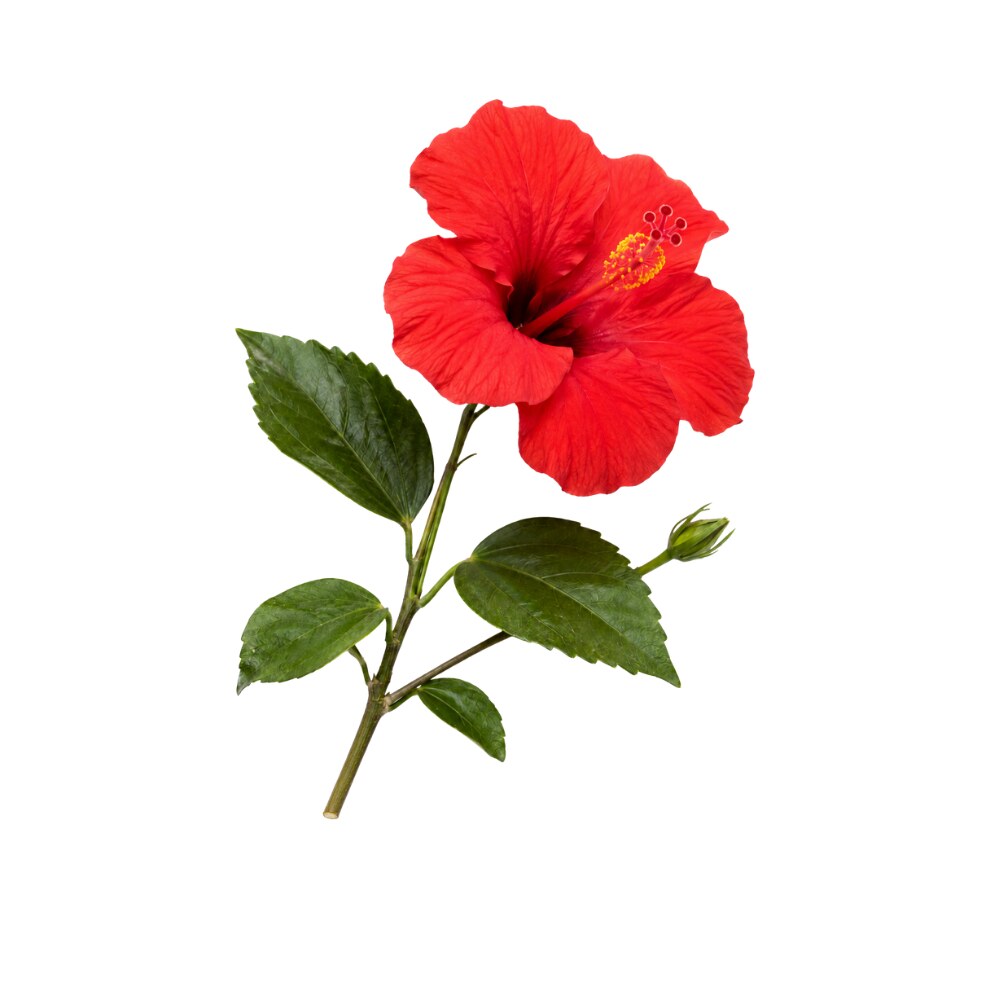
The hibiscus most people picture — a glossy tropical shrub hung with saucer-sized red or pink trumpets — is Hibiscus rosa-sinensis, the Chinese or ornamental hibiscus. It is a tender evergreen member of the mallow family (Malvaceae), woody at the base and reaching roughly waist-to-head height where frost never bites, with toothed, lacquer-green leaves and five-petalled flowers whose fused column of stamens juts well beyond the petals.
For herbalists the crucial point is that this is the ornamental, not the medicinal-tea hibiscus. The tart red “hibiscus” of teas, cordials and much traditional sour-cooling medicine comes from a separate species, roselle (Hibiscus sabdariffa), whose swollen fleshy calyces are the part harvested. H. rosa-sinensis has its own folk traditions — chiefly the flowers and leaves used in hair oils, rinses and topical preparations across South and Southeast Asia — but it is a different plant from the one behind commercial hibiscus tea, and material sold simply as “hibiscus” should be identified to species before any internal use.
H. rosa-sinensis is essentially a garden creation: no genuinely wild populations are known, and most plants in trade are hybrid cultivars rather than a fixed species.
Distribution
Chinese hibiscus has no verified wild range and is presumed to have arisen in cultivation somewhere in East Asia or the western Pacific. It is now planted throughout the tropics and subtropics as an ornamental, and is grown as a potted or conservatory plant well beyond the frost line.
Growing Conditions
- Tender tropical shrub: hardy outdoors only in about USDA zones 9–11; elsewhere grow in a pot and shelter it from frost.
- Wants full sun to part shade and moist, rich, well-drained soil for steady bloom.
- Feed and water generously through the warm season; flowering slows in cool, dim conditions.
- In cold regions bring containers indoors before frost and treat as a houseplant over winter.
- Full cultivation detail lives on the companion farm-wiki grow guide for Hibiscus rosa-sinensis (link to be added once that project’s public URL is confirmed).
Phytochemistry
The deep red flowers owe their colour to anthocyanins, chiefly cyanidin-3-sophoroside, which is the major pigment of the red cultivars and is absent from white and yellow forms 3Reference 3Color, antioxidant capacity and flavonoid composition in Hibiscus rosa-sinensis cultivars — analytical (UHPLC-MS)View study →. Alongside the pigments sit antioxidant flavonols — quercetin, kaempferol and rutin — while the leaves are rich in a soothing, gel-forming mucilage that accounts for their traditional emollient use 1Reference 1ReviewA comprehensive overview of Hibiscus rosa-sinensis L.: ethnobotany, phytochemistry, therapeutic uses, pharmacology and toxicology — reviewView study →. (Note that the tart “hibiscus tea” of commerce is usually the related species Hibiscus sabdariffa, not this ornamental.)
Constituent Summary
Flower aglycone figures are mg per gram of fresh petal tissue and vary strongly with petal colour (red cultivars carry the most anthocyanin and the least flavonol) 3Reference 3Color, antioxidant capacity and flavonoid composition in Hibiscus rosa-sinensis cultivars — analytical (UHPLC-MS)View study →. Entries marked No Data are documented qualitatively only.
Anthocyanin3 compounds2 with data
Flavonoid3 compounds1 with data
Mucilage1 compound1 with data
Pharmacology & Research
Hibiscus rosa-sinensis — the ornamental Chinese hibiscus or shoeflower — carries a broad but almost entirely preclinical literature (~260 PubMed records), and the first thing to untangle is a species confusion baked into “hibiscus” research: the famous blood-pressure and lipid RCTs are on the tart tea species Hibiscus sabdariffa (roselle), a different plant, and essentially none of that human evidence transfers to this glossy-leaved ornamental 1,2Reference 1ReviewA comprehensive overview of Hibiscus rosa-sinensis L.: ethnobotany, phytochemistry, therapeutic uses, pharmacology and toxicology — reviewView study →Reference 2ReviewHibiscus rosa-sinensis: a multifunctional flower bridging nutrition, medicine, and molecular therapeutics — reviewView study →. For rosa-sinensis itself the strongest and most replicated signals are its cultivar-dependent antioxidant flavonoid content, a robust animal antifertility/anti-implantation effect that anchors the pregnancy warning, and a consistent antihyperglycaemic effect in diabetic rodents. Wound-healing, vasorelaxant, anti-inflammatory, neurobehavioural, antimicrobial and hair-growth effects are all documented but rest on single or small clusters of animal and in-vitro studies. No registered clinical trial exists for any indication in this species — the evidence base is preclinical throughout, and results obtained with solvent-standardised extracts do not necessarily carry over to the flower tea or leaf mucilage as traditionally used.
- Best-supported: cultivar-dependent antioxidant capacity tied to anthocyanin/flavonol content 3,5Reference 3Color, antioxidant capacity and flavonoid composition in Hibiscus rosa-sinensis cultivars — analytical (UHPLC-MS)View study →Reference 5In vitroAntioxidant and antibacterial activities of Hibiscus rosa-sinensis Linn. flower extracts — in vitroView study →; reversible antifertility and anti-implantation activity in rodents 16,17,18,19Reference 16AnimalAntifertility potentiality of Hibiscus rosa-sinensis: parts of medicinal value, species and seasonal variation — ratView study →Reference 17AnimalEffect of Hibiscus rosa-sinensis on spermatogenesis and accessory reproductive organs in rats — in vivoView study →Reference 18AnimalAntifertility activity of a benzene extract of Hibiscus rosa-sinensis flowers in female rats — in vivoView study →Reference 19AnimalFlowers of Hibiscus rosa-sinensis, a potential contragestative agent: anti-implantation effect of the benzene extract — in vivoView study →; antihyperglycaemic effect in diabetic rats 8,9,10,11,12,29Reference 8AnimalHibiscus rosa-sinensis petals modulate glycogen metabolism and glucose-homeostasis signalling in diabetic rats — in vivoView study →Reference 9In vitroHibiscus rosa-sinensis petals attenuate high-glucose-induced apoptotic and inflammatory signalling in pancreatic β-cells — in vitroView study →Reference 10In vitroAMPK-activating and anti-adipogenic potential of Hibiscus rosa-sinensis flower in 3T3-L1 cells — in vitroView study →Reference 11AnimalHypoglycaemic effect of Hibiscus rosa-sinensis leaf extract in diabetic rats — in vivoView study →Reference 12AnimalA preliminary investigation of the possible hypoglycaemic activity of Hibiscus rosa-sinensis — in vivoView study →Reference 29In vitroAnti-hyperglycaemic activity of Hibiscus rosa-sinensis leaves via carbohydrate-digestion inhibition and enhanced insulin secretion — in vivo/in vitroView study →.
- Emerging, worth watching: accelerated wound closure with topical flower extract 13,14,15Reference 13AnimalWound-healing activity of Hibiscus rosa-sinensis flower extract in rats — in vivoView study →Reference 14AnimalWound-healing activity of ethanolic Hibiscus rosa-sinensis flower extract in rats (excision/incision/dead-space) — in vivoView study →Reference 15AnimalN-butanol fraction of Hibiscus rosa-sinensis flowers enhances excisional wound healing in rats — in vivoView study →; endothelium-independent vasorelaxation and mild BP lowering in hypertensive (not normotensive) rats 6Reference 6In vitroAntihypertensive and vasorelaxant effects of Hibiscus rosa-sinensis via ACE-2 and Ca²⁺-channel pathways — in vivo/in vitro (rat)View study →; hair-growth promotion with leaf extract 24Reference 24AnimalIn-vivo and in-vitro evaluation of hair-growth potential of Hibiscus rosa-sinensis — ratView study →.
- Mechanistically thin: anticancer, and most CNS and anti-inflammatory effects, rest on single animal or in-silico models.
- The caveat: every finding is preclinical, there is no standardised human dose, and the antioxidant/pigment story is highly cultivar-specific — red flowers carry the anthocyanins, white and yellow forms largely do not 3Reference 3Color, antioxidant capacity and flavonoid composition in Hibiscus rosa-sinensis cultivars — analytical (UHPLC-MS)View study →.
1. Antioxidant
The antioxidant story is the best-characterised part of this plant’s chemistry. A 2023 UHPLC-Orbitrap-MS survey of 16 cultivars found that red, pink, orange and lilac flowers carry cyanidin-based anthocyanins (chiefly the sophoroside) while white and yellow forms do not, and that total flavonol content — quercetin- and kaempferol-glycosides — runs inversely to anthocyanin content 3Reference 3Color, antioxidant capacity and flavonoid composition in Hibiscus rosa-sinensis cultivars — analytical (UHPLC-MS)View study →. Flower extracts show concentration-dependent DPPH/ABTS radical scavenging and reducing power in vitro 5Reference 5In vitroAntioxidant and antibacterial activities of Hibiscus rosa-sinensis Linn. flower extracts — in vitroView study →, and a root extract restored antioxidant enzymes while lowering lipids in diabetic rats 4Reference 4AnimalAntidyslipidemic and antioxidant activity of Hibiscus rosa-sinensis root extract in alloxan-induced diabetic rats — in vivoView study →. This is a genuine, dose-related activity, but it is measured almost entirely in chemical and animal assays and is cultivar-dependent: the “antioxidant hibiscus” claim really applies to the pigmented flowers, not white/yellow ornamentals or the leaf.
Gap: No human bioavailability or clinical antioxidant-status data; anthocyanins are poorly absorbed, so in-vitro scavenging need not translate to systemic effect.
2. Antifertility / anti-implantation
This is the oldest and most reproducibly documented pharmacology of the species. Benzene and ethanol extracts of the flowers, given post-coitally, produced significant anti-implantation and abortifacient effects in rats and altered oestrous cyclicity across several independent 1977–1985 studies 16,18Reference 16AnimalAntifertility potentiality of Hibiscus rosa-sinensis: parts of medicinal value, species and seasonal variation — ratView study →Reference 18AnimalAntifertility activity of a benzene extract of Hibiscus rosa-sinensis flowers in female rats — in vivoView study →, with a dedicated study confirming the flowers as a benzene-extract “contragestative” agent acting through anti-implantation 19Reference 19AnimalFlowers of Hibiscus rosa-sinensis, a potential contragestative agent: anti-implantation effect of the benzene extract — in vivoView study →; antispermatogenic effects on the male reproductive organs are also documented 17Reference 17AnimalEffect of Hibiscus rosa-sinensis on spermatogenesis and accessory reproductive organs in rats — in vivoView study →. The effect is reversible and dose-dependent, and it is the direct pharmacological basis for the traditional use as an emmenagogue/contraceptive — and therefore for avoiding the flower in pregnancy.
Gap: All rodent; no controlled human reproductive data. The active fraction and mechanism (hormonal vs. direct uterine) are not fully resolved, and doses are far above culinary tea exposure.
3. Antidiabetic / antihyperglycaemic
Flower and leaf extracts lower blood glucose in streptozotocin- and alloxan-diabetic rats fairly consistently across groups. Early work showed hypoglycaemic activity of leaf and flower extracts in diabetic rats 11,12Reference 11AnimalHypoglycaemic effect of Hibiscus rosa-sinensis leaf extract in diabetic rats — in vivoView study →Reference 12AnimalA preliminary investigation of the possible hypoglycaemic activity of Hibiscus rosa-sinensis — in vivoView study →, and later studies tied the effect to regulation of glycogen metabolism and glucose-homeostasis signalling 8Reference 8AnimalHibiscus rosa-sinensis petals modulate glycogen metabolism and glucose-homeostasis signalling in diabetic rats — in vivoView study →, protection of pancreatic β-cells from glucotoxicity 9Reference 9In vitroHibiscus rosa-sinensis petals attenuate high-glucose-induced apoptotic and inflammatory signalling in pancreatic β-cells — in vitroView study →, AMPK activation with anti-adipogenic effects 10Reference 10In vitroAMPK-activating and anti-adipogenic potential of Hibiscus rosa-sinensis flower in 3T3-L1 cells — in vitroView study →, and — for the leaves — inhibition of carbohydrate digestion and absorption alongside enhanced insulin secretion 29Reference 29In vitroAnti-hyperglycaemic activity of Hibiscus rosa-sinensis leaves via carbohydrate-digestion inhibition and enhanced insulin secretion — in vivo/in vitroView study →. The signal is reproducible in rodents and mechanistically plausible, and a mild hypolipidaemic effect has been reported alongside it 4Reference 4AnimalAntidyslipidemic and antioxidant activity of Hibiscus rosa-sinensis root extract in alloxan-induced diabetic rats — in vivoView study →. It remains entirely preclinical.
Gap: No human glycaemic trials; extract doses (often 250–500 mg/kg in rats) don’t map onto any defined human preparation or dose.
4. Wound healing
Topical application supports the traditional vulnerary use. An aqueous flower extract accelerated wound contraction, epithelialisation and tensile strength in excision and incision wounds in rats 13Reference 13AnimalWound-healing activity of Hibiscus rosa-sinensis flower extract in rats — in vivoView study →, and an ethanolic flower extract likewise improved breaking strength and collagen (hydroxyproline) content across excision, incision and dead-space models 14Reference 14AnimalWound-healing activity of ethanolic Hibiscus rosa-sinensis flower extract in rats (excision/incision/dead-space) — in vivoView study →; an n-butanol flower fraction enhanced healing in a comparative study 15Reference 15AnimalN-butanol fraction of Hibiscus rosa-sinensis flowers enhances excisional wound healing in rats — in vivoView study →. The effect is credible for a mucilage- and flavonoid-rich botanical, but rests on a small cluster of animal studies.
Gap: No human wound-care data; optimal preparation (fresh mucilage vs. dried extract) and concentration undefined.
5. Antihypertensive / vasorelaxant
An aqueous flower extract (100 mg/kg orally, 7 days) lowered systolic, diastolic and mean arterial pressure in hypertensive rats without affecting normotensive animals, and relaxed isolated aortic rings through an endothelium-independent mechanism involving Ca²⁺-channel and ACE-related pathways 6Reference 6In vitroAntihypertensive and vasorelaxant effects of Hibiscus rosa-sinensis via ACE-2 and Ca²⁺-channel pathways — in vivo/in vitro (rat)View study →. A separate study reported blood-pressure and metabolic benefits in fructose-induced hypertensive rats 7Reference 7AnimalEffect of aqueous Hibiscus rosa-sinensis on blood pressure and metabolic alterations in fructose-induced hypertensive rats — in vivoView study →. The signal is real but small and species-specific: most human “hibiscus lowers blood pressure” evidence belongs to H. sabdariffa, and should not be read onto this ornamental.
Gap: No human data for rosa-sinensis; effect seen only in already-hypertensive animals, and the traditional preparation (flower tea) has never been tested for this.
6. Anti-inflammatory / analgesic
An ethanolic root extract showed analgesic and anti-inflammatory activity in standard rodent models 21Reference 21AnimalAnalgesic and anti-inflammatory activity of the ethanol extract of Hibiscus rosa-sinensis roots — rodent modelsView study →, and a hydroalcoholic leaf extract reduced experimental colitis in rats — lowering TNF-α, myeloperoxidase, nitric oxide and lipid peroxidation while restoring SOD and glutathione 22Reference 22AnimalHydroalcoholic Hibiscus rosa-sinensis leaf extract in experimental colitis in rats (TNF-α ↓, antioxidant) — in vivoView study →. The findings are consistent with the plant’s flavonoid content and point to NF-κB/TNF-α-linked suppression, but come from a small number of models without dose-response replication across labs.
Gap: Acute and single-model animal studies; no chronic-inflammation or human data, and the anti-inflammatory fraction is not standardised.
7. Neuroprotective / CNS
Separate rat studies report a spread of central effects that don’t converge on one mechanism: antidepressant-like activity of flower anthocyanidins in forced-swim and tail-suspension tests 26Reference 26AnimalAntidepressant-like activity of anthocyanidins from Hibiscus rosa-sinensis flowers (tail-suspension/forced-swim) — miceView study →, anxiolytic activity via ionotropic GABA-A receptor modulation 25Reference 25AnimalHibiscus rosa-sinensis mediates an anxiolytic effect via ionotropic GABA-A receptor modulation — ratView study →, neuroprotection in a cerebral ischemia–reperfusion (oxidative-stress) model 27Reference 27AnimalNeuroprotective effect of Hibiscus rosa-sinensis in a cerebral post-ischemic reperfusion oxidative-stress model — ratView study →, and altered neurobehaviour in a reserpine model 28Reference 28AnimalEffect of Hibiscus rosa-sinensis on reserpine-induced neurobehavioural and biochemical alterations — ratView study →. Individually plausible and aligned with the traditional “cooling/relaxant” use, but none has been replicated or tested in humans.
Gap: Heterogeneous single-model studies; no shared mechanism, no clinical signal, and sedative claims for the tea are unverified.
8. Antimicrobial
Flower and leaf extracts show in-vitro activity against Gram-positive and Gram-negative bacteria and some fungi in disc-diffusion and MIC assays 5Reference 5In vitroAntioxidant and antibacterial activities of Hibiscus rosa-sinensis Linn. flower extracts — in vitroView study →, and a red-flower extract inhibited antibiotic-resistant strains of Helicobacter pylori while its active flower constituents were characterised 23Reference 23In vitroAntibacterial activity of Hibiscus rosa-sinensis red flower against antibiotic-resistant Helicobacter pylori, with constituent identification — in vitroView study →. The activity is real in the dish but generally modest relative to reference antibiotics.
Gap: In-vitro only; no systemic or topical antimicrobial data in animals or humans, and no evidence the tea reaches inhibitory concentrations in vivo.
9. Hair growth
The traditional cosmetic use has one experimental anchor: a rat study in which leaf extract (more than flower extract) promoted hair growth, increasing follicle count and length and shortening time to regrowth 24Reference 24AnimalIn-vivo and in-vitro evaluation of hair-growth potential of Hibiscus rosa-sinensis — ratView study →. It is a single, decades-old study, but it aligns closely with the plant’s long documented use in hair oils and scalp care.
Gap: One animal study; no controlled human trial for hair loss or growth, and the effective preparation/concentration is undefined.
10. Anticancer
Signals are early and constituent-level: a flower extract inhibited chemically-induced skin papillomas in mice, an effect linked to the constituent gentisic acid and to reduced oxidative stress 30Reference 30AnimalPrevention of two-stage skin carcinogenesis by Hibiscus rosa-sinensis extract and its constituent gentisic acid — miceView study →, and an in-silico screen modelled flower constituents against the mTOR pathway 31Reference 31In-silico screening of Hibiscus rosa-sinensis anti-cancer constituents targeting mTOR (molecular docking / pharmacokinetics)View study →. These are exploratory findings from single models — far from any therapeutic claim.
Gap: In-vitro, in-silico and single-mouse-model only; no in-vivo tumour-burden replication and no human data whatsoever.
Mechanisms
| Mechanism | Drives | Key compounds |
|---|---|---|
| Radical scavenging, metal chelation; pigment content is cultivar-dependent | antioxidant | anthocyanins — cyanidin, cyanidin-3-sophoroside |
| NF-κB / TNF-α ↓, prostaglandin ↓, antioxidant-enzyme support | anti-inflammatoryantioxidant | flavonols — quercetin, kaempferol, rutin |
| Emollient film, moisture retention, collagen / hydroxyproline support | wound healinghair & skin | leaf polysaccharide mucilage |
| AMPK activation, improved insulin secretion & glycogen handling; carbohydrate-digestion inhibition | antidiabetic | flower / leaf flavonoid fraction |
| Endothelium-independent vasorelaxation via Ca²⁺-channel / ACE pathways | antihypertensive | flower extract (active fraction unidentified) |
| Anti-implantation, altered oestrous cycle, antispermatogenic | antifertility | flower / root benzene-soluble fraction |
Clinical trials
No registered clinical trials were identified for Hibiscus rosa-sinensis for any indication — searches of ClinicalTrials.gov and PubMed returned only preclinical (animal and in-vitro) work. The one “HIBISCUS” trial on the registry (NCT04624659) is an unrelated sickle-cell drug study, and the human blood-pressure and lipid trials often filed under “hibiscus” are on the separate species Hibiscus sabdariffa.
| Completed | Planned | Terminated | Preclinical |
|---|---|---|---|
| 0 | 0 | 0 | ~260 |
Last checked: July 2026.
Dosage
Hibiscus rosa-sinensis is used as a flower tea and, traditionally, as a leaf or flower paste for the hair rather than as a dosed medicine. There is no standardised or research-derived human dose: every quantitative figure in the literature comes from animal studies (for example ~100 mg/kg of aqueous flower extract for blood pressure, or 250–500 mg/kg for glucose endpoints in rats), and these do not translate to a human amount. As a beverage it is prepared like any flower infusion — a few grams of dried flowers steeped in hot water — and for hair care the leaf mucilage or flower paste is applied topically. Amounts follow culinary and cosmetic custom, not a therapeutic target.
Safety & Pregnancy
Hibiscus rosa-sinensis is generally low-risk as a flower tea, but its clearest safety signal is reproductive — replicated antifertility and abortifacient activity in rodents means it should be avoided in pregnancy and when trying to conceive.
- Avoid in pregnancy. Replicated anti-implantation, abortifacient and antispermatogenic effects in rodents; also avoid when trying to conceive.
- Antihypertensive drugs. Mild BP-lowering in hypertensive rats — a plausible additive effect, unquantified in humans.
- Glucose-lowering drugs. Consistent antihyperglycaemic activity in diabetic rats raises a theoretical additive risk.
- Lactation unassessed. No data — absence of data is not evidence of safety.
- Low-risk as a tea. Consumed widely as food and beverage; no human toxicity reports identified.
Full safety & interactions detail
Hibiscus rosa-sinensis is generally low-risk as a flower tea and is consumed widely as food and beverage, but its safety profile rests almost entirely on traditional use and animal data rather than human studies. The clearest signal is reproductive: flower and root extracts show consistent anti-implantation, abortifacient and antispermatogenic activity in rodents 16,17,18,19Reference 16AnimalAntifertility potentiality of Hibiscus rosa-sinensis: parts of medicinal value, species and seasonal variation — ratView study →Reference 17AnimalEffect of Hibiscus rosa-sinensis on spermatogenesis and accessory reproductive organs in rats — in vivoView study →Reference 18AnimalAntifertility activity of a benzene extract of Hibiscus rosa-sinensis flowers in female rats — in vivoView study →Reference 19AnimalFlowers of Hibiscus rosa-sinensis, a potential contragestative agent: anti-implantation effect of the benzene extract — in vivoView study →, and in pregnant rats an aqueous flower extract impaired cardiac and reproductive function in healthy (non-diabetic) animals — even though it improved outcomes in diabetic dams 20Reference 20AnimalEffects of Hibiscus rosa-sinensis flower aqueous extract on maternal–fetal outcomes in diabetic and non-diabetic pregnant rats — in vivoView study →. On that basis it should be avoided in pregnancy and by anyone actively trying to conceive. An aqueous flower extract mildly lowered blood pressure in hypertensive (but not normotensive) rats 6Reference 6In vitroAntihypertensive and vasorelaxant effects of Hibiscus rosa-sinensis via ACE-2 and Ca²⁺-channel pathways — in vivo/in vitro (rat)View study →, so a theoretical additive effect with antihypertensive medication is plausible though unquantified in humans — and most human “hibiscus lowers blood pressure” data belong to the separate species H. sabdariffa, not this ornamental. Consistent antihyperglycaemic activity in diabetic rats 8,9,10,11,12,29Reference 8AnimalHibiscus rosa-sinensis petals modulate glycogen metabolism and glucose-homeostasis signalling in diabetic rats — in vivoView study →Reference 9In vitroHibiscus rosa-sinensis petals attenuate high-glucose-induced apoptotic and inflammatory signalling in pancreatic β-cells — in vitroView study →Reference 10In vitroAMPK-activating and anti-adipogenic potential of Hibiscus rosa-sinensis flower in 3T3-L1 cells — in vitroView study →Reference 11AnimalHypoglycaemic effect of Hibiscus rosa-sinensis leaf extract in diabetic rats — in vivoView study →Reference 12AnimalA preliminary investigation of the possible hypoglycaemic activity of Hibiscus rosa-sinensis — in vivoView study →Reference 29In vitroAnti-hyperglycaemic activity of Hibiscus rosa-sinensis leaves via carbohydrate-digestion inhibition and enhanced insulin secretion — in vivo/in vitroView study → similarly raises a theoretical additive risk with glucose-lowering drugs. No human toxicity, drug-interaction or organ-toxicity studies were identified, and lactation has not been assessed — absence of data is not evidence of safety.
This is the strongest safety signal for the plant. Flower and root extracts produce replicated anti-implantation, abortifacient and antispermatogenic effects in rodents 16,17,18,19Reference 16AnimalAntifertility potentiality of Hibiscus rosa-sinensis: parts of medicinal value, species and seasonal variation — ratView study →Reference 17AnimalEffect of Hibiscus rosa-sinensis on spermatogenesis and accessory reproductive organs in rats — in vivoView study →Reference 18AnimalAntifertility activity of a benzene extract of Hibiscus rosa-sinensis flowers in female rats — in vivoView study →Reference 19AnimalFlowers of Hibiscus rosa-sinensis, a potential contragestative agent: anti-implantation effect of the benzene extract — in vivoView study →, and an aqueous flower extract impaired cardiac and reproductive function in healthy pregnant rats 20Reference 20AnimalEffects of Hibiscus rosa-sinensis flower aqueous extract on maternal–fetal outcomes in diabetic and non-diabetic pregnant rats — in vivoView study →; this pharmacology is the basis for the plant’s traditional use as an emmenagogue and contraceptive. The caution extends to anyone actively trying to conceive. Lactation has not been studied — treat it as unassessed rather than safe.
References
- Amtaghri, S., et al. (2024). A comprehensive overview of Hibiscus rosa-sinensis L.: ethnobotany, phytochemistry, therapeutic uses, pharmacology and toxicology — review. Endocr Metab Immune Disord Drug Targets. https://pubmed.ncbi.nlm.nih.gov/37218183/
- Raza, H., et al. (2025). Hibiscus rosa-sinensis: a multifunctional flower bridging nutrition, medicine, and molecular therapeutics — review. Food Sci Nutr. https://doi.org/10.1002/fsn3.71254
- Mejía, J. J., et al. (2023). Color, antioxidant capacity and flavonoid composition in Hibiscus rosa-sinensis cultivars — analytical (UHPLC-MS). Molecules, 28(4), 1779. https://doi.org/10.3390/molecules28041779
- Kumar, V., et al. (2012). Antidyslipidemic and antioxidant activity of Hibiscus rosa-sinensis root extract in alloxan-induced diabetic rats — in vivo. Indian J Clin Biochem. https://doi.org/10.1007/s12291-012-0223-x
- Khan, Z. A., et al. (2014). Antioxidant and antibacterial activities of Hibiscus rosa-sinensis Linn. flower extracts — in vitro. Pak J Pharm Sci. https://pubmed.ncbi.nlm.nih.gov/24811803/
- Amtaghri, S., et al. (2022). Antihypertensive and vasorelaxant effects of Hibiscus rosa-sinensis via ACE-2 and Ca²⁺-channel pathways — in vivo/in vitro (rat). Cardiovasc Hematol Disord Drug Targets. https://pubmed.ncbi.nlm.nih.gov/35352670/
- Mohan, M., et al. (2012). Effect of aqueous Hibiscus rosa-sinensis on blood pressure and metabolic alterations in fructose-induced hypertensive rats — in vivo. Nat Prod Res. https://pubmed.ncbi.nlm.nih.gov/21790490/
- Pillai, S. S., & Mini, S. (2016). Hibiscus rosa-sinensis petals modulate glycogen metabolism and glucose-homeostasis signalling in diabetic rats — in vivo. Plant Foods Hum Nutr. https://pubmed.ncbi.nlm.nih.gov/26590603/
- Pillai, S. S., & Mini, S. (2018). Hibiscus rosa-sinensis petals attenuate high-glucose-induced apoptotic and inflammatory signalling in pancreatic β-cells — in vitro. J Ethnopharmacol. https://pubmed.ncbi.nlm.nih.gov/30120944/
- Lingesh, A., et al. (2019). AMPK-activating and anti-adipogenic potential of Hibiscus rosa-sinensis flower in 3T3-L1 cells — in vitro. J Ethnopharmacol. https://pubmed.ncbi.nlm.nih.gov/30593890/
- Sachdewa, A., Nigam, R., & Khemani, L. D. (2001). Hypoglycaemic effect of Hibiscus rosa-sinensis leaf extract in diabetic rats — in vivo. Indian J Exp Biol. https://pubmed.ncbi.nlm.nih.gov/11495291/
- Sachdewa, A., & Khemani, L. D. (1999). A preliminary investigation of the possible hypoglycaemic activity of Hibiscus rosa-sinensis — in vivo. Biomed Environ Sci. https://pubmed.ncbi.nlm.nih.gov/10674186/
- Nayak, B. S., et al. (2007). Wound-healing activity of Hibiscus rosa-sinensis flower extract in rats — in vivo. Int J Low Extrem Wounds. https://pubmed.ncbi.nlm.nih.gov/17558005/
- Bhaskar, A., & Nithya, V. (2012). Wound-healing activity of ethanolic Hibiscus rosa-sinensis flower extract in rats (excision/incision/dead-space) — in vivo. Indian J Pharmacol. https://doi.org/10.4103/0253-7613.103252
- Shen, H. M., et al. (2017). N-butanol fraction of Hibiscus rosa-sinensis flowers enhances excisional wound healing in rats — in vivo. J Ethnopharmacol. https://pubmed.ncbi.nlm.nih.gov/28088494/
- Kholkute, S. D., et al. (1977). Antifertility potentiality of Hibiscus rosa-sinensis: parts of medicinal value, species and seasonal variation — rat. Planta Med. https://pubmed.ncbi.nlm.nih.gov/840927/
- Kholkute, S. D. (1977). Effect of Hibiscus rosa-sinensis on spermatogenesis and accessory reproductive organs in rats — in vivo. Planta Med. https://pubmed.ncbi.nlm.nih.gov/854540/
- Singh, M. P., et al. (1982). Antifertility activity of a benzene extract of Hibiscus rosa-sinensis flowers in female rats — in vivo. Planta Med. https://pubmed.ncbi.nlm.nih.gov/7089096/
- Pal, A. K., et al. (1985). Flowers of Hibiscus rosa-sinensis, a potential contragestative agent: anti-implantation effect of the benzene extract — in vivo. Contraception. https://pubmed.ncbi.nlm.nih.gov/4085250/
- Afiune, L. A. F., et al. (2017). Effects of Hibiscus rosa-sinensis flower aqueous extract on maternal–fetal outcomes in diabetic and non-diabetic pregnant rats — in vivo. PLoS One. https://doi.org/10.1371/journal.pone.0179785
- Begum, Z., et al. (2018). Analgesic and anti-inflammatory activity of the ethanol extract of Hibiscus rosa-sinensis roots — rodent models. Pak J Pharm Sci. https://pubmed.ncbi.nlm.nih.gov/30150191/
- Kandhare, A. D., et al. (2012). Hydroalcoholic Hibiscus rosa-sinensis leaf extract in experimental colitis in rats (TNF-α ↓, antioxidant) — in vivo. Asian Pac J Trop Biomed. https://doi.org/10.1016/S2221-1691(12)60053-7
- Ngan, L. T. M., et al. (2021). Antibacterial activity of Hibiscus rosa-sinensis red flower against antibiotic-resistant Helicobacter pylori, with constituent identification — in vitro. Braz J Med Biol Res. https://doi.org/10.1590/1414-431X2020e10889
- Adhirajan, N., et al. (2003). In-vivo and in-vitro evaluation of hair-growth potential of Hibiscus rosa-sinensis — rat. J Ethnopharmacol. https://pubmed.ncbi.nlm.nih.gov/12963149/
- Begum, Z., & Younus, I. (2018). Hibiscus rosa-sinensis mediates an anxiolytic effect via ionotropic GABA-A receptor modulation — rat. Metab Brain Dis. https://pubmed.ncbi.nlm.nih.gov/29372452/
- Shewale, P. B., et al. (2012). Antidepressant-like activity of anthocyanidins from Hibiscus rosa-sinensis flowers (tail-suspension/forced-swim) — mice. Indian J Pharmacol. https://doi.org/10.4103/0253-7613.99303
- Nade, V. S., et al. (2010). Neuroprotective effect of Hibiscus rosa-sinensis in a cerebral post-ischemic reperfusion oxidative-stress model — rat. Pharm Biol. https://pubmed.ncbi.nlm.nih.gov/20645783/
- Nade, V. S., et al. (2009). Effect of Hibiscus rosa-sinensis on reserpine-induced neurobehavioural and biochemical alterations — rat. Indian J Exp Biol. https://pubmed.ncbi.nlm.nih.gov/19761039/
- Ansari, P., et al. (2020). Anti-hyperglycaemic activity of Hibiscus rosa-sinensis leaves via carbohydrate-digestion inhibition and enhanced insulin secretion — in vivo/in vitro. J Ethnopharmacol. https://pubmed.ncbi.nlm.nih.gov/32035878/
- Sharma, S., et al. (2004). Prevention of two-stage skin carcinogenesis by Hibiscus rosa-sinensis extract and its constituent gentisic acid — mice. Eur J Cancer Prev. https://pubmed.ncbi.nlm.nih.gov/15075789/
- Rasul, A., et al. (2022). In-silico screening of Hibiscus rosa-sinensis anti-cancer constituents targeting mTOR (molecular docking / pharmacokinetics). Mol Divers. https://pubmed.ncbi.nlm.nih.gov/36318405/