Materia Medica
Ice Plant
Delosperma spp.
Ice plant (Delosperma spp.) is a group of southern African succulents, some of which contain kanna-like mesembrine alkaloids of interest for mood support.
What Is Ice Plant?
Delosperma is a genus of low, mat-forming succulents in the family Aizoaceae (older literature calls it the Mesembryanthemaceae — the same family), native to southern Africa and widely grown as cold-hardy ornamental ground covers with brilliant daisy-like flowers. It shares that family with kanna (Sceletium tortuosum), and some taxa have been reported at trace levels to carry the same class of mesembrine-type alkaloids that make kanna psychoactive. Reliably quantified, Delosperma-specific alkaloid data are lacking.
“Ice plant” is a shared common name. This page is the ornamental Delosperma; it is not the edible crystalline ice plant (Mesembryanthemum crystallinum) or the invasive coastal Carpobrotus — don’t conflate their literatures.
Traditional & Modern Uses
Unlike kanna, Delosperma has no documented traditional psychoactive use, and most species are grown purely as garden plants. Interest is recent and largely chemical: the discovery of mesembrine and related alkaloids in some Delosperma species has led to their being explored as possible alternative sources of kanna-like mood-supporting compounds. Reliable traditional dosing does not exist.
Botany
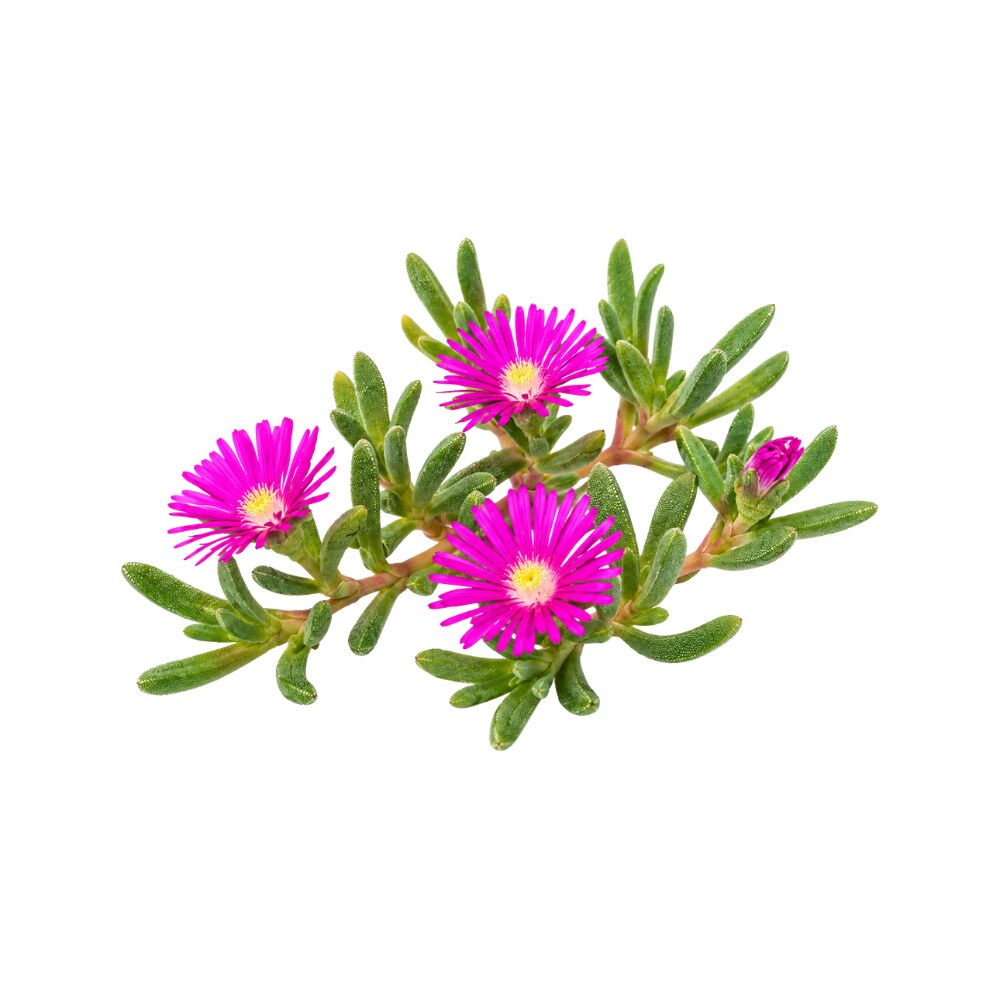
The hardy ice plant is not one species but a genus, Delosperma — a large group of low, creeping succulents in the southern-African mesemb family, the same family as kanna and the crystalline ice plant. It spreads into dense mats of small, fleshy leaves studded with glistening water-cells that catch the light like frost (the “ice” of the name), and in summer it disappears under a blaze of daisy-like flowers in magenta, purple, orange or gold. Those “petals” are really slender staminodes, a mesemb trademark.
Two species do most of the garden work: Delosperma cooperi, with magenta blooms, and the lower, yellow-flowered D. nubigenum. It is the aerial parts — the fleshy foliage and flowers — that carry the trace mesembrine-type alkaloids that give the genus its minor herbal interest.
Distribution
Unlike its frost-tender mesemb relatives, hardy ice plant comes from the high country — the summer-rainfall grasslands of the Drakensberg mountains of South Africa and Lesotho, often well above 2,000 metres, where it endures both baking sun and mountain frost. That alpine origin is exactly why these particular ice plants shrug off cold that would kill most succulents, and why they have become such popular garden ground covers.
Growing Conditions
- Full sun is essential — both flowering and compact growth fall off in shade.
- Give it sharp, fast-draining soil (sandy, gritty or rocky); it tolerates lean, poor ground but not wet feet, and winter wet — not cold — is the usual killer.
- Genuinely cold-hardy for a succulent (roughly USDA zones 5–9, some selections to zone 4), making it a rare frost-tough mesemb.
- Very easy to propagate: trailing stems root where they touch the ground, and cuttings or divisions establish readily; drought-tolerant once settled.
- Full cultivation detail lives on the companion farm-wiki grow guide for Delosperma (link to be added once that project’s public URL is confirmed).
Phytochemistry
The compounds of interest in Delosperma are the mesembrine-type alkaloids — mesembrine, mesembrenone, mesembrenol and mesembranol — the same serotonin-reuptake-inhibiting alkaloids that make kanna (Sceletium tortuosum) psychoactive, and the reason these plants are of pharmacological interest at all (SERT blockade plus PDE4 inhibition). In Delosperma these alkaloids have only been detected at very low levels, and in survey work across the Mesembryanthemaceae several samples fell below the detection threshold of the assay used 1Reference 1The distribution of mesembrine alkaloids in selected taxa of the Mesembryanthemaceae and their modification in the Sceletium-derived ‘Kougoed’ — chemical surveyView study →, so no reliable concentration can be stated. Content varies considerably between species and populations and is generally poorly characterised, which is why every figure below is recorded as No Data rather than a number.
Constituent Summary
Mesembrine-type alkaloids reported from screening of selected Delosperma taxa; where detected they occur only in trace amounts, and in some samples no alkaloid was detectable. Concentrations are not reliably quantified, so all values are given as No Data. No Data = not quantified in the sources consulted.
Mesembrine alkaloid4 compoundsno data
Pharmacology & Research
There is essentially no pharmacological literature on Delosperma itself — a PubMed search returns only leaf-biomechanics, CAM-photosynthesis, green-roof and ecology work, and no clinical trial of any Delosperma species is registered. All therapeutic interest is inferred at the constituent level, from the fact that some taxa in this family carry the same mesembrine-type alkaloids that make kanna (Sceletium tortuosum) psychoactive 1,2Reference 1The distribution of mesembrine alkaloids in selected taxa of the Mesembryanthemaceae and their modification in the Sceletium-derived ‘Kougoed’ — chemical surveyView study →Reference 2ReviewMesembrine alkaloids: review of their occurrence, chemistry, and pharmacology — reviewView study →. Those alkaloids have a genuine, partly human-tested pharmacology — serotonin-reuptake inhibition, monoamine release and PDE4 inhibition 3,4,5Reference 3In vitroPharmacological actions of the South African medicinal and functional food plant Sceletium tortuosum and its principal alkaloids — in vitro receptor/enzyme panelView study →Reference 4RCTSceletium tortuosum (Zembrin®) ameliorates experimentally induced anxiety in healthy volunteers — randomised, double-blind, placebo-controlled trialView study →Reference 5RCTAcute effects of Sceletium tortuosum (Zembrin), a dual 5-HT reuptake and PDE4 inhibitor, in the human amygdala — randomised controlled fMRI trialView study → — but every one of those studies used Sceletium/Zembrin® at standardised alkaloid levels, whereas in Delosperma the alkaloids sit at trace or below-detection amounts and are poorly characterised 1Reference 1The distribution of mesembrine alkaloids in selected taxa of the Mesembryanthemaceae and their modification in the Sceletium-derived ‘Kougoed’ — chemical surveyView study →. Read the scores below as evidence about a chemical hypothesis, not about a tested remedy: Delosperma is a botanically plausible but chemically thin, clinically untested stand-in for kanna.
- Best-supported (but for kanna, not this plant): the anxiolytic/mood pharmacology of mesembrine-type alkaloids is real and partly human-tested — dual 5-HT reuptake + PDE4 inhibition, an acute anxiety signal in a controlled RCT, and mesembrine identified as the principal anxiolytic constituent 3,4,6Reference 3In vitroPharmacological actions of the South African medicinal and functional food plant Sceletium tortuosum and its principal alkaloids — in vitro receptor/enzyme panelView study →Reference 4RCTSceletium tortuosum (Zembrin®) ameliorates experimentally induced anxiety in healthy volunteers — randomised, double-blind, placebo-controlled trialView study →Reference 6AnimalSceletium tortuosum-derived mesembrine significantly contributes to the anxiolytic effect of Zembrin®, but its anti-depressant effect may require synergy of multiple constituents — in vivo zebrafishView study →. None of it was generated in Delosperma.
- Emerging, worth watching: PDE4-linked cognitive/attentional effects and neuro-inflammatory modulation — again shown only for standardised Sceletium extract 9,10Reference 9AnimalNeuro-inflammatory and behavioral changes are selectively reversed by Sceletium tortuosum (Zembrin®) and mesembrine in male rats subjected to unpredictable chronic mild stress — animal modelView study →Reference 10RCTProof-of-concept randomized controlled study of cognition effects of the proprietary extract Sceletium tortuosum (Zembrin) targeting phosphodiesterase-4 in cognitively healthy subjects — randomised, double-blind, placebo-controlled crossover trial (NCT01805518)View study →.
- Mechanistically thin (for Delosperma): any mood claim rests on transferring kanna’s alkaloid pharmacology across a species and a concentration gap — the alkaloids are trace/below-detection here 1Reference 1The distribution of mesembrine alkaloids in selected taxa of the Mesembryanthemaceae and their modification in the Sceletium-derived ‘Kougoed’ — chemical surveyView study →.
- The caveat: no Delosperma efficacy study, no clinical trial, no standardised preparation, and no documented traditional psychoactive use — the plant is grown as a garden ground cover, not ingested.
1. Anxiolytic & mood support
This is the whole reason the plant is of interest, and all the supporting data come from kanna, not Delosperma. In a standardised Sceletium extract (Zembrin®), mesembrine and mesembrenone act as potent 5-HT transporter blockers on a receptor/enzyme panel, and the extract is also a monoamine-releasing agent rather than a pure reuptake inhibitor 3,12Reference 3In vitroPharmacological actions of the South African medicinal and functional food plant Sceletium tortuosum and its principal alkaloids — in vitro receptor/enzyme panelView study →Reference 12In vitroHigh-mesembrine Sceletium extract (Trimesemine™) is a monoamine releasing agent, rather than only a selective serotonin reuptake inhibitor — in vitro cell modelView study →. Human signal exists but is modest: a single 25 mg dose lowered subjective anxiety and heart-rate reactivity during a simulated public-speaking stressor in 20 healthy volunteers 4Reference 4RCTSceletium tortuosum (Zembrin®) ameliorates experimentally induced anxiety in healthy volunteers — randomised, double-blind, placebo-controlled trialView study →, and a functional-MRI RCT showed attenuated amygdala reactivity to fearful faces and reduced amygdala–hypothalamus coupling after Zembrin® 5Reference 5RCTAcute effects of Sceletium tortuosum (Zembrin), a dual 5-HT reuptake and PDE4 inhibitor, in the human amygdala — randomised controlled fMRI trialView study →. In a zebrafish dose-response, mesembrine specifically accounted for the anxiolytic-like effect of the whole extract, while the antidepressant-like effect required the intact extract and could not be reproduced by any single alkaloid 6Reference 6AnimalSceletium tortuosum-derived mesembrine significantly contributes to the anxiolytic effect of Zembrin®, but its anti-depressant effect may require synergy of multiple constituents — in vivo zebrafishView study →; earlier zebrafish and rat work is directionally consistent 7,8Reference 7AnimalMesembryanthemum tortuosum L. alkaloids modify anxiety-like behaviour in a zebrafish model — in vivo zebrafishView study →Reference 8AnimalEffects of Sceletium tortuosum in rats — animal behavioural modelView study →. For Delosperma, none of this has been tested, and the driving alkaloids are present only in trace amounts, often below detection 1Reference 1The distribution of mesembrine alkaloids in selected taxa of the Mesembryanthemaceae and their modification in the Sceletium-derived ‘Kougoed’ — chemical surveyView study →.
Gap: Zero Delosperma studies of any kind; the human data are single-dose, small, and Sceletium-specific, and Delosperma lacks both a standardised alkaloid content and any documented ingestion history.
2. Cognitive & attentional support
The cognitive claim rests almost entirely on one small proof-of-concept RCT of standardised Sceletium extract: 25 mg/day of Zembrin® for three weeks in 21 cognitively healthy adults (crossover) improved cognitive set-flexibility and executive function versus placebo, with the authors attributing the effect to PDE4–cAMP–CREB signalling 10Reference 10RCTProof-of-concept randomized controlled study of cognition effects of the proprietary extract Sceletium tortuosum (Zembrin) targeting phosphodiesterase-4 in cognitively healthy subjects — randomised, double-blind, placebo-controlled crossover trial (NCT01805518)View study →. Mesembrenone is the alkaloid carrying the more potent PDE4-inhibitory activity that underpins this rationale 2,3Reference 2ReviewMesembrine alkaloids: review of their occurrence, chemistry, and pharmacology — reviewView study →Reference 3In vitroPharmacological actions of the South African medicinal and functional food plant Sceletium tortuosum and its principal alkaloids — in vitro receptor/enzyme panelView study →. Ex vivo, Zembrin® and its four alkaloids (mesembrine, mesembrenone, mesembrenol, mesembranol) alter electrical excitability in the rat hippocampus 11Reference 11In vitroEffect of Zembrin® and four of its alkaloid constituents on electric excitability of the rat hippocampus — ex vivo/in vitroView study →, and a 2025 chronic-mild-stress rat study reported that both the extract and isolated mesembrine reversed selected neuro-inflammatory and behavioural changes 9Reference 9AnimalNeuro-inflammatory and behavioral changes are selectively reversed by Sceletium tortuosum (Zembrin®) and mesembrine in male rats subjected to unpredictable chronic mild stress — animal modelView study →. All of this is Sceletium; the transfer to Delosperma is weaker here than for the anxiolytic claim, because the effect appears to depend on the standardised whole-extract composition rather than any single trace alkaloid.
Gap: One small human trial, one preparation, one company’s extract; no Delosperma cognitive data, and the PDE4 rationale depends on mesembrenone levels that are unquantified in Delosperma.
Mechanisms
| Mechanism | Drives | Key compounds |
|---|---|---|
| 5-HT transporter (SERT) blockade; monoamine release 3,12Reference 3In vitroPharmacological actions of the South African medicinal and functional food plant Sceletium tortuosum and its principal alkaloids — in vitro receptor/enzyme panelView study →Reference 12In vitroHigh-mesembrine Sceletium extract (Trimesemine™) is a monoamine releasing agent, rather than only a selective serotonin reuptake inhibitor — in vitro cell modelView study → | anxiolytic & mood support | mesembrine, mesembrenone |
| PDE4 inhibition → cAMP / CREB signalling 2,10Reference 2ReviewMesembrine alkaloids: review of their occurrence, chemistry, and pharmacology — reviewView study →Reference 10RCTProof-of-concept randomized controlled study of cognition effects of the proprietary extract Sceletium tortuosum (Zembrin) targeting phosphodiesterase-4 in cognitively healthy subjects — randomised, double-blind, placebo-controlled crossover trial (NCT01805518)View study → | cognitive & attentional support | mesembrenone |
| modulation of hippocampal electrical excitability, ex vivo 11Reference 11In vitroEffect of Zembrin® and four of its alkaloid constituents on electric excitability of the rat hippocampus — ex vivo/in vitroView study → | mood / cognitive (mechanistic only) | mesembrenol, mesembranol |
Clinical trials
No registered clinical trials identified for any Delosperma species — the evidence base is preclinical/traditional, and what human data exist are for Sceletium/Zembrin®, not this plant. The three registered trials in this chemical space (including NCT01805518, the Zembrin® cognition study 10Reference 10RCTProof-of-concept randomized controlled study of cognition effects of the proprietary extract Sceletium tortuosum (Zembrin) targeting phosphodiesterase-4 in cognitively healthy subjects — randomised, double-blind, placebo-controlled crossover trial (NCT01805518)View study →) all study Sceletium tortuosum.
| Completed | Planned | Terminated | Preclinical |
|---|---|---|---|
| 0(Delosperma) | 0 | 0 | 0(Delosperma); ~10+ for Sceletium/mesembrine |
Last checked: July 2026.
Dosage
No Delosperma dosing exists, and reliable traditional dosing does not exist — the plant is grown as an ornamental ground cover, not ingested. Any psychoactive use is experimental and undosed. Where a dose has been characterised at all in this chemical space, it was for standardised Sceletium extract (25 mg/day of Zembrin® in the human trials 4,10Reference 4RCTSceletium tortuosum (Zembrin®) ameliorates experimentally induced anxiety in healthy volunteers — randomised, double-blind, placebo-controlled trialView study →Reference 10RCTProof-of-concept randomized controlled study of cognition effects of the proprietary extract Sceletium tortuosum (Zembrin) targeting phosphodiesterase-4 in cognitively healthy subjects — randomised, double-blind, placebo-controlled crossover trial (NCT01805518)View study →), which is a different plant and preparation and should not be read across to Delosperma.
Traditional Dosage
There is no traditional Delosperma dosage. Unlike kanna — whose fermented “kougoed” has a documented ethnobotanical record — Delosperma has no history of preparation or ingestion for effect 15Reference 15ReviewPsychoactive constituents of the genus Sceletium N.E.Br. and other Mesembryanthemaceae: a review — historical/ethnobotanical reviewView study →.
Safety & Pregnancy
Human safety data for Delosperma are absent, and ornamental garden use raises no known concern. The only reason for caution is chemical — some taxa carry kanna-like serotonergic alkaloids, so if a preparation did contain meaningful levels the same SSRI/MAOI caution would apply.
- No human data. No clinical, toxicological or case-report literature exists for any Delosperma species — treat medicinal use as unstudied.
- Serotonergic caution (inferred). If a preparation carried meaningful mesembrine-type alkaloids, avoid combining with SSRIs, SNRIs, MAOIs or triptans (serotonin-syndrome risk).
- Ornamental use. Grown as a garden ground cover; the alkaloids sit at trace or below-detection levels, so both benefit and interaction risk are unquantified.
Full safety & interactions detail
Human safety data for Delosperma are absent — no clinical, toxicological, or case-report literature exists for any Delosperma species, and ornamental garden use raises no known concern. The only reason for caution is chemical: some taxa in this family contain mesembrine-type alkaloids that inhibit serotonin reuptake and release monoamines 3,12Reference 3In vitroPharmacological actions of the South African medicinal and functional food plant Sceletium tortuosum and its principal alkaloids — in vitro receptor/enzyme panelView study →Reference 12In vitroHigh-mesembrine Sceletium extract (Trimesemine™) is a monoamine releasing agent, rather than only a selective serotonin reuptake inhibitor — in vitro cell modelView study →, so if a Delosperma preparation did carry meaningful alkaloid levels, the same serotonergic caution that applies to kanna would apply — avoid combining with SSRIs, SNRIs, MAOIs, triptans or other serotonergic agents, where the specific concern is additive serotonergic load (serotonin syndrome). In practice the alkaloids in Delosperma are reported at trace or below-detection levels 1Reference 1The distribution of mesembrine alkaloids in selected taxa of the Mesembryanthemaceae and their modification in the Sceletium-derived ‘Kougoed’ — chemical surveyView study →, so both the benefit and this interaction risk are unquantified rather than absent. Where safety has been characterised at all in this chemical space it was for standardised Sceletium extract (rat NOAEL 600 mg/kg/day over 90 days; well tolerated in a 3-month human RCT) 13,14Reference 13RCTA randomized, double-blind, parallel-group, placebo-controlled trial of extract Sceletium tortuosum (Zembrin) in healthy adults — randomised controlled safety/tolerability trialView study →Reference 14AnimalA toxicological safety assessment of a standardized extract of Sceletium tortuosum (Zembrin®) in rats — 14-day and 90-day subchronic oral toxicity studyView study →, not for this plant. No pharmacopoeia (WHO/ESCOP/EMA/Commission E) covers Delosperma.
Herb–drug interactions have not been specifically evaluated for Delosperma: the SSRI/MAOI caution above is inferred from the pharmacology of the shared alkaloids in Sceletium, not measured in this plant, and is contingent on those alkaloids being present at meaningful levels — which the same evidence says they are not. Absence of reported problems is not evidence of safety.
Pregnancy and lactation have not been assessed for Delosperma or for the isolated mesembrine-type alkaloids. Given a plant with essentially no human data, treat any medicinal or psychoactive use as unstudied in pregnancy and lactation, and avoid it.
References
- Smith MT, Field CR, Crouch NR, Hirst M. (1998). The distribution of mesembrine alkaloids in selected taxa of the Mesembryanthemaceae and their modification in the Sceletium-derived ‘Kougoed’ — chemical survey. Pharmaceutical Biology, 36(3):173–179. https://doi.org/10.1076/phbi.36.3.173.6350
- Krstenansky JL. (2017). Mesembrine alkaloids: review of their occurrence, chemistry, and pharmacology — review. Journal of Ethnopharmacology, 195:10–19. https://pubmed.ncbi.nlm.nih.gov/27939420/
- Harvey AL, Young LC, Viljoen AM, Gericke NP. (2011). Pharmacological actions of the South African medicinal and functional food plant Sceletium tortuosum and its principal alkaloids — in vitro receptor/enzyme panel. Journal of Ethnopharmacology, 137(3):1124–1129. https://pubmed.ncbi.nlm.nih.gov/21798331/
- Reay J, Wetherell MA, Morton E, Lillis J, Badmaev V. (2020). Sceletium tortuosum (Zembrin®) ameliorates experimentally induced anxiety in healthy volunteers — randomised, double-blind, placebo-controlled trial. Human Psychopharmacology, 35(6):1–7. https://pubmed.ncbi.nlm.nih.gov/32761980/
- Terburg D, Syal S, Rosenberger LA, et al. (2013). Acute effects of Sceletium tortuosum (Zembrin), a dual 5-HT reuptake and PDE4 inhibitor, in the human amygdala — randomised controlled fMRI trial. Neuropsychopharmacology, 38(13):2708–2716. https://pubmed.ncbi.nlm.nih.gov/23903032/
- Gericke J, Steyn SF, Viljoen AM, et al. (2024). Sceletium tortuosum-derived mesembrine significantly contributes to the anxiolytic effect of Zembrin®, but its anti-depressant effect may require synergy of multiple constituents — in vivo zebrafish. Journal of Ethnopharmacology, 319(Pt 1):117113. https://pubmed.ncbi.nlm.nih.gov/37660956/
- Maphanga VB, Skalicka-Woźniak K, Budzynska B, et al. (2022). Mesembryanthemum tortuosum L. alkaloids modify anxiety-like behaviour in a zebrafish model — in vivo zebrafish. Journal of Ethnopharmacology, 290:115068. https://pubmed.ncbi.nlm.nih.gov/35134486/
- Loria MJ, Ali Z, Abe N, Sufka KJ, Khan IA. (2014). Effects of Sceletium tortuosum in rats — animal behavioural model. Journal of Ethnopharmacology, 155(1):731–735. https://pubmed.ncbi.nlm.nih.gov/24930358/
- Gericke J, Brand L, Steyn SF, et al. (2025). Neuro-inflammatory and behavioral changes are selectively reversed by Sceletium tortuosum (Zembrin®) and mesembrine in male rats subjected to unpredictable chronic mild stress — animal model. Cells, 14(13). https://pubmed.ncbi.nlm.nih.gov/40643548/
- Chiu S, Gericke N, Farina-Woodbury M, et al. (2014). Proof-of-concept randomized controlled study of cognition effects of the proprietary extract Sceletium tortuosum (Zembrin) targeting phosphodiesterase-4 in cognitively healthy subjects — randomised, double-blind, placebo-controlled crossover trial (NCT01805518). Evidence-Based Complementary and Alternative Medicine, 2014:682014. https://pubmed.ncbi.nlm.nih.gov/25389443/
- Dimpfel W, Gericke N, Suliman S, Chiegoua Dipah G. (2018). Effect of Zembrin® and four of its alkaloid constituents on electric excitability of the rat hippocampus — ex vivo/in vitro. Journal of Ethnopharmacology, 223:135–141. https://pubmed.ncbi.nlm.nih.gov/29758341/
- Coetzee DD, López V, Smith C. (2016). High-mesembrine Sceletium extract (Trimesemine™) is a monoamine releasing agent, rather than only a selective serotonin reuptake inhibitor — in vitro cell model. Journal of Ethnopharmacology, 177:111–116. https://pubmed.ncbi.nlm.nih.gov/26615766/
- Nell H, Siebert M, Chellan P, Gericke N. (2013). A randomized, double-blind, parallel-group, placebo-controlled trial of extract Sceletium tortuosum (Zembrin) in healthy adults — randomised controlled safety/tolerability trial. Journal of Alternative and Complementary Medicine, 19(11):898–904. https://pubmed.ncbi.nlm.nih.gov/23441963/
- Murbach TS, Hirka G, Szakonyiné IP, Gericke N, Endres JR. (2014). A toxicological safety assessment of a standardized extract of Sceletium tortuosum (Zembrin®) in rats — 14-day and 90-day subchronic oral toxicity study. Food and Chemical Toxicology, 74:190–199. https://pubmed.ncbi.nlm.nih.gov/25301237/
- Smith MT, Crouch NR, Gericke N, Hirst M. (1996). Psychoactive constituents of the genus Sceletium N.E.Br. and other Mesembryanthemaceae: a review — historical/ethnobotanical review. Journal of Ethnopharmacology, 50(3):119–130. https://pubmed.ncbi.nlm.nih.gov/8691846/