

The Racetam Family Of Nootropics
Since piracetam, several dozen racetam-family compounds have been synthesized, though only a handful are commonly used for cognitive enhancement.
All racetams are classified due to their related structure.
In the body, this structure is broken apart to release a number of smaller metabolites which then go on to interact with the brain’s chemistry.
They work mainly by increasing the production of the neurotransmitter acetylcholine, and to a lesser extent, the production of dopamine, glutamine, and serotonin.
The History Of Racetams
The racetam family of nootropics were the first nootropics to be discovered when researchers synthesized a molecule designed to combat motion sickness.
This molecule was called piracetam.
Piracetam was first synthesized in 1964, and clinical interest shifted toward cognition after reports emerged that people taking the motion-sickness compound experienced improved mental clarity as a side effect.
Dr. Corneliu Giurgea, the Romanian scientist who led the team that created piracetam, coined the term “nootropic” in 1972 — from the Greek noos (“mind”) and trepein (“to bend or turn”) — to describe this new class of cognition-enhancing compounds.
He spent many years closely investigating the concept of cognitive enhancement, and sought out mechanisms of action for this new class of drugs.
Since this time, there have been many different racetam drugs created, all with the same central structure, but various other additions to the molecule to amplify their effects of absorption in one way or another.
The Structure Of A Racetam
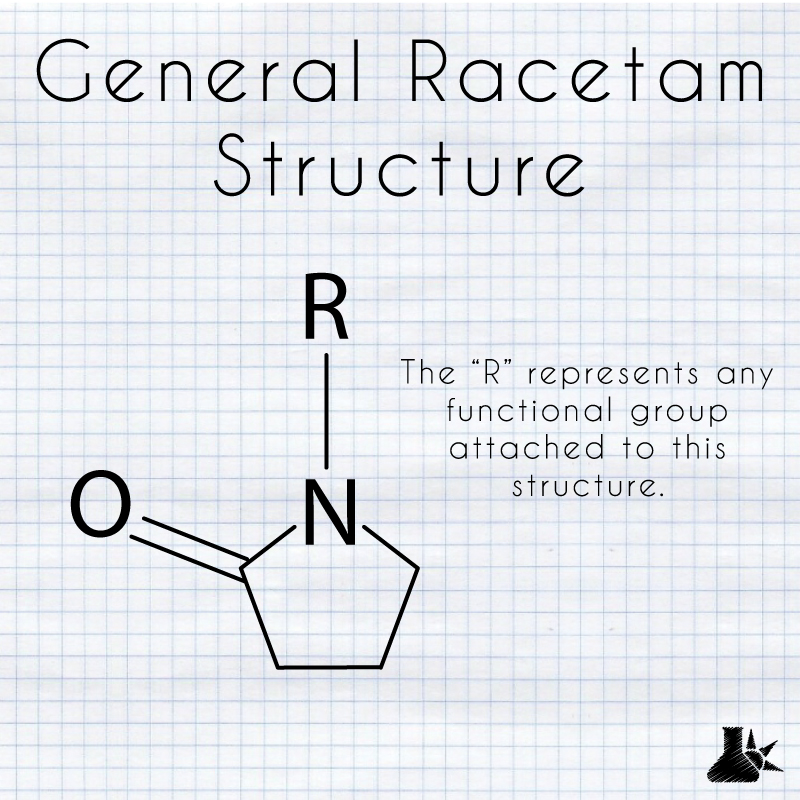
In order to classify as a racetam, the compound must have a 2-pyrrolidone nucleus made up of oxygen, nitrogen, and hydrogen.
The Different Racetams
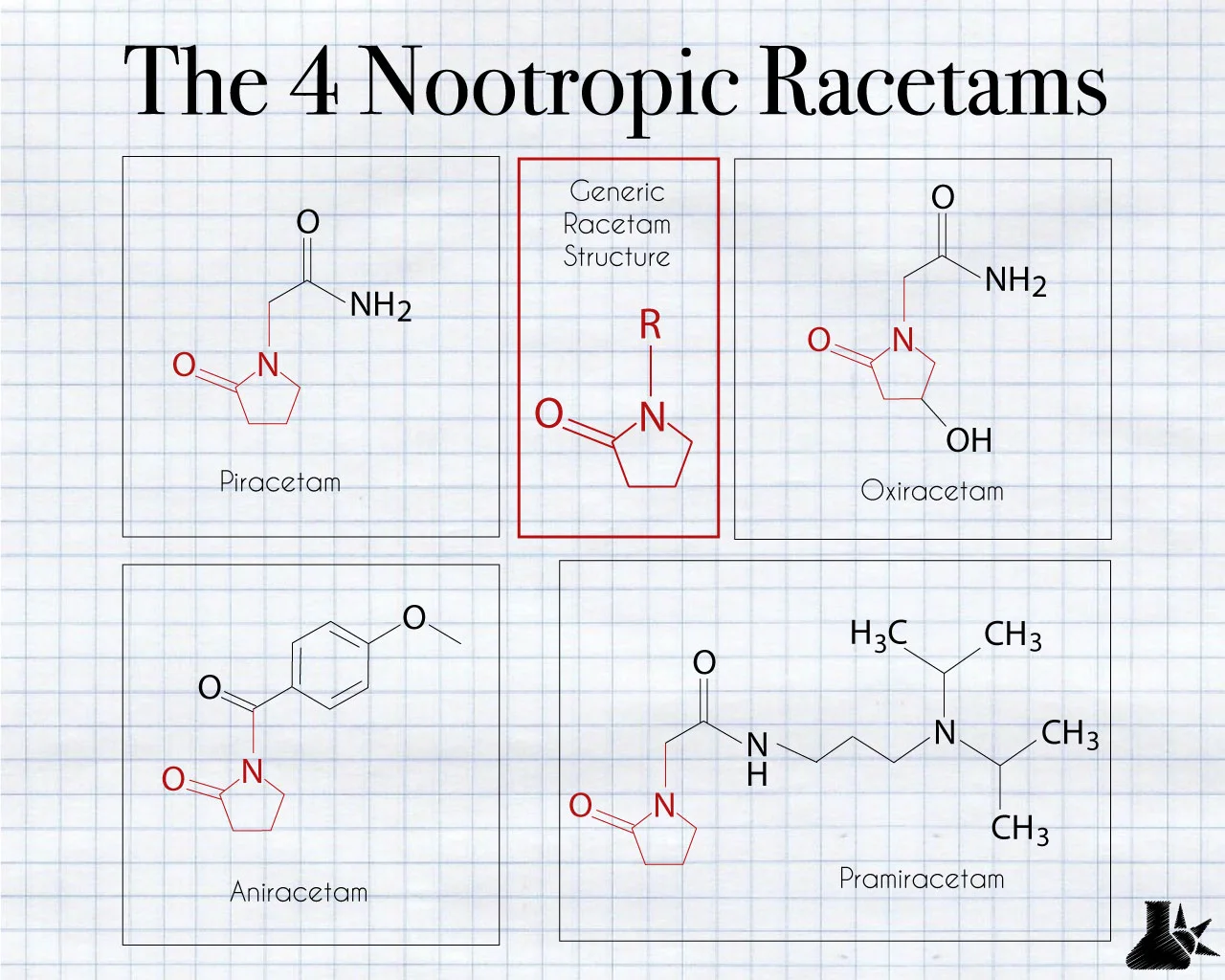
Since piracetam’s discovery, chemists have synthesized several dozen related racetam and “racetam-like” compounds (sources commonly cite figures in the low-to-mid twenties for close structural analogues, with additional loosely related compounds beyond that) 1Reference 1Nootropics as cognitive enhancers: types, dosage and side effects of smart drugs. Of these, only a handful see regular use as nootropics — most commonly piracetam, aniracetam, oxiracetam, and pramiracetam.
All of these racetams have the same nucleus, which is illustrated below as the red portion of the structure.
From here, the “R” groups change. These differences change how the drug is metabolized, its absorption, and its elimination from the body.
1. Piracetam
The simplest structure, piracetam, was the first racetam (and nootropic for that matter) ever created.
It’s the simplest of the four, and has a long history of use dating back to its synthesis in 1964.
Piracetam works mainly through stimulation of acetylcholine production, but also has an effect on serotonin, dopamine, and glutamate.
2. Aniracetam
Aniracetam is a close relative of piracetam but is a bit more potent and longer lasting in its effects.
The compound is fat soluble (rather than water soluble) which helps it last longer inside the body.
It works in a similar way to piracetam but has a stronger effect on the AMPA receptors. This makes it a better candidate for studying.
3. Oxiracetam
Moving on up the ranks we reach oxiracetam.
This version is even stronger in its actions and is slightly longer lasting than aniracetam. It works in a similar way to the other racetams but is suggested to have a better effect on ATP, thus improving mental energy along the way.
It’s considered by many to have a stimulating effect on the mind. This is a great nootropic for periods of mental fatigue, but should not be overused.
4. Pramiracetam
Pramiracetam is the largest of the 4, and as such has a few differences in its functions. It’s widely considered the most potent of the commonly used racetams by dose — anecdotal and vendor sources put this anywhere from roughly 10 to 30 times piracetam’s potency by weight, but there isn’t solid peer-reviewed human dose-comparison data to pin down an exact multiplier, so treat any specific number with caution.
It has both the strongest action and the longest half-life once inside the body.
It is fat soluble and has a notably high bioavailability. Pramiracetam also has a high level of safety, with few side effects noted despite long-term use.
Are Racetams Safe?
The clinical literature that does exist, mainly for piracetam, generally reports a mild side-effect profile — headaches, agitation, and gastrointestinal upset are the most common, often linked to choline depletion (which is why racetams are commonly paired with a choline source like alpha-GPC) 2Reference 2ReviewPiracetam: a review of pharmacological properties and clinical uses. Some of the negativity around racetams online comes from anecdotal reports rather than controlled data — those reports have their own value, but they aren’t a substitute for trials.
That said, “safe” needs a regulatory caveat. In the United States, none of the racetams — including piracetam — are FDA-approved as drugs or lawfully marketable as dietary supplements: piracetam does not meet the legal definition of a dietary ingredient, and the FDA has sent warning letters to companies selling it as a supplement 3,4Reference 3Warning Letter — Pure Nootropics, LLC (565425)Reference 4Presence of piracetam in cognitive enhancement dietary supplements. It remains widely available online despite this, occupying a legal grey area rather than a clearly sanctioned one. In several European countries piracetam is sold as a prescription drug for conditions like myoclonus and cognitive decline, but that regulatory approval doesn’t extend to informal nootropic use, and it does not apply in the US or most of the EU as an over-the-counter product.
As with any unregulated compound, if you choose to use a racetam, start with a low dose, pay attention to side effects, and build up gradually.
Article By:
The Sunlight Experiment
References:
- Malík, M., & Tlustoš, P. (2022). Nootropics as cognitive enhancers: types, dosage and side effects of smart drugs. Nutrients, 14(16), 3367. Link
- Winblad, B. (2005). Piracetam: a review of pharmacological properties and clinical uses. CNS Drug Reviews, 11(2), 169-182. Link
- U.S. Food and Drug Administration/Federal Trade Commission (2019). Warning Letter — Pure Nootropics, LLC (565425). Link
- Cohen, P. A., Zakharevich, I., & Gerona, R. (2019). Presence of piracetam in cognitive enhancement dietary supplements. JAMA Internal Medicine, 180(3), 458-459. Link
Justin Cooke
Clinical herbalist and the writer behind The Sunlight Experiment — an evidence-based pharmacopoeia of herbs, supplements, and the chemistry behind them.