
Materia Medica
California Poppy
Eschscholzia californica
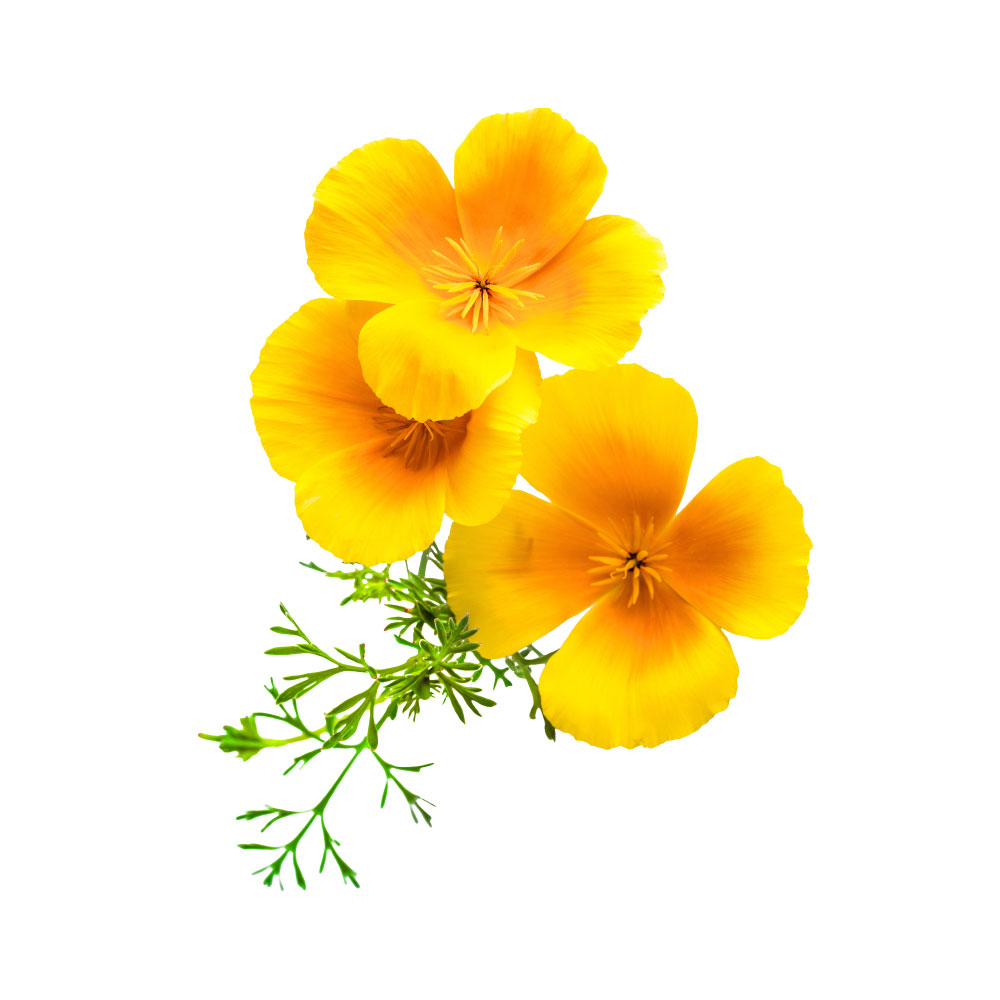
California poppy (Eschscholzia californica) — a mild, non-addictive herbal sedative used for anxiety, insomnia and chronic pain.
California Poppy Summary
California poppy is a relative of the opium poppy that gives us morphine. This particular member contains a different set of alkaloids with similar, but milder effects.
California Poppy is the official state flower for California but grows throughout the Southern parts of the United States.
Its primary uses — both in modern herbal medicine and traditional herbal medicine — is for treating anxiety, chronic pain, and insomnia. It’s one of the most potent herbal sedatives available.
How Is California Poppy Used?
California poppy is used for its sedative and analgesic effects. It contains a set of alkaloids similar to morphine, though not as strong. It can be used both internally for anxiety, insomnia, and chronic pain, as well as topically for skin irritations and ulcers.
Botany
California poppy is a herbaceous plant in the poppy family (Papaveraceae — roughly 42 genera and 775 species; the genus Eschscholzia holds about 12 species). The species has been extensively bred commercially and by hobbyists as an ornamental garden flower, producing a wide range of colors and forms.
Distribution
Eschscholzia californica is native to the western United States, from hillsides, roadsides and open areas of southern Washington south through California, Nevada and New Mexico to northern Mexico. It has naturalized well beyond that range and become clearly invasive in some places: in central Chile it has spread through disturbed open habitat and grassland since its introduction as an ornamental in the 1890s, and in Australia it is regarded as invasive in Victoria and a major weed of open habitat in the Blue Mountains region of New South Wales.
Growing Conditions
- Full sun; medium water, low maintenance; readily self-seeds. Roughly USDA zone 6-10 (short-lived perennial in zones 8-10, annual in colder climates).
- Full cultivation detail lives on the companion farm-wiki grow guide for Eschscholzia californica (link to be added once that project’s public URL is confirmed).
Phytochemistry
The activity of California poppy is carried almost entirely by its isoquinoline alkaloids, which accumulate to roughly 1.6% of the dried aerial parts (the root is richer still) 1Reference 1Modulatory effects of Eschscholzia californica alkaloids on recombinant GABAA receptorsView study →. The two dominant compounds are the pavine alkaloids californidine and eschscholtzine, with the aporphine N-methyllaurotetanine next most abundant — these are the alkaloids most associated with the herb’s GABA-modulating, sedative and anxiolytic profile 1,2Reference 1Modulatory effects of Eschscholzia californica alkaloids on recombinant GABAA receptorsView study →Reference 2In vitroAlkaloids from Eschscholzia californica and their capacity to inhibit binding of [3H]8-OH-DPAT to 5-HT1A receptors in vitroView study →.
Present at far lower levels are the protopine-type alkaloids protopine and allocryptopine, and trace amounts of the benzophenanthridines sanguinarine and chelerythrine 1Reference 1Modulatory effects of Eschscholzia californica alkaloids on recombinant GABAA receptorsView study →. Unlike its relative the opium poppy, Eschscholzia californica contains no morphine or other phenanthrene opiates.
Constituent Summary
Values are the share of total alkaloids in the dried aerial parts; “dominant / minor / trace” reflect relative abundance reported across analyses rather than fixed percentages, and the actual content varies with chemotype, plant part and growing conditions 1,2Reference 1Modulatory effects of Eschscholzia californica alkaloids on recombinant GABAA receptorsView study →Reference 2In vitroAlkaloids from Eschscholzia californica and their capacity to inhibit binding of [3H]8-OH-DPAT to 5-HT1A receptors in vitroView study →.
Isoquinoline8 compounds8 with data
Pharmacology & Research
The pharmacological literature on California poppy (Eschscholzia californica) is small and tilted heavily toward preclinical work: a handful of mouse behavioural studies from the 1990s–2000s, several in vitro receptor and enzyme assays, and a genome/biosynthesis literature that dwarfs the therapeutic one. The signal the studies most consistently support is a mild central-nervous-system depressant (sedative/anxiolytic) effect, mapped mechanistically to GABAA and serotonin (5-HT1A) receptor modulation rather than to opioid pathways 1,2,4,5Reference 1Modulatory effects of Eschscholzia californica alkaloids on recombinant GABAA receptorsView study →Reference 2In vitroAlkaloids from Eschscholzia californica and their capacity to inhibit binding of [3H]8-OH-DPAT to 5-HT1A receptors in vitroView study →Reference 4Behavioural effects of the American traditional plant Eschscholzia californica: sedative and anxiolytic propertiesView study →Reference 5Neurophysiological effects of an extract of Eschscholzia californica ChamView study →. Human data exist but remain weak: the one published positive randomised controlled trial tested California poppy only inside a fixed combination with hawthorn and magnesium, so the herb’s individual contribution is unquantified 3Reference 3RCTDouble-blind, randomised, placebo-controlled study of a fixed combination of Crataegus oxyacantha and Eschscholtzia californica and magnesium in mild-to-moderate anxietyView study →. A completed Phase 3 placebo-controlled monotherapy trial of Eschscholzia tablets for sleep (NCT06795776, n=104) does exist, but its results have not been posted, so it cannot yet be weighed. Almost everything hinges on preparation: alkaloid content varies several-fold between commercial products, and the ethanol tincture that the site lists as the standard dose is pharmacologically distinct from the aqueous tea, which appears far less active at CYP enzymes 8,11Reference 8Modulation of CYPs, P-gp, and PXR by Eschscholzia californica and its alkaloidsView study →Reference 11Alkaloids in commercial preparations of California poppy — quantification, intestinal permeability and microbiota interactionsView study →.
- Best-supported: mild anxiolytic and sedative activity, replicated across mouse behavioural models and one combination-product RCT, with a flumazenil-reversible (benzodiazepine-site) mechanism 1,3,4,5Reference 1Modulatory effects of Eschscholzia californica alkaloids on recombinant GABAA receptorsView study →Reference 3RCTDouble-blind, randomised, placebo-controlled study of a fixed combination of Crataegus oxyacantha and Eschscholtzia californica and magnesium in mild-to-moderate anxietyView study →Reference 4Behavioural effects of the American traditional plant Eschscholzia californica: sedative and anxiolytic propertiesView study →Reference 5Neurophysiological effects of an extract of Eschscholzia californica ChamView study →.
- Emerging, worth watching: peripheral analgesia in mice 5Reference 5Neurophysiological effects of an extract of Eschscholzia californica ChamView study →; in vitro antioxidant/anti-hepatotoxic and cholinesterase-inhibiting activity of aerial-part extracts 12Reference 12Comprehensive metabolomic profiling and biological activity analysis of Eschscholzia californica extracts using LC-ESI-QTOF-MSView study →.
- Mechanistically thin: hypocholesterolemic and anticancer claims rest on isolated single alkaloids (californidine, sanguinarine) in cell lines, not the whole herb 12,13Reference 12Comprehensive metabolomic profiling and biological activity analysis of Eschscholzia californica extracts using LC-ESI-QTOF-MSView study →Reference 13Evaluation of natural isoquinoline alkaloids on LDLR and PCSK9 in hepatocytes as potential hypocholesterolemic agentsView study →.
- The caveat: no published monotherapy human trial exists (a completed Phase 3 sleep trial, NCT06795776, awaits results), there is no standardised dose, and alkaloid content varies several-fold between products — a tea and a tincture are not interchangeable 8,11Reference 8Modulation of CYPs, P-gp, and PXR by Eschscholzia californica and its alkaloidsView study →Reference 11Alkaloids in commercial preparations of California poppy — quantification, intestinal permeability and microbiota interactionsView study →.
1. Anxiolytic
The anxiolytic claim is the herb’s best-supported use, though the human evidence is indirect. In mice, an aqueous extract produced an anticonflict effect at a low dose (25 mg/kg) — more steps climbed in the staircase test and more time in the lit compartment of a light/dark box — separable from frank sedation, which appeared only at higher doses 4Reference 4Behavioural effects of the American traditional plant Eschscholzia californica: sedative and anxiolytic propertiesView study →. A follow-up study showed the anxiolytic and sedative effects were abolished by flumazenil, implicating the benzodiazepine site of the GABAA receptor 5Reference 5Neurophysiological effects of an extract of Eschscholzia californica ChamView study →. Mechanistically, the aerial-part alkaloid (S)-reticuline acts as a positive allosteric modulator at α3, α5 and α6 GABAA isoforms, while N-methyllaurotetanine contributes 5-HT1A affinity 1,2Reference 1Modulatory effects of Eschscholzia californica alkaloids on recombinant GABAA receptorsView study →Reference 2In vitroAlkaloids from Eschscholzia californica and their capacity to inhibit binding of [3H]8-OH-DPAT to 5-HT1A receptors in vitroView study →. The only randomised controlled trial (n=264, 3 months) tested a fixed combination of California poppy, hawthorn (Crataegus) and magnesium (Sympathyl) against placebo in mild-to-moderate generalised anxiety, finding a modest but significant advantage on the Hamilton anxiety score (−10.6 vs −8.9; p=0.005) 3Reference 3RCTDouble-blind, randomised, placebo-controlled study of a fixed combination of Crataegus oxyacantha and Eschscholtzia californica and magnesium in mild-to-moderate anxietyView study →.
Gap: No published trial has tested California poppy alone in humans (the completed monotherapy trial NCT06795776 targets sleep, not anxiety, and has no posted results), so its contribution within the anxiety combination product — and the effective monotherapy dose — is unknown.
2. Sedative / sleep support
California poppy’s traditional use as a sleep aid has some experimental backing, again mostly preclinical. In mice the aqueous extract induced sleep and reduced spontaneous locomotion at doses above 100 mg/kg 4Reference 4Behavioural effects of the American traditional plant Eschscholzia californica: sedative and anxiolytic propertiesView study →. In humans, a placebo-controlled quantitative-EEG screen of eight plant extracts detected a measurable acute sedative signal for California poppy alongside increased self-rated tiredness, though the effect was weaker and qualitatively different from the diazepam reference 6Reference 6The quantitative EEG as a screening instrument to identify sedative effects of single doses of plant extracts in comparison with diazepamView study →. The only human sleep-outcome data come from a 4-week open-label pilot (n=40) of a multi-ingredient product combining melatonin, vitamin B6, California poppy, passionflower and lemon balm, which improved sleep-quality scores — a result that cannot be attributed to the poppy specifically 9Reference 9A combination of melatonin, vitamin B6 and medicinal plants in the treatment of mild-to-moderate insomnia: a prospective pilot studyView study →.
Gap: Every published human sleep result is confounded by co-administered melatonin or other sedative herbs; a single-herb, placebo-controlled Phase 3 sleep trial has completed (NCT06795776, n=104) but its results are not yet posted, and no hypnotic dose is defined.
3. Analgesic
Analgesia is a traditional indication with limited but mechanistically interesting support. In mice, the extract produced peripheral analgesic effects, but — importantly — did not behave like an opioid or a muscle relaxant, and did not protect against pentylenetetrazol convulsions 5Reference 5Neurophysiological effects of an extract of Eschscholzia californica ChamView study →. This distinguishes California poppy from its relative the opium poppy: it contains no morphine or phenanthrene opiates, and its pain effect appears to run through the same GABAergic/benzodiazepine-site mechanism as its sedation rather than through opioid receptors 5Reference 5Neurophysiological effects of an extract of Eschscholzia californica ChamView study →. The protopine-type and pavine alkaloids are the presumed actives.
Gap: No human analgesia trial exists, and the “opioid receptor agonist” description sometimes attached to the herb is not supported by the primary pharmacology, which points to a non-opioid, benzodiazepine-site mechanism.
4. Antioxidant
Antioxidant activity is confined to in vitro work on aerial-part extracts. A 2025 LC-QTOF-MS study characterised four extracts (ethyl acetate, ethanol, 70% ethanol/water, water), identifying 70 compounds including rutin, quercetin glycosides and caffeic-acid derivatives, and measured concentration-dependent radical-scavenging activity across standard assays 12Reference 12Comprehensive metabolomic profiling and biological activity analysis of Eschscholzia californica extracts using LC-ESI-QTOF-MSView study →. The activity tracks the flavonoid fraction rather than the signature alkaloids.
Gap: No animal or human antioxidant data — the effect is measured only in cell-free and cell-culture systems, and the flavonoids responsible are not unique to this herb.
5. Cholinesterase inhibition
A single 2025 study screened E. californica extracts for neuroprotective-enzyme inhibition, reporting anti-acetylcholinesterase activity (highest in the ethanol extract, 2.39 mg GALAE/g) and anti-butyrylcholinesterase activity (highest in ethyl acetate) 12Reference 12Comprehensive metabolomic profiling and biological activity analysis of Eschscholzia californica extracts using LC-ESI-QTOF-MSView study →. Accompanying network-pharmacology and docking work flagged protopine, boldine and (S)-scoulerine as candidate binders of insomnia-related dopaminergic and serotonin-transporter targets 12Reference 12Comprehensive metabolomic profiling and biological activity analysis of Eschscholzia californica extracts using LC-ESI-QTOF-MSView study →.
Gap: This rests on one in vitro/in silico paper with no behavioural or clinical follow-up; the cholinesterase result is a screening observation, not evidence of a cognitive effect.
6. Hypocholesterolemic
This is a constituent-level inference, not a whole-herb finding. In a hepatocyte model, the isolated pavine alkaloid californidine induced LDL-receptor expression comparably to low-dose simvastatin and reduced PCSK9 expression, alongside berberine and other isoquinoline alkaloids 13Reference 13Evaluation of natural isoquinoline alkaloids on LDLR and PCSK9 in hepatocytes as potential hypocholesterolemic agentsView study →. California poppy is one of several plants that contain such alkaloids, but the whole herb has never been tested for lipid effects.
Gap: The effect is shown only for a purified single molecule in cell culture; there is no evidence the alkaloid reaches relevant concentrations from a normal dose of the herb, and no in vivo or human lipid data.
Mechanisms
| Mechanism | Drives | Key compounds |
|---|---|---|
| GABAA positive allosteric modulation (benzodiazepine site; flumazenil-reversible) | anxiolyticsedativeanalgesic | (S)-reticuline (N-methyllaurotetanine inactive <30 µM) |
| 5-HT1A / 5-HT7 receptor binding | anxiolyticsedative | N-methyllaurotetanine |
| Radical scavenging / anti-lipoperoxidation | antioxidant | rutin, quercetin |
| Cholinesterase (AChE/BuChE) inhibition | cholinesterase inhibition | protopine, boldine |
| LDLR induction / PCSK9 suppression | hypocholesterolemic | californidine |
| CYP3A4/2C9/2C19/2D6 inhibition, PXR activation (ethanol extract; drug-interaction risk) | — (safety) | eschscholtzine, allocryptopine, protopine |
Clinical trials
Several trials appear on ClinicalTrials.gov. A single-herb Phase 3 placebo-controlled sleep trial of Eschscholzia tablets has completed (NCT06795776, n=104) but has no posted results; the only published controlled human evidence is a combination-product RCT (California poppy + hawthorn + magnesium) 3Reference 3RCTDouble-blind, randomised, placebo-controlled study of a fixed combination of Crataegus oxyacantha and Eschscholtzia californica and magnesium in mild-to-moderate anxietyView study →; further completed trials tested combination sleep/anxiety supplements (e.g. POWEROFF NCT03364101, Audistim NCT05300594), and one single-herb sleep trial (CALPXT96, NCT02232256) was withdrawn before enrolment.
| Completed | Planned | Terminated | Preclinical |
|---|---|---|---|
| 4(1 single-herb, results unposted; 3 combination) | 0 | 1(withdrawn) | ~10 |
Last checked: July 2026.
Dosage
In the human research, California poppy has only been trialled inside fixed combination products, so no monotherapy dose is defined; the table below reports the doses each study actually used, and their poppy content is mostly undisclosed. These are research doses — not recommendations.
| Indication | Preparation | Dose | Est. dried-herb equivalent | Source |
|---|---|---|---|---|
| Anxiolytic (combination) | Fixed combination tablet (Sympathyl: Eschscholtzia + Crataegus + Mg) | 2 tablets twice daily, 3 months (poppy content not disclosed per tablet) | — (proprietary; no marker % given) | 3Reference 3RCTDouble-blind, randomised, placebo-controlled study of a fixed combination of Crataegus oxyacantha and Eschscholtzia californica and magnesium in mild-to-moderate anxietyView study → |
| Sedative / sleep (combination) | Multi-herb capsule (with melatonin, B6, passionflower, lemon balm) | 1 capsule/day, 2 weeks | — (proprietary) | 9Reference 9A combination of melatonin, vitamin B6 and medicinal plants in the treatment of mild-to-moderate insomnia: a prospective pilot studyView study → |
| Anxiolytic / sedative (preclinical) | Aqueous extract, mouse | anticonflict 25 mg/kg; sedation/sleep >100 mg/kg | not translatable to a human dose | 4Reference 4Behavioural effects of the American traditional plant Eschscholzia californica: sedative and anxiolytic propertiesView study → |
The dried-herb equivalent is left blank because every published human product is a proprietary combination with no disclosed poppy content or marker percentage — inventing a ratio would be unsupported.
Traditional Dosage
Western herbal practice uses the whole aerial parts as a tea or tincture; these traditional doses are not interchangeable with the standardised extracts in the trials above.
| System | Preparation | Dose |
|---|---|---|
| Western herbal | 1:2 liquid extract | 20–40 mL/week (~3–6 mL/day) |
| Western herbal | Dried aerial parts (tea/infusion) | ~2 g, up to 2–3× daily |
| Western herbal | Tincture 1:5 | ~1–4 mL, up to 3× daily |
Safety & Pregnancy
California poppy is generally well tolerated at traditional doses. Its most concrete safety signal is a drug-interaction risk: the ethanol tincture strongly inhibits several major CYP450 enzymes in vitro, and its benzodiazepine-site action means additive sedation with alcohol and other CNS depressants is expected.
- Drug interactions. the ethanol tincture inhibits CYP3A4/2C9/2C19/2D6 — plausible risk with medicines cleared by those enzymes
- Additive sedation. compounds alcohol, benzodiazepines and other CNS depressants
- Pregnancy & breastfeeding. no human data — avoid
- Well tolerated. low toxicity at traditional doses; no genotoxicity signal
Full safety & interactions detail
California poppy is generally well tolerated at traditional doses, and its constituent alkaloids showed no genotoxicity and no adverse effects in placental-cell safety assays at clinically relevant concentrations 10Reference 10In vitroAdvanced in vitro safety assessment of herbal medicines for the treatment of non-psychotic mental disorders in pregnancyView study →. The most concrete safety signal is pharmacokinetic: the ethanol extract and its alkaloids (eschscholtzine, allocryptopine, protopine) strongly inhibit CYP3A4, CYP2C9, CYP2C19 and CYP2D6 and activate the pregnane X receptor in vitro, so the tincture carries a plausible herb–drug interaction risk with medicines metabolised by these enzymes — notably other sedatives, benzodiazepines and CYP-substrate drugs 8Reference 8Modulation of CYPs, P-gp, and PXR by Eschscholzia californica and its alkaloidsView study →. Notably, the aqueous tea and its main alkaloid californidine did not affect these enzymes, so interaction risk appears preparation-dependent 8Reference 8Modulation of CYPs, P-gp, and PXR by Eschscholzia californica and its alkaloidsView study →. Because the herb acts at the benzodiazepine site of the GABAA receptor, additive sedation with alcohol, benzodiazepines and other CNS depressants is mechanistically expected 1,5Reference 1Modulatory effects of Eschscholzia californica alkaloids on recombinant GABAA receptorsView study →Reference 5Neurophysiological effects of an extract of Eschscholzia californica ChamView study →.
Scope: one in vitro study characterised the CYP450/P-gp/PXR interactions 8Reference 8Modulation of CYPs, P-gp, and PXR by Eschscholzia californica and its alkaloidsView study →; there are no clinical drug-interaction studies. Pregnancy safety rests on a single in vitro placental-cell study 10Reference 10In vitroAdvanced in vitro safety assessment of herbal medicines for the treatment of non-psychotic mental disorders in pregnancyView study → — there are no human data. Absence of reports is not evidence of safety.
Not established — avoid without professional advice. No clinical safety data exist for California poppy in pregnancy or lactation. In vitro placental-cell (BeWo b30) work found extracts and the alkaloid protopine were non-cytotoxic and non-genotoxic at usual clinical doses, which is reassuring but not equivalent to human safety evidence 10Reference 10In vitroAdvanced in vitro safety assessment of herbal medicines for the treatment of non-psychotic mental disorders in pregnancyView study →. Given the documented CYP-inhibiting alkaloids and the absence of human data, avoidance during pregnancy and breastfeeding is the prudent default.
References
- Fedurco M, Gregorová J, Šebrlová K, et al. Modulatory effects of Eschscholzia californica alkaloids on recombinant GABAA receptors. Biochemistry Research International. 2015;2015:617620. https://pubmed.ncbi.nlm.nih.gov/26509084/
- Gafner S, Dietz BM, McPhail KL, et al. Alkaloids from Eschscholzia californica and their capacity to inhibit binding of [3H]8-OH-DPAT to 5-HT1A receptors in vitro. Journal of Natural Products. 2006;69(3):432–435. https://pubmed.ncbi.nlm.nih.gov/16562853/
- Hanus M, Lafon J, Mathieu M. Double-blind, randomised, placebo-controlled study of a fixed combination of Crataegus oxyacantha and Eschscholtzia californica and magnesium in mild-to-moderate anxiety. Current Medical Research and Opinion. 2004;20(1):63–71. https://pubmed.ncbi.nlm.nih.gov/14741074/
- Rolland A, Fleurentin J, Lanhers MC, et al. Behavioural effects of the American traditional plant Eschscholzia californica: sedative and anxiolytic properties. Planta Medica. 1991;57(3):212–216. https://pubmed.ncbi.nlm.nih.gov/1680240/
- Rolland A, Fleurentin J, Lanhers MC, et al. Neurophysiological effects of an extract of Eschscholzia californica Cham. (Papaveraceae). Phytotherapy Research. 2001;15(5):377–381. https://pubmed.ncbi.nlm.nih.gov/11507727/
- Schulz H, Jobert M, Hübner WD. The quantitative EEG as a screening instrument to identify sedative effects of single doses of plant extracts in comparison with diazepam. Phytomedicine. 1998;5(6):449–458. https://pubmed.ncbi.nlm.nih.gov/23196028/
- Sarris J, McIntyre E, Camfield DA. Plant-based medicines for anxiety disorders, part 1: a review of preclinical studies. CNS Drugs. 2013;27:207–219. https://pubmed.ncbi.nlm.nih.gov/23436255/
- Manda VK, Ibrahim MA, Dale OR, et al. Modulation of CYPs, P-gp, and PXR by Eschscholzia californica and its alkaloids. Planta Medica. 2016;82(6):551–558. https://pubmed.ncbi.nlm.nih.gov/27054913/
- Lemoine P, Bablon JC, Da Silva C. A combination of melatonin, vitamin B6 and medicinal plants in the treatment of mild-to-moderate insomnia: a prospective pilot study. Complementary Therapies in Medicine. 2019;45:104–108. https://pubmed.ncbi.nlm.nih.gov/31331545/
- Spiess D, Winker M, Dolder Behna A, et al. Advanced in vitro safety assessment of herbal medicines for the treatment of non-psychotic mental disorders in pregnancy. Frontiers in Pharmacology. 2022;13:882997. https://pubmed.ncbi.nlm.nih.gov/35814220/
- Chauveau A, Boisard S, Marchand P, et al. Alkaloids in commercial preparations of California poppy — quantification, intestinal permeability and microbiota interactions. Biomedicine & Pharmacotherapy. 2023. https://pubmed.ncbi.nlm.nih.gov/37673017/
- Kalyniukova A, et al. Comprehensive metabolomic profiling and biological activity analysis of Eschscholzia californica extracts using LC-ESI-QTOF-MS. Food Science & Nutrition. 2025. https://doi.org/10.1002/fsn3.70885 · https://pubmed.ncbi.nlm.nih.gov/40909255/
- Maharjan B, et al. Evaluation of natural isoquinoline alkaloids on LDLR and PCSK9 in hepatocytes as potential hypocholesterolemic agents. Bioorganic Chemistry. 2022;121:105686. https://pubmed.ncbi.nlm.nih.gov/35217376/