
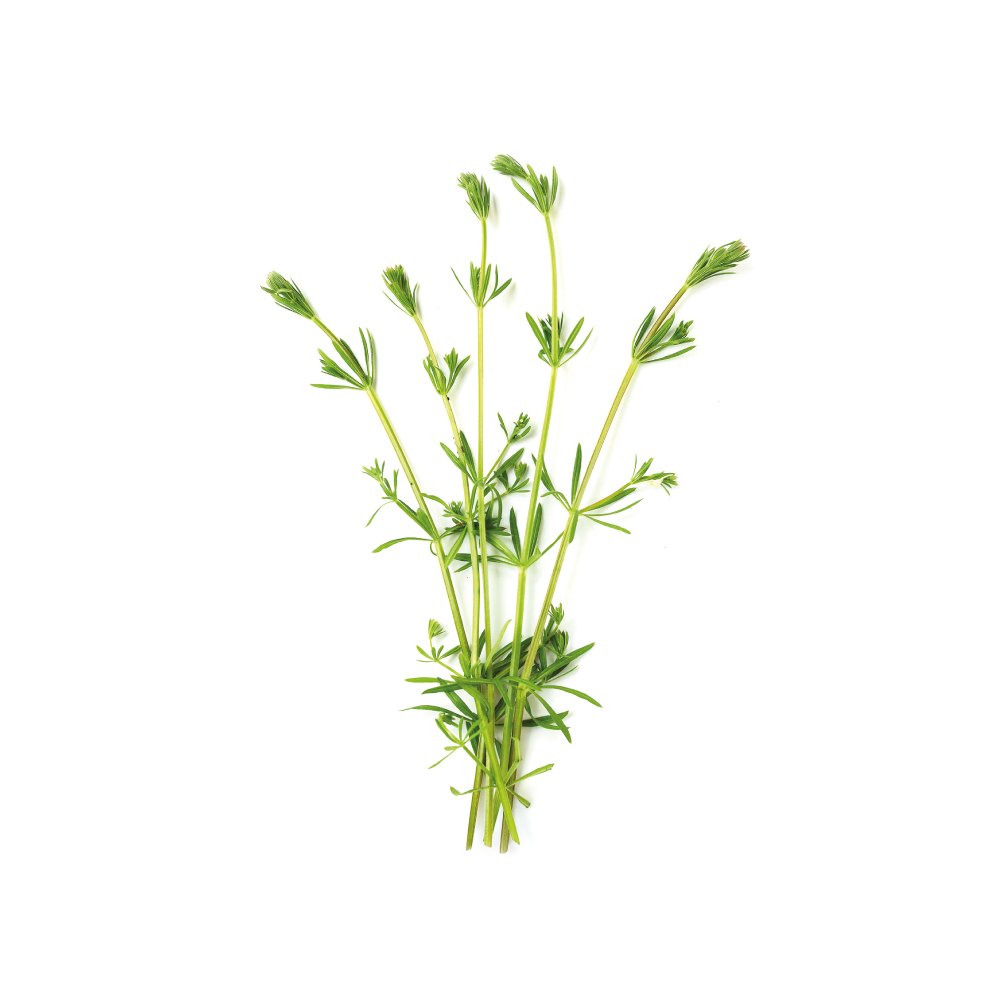
What Is Cleavers?
Cleavers is the sprawling, self-clinging aerial herb of Galium aparine (Rubiaceae), an annual best known for the tiny hooked bristles that make it cling to clothing and fur — the origin of folk names like “sticky willy” and “goosegrass.” In Western herbal medicine it is a cooling, salty-bitter lymphatic and diuretic alterative: a gentle, low-toxicity herb taken steadily over time for swollen glands, lymphatic congestion, skin eruptions, and urinary complaints such as cystitis. The aerial parts are the medicine, used fresh wherever possible and prepared as a juice, a cool aqueous infusion, or a 1:2 liquid extract.
What sets cleavers apart on this site is how far its reputation outruns its evidence. Its headline actions — the diuretic and “lymphatic” effects that justify its traditional use for UTIs and swollen glands — have no experimental confirmation at all; they rest on pharmacopoeial tradition and constituent inference alone. The research that does exist is small and entirely preclinical, with no registered or published human trial. What has been studied clusters elsewhere: dose-dependent immune stimulation (the only theme with an in vivo animal study) 1,2,3Reference 1In vitroPhytochemical Profiles and In Vitro Immunomodulatory Activity of Ethanolic Extracts from Galium aparine L. — in vitro studyView study →Reference 2In vitroImmunomodulatory Activity and Phytochemical Profile of Infusions from Cleavers Herb — in vitro studyView study →Reference 3AnimalImmuno-Enhancing Effects of Galium aparine L. in Cyclophosphamide-Induced Immunosuppressed Animal Models — in vivo animal modelView study →, broadly replicated antioxidant scavenging 4,2Reference 4In vitroEvaluation of diverse antioxidant activities of Galium aparine — in vitro studyView study →Reference 2In vitroImmunomodulatory Activity and Phytochemical Profile of Infusions from Cleavers Herb — in vitro studyView study →, a single solid rat study of liver protection 5Reference 5AnimalGalium aparine L. protects against acetaminophen-induced hepatotoxicity in rats — in vivo animal modelView study →, and scattered anticancer, antimicrobial and wound-healing signals from cell and tissue models 6,7,8,9,10Reference 6In vitroBringing back Galium aparine L. from forgotten corners of traditional wound treatment procedures: an antimicrobial, antioxidant, and in-vitro wound healing assay — in vitro studyView study →Reference 7In vitroAnti-methicillin-resistant Staphylococcus aureus (MRSA) activity of Rubiaceae, Fabaceae and Poaceae plants — in vitro studyView study →Reference 8In vitroEffects of Galium aparine extract on the cell viability, cell cycle and cell death in breast cancer cell lines — in vitro studyView study →Reference 9In vitroSeparation and purification and in vitro anti-proliferative activity of leukemia cell K562 of Galium aparine L. petroleum ether phase — in vitro studyView study →Reference 10In vitroAnticancer Effects of Galium aparine L Extract: Dose-Dependent Cytotoxicity in HNO210 Human Laryngeal Carcinoma Cells — in vitro studyView study →.
Chemically, cleavers is defined by its iridoid glycosides — the bitter, cooling markers of the Rubiaceae, led by asperuloside alongside monotropein and deacetylasperulosidic acid — layered over phenolic flavonoids (quercetin, rutin), coumarins (scopoletin, umbelliferone) and condensed tannins, with a red-dye anthraquinone in the root. It is this profile, rather than any single active molecule, that traditional use maps onto. Read the herb, then, as a well-established folk remedy with a thin and one-sided modern research base — genuinely gentle, but far less “proven” than its long history might suggest.
How Is Cleavers Used?
Cleavers is most often taken as a 1:2 liquid extract, with 30–60 mL spread across the week (roughly 4–8 mL/day in divided doses) rather than as a single daily dose — consistent with its traditional use as a mild, low-toxicity “alterative” meant to be taken steadily over time rather than in large single hits. It is also drunk as a simple aqueous infusion of the aerial parts, the form closest to traditional use and the one tested directly for antioxidant and immune-stimulating activity 2Reference 2In vitroImmunomodulatory Activity and Phytochemical Profile of Infusions from Cleavers Herb — in vitro studyView study →. Topically, the fresh or dried herb has a long history of use as a poultice or wash for minor skin complaints, ulcers and slow-healing wounds 6,11Reference 6In vitroBringing back Galium aparine L. from forgotten corners of traditional wound treatment procedures: an antimicrobial, antioxidant, and in-vitro wound healing assay — in vitro studyView study →Reference 11Galium Aparine as a Remedy for Chronic Ulcers — historical clinical noteView study →, a use now given some preliminary in vitro support.
Traditional Uses
Western Herbal Medicine
Cleavers has a long-standing place in British and European herbal tradition as a cooling “alterative” and lymphatic tonic — used for swollen glands, lymphatic congestion, and skin eruptions thought to reflect sluggish lymphatic clearance. It is listed in the British Herbal Pharmacopoeia as a diuretic and mild astringent, and was used for cystitis and other urinary complaints on that basis. An 1883 clinical note in the British Medical Journal records its topical use for chronic ulcers 11Reference 11Galium Aparine as a Remedy for Chronic Ulcers — historical clinical noteView study →, echoing a broader folk tradition of applying the bruised or infused herb to wounds, burns and skin afflictions.
Traditional Chinese Medicine
Galium aparine is not one of the classical, canonised herbs of Chinese medicine, but the plant does appear in Chinese folk and regional materia medica under the name zhū yāng yāng (猪殃殃), where it has been used to clear heat and resolve toxicity, and for edema and painful urination — a role that parallels its Western use for urinary complaints and skin conditions. Its role is minor and regional rather than part of the core classical canon, so this should be read as a folk-tradition footnote rather than an established TCM indication.
Ayurvedic Medicine
Cleavers has no established role in classical Ayurvedic medicine. Galium aparine is a Eurasian species outside the traditional Ayurvedic materia medica, and no meaningful body of Ayurvedic use or textual reference for the plant exists — it would be inaccurate to claim otherwise.
Indications
- Lymphatic congestion, swollen glands — the herb’s headline traditional “alterative” use, and loosely consistent with the dose-dependent immune-stimulant activity seen in animal and in vitro studies 1,2,3Reference 1In vitroPhytochemical Profiles and In Vitro Immunomodulatory Activity of Ethanolic Extracts from Galium aparine L. — in vitro studyView study →Reference 2In vitroImmunomodulatory Activity and Phytochemical Profile of Infusions from Cleavers Herb — in vitro studyView study →Reference 3AnimalImmuno-Enhancing Effects of Galium aparine L. in Cyclophosphamide-Induced Immunosuppressed Animal Models — in vivo animal modelView study →
- Minor skin complaints, chronic ulcers, slow-healing wounds — supported by in vitro wound-closure and anti-Staphylococcus data 6,7Reference 6In vitroBringing back Galium aparine L. from forgotten corners of traditional wound treatment procedures: an antimicrobial, antioxidant, and in-vitro wound healing assay — in vitro studyView study →Reference 7In vitroAnti-methicillin-resistant Staphylococcus aureus (MRSA) activity of Rubiaceae, Fabaceae and Poaceae plants — in vitro studyView study →, echoing 19th-century clinical use 11Reference 11Galium Aparine as a Remedy for Chronic Ulcers — historical clinical noteView study →
- Urinary tract infections (UTIs) and cystitis — a classical Western herbal indication, but one resting on pharmacopoeial tradition alone; no diuretic or urinary-specific study of cleavers exists
- General immune support — supported by preclinical evidence of immune stimulation, including one dose-dependent in vivo mouse model 1,2,3Reference 1In vitroPhytochemical Profiles and In Vitro Immunomodulatory Activity of Ethanolic Extracts from Galium aparine L. — in vitro studyView study →Reference 2In vitroImmunomodulatory Activity and Phytochemical Profile of Infusions from Cleavers Herb — in vitro studyView study →Reference 3AnimalImmuno-Enhancing Effects of Galium aparine L. in Cyclophosphamide-Induced Immunosuppressed Animal Models — in vivo animal modelView study →, though this has not been tested in humans
Other traditional indications for cleavers — including gonorrhea and uterine fibroids — appear in historical and folk sources but have no corroborating pharmacological evidence and are not supported by the research reviewed here.
Botany
Cleavers is the classic “sticky” plant of spring hedgerows — a soft, sprawling annual you identify with your fingertips before your eyes. Run a hand along it and the whole plant grips back: minute, downward-pointing hooked bristles line the square stems and the ruffs of narrow leaves that ring each node in whorls of six to eight. Those same hooks are the plant’s climbing gear, letting a flimsy stem clamber several feet up through nettles and shrubs, or knit itself into a tumbling mat over bare soil.
For the herbalist the relevant part is the aerial parts — the whole leafy, clinging tops, gathered in spring before or as the plant flowers and worked with fresh, since drying dulls its character. The flowers themselves are almost an afterthought: pin-head sized, pale, four-pointed, followed by the tiny paired burrs everyone knows from having them flung, gently, at a friend’s jumper. It sits within the madder family (Rubiaceae) beside lady’s bedstraw and the dye-madders.
Distribution
Cleavers is native to Europe, North Africa and temperate Asia, and has since spread as a near-cosmopolitan weed of moist, disturbed and cultivated ground. In North America it now grows almost everywhere, favouring the shaded, fertile edges of gardens, hedges and fields.
Growing Conditions
- Cool-season annual that germinates in autumn or early spring and races to seed before summer heat.
- Prefers moist, fertile soil and does best in part shade, though it tolerates full sun where the ground stays damp.
- Self-clinging and self-seeding — it needs no support or sowing effort and readily colonizes disturbed edges on its own.
- Genuinely weedy: expect it to spread by hooked burrs and to reappear yearly unless the tops are pulled before seed sets.
- Full cultivation detail lives on the companion farm-wiki grow guide for Galium aparine (link to be added once that project’s public URL is confirmed).
Pharmacology & Research
The research base for cleavers (Galium aparine) is small and entirely preclinical. Fewer than a dozen studies examine the herb specifically — the genus Galium is dominated by work on its relative G. verum (lady’s bedstraw), which must not be read across to cleavers. What exists for G. aparine clusters around three themes: immunomodulation (the only theme with an in vivo animal study), antioxidant capacity, and cytotoxicity against cancer cell lines, with scattered signals for hepatoprotection, antimicrobial action and wound healing. No human clinical trial of cleavers has ever been registered or published — every score below rests on cell-culture or rodent data. Almost all of it used ethanolic or methanolic extracts or aqueous infusions of the aerial parts; where a study used a fraction or an isolated compound rather than a whole preparation, that is flagged, because it changes what the result means for a herb taken as a tincture or tea.
- Best-supported: immunostimulant activity — three dedicated studies including one dose-dependent in vivo mouse model 1,2,3Reference 1In vitroPhytochemical Profiles and In Vitro Immunomodulatory Activity of Ethanolic Extracts from Galium aparine L. — in vitro studyView study →Reference 2In vitroImmunomodulatory Activity and Phytochemical Profile of Infusions from Cleavers Herb — in vitro studyView study →Reference 3AnimalImmuno-Enhancing Effects of Galium aparine L. in Cyclophosphamide-Induced Immunosuppressed Animal Models — in vivo animal modelView study →; broad antioxidant/free-radical scavenging across multiple assays 4,2Reference 4In vitroEvaluation of diverse antioxidant activities of Galium aparine — in vitro studyView study →Reference 2In vitroImmunomodulatory Activity and Phytochemical Profile of Infusions from Cleavers Herb — in vitro studyView study →; and a single but well-designed in vivo rat study of liver protection 5Reference 5AnimalGalium aparine L. protects against acetaminophen-induced hepatotoxicity in rats — in vivo animal modelView study →.
- Emerging, worth watching: selective cytotoxicity toward breast, leukaemia and laryngeal cancer cell lines 8,9,10Reference 8In vitroEffects of Galium aparine extract on the cell viability, cell cycle and cell death in breast cancer cell lines — in vitro studyView study →Reference 9In vitroSeparation and purification and in vitro anti-proliferative activity of leukemia cell K562 of Galium aparine L. petroleum ether phase — in vitro studyView study →Reference 10In vitroAnticancer Effects of Galium aparine L Extract: Dose-Dependent Cytotoxicity in HNO210 Human Laryngeal Carcinoma Cells — in vitro studyView study →, and in vitro wound-closure plus anti-Staphylococcus activity that echoes the plant’s oldest recorded use for ulcers and skin afflictions 6,7Reference 6In vitroBringing back Galium aparine L. from forgotten corners of traditional wound treatment procedures: an antimicrobial, antioxidant, and in-vitro wound healing assay — in vitro studyView study →Reference 7In vitroAnti-methicillin-resistant Staphylococcus aureus (MRSA) activity of Rubiaceae, Fabaceae and Poaceae plants — in vitro studyView study →.
- Mechanistically thin: the traditional diuretic and “lymphatic” reputation — the herb’s headline actions — have no experimental confirmation; they rest on pharmacopoeial tradition and constituent inference alone.
- The caveat: no human data, no standardised dose, wide variation between extract types, and several anticancer signals traced to compounds (β-sitosterol, dibutyl phthalate) that are either ubiquitous or a possible laboratory contaminant.
1. Immunomodulatory
This is the strongest theme, and the only one with an in vivo animal study. In immunosuppressed mice (cyclophosphamide model), an oral G. aparine extract produced a dose-dependent recovery of spleen weight, enhanced splenocyte proliferation, restored natural-killer-cell activity and raised IL-6, TNF-α and IFN-γ 3Reference 3AnimalImmuno-Enhancing Effects of Galium aparine L. in Cyclophosphamide-Induced Immunosuppressed Animal Models — in vivo animal modelView study →. Two earlier in vitro studies from the same Ukrainian group showed that both 20–96% ethanolic extracts 1Reference 1In vitroPhytochemical Profiles and In Vitro Immunomodulatory Activity of Ethanolic Extracts from Galium aparine L. — in vitro studyView study → and a plain aqueous infusion 2Reference 2In vitroImmunomodulatory Activity and Phytochemical Profile of Infusions from Cleavers Herb — in vitro studyView study → of the aerial parts stimulate lymphocyte blast transformation, with the 96% ethanolic extract most active 1Reference 1In vitroPhytochemical Profiles and In Vitro Immunomodulatory Activity of Ethanolic Extracts from Galium aparine L. — in vitro studyView study →. The active constituents map onto the herb’s iridoids (monotropein, asperulosidic acid) and caffeoylquinic acids rather than any single molecule. Note the direction of effect: cleavers behaves as an immune stimulant, which is consistent with its folk use for “swollen glands” but is the opposite of an immunosuppressant.
Gap: No human data, and the pro-inflammatory cytokine profile means the “gentle alterative” framing may understate a genuine immune-activating effect that could matter in autoimmune or inflammatory conditions.
2. Antioxidant
The most replicated activity. A fractionation study found the aqueous fraction of a methanol extract to be the strongest scavenger of DPPH, ABTS, hydroxyl, superoxide and hydrogen-peroxide radicals, with activity tracking total phenolic and flavonoid content 4Reference 4In vitroEvaluation of diverse antioxidant activities of Galium aparine — in vitro studyView study →. The cleavers infusion study confirmed direct DPPH, nitric-oxide and H₂O₂ scavenging in a preparation identical to how the herb is actually drunk 2Reference 2In vitroImmunomodulatory Activity and Phytochemical Profile of Infusions from Cleavers Herb — in vitro studyView study →, and a 2024 wound-healing study reported DPPH scavenging comparable to ascorbic acid 6Reference 6In vitroBringing back Galium aparine L. from forgotten corners of traditional wound treatment procedures: an antimicrobial, antioxidant, and in-vitro wound healing assay — in vitro studyView study →. The activity is attributed to the phenolic layer — quercetin, rutin and caffeoylquinic acids — rather than the iridoids.
Gap: Entirely in vitro. No study has measured an antioxidant effect in a living system (plasma markers, tissue lipid peroxidation), so the leap from test-tube scavenging to physiological benefit is unproven.
3. Hepatoprotective
A single, methodologically solid in vivo study underpins this. In rats, oral pretreatment with G. aparine (250 and 500 mg/kg for five days) before a hepatotoxic dose of paracetamol/acetaminophen significantly reduced liver necrosis and lowered ALT, AST and bilirubin, with supporting histopathology 5Reference 5AnimalGalium aparine L. protects against acetaminophen-induced hepatotoxicity in rats — in vivo animal modelView study →. The effect fits both the herb’s antioxidant profile and its traditional use for jaundice. The same study found only a limited effect on the neurological (hepatic-encephalopathy) endpoints, so the protection appears to be at the level of the liver itself rather than downstream.
Gap: One study, one species, a prophylactic (pre-treatment) design that does not test whether cleavers helps once liver injury is established — and no human confirmation.
4. Antimicrobial
Two in vitro studies agree that cleavers extracts inhibit Staphylococcus aureus. A methanolic leaf extract was among the most active of several Rubiaceae/Fabaceae/Poaceae plants against a large panel of methicillin-resistant S. aureus (MRSA) isolates, correlating with high polyphenol and flavonoid content 7Reference 7In vitroAnti-methicillin-resistant Staphylococcus aureus (MRSA) activity of Rubiaceae, Fabaceae and Poaceae plants — in vitro studyView study →. A 2024 study similarly found S. aureus more susceptible than E. coli or S. epidermidis to a G. aparine extract 6Reference 6In vitroBringing back Galium aparine L. from forgotten corners of traditional wound treatment procedures: an antimicrobial, antioxidant, and in-vitro wound healing assay — in vitro studyView study →. The Gram-positive selectivity is consistent with a phenolic mechanism.
Gap: Disc-diffusion and broth assays only; no in vivo infection model, and the effect is modest relative to reference antibiotics. Relevance to a systemic urinary infection — the herb’s traditional indication — is not demonstrated.
5. Antiproliferative
Three in vitro studies report cytotoxicity to cancer cell lines. A methanolic extract reduced viability of MCF-7 and MDA-MB-231 breast cancer cells in a dose- and time-dependent way while sparing non-transformed MCF-10A breast epithelium, inducing G1 arrest and cell death 8Reference 8In vitroEffects of Galium aparine extract on the cell viability, cell cycle and cell death in breast cancer cell lines — in vitro studyView study →. Separate work found the petroleum-ether fraction anti-proliferative against K562 leukaemia cells, attributing activity to β-sitosterol, daucosterol and dibutyl phthalate 9Reference 9In vitroSeparation and purification and in vitro anti-proliferative activity of leukemia cell K562 of Galium aparine L. petroleum ether phase — in vitro studyView study →, and a 2026 study showed dose-dependent cytotoxicity to HNO210 laryngeal carcinoma cells 10Reference 10In vitroAnticancer Effects of Galium aparine L Extract: Dose-Dependent Cytotoxicity in HNO210 Human Laryngeal Carcinoma Cells — in vitro studyView study →.
Gap: All in vitro, across unrelated cell lines with no consistent mechanism. The leukaemia effect was pinned partly on dibutyl phthalate — a common plasticiser and possible extraction contaminant rather than a genuine plant metabolite — which weakens the claim. Selectivity was tested in only one study.
6. Wound healing
One 2024 study directly tested the plant’s oldest documented use. A G. aparine extract accelerated scratch-wound closure in human dermal fibroblast and umbilical-endothelial (HUVEC/NHDF) monolayers without cytotoxicity, alongside antibacterial activity against S. aureus and ascorbic-acid-comparable antioxidant capacity 6Reference 6In vitroBringing back Galium aparine L. from forgotten corners of traditional wound treatment procedures: an antimicrobial, antioxidant, and in-vitro wound healing assay — in vitro studyView study →. This is a plausible convergence — antimicrobial plus antioxidant plus pro-migratory effects are the recognised ingredients of wound repair — and it echoes an 1883 clinical note on cleavers for chronic ulcers 11Reference 11Galium Aparine as a Remedy for Chronic Ulcers — historical clinical noteView study → and the herb’s long topical tradition for skin afflictions 2Reference 2In vitroImmunomodulatory Activity and Phytochemical Profile of Infusions from Cleavers Herb — in vitro studyView study →.
Gap: In vitro scratch assay, not a healing-wound animal or human model. Whether topical cleavers speeds real wound closure is untested.
7. Anti-inflammatory
The weakest of the scored activities, and internally inconsistent. The infusion study showed scavenging of nitric oxide and hydrogen peroxide 2Reference 2In vitroImmunomodulatory Activity and Phytochemical Profile of Infusions from Cleavers Herb — in vitro studyView study →, both plausible anti-inflammatory mechanisms, and the herb’s flavonoid content (quercetin, rutin) is associated with NF-κB and COX-2 down-regulation in other contexts. But the best in vivo G. aparine study pushed pro-inflammatory cytokines (IL-6, TNF-α, IFN-γ) up, not down 3Reference 3AnimalImmuno-Enhancing Effects of Galium aparine L. in Cyclophosphamide-Induced Immunosuppressed Animal Models — in vivo animal modelView study →, so the net inflammatory effect of the whole herb is genuinely unclear.
Gap: No dedicated anti-inflammatory study (no paw-oedema, no cytokine-suppression model) for cleavers itself; the mechanism is inferred from constituents and partly contradicted by the herb’s immunostimulant profile.
8. Diuretic
Included only because it is the herb’s headline traditional action, not because experiment supports it. Cleavers is classified as a diuretic and “lymphatic” in the British Herbal Pharmacopoeia and Western herbal tradition, and this is the basis of its use for cystitis and urinary complaints. No study has measured urine output, electrolyte excretion or any renal endpoint for G. aparine. The rationale is entirely traditional plus loose inference from a cooling, mineral-salt-rich, iridoid-containing profile.
Gap: Zero experimental evidence. This is a documented traditional claim with no mechanistic confirmation — the honest floor of the scale.
Mechanisms
| Mechanism | Drives | Key compounds |
|---|---|---|
| Lymphocyte blast-transformation ↑, immune-cell activation | immunomodulatory | asperuloside, monotropein, asperulosidic acid |
| Free-radical scavenging; NF-κB / COX-2 ↓ (inferred) | antioxidantanti-inflammatoryhepatoprotective | quercetin, rutin |
| Radical scavenging; Gram-positive membrane disruption | antioxidantantimicrobialwound healing | caffeoylquinic acids, p-hydroxybenzoic acid |
| Antioxidant / anti-inflammatory support (inferred) | antioxidant | scopoletin, umbelliferone |
| Cell-cycle arrest, pro-apoptotic (cell lines) | antiproliferative | β-sitosterol, daucosterol |
Clinical trials
No registered clinical trials of Galium aparine in humans were identified — the evidence base is entirely preclinical (cell lines and rodents). A ClinicalTrials.gov search returned no studies of the herb; the count below reflects the published experimental literature.
| Completed | Planned | Terminated | Preclinical |
|---|---|---|---|
| 0 | 0 | 0 | ~10(G. aparine-specific) |
Last checked: July 2026.
Phytochemistry
The defining chemistry of cleavers is its complement of iridoid glycosides, the bitter cooling principles typical of the Rubiaceae. The chemical marker is asperuloside, accompanied by monotropein and deacetylasperulosidic acid. Layered over the iridoids are phenolic constituents — the flavonoids quercetin and rutin, the coumarins scopoletin and umbelliferone, and condensed tannins — while the root carries the anthraquinone nordamnacanthal, the basis of the red dye historically obtained from the plant.
Constituent Summary
Reported from the aerial parts of Galium aparine (the anthraquinone from the root). Units differ by source and are stated per row: figures given as % of dry herb are bulk-class estimates, whereas figures in µg/mg are concentrations measured in a raw aqueous extract; the two are not directly comparable. Constituents identified qualitatively but not quantified are marked No Data.
Iridoid3 compounds3 with data
Anthraquinone1 compound1 with data
Condensed tannins are additionally reported at roughly 2–5% of the dry herb.
Dosage
There is no clinical dosing data for cleavers and no standardised extract, so the figures below are traditional and reported ranges, not recommendations. In practice the herb is dosed by preparation rather than by a fixed milligram of active constituent: it is treated as a mild alterative meant to be taken steadily over time rather than in large single hits. The most commonly cited modern form is a 1:2 liquid extract at 30–60 mL/week — roughly 4–8 mL/day in divided doses. It is also drunk as a simple aqueous infusion of the aerial parts (the form closest to traditional use, and the one tested directly for antioxidant and immune activity 2Reference 2In vitroImmunomodulatory Activity and Phytochemical Profile of Infusions from Cleavers Herb — in vitro studyView study →), and applied topically as a poultice or wash for minor skin complaints, ulcers and slow-healing wounds 6,11Reference 6In vitroBringing back Galium aparine L. from forgotten corners of traditional wound treatment procedures: an antimicrobial, antioxidant, and in-vitro wound healing assay — in vitro studyView study →Reference 11Galium Aparine as a Remedy for Chronic Ulcers — historical clinical noteView study →.
| Preparation | Dose | Notes |
|---|---|---|
| 1:2 liquid extract | 30–60 mL/week (~4–8 mL/day, divided) | Most commonly cited modern form; spread across the week rather than taken as one daily dose. |
| Aqueous infusion (aerial parts) | Traditional; no standardised amount | Closest to historical use and the form tested for antioxidant/immune activity 2Reference 2In vitroImmunomodulatory Activity and Phytochemical Profile of Infusions from Cleavers Herb — in vitro studyView study →. Best made from fresh or recently dried herb. |
| Topical poultice or wash | Traditional; applied as needed | Long folk use for minor skin complaints, chronic ulcers and slow-healing wounds 6,11Reference 6In vitroBringing back Galium aparine L. from forgotten corners of traditional wound treatment procedures: an antimicrobial, antioxidant, and in-vitro wound healing assay — in vitro studyView study →Reference 11Galium Aparine as a Remedy for Chronic Ulcers — historical clinical noteView study →. |
These are traditional and reported doses drawn from herbal practice, not clinically established regimens — no human trial has tested any dose of cleavers.
Safety & Pregnancy
Cleavers has a long record as a gentle, low-toxicity herb with no reports of significant toxicity, but its evidence base is tiny; the one point that reframes its mild image is experimental evidence that it acts as an immune stimulant.
- Immune stimulant. An oral extract raised inflammatory cytokines and immune-cell activity in mice — theoretically best avoided with immunosuppressant therapy or in active autoimmune disease.
- Diuretic caution. Its traditional diuretic reputation makes caution reasonable in people on prescription diuretics or with significant kidney or urinary disease.
- Rubiaceae allergy. Avoid in known allergy to madder-family (Rubiaceae) plants.
- Gentle & low-toxicity. Long traditional record with no reports of significant toxicity — though never formally safety-tested.
Full safety & interactions detail
Cleavers has a long record as a gentle, low-toxicity herb, and the modern literature contains no reports of significant toxicity — though it also contains no dedicated safety, interaction or reproductive-toxicology study, so “safe” here means “no signal in a very small evidence base,” not “formally assessed.” Its diuretic reputation is traditional and unquantified, but on that basis caution is reasonable in people taking prescription diuretics or with significant kidney or urinary disease. The one finding that reframes the herb’s gentle image is experimental rather than traditional: in immunosuppressed mice an oral extract raised IL-6, TNF-α and IFN-γ and stimulated lymphocyte and NK-cell activity 3Reference 3AnimalImmuno-Enhancing Effects of Galium aparine L. in Cyclophosphamide-Induced Immunosuppressed Animal Models — in vivo animal modelView study →, so cleavers acts as an immune stimulant and is theoretically best avoided alongside immunosuppressant therapy or in active autoimmune disease. Avoid in known allergy to Rubiaceae-family plants.
Scope: no pharmacokinetic, drug-interaction or reproductive-toxicology study of G. aparine was found. The diuretic- and immunosuppressant-interaction cautions are theoretical — inferred from the herb’s traditional diuretic action and its observed immunostimulant effect — not tested. Absence of reports is not evidence of safety.
Cleavers is best avoided in pregnancy and lactation, but this is a precautionary rather than evidence-based position: no reproductive or developmental toxicology study of Galium aparine exists, and there are no lactation data either. Traditional practice treats it as one to avoid while pregnant or breastfeeding, and with no safety testing to draw on that caution is the sensible default.
References
- Ilina, T., Kashpur, N., Granica, S., Bazylko, A., Shinkovenko, I., Kovalyova, A., Goryacha, O., & Koshovyi, O. (2019). Phytochemical Profiles and In Vitro Immunomodulatory Activity of Ethanolic Extracts from Galium aparine L. — in vitro study. Plants, 8(12), 541. https://pubmed.ncbi.nlm.nih.gov/31775336/
- Ilina, T., Skowrońska, W., Kashpur, N., Granica, S., Bazylko, A., Kovalyova, A., Goryacha, O., & Koshovyi, O. (2020). Immunomodulatory Activity and Phytochemical Profile of Infusions from Cleavers Herb — in vitro study. Molecules, 25(16), 3721. https://pubmed.ncbi.nlm.nih.gov/32824103/
- Lee, S. Y., Park, S. Y., & Park, H. J. (2024). Immuno-Enhancing Effects of Galium aparine L. in Cyclophosphamide-Induced Immunosuppressed Animal Models — in vivo animal model. Nutrients, 16(5), 597. https://pubmed.ncbi.nlm.nih.gov/38474724/
- Bokhari, J., Khan, M. R., Shabbir, M., Rashid, U., Shah, M. R., & Anwar, F. (2013). Evaluation of diverse antioxidant activities of Galium aparine — in vitro study. Spectrochimica Acta Part A: Molecular and Biomolecular Spectroscopy, 102, 24–29. https://pubmed.ncbi.nlm.nih.gov/23211618/
- Sahin, B., Karabulut, S., Filiz, A. K., Özkaraca, M., & Ozdemir, O. (2022). Galium aparine L. protects against acetaminophen-induced hepatotoxicity in rats — in vivo animal model. Chemico-Biological Interactions, 366, 110119. https://pubmed.ncbi.nlm.nih.gov/36029804/
- Beirami, A. D., Akhtari, N., Noroozi, R., Hatamabadi, D., et al. (2024). Bringing back Galium aparine L. from forgotten corners of traditional wound treatment procedures: an antimicrobial, antioxidant, and in-vitro wound healing assay — in vitro study. BMC Complementary Medicine and Therapies, 24(1), 279. https://pubmed.ncbi.nlm.nih.gov/39044256/
- Sharifi-Rad, M., Iriti, M., Sharifi-Rad, M., Gibbons, S., & Sharifi-Rad, J. (2016). Anti-methicillin-resistant Staphylococcus aureus (MRSA) activity of Rubiaceae, Fabaceae and Poaceae plants — in vitro study. Cellular and Molecular Biology, 62(9), 39–45. https://pubmed.ncbi.nlm.nih.gov/27585260/
- Atmaca, H., Bozkurt, E., Cittan, M., & Dilek Tepe, H. (2016). Effects of Galium aparine extract on the cell viability, cell cycle and cell death in breast cancer cell lines — in vitro study. Journal of Ethnopharmacology, 186, 305–310. https://pubmed.ncbi.nlm.nih.gov/27085941/
- Shi, G., Liu, J., Zhao, W., Liu, Y., et al. (2016). Separation and purification and in vitro anti-proliferative activity of leukemia cell K562 of Galium aparine L. petroleum ether phase — in vitro study. Saudi Pharmaceutical Journal, 24(3), 241–244. https://pubmed.ncbi.nlm.nih.gov/27275108/
- Kubilay, U., Bayar Muluk, N., Alaskarov, E., Bulbul, M. V., et al. (2026). Anticancer Effects of Galium aparine L Extract: Dose-Dependent Cytotoxicity in HNO210 Human Laryngeal Carcinoma Cells — in vitro study. The Journal of Craniofacial Surgery. https://pubmed.ncbi.nlm.nih.gov/41493013/
- (1883). Galium Aparine as a Remedy for Chronic Ulcers — historical clinical note. British Medical Journal, 1(1172), 1173. https://pubmed.ncbi.nlm.nih.gov/20750642/