
Materia Medica
Devils club
Oplopanax horridus
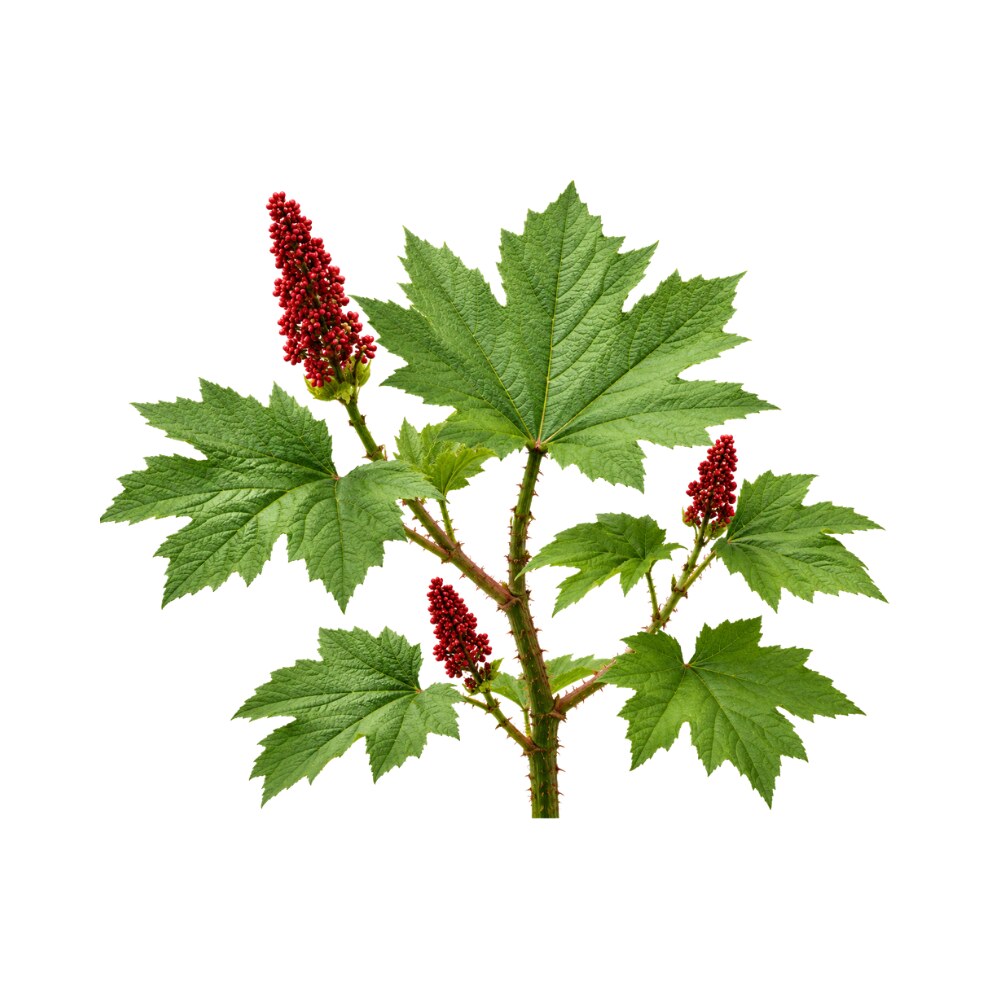
Devil's club (Oplopanax horridus) — a spiny North American relative of ginseng, traditionally used as a tonic and for blood sugar balance.
What Is Devil’s Club?
Devil’s club is Oplopanax horridus, a large, spiny understory shrub of the Pacific Northwest and a genuine North American relative of ginseng — both belong to the ginseng family, Araliaceae. Its densely thorned stems earn it names like “devil’s walking stick,” while its reputation as a tonic earned it the nickname “Alaskan ginseng.” The medicinal material is the root and stem bark, most often taken as a 1:5 tincture, though traditional Pacific Northwest practice favours a decoction or infusion of the bark used sparingly.
Devil’s club holds an important place in the traditional medicine of Pacific Northwest Indigenous peoples, who used it both internally and topically as a highly regarded root-bark medicine — as a general tonic, for infections, and for a range of other complaints. Early 20th-century ethnobotanical literature catalogued it as a tonic and blood-sugar remedy, which is how it acquired its folk standing as a plant for blood sugar balance. That headline traditional reputation is the plant’s most famous claim.
The modern evidence is small, distinctive, and honest about its limits. Devil’s club has roughly two dozen primary papers, overwhelmingly phytochemical and preclinical, built around a single class of bioactive molecules — the falcarinol-type polyynes concentrated in the root and stem bark. The most developed signal is anticancer/antiproliferative activity, confirmed in vitro and in two mouse models 9,10,17Reference 9AnimalIdentification of potential anticancer compounds from Oplopanax horridus — [in vivo xenograft]View study →Reference 10AnimalChemopreventive effects of oplopantriol A, a novel compound isolated from Oplopanax horridus, on colorectal cancer — [in vivo xenograft]View study →Reference 17AnimalExtracts of Devil’s club (Oplopanax horridus) exert therapeutic efficacy in experimental models of acute myeloid leukemia — [in vivo murine model]View study →; a striking antimycobacterial finding rounds it out 3Reference 3In vitroAntimycobacterial polyynes of Devil’s Club (Oplopanax horridus), a North American native medicinal plant — [in vitro]View study →. But there are no registered clinical trials for any indication, and the one human study ever conducted — a 1990 pilot on the tea’s effect on blood glucose — found no hypoglycaemic effect 19Reference 19Effect of Devil’s Club Tea on Blood Glucose Levels in Diabetes Mellitus — [human pilot study]View study →, cutting directly against the plant’s best-known traditional use.
How Is Devils club Used?
Devil’s club is almost always taken as a tincture made from the root or stem bark: a 1:5 tincture dosed at 2–4 mL, three times daily, is the standard Western herbal-practice preparation. Traditionally, Pacific Northwest Indigenous use favours a decoction or infusion of the bark instead, taken sparingly — high doses of the whole-bark preparation are reported to be emetic and purgative, so traditional practice deliberately keeps the dose modest rather than pushing for a stronger effect.
In practice it is used as a general tonic and adaptogen, with the tincture taken regularly (three times a day) rather than as a single large dose. Because no dose-response or clinical-dosing study has ever been conducted, the tincture dose above reflects long-standing herbal-practice convention, not a research-derived therapeutic target — see Dosage below for the caveats around preparation type.
Traditional Uses
Western Herbal Medicine
Western/North American herbal practice draws directly on Pacific Northwest Indigenous use, where devil’s club was a highly regarded root-bark medicine — taken as a decoction or infusion, and used topically as well as internally. Early 20th-century ethnobotanical and pharmacognosy literature catalogued it as a general tonic and blood-sugar remedy, which is how it picked up the “Alaskan ginseng” name; modern Western herbalists continue to use the 1:5 root/stem-bark tincture as an adaptogenic tonic, though (see Pharmacology & Research) the traditional blood-sugar claim was not confirmed in the one human pilot that tested it 19Reference 19Effect of Devil’s Club Tea on Blood Glucose Levels in Diabetes Mellitus — [human pilot study]View study →.
Traditional Chinese Medicine
Devil’s club has no genuine traditional role in Chinese medicine — it is a Pacific Northwest North American species with no historical presence in the TCM materia medica. The related Asian species Oplopanax elatus does have a documented use in Chinese and Korean herbal medicine, but its pharmacology (anti-inflammatory, hepatoprotective) is repeatedly cited as not transferable to O. horridus elsewhere on this page, and the same caution applies here: no TCM tradition exists for this species, and none should be implied.
Ayurvedic Medicine
Devil’s club has no traditional use in Ayurveda. As a North American temperate/boreal understory plant with no historical trade or cultivation link to South Asia, it does not appear in the classical Ayurvedic materia medica, and there is no genuine indigenous Ayurvedic tradition to draw on here.
Indications
Grounded in the evidence-by-indication table above, from strongest to weakest support:
- Traditional general tonic / adaptogenic use — the primary way the herb is actually taken (root/stem-bark tincture), consistent with its long-standing Pacific Northwest Indigenous and Western herbal reputation, though this use has not itself been formally tested.
- Adjunctive interest in oncology research (preclinical only) — the deepest evidence base on this page: broad in vitro antiproliferative activity plus two in vivo mouse models (xenograft and AML) 9,10,17Reference 9AnimalIdentification of potential anticancer compounds from Oplopanax horridus — [in vivo xenograft]View study →Reference 10AnimalChemopreventive effects of oplopantriol A, a novel compound isolated from Oplopanax horridus, on colorectal cancer — [in vivo xenograft]View study →Reference 17AnimalExtracts of Devil’s club (Oplopanax horridus) exert therapeutic efficacy in experimental models of acute myeloid leukemia — [in vivo murine model]View study →. This is not a basis for using devil’s club to treat cancer — there is no human data and no defined oral dose.
- Microbial/infection-related traditional use — supported by a single but well-characterised in vitro study showing antimycobacterial and anti-Candida activity of the isolated polyynes 3Reference 3In vitroAntimycobacterial polyynes of Devil’s Club (Oplopanax horridus), a North American native medicinal plant — [in vitro]View study →, broadly consistent with traditional use for infections.
- General antioxidant support — plausible but in vitro only, and the strongest data come from the leaf rather than the root/stem bark that is actually used medicinally 6,18Reference 6In vitroIn vitro anti-proliferative and antioxidant studies on Devil’s Club Oplopanax horridus — [in vitro]View study →Reference 18In vitroAnti-oxidative and anti-inflammatory activities of devil’s club (Oplopanax horridus) leaves — [in vitro]View study →.
- Blood-sugar support is not supported as an indication — despite being the plant’s headline traditional reputation, the one human pilot found no hypoglycaemic effect 19Reference 19Effect of Devil’s Club Tea on Blood Glucose Levels in Diabetes Mellitus — [human pilot study]View study →; this should not be relied on for diabetes management, and any use alongside antidiabetic medication should be monitored for the opposite reason — theoretical interaction risk, not demonstrated benefit.
- Anti-inflammatory and antiviral use are traditionally reported but rest on the thinnest modern evidence (largely a different species, or a single partial screen) and are not indications the current data can support with confidence.
Botany
Devil’s club is one of North America’s most distinctive medicinal shrubs — impossible to mistake and difficult to forget once you’ve brushed against it. A member of the ginseng family (Araliaceae), it is a true North American cousin of Asian Panax ginseng and of the Aralia and Asian Oplopanax species, which is part of why it has long drawn the interest of Western herbalists.
The plant grows as a sprawling, deciduous understory shrub, usually waist- to head-high but reaching well overhead in the deep, wet forest where it thrives. Its thick, cane-like stems and the veins of its enormous, maple-like leaves are densely covered in brittle, needle-sharp spines — the “horridus” of its name is entirely earned. In late summer it carries tight, showy clusters of scarlet berries above the foliage.
For the herbalist, the working parts are the root and the inner stem bark, harvested and dried rather than the leaves or berries. Devil’s club holds deep significance in the medicine and spiritual practice of many Pacific Northwest Indigenous peoples, for whom it is far more than a botanical curiosity; anyone approaching the plant is stepping into that long tradition and should do so with corresponding respect and care.
Distribution
Devil’s club is a plant of the cool, wet Pacific Northwest, ranging from coastal Alaska and the Yukon down through British Columbia into Oregon and Montana. It favours shaded, moist old-growth forest and streambanks, with a curious outlying population surviving around the Great Lakes.
Growing Conditions
- Deep or partial shade — a forest-understory plant that resents full sun.
- Consistently moist, rich, humus-heavy soil; it naturally grows along streambanks and in wet gullies.
- Cool, humid conditions; well suited to the maritime Pacific Northwest rather than hot, dry climates.
- Slow to establish and best propagated from stem cuttings or fresh seed; handle with heavy gloves because of the spines.
- Full cultivation detail lives on the companion farm-wiki grow guide for Oplopanax horridus (link to be added once that project’s public URL is confirmed).
Pharmacology & Research
Devil’s club has a small but distinctive research literature — roughly two dozen primary papers, overwhelmingly phytochemical and preclinical, built around a single class of bioactive molecules: the falcarinol-type polyynes (falcarindiol, oplopandiol, falcarinol) concentrated in the root and stem bark 1,2Reference 1ReviewOplopanax horridus: Phytochemistry and Pharmacological Diversity and Structure-Activity Relationship on Anticancer Effects — [review]View study →Reference 2ReviewChemical and pharmacological studies of Oplopanax horridus, a North American botanical — [review]View study →. The most developed and replicated signal is anticancer/antiproliferative activity, where extracts and isolated polyynes inhibit a wide panel of human cancer cell lines and — importantly — two of these compounds have been confirmed in mouse xenograft and immunocompetent models 9,10,17Reference 9AnimalIdentification of potential anticancer compounds from Oplopanax horridus — [in vivo xenograft]View study →Reference 10AnimalChemopreventive effects of oplopantriol A, a novel compound isolated from Oplopanax horridus, on colorectal cancer — [in vivo xenograft]View study →Reference 17AnimalExtracts of Devil’s club (Oplopanax horridus) exert therapeutic efficacy in experimental models of acute myeloid leukemia — [in vivo murine model]View study →. The most interesting emerging thread is antimycobacterial activity: the polyynes kill Mycobacterium tuberculosis and drug-resistant M. avium in vitro 3Reference 3In vitroAntimycobacterial polyynes of Devil’s Club (Oplopanax horridus), a North American native medicinal plant — [in vitro]View study →. The single most important caveat cuts against the plant’s headline traditional reputation — the one human study ever conducted, a 1990 pilot on the tea’s effect on blood glucose, found no hypoglycaemic effect 19Reference 19Effect of Devil’s Club Tea on Blood Glucose Levels in Diabetes Mellitus — [human pilot study]View study →. No modern randomised controlled trial exists for any indication, and much of the anti-inflammatory literature comes from a separate Asian species, Oplopanax elatus, whose data do not transfer to the North American O. horridus sold as devil’s club.
- Best-supported: antiproliferative activity against multiple human cancer cell lines, with in vivo xenograft confirmation for falcarindiol and oplopantriol A 9,10Reference 9AnimalIdentification of potential anticancer compounds from Oplopanax horridus — [in vivo xenograft]View study →Reference 10AnimalChemopreventive effects of oplopantriol A, a novel compound isolated from Oplopanax horridus, on colorectal cancer — [in vivo xenograft]View study →; broad-spectrum antimicrobial including antimycobacterial action of the polyynes 3Reference 3In vitroAntimycobacterial polyynes of Devil’s Club (Oplopanax horridus), a North American native medicinal plant — [in vitro]View study →.
- Emerging, worth watching: immunomodulation in an AML mouse model (fewer regulatory T cells, better CD8⁺ function) 17Reference 17AnimalExtracts of Devil’s club (Oplopanax horridus) exert therapeutic efficacy in experimental models of acute myeloid leukemia — [in vivo murine model]View study →; antioxidant free-radical scavenging 6,18Reference 6In vitroIn vitro anti-proliferative and antioxidant studies on Devil’s Club Oplopanax horridus — [in vitro]View study →Reference 18In vitroAnti-oxidative and anti-inflammatory activities of devil’s club (Oplopanax horridus) leaves — [in vitro]View study →.
- Mechanistically thin: anti-inflammatory activity (best evidence is from the different species O. elatus); antiviral action rests on one partial-inhibition screen 4Reference 4In vitroAntiviral screening of British Columbian medicinal plants — [in vitro]View study →.
- The caveat: the traditional “blood sugar” use is not borne out — the one human pilot on devil’s club tea was null 19Reference 19Effect of Devil’s Club Tea on Blood Glucose Levels in Diabetes Mellitus — [human pilot study]View study → — and all positive efficacy data are preclinical, cell-line- and extract-dependent, with no standardised dose.
1. Anticancer
This is the deepest part of the literature. Root- and stem-bark extracts of devil’s club inhibit proliferation across a broad panel of human cancer cell lines — leukemia (K562, HL60), breast (MCF-7, MDA-MB-231/468), ovarian (A2780, OVCAR), colorectal (HCT-116, SW-480, HT-29) and pancreatic (PANC-1, BxPC-3) — typically by arresting the cell cycle in S and G2/M phase and inducing apoptosis through the mitochondrial pathway 5,6,7,8,13,14,15,16Reference 5In vitroHydrophobic constituents and their potential anticancer activities from Devil’s Club (Oplopanax horridus Miq.) — [in vitro]View study →Reference 6In vitroIn vitro anti-proliferative and antioxidant studies on Devil’s Club Oplopanax horridus — [in vitro]View study →Reference 7In vitroInhibition of human ovarian cancer cell lines by devil’s club Oplopanax horridus — [in vitro]View study →Reference 8In vitroEffects of Oplopanax horridus on human colorectal cancer cells — [in vitro]View study →Reference 13In vitroInhibition of Human Pancreatic Cancer Cell Proliferation by Devil’s Club Oplopanax horridus and Its Polyacetylene Bioactive Compound — [in vitro]View study →Reference 14In vitroDevil’s Club Falcarinol-Type Polyacetylenes Inhibit Pancreatic Cancer Cell Proliferation — [in vitro]View study →Reference 15In vitroHuman ovarian cancer multicellular spheroids: a model for testing antiproliferation activity of Devil’s club (Oplopanax horridus) and anticancer agents — [in vitro]View study →Reference 16In vitroAnticancer activities of polyynes from the root bark of Oplopanax horridus and their acetylated derivatives — [in vitro]View study →. The activity tracks to the falcarinol-type polyynes: falcarindiol is repeatedly the most potent isolate, and the novel triol oplopantriol A kills cancer cells via endoplasmic-reticulum stress and the BH3-only proteins Noxa and Bim 9,10,11Reference 9AnimalIdentification of potential anticancer compounds from Oplopanax horridus — [in vivo xenograft]View study →Reference 10AnimalChemopreventive effects of oplopantriol A, a novel compound isolated from Oplopanax horridus, on colorectal cancer — [in vivo xenograft]View study →Reference 11In vitroAnticancer compound Oplopantriol A kills cancer cells through inducing ER stress and BH3 proteins Bim and Noxa — [in vitro]View study →. Crucially, two compounds have moved beyond the dish: falcarindiol suppressed HCT-116 colon-tumour growth in athymic mice at 15 mg/kg, and oplopantriol A dose-dependently shrank xenograft colon tumours 9,10Reference 9AnimalIdentification of potential anticancer compounds from Oplopanax horridus — [in vivo xenograft]View study →Reference 10AnimalChemopreventive effects of oplopantriol A, a novel compound isolated from Oplopanax horridus, on colorectal cancer — [in vivo xenograft]View study →. A separate study in an immunocompetent AML mouse model showed the ethanol root extract improved survival while shifting the immune environment (fewer regulatory T cells, better CD8⁺ T-cell function) 17Reference 17AnimalExtracts of Devil’s club (Oplopanax horridus) exert therapeutic efficacy in experimental models of acute myeloid leukemia — [in vivo murine model]View study →. Several studies also report synergy when non-cytotoxic extract doses are combined with cisplatin, gemcitabine or paclitaxel 7,12Reference 7In vitroInhibition of human ovarian cancer cell lines by devil’s club Oplopanax horridus — [in vitro]View study →Reference 12In vitroAntiproliferation activity of Devil’s club (Oplopanax horridus) and anticancer agents on human pancreatic cancer multicellular spheroids — [in vitro]View study →.
Gap: Every result is preclinical. There is no human trial, no oral-bioavailability or dosing data in people, and the effective in vitro concentrations come from purified compounds or standardised extracts — not the whole-plant tincture the herb is actually taken as.
2. Antioxidant
Devil’s club extracts show free-radical scavenging in cell-free chemistry. A root-bark ethanol extract scavenged hydroxyl radicals in a cell-free system alongside its antiproliferative activity 6Reference 6In vitroIn vitro anti-proliferative and antioxidant studies on Devil’s Club Oplopanax horridus — [in vitro]View study →, and a 2017 study of the leaf extract reported DPPH-type radical scavenging and reduced oxidative markers 18Reference 18In vitroAnti-oxidative and anti-inflammatory activities of devil’s club (Oplopanax horridus) leaves — [in vitro]View study →. The lignan sesamin and the phytosterols present in the plant are plausible contributors, though none has been isolated and tested for this endpoint in devil’s club specifically. The leaves additionally carry a set of lupane-type triterpenoid saponins distinct from the root-bark polyynes 22Reference 22In vitroNew lupane-type triterpenoid saponins from leaves of Oplopanax horridus (Devil’s Club) — [in vitro]View study →, and the plant’s constituents are extensively transformed by human intestinal microbiota, which complicates any read-across from in vitro potency to oral effect 21Reference 21In vitroHuman intestinal microbiota derived metabolism signature from a North American native botanical Oplopanax horridus with UPLC/Q-TOF-MS analysis — [in vitro]View study →.
Gap: In vitro only, and the strongest antioxidant data are from leaves — not the root and stem bark that constitute the medicinal material. Whether this translates to any antioxidant effect after oral dosing is untested.
3. Antimicrobial
The plant’s polyynes are broadly antimicrobial. In the defining study, five polyynes isolated from devil’s club showed significant anti-Candida, antibacterial and antimycobacterial activity, killing Mycobacterium tuberculosis and isoniazid-resistant Mycobacterium avium at 10 µg/disk in a disk-diffusion assay 3Reference 3In vitroAntimycobacterial polyynes of Devil’s Club (Oplopanax horridus), a North American native medicinal plant — [in vitro]View study →. Falcarinol-type diynes are the active principle. This aligns with the traditional use of devil’s club for external and internal infections.
Gap: All data are in vitro disk-diffusion from a single 1997 study; there is no whole-extract MIC panel, no in vivo infection model, and no work on the tincture form. The antimycobacterial finding is genuinely interesting but has not been followed up in nearly three decades.
4. Anti-inflammatory
For devil’s club itself, the direct evidence is limited: the 2017 leaf-extract study reported anti-inflammatory activity alongside its antioxidant assays 18Reference 18In vitroAnti-oxidative and anti-inflammatory activities of devil’s club (Oplopanax horridus) leaves — [in vitro]View study →. The more mechanistically detailed anti-inflammatory literature — COX-2 and prostaglandin-E₂ suppression in LPS-stimulated macrophages 24Reference 24In vitroInhibitory Mechanisms of Water Extract of Oplopanax elatus on Lipopolysaccharide-Induced Inflammatory Responses in RAW 264.7 Murine Macrophage Cells — [in vitro — O. elatus]View study →, and NF-κB and MAPK pathway inhibition 25Reference 25In vitroAdventitious root cultures of Oplopanax elatus inhibit LPS-induced inflammation via suppressing MAPK and NF-κB signaling pathways — [in vivo/in vitro — O. elatus]View study → — comes from Oplopanax elatus, a related but distinct Asian species, and cannot be assumed to hold for North American O. horridus. Traditional use for arthritis and other inflammatory complaints is well documented but is not, on its own, mechanistic evidence.
Gap: Direct O. horridus data amount to one leaf study; the compelling pathway work is on a different species and a different preparation. Species substitution is the central caveat here.
6. Antidiabetic
This is the plant’s most famous traditional use — the “Alaskan ginseng” reputation for blood-sugar balance — and it has the weakest support in the modern literature. The one human study, a 1990 pilot that carefully monitored blood glucose in an insulin-dependent diabetic, a newly diagnosed type-2 diabetic and two healthy adults drinking devil’s club tea, found no hypoglycaemic effect 19Reference 19Effect of Devil’s Club Tea on Blood Glucose Levels in Diabetes Mellitus — [human pilot study]View study →. The positive claims trace back to early-20th-century animal reports (hypoglycaemia in rabbits) catalogued in the ethnopharmacological reviews 1,2,20Reference 1ReviewOplopanax horridus: Phytochemistry and Pharmacological Diversity and Structure-Activity Relationship on Anticancer Effects — [review]View study →Reference 2ReviewChemical and pharmacological studies of Oplopanax horridus, a North American botanical — [review]View study →Reference 20ReviewArctic pharmacognosia IIView study →, and later reviews note antidiabetic activity attributed to the polyynes without robust confirmation 1,2Reference 1ReviewOplopanax horridus: Phytochemistry and Pharmacological Diversity and Structure-Activity Relationship on Anticancer Effects — [review]View study →Reference 2ReviewChemical and pharmacological studies of Oplopanax horridus, a North American botanical — [review]View study →. The traditional and historical record is real; the pharmacological demonstration in humans is absent, and what human data exist are negative.
Gap: The single human test was null 19Reference 19Effect of Devil’s Club Tea on Blood Glucose Levels in Diabetes Mellitus — [human pilot study]View study →. There is no controlled human trial, no defined active constituent for a glucose-lowering effect, and the modern evidence does not support the traditional headline claim. This indication is retained only because the traditional documentation is substantial — the score reflects that, not efficacy.
Mechanisms
| Mechanism | Drives | Key compounds |
|---|---|---|
| S / G2–M cell-cycle arrest; mitochondrial + ER-stress apoptosis (Noxa, Bim); disruption of microbial membranes | anticancerantimicrobial | falcarindiol, oplopandiol, oplopantriol A |
| minor antiproliferative / aromatic constituents | anticancer (adjunct)aroma | nerolidol, oplopanone, cadinol |
| radical scavenging / antioxidant contribution | antioxidant | sesamin |
| membrane-level anti-inflammatory activity (class effect) | anti-inflammatory (weak) | β-sitosterol, stigmasterol |
Clinical trials
No registered clinical trials identified for any single indication — the evidence base is preclinical, apart from one small uncontrolled human pilot on blood glucose from 1990 19Reference 19Effect of Devil’s Club Tea on Blood Glucose Levels in Diabetes Mellitus — [human pilot study]View study →.
| Completed | Planned | Terminated | Preclinical |
|---|---|---|---|
| 0 | 0 | 0 | ~20 |
Last checked: July 2026.
Phytochemistry
The chemistry of devil’s club is dominated by lipophilic polyynes (polyacetylenes) concentrated in the root and stem bark. The two best-studied are falcarindiol and oplopandiol, the falcarinol-type diynes that drive the plant’s documented antimycobacterial and antiproliferative activity; the related falcarinol is also present. Alongside these sit a family of sesquiterpenes — notably oplopanone — together with the lignan sesamin and the phytosterols β-sitosterol and stigmasterol.
Constituent Summary
Reported from the root and stem bark of Oplopanax horridus. The phytochemical literature on this species is largely qualitative and bioactivity-driven (anticancer and antimycobacterial isolation work), so most constituents have been identified and characterised structurally rather than quantified as a percentage of dry weight; these are marked No Data.
Polyyne5 compoundsno data
Sesquiterpene1 compoundno data
Lignan1 compoundno data
Dosage
There is no standardised or research-derived dose for devil’s club: no dose-response or clinical-dosing study exists, and the effective concentrations in the anticancer and antimicrobial literature come from purified compounds or standardised ethanol extracts, not the whole-plant preparation the herb is taken as. A preparation caveat matters here — essentially all of the positive efficacy data are from ethanol extracts or isolated polyynes, while the water infusion (tea) is the one form actually tested in humans, and it specifically failed to lower blood glucose 19Reference 19Effect of Devil’s Club Tea on Blood Glucose Levels in Diabetes Mellitus — [human pilot study]View study →. The dose below is the traditional whole-herb range from Western herbal practice; it is not a research-validated therapeutic dose.
Traditional Dosage
| System | Preparation | Dose |
|---|---|---|
| Western herbal medicine | Root/stem-bark tincture (1:5) | 2–4 mL three times daily |
| Pacific Northwest Indigenous | Root/bark decoction or infusion | Whole-bark decoction, traditionally used sparingly (high doses emetic/purgative) |
Safety & Pregnancy
Devil’s club has a low reported toxicity profile in traditional use, but modern safety data are sparse and almost entirely preclinical; its main cautions are a theoretical blood-sugar interaction and the plant’s needle-sharp spines.
- Antidiabetic drugs. Traditionally taken to lower blood sugar — monitor glucose alongside insulin or oral antidiabetics, though the one human pilot found no effect.
- Emetic at high doses. High doses of the bark preparations are traditionally reported to be emetic and purgative.
- Spine injury. The rigid, brittle spines are a mechanical hazard; a corneal-perforation case is on record.
- Largely unstudied. No controlled interaction, pregnancy or organ-toxicity studies exist — absence of reports is not evidence of safety.
- Low reported toxicity. Long topical and internal traditional use with few reported problems.
Full safety & interactions detail
Devil’s club is used topically and internally in traditional Pacific Northwest practice with a low reported toxicity profile, but modern safety data are sparse and almost entirely traditional or preclinical. Its best-characterised risk is pharmacodynamic: the plant is traditionally taken to lower blood sugar, so it should be used cautiously alongside insulin or oral antidiabetic drugs with blood-glucose monitoring — though notably the one human pilot found no hypoglycaemic effect 19Reference 19Effect of Devil’s Club Tea on Blood Glucose Levels in Diabetes Mellitus — [human pilot study]View study →, meaning the interaction is theoretical rather than demonstrated. High doses of the bark preparations are traditionally reported to be emetic and purgative. The rigid, brittle spines are a mechanical hazard: a documented case of corneal perforation and delayed anterior-chamber collapse from a devil’s club thorn exists in the ophthalmology literature 26Reference 26Case reportCorneal perforation and delayed anterior chamber collapse from a devil’s club thorn — [case report]View study →. No controlled interaction, pregnancy, or organ-toxicity studies have been conducted.
Herb–drug interactions have not been formally assessed: the antidiabetic-medication caution is inferred from the plant’s traditional glucose-lowering use, not from a dedicated interaction trial. No CYP450 interaction has been demonstrated for O. horridus (the CYP450/PPAR-signalling hepatoprotective finding sometimes cited belongs to O. elatus 23Reference 23AnimalHepatoprotective Effect of Oplopanax elatus Nakai Adventitious Roots Extract by Regulating CYP450 and PPAR Signaling Pathway — [in vivo — O. elatus]View study →, a different species, and must not be attributed here). The absence of reported problems is not evidence of safety.
No reproductive or lactation safety study for devil’s club was identified; the traditional advice to avoid it in pregnancy and breastfeeding is precautionary, not the result of a studied finding. Treat medicinal use in pregnancy and lactation as unstudied, and do not read the absence of reports as clearance.
References
- Wu K, Wang CZ, Yuan CS, Huang WH (2018). Oplopanax horridus: Phytochemistry and Pharmacological Diversity and Structure-Activity Relationship on Anticancer Effects — [review]. Evid Based Complement Alternat Med. https://pubmed.ncbi.nlm.nih.gov/30302120/
- Calway T, Du GJ, Wang CZ, Huang WH, et al. (2012). Chemical and pharmacological studies of Oplopanax horridus, a North American botanical — [review]. J Nat Med. https://pubmed.ncbi.nlm.nih.gov/22101399/
- Kobaisy M, Abramowski Z, Lermer L, Saxena G, et al. (1997). Antimycobacterial polyynes of Devil’s Club (Oplopanax horridus), a North American native medicinal plant — [in vitro]. J Nat Prod. https://pubmed.ncbi.nlm.nih.gov/9392889/
- McCutcheon AR, Roberts TE, Gibbons E, Ellis SM, et al. (1995). Antiviral screening of British Columbian medicinal plants — [in vitro]. J Ethnopharmacol. https://pubmed.ncbi.nlm.nih.gov/8847882/
- Sun S, Du GJ, Qi LW, Williams S, et al. (2010). Hydrophobic constituents and their potential anticancer activities from Devil’s Club (Oplopanax horridus Miq.) — [in vitro]. J Ethnopharmacol. https://pubmed.ncbi.nlm.nih.gov/20723598/
- Tai J, Cheung S, Cheah S, Chan E, et al. (2006). In vitro anti-proliferative and antioxidant studies on Devil’s Club Oplopanax horridus — [in vitro]. J Ethnopharmacol. https://pubmed.ncbi.nlm.nih.gov/16814500/
- Tai J, Cheung S, Chan E, Hasman D (2010). Inhibition of human ovarian cancer cell lines by devil’s club Oplopanax horridus — [in vitro]. J Ethnopharmacol. https://pubmed.ncbi.nlm.nih.gov/19835944/
- Li XL, Sun S, Du GJ, Qi LW, et al. (2010). Effects of Oplopanax horridus on human colorectal cancer cells — [in vitro]. Anticancer Res. https://pubmed.ncbi.nlm.nih.gov/20332432/
- Wang CZ, Zhang Z, Huang WH, Du GJ, et al. (2013). Identification of potential anticancer compounds from Oplopanax horridus — [in vivo xenograft]. Phytomedicine. https://pubmed.ncbi.nlm.nih.gov/23746754/
- Zhang Z, Yu C, Zhang CF, Wu XH, et al. (2014). Chemopreventive effects of oplopantriol A, a novel compound isolated from Oplopanax horridus, on colorectal cancer — [in vivo xenograft]. Nutrients. https://pubmed.ncbi.nlm.nih.gov/25045937/
- Jin HR, Liao Y, Li X, Zhang Z, et al. (2014). Anticancer compound Oplopantriol A kills cancer cells through inducing ER stress and BH3 proteins Bim and Noxa — [in vitro]. Cell Death Dis. https://pubmed.ncbi.nlm.nih.gov/24763047/
- Tai J, Cheung SS, Ou D, Warnock GL, et al. (2014). Antiproliferation activity of Devil’s club (Oplopanax horridus) and anticancer agents on human pancreatic cancer multicellular spheroids — [in vitro]. Phytomedicine. https://pubmed.ncbi.nlm.nih.gov/24215675/
- Cheung SS, Tai J, Hasman D, Ou D, et al. (2015). Inhibition of Human Pancreatic Cancer Cell Proliferation by Devil’s Club Oplopanax horridus and Its Polyacetylene Bioactive Compound — [in vitro]. Nutr Cancer. https://pubmed.ncbi.nlm.nih.gov/26221768/
- Cheung SSC, Hasman D, Khelifi D, Tai J, et al. (2019). Devil’s Club Falcarinol-Type Polyacetylenes Inhibit Pancreatic Cancer Cell Proliferation — [in vitro]. Nutr Cancer. https://pubmed.ncbi.nlm.nih.gov/30661403/
- Tai J, Cheung SS, Hasman D (2014). Human ovarian cancer multicellular spheroids: a model for testing antiproliferation activity of Devil’s club (Oplopanax horridus) and anticancer agents — [in vitro]. Planta Med. https://pubmed.ncbi.nlm.nih.gov/24922275/
- Huang WH, Shao L, Wang CZ, Yuan CS, et al. (2014). Anticancer activities of polyynes from the root bark of Oplopanax horridus and their acetylated derivatives — [in vitro]. Molecules. https://pubmed.ncbi.nlm.nih.gov/24830715/
- McGill CM, Alba-Rodriguez EJ, Li S, Benson CJ, et al. (2014). Extracts of Devil’s club (Oplopanax horridus) exert therapeutic efficacy in experimental models of acute myeloid leukemia — [in vivo murine model]. Phytother Res. https://pubmed.ncbi.nlm.nih.gov/25340187/
- Jang M, Lee YC, Hong HD, Rhee YK, et al. (2017). Anti-oxidative and anti-inflammatory activities of devil’s club (Oplopanax horridus) leaves — [in vitro]. Food Sci Biotechnol. https://pubmed.ncbi.nlm.nih.gov/30263531/
- Thommasen HV, Wilson RA, McIlwain RG (1990). Effect of Devil’s Club Tea on Blood Glucose Levels in Diabetes Mellitus — [human pilot study]. Can Fam Physician. https://pubmed.ncbi.nlm.nih.gov/21249104/
- Smith GW (1983). Arctic pharmacognosia II. Devil’s Club, Oplopanax horridus — [review]. J Ethnopharmacol. https://pubmed.ncbi.nlm.nih.gov/6876853/
- Wang CZ, Wan JY, Wan J, Wang S, et al. (2020). Human intestinal microbiota derived metabolism signature from a North American native botanical Oplopanax horridus with UPLC/Q-TOF-MS analysis — [in vitro]. Biomed Chromatogr. https://pubmed.ncbi.nlm.nih.gov/32496571/
- Liu PP, Li M, Kang TG, Dou DQ, et al. (2010). New lupane-type triterpenoid saponins from leaves of Oplopanax horridus (Devil’s Club) — [in vitro]. Nat Prod Commun. https://pubmed.ncbi.nlm.nih.gov/20734931/
- Jiang XL, Luo PY, Zhou YY, Luo ZH, et al. (2022). Hepatoprotective Effect of Oplopanax elatus Nakai Adventitious Roots Extract by Regulating CYP450 and PPAR Signaling Pathway — [in vivo — O. elatus]. Front Pharmacol. https://pubmed.ncbi.nlm.nih.gov/35586046/
- Kwon KS, Lim H, Kwon YS, Kim MJ, et al. (2020). Inhibitory Mechanisms of Water Extract of Oplopanax elatus on Lipopolysaccharide-Induced Inflammatory Responses in RAW 264.7 Murine Macrophage Cells — [in vitro — O. elatus]. Chin J Integr Med. https://pubmed.ncbi.nlm.nih.gov/31970677/
- Tian W, Piao XM, Yin CR, Jiang XL, et al. (2019). Adventitious root cultures of Oplopanax elatus inhibit LPS-induced inflammation via suppressing MAPK and NF-κB signaling pathways — [in vivo/in vitro — O. elatus]. In Vitro Cell Dev Biol Anim. https://pubmed.ncbi.nlm.nih.gov/31529418/
- Mader TH, Werner RP, Chamberlain DG (2008). Corneal perforation and delayed anterior chamber collapse from a devil’s club thorn — [case report]. Cornea. https://pubmed.ncbi.nlm.nih.gov/18724165/
Original notes (from the old site — sort into the sections above)
Herbal Actions:
Botanical Name:
Oplopanax horridus
Family:
Part used:
Dosage:
Indications:
Common Names:
- Devils club
- Devils walking stick
- Alaskan ginseng
- Oplopanax