
Materia Medica
Fly Agaric
Amanita muscaria
Fly agaric (Amanita muscaria) is the iconic red-and-white deliriant mushroom whose ibotenic acid and muscimol produce a sedative, dream-like and potentially toxic intoxication. It is not a psilocybin mushroom.
What Is Amanita muscaria?
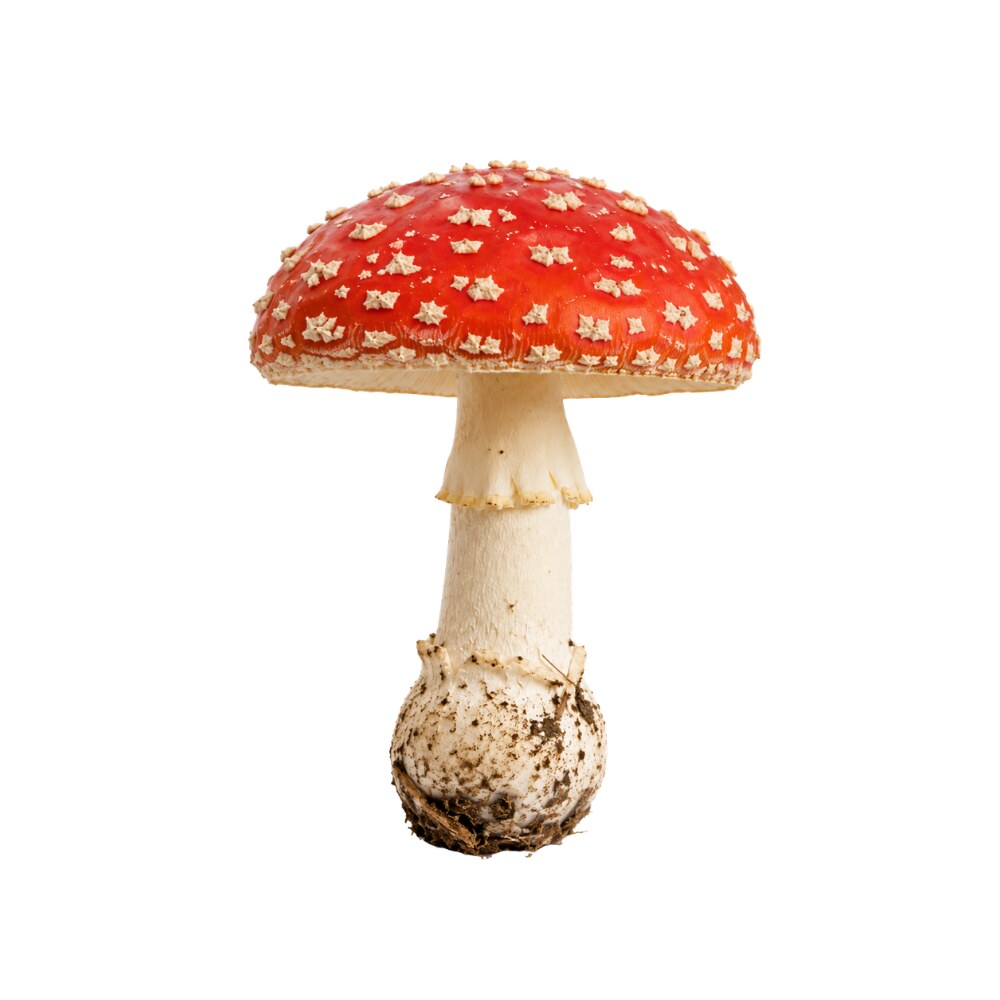
Fly agaric is the instantly recognisable red-capped, white-spotted mushroom of birch, pine and spruce woodlands across the temperate Northern Hemisphere — the storybook toadstool, the “Mario mushroom,” the emoji 🍄. It is also genuinely toxic, and almost nothing about it works the way people assume.
The single most important thing to understand is that Amanita muscaria is not a “magic mushroom.” It contains no psilocybin and shares none of that pharmacology. Its activity comes from two isoxazole compounds — ibotenic acid and muscimol — that act on the GABA and glutamate systems rather than serotonin. The result is closer to a deliriant and oneirogen (a dream-inducer) than a classic psychedelic: not crisp visuals, but a heavy, sedating, dream-logic haze in which objects seem to swell or shrink and it becomes hard to tell waking from sleep. Most people who try it for a “trip” do not try it again — the experience tends to be more disorienting and physically unpleasant than insightful.
The caution here is not abstract. Raw or high-dose fly agaric reliably causes nausea, vomiting, sweating, salivation and confusion, and at large doses can produce delirium and, rarely, seizures. The mushroom also grows alongside some of the deadliest fungi on Earth — the death cap and destroying angels — which have killed people who misidentified them. Reported deaths from A. muscaria itself are very rare (none in North America in over a century, per the North American Mycological Association), but serious poisonings are not, and this monograph treats the species as a toxic plant first and a curiosity second.
Traditional Uses
Fly agaric has one of the richest ethnographic histories of any psychoactive fungus, concentrated in the cold northern reaches of the world. Among Siberian peoples — the Koryak, Chukchi, Sámi and others — dried caps were eaten ritually by shamans. A notorious detail records that the urine of someone who had eaten the mushroom remained psychoactive, and was sometimes drunk by others (or sought out by reindeer); this effectively concentrated the desirable muscimol while filtering out some of the toxic ibotenic acid — an accidental form of “purification.”
The mushroom sits at the centre of several enduring theories. The ethnomycologist R. Gordon Wasson famously proposed that fly agaric was Soma, the divine intoxicant of the Hindu Rigveda — though the identity of Soma remains contested, with psilocybin mushrooms, Syrian rue (Peganum harmala) and ephedra all suggested instead. It has been linked, more speculatively, to Viking “berserker” rage and even to the imagery of Christmas: red-and-white shaman’s dress, reindeer that “fly,” and a gift-bringer from the frozen north are all folkloric echoes that some trace back to this mushroom. These stories are colourful and unprovable in equal measure, but they explain why fly agaric looms so large in the cultural imagination — and why it turns up in everything from Alice in Wonderland to video games.
Modern interest is narrower and more sober: careful drying and gentle heating to convert the toxic ibotenic acid into milder muscimol, and low-dose or microdose use reported to intensify dreams.
How Much Should I Take?
This is a high-variance, genuinely risky mushroom, and the honest answer is that for most people the right dose is none. If you read nothing else in this section: potency swings several-fold between specimens depending on rainfall, temperature, host tree, altitude and season, so without lab testing you cannot really know how strong a given cap is — and the dose that produces effects sits uncomfortably close to the dose that makes you sick.
Preparation matters more than quantity. Fresh, raw caps are the worst of both worlds — maximal ibotenic acid (the nauseating, excitotoxic compound) and minimal muscimol. The traditional and modern approach is decarboxylation: thoroughly drying the caps and gently heating them, often in mild acid (vinegar or lemon juice) and without boiling hard, which converts much of the ibotenic acid into the gentler, more sedative muscimol. This reduces — but does not eliminate — toxicity and side effects. Trace muscarine can be lowered further by heating. Done carelessly, none of this protects you.
For orientation only (dried material, not a recommendation): a microdose is under ~1 g, a threshold dose ~2–3 g, and a “standard” psychoactive dose ~5–10 g, with anything above that sharply increasing the risk of a cholinergic crisis. Do not exceed roughly 10 g under any circumstances. Onset is slow — up to about 3 hours — effects peak around the 5-hour mark and can last up to 12 hours, with some people reporting unusually vivid dreams for days afterward.
Why decarboxylation reduces toxicity
Ibotenic acid is the more toxic of the two main compounds — an excitotoxic glutamate-receptor agonist that drives the nausea, vomiting and neurological agitation. Muscimol, into which ibotenic acid converts when it loses a carboxyl group (decarboxylation), is the more desirable, sedative GABA-A agonist. Heat and drying push that conversion forward, so well-dried and gently heated material tends to be milder and less sickening than fresh caps. The catch is that the process is imprecise: you cannot easily know how complete it was, and residual ibotenic acid remains. Decarboxylation lowers the odds of a miserable experience; it does not make the mushroom safe.
How Does Amanita muscaria Work?
Fly agaric is pharmacologically unlike almost every other psychoactive plant or fungus. It does not act on the serotonin 5-HT2A receptor (the target of psilocybin, LSD and mescaline), nor on the kappa-opioid system (salvia, ketamine, DXM). Instead its two active compounds work on the brain’s two main “volume controls” — the inhibitory and excitatory systems — at the same time:
- Muscimol → GABA-A. Muscimol is structurally similar to GABA, the central nervous system’s chief inhibitory (calming) neurotransmitter, and acts as a potent GABA-A agonist. This drives the heavy sedation, the dreamy dissociation and the tendency to drift in and out of sleep.
- Ibotenic acid → glutamate/NMDA. Ibotenic acid resembles glutamic acid, the brain’s main excitatory neurotransmitter, and activates glutamate (including NMDA) receptors 4Reference 4Novel 5-substituted 1-pyrazolol analogues of ibotenic acid: synthesis and pharmacology at glutamate receptors. This excitatory, excitotoxic action is thought to underlie both the early “energised” phase and much of the toxicity and nausea.
- A cholinergic tilt. Clinically, fly agaric behaves as a cholinergic — it pushes the parasympathetic “rest and digest” system, which is why the side-effect profile includes sweating, salivation, low blood pressure, slowed heart rate, increased urination and vomiting. This is the mirror image of deliriant nightshades like datura and mandrake, which are anticholinergic (dry mouth, racing heart, fever). Notably, small amounts of the compound muscarine are present, but in A. muscaria it occurs only in trace amounts and is not the driver of the experience.
The strange part — and researchers admit this openly — is that it is still not fully understood how simultaneously inhibiting (GABA) and exciting (glutamate) the brain produces such a distinctive dreamlike state 3Reference 3ReviewAmanita muscaria: chemistry, biology, toxicology, and ethnomycology.
Pharmacology & Medical Research
Fly agaric is far better characterised as a toxin and an ethnographic curiosity than as a medicine. The research base is thin, and what exists is mostly chemistry, toxicology and pharmacology rather than clinical trials.
Muscimol and the GABA system
Muscimol is the compound most responsible for the desirable, sedative side of fly agaric. As a GABA-A agonist it depresses central nervous system activity — producing the sedation, muscle relaxation and dreamlike haze — and it has long been used as a research tool for probing GABAergic signalling. Its toxicity is dose-dependent: reported LD50 values in rodents are roughly 45 mg/kg (rats) and 20 mg/kg (mice) orally 1Reference 1Pharmacological and experimental psychological studies with two components of fly agaric (Amanita muscaria), well above a typical psychoactive dose, which is part of why acute fatalities are rare even though unpleasant poisonings are not.
Ibotenic acid, decarboxylation and toxicity
Ibotenic acid is best understood as both the source of the mushroom’s toxicity and a prodrug for muscimol. As a glutamate/NMDA-receptor agonist it is frankly excitotoxic — it is used in neuroscience precisely because it can lesion neurons — and in the body it produces the nausea, vomiting and neurological agitation of the early phase 3,4Reference 3ReviewAmanita muscaria: chemistry, biology, toxicology, and ethnomycologyReference 4Novel 5-substituted 1-pyrazolol analogues of ibotenic acid: synthesis and pharmacology at glutamate receptors. Drying and gentle heating decarboxylate much of it into muscimol, which is why preparation shifts the experience toward sedation and away from sickness. The conversion is incomplete and variable, so residual ibotenic acid always remains a factor.
Sedative, dream and dissociative effects
The hallmark of fly agaric is its effect on sleep and dreaming rather than on waking perception, which is why it is best classed as an oneirogen. Even low doses are reported to produce unusually vivid, bizarre and sometimes lucid dreams; at higher doses users tend to fall in and out of sleep, with the most intense imagery arriving once they do. Waking effects are more about distortion of size and time (objects seeming to grow or shrink) than the structured visuals of a classic psychedelic 1Reference 1Pharmacological and experimental psychological studies with two components of fly agaric (Amanita muscaria). The dreams are frequently described as chaotic and hard to interpret — and not always pleasant.
Traditional and emerging use
Historically the mushroom was used ritually in Siberian shamanism, including the practice of recycling psychoactive urine to concentrate muscimol, and it features in long-running (and unresolved) debates about Soma and the roots of certain folklore 3Reference 3ReviewAmanita muscaria: chemistry, biology, toxicology, and ethnomycology. Contemporary interest is mostly informal: microdosing for dream enhancement, and isolated muscimol as a subject of pharmacological study. There is, at present, no robust clinical evidence supporting fly agaric or muscimol as a treatment for any condition, and its toxicity makes self-experimentation hazardous.
Mycology
The fly agaric is the storybook toadstool — a brilliant scarlet cap flecked with white, on a white stalk with a skirt-like ring and a bulbous, scaly base. Those white flecks are the torn remnants of the “universal veil” that wrapped the young mushroom when it first pushed up like an egg, and the whole combination of red cap, white warts, white gills, ring and swollen base makes it the type species of the great genus Amanita. What is gathered is the fruiting body — the mushroom itself.
Beneath the ground, the fungus lives in partnership with trees, wrapping the fine roots of birch, pine and spruce in an exchange of nutrients — which is why fly agaric is always found near its host trees and never far out in the open. (It is both poisonous and psychoactive, and is never a food mushroom.)
Distribution
Fly agaric grows throughout the cool temperate and northern forests of the Northern Hemisphere, in birch, pine and spruce woodland across Europe, Asia and North America. It has also hitched a ride to the Southern Hemisphere on the roots of planted pines and birches, and now grows in Australia, New Zealand, South Africa and South America — sometimes spreading from plantations into native bush.
Cultivation
- It cannot really be cultivated. Fly agaric lives in obligate partnership with tree roots (it is ectomycorrhizal), so it needs a living tree to fruit at all.
- Unlike button, oyster or shiitake mushrooms, it will not grow on compost, grain, straw or logs — no amount of substrate will make it fruit on its own.
- The only way to “grow” it is to establish its host trees (birch, pine, spruce) and wait years for the natural symbiosis to form, after which mushrooms may appear in late summer and autumn.
- In practice it is a wild fungus, found rather than farmed.
- Habitat and identification notes live on the companion farm-wiki entry for Amanita muscaria (link to be added once that project’s public URL is confirmed).
Phytochemistry
The activity of Amanita muscaria comes from a small group of isoxazole compounds rather than the tryptamines of psilocybin mushrooms. The two principal and defining compounds are ibotenic acid — a glutamate-receptor agonist and the main source of toxicity and nausea — and muscimol, a potent GABA-A agonist responsible for the sedative, dreamy, dissociative effects. Muscimol is formed by decarboxylation of ibotenic acid as the mushroom dries; the related minor isoxazole muscazone arises as a photochemical breakdown product of ibotenic acid. Small amounts of the amine muscarine are also present but do not drive the typical effects.
Reported levels vary widely between specimens with habitat, age and drying. Laboratory analysis of dried caps has found muscimol around 1 mg/g and ibotenic acid roughly 2.6–4.2 mg/g of dried material, while muscarine occurs only in trace amounts (on the order of a few mg/kg of fresh mushroom) and is not responsible for the inebriation 2,3Reference 2In vitroAnalysis of the ibotenic acid, muscimol, and ergosterol content of an Amanita muscaria hydroalcoholic extract with an evaluation of its cytotoxic effect against a panel of lung cell lines in vitroReference 3ReviewAmanita muscaria: chemistry, biology, toxicology, and ethnomycology. Fly agaric is also notable for bioaccumulating vanadium from the soil as the organometallic compound amavadin, sometimes at hundreds of times the levels found in ordinary plants and fungi, though the health significance of this is unclear 5Reference 5Investigations of amavadin.
Constituent Summary
Figures are per gram of dried cap (mg/g) unless noted; content varies several-fold with specimen, maturity, habitat and drying, and drying converts ibotenic acid to muscimol. † marks ibotenic acid and muscimol as the defining psychoactive markers of the species.
Isoxazole3 compounds2 with data
Amine1 compound1 with data
Safety & Pregnancy
Treat fly agaric as a poisonous mushroom that happens to be psychoactive, not a recreational drug that happens to be a bit risky: its toxicity is dose-dependent, the active dose sits close to the sickening one, and it grows among some of the deadliest fungi on Earth.
- Deadly lookalikes. Death caps and destroying angels share its habitat — a misidentification can cause fatal organ failure.
- Genuinely toxic. Dose-dependent nausea, vomiting, delirium and, rarely, seizures — escalating to a cholinergic crisis at high dose.
- Avoid in pregnancy & lactation. No safety data and a real toxicity risk.
- CNS depressant stacking. Do not combine with alcohol, benzodiazepines, sleep aids or other sedatives.
- Unpredictable potency. Strength swings several-fold between specimens; without lab testing you cannot know a cap’s strength.
- Legal status varies. Unregulated in many countries, scheduled or restricted in others.
Full safety & interactions detail
Treat fly agaric as a poisonous mushroom that happens to be psychoactive, not as a recreational drug that happens to be a bit risky. Its toxicity is dose-dependent, and the gap between an active dose and a sickening one is small and unpredictable.
- Nausea, vomiting and the cholinergic load. The most common adverse effects — driven largely by ibotenic acid and the mushroom’s cholinergic action — are nausea, vomiting, sweating, salivation, low blood pressure and a slowed heart rate. At higher doses these can escalate toward a cholinergic crisis (sometimes summarised by the acronym SLUDGE: salivation, lacrimation, urination, defecation, gastrointestinal distress, emesis), along with ataxia (loss of coordination), agitation, delirium and, rarely, seizures. Proper drying and decarboxylation reduce — but do not remove — this risk.
- The lethal-lookalike danger (read this twice). This is the most serious hazard of all. The Amanita genus contains some of the deadliest fungi known — the death cap (Amanita phalloides) and the destroying angels (A. virosa, A. bisporigera, A. ocreata and others) — which can cause fatal liver and kidney failure from a single meal. They grow in the same habitats as fly agaric and can resemble it at various life stages (a young, unopened A. muscaria button is especially easy to confuse). Never wild-harvest this or any Amanita unless you are 100% certain of the identification. A mistake here is not “a bad trip” — it is potentially fatal organ failure.
- Other cautions. Fly agaric bioaccumulates vanadium (as amavadin) and may carry other contaminants from its environment 5Reference 5Investigations of amavadin; high-dose risk is greater in people with pre-existing liver or kidney disease. Do not combine it with alcohol, benzodiazepines, sleep aids or other CNS depressants, as muscimol is itself a strong sedative. Driving or operating machinery is out of the question given the sedation and confusion. Legal status varies: the mushroom is unregulated in much of the world (including the United States, Canada and the UK), but it is banned or restricted in some places (e.g. Australia, where muscimol is scheduled, and certain European countries; in the US, Louisiana restricts it), so confirm local law before any handling or possession.
Fly agaric should be avoided entirely in pregnancy and breastfeeding. There is no safety data either way, and the mushroom carries a real toxicity risk — ibotenic acid is excitotoxic and the fungus is genuinely poisonous at dose — so this is a firm avoid rather than a simple untested unknown.
References
- Theobald, W., Büch, O., Kunz, H. A., Krupp, P., Stenger, E. G., & Heimann, H. (1968). Pharmacological and experimental psychological studies with two components of fly agaric (Amanita muscaria). Arzneimittel-Forschung, 18(3), 311–315. (Early pharmacological characterisation of muscimol and ibotenic acid, including approximate human psychoactive doses.)
- Voynova, M., Shkondrov, A., Kondeva-Burdina, M., & Krasteva, I. (2023). Analysis of the ibotenic acid, muscimol, and ergosterol content of an Amanita muscaria hydroalcoholic extract with an evaluation of its cytotoxic effect against a panel of lung cell lines in vitro. Molecules, 28(2), 577. (Quantifies ibotenic acid and muscimol in dried A. muscaria material, with ibotenic acid the larger fraction and muscimol around 1 mg/g.)
- Michelot, D., & Melendez-Howell, L. M. (2003). Amanita muscaria: chemistry, biology, toxicology, and ethnomycology. Mycological Research, 107(2), 131–146. (Comprehensive review: ibotenic acid and muscimol as the principal isoxazoles, muscazone a photochemical derivative, muscarine present only in trace amounts, the combined GABAergic/glutamatergic mechanism, and the ethnomycology including Siberian use and the Soma debate.)
- Jørgensen, C. G., Bräuner-Osborne, H., Nielsen, B., Kehler, J., Clausen, R. P., Krogsgaard-Larsen, P., & Madsen, U. (2007). Novel 5-substituted 1-pyrazolol analogues of ibotenic acid: synthesis and pharmacology at glutamate receptors. Bioorganic & Medicinal Chemistry, 15(10), 3524–3538. (Characterises ibotenic acid and analogues as agonists at glutamate, including NMDA, receptors.)
- Garner, C. D., Armstrong, E. M., Berry, R. E., Beddoes, R. L., Collison, D., Cooney, J. J. A., … & Helliwell, M. (2000). Investigations of amavadin. Journal of Inorganic Biochemistry, 80(1–2), 17–20. (Documents the vanadium-containing compound amavadin that A. muscaria accumulates from soil.)