
Materia Medica
Mullein
Verbascum thapsus
Mullein (Verbascum thapsus) — a soothing respiratory herb for dry coughs, catarrh and bronchial irritation, with a large preclinical (mostly in vitro) evidence base.
What Is Mullein?
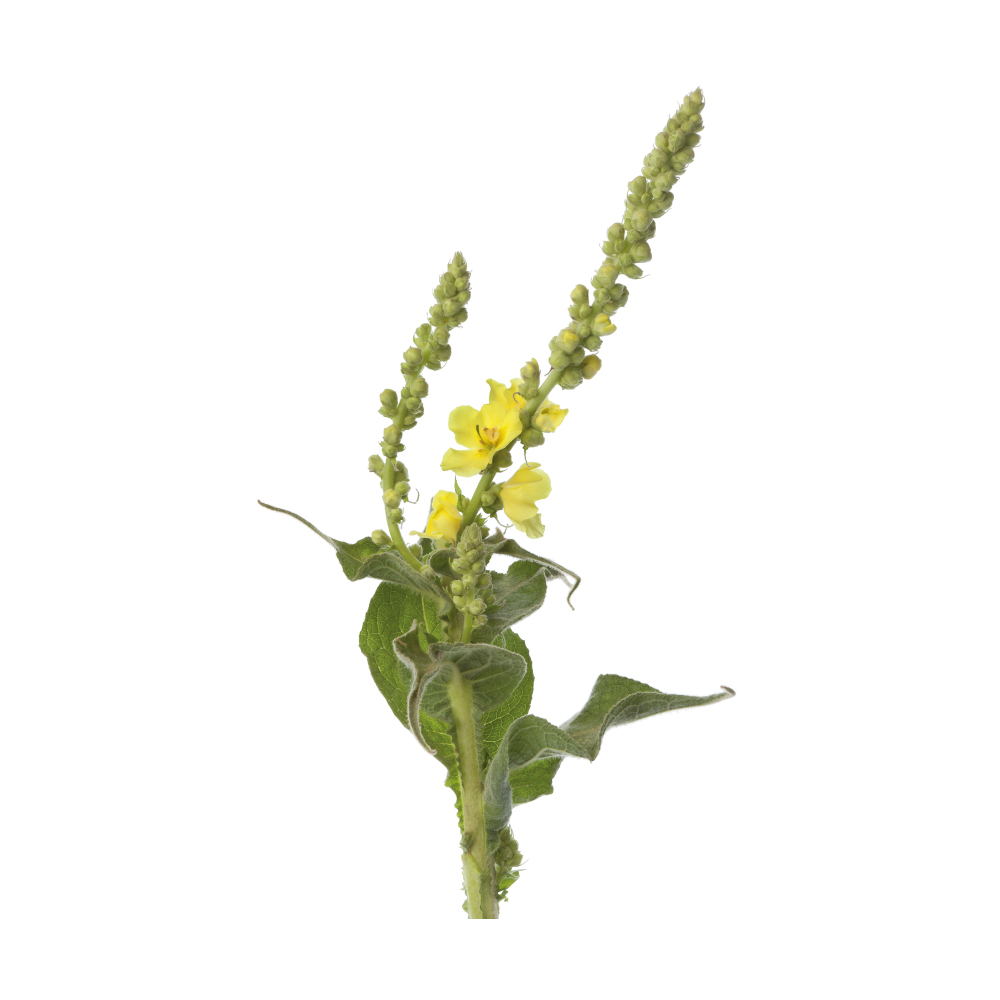
Mullein (Verbascum thapsus) is a staple of Western herbal medicine — a tall, velvety-leaved biennial in the figwort family whose leaves, flowers and (less often) roots have been used for centuries as a soothing remedy for the respiratory tract. Native to Europe and the Mediterranean, it was carried to North America by European settlers, naturalised widely, and was adopted into local folk medicine. It picked up a long list of common names along the way — Aaron’s rod, candlewick, and “cowboy toilet paper” among them — earned from its soft, flannel-like leaves and its tall flowering spike.
Mullein is best known as a gentle demulcent for dry, irritated coughs and catarrh. Its soothing character comes largely from the mucilage in the leaf and flower, which coats and calms irritated mucous membranes; the leaves are traditionally favoured for dry coughs and the root for productive, wet coughs, though this leaf-versus-root split is a traditional distinction rather than a research finding. The herb is also used topically for skin irritation and, famously, as a flower-infused oil for earache.
Mullein has a long, benign reputation and a low measured toxicity, but “very safe” claims should be read with the caveats below — the fine leaf hairs can irritate, and wild-gathered material can carry contaminants.
Traditional & Modern Uses
Mullein’s central traditional use is respiratory: soothing dry, unproductive coughs, easing catarrh and bronchial irritation, and calming spasmodic coughs. Somewhat ironically for a lung herb, the dried leaf has also long been smoked for a soothing effect — though inhaled smoke can itself irritate sensitive airways. The mucilaginous leaf and flower are taken as infusions, tinctures and syrups; the herb is also used traditionally for gastrointestinal irritation, and historically as an anthelmintic (worm) remedy.
Topically, mullein is applied to skin irritations and, most famously, is infused into oil for earache — the drops are used for pain relief rather than to cure the underlying infection. This popular “mullein garlic ear oil” use has the closest thing mullein has to human evidence, but the tested product was a four-herb combination (see Pharmacology & Research), so the ear benefit cannot be attributed to mullein alone.
(Note: mullein is sometimes casually called “Indian tobacco,” but that name properly belongs to Lobelia inflata — a different and considerably more toxic plant. The two should not be confused.)
Botany & Varieties
Mullein belongs to the figwort family (Scrophulariaceae), which comprises roughly 65 genera and around 1,800 species; the Verbascum genus itself contains some 250 species. It is a popular garden plant, valued for thriving in dry, nutrient-poor soils and for its long flowering season.
The plant is biennial: in its first season it forms a low rosette of large, soft, densely hairy leaves, and in its second it throws up a tall velvety flower spike that can reach up to three metres. The dense leaf hairs (trichomes) that give the plant its flannel-like feel are also a mild mechanical irritant, which matters for how the leaf is prepared as tea.
Habitat & Harvesting
Mullein is a hardy coloniser of disturbed ground — roadsides, waste places, railway embankments and gravelly, poor soils across Europe and North America. That ecology carries a practical harvesting caveat: V. thapsus is a documented accumulator of heavy metals from soil, and uptake into its roots and leaves rises sharply on polluted ground 19Reference 19Influence of soil pollution on the morphology of roots and leaves of Verbascum thapsus L. — heavy-metal accumulationView study →. Wild-gathered material should therefore come from clean sites, well away from roads and contaminated land.
Phytochemistry
Mullein’s soothing, demulcent character comes first from its mucilage — a load of polysaccharides, abundant in the leaf and flower, that coats and calms irritated mucous membranes and underpins the herb’s use for dry coughs. Layered onto this are bitter iridoid glycosides, chiefly aucubin (concentrated in the leaf), which lend anti-inflammatory and mild antimicrobial activity.
The most studied single phenolic is verbascoside (also called acteoside), a phenylethanoid glycoside with documented antioxidant, anti-inflammatory and wound-healing actions. The herb’s expectorant reputation is generally credited to triterpene saponins, including verbascosaponin, which help thin and move bronchial secretions; flavonoids such as hesperidin round out the leaf.
Constituent Summary
Constituents below are reported qualitatively in the published literature; reliable quantitative figures for V. thapsus leaf and flower are scarce, hence the No Data entries. No units are shared across the table.
Mucilage1 compoundno data
Phenylpropanoids1 compoundno data
Flavonoids1 compoundno data
Pharmacology & Research
Mullein has a long medicinal history but a modest and preclinical-dominated evidence base: roughly a hundred Verbascum thapsus–specific papers, almost all in vitro or animal, plus review coverage in Phytotherapy Research 1,2Reference 1ReviewCommon mullein (Verbascum thapsus L.): recent advances in research — reviewView study →Reference 2ReviewHealth-promoting and disease-mitigating potential of Verbascum thapsus L. (common mullein): a reviewView study →. The only human randomised data come from two paediatric trials of a herbal ear-drop in which mullein is one of four botanicals, so no result isolates mullein itself 5,6Reference 5RCTEfficacy of naturopathic extracts in the management of ear pain associated with acute otitis media — randomised controlled trialView study →Reference 6RCTNaturopathic treatment for ear pain in children — randomised, double-blind, multicenter trialView study →. The most consistent laboratory signals are antibacterial, antioxidant and anti-inflammatory activity, the last largely attributable to the phenylethanoid glycoside verbascoside 3,4,8,9Reference 3In vitroBiological activity of common mullein, a medicinal plant — in vitro (antibacterial, antitumor, toxicity)View study →Reference 4ReviewVerbascoside — a review of its occurrence, (bio)synthesis and pharmacological significanceView study →Reference 8In vitroAnti-inflammatory effects in THP-1 cells treated with verbascoside — in vitroView study →Reference 9Correlation between polyphenol content and anti-inflammatory activity of Verbascum phlomoides (mullein)View study →. The herb’s flagship traditional use — a demulcent for dry coughs and catarrh — rests on its mucilage and saponin content and on centuries of documented use rather than on trial data. Most work uses methanol or ethanol whole-plant extracts, which do not map cleanly onto the teas, tinctures and infused oils the herb is actually taken as.
- Best-supported: broad in vitro antibacterial activity against common respiratory and skin pathogens 3,7Reference 3In vitroBiological activity of common mullein, a medicinal plant — in vitro (antibacterial, antitumor, toxicity)View study →Reference 7In vitroAntioxidant, AChE inhibitory, and anticancer effects of Verbascum thapsus extract — in vitroView study →, and antioxidant/anti-inflammatory activity concentrated in verbascoside 4,8,9Reference 4ReviewVerbascoside — a review of its occurrence, (bio)synthesis and pharmacological significanceView study →Reference 8In vitroAnti-inflammatory effects in THP-1 cells treated with verbascoside — in vitroView study →Reference 9Correlation between polyphenol content and anti-inflammatory activity of Verbascum phlomoides (mullein)View study →.
- Emerging, worth watching: antiviral activity against influenza and pseudorabies virus in cell culture 10,11Reference 10In vitroAntiviral activity of some plants used in Nepalese traditional medicine — in vitro anti-influenza screenView study →Reference 11In vitroAntiviral effect and mode of action of methanolic extract of Verbascum thapsus on pseudorabies virus — in vitroView study →, and two paediatric RCTs where a mullein-containing ear-drop matched anaesthetic drops for ear pain 5,6Reference 5RCTEfficacy of naturopathic extracts in the management of ear pain associated with acute otitis media — randomised controlled trialView study →Reference 6RCTNaturopathic treatment for ear pain in children — randomised, double-blind, multicenter trialView study →.
- Mechanistically thin: the classic expectorant/demulcent cough use — plausible from mucilage and saponins but with no direct clinical or strong preclinical test.
- The caveat: almost everything is preclinical, extracts are rarely standardised, and results from methanol whole-plant extracts don’t transfer to teas or infused oils.
1. Antibacterial
Whole-plant extracts of mullein inhibit a range of bacteria in the laboratory. A benchmark ethnopharmacology study found water, ethanol and methanol leaf extracts active against Klebsiella pneumoniae, Staphylococcus aureus, Staphylococcus epidermidis and Escherichia coli, with the water extract — the closest analogue to a tea — among the more active 3Reference 3In vitroBiological activity of common mullein, a medicinal plant — in vitro (antibacterial, antitumor, toxicity)View study →. Later in vitro work reproduced activity against Gram-positive and Gram-negative strains, and reviews consolidate antibacterial action as the herb’s most repeatedly demonstrated pharmacology 1,7Reference 1ReviewCommon mullein (Verbascum thapsus L.): recent advances in research — reviewView study →Reference 7In vitroAntioxidant, AChE inhibitory, and anticancer effects of Verbascum thapsus extract — in vitroView study →. The recurring interest in mullein against Mycobacterium (the plant’s folk names historically link it to tuberculosis) remains a historical and mechanistic hypothesis rather than a demonstrated cure 12Reference 12ReviewWhat’s in a name? Can mullein weed beat TB where modern drugs are failing? — reviewView study →. All of this is in vitro; no clinical infection trial exists.
Gap: No human data, and minimum-inhibitory concentrations vary widely with extract solvent and plant part, so a real-world dose is undefined.
2. Antioxidant
Mullein extracts consistently scavenge free radicals in standard chemical assays. Methanol leaf extract shows measurable DPPH and ABTS radical-scavenging activity alongside a characterised phenolic profile 7Reference 7In vitroAntioxidant, AChE inhibitory, and anticancer effects of Verbascum thapsus extract — in vitroView study →, and a separate extract study reports comparable antioxidant capacity attributed to flavonoids, saponins and lignans 13Reference 13In vitroThe antioxidant, anticarcinogenic and antimicrobial properties of Verbascum thapsus L. — in vitroView study →. Most of the activity tracks the phenylethanoid glycoside verbascoside, whose antioxidant behaviour is documented across a large review literature 4Reference 4ReviewVerbascoside — a review of its occurrence, (bio)synthesis and pharmacological significanceView study →. These are cell-free or cell-line measurements; whether drinking mullein tea raises antioxidant status in people has not been tested.
Gap: Antioxidant capacity is measured in a test tube, not in humans, and the effective in vivo dose is unknown.
3. Anti-inflammatory
The anti-inflammatory reputation is best explained at the constituent level. Verbascoside suppresses inducible nitric oxide synthase (iNOS) and NF-κB signalling in stimulated human THP-1 monocytes, lowering nitric oxide output 8Reference 8In vitroAnti-inflammatory effects in THP-1 cells treated with verbascoside — in vitroView study →. A polyphenol-rich flower extract of the related Verbascum phlomoides — sold interchangeably as “mullein” in parts of Europe — showed anti-inflammatory activity that correlated with its polyphenol content, though this is a different species 9Reference 9Correlation between polyphenol content and anti-inflammatory activity of Verbascum phlomoides (mullein)View study →. Reviews list anti-inflammatory action among mullein’s better-characterised effects, but the direct evidence is cell-based or from constituents rather than whole-herb human studies 1,2Reference 1ReviewCommon mullein (Verbascum thapsus L.): recent advances in research — reviewView study →Reference 2ReviewHealth-promoting and disease-mitigating potential of Verbascum thapsus L. (common mullein): a reviewView study →.
Gap: No whole-herb animal or human anti-inflammatory trial; the strongest data are for an isolated compound and a sibling species.
4. Ear pain (otitis media)
This is the only indication with human randomised data, and it is heavily qualified. Two paediatric trials tested Otikon, a herbal ear-drop containing Allium sativum (garlic), Verbascum thapsus (mullein), Calendula and Hypericum in olive oil. A 2001 single-centre RCT reported that the herbal drop relieved otitis-media ear pain comparably to an anaesthetic drop 5Reference 5RCTEfficacy of naturopathic extracts in the management of ear pain associated with acute otitis media — randomised controlled trialView study →, and a 2003 multicentre double-blind trial found the herbal drop, with or without topical anaesthetic, gave effective and well-tolerated pain relief 6Reference 6RCTNaturopathic treatment for ear pain in children — randomised, double-blind, multicenter trialView study →. Because mullein is one of four botanicals in an olive-oil base, neither trial can attribute the benefit to mullein specifically — a caveat directly relevant to the popular “mullein garlic ear oil.” The effect is symptomatic pain relief, not cure of infection.
Gap: Mullein’s individual contribution is unproven — the tested product is a four-herb combination — and no trial has used mullein oil alone.
6. Anthelmintic & antispasmodic
A single study underpins the traditional “wormwood”-type and antispasmodic uses. A crude aqueous-methanolic extract paralysed and killed roundworms (Ascaridia galli) and tapeworms (Raillietina spiralis) in vitro, and relaxed KCl-contracted rabbit jejunum, supporting both anthelmintic and smooth-muscle-relaxant (antispasmodic) activity 14Reference 14In vitroAnthelmintic and relaxant activities of Verbascum thapsus mullein — in vitro/ex vivoView study →. The smooth-muscle relaxation is a plausible mechanistic thread for the herb’s use in spasmodic coughs, but it comes from one isolated-tissue experiment.
Gap: One study, in vitro and ex vivo only — no confirmation in a living animal or human, and no dose translation.
7. Expectorant & demulcent
This is mullein’s principal traditional use and its weakest experimental case. The demulcent, cough-soothing action is attributed to the leaf and flower mucilage — polysaccharides that coat and calm irritated mucous membranes — and the expectorant reputation to triterpene saponins thought to thin bronchial secretions 1,2Reference 1ReviewCommon mullein (Verbascum thapsus L.): recent advances in research — reviewView study →Reference 2ReviewHealth-promoting and disease-mitigating potential of Verbascum thapsus L. (common mullein): a reviewView study →. This mechanism is textbook-plausible and the use is documented across European and North American herbal traditions, but there is no clinical or robust preclinical study of mullein for cough, catarrh or bronchial irritation. The claim rests on tradition plus constituent-level reasoning, not on trials.
Gap: No cough or respiratory clinical trial exists; the demulcent/expectorant action is inferred from mucilage and saponin content, not measured.
8. Anticancer (cytotoxic)
Cytotoxicity signals are preliminary and inconsistent. Mullein extract inhibited Agrobacterium-induced tumours in the potato-disc assay and showed activity in brine-shrimp toxicity screening 3Reference 3In vitroBiological activity of common mullein, a medicinal plant — in vitro (antibacterial, antitumor, toxicity)View study →, and a methanol extract reduced viability of cancer cells in MTT assays alongside its antioxidant and acetylcholinesterase-inhibitory effects 15Reference 15In vitroAnticancer (cytotoxic, MTT) effects of Verbascum thapsus extract — in vitroView study →. A further extract study reported anticarcinogenic constituents by GC-MS 13Reference 13In vitroThe antioxidant, anticarcinogenic and antimicrobial properties of Verbascum thapsus L. — in vitroView study →. These are early-stage in vitro results with no consistent target, cell panel or in vivo follow-up.
Gap: In vitro screening only, with mixed models and no animal or human oncology data.
9. Antifungal
One recent study characterised mullein tissue oils (leaf, stem, root) and reported antifungal activity in vitro alongside phenolic and fatty-acid profiling 16Reference 16In vitroPhytochemical profiling and antifungal activity of mullein (Verbascum thapsus) tissue oils — in vitroView study →. This is a single laboratory report on an oil preparation, not the water or alcohol extracts most people use, so it stands as a preliminary signal rather than a validated action.
Gap: A single in vitro study on tissue oils — unreplicated, and in a preparation form few people actually use.
10. Antiprotozoal
An ethanol extract of mullein induced apoptosis and inhibited growth and motility of Trichomonas vaginalis in vitro, proposed as a possible alternative to metronidazole 17Reference 17In vitroEffect of Verbascum thapsus ethanol extract on induction of apoptosis in Trichomonas vaginalis — in vitroView study →. This is one cell-based study; it aligns loosely with the traditional use for genitourinary and diarrhoeal complaints but has no in vivo or clinical support.
Gap: Single in vitro study against one protozoan — no animal or clinical confirmation.
Mechanisms
| Mechanism | Drives | Key compounds |
|---|---|---|
| iNOS ↓, NF-κB ↓, nitric oxide ↓ | anti-inflammatory | verbascoside |
| Free-radical scavenging (DPPH/ABTS) | antioxidant | verbascoside, flavonoids, hesperidin |
| Mucilage coating of mucous membranes | demulcentdry-cough soothing | mucilage polysaccharides |
| Saponin surfactant action on secretions | expectorant | triterpene saponins, verbascosaponin |
| Membrane/microbial disruption in vitro | antibacterialantifungalantiviral | saponins, aucubin, verbascoside |
| Smooth-muscle relaxation (KCl-contracted tissue) | antispasmodicanthelmintic | crude extract (constituent undetermined) |
Clinical trials
The only completed human trials of a mullein-containing product are the two paediatric otic-drop RCTs of the four-herb Otikon solution 5,6Reference 5RCTEfficacy of naturopathic extracts in the management of ear pain associated with acute otitis media — randomised controlled trialView study →Reference 6RCTNaturopathic treatment for ear pain in children — randomised, double-blind, multicenter trialView study →; a not-yet-recruiting olive-plus-mullein cognitive-function supplement trial is registered (NCT07586410), and no trial has tested mullein as a single herb.
| Completed | Planned | Terminated | Preclinical |
|---|---|---|---|
| 2(combination product) | 1(combination) | 0 | ~100 |
Last checked: July 2026.
Dosage
Mullein has no research-derived oral dose: the only human trials used a proprietary four-herb topical ear drop with no stated mullein content, and every other study is in vitro. The doses below are therefore traditional, from the reference texts, not from trials.
| Indication | Preparation | Dose | Est. dried-herb equivalent | Source |
|---|---|---|---|---|
| Ear pain (otitis media) | 4-herb otic solution (garlic, mullein, calendula, St John’s wort in olive oil), topical | Instilled into the affected ear canal (paediatric, ages 5–18) | — (topical combination product; not a whole-herb oral dose) | 5,6Reference 5RCTEfficacy of naturopathic extracts in the management of ear pain associated with acute otitis media — randomised controlled trialView study →Reference 6RCTNaturopathic treatment for ear pain in children — randomised, double-blind, multicenter trialView study → |
The only human evidence is a proprietary multi-herb topical drop with no stated mullein marker content, so no whole-herb weight can be back-calculated. All other indications are in vitro and do not translate to a human oral dose.
Traditional Dosage
Traditional use is of the whole leaf, flower or (for productive coughs) root, taken as an infusion, tincture or infused oil.
| System | Preparation | Dose |
|---|---|---|
| Western herbal | Dried leaf/flower infusion | ~3–4 g dried herb per cup, up to 3×/day (strain well) |
| Western herbal | Liquid extract 1:2 | 20–60 mL/week |
| Western herbal | Infused flower/leaf oil | Topical; a few drops in the ear or applied to skin |
Safety & Pregnancy
Mullein has a strong traditional safety record and is generally well tolerated; the practical cautions are its irritant leaf hairs (strain teas well) and the heavy-metal contamination risk of wild-harvested material.
- Well tolerated. strong traditional safety record; no genotoxicity in a mouse micronucleus test up to 500 mg/kg 18Reference 18AnimalGenotoxic evaluation of a methanolic extract of Verbascum thapsus using micronucleus test in mouse bone marrow — animal modelView study →.
- Irritant leaf hairs. trichomes can itch the skin, mouth or throat — strain leaf teas well; inhaled smoke may irritate sensitive airways.
- Wild-harvest contamination. V. thapsus accumulates heavy metals from soil, so gather only from clean sites 19Reference 19Influence of soil pollution on the morphology of roots and leaves of Verbascum thapsus L. — heavy-metal accumulationView study →.
- Interactions unstudied. no human drug-interaction studies have been conducted and formal contraindications are not established.
Full safety & interactions detail
Mullein has a strong traditional safety record and is generally well tolerated; a methanolic extract showed no genotoxicity in the mouse bone-marrow micronucleus test at doses up to 500 mg/kg 18Reference 18AnimalGenotoxic evaluation of a methanolic extract of Verbascum thapsus using micronucleus test in mouse bone marrow — animal modelView study →. The fine leaf hairs (trichomes) are a mechanical irritant and can cause itching of the skin, mouth or throat, so leaf teas should be well strained and inhaled smoke may irritate sensitive airways. Because Verbascum thapsus readily accumulates heavy metals from soil and is often gathered from roadsides and disturbed ground, wild-harvested material carries a contamination risk and should come from clean sites 19Reference 19Influence of soil pollution on the morphology of roots and leaves of Verbascum thapsus L. — heavy-metal accumulationView study →. No human drug-interaction studies have been conducted, and formal contraindications have not been established.
Not specifically researched. No controlled human or animal reproductive-safety studies of mullein have been identified. Traditional practice has treated the leaf and flower as gentle, but safety in pregnancy and lactation has not been formally assessed, so use during these periods cannot be affirmed from the available evidence.
References
- Turker AU, Gurel E. (2005). Common mullein (Verbascum thapsus L.): recent advances in research — review. Phytotherapy Research. https://pubmed.ncbi.nlm.nih.gov/16222647/
- Gupta A, Atkinson AN, et al. (2022). Health-promoting and disease-mitigating potential of Verbascum thapsus L. (common mullein): a review. Phytotherapy Research. https://pubmed.ncbi.nlm.nih.gov/35088467/
- Turker AU, Camper ND. (2002). Biological activity of common mullein, a medicinal plant — in vitro (antibacterial, antitumor, toxicity). Journal of Ethnopharmacology. https://pubmed.ncbi.nlm.nih.gov/12241986/
- Alipieva K, Korkina L, et al. (2014). Verbascoside — a review of its occurrence, (bio)synthesis and pharmacological significance. Biotechnology Advances. https://pubmed.ncbi.nlm.nih.gov/25048704/
- Sarrell EM, Mandelberg A, et al. (2001). Efficacy of naturopathic extracts in the management of ear pain associated with acute otitis media — randomised controlled trial. Archives of Pediatrics & Adolescent Medicine. https://pubmed.ncbi.nlm.nih.gov/11434846/
- Sarrell EM, Cohen HA, et al. (2003). Naturopathic treatment for ear pain in children — randomised, double-blind, multicenter trial. Pediatrics. https://pubmed.ncbi.nlm.nih.gov/12728112/
- Zhang N, Baran A, et al. (2023). Antioxidant, AChE inhibitory, and anticancer effects of Verbascum thapsus extract — in vitro. Cellular and Molecular Biology. https://pubmed.ncbi.nlm.nih.gov/38279434/
- Speranza L, Franceschelli S, et al. (2010). Anti-inflammatory effects in THP-1 cells treated with verbascoside — in vitro. Phytotherapy Research. https://pubmed.ncbi.nlm.nih.gov/20812283/
- Grigore A, Colceru-Mihul S, et al. (2013). Correlation between polyphenol content and anti-inflammatory activity of Verbascum phlomoides (mullein). Pharmaceutical Biology. https://pubmed.ncbi.nlm.nih.gov/23627472/
- Rajbhandari M, Mentel R, et al. (2009). Antiviral activity of some plants used in Nepalese traditional medicine — in vitro anti-influenza screen. Evidence-Based Complementary and Alternative Medicine. https://pubmed.ncbi.nlm.nih.gov/18955262/
- Escobar FM, Sabini MC, et al. (2012). Antiviral effect and mode of action of methanolic extract of Verbascum thapsus on pseudorabies virus — in vitro. Natural Product Research. https://pubmed.ncbi.nlm.nih.gov/21999656/
- McCarthy E, O’Mahony JM. (2011). What’s in a name? Can mullein weed beat TB where modern drugs are failing? — review. Evidence-Based Complementary and Alternative Medicine. https://pubmed.ncbi.nlm.nih.gov/20953419/
- Mahdavi S, Amiradalat M, et al. (2020). The antioxidant, anticarcinogenic and antimicrobial properties of Verbascum thapsus L. — in vitro. Medicinal Chemistry. https://pubmed.ncbi.nlm.nih.gov/31456524/
- Ali N, Ali Shah SW, et al. (2012). Anthelmintic and relaxant activities of Verbascum thapsus mullein — in vitro/ex vivo. BMC Complementary and Alternative Medicine. https://pubmed.ncbi.nlm.nih.gov/22463730/
- Zhang N, Baran A, et al. (2023). Anticancer (cytotoxic, MTT) effects of Verbascum thapsus extract — in vitro. Cellular and Molecular Biology. https://pubmed.ncbi.nlm.nih.gov/38279434/
- Singh R, Kumar A, et al. (2026). Phytochemical profiling and antifungal activity of mullein (Verbascum thapsus) tissue oils — in vitro. Chemistry & Biodiversity. https://pubmed.ncbi.nlm.nih.gov/42138428/
- Kashan ZF, Arbabi M, et al. (2015). Effect of Verbascum thapsus ethanol extract on induction of apoptosis in Trichomonas vaginalis — in vitro. Infectious Disorders Drug Targets. https://pubmed.ncbi.nlm.nih.gov/26239850/
- Escobar FM, Sabini MC, et al. (2011). Genotoxic evaluation of a methanolic extract of Verbascum thapsus using micronucleus test in mouse bone marrow — animal model. Natural Product Communications. https://pubmed.ncbi.nlm.nih.gov/21834240/
- Chaplygin V, Chernikova N, et al. (2022). Influence of soil pollution on the morphology of roots and leaves of Verbascum thapsus L. — heavy-metal accumulation. Environmental Geochemistry and Health. https://pubmed.ncbi.nlm.nih.gov/34050848/