
Materia Medica
Periwinkle
Vinca major
Periwinkle (Vinca major) — an ornamental Apocynaceae herb used traditionally as an astringent; its cognitive reputation belongs to the isolated alkaloid vincamine (chiefly from Vinca minor) and semi-synthetic vinpocetine, not the crude herb.
What Is Periwinkle?
Greater periwinkle (Vinca major) is a trailing evergreen of the dogbane family (Apocynaceae), grown worldwide as ground cover and known in Western herbalism as an astringent for bleeding and mucosal complaints. Its modern fame, however, is largely borrowed. The cognitive reputation attached to “periwinkle” belongs to the isolated alkaloid vincamine — concentrated chiefly from the related Vinca minor (lesser periwinkle), not this species — and to vinpocetine, a semi-synthetic derivative of that alkaloid which is not present in any living plant 3Reference 3Meta-analysisVinpocetine for cognitive impairment and dementia — Cochrane systematic review and meta-analysisView study →.
Vincamine, as a purified molecule, has been reported to slow heart rate, relax smooth muscle and dilate cerebral arteries, and it is this last action that made vincamine and vinpocetine popular additions to nootropic formulas 5Reference 5RCTTherapeutic efficacy of vincamine in dementia — randomised placebo-controlled trialView study →. None of those effects have been demonstrated for whole V. major herb, whose alkaloid content is unstandardised and variable 2Reference 2Studies on Vinca major (Apocynaceae)View study →.
Traditional & Modern Uses
As a whole herb, periwinkle’s traditional use is astringent: it was applied to heavy menstrual bleeding (menorrhagia and metrorrhagia), diarrhoea, mouth ulcers and other mucosal complaints — actions attributed to its tannin content rather than its alkaloids.
Its better-known “use” today is not the crude plant at all but the concentrated alkaloid vincamine and the semi-synthetic vinpocetine, sold in nootropic formulas to support memory and cerebral circulation. The evidence for that use is mixed and belongs to the purified molecules — a positive dementia trial of vincamine set against a Cochrane review that judged the vinpocetine data inconclusive 3,5Reference 3Meta-analysisVinpocetine for cognitive impairment and dementia — Cochrane systematic review and meta-analysisView study →Reference 5RCTTherapeutic efficacy of vincamine in dementia — randomised placebo-controlled trialView study →. The whole herb has no human data of its own.
Botany & Varieties
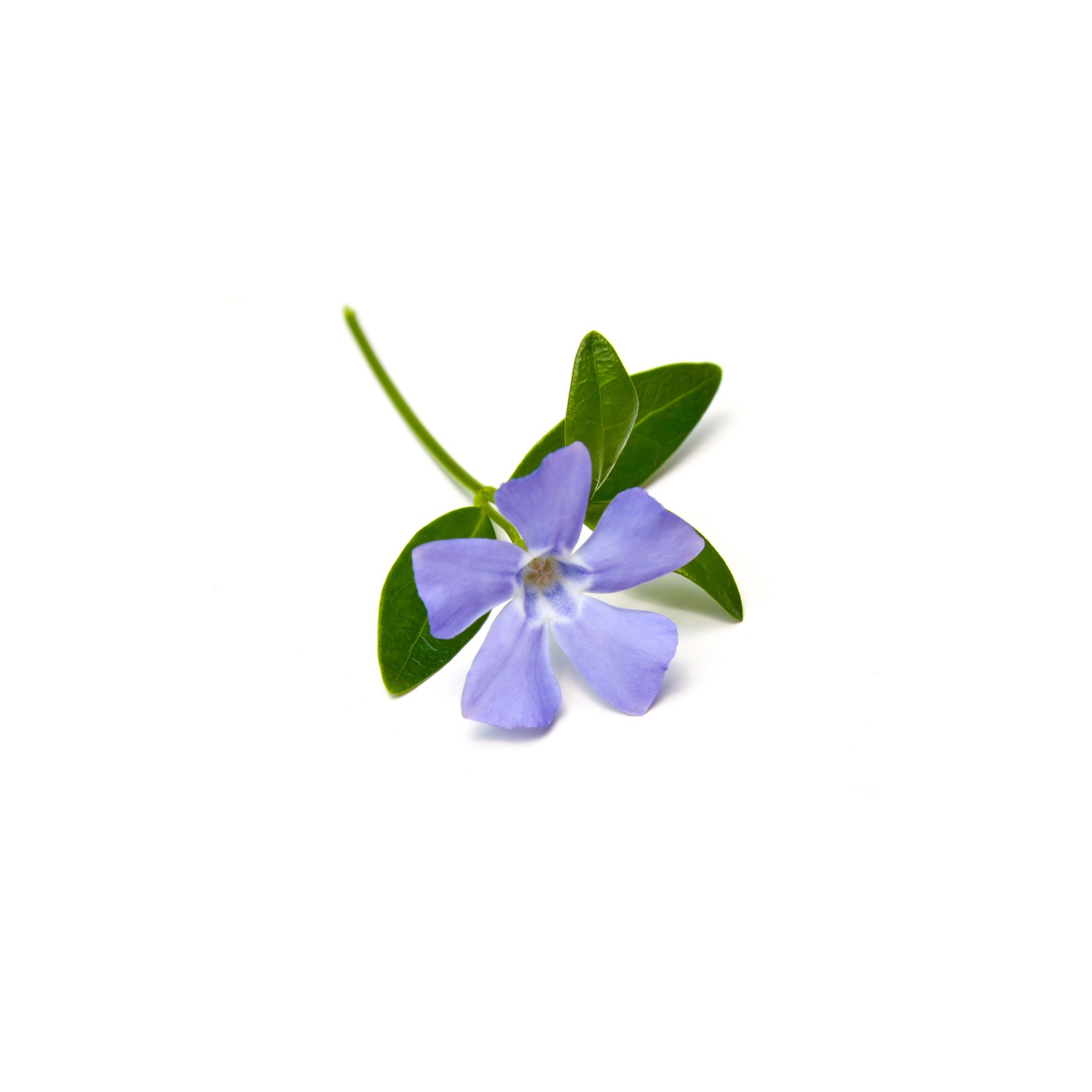
Periwinkle is a member of the Apocynaceae (dogbane) family — a large, mostly tropical group of trees, shrubs, vines and succulents that also includes oleander and the medicinally important Rauvolfia and Catharanthus. Vinca major itself is a spreading, sub-shrubby vine that trails along the ground, rooting where it touches and forming clumping mats; it carries blue-violet, five-lobed flowers and glossy evergreen leaves.
It is easily confused with two relatives, and the distinction matters for its chemistry. Lesser periwinkle (Vinca minor) is a smaller plant and the principal commercial source of vincamine. Madagascar periwinkle (Catharanthus roseus) — often loosely called “periwinkle” — is a separate genus entirely and the source of the anticancer drugs vinblastine and vincristine, which do not occur in V. major 2Reference 2Studies on Vinca major (Apocynaceae)View study →. Alkaloid claims are not interchangeable between the three.
Habitat & Distribution
Periwinkle originates from Southern Europe and Northern Africa. It has since spread across much of the temperate world and is now considered an invasive species in Australia, the United States and New Zealand, where its dense trailing mats can crowd out native ground flora.
Phytochemistry
Periwinkle’s chemistry is defined by its monoterpene indole alkaloids 1,2Reference 1Vinca major L. alkaloids: presence of reserpinine — phytochemical studyView study →Reference 2Studies on Vinca major (Apocynaceae)View study →. The best-known member is vincamine — the molecule concentrated (chiefly from V. minor) and chemically modified into the nootropic vinpocetine, a semi-synthetic derivative not found in the living plant. Alongside it, Vinca major yields a large family of minor indole alkaloids including vincamajine, reserpinine, majdine, eburnamenine and the more recently isolated 11-hydroxypolyneuridine, set against a background of astringent tannins 1,2Reference 1Vinca major L. alkaloids: presence of reserpinine — phytochemical studyView study →Reference 2Studies on Vinca major (Apocynaceae)View study →. Vincamine specifically is a minor and variable component of V. major — far more abundant in V. minor — so the species is a poor natural source of it.
Constituent Summary
No single standardized assay exists for whole Vinca major herb; published alkaloid levels are sparse and vary strongly with the growing environment and chemotype 2Reference 2Studies on Vinca major (Apocynaceae)View study →. Amounts below are for the plant material as noted.
Indole alkaloid6 compoundsno data
Phenolic1 compoundno data
Pharmacology & Research
The research base for Vinca major itself is small and almost entirely preclinical: fewer than three dozen indexed papers name the species, and most are phytochemistry — the isolation of its monoterpene indole alkaloids — rather than tests of therapeutic effect 1,2Reference 1Vinca major L. alkaloids: presence of reserpinine — phytochemical studyView study →Reference 2Studies on Vinca major (Apocynaceae)View study →. The plant’s clinical reputation is borrowed: it rests on vincamine, an alkaloid found chiefly in the related Vinca minor (Lesser Periwinkle), and on vinpocetine, a semi-synthetic derivative of vincamine that is not present in any living plant 3Reference 3Meta-analysisVinpocetine for cognitive impairment and dementia — Cochrane systematic review and meta-analysisView study →. Human randomised trials exist only for those isolated molecules, not for whole V. major herb, and even there the evidence is mixed — a Cochrane review judged the dementia data “inconclusive” and inadequate to support clinical use 3Reference 3Meta-analysisVinpocetine for cognitive impairment and dementia — Cochrane systematic review and meta-analysisView study →. The whole-herb signals that do exist (antioxidant, cholinesterase and tyrosinase inhibition) are in-vitro only, and alkaloid content varies so strongly with growing conditions that no standardised whole-herb preparation exists 2,4Reference 2Studies on Vinca major (Apocynaceae)View study →Reference 4Indole alkaloids from Vinca major and V. minor growing in Turkey — antioxidant and anticholinesterase activityView study →. Treat the crude herb and the purified alkaloid as two different subjects throughout.
- Best-supported: cognitive decline / dementia — but only for isolated vincamine and vinpocetine, with a positive 12-week RCT of vincamine set against an inconclusive Cochrane verdict on vinpocetine 3,5Reference 3Meta-analysisVinpocetine for cognitive impairment and dementia — Cochrane systematic review and meta-analysisView study →Reference 5RCTTherapeutic efficacy of vincamine in dementia — randomised placebo-controlled trialView study →.
- Emerging, worth watching: antioxidant and anticholinesterase activity of V. major alkaloid extracts, and tyrosinase inhibition relevant to skin depigmentation — all in vitro 4,6,7Reference 4Indole alkaloids from Vinca major and V. minor growing in Turkey — antioxidant and anticholinesterase activityView study →Reference 6Non-alkaloid constituents of Vinca major — a new iridoid glycoside with DPPH antioxidant activityView study →Reference 7Tyrosinase inhibitory effects of Vinca major and its secondary metabolites — enzyme kinetics and in-silico modelView study →.
- Mechanistically thin: antidiabetic and anticancer claims rest on single cell-line screens, several with null or toxic results 8,9,10Reference 8In-vitro α-glycosidase and urease enzyme inhibition profile of selected medicinal plants of PakistanView study →Reference 9Antidiabetic screening and scoring of 11 plants traditionally used in South Africa — in-vitro cell-line studyView study →Reference 10Three new monoterpenoid indole alkaloids from Vinca major — cytotoxicity screenView study →.
- The caveat: the whole herb has no human data, no standardised dose, and highly variable alkaloid content; the clinical evidence belongs to purified molecules from a different species.
1. Cognitive decline & dementia
This is the herb’s headline use, but the human evidence is entirely for purified alkaloids, not Vinca major leaf. vincamine — concentrated chiefly from Vinca minor — was superior to placebo across four cognitive and clinical endpoints in a 12-week double-blind RCT of 142 patients with degenerative or vascular dementia, dosed at 30 mg twice daily 5Reference 5RCTTherapeutic efficacy of vincamine in dementia — randomised placebo-controlled trialView study →. The semi-synthetic derivative vinpocetine is widely sold as a nootropic, but a Cochrane review of the three eligible randomised trials (583 patients, all conducted before the 1990s) concluded the evidence is “inconclusive and does not support clinical use” 3Reference 3Meta-analysisVinpocetine for cognitive impairment and dementia — Cochrane systematic review and meta-analysisView study →. Later umbrella and network meta-analyses continue to rate vinpocetine’s dementia and post-stroke cognition signal as weak or mixed 12,13Reference 12Meta-analysisEfficacy and safety of herbal medicine on dementia and cognitive function — umbrella review of systematic reviews and meta-analysesView study →Reference 13ReviewAn update on vinpocetine: new discoveries and clinical implications — reviewView study →. None of this transfers to whole V. major herb, whose alkaloid profile and dose are unstandardised 2Reference 2Studies on Vinca major (Apocynaceae)View study →.
Gap: No trial has ever tested Vinca major itself; the positive data are for a single alkaloid from a different species, and the best-designed synthesis (Cochrane) is negative.
2. Antioxidant
Alkaloid extracts of V. major (and V. minor) collected in Turkey showed high DPPH radical-scavenging and lipid-peroxidation-inhibiting activity in vitro 4Reference 4Indole alkaloids from Vinca major and V. minor growing in Turkey — antioxidant and anticholinesterase activityView study →. Separately, a new iridoid glycoside isolated from the leaves and stems, together with two other non-alkaloid constituents, showed moderate DPPH scavenging (IC50 ~33–71 µmol/L) 6Reference 6Non-alkaloid constituents of Vinca major — a new iridoid glycoside with DPPH antioxidant activityView study →. These are test-tube assays on solvent extracts and purified compounds; there is no cellular, animal, or human antioxidant data, and no evidence the effect survives digestion of the crude herb.
Gap: All activity is in isolated chemical assays — no in-vivo confirmation that any relevant antioxidant reaches tissue from the whole plant.
3. Cholinesterase inhibition
The same Turkish study reported “very strong” anticholinesterase activity for the alkaloid extracts of both Vinca species 4Reference 4Indole alkaloids from Vinca major and V. minor growing in Turkey — antioxidant and anticholinesterase activityView study →. Cholinesterase inhibition is the mechanism behind approved dementia drugs, so this is a biologically coherent lead that dovetails with the herb’s traditional cognitive reputation. It remains a single in-vitro observation on a crude alkaloid fraction, with no identified active constituent, no potency benchmark against a standard inhibitor reported in usable form, and no cellular or animal follow-up.
Gap: One in-vitro report, no isolated active molecule and no in-vivo work — the link from enzyme assay to cognitive benefit is unproven.
4. Tyrosinase inhibition
A V. major extract inhibited the pigment-forming enzyme tyrosinase with an IC50 of ~20 µg/mL, and several isolated secondary metabolites were more potent than the reference inhibitor kojic acid on a molar basis, with enzyme-kinetics and molecular-docking analysis supporting direct binding near the active-site copper 7Reference 7Tyrosinase inhibitory effects of Vinca major and its secondary metabolites — enzyme kinetics and in-silico modelView study →. This points to a plausible skin-depigmentation / anti-melanogenic application. It is, however, purely an isolated-enzyme and in-silico study — no cell, skin-model, or clinical testing has been done.
Gap: Enzyme-kinetics and docking only; no cellular melanocyte or human skin data to show the effect translates to depigmentation in use.
5. Antidiabetic
The evidence here is weak and partly cautionary. A crude methanolic extract of V. major inhibited α-glucosidase in vitro but only at a high IC50 (~430–700 µg/mL range for the tested plants) and showed no urease inhibition at all 8Reference 8In-vitro α-glycosidase and urease enzyme inhibition profile of selected medicinal plants of PakistanView study →. In a South African cell-line screen of traditionally used antidiabetic plants, V. major was noted alongside Catharanthus roseus for in-vitro toxicity that “raises concern for chronic use” rather than for a useful glucose-lowering effect 9Reference 9Antidiabetic screening and scoring of 11 plants traditionally used in South Africa — in-vitro cell-line studyView study →. There is no animal or human antidiabetic data.
Gap: Only weak in-vitro enzyme inhibition, no in-vivo efficacy, and a cell-line toxicity flag that argues against — not for — chronic use.
6. Anticancer / cytotoxic
Interest here is driven by the anticancer reputation of Vinca-type indole alkaloids generally, but the V. major-specific data are thin and largely negative. Three new monoterpenoid indole alkaloids isolated from the whole plant were screened against five human cancer cell lines 10Reference 10Three new monoterpenoid indole alkaloids from Vinca major — cytotoxicity screenView study →, and three new pyridine alkaloids were tested against glioma, glioblastoma, and lung cancer lines — none active at 20 µg/mL 11Reference 11Three new pyridine alkaloids from Vinca major cultivated in Pakistan — cytotoxicity screen (inactive)View study →. The clinically used anticancer vinca alkaloids (vinblastine, vincristine) come from Catharanthus roseus, a distinct genus, and do not occur in V. major 2Reference 2Studies on Vinca major (Apocynaceae)View study →.
Gap: Constituent-level cell-line screens only, several explicitly inactive; the famous anticancer vinca alkaloids are from a different plant entirely.
Mechanisms
| Mechanism | Drives | Key compounds |
|---|---|---|
| Cerebral vasodilation / cerebral blood flow ↑ | cognitive decline & dementia | vincamine |
| Phosphodiesterase-1 inhibition, cAMP/cGMP ↑ | cognitive decline & dementia | vinpocetine |
| Acetylcholinesterase inhibition | cognitive decline & dementia | indole alkaloids (crude fraction) |
| Free-radical (DPPH) / lipid-peroxidation scavenging | antioxidant | indole alkaloids, iridoid glycosides |
| Tyrosinase active-site (copper) binding | tyrosinase inhibition | secondary metabolites (extract) |
Clinical trials
No registered trials of whole Vinca major herb exist; the human evidence is confined to the isolated alkaloid vincamine (one positive 12-week RCT) and to vinpocetine, whose dementia trials all predate the 1990s and were judged inconclusive by Cochrane, with a small number of newer vinpocetine trials registered on ClinicalTrials.gov 3,5Reference 3Meta-analysisVinpocetine for cognitive impairment and dementia — Cochrane systematic review and meta-analysisView study →Reference 5RCTTherapeutic efficacy of vincamine in dementia — randomised placebo-controlled trialView study →.
| Completed | Planned | Terminated | Preclinical |
|---|---|---|---|
| 0(whole herb); ~5 (vinpocetine) | ~2(vinpocetine) | 0 | ~25 |
Last checked: July 2026.
Dosage
There is no established whole-herb dose for periwinkle: the crude plant is regarded as toxic and is not used as a self-administered simple. The only quantified doses in the literature are for the isolated alkaloids, given as purified molecules — they are not whole-herb doses and are shown here for reference, not as recommendations.
| Indication | Preparation | Dose | Est. dried-herb equivalent | Source |
|---|---|---|---|---|
| Cognitive decline & dementia | Isolated vincamine (oral) | 30 mg twice daily (60 mg/day), 12 wk | — (isolated alkaloid; not back-convertible) | 5Reference 5RCTTherapeutic efficacy of vincamine in dementia — randomised placebo-controlled trialView study → |
| Cognitive decline & dementia | Vinpocetine (oral) | 30–60 mg/day | — (semi-synthetic; not present in the plant) | 3Reference 3Meta-analysisVinpocetine for cognitive impairment and dementia — Cochrane systematic review and meta-analysisView study → |
The dried-herb equivalent is left blank deliberately. Whole V. major has no standardised alkaloid assay and vincamine is a minor, variable component, so back-converting a purified-alkaloid dose to a herb weight would be misleading — no conversion ratio is proposed.
Traditional Dosage
Traditional Western herbal use is of the dried aerial parts as an astringent, in small amounts only.
| System | Preparation | Dose |
|---|---|---|
| Western herbal | Dried aerial parts (astringent for menorrhagia, mouth ulcers, diarrhoea) | Not established as a standardised simple; historically small doses only — the whole herb is regarded as toxic and not self-administered |
Safety & Pregnancy
Vinca major contains toxic, unstandardised monoterpene indole alkaloids and is not used as a self-administered simple — its cognitive reputation belongs to purified vincamine and semi-synthetic vinpocetine, not the crude herb.
- Toxic crude herb. Contains cytotoxic indole alkaloids in variable amounts; regarded as toxic and not self-administered.
- Avoid in pregnancy. Reproductive safety unstudied and the alkaloids are cytotoxic — a precautionary contraindication.
- Blood pressure & surgery. The isolated alkaloids lower blood pressure — avoid with hypotension, antihypertensives, and before surgery.
- Not for long-term use. An in-vitro toxicity flag reinforces the caution against chronic dosing.
- Interactions unstudied. Whole-herb interactions have not been formally assessed — absence of reports is not safety.
Full safety & interactions detail
Vinca major contains toxic monoterpene indole alkaloids and is not used as a self-administered simple; its cognitive reputation belongs to the isolated alkaloid vincamine (from the related Vinca minor) and the semi-synthetic vinpocetine, not the crude herb 2,3Reference 2Studies on Vinca major (Apocynaceae)View study →Reference 3Meta-analysisVinpocetine for cognitive impairment and dementia — Cochrane systematic review and meta-analysisView study →. An in-vitro cell-line screen flagged V. major extract for toxicity that “raises concern for chronic use,” reinforcing the traditional caution against long-term therapeutic dosing 9Reference 9Antidiabetic screening and scoring of 11 plants traditionally used in South Africa — in-vitro cell-line studyView study →. Vincamine and vinpocetine can lower blood pressure and act on cerebral circulation, so the concentrated alkaloids should be avoided with hypotension, alongside antihypertensive drugs, and before surgery 3,5Reference 3Meta-analysisVinpocetine for cognitive impairment and dementia — Cochrane systematic review and meta-analysisView study →Reference 5RCTTherapeutic efficacy of vincamine in dementia — randomised placebo-controlled trialView study →. Interactions and reproductive safety for the whole herb have not been formally studied — absence of reports is not evidence of safety.
Reproductive safety of Vinca major has not been specifically researched, and the herb contains cytotoxic indole alkaloids in an unstandardised, variable amount; the related Catharanthus vinca alkaloids are established antimitotic agents, which makes any periwinkle exposure in pregnancy inadvisable on precautionary grounds 2,9Reference 2Studies on Vinca major (Apocynaceae)View study →Reference 9Antidiabetic screening and scoring of 11 plants traditionally used in South Africa — in-vitro cell-line studyView study →. No lactation data exist. This is a precautionary contraindication, not a finding of demonstrated harm.
References
- Janot, M. M., & Le Men, J. (1954). Vinca major L. alkaloids: presence of reserpinine — phytochemical study. Comptes Rendus Hebdomadaires des Séances de l’Académie des Sciences, 238(26), 2550–2552. https://pubmed.ncbi.nlm.nih.gov/13199943/
- Farnsworth, N. R., Loub, W. D., Blomster, R. N., & Gosmann, M. (1962). Studies on Vinca major (Apocynaceae). II. Phytochemical investigation. Journal of Pharmaceutical Sciences, 51, 217–224. https://doi.org/10.1002/jps.2600510307
- Szatmári, S. Z., & Whitehouse, P. J. (2003). Vinpocetine for cognitive impairment and dementia — Cochrane systematic review and meta-analysis. Cochrane Database of Systematic Reviews, CD003119. https://pubmed.ncbi.nlm.nih.gov/12535455/
- Bahadori, F., et al. (2012). Indole alkaloids from Vinca major and V. minor growing in Turkey — antioxidant and anticholinesterase activity. Natural Product Communications, 7(6), 731–734. https://pubmed.ncbi.nlm.nih.gov/22816294/
- Fischhof, P. K., et al. (1996). Therapeutic efficacy of vincamine in dementia — randomised placebo-controlled trial. Neuropsychobiology, 34(1), 29–35. https://pubmed.ncbi.nlm.nih.gov/8884757/
- Wang, Y., et al. (2016). Non-alkaloid constituents of Vinca major — a new iridoid glycoside with DPPH antioxidant activity. Chinese Journal of Natural Medicines, 14(1), 56–60. https://doi.org/10.3724/SP.J.1009.2016.00056
- Zengin, G., et al. (2019). Tyrosinase inhibitory effects of Vinca major and its secondary metabolites — enzyme kinetics and in-silico model. Bioorganic Chemistry, 92, 103259. https://doi.org/10.1016/j.bioorg.2019.103259
- Khan, T., et al. (2021). In-vitro α-glycosidase and urease enzyme inhibition profile of selected medicinal plants of Pakistan. Natural Product Research, 35(23), 5434–5439. https://doi.org/10.1080/14786419.2020.1779264
- van de Venter, M., et al. (2008). Antidiabetic screening and scoring of 11 plants traditionally used in South Africa — in-vitro cell-line study. Journal of Ethnopharmacology, 119(1), 81–86. https://pubmed.ncbi.nlm.nih.gov/18588966/
- Zhang, L., et al. (2016). Three new monoterpenoid indole alkaloids from Vinca major — cytotoxicity screen. Journal of Asian Natural Products Research, 18(4), 328–333. https://doi.org/10.1080/10286020.2015.1094463
- Nasir, A., et al. (2017). Three new pyridine alkaloids from Vinca major cultivated in Pakistan — cytotoxicity screen (inactive). Natural Products and Bioprospecting, 7(4), 323–327. https://doi.org/10.1007/s13659-017-0137-7
- Kwok, C. S., et al. (2023). Efficacy and safety of herbal medicine on dementia and cognitive function — umbrella review of systematic reviews and meta-analyses. Phytotherapy Research, 37(4). https://doi.org/10.1002/ptr.7759
- Nabavi, S. M., et al. (2018). An update on vinpocetine: new discoveries and clinical implications — review. European Journal of Pharmacology, 819, 88–95. https://doi.org/10.1016/j.ejphar.2017.11.041