Materia Medica
Red Clover
Trifolium pratense
Red clover (Trifolium pratense) — a phytoestrogenic alterative herb used for skin complaints, the menopause and as a gentle blood cleanser.
What Is Red Clover?
Red clover is a flowering legume native to Europe, western Asia, and parts of North Africa that has become naturalized throughout much of the world. The flowering tops have a long history of use in Western herbal medicine as a gentle alterative, lymphatic remedy, and women’s health herb.
Traditionally associated with chronic skin conditions and “blood cleansing,” red clover became especially valued in constitutional formulas intended for long-term inflammatory and metabolic imbalance. Modern herbal interest focuses largely on the herb’s phytoestrogenic isoflavones and their potential role during menopause.
The herb is generally considered mild, nutritive, and suitable for long-term tonic use.
How Is Red Clover Used?
Red clover is most commonly prepared as teas, tinctures, capsules, extracts, and traditional alterative formulas.
The flowering tops are traditionally used for chronic skin conditions such as eczema, psoriasis, acne, and inflammatory eruptions, particularly where sluggish elimination or constitutional imbalance is believed to contribute.
Modern use frequently centers around menopausal support due to the herb’s isoflavone content. Red clover is commonly included in formulas targeting hot flashes, hormonal transition, and healthy aging.
The herb is also widely combined with burdock, yellow dock, cleavers, nettle, or dandelion in traditional “blood cleansing” and lymphatic formulas.
Traditional Uses
Western Herbal Medicine
In Western herbal medicine, red clover is regarded as an alterative, lymphatic, mildly expectorant, and phytoestrogenic herb.
Traditional indications include eczema, psoriasis, acne, chronic inflammatory skin conditions, swollen lymphatics, coughs, menopausal symptoms, and constitutional stagnation.
Eclectic and folk herbalists frequently used red clover in long-term tonic formulas intended to gradually improve elimination, skin health, and systemic balance.
The herb was also historically regarded as mildly nutritive and restorative during chronic weakness.
Traditional Folk Uses
Traditional folk medicine used red clover for coughs, inflammatory conditions, skin eruptions, and purification tonics.
The flowers were commonly consumed as teas and spring tonics following winter dietary deprivation.
Indications
Red clover is primarily indicated for chronic inflammatory and hormonal conditions.
Common traditional and modern indications include:
- Menopause
- Hot flashes
- Hormonal transition
- Eczema
- Psoriasis
- Acne
- Chronic skin eruptions
- Lymphatic stagnation
- Mild respiratory irritation
- General constitutional cleansing
- Alterative support
Clinically, the herb is most commonly used for menopause support and chronic inflammatory skin conditions.
Botany
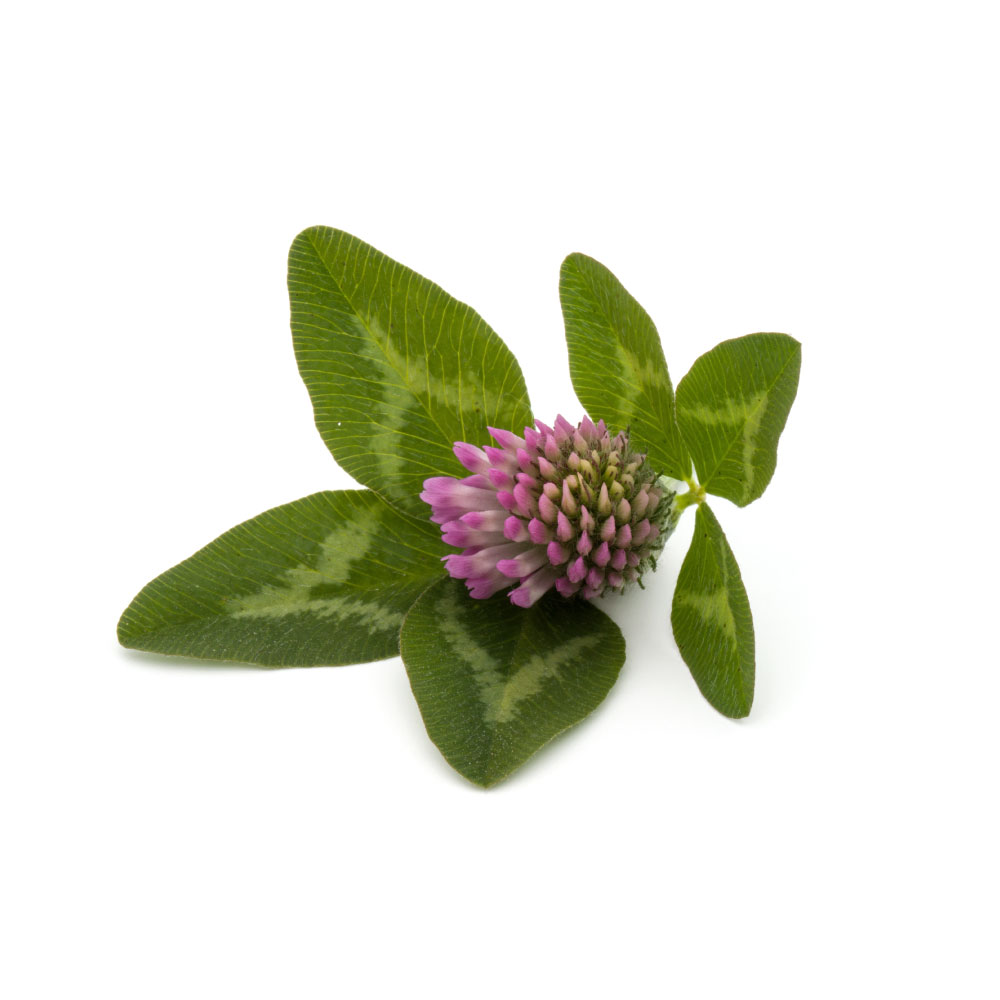
Red clover is a member of the pea and bean family (Fabaceae), a close cousin of the familiar white clover of lawns and the wider clan of true clovers. It grows as a low, softly hairy, short-lived perennial, sending up trifoliate leaves — each leaflet stamped with a pale chevron — and the rounded, pinkish-purple flower heads that make it so easy to recognise in a summer pasture.
For the herbalist it is those flowering heads that matter: they are the part gathered and dried for use, one of the classic isoflavone-rich herbs long associated in Western herbalism with women’s and menopausal complaints.
Distribution
Red clover is originally a plant of Europe, western Asia and North Africa, but centuries of cultivation as fodder have scattered it across the temperate world. It now grows wild throughout North America and much of the Southern Hemisphere — an easy find along field edges, roadsides and meadows wherever it has slipped out of pasture.
Growing Conditions
- Thrives in full sun, tolerating a little afternoon shade, especially as young seedlings.
- Prefers moist but well-drained soil and handles slightly acidic and even damp ground better than most legumes.
- Hardy through cold winters (roughly USDA zones 3–8) but naturally short-lived, so it is often resown every couple of years.
- As a nitrogen-fixing legume it improves the soil it grows in, making it easy to tuck into a garden bed or meadow mix.
- Full cultivation detail lives on the companion farm-wiki grow guide for Trifolium pratense (link to be added once that project’s public URL is confirmed).
Pharmacology & Research
TODO.
Phytochemistry
Red clover’s reputation as a phytoestrogen rests on its isoflavones, and unusually it is dominated by the methylated forms: biochanin A and formononetin, each making up roughly 0.1–0.9% of the dried flowering herb 1,2Reference 1Red clover (Trifolium pratense L.) isoflavones: concentrations of formononetin, biochanin A, daidzein and genisteinReference 2ReviewTrifolium pratense (red clover) in support of menopause therapy: phytochemistry and clinical effects. (Review.). In the body these are demethylated to the better-known daidzein and genistein, which are present natively only in trace amounts 1,2Reference 1Red clover (Trifolium pratense L.) isoflavones: concentrations of formononetin, biochanin A, daidzein and genisteinReference 2ReviewTrifolium pratense (red clover) in support of menopause therapy: phytochemistry and clinical effects. (Review.).
Because these isoflavones bind estrogen receptors (with some preference for ERβ), they underpin red clover’s traditional use for menopausal symptoms. The coumestan coumestrol and a range of flavonoids add to the estrogenic and antioxidant profile 2Reference 2ReviewTrifolium pratense (red clover) in support of menopause therapy: phytochemistry and clinical effects. (Review.).
Constituent Summary
Figures are approximate dry-herb ranges; the methylated isoflavones dominate, and standardised extracts are far more concentrated 1,2Reference 1Red clover (Trifolium pratense L.) isoflavones: concentrations of formononetin, biochanin A, daidzein and genisteinReference 2ReviewTrifolium pratense (red clover) in support of menopause therapy: phytochemistry and clinical effects. (Review.).
Isoflavone4 compounds4 with data
Coumestan1 compoundno data
Flavonoid1 compoundno data
Dosage
Dosage varies depending on preparation and standardization.
Typical adult dosing ranges include:
- Tea or infusion: 1–3 cups daily
- Dried flowering tops: 2–6 g daily
- Tincture (1:5): 2–5 mL, up to three times daily
- Standardized isoflavone extracts: follow product-specific dosing
Red clover is commonly used long term as a gentle tonic herb.
Safety & Pregnancy
Red clover is generally well tolerated, but its phytoestrogenic isoflavones warrant caution in hormone-sensitive conditions and alongside hormonal or anticoagulant medications.
- Hormone-sensitive conditions. Phytoestrogenic isoflavones; caution where estrogen activity is a concern.
- Drug interactions. Caution with hormone-related medications and, at large doses, with anticoagulants.
- Sensitivity. Occasional digestive upset or allergic reactions in sensitive individuals.
- Well tolerated. Generally safe when used appropriately.
Full safety & interactions detail
Red clover is generally considered safe and well tolerated when used appropriately.
Because the herb contains phytoestrogenic isoflavones, caution is advised in individuals with hormone-sensitive conditions or those using hormone-related medications.
Large doses may theoretically increase anticoagulant activity due to coumarin-related compounds naturally present in some clover species.
Occasional digestive upset or allergic reactions may occur in sensitive individuals.
Red clover is generally approached cautiously and usually avoided in pregnancy because of the herb’s phytoestrogenic hormonal activity. Its safety during pregnancy and lactation has not been established, so it is best avoided during these periods unless advised otherwise.
References
- Saviranta, N. M. M., et al. (2008). Red clover (Trifolium pratense L.) isoflavones: concentrations of formononetin, biochanin A, daidzein and genistein.
- Kanadys, W., et al. (2021). Trifolium pratense (red clover) in support of menopause therapy: phytochemistry and clinical effects. (Review.)