
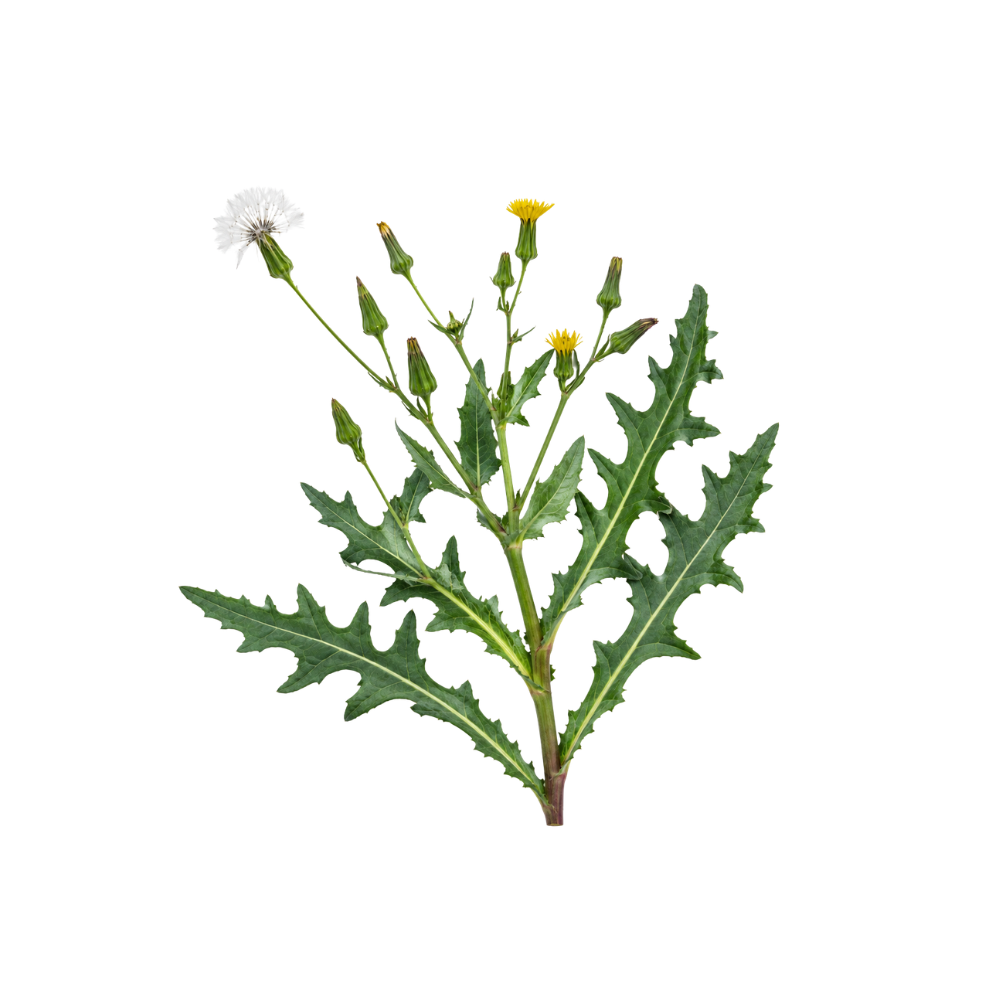
Materia Medica
Wild Lettuce
Lactuca virosa
Wild Lettuce (Lactuca virosa) is a bitter wild relative of garden lettuce whose milky latex has a traditional mild sedative and pain-easing reputation.
What is Wild Lettuce?
Wild lettuce is a tall, bitter biennial of the daisy family, a wild relative of cultivated lettuce, native to Europe, North Africa and western Asia. When the stem or leaves are cut they exude a milky latex that dries into a brownish substance called lactucarium, or “lettuce opium” — the historical source of its sedative reputation. It is used as a tea, tincture or, less commonly, smoked.
Traditional & Modern Uses
Historically, lactucarium was used as a mild sedative and cough remedy, sometimes as a gentle substitute for opium (though it is chemically unrelated) — a use well documented in the 19th-century materia medica literature 22Reference 22ReviewLettuce (Lactuca sp.) as a medicinal plant in Polish publications of the 19th century — historical reviewView study →. Wild lettuce has a folk reputation for easing restlessness, mild pain and promoting sleep, and for calming irritable coughs. Contemporary herbal use continues along these lines as a gentle relaxant and sleep aid. It is worth keeping traditional reputation and tested activity distinct: the sedative and analgesic claims now have some preclinical mechanistic support, while the cough/expectorant use rests on tradition alone (see the research section below).
Botany
Wild lettuce is a tall, bitter biennial of the Asteraceae — the same tribe as dandelion and chicory, and a genuine relative of the lettuce we eat. In its first year it sits as a flat rosette; in its second it throws up a lone, sturdy flowering stalk that can top a person’s head, sometimes streaked with purple. The leaves are large, greyish and stiff, edged with fine prickles, with a row of little spines down the underside of the central rib.
What matters to the herbalist is not the flower but the sap. Nick the stem or a leaf and it weeps a thick white latex, intensely bitter to the tongue. Gathered and air-dried, this exudate stiffens into a resinous material long known as lactucarium — “lettuce opium” — prized historically for its calming, sedative character. The bitterness is the signature; a wild lettuce that does not bleed a bitter milk is worth a second look at the identification.
That second look matters because of the plant’s siblings. Prickly lettuce (Lactuca serriola) is the near twin and the wild forebear of cultivated garden lettuce (L. sativa); it is used in much the same sedative fashion but is typically leaner, with more deeply cut leaves. L. virosa runs taller, stouter and broader-leaved, and is regarded as the more potent of the two. None of these should be confused with the mild, sweet garden lettuce bred for the salad bowl, from which selection stripped most of the bitter latex.
Distribution
Wild lettuce is native to Europe, especially its central and southern reaches, along with Madeira and northwest Africa, spilling toward the Mediterranean and western Asia. It is a plant of open, disturbed, sunny ground — verges, waste lots and riverbanks — and has since spread as a naturalised introduction across parts of North America and, more locally, Australia and South America.
Growing Conditions
- Full sun and open, disturbed ground — it thrives on roadside, waste-lot and field-margin conditions rather than pampered beds.
- Tolerant of poor, dry, well-drained soils; dislikes waterlogged sites.
- Grown from seed sown on the surface (light aids germination); self-sows readily once established.
- A biennial: expect a leaf rosette the first year and the tall flowering stalk, latex and seed the second.
- Full cultivation detail lives on the companion farm-wiki grow guide for Lactuca virosa (link to be added once that project’s public URL is confirmed).
Phytochemistry
The defining constituents are the bitter sesquiterpene lactones of the dried latex (lactucarium): lactucin, lactucopicrin and lactucic acid, with lactucin-8-sulfate also present. In animal tests the isolated compounds lactucin and lactucopicrin — molecules shared with chicory and garden lettuce, so tested here as purified guaianolides rather than as a whole wild-lettuce preparation — showed sedative and analgesic activity, with lactucopicrin the most potent 1Reference 1AnimalAnalgesic and sedative activities of lactucin and some lactucin-like guaianolides in mice — animal in vivoView study →. These guaianolides, not any opiate, account for the plant’s “lettuce opium” reputation. Lactuca virosa also yields pentacyclic triterpenes such as lupeol, taraxasterol and germanicol, and the sterol β-sitosterol. Despite the nickname it contains no opiate alkaloids.
Constituent Summary
Sesquiterpene-lactone content varies widely with plant age, part and the way the latex is collected and dried; published quantitative figures come mainly from latex of other Lactuca species rather than L. virosa itself, so amounts here are given as No Data. † marks the lactucarium bitters that characterise the herb.
Sesquiterpene lactone4 compoundsno data
Triterpene3 compoundsno data
Sterol1 compoundno data
Pharmacology & Research
Wild lettuce sits almost entirely in the preclinical evidence tier: there is a moderate body of laboratory and animal work on its characteristic bitter sesquiterpene lactones — chiefly lactucin and lactucopicrin — but no clinical trial has ever tested Lactuca virosa itself, and the herb has no registered trials of any kind. A crucial reading caveat runs through the whole literature: the two compounds that carry wild lettuce’s reputation are shared with chicory (Cichorium intybus) and garden lettuce (Lactuca sativa), and most mechanistic and in vivo data were generated in those species or on the isolated molecules, not on wild-lettuce preparations. The strongest and most consistent signal is sedative/sleep-supporting activity acting through GABA-A and adenosine pathways, replicated across several rodent studies, with the one study using L. virosa’s own guaianolides showing mouse analgesia comparable to ibuprofen 1Reference 1AnimalAnalgesic and sedative activities of lactucin and some lactucin-like guaianolides in mice — animal in vivoView study →. Anti-inflammatory NF-κB suppression by lactucopicrin is the best-developed emerging mechanism, demonstrated in live mice 8,9Reference 8AnimalNatural lactucopicrin alleviates importin-α3–mediated NF-κB activation in inflamed endothelial cells and improves sepsis in mice — animal in vivoView study →Reference 9AnimalLactucopicrin inhibits cytoplasmic dynein–mediated NF-κB activation in inflamed macrophages and alleviates atherogenesis in ApoE-deficient mice — animal in vivoView study →. Because sesquiterpene-lactone content varies enormously with plant age, part, and how the latex is dried, none of this translates cleanly to a standardised human dose.
- Best-supported: mild sedative/sleep support via GABA-A– and adenosine-linked mechanisms 2,3,4Reference 2AnimalEffectiveness of the sleep enhancement by green romaine lettuce (Lactuca sativa) in a rodent model — animal in vivoView study →Reference 3AnimalHeukharang lettuce (Lactuca sativa) leaf extract displays sleep-promoting effects through GABA-A receptor — animal in vivoView study →Reference 4AnimalLactuca sativa extract enhances sleep duration through upregulation of adenosine A1 receptor and GABA-A receptor subunits in pentobarbital-injected mice — animal in vivoView study →, and guaianolide analgesia shown in mice at ibuprofen-comparable doses 1Reference 1AnimalAnalgesic and sedative activities of lactucin and some lactucin-like guaianolides in mice — animal in vivoView study →.
- Emerging, worth watching: lactucopicrin as an NF-κB–suppressing anti-inflammatory in live mice 8,9Reference 8AnimalNatural lactucopicrin alleviates importin-α3–mediated NF-κB activation in inflamed endothelial cells and improves sepsis in mice — animal in vivoView study →Reference 9AnimalLactucopicrin inhibits cytoplasmic dynein–mediated NF-κB activation in inflamed macrophages and alleviates atherogenesis in ApoE-deficient mice — animal in vivoView study →, and acetylcholinesterase inhibition relevant to cognition 13,14Reference 13In vitroApplication of the in-combo screening approach for the discovery of non-alkaloid acetylcholinesterase inhibitors from Cichorium intybus (8-deoxylactucin, lactucopicrin) — in vitroView study →Reference 14In vitroEvaluation of activity of sesquiterpene lactones and chicory extracts as acetylcholinesterase inhibitors in calorimetric and docking simulation studies — in vitroView study →.
- Mechanistically thin: anticancer and antimalarial signals rest on single-cell-line or isolated-compound work 16,17,18Reference 16In vitroImplication of lactucopicrin in autophagy, cell-cycle arrest and oxidative stress to inhibit U87Mg glioblastoma cell growth — in vitroView study →Reference 17AnimalLactucin inhibits growth and induces apoptosis in gastric cancer cells by targeting MAPK signaling — animal in vivo (xenograft)View study →Reference 18In vitroAntimalarial activity of lactucin and lactucopicrin: sesquiterpene lactones isolated from Cichorium intybus — in vitroView study →; traditional cough/expectorant use has essentially no experimental support.
- The caveat: almost no data are from L. virosa itself — most come from the same lactones in chicory or garden lettuce, there is no standardised dose, and no human trial has tested wild lettuce.
1. Sedative & sleep-supporting
This is the traditional core of wild lettuce and its best-mapped mechanism, though the direct evidence is preclinical. In mice, lactucin and lactucopicrin reduced spontaneous locomotor activity — a sedation readout — while a closely related guaianolide did not 1Reference 1AnimalAnalgesic and sedative activities of lactucin and some lactucin-like guaianolides in mice — animal in vivoView study →. Rodent studies of lettuce extracts standardised for these same lactones consistently increase sleep duration and non-REM sleep and reverse caffeine-induced arousal, with effects blocked by the benzodiazepine-site antagonist flumazenil, pointing to a GABA-A/benzodiazepine mechanism; lactucin and lactucopicrin bind the GABA-A–benzodiazepine receptor with 81% and 56% affinity respectively 2,5Reference 2AnimalEffectiveness of the sleep enhancement by green romaine lettuce (Lactuca sativa) in a rodent model — animal in vivoView study →Reference 5AnimalSleep-inducing effect of lettuce (Lactuca sativa) varieties on pentobarbital-induced sleep — animal in vivoView study →. A separate mouse study attributes lettuce’s sleep effect to up-regulation of the adenosine A1 receptor alongside GABA-A subunits 4Reference 4AnimalLactuca sativa extract enhances sleep duration through upregulation of adenosine A1 receptor and GABA-A receptor subunits in pentobarbital-injected mice — animal in vivoView study →, and a GABA-A route was confirmed by EEG in another 3Reference 3AnimalHeukharang lettuce (Lactuca sativa) leaf extract displays sleep-promoting effects through GABA-A receptor — animal in vivoView study →. Two small human trials report sedative/hypnotic benefit — but both used Lactuca sativa (garden lettuce) seed oil, not wild lettuce, so they support the mechanism rather than the herb 6,7Reference 6RCTPilot study of the efficacy and safety of lettuce seed oil in patients with sleep disorders — randomised placebo-controlled trialView study →Reference 7RCTEvaluation of sedative effects of an intranasal dosage form containing saffron, lettuce seeds and sweet violet in primary chronic insomnia — randomised, double-blind, placebo-controlled trialView study →.
Gap: No trial has ever tested L. virosa itself; the human data are from a different species and preparation (garden-lettuce seed oil), and there is no standardised lactucarium dose.
2. Anti-inflammatory
The most active emerging area, driven almost entirely by lactucopicrin. In lipopolysaccharide- or TNF-α–stimulated macrophages and endothelial cells it dose-dependently suppresses NF-κB activation — not by touching the IKK complex or p65 DNA binding, but by destabilising importin-α3 mRNA and blocking dynein-mediated p65 nuclear transport 8,9,10Reference 8AnimalNatural lactucopicrin alleviates importin-α3–mediated NF-κB activation in inflamed endothelial cells and improves sepsis in mice — animal in vivoView study →Reference 9AnimalLactucopicrin inhibits cytoplasmic dynein–mediated NF-κB activation in inflamed macrophages and alleviates atherogenesis in ApoE-deficient mice — animal in vivoView study →Reference 10In vitroLactucopicrin: a sesquiterpene lactone with anti-inflammatory activity modulating the crosstalk between NF-κB and AHR pathways — in vitroView study →. These are not cell-only findings: oral lactucopicrin cut mortality by ~30% in LPS-induced septic mice and reduced plaque burden in atherosclerotic ApoE-deficient mice 8,9Reference 8AnimalNatural lactucopicrin alleviates importin-α3–mediated NF-κB activation in inflamed endothelial cells and improves sepsis in mice — animal in vivoView study →Reference 9AnimalLactucopicrin inhibits cytoplasmic dynein–mediated NF-κB activation in inflamed macrophages and alleviates atherogenesis in ApoE-deficient mice — animal in vivoView study →. Related guaianolides including lactucin show strong anti-neuroinflammatory activity in cultured cells (IC50 ≈ 1.8 µM) 12Reference 12In vitroGuaianolide sesquiterpene lactones from Cichorium glandulosum and their anti-neuroinflammation activities (including lactucin) — in vitroView study →, and lactucopicrin also curbs macrophage foam-cell formation by lowering LOX-1 11Reference 11In vitroTerpene lactucopicrin limits macrophage foam cell formation by reducing LOX-1 in lipid rafts — in vitroView study →.
Gap: Every result is on the isolated compound — largely sourced from chicory — at doses far above what a wild-lettuce tea or tincture would deliver; no study has shown a whole-herb L. virosa preparation is anti-inflammatory in vivo.
3. Analgesic
Wild lettuce’s folk reputation for easing mild pain has one direct experimental anchor. In mice, lactucin, lactucopicrin and 11β,13-dihydrolactucin — described as characteristic lactones of L. virosa and chicory — produced analgesia in the hot-plate and tail-flick tests at 15–30 mg/kg, comparable to ibuprofen at 30–60 mg/kg, with lactucopicrin the most potent 1Reference 1AnimalAnalgesic and sedative activities of lactucin and some lactucin-like guaianolides in mice — animal in vivoView study →. This is peripheral/central antinociception from the herb’s own guaianolides, and it is chemically unrelated to opioids despite the “lettuce opium” nickname — the plant contains no opiate alkaloids. Beyond this single study the analgesic literature is traditional rather than experimental.
Gap: Rests essentially on one mouse study of isolated compounds; there is no dose-response work, no human analgesia data, and no demonstration that a drunk tea or tincture reaches analgesic exposure.
4. Cognitive / neuroprotective
An in-vitro-only signal built on acetylcholinesterase (AChE) inhibition — the same enzyme target as several Alzheimer’s drugs. Activity-guided fractionation of chicory identified lactucopicrin and 8-deoxylactucin as dose-dependent AChE inhibitors (IC50 ≈ 150 and 308 µM) 13Reference 13In vitroApplication of the in-combo screening approach for the discovery of non-alkaloid acetylcholinesterase inhibitors from Cichorium intybus (8-deoxylactucin, lactucopicrin) — in vitroView study →, and calorimetry plus docking confirmed lactucopicrin as the stronger binder among the sesquiterpene lactones 14Reference 14In vitroEvaluation of activity of sesquiterpene lactones and chicory extracts as acetylcholinesterase inhibitors in calorimetric and docking simulation studies — in vitroView study →. In cultured neuronal cells lactucopicrin also promotes neurite outgrowth and raises NGF, BDNF and NT-3 via Ca²⁺/CaMKII/ATF1 signalling 15Reference 15In vitroLactucopicrin potentiates neuritogenesis and neurotrophic effects by regulating Ca²⁺/CaMKII/ATF1 signaling — in vitroView study →.
Gap: The inhibitory concentrations are high (micromolar) and everything is cell-based — no animal cognition model, no blood-brain-barrier or bioavailability data, and no link to wild-lettuce dosing.
5. Anticancer
Early-stage and heterogeneous. Lactucopicrin isolated from L. virosa was cytotoxic to U87Mg glioblastoma cells, triggering autophagy, G2/M arrest (via p53/p21) and apoptosis, with the effect reversed by the antioxidant N-acetylcysteine — implicating reactive oxygen species 16Reference 16In vitroImplication of lactucopicrin in autophagy, cell-cycle arrest and oxidative stress to inhibit U87Mg glioblastoma cell growth — in vitroView study →. Separately, lactucin suppressed gastric-cancer cell growth and induced apoptosis through MAPK signalling, with confirmation in a mouse xenograft 17Reference 17AnimalLactucin inhibits growth and induces apoptosis in gastric cancer cells by targeting MAPK signaling — animal in vivo (xenograft)View study →.
Gap: Single cell lines per cancer type, isolated compounds only, and no evidence a wild-lettuce preparation reaches cytotoxic concentrations in vivo — this is exploratory pharmacology, not an established use.
6. Antimalarial
The weakest scored signal. Screening of chicory constituents against Plasmodium falciparum found the shared guaianolides lactucin and lactucopicrin to be the active antimalarial molecules in vitro 18Reference 18In vitroAntimalarial activity of lactucin and lactucopicrin: sesquiterpene lactones isolated from Cichorium intybus — in vitroView study →. The compounds are light-sensitive, which complicates any therapeutic reading.
Gap: A single in vitro assay of isolated compounds sourced from chicory, with no animal model, no potency benchmarking against antimalarial standards, and no relevance to how wild lettuce is actually used.
Mechanisms
| Mechanism | Drives | Key compounds |
|---|---|---|
| GABA-A / benzodiazepine-site binding; adenosine A1 up-regulation | sedative & sleep-supporting | lactucin, lactucopicrin |
| NF-κB ↓ (importin-α3 destabilisation, dynein-mediated p65 transport block) | anti-inflammatory | lactucopicrin |
| Guaianolide antinociception (non-opioid) | analgesic | lactucin, lactucopicrin |
| Acetylcholinesterase inhibition; NGF/BDNF/CaMKII signalling | cognitive / neuroprotective | lactucopicrin, 8-deoxylactucin |
| ROS induction, G2/M arrest, MAPK-linked apoptosis | anticancer | lactucopicrin, lactucin |
Clinical trials
No registered clinical trials of Lactuca virosa or its constituents were identified — the evidence base is preclinical, and the only human sedation data come from separate small trials of Lactuca sativa (garden lettuce) seed oil.
| Completed | Planned | Terminated | Preclinical |
|---|---|---|---|
| 0 | 0 | 0 | ~20 |
Last checked: July 2026.
Dosage
In research, wild lettuce has never been given as a standardised whole-herb dose — every reported dose is either an isolated guaianolide in mice or a different Lactuca species/preparation, so none is a wild-lettuce dose you can act on.
| Indication | Preparation | Dose | Est. dried-herb equivalent | Source |
|---|---|---|---|---|
| Analgesia / sedation | Isolated lactucin/lactucopicrin, oral, mice | 15–30 mg/kg | — (isolated compound, not whole herb) | 1Reference 1AnimalAnalgesic and sedative activities of lactucin and some lactucin-like guaianolides in mice — animal in vivoView study → |
| Sleep support | L. sativa leaf/seed extract, oral, rodents | 100–150 mg/kg extract | — (different species; extract not standardised to herb weight) | 2,3Reference 2AnimalEffectiveness of the sleep enhancement by green romaine lettuce (Lactuca sativa) in a rodent model — animal in vivoView study →Reference 3AnimalHeukharang lettuce (Lactuca sativa) leaf extract displays sleep-promoting effects through GABA-A receptor — animal in vivoView study → |
| Insomnia (human) | L. sativa seed oil capsule | 1000 mg/day | — (garden-lettuce seed oil, not wild lettuce) | 6Reference 6RCTPilot study of the efficacy and safety of lettuce seed oil in patients with sleep disorders — randomised placebo-controlled trialView study → |
The dried-herb-equivalent column is left blank throughout: every reported dose is either an isolated compound (mg/kg in mice) or a different species/preparation, and no marker-% for L. virosa lactucarium is available, so any back-conversion would be invented. These are research figures, not recommendations.
Traditional Dosage
Western herbal practice uses the dried leaf as a tea or the concentrated lactucarium sparingly. No WHO/ESCOP/EMA-HMPC or Commission E monograph establishes a validated L. virosa dose, so the figures below are traditional guides only, not clinical doses.
| System | Preparation | Dose |
|---|---|---|
| Western herbal | Dried leaf, infusion | ~1–2 g as a tea, once to a few times daily (traditional) |
| Western herbal | Tincture / lactucarium (dried latex) | Dosed sparingly — lactucarium is far more concentrated than leaf; low drop-dose range traditionally |
Traditional and research doses are not interchangeable, and the traditional figures above are unverified against a primary pharmacopoeial source.
Safety & Pregnancy
Wild lettuce is mild at traditional doses but genuinely sedating, and documented overdose has needed hospital care — so it should be kept away from other CNS depressants and from driving, and avoided in pregnancy.
- Documented overdose. A case series of eight patients needed hospital care after eating wild lettuce — including one 48-hour intensive-care admission, with agitation — and all recovered 19Reference 19Case reportWild lettuce (Lactuca virosa) toxicity — case seriesView study →.
- Genuinely sedating. Do not combine with alcohol, benzodiazepines, opioids or other CNS depressants, and not before driving or operating machinery.
- Avoid in pregnancy & lactation. Safety is not established; best avoided.
- Daisy-family allergen. Its bitter sesquiterpene lactones (lactucin, lactucopicrin) are potential contact allergens within the Asteraceae family.
- Smoking risk. Smoking any plant material, including dried latex, carries respiratory risk.
Full safety & interactions detail
Wild lettuce is generally mild in traditional doses, but it is genuinely sedating, so it should not be combined with alcohol, benzodiazepines, opioids, or other CNS depressants, and should not be taken before driving or operating machinery. Documented overdose is real, not theoretical: a case series of eight patients who ate wild lettuce described toxicity requiring hospital care — including one 48-hour intensive-care admission — with agitation, and all recovered on supportive treatment 19Reference 19Case reportWild lettuce (Lactuca virosa) toxicity — case seriesView study →, and a separate case documents abuse of the plant for its psychoactive effect 20,21Reference 20Case reportAbuse of Lactuca virosa — case reportView study →Reference 21ReviewBiomedical analysis of new psychoactive substances of natural origin — reviewView study →. Despite the “opium lettuce” nickname the plant contains no opiate alkaloids; its activity comes from bitter sesquiterpene lactones (lactucin, lactucopicrin), which are potential contact allergens within the Asteraceae/daisy family. Smoking any plant material, including dried latex, carries respiratory risk.
Scope note: no formal pharmacokinetic or CYP450 interaction study exists — the CNS-depressant caution is pharmacodynamic (additive sedation) and mechanistic, not from a trial. Absence of an interaction report is not evidence of safety.
Safety of wild lettuce in pregnancy and lactation has not been formally studied. Given its sedative activity and the absence of any reproductive-toxicity data, it is best avoided during pregnancy and breastfeeding. This is a precaution from lack of data, not evidence of harm.
References
- Wesołowska A, et al. (2006). Analgesic and sedative activities of lactucin and some lactucin-like guaianolides in mice — animal in vivo. Journal of Ethnopharmacology. https://pubmed.ncbi.nlm.nih.gov/16621374/
- Kim HW, et al. (2019). Effectiveness of the sleep enhancement by green romaine lettuce (Lactuca sativa) in a rodent model — animal in vivo. Biological & Pharmaceutical Bulletin. https://pubmed.ncbi.nlm.nih.gov/31582660/
- Ahn Y, et al. (2023). Heukharang lettuce (Lactuca sativa) leaf extract displays sleep-promoting effects through GABA-A receptor — animal in vivo. Journal of Ethnopharmacology. https://pubmed.ncbi.nlm.nih.gov/37149068/
- Lee M, et al. (2024). Lactuca sativa extract enhances sleep duration through upregulation of adenosine A1 receptor and GABA-A receptor subunits in pentobarbital-injected mice — animal in vivo. Journal of Medicinal Food. https://pubmed.ncbi.nlm.nih.gov/38603571/
- Kim HD, et al. (2017). Sleep-inducing effect of lettuce (Lactuca sativa) varieties on pentobarbital-induced sleep — animal in vivo. Food Science and Biotechnology. https://pubmed.ncbi.nlm.nih.gov/30263607/
- Yakoot M, et al. (2011). Pilot study of the efficacy and safety of lettuce seed oil in patients with sleep disorders — randomised placebo-controlled trial. International Journal of General Medicine. https://pubmed.ncbi.nlm.nih.gov/21731897/
- Taherzadeh Z, et al. (2020). Evaluation of sedative effects of an intranasal dosage form containing saffron, lettuce seeds and sweet violet in primary chronic insomnia — randomised, double-blind, placebo-controlled trial. Journal of Ethnopharmacology. https://pubmed.ncbi.nlm.nih.gov/32736046/
- Weng H, et al. (2021). Natural lactucopicrin alleviates importin-α3–mediated NF-κB activation in inflamed endothelial cells and improves sepsis in mice — animal in vivo. Biochemical Pharmacology. https://pubmed.ncbi.nlm.nih.gov/33684389/
- He L, et al. (2021). Lactucopicrin inhibits cytoplasmic dynein–mediated NF-κB activation in inflamed macrophages and alleviates atherogenesis in ApoE-deficient mice — animal in vivo. Molecular Nutrition & Food Research. https://pubmed.ncbi.nlm.nih.gov/33377310/
- Ávila-Gálvez MÁ, et al. (2025). Lactucopicrin: a sesquiterpene lactone with anti-inflammatory activity modulating the crosstalk between NF-κB and AHR pathways — in vitro. Journal of Medicinal Chemistry. https://pubmed.ncbi.nlm.nih.gov/41186284/
- Li Q, et al. (2022). Terpene lactucopicrin limits macrophage foam cell formation by reducing LOX-1 in lipid rafts — in vitro. Molecular Nutrition & Food Research. https://pubmed.ncbi.nlm.nih.gov/34932892/
- Wei Z, et al. (2024). Guaianolide sesquiterpene lactones from Cichorium glandulosum and their anti-neuroinflammation activities (including lactucin) — in vitro. Phytochemistry. https://pubmed.ncbi.nlm.nih.gov/39032793/
- Rollinger JM, et al. (2005). Application of the in-combo screening approach for the discovery of non-alkaloid acetylcholinesterase inhibitors from Cichorium intybus (8-deoxylactucin, lactucopicrin) — in vitro. Current Drug Discovery Technologies. https://pubmed.ncbi.nlm.nih.gov/16472227/
- Jaśkiewicz A, et al. (2022). Evaluation of activity of sesquiterpene lactones and chicory extracts as acetylcholinesterase inhibitors in calorimetric and docking simulation studies — in vitro. Nutrients. https://pubmed.ncbi.nlm.nih.gov/36079888/
- Venkatesan R, et al. (2017). Lactucopicrin potentiates neuritogenesis and neurotrophic effects by regulating Ca²⁺/CaMKII/ATF1 signaling — in vitro. Journal of Ethnopharmacology. https://pubmed.ncbi.nlm.nih.gov/28011163/
- Rotondo R, et al. (2020). Implication of lactucopicrin in autophagy, cell-cycle arrest and oxidative stress to inhibit U87Mg glioblastoma cell growth — in vitro. Molecules. https://pubmed.ncbi.nlm.nih.gov/33322048/
- Wei D, et al. (2026). Lactucin inhibits growth and induces apoptosis in gastric cancer cells by targeting MAPK signaling — animal in vivo (xenograft). Folia Histochemica et Cytobiologica. https://pubmed.ncbi.nlm.nih.gov/42138553/
- Bischoff TA, et al. (2004). Antimalarial activity of lactucin and lactucopicrin: sesquiterpene lactones isolated from Cichorium intybus — in vitro. Journal of Ethnopharmacology. https://pubmed.ncbi.nlm.nih.gov/15507374/
- Besharat S, et al. (2009). Wild lettuce (Lactuca virosa) toxicity — case series. BMJ Case Reports. https://pubmed.ncbi.nlm.nih.gov/21686920/
- Spadari M, et al. (2003). Abuse of Lactuca virosa — case report. Presse Médicale. https://pubmed.ncbi.nlm.nih.gov/12762295/
- Lo Faro AF, et al. (2020). Biomedical analysis of new psychoactive substances of natural origin — review. Journal of Pharmaceutical and Biomedical Analysis. https://pubmed.ncbi.nlm.nih.gov/31704129/
- Trojanowska A (2005). Lettuce (Lactuca sp.) as a medicinal plant in Polish publications of the 19th century — historical review. Kwartalnik Historii Nauki i Techniki. https://pubmed.ncbi.nlm.nih.gov/17153150/