Materia Medica
Willow
Salix alba
Willow (Salix alba) is the bark that gave us aspirin, a traditional anti-inflammatory and pain reliever via its salicin content.
What is Willow?
White willow is a large deciduous tree native to Europe, western and central Asia and North Africa, common along rivers and wetlands. Its bark has been used medicinally for thousands of years and is historically important as the plant from which salicylic acid — and ultimately aspirin — was derived. Two points worth getting right up front: the name “aspirin” actually derives from Spiraea (meadowsweet, Filipendula ulmaria), the other salicylate plant from which the acid was also obtained, and — more practically — the effective preparation in every clinical trial is a standardised ethanolic extract dosed by salicin content, not a casual tea or whole-bark powder. Salix alba is a comparatively low-salicin species, so results from standardised, often higher-salicin, extracts do not transfer to arbitrary willow preparations.
Traditional & Modern Uses
Willow bark has been used since antiquity to relieve pain, fever and inflammation; ancient Greek and other traditions recommended it for aches and fevers. Today it is used much like a gentle, slower-acting herbal aspirin for headaches, joint and muscle pain, back pain and feverish conditions. Unlike most botanicals, willow’s leading use — short-term relief of low back pain — is backed by genuine randomised-controlled-trial evidence and a moderate-quality Cochrane review 2,3Reference 2RCTTreatment of low back pain exacerbations with willow bark extract: a randomized double-blind study — RCTView study →Reference 3Systematic reviewHerbal medicine for low-back pain — Cochrane systematic reviewView study →. One nuance the “herbal aspirin” label misses: because willow’s salicylate is not acetylated, it lacks aspirin’s irreversible antiplatelet action 20Reference 20Clinical trialEffect of Salicis cortex extract on human platelet aggregation — controlled human studyView study →, so it is not simply a weaker aspirin. Fever and headache use remains traditional rather than trial-tested.
Botany
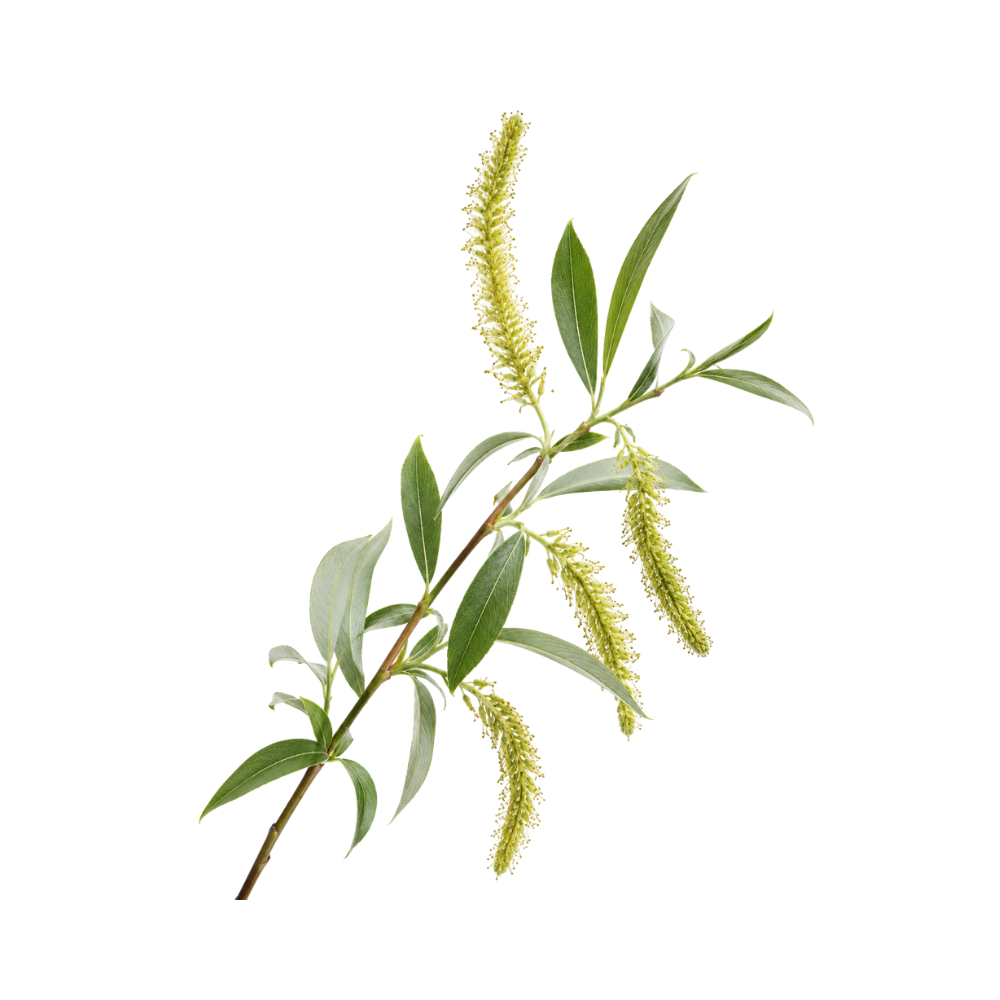
The white willow (Salix alba) is a tall, quick-growing deciduous tree of European and west-Asian riversides, easily known by its slim, pointed leaves that flash silvery-white on the underside — the trait behind both the common and the botanical name. It is a member of the willow family (Salicaceae) and, like its relatives, carries male and female catkins on separate trees.
In the herbal tradition the part that matters is not the leaf but the bark. Willow bark is the original “herbal aspirin”: for centuries decoctions of it were taken for fever, aches and inflammation, and the active principle was later isolated as salicin — the compound whose chemistry became the historical springboard for the synthesis of aspirin (acetylsalicylic acid).
White willow is only the best-known of a group of interchangeable medicinal willows. Purple willow (Salix purpurea), crack willow (Salix fragilis) and violet willow (Salix daphnoides) are all harvested for their bark, and commercial willow-bark preparations are commonly pooled across species rather than tied to one. Because willows hybridize readily and look much alike, this pooling is long-standing practice rather than sloppiness.
Distribution
White willow is native across Europe, western and central Asia and northwestern Africa, at home on riverbanks, streamsides and other consistently damp ground. Brought to North America by early European settlers, it has since naturalized widely there, particularly in the Northeast.
Growing Conditions
- Loves water — plant near streams, ponds, ditches or any reliably moist to wet ground; it dislikes drought.
- Full sun is best, though it tolerates part shade.
- Extremely fast-growing and very cold-hardy, thriving across a broad temperate range.
- Propagates almost effortlessly from hardwood cuttings — a cut twig pushed into damp soil will often root on its own.
- Full cultivation detail lives on the companion farm-wiki grow guide for Salix alba (link to be added once that project’s public URL is confirmed).
Phytochemistry
The defining compound is salicin, a phenolic glycoside that gut bacteria and the liver convert to salicylic acid — the same active principle behind aspirin 1Reference 1ReviewAssessment report on Salix [various species including S. purpurea L., S. daphnoides Vill., S. fragilis L.], cortex — regulatory monographView study →. It is accompanied by the larger salicylate esters salicortin and tremulacin, which break down to salicin and salicylates; together salicin and salicortin make up the great majority of the bark’s phenolic glycosides 1Reference 1ReviewAssessment report on Salix [various species including S. purpurea L., S. daphnoides Vill., S. fragilis L.], cortex — regulatory monographView study →. The bark is also rich in astringent condensed tannins and catechins, with the yellow chalcone isosalipurposide and the flavonol quercetin adding to its anti-inflammatory character 1Reference 1ReviewAssessment report on Salix [various species including S. purpurea L., S. daphnoides Vill., S. fragilis L.], cortex — regulatory monographView study →. Notably, salicin content is far too low to explain the extract’s aspirin-like potency on its own — detailed fractionation implicates the polyphenols as co-active constituents 11Reference 11ReviewWillow bark extract: the contribution of polyphenols to the overall effect — reviewView study →.
Constituent Summary
Figures are percent of dried bark and vary widely by species, with Salix alba notably lower in salicin than purple or crack willow; † marks salicin as the species-differentiating marker on which standardised willow-bark products are dosed 1Reference 1ReviewAssessment report on Salix [various species including S. purpurea L., S. daphnoides Vill., S. fragilis L.], cortex — regulatory monographView study →. Entries marked No Data are documented qualitatively only.
Phenolic acid5 compounds4 with data
Chalcone1 compound1 with data
Flavonoid1 compoundno data
Flavanol1 compoundno data
Tannin1 compound1 with data
Pharmacology & Research
Willow bark is one of the few herbal analgesics with genuine randomised-controlled-trial evidence, not just tradition and mechanism. The pivotal signal is short-term relief of low back pain: a dose-ranging placebo-controlled trial found roughly a third of patients pain-free on the higher salicin dose versus 6% on placebo, and a 2014 Cochrane review rated the low-back-pain evidence “moderate quality” — a high bar for any botanical 2,3Reference 2RCTTreatment of low back pain exacerbations with willow bark extract: a randomized double-blind study — RCTView study →Reference 3Systematic reviewHerbal medicine for low-back pain — Cochrane systematic reviewView study →. Beyond pain, the interesting story is mechanistic: the extract suppresses COX-2, inflammatory cytokines and leukotrienes about as strongly as aspirin on a weight basis, yet its salicin content is far too low to explain this, pointing to polyphenols as co-active constituents 10,11Reference 10AnimalMechanisms involved in the anti-inflammatory effect of a standardized willow bark extract — animal model (rat)View study →Reference 11ReviewWillow bark extract: the contribution of polyphenols to the overall effect — reviewView study →. Two caveats frame everything below: essentially all human data used a standardised ethanolic extract dosed to 120–240 mg salicin/day, not a casual tea or whole powder, and Salix alba itself is comparatively low in salicin, so results do not transfer to arbitrary willow preparations 1,5Reference 1ReviewAssessment report on Salix [various species including S. purpurea L., S. daphnoides Vill., S. fragilis L.], cortex — regulatory monographView study →Reference 5Systematic reviewA systematic review on the effectiveness of willow bark for musculoskeletal pain — systematic reviewView study →.
- Best-supported: short-term relief of low back pain from salicin-standardised extract, dose-dependent and backed by moderate-quality Cochrane evidence 2,3Reference 2RCTTreatment of low back pain exacerbations with willow bark extract: a randomized double-blind study — RCTView study →Reference 3Systematic reviewHerbal medicine for low-back pain — Cochrane systematic reviewView study →.
- Emerging, worth watching: a purified procyanidin fraction relaxes coronary arteries via endothelial signalling, and whole-extract fractions inhibit cancer cell lines — both early, both preclinical 16,17,18Reference 16In vitroA chemically defined 2,3-trans procyanidin fraction from willow bark causes redox-sensitive endothelium-dependent relaxation in porcine coronary arteries — ex vivo / in vitroView study →Reference 17In vitroIn vitro anti-proliferative effects of the willow bark extract STW 33-I — in vitroView study →Reference 18In vitroWillow bark extract (BNO 1455) and its fractions suppress growth and induce apoptosis in human colon and lung cancer cells — in vitroView study →.
- Mechanistically thin: antioxidant activity rests on in-vitro assays (often of other Salix species) plus a glutathione rise in rats — no human antioxidant data 10,15Reference 10AnimalMechanisms involved in the anti-inflammatory effect of a standardized willow bark extract — animal model (rat)View study →Reference 15In vitroAntioxidant activity and chemical characteristics of supercritical CO2 and water extracts from willow and poplar — in vitroView study →.
- The caveat: benefits are demonstrated only for a standardised ethanolic extract at 120–240 mg salicin/day over a few weeks; osteoarthritis data are genuinely mixed, and no long-term trials exist.
1. Low back pain
This is willow’s strongest indication. In a 4-week double-blind trial, 210 patients with an exacerbation of chronic low back pain received extract standardised to 120 mg or 240 mg salicin, or placebo; 39% of the high-dose group were pain-free in the final week versus 21% on low dose and 6% on placebo (P < 0.001), a clear dose-response with benefit visible within one week 2Reference 2RCTTreatment of low back pain exacerbations with willow bark extract: a randomized double-blind study — RCTView study →. An open randomised comparison found the 240 mg salicin dose broadly equivalent to the COX-2 inhibitor rofecoxib 12.5 mg/day 4Reference 4RCTTreatment of low back pain with a herbal or synthetic anti-rheumatic: a randomized controlled study — RCTView study →. A 2014 Cochrane review concluded that Salix alba standardised to 120–240 mg salicin is “probably better than placebo for short-term improvements in pain and rescue medication” and graded this moderate quality — with the rofecoxib-equivalence claim graded much lower 3Reference 3Systematic reviewHerbal medicine for low-back pain — Cochrane systematic reviewView study →. A dedicated systematic review reached the same “moderate evidence” verdict for the ethanolic extract 5Reference 5Systematic reviewA systematic review on the effectiveness of willow bark for musculoskeletal pain — systematic reviewView study →.
Gap: All trials are short (≤ 6 weeks) and use one ethanolic, salicin-standardised extract; there is no long-term data and no evidence that teas or non-standardised products reproduce the effect.
2. Anti-inflammatory
The anti-inflammatory action is the best-characterised mechanism and the plausible engine behind the analgesia, though the direct human evidence is indirect. In two rat models (air-pouch and adjuvant arthritis) the standardised extract STW 33-I reduced leukocyte infiltration, cytokines and prostaglandins at least as effectively as aspirin on a mg/kg basis, suppressed leukotrienes more strongly, and preferentially inhibited COX-2 10Reference 10AnimalMechanisms involved in the anti-inflammatory effect of a standardized willow bark extract — animal model (rat)View study →. In LPS-activated human monocytes and macrophages the aqueous extract downregulated inflammatory mediators, and detailed fractionation shows the effect cannot be explained by salicin alone — the polyphenol fraction is co-active, since salicin metabolites lack aspirin’s acetylating capacity and circulating salicylic acid is too low to account for the full effect 11,12,19Reference 11ReviewWillow bark extract: the contribution of polyphenols to the overall effect — reviewView study →Reference 12In vitroAnti-inflammatory effects of the willow bark extract STW 33-I in LPS-activated human monocytes and differentiated macrophages — in vitroView study →Reference 19Identification of phase-II metabolites from human serum samples after oral intake of a willow bark extract — human pharmacokineticView study →. Isolated willow polyphenols also lowered IL-1β, IL-6 and TNF-α in THP-1 macrophages 13Reference 13In vitroInhibition of proinflammatory biomarkers in THP-1 macrophages by polyphenols derived from chamomile, meadowsweet and willow bark — in vitroView study →. The one direct human test — a 4-week beverage combining willow with chamomile and meadowsweet in 20 healthy adults — showed a non-significant 21.7% drop in IL-1β and no clear anti-inflammatory effect, but it was small and used a herb blend rather than willow alone 14Reference 14RCTAn in vivo study examining the anti-inflammatory effects of chamomile, meadowsweet, and willow bark in a novel functional beverage — randomised human trialView study →.
Gap: No trial has shown willow bark lowering inflammatory biomarkers in humans on its own; the strong mechanistic case rests on animal and cell-culture models.
3. Osteoarthritis
Human osteoarthritis data are real but genuinely conflicting, which is why this scores below the mechanism. A 2-week placebo-controlled RCT (n = 78) at 240 mg salicin/day found a statistically significant but modest WOMAC pain reduction (−14% vs +2% on placebo; d = 6.5 mm, P = 0.047) with good tolerability 6Reference 6RCTEfficacy and tolerability of a standardized willow bark extract in patients with osteoarthritis: randomized placebo-controlled, double-blind clinical trial — RCTView study →. Against that, a larger, better-powered 6-week trial (n = 127, hip/knee OA) found willow bark no better than placebo (−2.8 mm, P = 0.55) while the diclofenac comparator was clearly effective; its parallel rheumatoid-arthritis arm was also null but severely underpowered (n = 26) 7Reference 7RCTEfficacy and safety of willow bark extract in the treatment of osteoarthritis and rheumatoid arthritis: results of 2 randomized double-blind controlled trials — RCTView study →. A 2023 meta-analysis of six arthritis RCTs reported significant pooled pain relief versus placebo, but rated the certainty inadequate owing to bias 8Reference 8Meta-analysisWillow bark (Salix spp.) used for pain relief in arthritis: a meta-analysis of randomized controlled trials — meta-analysisView study →. An observational cohort in gonarthrosis and coxarthrosis reported benefit under real-world use without a randomised control 9Reference 9ObservationalWillow bark extract (Salicis cortex) for gonarthrosis and coxarthrosis — results of a cohort study with a control group — cohort/observationalView study →.
Gap: The best-powered RCT was negative; positive results come from a short small trial and a low-certainty meta-analysis. Whether a dose above 240 mg salicin/day is needed for arthritis remains untested 5Reference 5Systematic reviewA systematic review on the effectiveness of willow bark for musculoskeletal pain — systematic reviewView study →.
4. Antioxidant
Antioxidant activity is frequently attributed to willow’s polyphenols but the evidence is preclinical and partly off-species. Bark and wood extracts show measurable radical-scavenging capacity in standard in-vitro assays, though the better-characterised antioxidant material came from Salix purpurea and S. viminalis rather than S. alba, and from combined bark-plus-wood fractions 15Reference 15In vitroAntioxidant activity and chemical characteristics of supercritical CO2 and water extracts from willow and poplar — in vitroView study →. The one in-vivo signal is indirect: in the rat arthritis model the standardised extract raised reduced glutathione and lowered lipid-peroxidation markers more than aspirin or celecoxib, an effect its authors linked to the polyphenol content 10Reference 10AnimalMechanisms involved in the anti-inflammatory effect of a standardized willow bark extract — animal model (rat)View study →. No human antioxidant endpoint has been measured.
Gap: No human data, and much of the antioxidant characterisation is on other Salix species — this is a constituent-level, mechanism-plausible claim rather than a demonstrated whole-herb effect.
5. Antiproliferative
An early-stage, in-vitro-only signal. Willow bark extract and its fractions inhibited growth and induced apoptosis in human colon (COX-2-positive HT-29 and COX-2-negative HCT-116) and lung cancer cell lines, with activity across salicylalcohol-derivative, flavonoid and proanthocyanidin fractions rather than salicin alone 18Reference 18In vitroWillow bark extract (BNO 1455) and its fractions suppress growth and induce apoptosis in human colon and lung cancer cells — in vitroView study →. A separate study of the STW 33-I extract likewise found concentration-dependent anti-proliferative and pro-apoptotic effects in cultured tumour cells, mirroring effects reported for aspirin 17Reference 17In vitroIn vitro anti-proliferative effects of the willow bark extract STW 33-I — in vitroView study →.
Gap: Cell-culture only — no animal in-vivo tumour data and no human evidence. This is a mechanistic curiosity, not a basis for any anticancer use.
6. Endothelial / vascular
The most speculative signal, included because it is chemically defined and worth tracking. A highly purified 2,3-trans procyanidin fraction from willow bark produced concentration-dependent, endothelium-dependent relaxation of pre-contracted porcine coronary arteries, acting through redox-sensitive PI3-kinase/Akt signalling and nitric oxide 16Reference 16In vitroA chemically defined 2,3-trans procyanidin fraction from willow bark causes redox-sensitive endothelium-dependent relaxation in porcine coronary arteries — ex vivo / in vitroView study →. This is consistent with vascular effects seen for procyanidins from other plants, but it was demonstrated ex vivo on isolated arteries using a purified fraction, not the bark or extract as anyone actually takes it.
Gap: A single ex-vivo study of an isolated fraction; the bark as consumed has never been tested for any cardiovascular endpoint, so this cannot support a vascular indication.
Mechanisms
| Mechanism | Drives | Key compounds |
|---|---|---|
| Salicin → salicylic acid; COX-2 inhibition | analgesicantipyreticanti-inflammatory | salicin, salicortin |
| Cytokine ↓ (IL-1β, IL-6, TNF-α), leukotriene ↓ | anti-inflammatorylow-back / arthritis pain | polyphenols, salicylic acid |
| Radical scavenging, glutathione ↑ | antioxidantanti-inflammatory support | quercetin, catechins |
| Endothelial NO / PI3K–Akt activation | vasorelaxation (preclinical only) | procyanidins |
Clinical trials
The pivotal efficacy RCTs were run in Germany between 2000 and 2004 and predate mandatory trial registration; current ClinicalTrials.gov entries mentioning willow are mostly multi-herb combination formulas rather than willow-bark monotherapy, and no new dedicated monotherapy trial is recruiting.
| Completed | Planned | Terminated | Preclinical |
|---|---|---|---|
| 4(RCTs) | 0 | 0 | ~7 |
Last checked: July 2026.
Dosage
In research, willow bark is almost always given as a standardised ethanolic extract titrated to a set salicin dose — not by bark weight, tea, or whole powder. This matters because Salix alba is a low-salicin species, so an effective salicin dose is impractical to reach from its own bark by weight.
| Indication | Preparation | Dose | Est. dried-herb equivalent | Source |
|---|---|---|---|---|
| Low back pain | Standardised ethanolic extract, salicin-standardised | 240 mg salicin/day (high dose; 120 mg was weaker) | ~24 g bark at 1% salicin dosing-grade material; ~48 g against S. alba’s own ~0.5% bark* | 2Reference 2RCTTreatment of low back pain exacerbations with willow bark extract: a randomized double-blind study — RCTView study → |
| Low back pain (vs rofecoxib) | Proprietary extract (Assalix) | 240 mg salicin/day | ~24 g bark (as above)* | 4Reference 4RCTTreatment of low back pain with a herbal or synthetic anti-rheumatic: a randomized controlled study — RCTView study → |
| Osteoarthritis | Standardised extract | 240 mg salicin/day (positive small RCT); same dose null in larger RCT | ~24 g bark (as above)* | 6,7Reference 6RCTEfficacy and tolerability of a standardized willow bark extract in patients with osteoarthritis: randomized placebo-controlled, double-blind clinical trial — RCTView study →Reference 7RCTEfficacy and safety of willow bark extract in the treatment of osteoarthritis and rheumatoid arthritis: results of 2 randomized double-blind controlled trials — RCTView study → |
*Est. dried-herb equivalent uses the stated assumption that dosing-grade willow bark ≈ 1% total salicin, giving 240 mg salicin ≈ 24 g bark; against Salix alba’s own bark (~0.5% salicin) the same dose implies ~48 g, which is impractical as a tea. This is exactly why products use higher-salicin species and standardised extracts rather than S. alba bark by weight. These are illustrative estimates, not a conversion factor or a recommendation.
Traditional Dosage
Western herbal texts use the whole bark as a decoction or a liquid extract. These traditional doses are not interchangeable with the salicin-standardised extract doses trialled above.
| System | Preparation | Dose |
|---|---|---|
| Western herbal (EMA/HMPC traditional use) | Dried bark as decoction | Equivalent to 120–240 mg total salicin daily; ~1–3 g dried bark per cup, up to 3× daily |
| Western herbal | Liquid extract 1:1 (25% ethanol) | ~1–3 mL, up to 3× daily |
| Western herbal | Tincture 1:5 (25% ethanol) | ~5–8 mL daily in divided doses |
Safety & Pregnancy
Willow bark acts through salicylates, so it broadly shares aspirin’s cautions — avoid it with salicylate allergy, in children during viral illness, and in pregnancy — but it was generally well tolerated in the controlled trials.
- Shares aspirin’s cautions. Acts through salicylates — avoid with salicylate or aspirin allergy; one severe allergic reaction occurred in the pivotal low-back-pain trial 2Reference 2RCTTreatment of low back pain exacerbations with willow bark extract: a randomized double-blind study — RCTView study →.
- Reye’s syndrome risk. As with aspirin, do not give to children or adolescents during viral illness.
- Avoid in pregnancy & lactation. EMA/HMPC does not recommend use — safety not established and salicylates cross the placenta 1Reference 1ReviewAssessment report on Salix [various species including S. purpurea L., S. daphnoides Vill., S. fragilis L.], cortex — regulatory monographView study →.
- Drug interactions. May add to anticoagulant and antiplatelet drugs, though its antiplatelet action is substantially weaker than aspirin’s (its salicylate is not acetylated) 20Reference 20Clinical trialEffect of Salicis cortex extract on human platelet aggregation — controlled human studyView study →; avoid combining with other NSAIDs or salicylate products.
- Use caution with conditions. Peptic ulcer disease, salicylate-sensitive asthma, or renal impairment.
- Generally well tolerated. Across controlled trials, only minor, mostly gastrointestinal adverse events were reported 5,6Reference 5Systematic reviewA systematic review on the effectiveness of willow bark for musculoskeletal pain — systematic reviewView study →Reference 6RCTEfficacy and tolerability of a standardized willow bark extract in patients with osteoarthritis: randomized placebo-controlled, double-blind clinical trial — RCTView study →.
Full safety & interactions detail
Willow bark acts through salicylates, so it broadly shares aspirin’s cautions. It should be avoided by anyone allergic to salicylates or aspirin — one severe allergic reaction, possibly to the extract, occurred in the pivotal low-back-pain trial 2Reference 2RCTTreatment of low back pain exacerbations with willow bark extract: a randomized double-blind study — RCTView study →. As with aspirin, it should not be given to children or adolescents during viral illness because of the theoretical risk of Reye’s syndrome, and it may add to the effect of anticoagulant and antiplatelet drugs; however, a controlled comparison found willow bark had only a minimal effect on platelet aggregation relative to a cardioprotective dose of acetylsalicylate, so its antiplatelet action appears substantially weaker than aspirin’s — its salicin-derived salicylate is not acetylated and does not irreversibly inhibit platelets the way aspirin does 20Reference 20Clinical trialEffect of Salicis cortex extract on human platelet aggregation — controlled human studyView study →. Caution is warranted in people with peptic ulcer disease, asthma sensitive to salicylates, or renal impairment, and concurrent use with other NSAIDs or salicylate-containing products should be avoided. Across the controlled trials the extract was generally well tolerated, with only minor, mostly gastrointestinal adverse events reported 5,6Reference 5Systematic reviewA systematic review on the effectiveness of willow bark for musculoskeletal pain — systematic reviewView study →Reference 6RCTEfficacy and tolerability of a standardized willow bark extract in patients with osteoarthritis: randomized placebo-controlled, double-blind clinical trial — RCTView study →.
Scope note: interactions were only partially assessed in this research — a direct platelet-aggregation study exists (minimal effect vs aspirin) 20Reference 20Clinical trialEffect of Salicis cortex extract on human platelet aggregation — controlled human studyView study →, but the anticoagulant/NSAID additive risk is inferred from salicylate pharmacology rather than from dedicated drug–drug interaction trials, and no CYP450 interaction study was identified.
The EMA/HMPC monograph states that use during pregnancy and lactation is not recommended because safety has not been established and salicylates cross the placenta 1Reference 1ReviewAssessment report on Salix [various species including S. purpurea L., S. daphnoides Vill., S. fragilis L.], cortex — regulatory monographView study →. On general pharmacological grounds, salicylate exposure in late pregnancy is a concern (analogous to aspirin), so willow bark should be avoided in pregnancy and breastfeeding unless directed by a clinician. This verdict is precautionary and regulatory, not a finding of harm.
References
- European Medicines Agency, Committee on Herbal Medicinal Products (HMPC). (2017). Assessment report on Salix [various species including S. purpurea L., S. daphnoides Vill., S. fragilis L.], cortex — regulatory monograph. EMA/HMPC/80628/2016. https://www.ema.europa.eu/en/medicines/herbal/salicis-cortex
- Chrubasik, S., et al. (2000). Treatment of low back pain exacerbations with willow bark extract: a randomized double-blind study — RCT. The American Journal of Medicine. https://pubmed.ncbi.nlm.nih.gov/10936472/
- Oltean, H., et al. (2014). Herbal medicine for low-back pain — Cochrane systematic review. Cochrane Database of Systematic Reviews. https://pubmed.ncbi.nlm.nih.gov/25536022/
- Chrubasik, S., et al. (2001). Treatment of low back pain with a herbal or synthetic anti-rheumatic: a randomized controlled study — RCT. Rheumatology (Oxford). https://pubmed.ncbi.nlm.nih.gov/11752510/
- Vlachojannis, J. E., et al. (2009). A systematic review on the effectiveness of willow bark for musculoskeletal pain — systematic review. Phytotherapy Research. https://pubmed.ncbi.nlm.nih.gov/19140170/
- Schmid, B., et al. (2001). Efficacy and tolerability of a standardized willow bark extract in patients with osteoarthritis: randomized placebo-controlled, double-blind clinical trial — RCT. Phytotherapy Research. https://pubmed.ncbi.nlm.nih.gov/11406860/
- Biegert, C., et al. (2004). Efficacy and safety of willow bark extract in the treatment of osteoarthritis and rheumatoid arthritis: results of 2 randomized double-blind controlled trials — RCT. The Journal of Rheumatology. https://pubmed.ncbi.nlm.nih.gov/15517622/
- Lin, C. R., et al. (2023). Willow bark (Salix spp.) used for pain relief in arthritis: a meta-analysis of randomized controlled trials — meta-analysis. Life (Basel). https://pubmed.ncbi.nlm.nih.gov/37895439/
- Beer, A. M., & Wegener, T. (2008). Willow bark extract (Salicis cortex) for gonarthrosis and coxarthrosis — results of a cohort study with a control group — cohort/observational. Phytomedicine. https://pubmed.ncbi.nlm.nih.gov/18815018/
- Khayyal, M. T., et al. (2005). Mechanisms involved in the anti-inflammatory effect of a standardized willow bark extract — animal model (rat). Arzneimittel-Forschung. https://pubmed.ncbi.nlm.nih.gov/16366042/
- Nahrstedt, A., et al. (2007). Willow bark extract: the contribution of polyphenols to the overall effect — review. Wiener Medizinische Wochenschrift. https://pubmed.ncbi.nlm.nih.gov/17704985/
- Bonaterra, G. A., et al. (2010). Anti-inflammatory effects of the willow bark extract STW 33-I in LPS-activated human monocytes and differentiated macrophages — in vitro. Phytomedicine. https://pubmed.ncbi.nlm.nih.gov/20570123/
- Drummond, E. M., et al. (2013). Inhibition of proinflammatory biomarkers in THP-1 macrophages by polyphenols derived from chamomile, meadowsweet and willow bark — in vitro. Phytotherapy Research. https://pubmed.ncbi.nlm.nih.gov/22711544/
- Drummond, E. M., et al. (2013). An in vivo study examining the anti-inflammatory effects of chamomile, meadowsweet, and willow bark in a novel functional beverage — randomised human trial. Journal of Dietary Supplements. https://pubmed.ncbi.nlm.nih.gov/24237191/
- Ostolski, M., et al. (2021). Antioxidant activity and chemical characteristics of supercritical CO2 and water extracts from willow and poplar — in vitro. Molecules. https://pubmed.ncbi.nlm.nih.gov/33494378/
- Kaufeld, A. M., et al. (2014). A chemically defined 2,3-trans procyanidin fraction from willow bark causes redox-sensitive endothelium-dependent relaxation in porcine coronary arteries — ex vivo / in vitro. Journal of Natural Products. https://pubmed.ncbi.nlm.nih.gov/24957134/
- Bonaterra, G. A., et al. (2010). In vitro anti-proliferative effects of the willow bark extract STW 33-I — in vitro. Arzneimittel-Forschung. https://pubmed.ncbi.nlm.nih.gov/20648923/
- Hostanska, K., et al. (2007). Willow bark extract (BNO 1455) and its fractions suppress growth and induce apoptosis in human colon and lung cancer cells — in vitro. Cancer Detection and Prevention. https://pubmed.ncbi.nlm.nih.gov/17418981/
- Untergehrer, M., et al. (2019). Identification of phase-II metabolites from human serum samples after oral intake of a willow bark extract — human pharmacokinetic. Phytomedicine. https://pubmed.ncbi.nlm.nih.gov/30849676/
- Krivoy, N., et al. (2001). Effect of Salicis cortex extract on human platelet aggregation — controlled human study. Planta Medica. https://pubmed.ncbi.nlm.nih.gov/11345689/