
Materia Medica
Wireweed
Sida acuta
Wireweed (Sida acuta) is a tough tropical weed of the mallow family used in folk medicine, notable for containing the stimulant ephedrine.
What is Wireweed?
Wireweed is a tough, wiry-stemmed plant of the mallow family, native to the American tropics and now a widespread pantropical weed. Despite its weedy reputation it has a substantial place in traditional medicine across Africa, Asia and Latin America, where the leaves, roots and aerial parts are used in a range of preparations.
Traditional & Modern Uses
Various traditions use Sida acuta for fevers, inflammation, respiratory complaints and as a general tonic and “energizer.” Its stimulant and bronchodilating reputation is linked to ephedrine-type alkaloids, and it has also been smoked or added to blends for a mild stimulating effect. Uses vary widely by region.
Botany
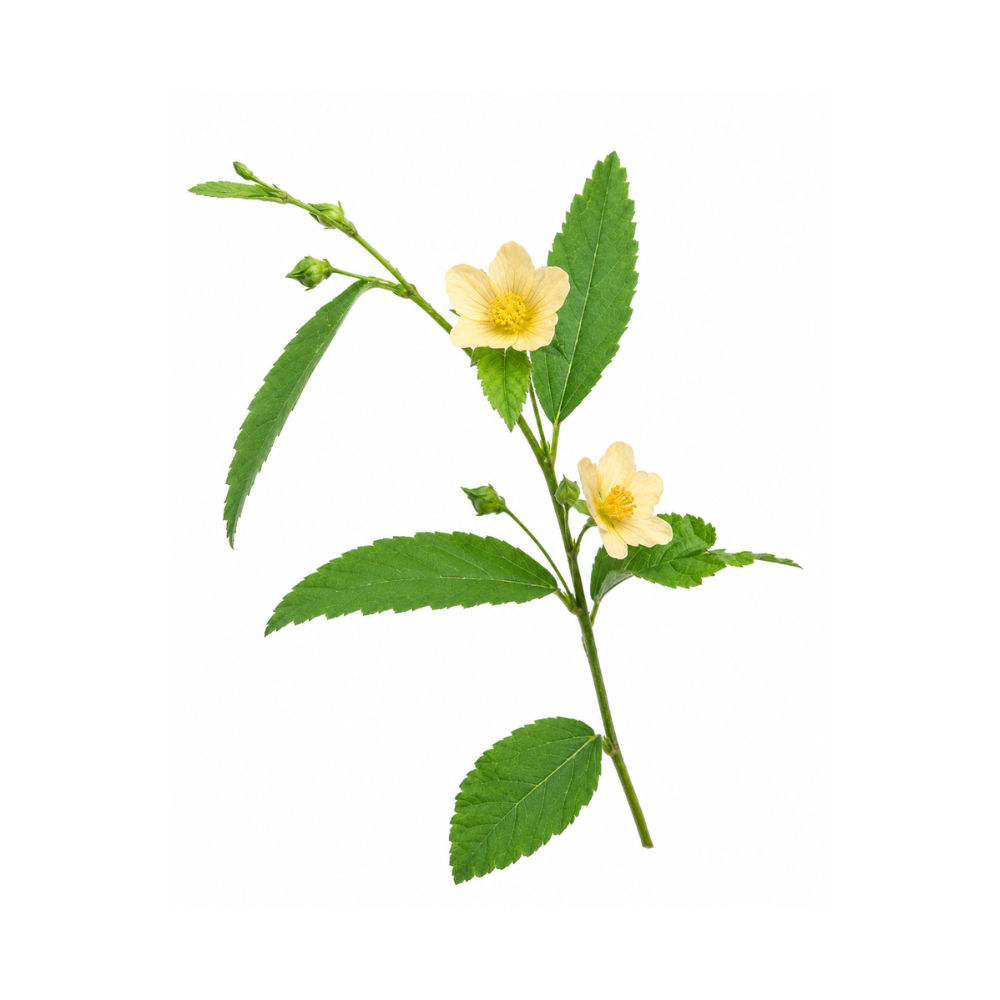
Wireweed is a small, tough, wiry subshrub of the mallow family — the same family as hibiscus and okra — but a far humbler plant, low and much-branched, springing from a woody rootstock and a deep taproot. Its leaves are narrow and sharply toothed, and it scatters small pale-yellow to orange five-petalled mallow flowers in the leaf axils. The stems give it both its name and its uses: they are so fibrous and stiff that the bark is stripped for cordage and fishnets, and the twigs are tied into brooms — hence “broomweed.”
The whole plant, root included, is used in traditional practice.
Distribution
Wireweed is a weed of the whole tropical world. Most likely native to tropical Central America, it has spread across the tropics of Asia, Africa, the Caribbean and the Pacific, thriving on roadsides, waste ground and overgrazed pasture. In northern Australia it is a declared invasive, forming dense thickets that smother pasture and native plants — enough of a problem that a leaf beetle has been introduced to control it.
Growing Conditions
- A full-sun coloniser of open, disturbed, degraded ground; it thrives in hot tropical conditions.
- Extremely tough and drought-tolerant, its deep woody taproot letting it survive poor, dry, overgrazed soils across a wide range.
- Invasive — do not plant. It is a declared/noxious weed in parts of northern Australia and an agricultural weed across the tropics; a vigorous self-seeder whose long-lived seed persists in the soil for years.
- It needs no encouragement to grow; the challenge with wireweed is always control, not cultivation.
- Full cultivation detail (and control notes) lives on the companion farm-wiki grow guide for Sida acuta (link to be added once that project’s public URL is confirmed).
Phytochemistry
The chemistry of Sida acuta is dominated by alkaloids. Its signature and differentiating compounds are the indoloquinoline alkaloids cryptolepine and quindoline, the major bases of the aerial parts and the constituents most characteristic of the species 18Reference 18Alkaloid constituents of Sida acuta, S. humilis, S. rhombifolia and S. spinosa — analyticalView study →. Activity-guided fractionation of the whole plant has also isolated the related indoloquinolinones cryptolepinone, quindolinone and 11-methoxyquindoline 12Reference 12In vitroCompounds obtained from Sida acuta with the potential to induce quinone reductase and to inhibit DMBA-induced preneoplastic lesions in a mouse mammary organ culture model — in vitroView study →. The roots add the quinazoline alkaloids vasicine and vasicinone 18,20Reference 18Alkaloid constituents of Sida acuta, S. humilis, S. rhombifolia and S. spinosa — analyticalView study →Reference 20Simultaneous determination of vasicine and vasicinone by HPLC in roots of eight Sida species — analytical studyView study →, with the phenolic acid ferulic acid credited with the root’s hepatoprotective effect 10Reference 10AnimalHepatoprotective studies on Sida acuta Burm. f. — in vivo rat modelView study →, the ecdysteroid 20-hydroxyecdysone 3Reference 3In vitroChemical constituents of two Cameroonian medicinal plants: Sida rhombifolia and Sida acuta; in vitro antiplasmodial activityView study →, phytosterols such as β-sitosterol and stigmasterol, and minor flavonoids (quercetin, kaempferol) and tannins reported across the genus 19Reference 19ReviewSecondary metabolite compounds from Sida genus and their bioactivity — reviewView study →. The much-cited ephedrine-type phenethylamines are best documented as the marker bases of the related Sida cordifolia (whole-plant ephedrine up to ~0.112%) and are reported only inconsistently in S. acuta 18,19Reference 18Alkaloid constituents of Sida acuta, S. humilis, S. rhombifolia and S. spinosa — analyticalView study →Reference 19ReviewSecondary metabolite compounds from Sida genus and their bioactivity — reviewView study →.
Constituent Summary
Figures are percent of dry weight by HPLC; the alkaloid figures below are for Sida acuta unless noted, and the ephedrine-type bases are quantified mainly in S. cordifolia. Content varies widely with plant part, provenance and method, and reports of ephedrine in this genus remain disputed. † marks the indoloquinoline alkaloids that characterise and differentiate Sida acuta.
Indole alkaloid5 compounds4 with data
Quinazoline alkaloid2 compounds2 with data
Phenolic acid1 compound1 with data
Ecdysteroid1 compound1 with data
Amine alkaloid2 compounds1 with data
Tannins1 compoundno data
Pharmacology & Research
The research literature on Sida acuta is modest in size (a few dozen primary papers) and entirely preclinical — no human clinical trial of the herb or its lead alkaloid has been registered or published. The best-developed and most consistently replicated signal is antiplasmodial: several independent West and Central African laboratories (Burkina Faso, Ivory Coast, Cameroon) have shown decoctions and extracts kill Plasmodium falciparum in vitro, and the activity tracks to the indoloquinoline alkaloid cryptolepine 1,2,3Reference 1In vitroAntimalarial activity of Sida acuta Burm. f. (Malvaceae) and Pterocarpus erinaceus Poir. (Fabaceae) — in vitro comparative studyView study →Reference 2In vitroStudies on medicinal plants of Ivory Coast: investigation of Sida acuta for in vitro antiplasmodial activities and identification of an active constituent (cryptolepine)View study →Reference 3In vitroChemical constituents of two Cameroonian medicinal plants: Sida rhombifolia and Sida acuta; in vitro antiplasmodial activityView study →. Antibacterial, antioxidant, anti-inflammatory and hepatoprotective effects are also reported, mostly from cell assays and rodent models. It is worth flagging up front that the traditional “stimulant/ephedrine” framing is poorly supported for this species — ephedrine content in S. acuta is disputed, its alkaloid profile is dominated by cryptolepine and vasicine rather than phenethylamines, and the one cardiovascular study on record found the extract slowed heart rate rather than raising it 15Reference 15In vitroCynodon dactylon and Sida acuta extracts impact on the function of the cardiovascular system in zebrafish embryos — in vitro/zebrafish modelView study →. Because activity is carried by alkaloids that vary widely with plant part, provenance and extraction, results from one preparation do not transfer cleanly to another.
- Best-supported: antiplasmodial activity against chloroquine-resistant and -sensitive P. falciparum, replicated across multiple in-vitro studies and traced to cryptolepine 1,2,3Reference 1In vitroAntimalarial activity of Sida acuta Burm. f. (Malvaceae) and Pterocarpus erinaceus Poir. (Fabaceae) — in vitro comparative studyView study →Reference 2In vitroStudies on medicinal plants of Ivory Coast: investigation of Sida acuta for in vitro antiplasmodial activities and identification of an active constituent (cryptolepine)View study →Reference 3In vitroChemical constituents of two Cameroonian medicinal plants: Sida rhombifolia and Sida acuta; in vitro antiplasmodial activityView study →; broad antibacterial activity including against multidrug-resistant Gram-negatives 4,5Reference 4In vitroDual anti-pseudomonal and resistance-modulatory actions of Sida acuta — in vitro assays with molecular docking (in silico)View study →Reference 5In vitroAnti-Proteus mirabilis and anti-struvite activity of Sida acuta leaf extract — in vitro studyView study →.
- Emerging, worth watching: antioxidant and anti-inflammatory effects with an in-vivo signal (cytokine and DNA-damage markers) 6,7Reference 6In vitroIn vitro antioxidant, lipoxygenase and xanthine oxidase inhibitory activities of fractions from Cienfuegosia digitata, Sida alba and Sida acutaView study →Reference 7AnimalAmeliorative effects of Sida acuta and vitamin C on serum DNA damage, pro- and anti-inflammatory cytokines in roosters fed aflatoxin B1 — in vivo animal studyView study →, and cryptolepine-driven cytotoxicity in cancer cell lines 11,12Reference 11In vitroCryptolepine, isolated from Sida acuta, sensitizes human gastric adenocarcinoma cells to TRAIL-induced apoptosis — in vitroView study →Reference 12In vitroCompounds obtained from Sida acuta with the potential to induce quinone reductase and to inhibit DMBA-induced preneoplastic lesions in a mouse mammary organ culture model — in vitroView study →.
- Mechanistically thin: the “stimulant/bronchodilator” reputation — no study has demonstrated stimulant or bronchodilator activity in S. acuta, and its ephedrine content is unconfirmed.
- The caveat: everything here is in vitro or animal work. There is no human efficacy data, no standardised extract, and no established therapeutic dose.
1. Antimalarial
This is the strongest and most-replicated indication. Screening fresh clinical P. falciparum isolates from Burkina Faso, a 2003 study found S. acuta the most active of four traditional plants (IC50 < 5 µg/mL) and attributed the effect to its alkaloids 1Reference 1In vitroAntimalarial activity of Sida acuta Burm. f. (Malvaceae) and Pterocarpus erinaceus Poir. (Fabaceae) — in vitro comparative studyView study →. A 2004 Ivory Coast study tested a traditional water decoction and an ethanol extract against both a chloroquine-resistant (FcM29) and a chloroquine-sensitive strain (IC50 ≈ 3.9–5.4 µg/mL), then purified the active fraction and identified cryptolepine — an indoloquinoline alkaloid and DNA intercalator — as the antiplasmodial constituent 2Reference 2In vitroStudies on medicinal plants of Ivory Coast: investigation of Sida acuta for in vitro antiplasmodial activities and identification of an active constituent (cryptolepine)View study →. A 2022 Cameroonian phytochemical study again isolated cryptolepine from S. acuta and reported IC50 values of 0.18–20.11 µg/mL against the chloroquine-sensitive 3D7 strain and 0.74–63.09 µg/mL against the chloroquine-resistant Dd2 strain 3Reference 3In vitroChemical constituents of two Cameroonian medicinal plants: Sida rhombifolia and Sida acuta; in vitro antiplasmodial activityView study →. The convergence of three independent groups on the same species, the same mechanism-bearing molecule, and retained activity against chloroquine-resistant parasites is what lifts this above the rest.
Gap: All in vitro against cultured or fresh-isolate parasites — no animal malaria model with survival endpoints and no human trial. Cryptolepine’s narrow therapeutic window (it is cytotoxic) is unaddressed for oral herbal use.
2. Antibacterial
Antibacterial activity is broad and frequently reproduced, and it aligns with the traditional use of the leaf on wounds and skin infections. Leaf and aerial-part extracts inhibit Staphylococcus aureus, Bacillus subtilis, Escherichia coli and Salmonella typhi at low MICs across several studies. Two recent papers stand out for tackling resistant organisms: an ethyl-acetate fraction of the aerial parts was bactericidal against clinical multidrug-resistant Pseudomonas aeruginosa (MIC 32–256 µg/mL) and synergised with β-lactams and fluoroquinolones, with molecular docking pointing to resveratrol and biochanin A acting on outer-membrane biogenesis and efflux targets 4Reference 4In vitroDual anti-pseudomonal and resistance-modulatory actions of Sida acuta — in vitro assays with molecular docking (in silico)View study →. A separate study showed a leaf extract inhibited uropathogenic Proteus mirabilis (MIC 8 mg/mL), suppressed its swarming and urease activity, and reduced struvite-crystal formation — with catechin, chlorogenic acid, rutin and ferulic acid identified in the extract 5Reference 5In vitroAnti-Proteus mirabilis and anti-struvite activity of Sida acuta leaf extract — in vitro studyView study →.
Gap: Effective concentrations are high relative to isolated antibiotics, the active preparations differ study-to-study (whole leaf vs solvent fraction), and none of this has moved beyond the plate to an infection model.
3. Antioxidant
S. acuta extracts show consistent free-radical-scavenging activity, and the effect tracks with polyphenol content. In a comparative fractionation study, the ethyl-acetate and dichloromethane fractions carried the highest total phenolics and the strongest DPPH, ABTS and FRAP activity, alongside inhibition of lipoxygenase and xanthine oxidase — linking the antioxidant action to a plausible anti-inflammatory mechanism 6Reference 6In vitroIn vitro antioxidant, lipoxygenase and xanthine oxidase inhibitory activities of fractions from Cienfuegosia digitata, Sida alba and Sida acutaView study →. The one in-vivo signal comes from a poultry model: adding S. acuta leaf meal to aflatoxin-B1-contaminated feed lowered serum markers of oxidative DNA damage (8-OHdG) and the pro-inflammatory regulator NF-κB while restoring anti-inflammatory cytokines 7Reference 7AnimalAmeliorative effects of Sida acuta and vitamin C on serum DNA damage, pro- and anti-inflammatory cytokines in roosters fed aflatoxin B1 — in vivo animal studyView study →.
Gap: The chemistry is whole-plant and unstandardised, the human-relevant dose is unknown, and antioxidant assays in vitro are notoriously poor predictors of clinical benefit.
4. Anti-inflammatory & analgesic
Rodent studies support an analgesic and anti-inflammatory action. An aqueous-acetone extract produced significant analgesia in the acetic-acid writhing and formalin tests in mice 8Reference 8AnimalToxicity assessment and analgesic activity investigation of aqueous acetone extracts of Sida acuta and Sida cordifolia — in vivo animal studyView study →, and an ethanol leaf extract reduced both writhing and formalin-induced paw-licking while also showing antidepressant-like effects 9Reference 9AnimalCentral nervous system activity of the ethanol leaf extract of Sida acuta in rats — in vivo animal modelView study →. Mechanistically this fits the antioxidant work — lipoxygenase inhibition in vitro 6Reference 6In vitroIn vitro antioxidant, lipoxygenase and xanthine oxidase inhibitory activities of fractions from Cienfuegosia digitata, Sida alba and Sida acutaView study → — and the poultry study’s suppression of TNF-α, IL-1β and NF-κB 7Reference 7AnimalAmeliorative effects of Sida acuta and vitamin C on serum DNA damage, pro- and anti-inflammatory cytokines in roosters fed aflatoxin B1 — in vivo animal studyView study →. Both cyclo-oxygenase/lipoxygenase and NF-κB signalling are plausible routes for the flavonoid and phenolic constituents.
Gap: No dose-response ceiling established, no comparison to standard anti-inflammatories at matched exposure, and no human data. The mechanism is inferred from mixed constituent-level and marker evidence rather than shown directly for the whole extract.
5. Hepatoprotective
One reasonably rigorous animal study underpins this. A methanolic root extract (50, 100, 200 mg/kg) dose-dependently protected Wistar rats against paracetamol-induced liver injury, lowering serum GPT, GOT, alkaline phosphatase and bilirubin, with histopathology confirming reduced damage and a shortened hexobarbitone narcosis time; the authors attributed the effect to the phenolic ferulic acid in the root 10Reference 10AnimalHepatoprotective studies on Sida acuta Burm. f. — in vivo rat modelView study →. This matches the plant’s traditional Indian use for liver and bile disorders.
Gap: A single unreplicated model in one acute-toxicity paradigm. No chronic-injury model, no other laboratory has confirmed it, and the marker compound (ferulic acid) is a common plant phenolic rather than anything distinctive to S. acuta.
6. Anticancer
Cytotoxic signals exist but rest on isolated constituents rather than the herb as used. Cryptolepine isolated from S. acuta sensitised human gastric adenocarcinoma (AGS) cells to TRAIL-induced apoptosis at 1.25–5 µM 11Reference 11In vitroCryptolepine, isolated from Sida acuta, sensitizes human gastric adenocarcinoma cells to TRAIL-induced apoptosis — in vitroView study →. Activity-guided fractionation of the whole plant yielded indoloquinolinones (quindolinone, cryptolepinone, 11-methoxyquindoline) that most strongly induced the detoxification enzyme quinone reductase; and in a mouse mammary organ-culture assay three isolates — cryptolepinone, the phenolic amide N-trans-feruloyltyramine, and a synthetic derivative (5,10-dimethylquindolin-11-one) — inhibited DMBA-induced pre-neoplastic lesions by 67–83% at 10 µg/mL 12Reference 12In vitroCompounds obtained from Sida acuta with the potential to induce quinone reductase and to inhibit DMBA-induced preneoplastic lesions in a mouse mammary organ culture model — in vitroView study →.
Gap: This is chemoprevention/cytotoxicity at the molecule level in vitro and in organ culture — cryptolepine is a cytotoxic DNA intercalator, which is a double-edged property. Nothing here supports the whole herb as an anticancer agent, and there is no animal tumour or human evidence.
7. Antidepressant-like
A single rodent behavioural study reported that an ethanol leaf extract reduced immobility in the forced-swim and tail-suspension tests — a classic antidepressant-like profile — while also showing analgesia, without affecting apomorphine-induced stereotypy 9Reference 9AnimalCentral nervous system activity of the ethanol leaf extract of Sida acuta in rats — in vivo animal modelView study →. The authors concluded the extract contains psychoactive constituents. This offers a modern, testable reframing of the plant’s traditional use for “nervous” complaints.
Gap: One study, one species of rodent, behavioural endpoints only — no neurochemical mechanism, no dose-response replication, and no human data. Behavioural despair tests are sensitive but non-specific.
Mechanisms
| Mechanism | Drives | Key compounds |
|---|---|---|
| DNA intercalation / topoisomerase inhibition | antimalarialanticancer (cytotoxic) | cryptolepine, cryptolepinone |
| Quinone-reductase (phase-II) induction | chemoprevention signal | quindolinone, 11-methoxyquindoline |
| NF-κB ↓, lipoxygenase ↓, cytokine modulation | anti-inflammatoryantioxidant | quercetin, phenolic acids |
| Free-radical scavenging (DPPH/ABTS/FRAP) | antioxidant | polyphenols, flavonoids |
| Membrane/efflux disruption + antibiotic synergy | antibacterial | resveratrol, methyl gallate |
Clinical trials
No registered clinical trials were identified for Sida acuta or for cryptolepine on ClinicalTrials.gov — the evidence base is entirely preclinical, and a 2015 genus-wide review likewise reported that no clinical study of Sida has been published 17Reference 17ReviewThe genus Sida L. — a traditional medicine: ethnopharmacological, phytochemical and pharmacological reviewView study →.
| Completed | Planned | Terminated | Preclinical |
|---|---|---|---|
| 0 | 0 | 0 | ~30 |
Last checked: July 2026.
Dosage
In research, Sida acuta is tested almost entirely as in-vitro extract concentrations or animal-model doses — there is no established human therapeutic dose, no standardised extract, and no pharmacopoeial monograph.
| Indication | Preparation | Dose | Est. dried-herb equivalent | Source |
|---|---|---|---|---|
| Antimalarial | Aqueous decoction / ethanol extract (aerial parts) | IC50 ≈ 3.9–5.4 µg/mL in vitro | — (in-vitro concentration; no oral dose) | 2Reference 2In vitroStudies on medicinal plants of Ivory Coast: investigation of Sida acuta for in vitro antiplasmodial activities and identification of an active constituent (cryptolepine)View study → |
| Antibacterial | Ethyl-acetate fraction (aerial parts) | MIC 32–256 µg/mL (MDR P. aeruginosa) in vitro | — | 4Reference 4In vitroDual anti-pseudomonal and resistance-modulatory actions of Sida acuta — in vitro assays with molecular docking (in silico)View study → |
| Antioxidant | Leaf meal in feed (in vivo, poultry) | 2.5–5.0 g/kg of diet | — (animal dietary inclusion, not a human dose) | 7Reference 7AnimalAmeliorative effects of Sida acuta and vitamin C on serum DNA damage, pro- and anti-inflammatory cytokines in roosters fed aflatoxin B1 — in vivo animal studyView study → |
| Anti-inflammatory / analgesic | Ethanol / aqueous-acetone extract | 100–500 mg/kg (rodent, oral/i.p.) | — (animal mg/kg; no human back-conversion) | 8,9Reference 8AnimalToxicity assessment and analgesic activity investigation of aqueous acetone extracts of Sida acuta and Sida cordifolia — in vivo animal studyView study →Reference 9AnimalCentral nervous system activity of the ethanol leaf extract of Sida acuta in rats — in vivo animal modelView study → |
| Hepatoprotective | Methanolic root extract | 50–200 mg/kg (rat, oral) | — | 10Reference 10AnimalHepatoprotective studies on Sida acuta Burm. f. — in vivo rat modelView study → |
Est. dried-herb equivalent is left as ”—” throughout: nearly all doses are in-vitro concentrations (µg/mL) or animal mg/kg with no marker-standardised extract, so no defensible whole-herb human equivalent can be back-calculated. There is no established human dose for Sida acuta. These figures are research parameters, not recommendations.
Traditional Dosage
Sida acuta has no WHO, ESCOP, EMA/HMPC or Commission E monograph, so authoritative traditional-dose figures do not exist. The table below states preparation and use direction only.
| System | Preparation | Dose |
|---|---|---|
| West African / African folk medicine | Decoction of aerial parts / leaf (antimalarial, fevers) | Not standardised in pharmacopoeial sources |
| Indian traditional medicine | Root decoction / powder (liver, “nervous” and urinary complaints) | Not standardised in pharmacopoeial sources |
Safety & Pregnancy
The safety literature on Sida acuta is thin but suggests low-to-moderate acute toxicity; the real concerns are theoretical — cytotoxic alkaloids, a genus tradition as an abortifacient, and additive toxicity alongside artemisinin-based antimalarials. The old stimulant/ephedrine cautions rest on disputed evidence.
- Avoid in pregnancy. The Sida genus has documented abortifacient / uterine-stimulant use.
- Cytotoxic alkaloids. Cryptolepine is a DNA intercalator with a narrow therapeutic window.
- Antimalarial interaction. Additive muscle-cell toxicity in vitro with artemisinin-based combination therapy.
- Low-to-moderate acute toxicity. i.p. LD50 ~3.2 g/kg in mice; a 28-day oral study found no consistent changes.
- Stimulant cautions unproven. Ephedrine content is disputed and a zebrafish study found the extract lowered heart rate.
Full safety & interactions detail
The safety literature on Sida acuta is limited but does not support the page’s current stimulant framing. Acute toxicity is low-to-moderate: an intraperitoneal LD50 of about 3.2 g/kg in mice and a 28-day oral study showing no consistent haematological or biochemical changes 8Reference 8AnimalToxicity assessment and analgesic activity investigation of aqueous acetone extracts of Sida acuta and Sida cordifolia — in vivo animal studyView study →, while a genus review notes that of the Sida species tested, extracts were found safe for oral use in rats 17Reference 17ReviewThe genus Sida L. — a traditional medicine: ethnopharmacological, phytochemical and pharmacological reviewView study →. The most concrete interaction signal is that S. acuta extract itself damaged cultured muscle cells and increased cell death when combined with the antimalarial drugs artesunate/amodiaquine and artemether/lumefantrine — a caution against co-use with artemisinin-based combination therapy 16Reference 16In vitroArtemisinin-based combination therapy synergized with medicinal plants (Sida acuta) to induce musculotoxic effects — in vitroView study →. The plant’s alkaloids (cryptolepine, a cytotoxic DNA intercalator; vasicine) and the Sida genus’s documented abortifacient/uterine-stimulant use are the main theoretical concerns 17Reference 17ReviewThe genus Sida L. — a traditional medicine: ethnopharmacological, phytochemical and pharmacological reviewView study →, and the ephedrine-based cardiovascular cautions historically attached to this plant rest on disputed evidence — ephedrine is inconsistently reported in this species and a zebrafish study found the extract lowered heart rate rather than raising it 15Reference 15In vitroCynodon dactylon and Sida acuta extracts impact on the function of the cardiovascular system in zebrafish embryos — in vitro/zebrafish modelView study →.
Scope note: interactions were only partially assessed in this research — one in-vitro study shows additive muscle-cell toxicity with artemisinin-based antimalarials 16Reference 16In vitroArtemisinin-based combination therapy synergized with medicinal plants (Sida acuta) to induce musculotoxic effects — in vitroView study →. No CYP450, anticoagulant, antihypertensive or stimulant/MAOI interaction has actually been studied; the older MAOI/decongestant/stimulant cautions are inferred from a disputed ephedrine claim, not tested.
Avoid. Species in the Sida genus have a documented traditional use as abortifacients and in childbirth/miscarriage, and the genus review flags this uterine activity directly 17Reference 17ReviewThe genus Sida L. — a traditional medicine: ethnopharmacological, phytochemical and pharmacological reviewView study →. No dedicated reproductive-toxicity study of Sida acuta has been performed, and lactation safety has not been assessed at all — so the recommendation to avoid is precautionary, based on the abortifacient tradition and the plant’s cytotoxic alkaloid content, not on a finding of safety.
References
- Karou, D., Dicko, M. H., Simpore, J., et al. (2003). Antimalarial activity of Sida acuta Burm. f. (Malvaceae) and Pterocarpus erinaceus Poir. (Fabaceae) — in vitro comparative study. Journal of Ethnopharmacology. https://pubmed.ncbi.nlm.nih.gov/14611894/
- Banzouzi, J. T., Prado, R., Menan, H., et al. (2004). Studies on medicinal plants of Ivory Coast: investigation of Sida acuta for in vitro antiplasmodial activities and identification of an active constituent (cryptolepine). Phytomedicine. https://pubmed.ncbi.nlm.nih.gov/15185848/
- Kamdoum, B. C., Fongang, Y. S. F., Ngnokam, D., et al. (2022). Chemical constituents of two Cameroonian medicinal plants: Sida rhombifolia and Sida acuta; in vitro antiplasmodial activity. Natural Product Research. https://pubmed.ncbi.nlm.nih.gov/34121522/
- Seukep, A. J., Mbuntcha, H. P. K., Kuete, V., et al. (2026). Dual anti-pseudomonal and resistance-modulatory actions of Sida acuta — in vitro assays with molecular docking (in silico). Pharmaceutical Biology. https://pubmed.ncbi.nlm.nih.gov/41502406/
- Smanthong, N., Tavichakorntrakool, R., Saisud, P., et al. (2022). Anti-Proteus mirabilis and anti-struvite activity of Sida acuta leaf extract — in vitro study. Molecules. https://pubmed.ncbi.nlm.nih.gov/35164357/
- Konaté, K., Souza, A., Coulibaly, A. Y., et al. (2010). In vitro antioxidant, lipoxygenase and xanthine oxidase inhibitory activities of fractions from Cienfuegosia digitata, Sida alba and Sida acuta. Pakistan Journal of Biological Sciences. https://pubmed.ncbi.nlm.nih.gov/21313883/
- Olarotimi, O. J., Adu, O. A., Gbore, F. A., et al. (2023). Ameliorative effects of Sida acuta and vitamin C on serum DNA damage, pro- and anti-inflammatory cytokines in roosters fed aflatoxin B1 — in vivo animal study. Toxicon. https://pubmed.ncbi.nlm.nih.gov/37944826/
- Konaté, K., Bassolé, I. H. N., Hilou, A., et al. (2012). Toxicity assessment and analgesic activity investigation of aqueous acetone extracts of Sida acuta and Sida cordifolia — in vivo animal study. BMC Complementary and Alternative Medicine. https://pubmed.ncbi.nlm.nih.gov/22883637/
- Ibironke, G. F., & Fasanmade, A. A. (2014). Central nervous system activity of the ethanol leaf extract of Sida acuta in rats — in vivo animal model. African Journal of Medicine and Medical Sciences. https://pubmed.ncbi.nlm.nih.gov/25335373/
- Sreedevi, C. D., Latha, P. G., Ancy, P., et al. (2009). Hepatoprotective studies on Sida acuta Burm. f. — in vivo rat model. Journal of Ethnopharmacology. https://pubmed.ncbi.nlm.nih.gov/19422907/
- Ahmed, F., Toume, K., Sadhu, S. K., et al. (2011). Cryptolepine, isolated from Sida acuta, sensitizes human gastric adenocarcinoma cells to TRAIL-induced apoptosis — in vitro. Phytotherapy Research. https://pubmed.ncbi.nlm.nih.gov/20623717/
- Jang, D. S., Cuendet, M., Pawlus, A. D., et al. (2003). Compounds obtained from Sida acuta with the potential to induce quinone reductase and to inhibit DMBA-induced preneoplastic lesions in a mouse mammary organ culture model — in vitro. Archives of Pharmacal Research. https://pubmed.ncbi.nlm.nih.gov/12967190/
- Franco-Espínola, J., Rodríguez, D., Cuéllar, A., et al. (2023). Screening of medicinal plants from El Salvador for anti-viral activity against herpes simplex 1 — in vitro screen. Natural Product Research. https://pubmed.ncbi.nlm.nih.gov/36239484/
- Membe Femoe, U., Dabolé, B., Tchuenté, L.-A. T., et al. (2022). Anticercarial, cytotoxicity and phytochemical profiles of Sida acuta and Sida rhombifolia hydroethanolic extracts — in vitro. Evidence-Based Complementary and Alternative Medicine. https://pubmed.ncbi.nlm.nih.gov/35047048/
- Kannan, R. R. R., Arumugam, R., Anantharaman, P. (2012). Cynodon dactylon and Sida acuta extracts impact on the function of the cardiovascular system in zebrafish embryos — in vitro/zebrafish model. Journal of Biomedical Research. https://pubmed.ncbi.nlm.nih.gov/23554736/
- Daubrey-Potey, T., Kouassi, K. M., Yao, K. E., et al. (2021). Artemisinin-based combination therapy synergized with medicinal plants (Sida acuta) to induce musculotoxic effects — in vitro. Evidence-Based Complementary and Alternative Medicine. https://pubmed.ncbi.nlm.nih.gov/34306158/
- Dinda, B., Das, N., Dinda, S., et al. (2015). The genus Sida L. — a traditional medicine: ethnopharmacological, phytochemical and pharmacological review. Journal of Ethnopharmacology. https://pubmed.ncbi.nlm.nih.gov/26497766/
- Prakash, A., Varma, R. K., Ghosal, S. (1981). Alkaloid constituents of Sida acuta, S. humilis, S. rhombifolia and S. spinosa — analytical. Planta Medica. https://doi.org/10.1055/s-2007-971529
- Aminah, N. S., Laili, E. R., Rafi, M., et al. (2021). Secondary metabolite compounds from Sida genus and their bioactivity — review. Heliyon. https://pubmed.ncbi.nlm.nih.gov/33912700/
- Subramanya, M. D., Pai, S. R., Upadhya, V., et al. (2016). Simultaneous determination of vasicine and vasicinone by HPLC in roots of eight Sida species — analytical study. Ayu. https://pubmed.ncbi.nlm.nih.gov/29200752/