

Nootropics have been well known by CEOs and scientists for years and are just now becoming popularized by college students and those simply wishing to optimize their cognitive performance.
Most nootropics, however, are synthesized and can be compared to pharmaceutical medications.
This does not mean they are dangerous, but many would prefer to use natural products to achieve optimal health.
Well if this is you then you’re in luck!
Nootropics are not limited to the pharmaceutical scene, and in fact, many of these synthetic chemicals are actually made after naturally occurring chemicals.
The only real difference with using whole plant extracts as nootropics compared with synthetic chemicals is that a higher dosage will be needed in order to achieve the same results.
Natural chemicals can also be concentrated from the natural herb in a lab environment which closer resemble the synthetic versions in dosage.
What are Nootropics?
Nootropics are not stimulants, but instead, promote the normal healthy functioning of the brain.
They are popular amongst students to make their study more efficient, older generations who are worried their memories are beginning to weaken, and for work by people who have demanding jobs which require them to think critically or quickly.
Some nootropics are even useful to stimulate creativity and imagination. Medicinally, the main application of nootropic and cognitive enhancing botanicals is for the treatment and prevention of Alzheimer’s and dementia (see my overview of Alzheimer’s and dementia) in older people, and ADD and ADHD in children.
I’ve included an example all-purpose nootropic formula at the end of this article.
Many Nootropic Substances Come From Plants
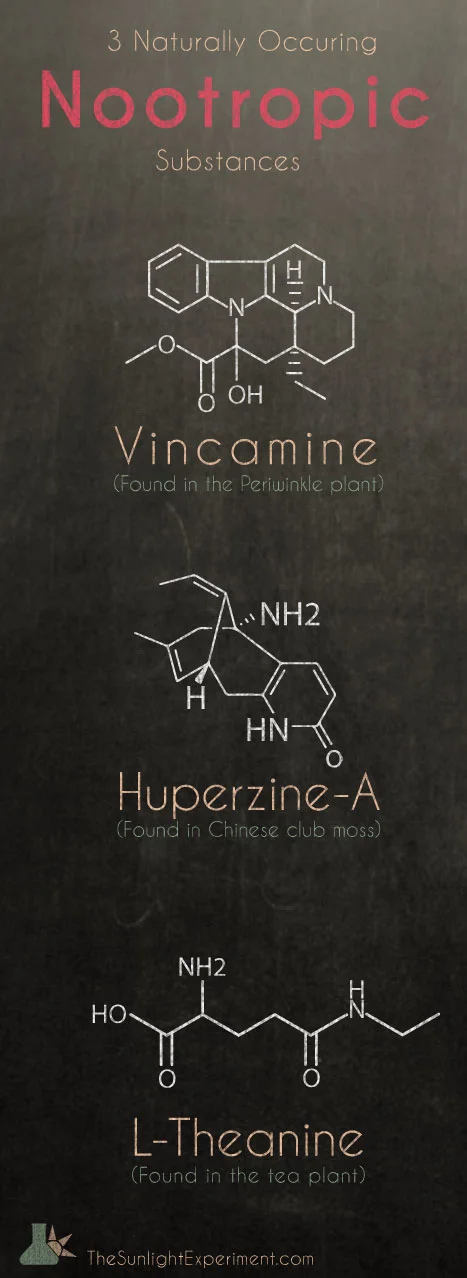
Many nootropics, synthetic or otherwise, actually come from or are replicated from natural components of medicinal plant species.
Vinpocetine, for example, is a synthetic version of vincamine which is a naturally occurring indole alkaloid found in the periwinkle plant.
These synthetic versions or concentrated extracts of vincamine itself are often highly concentrated, and only a very small dose is needed to achieve results.
This makes it a little bit easier to take, but often creates more side effects than using a more complete or holistic extract of the plant.
Whole botanicals or herbal extracts can be used similarly to these concentrated or synthetic extracts to achieve the same sort of results, but generally need to be used in higher dosages than their highly concentrated counterparts.
Here are some of the best natural nootropics:
1. Ginkgo
(Ginkgo biloba)
Especially useful when combined with ginseng (Panax ginseng or Panax quinquefolium).
Ginkgo is believed to act as a nootropic mainly by improving the blood flow to the brain. It tones the vascular system of the whole body, including the brain.
Alzheimer’s and other dementias are complex, but two factors often discussed are the buildup of beta-amyloid plaques (which form from a protein called APP — not, despite a common myth, from the breakdown of acetylcholine) and reduced blood flow to the brain.
Ginkgo is thought to help mainly with the second of these — toning the vascular system and allowing more oxygen and nutrients to reach brain cells. That said, large prevention trials of ginkgo have been disappointing, so it’s better thought of as a blood-flow tonic than a proven Alzheimer’s preventive.
Through this action, it is also believed to improve the performance of healthy individuals as well.
Ginkgo leaf extracts are often found highly concentrated (similar to many of the other nootropics) in order to be most effective and should be consumed over a long period of time.
2. Bacopa
(Bacopa monnieri)
Known as Brahmi in India, is only effective for cognition enhancement with long term use.
A study investigating the short term effects of bacopa found no improvement, but several long-term studies of 90 days or more have shown significant improvement in memory, cognitive function, and intelligence.
This herb has been especially associated with an improvement in hand-eye coordination. This suggests an action on the cerebellum of the brain which is known to be responsible for the coordination of muscular function.
Without this portion of the brain, we would have extremely poor hand-eye coordination.
3. Periwinkle
(Vinca minor)
As mentioned earlier, the relatively well-known nootropic vinpocetine is the synthetic (and slightly altered) version of vincamine.
This chemical is found in the periwinkle plant, which is actually a fairly common garden species for its beautiful purple colours.
The periwinkle plant, known botanically as Vinca minor, can be consumed in dried, powdered or extracted forms as well to naturally improve cognitive function in much the same way as its synthetic counterpart.
Vincamine is not as well studied as vinpocetine, likely due to the fact that the only synthetic versions of these chemicals are patentable, and the natural component is not.
Nevertheless, these two chemicals, though slightly different, appear to have the same or similar active regions and accomplish virtually the same results 2Reference 2ReviewVinpocetine: A smart drug and smart nutrient: A review.
This slight difference can be compared to the better-known aspirin, which is an acetylated version of the naturally occurring salicylic acid found in willow and birch bark.
These two chemicals have slight differences, but both accomplish the same anti-inflammatory actions through inhibition of the COX pathway, which is vital for certain kinds of inflammation.
4. Cannabis (CBD)
(Cannabis sativa/indica)
Most people associate cannabis with the exact opposite effects to cognitive performance.
The chemical cannabidiol (CBD) and other cannabinoids, however, have drawn interest for cognition. CBD has been studied for antioxidant and anti-inflammatory effects in the brain, and there’s early research into its effect on the enzyme acetylcholinesterase. To be clear on a common mix-up, though: acetylcholinesterase breaks down acetylcholine — it does not create the beta-amyloid plaques seen in Alzheimer’s, which form from the APP protein.
Smoking cannabis is not the best way to use it as a nootropic, however, as the carbon monoxide and other products of combustion can actually damage the brain instead, and reduce oxygen delivery to the brain cells which will no doubt result in reduced cognition.
The best way to take CBD is in a capsule, or liquid extract. CBD extracts can be purchased in areas where this highly useful herb is no longer ignorantly outlawed and will not produce a high.
The psychoactive components can be omitted and will likely prove to be even more nootropic in this form than the whole plant extract for this reason.
5. The Tea Plant (L-Theanine)
The tea plant (Camellia sinensis) contains a slurry of well-studied medicinal chemicals, but the main one considered a nootropic is the amino acid L-Theanine.
This amino acid has been shown to improve memory and concentration. Although found in pretty much all tea, it is contained in highest amounts in shade grown varieties of green tea.
This includes gyokuro, tencha, and of course matcha green tea.
Matcha is considered the best natural source of L-theanine because it is not steeped like other forms of the tea plant.
It’s powdered and consumed whole as a solution. This means that 100% of the contents of the leaves enter the body.
This is compounded by the fact that matcha is usually shade-grown. Shading the tea plant for the last few weeks before harvest causes a significant rise in L-Theanine compared to sun-grown varieties.
L-Theanine can also be found in a concentrated extraction from laboratory intervention.
This form of L-theanine is still highly effective, and very safe even with long term usage.
6. Lions Mane
(Hericium erinaceus)
Lion’s mane is a fungus (Hericium erinaceus) with a characteristic irregular shape resembling that of hair or a lion’s mane.
This mushroom is often eaten as a food, and actually, pairs very well cooked with butter. Much like other mushrooms, however, it offers additional medicinal actions.
Lion’s mane is well known to improve cognitive functions in doses as low as 750 mg daily. There are several ways that lions mane can improve cognitive performance and act as a nootropic.
The main one is that it is able to stimulate nerve growth factor (NGF), a protein complex that stimulates the nerve cells to grow. In most cases, it is agreed that the nerve cells are not the best multiplier, and once enough have been damaged, by conditions such as MS, traumatic injury, neurotoxic chemicals, or Alzheimer’s they generally do not come back.
By stimulating nerve growth factor it is believed that these degenerative conditions can be either slowed or prevented altogether depending on the severity of the condition. In healthy individuals, it is thought that the nerve growth stimulated by lions mane is more of a maintenance and preventative action, with only a mild increase in cognitive performance, memory, and concentration.
The more significant improvement appears to be in those with reduced cognitive function.
7. Chinese Club Moss (Huperzine-A)
(Huperzia serrata)
The popular nootropic huperzine-A is another naturally occurring compound that has been highly refined and concentrated for use as a nootropic supplement.
In order to concentrate this chemical to the level needed to be classified as specifically “huperzine-A” a laboratory is needed.
This may turn some people who prefer the more holistic approach, it is a safe and naturally occurring compound. Recently there has been an increase in interest in this chemical, and numerous studies on its safety and effectiveness have been published.
Many use it to support memory in Alzheimer’s and dementia. Unlike ginkgo, huperzine-A doesn’t work through blood flow — it inhibits acetylcholinesterase, the enzyme that breaks down the memory neurotransmitter acetylcholine. That’s the same broad mechanism as several prescription Alzheimer’s drugs.
The clinical evidence is still preliminary — a Cochrane review judged the existing trials too small and low in quality to draw firm conclusions — so treat it as a promising traditional compound rather than a proven treatment.
8. Black Ant
(Polyrhachis spp.)
Although this last example is not botanical in nature, it is one of the most interesting ones.
Polyrhachis is a large genus of ants commonly referred to as black ant. It has an impressive nutritional profile and contains multiple potent medicinal compounds along with high levels of zinc.
Black ant is often promoted as being unusually high in zinc — though the popular claim that it has the highest zinc content of any living thing isn’t well substantiated.
In China, black ant is commonly used by university students to help prevent the burnout associated with overworking and studying.
The cognitive enhancing properties associated with black ant has been suggested to be due to its high zinc content, ecdysterone, and its rich supply of the neurotransmitter precursors tryptophan, phenylalanine, and tyrosine. 1Reference 1ReviewBlack Ant (Polyrhachis spp.) — herb monograph.
9. Gotu Kola
(Centella asiatica)
Gotu kola comes out of India, Madagascar, and Sri Lanka, where it has a long history of use for focus and concentration. The monks reportedly used it to hold their attention through long hours of meditation.
Much like ginkgo, it seems to work by toning and supporting the blood vessels, which in turn supports healthy blood pressure and proper brain function. It’s also famously a favourite food of elephants, animals not exactly known for forgetting.
10. Passionflower
(Passiflora spp.)
I usually reach for passionflower’s leaves and stems for stress and anxiety, but those same actions feed directly into concentration. By lowering oxidative stress in the hippocampus and relaxing the muscles of the body, it settles a tense, racing mind enough to actually stay on task.
It won’t stimulate you the way some of the others on this list will, so think of it less as a push and more as clearing away the static. For an anxious student who can’t sit still long enough to study, it can be a quietly effective aid.
11. Catuaba
(Trichilia catigua)
Catuaba is the common name shared by several unrelated Amazonian trees; here I’m talking specifically about Trichilia catigua.
It has traditionally been used to support the dopamine system, and that’s the angle that interests me for cognition. Dopamine sits behind drive, nerve transmission, and our pleasure-reward system, so it has a hand in productivity, creativity, and concentration as well as mood and libido. When dopamine signalling runs low, the result tends to look like procrastination, leaning on stimulants like caffeine, and a flat, low motivation.
I’d frame catuaba as a gentle modulator here rather than a heavy hitter, but it’s a worthwhile herb to know.
12. Guarana
(Paullinia cupana)
Guarana is a seed out of the Amazon that, by weight, carries more caffeine than the coffee bean. It also brings theobromine and theophylline, caffeine-like alkaloids that seem to take the edge off some of caffeine’s rougher side effects.
So in the short term (a couple of hours) it works as a straightforward mental stimulant. More interesting is the long game: it’s increasingly discussed as an adaptogen, and its effects have been studied in animals. In one classic set of experiments, guarana reversed scopolamine-induced memory deficits in mice, and low doses given over an extended period produced effects that didn’t seem fully explained by caffeine alone — hinting at active constituents beyond the stimulant 3Reference 3Pharmacological activity of Guarana (Paullinia cupana Mart.) in laboratory animals.
13. Ginseng
(Panax ginseng / Panax quinquefolium)
Ginseng turns up earlier in this article as a synergist for ginkgo and in the formula below, but it’s worth a section of its own. It has a long history as an adaptogen and a go-to for fatigue, and there’s some clinical evidence for the mental-fatigue piece specifically.
A 2013 randomised, double-blind, placebo-controlled trial in PLOS ONE gave Panax ginseng extract to 90 subjects with idiopathic chronic fatigue and found that both a 1g and a 2g daily dose of concentrated extract significantly improved mental fatigue scores against placebo — though, notably, not physical fatigue scores 4Reference 4RCTAntifatigue Effects of Panax ginseng C.AView study →. A separate trial in American ginseng (Panax quinquefolium) suggested a similar benefit for cancer-related fatigue 5Reference 5RCTPilot study of Panax quinquefolius (American ginseng) to improve cancer-related fatigue: a randomized, double-blind, dose-finding evaluation: NCCTG trial N03CAView study →.
I’d read that as suggestive rather than settled — it’s a single trial on one fatigue population — but it lines up with the traditional use and with why so many students chew on a piece of ginseng while they study. One practical note from the trial: there was no statistically significant difference between the 1g and 2g doses, so the effect didn’t appear to be dose-dependent. For a formula, the concentrated powder is the convenient form since it goes into a capsule in a small dose.
Blending Nootropics: An Example Formula
Use liquid extracts (1:2) or dilute as necessary.
Take 10 ml of this formula 2 or 3 times a day.
- Periwinkle (2 parts)
- Ginseng (Asian or American) (2 parts)
- Ginkgo (2 parts)
- Lions mane (1 part)
Author
The Sunlight Experiment
References
- The Sunlight Experiment. Black Ant (Polyrhachis spp.) — herb monograph.
- Jha, M. K., Rahman, M., & Sheikh, H. (2012). Vinpocetine: A smart drug and smart nutrient: A review. International Journal of Pharmaceutical Sciences and Research, 3(2), 346–352.
- Espinola, E. B., Dias, R. F., Mattei, R., & Carlini, E. A. (1997). Pharmacological activity of Guarana (Paullinia cupana Mart.) in laboratory animals. Journal of Ethnopharmacology, 55(3), 223–229. Link
- Kim, H., Cho, J., Yoo, S., Lee, J., Han, J., Lee, N., Ahn, Y., Son, C. (2013). Antifatigue Effects of Panax ginseng C.A. Meyer: A Randomised, Double-Blind, Placebo-Controlled Trial. PLoS ONE, 8(4), e61271. doi:10.1371/journal.pone.0061271
- Barton DL, Soori GS, Bauer BA, Sloan JA, Johnson PA, et al. (2010) Pilot study of Panax quinquefolius (American ginseng) to improve cancer-related fatigue: a randomized, double-blind, dose-finding evaluation: NCCTG trial N03CA. Support Care Cancer 18: 179–187. doi: 10.1007/s00520-009-0642-2.
Justin Cooke
Clinical herbalist and the writer behind The Sunlight Experiment — an evidence-based pharmacopoeia of herbs, supplements, and the chemistry behind them.