
Materia Medica
Greater Celandine
Chelidonium majus
Greater celandine (Chelidonium majus) — a poppy-family herb whose alkaloids are used for pain, spasm and liver and gallbladder complaints, but which carries a documented risk of liver injury.
What Is Greater Celandine?
Greater celandine is a member of the poppy family with a lot of similarity to California or opium poppy. The alkaloids present in greater celandine are similar, but different to the alkaloids used to make opium, morphine, and heroin. Some of these alkaloids show analgesic activity in animal and cell studies through mechanisms distinct from the opioids, and a single mouse study suggests berberine may blunt morphine tolerance — but this is a preclinical and traditional hypothesis, not established practice, and there are no human analgesia data.
All poppies have a characteristic latex in their stems and leaves, which is often the source of medicine in this family of plants. Greater celandine’s latex is rich in alkaloids and has traditionally been applied topically to warts and skin infections. Cell-line studies show these alkaloids are cytotoxic, but the prominent “anticancer” human data belong to Ukrain — a semisynthetic derivative of the alkaloids, not the herb — whose trials were judged methodologically poor, so this is not evidence that the herb itself treats cancer.
What Is Greater Celandine Used For?
Greater celandine is used topically to treat a range of infectious conditions including warts, herpes, skin lesions, shingles, and has been used on skin cancers in the past.
Internally greater celandine is used as a hepatic herb to stimulate the flow of bile from the liver and gallbladder. It’s used traditionally for a range of liver conditions such as jaundice, hepatic congestion, biliary dyspepsia, bilious migraine headaches, hepatitis, gallstones, and indigestion. It’s also used to treat gastric spasms, and general pain. Note that these are traditional applications — the internal-use evidence is thin and the herb carries a documented risk of liver injury (see Safety).
Traditional Uses
Western Herbal Medicine
The botanical name of this herb, Chelidonium, stems from the Greek word chelidon, which refers to a swallow (the bird), was actually given to the herb by the famous herbalist Pliny, because it comes into flower when the swallows appear in spring, and fades when they leave again. He suggested the traditional use of using the herbs juice to remove films from the cornea of the eye was first discovered by the swallows, further leading to a connection between these 2 organisms 31,32Reference 31Principles and Practice of PhytotherapyReference 32A Modern Herbal — Celandine, GreaterView study →.
Both the root and the aerial parts of this flower have been used medicinally and contain similar alkaloids; the aerial parts are much preferred and used more commonly medicinally 31Reference 31Principles and Practice of Phytotherapy.
Traditional uses of chelidonium include: Gallbladder disease and stones, liver disease such as jaundice, to aid detoxification via liver and bowel, gastric ulcers, migraines, and skin conditions such as warts, ringworm, and fungal infection 29,31Reference 29ReviewChelidonium majus — an integrative review: traditional knowledge versus modern findings — reviewView study →Reference 31Principles and Practice of Phytotherapy.
Traditional Chinese Medicine
In China, chelidonium was used for similar indications as it was used in Europe such as gastritis, gastric ulcers, enteritis, jaundice, and abdominal pain. They also used it here however to treat bronchitis, and whooping cough 31Reference 31Principles and Practice of Phytotherapy.
Actions
Clears heat, cools, drying 29Reference 29ReviewChelidonium majus — an integrative review: traditional knowledge versus modern findings — reviewView study →.
Indications
Abdominal pain, peptic ulcers, chronic bronchitis, whooping cough 33Reference 33A Clinical Guide to Blending Liquid Herbs. Great for conditions involving damp-heat (such as congested bile) 29Reference 29ReviewChelidonium majus — an integrative review: traditional knowledge versus modern findings — reviewView study →. It’s mainly used to treat blood stasis due to stagnation of Qi, relieve pain, promote diuresis in edema conditions (also seen as stagnation), relieve cough and treat jaundice.
The bitter taste of Chelidonium majus is thought to influence the heart 29Reference 29ReviewChelidonium majus — an integrative review: traditional knowledge versus modern findings — reviewView study →.
Botany
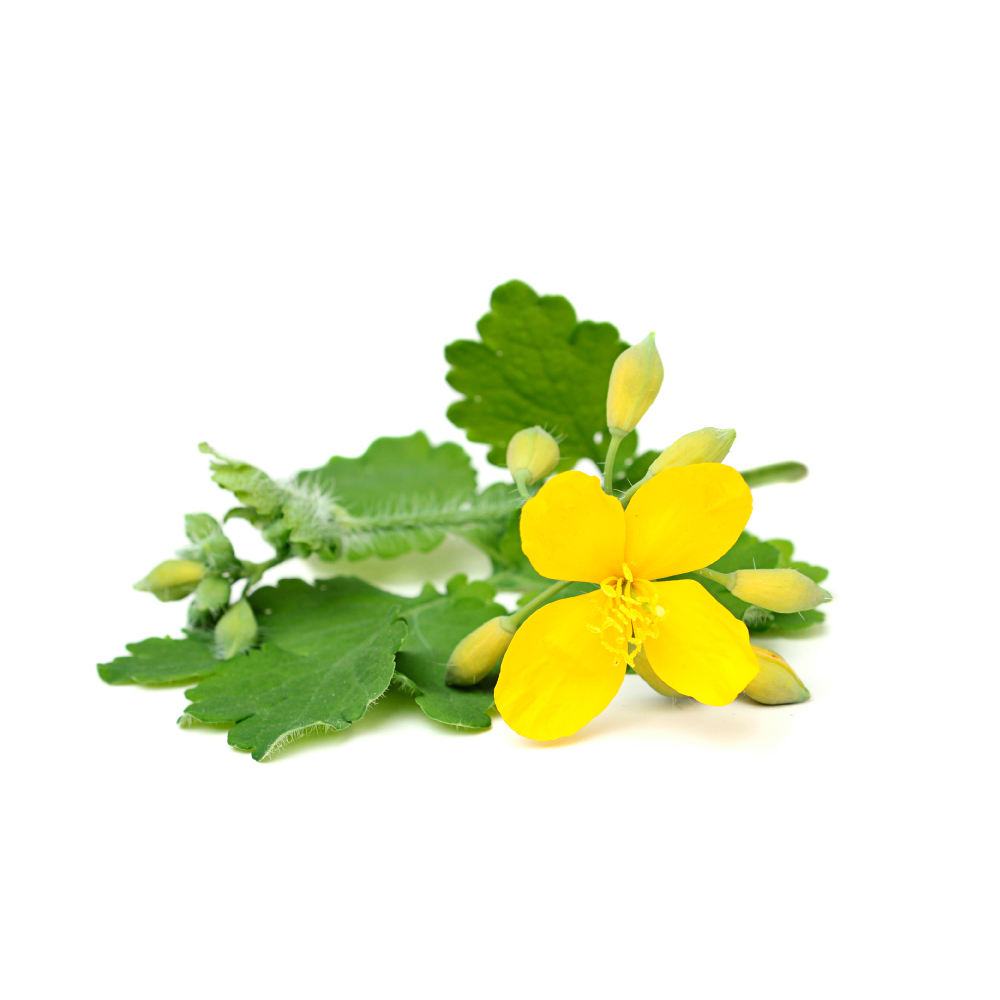
Greater celandine (Chelidonium majus) is a member of the poppy family (Papaveraceae) and, traditionally, the sole species of its genus. Despite the common name and yellow flowers, it is a true poppy relative and is unrelated to lesser celandine (Ficaria verna, a buttercup), which shares only the name. It is a short-lived perennial that often behaves as a biennial, growing to about 30–90 cm with soft, grey-green, deeply lobed leaves and loose clusters of four-petalled bright yellow flowers.
Like all poppy-family plants it is lactiferous, but its latex is distinctive: a bright yellow-to-orange sap that oozes from any bruised stem, leaf or root. That coloured latex — the source of the plant’s isoquinoline alkaloids and its medicine — is its single most reliable field mark, and no buttercup- or mustard-family look-alike produces it.
Distribution
Chelidonium majus is native across Europe and western Asia — from Macaronesia and Europe east to western Siberia, and the Mediterranean to northern Iran. Early European settlers carried it to North America for its traditional medicinal use.
There it has escaped cultivation and naturalized widely across eastern Canada, much of the eastern and upper-midwestern United States and parts of the Pacific Northwest, favouring moist, disturbed ground. It self-seeds aggressively and can crowd out native herbaceous plants, and is treated as invasive or noxious by a number of U.S. states.
Growing Conditions
- Short-lived perennial/biennial; part shade to full sun; hardy across roughly USDA zones 4–8; self-seeds aggressively.
- Full cultivation detail lives on the companion farm-wiki grow guide for Chelidonium majus (link to be added once that project’s public URL is confirmed).
Harvesting, Collection & Preparation
This herb is commonly made into a decoction, liquid extract, or capsules to take internally. A decoction, poultice, or succus (fresh juice) is used for topical applications 31Reference 31Principles and Practice of Phytotherapy.
Pharmacology & Research
Greater celandine sits in an unusual position: a herb with centuries of documented use for liver, gallbladder and pain complaints, a well-characterised isoquinoline-alkaloid chemistry, and yet almost no rigorous human efficacy data — while carrying one of the better-documented safety signals in Western herbalism (idiosyncratic liver injury). The literature is moderate in size and dominated by in vitro and rodent work; the only placebo-controlled trials of a Chelidonium-containing product tested it combined with turmeric for biliary pain, and the “anticancer” human data belong to Ukrain, a semisynthetic thiophosphoric alkaloid derivative that is not the herb and whose trial programme was discredited 19,20Reference 19Systematic reviewUkrain — a new cancer cure? A systematic review of randomised clinical trialsView study →Reference 20RCTNSC-631570 (Ukrain) in the palliative treatment of pancreatic cancer — phase II randomised clinical trialView study →. Nearly all activity traces to two alkaloid families — the benzophenanthridines (chelidonine, sanguinarine, chelerythrine) and the protoberberines (coptisine, berberine) — whose concentrations vary several-fold with plant part, chemotype and season, so results rarely transfer cleanly between preparations 17,28,29Reference 17In vitroSeasonal variability of Chelidonium majus L. secondary metabolites content and antioxidant activity — in vitroView study →Reference 28ReviewAlkaloids in Chelidonium majus L.: a review of its phytochemistry, pharmacology and toxicology — reviewView study →Reference 29ReviewChelidonium majus — an integrative review: traditional knowledge versus modern findings — reviewView study →.
- Best-supported: choleretic/biliary use, from a placebo-controlled trial of a Chelidonium–turmeric combination plus animal choleresis data 1,2Reference 1RCTThe effect of chelidonium- and turmeric root extract on upper abdominal pain due to functional disorders of the biliary system — a placebo-controlled double-blind randomised studyView study →Reference 2AnimalThe effect of Chelidonium majus herb extract on choleresis in the isolated perfused rat liver — animalView study →; anti-inflammatory activity mapped in an arthritis model and via lipoxygenase inhibition 3,4Reference 3AnimalSuppressive effects of Chelidonium majus methanol extract on collagen-induced arthritis in mice — animal modelView study →Reference 4In vitroBenzophenanthridine alkaloids of Chelidonium majus; inhibition of 5- and 12-lipoxygenase by a non-redox mechanism — in vitroView study →.
- Emerging, worth watching: hepatoprotective and cytotoxic (anticancer) signals that are consistent but entirely preclinical — and, for liver protection, sit in tension with real-world hepatotoxicity 6,7,11Reference 6AnimalEfficacy of a plant extract (Chelidonium majus L.) in combating induced hepatocarcinogenesis in mice — animalView study →Reference 7AnimalPLGA nano-encapsulation of chelidonine enhances its potential against cadmium-induced oxidative stress and hepatic injury in mice — animalView study →Reference 11In vitroChelidonium majus L. extract induces apoptosis via MAPK-independent NF-κB signalling in human epidermoid carcinoma A431 cells — in vitroView study →.
- Mechanistically thin: antiviral, antifungal and antioxidant claims rest on cell-line assays and constituent-level inference, with no clinical corroboration 10,12,17Reference 10In vitroAnti-TMV activity and mode of action of three alkaloids isolated from Chelidonium majus — in vitroView study →Reference 12In vitroPotential antioxidant activity, cytotoxic and apoptosis-inducing effects of Chelidonium majus L. extract on leukemia cells — in vitroView study →Reference 17In vitroSeasonal variability of Chelidonium majus L. secondary metabolites content and antioxidant activity — in vitroView study →.
- The caveat: no standardised human dose, no modern mono-herb RCT, and a documented risk of idiosyncratic liver injury that reframes the whole risk–benefit picture 21,22,23Reference 21Case reportHerbal hepatotoxicity by Greater Celandine (Chelidonium majus): causality assessment of 22 spontaneous reports — case seriesView study →Reference 22ReviewHepatotoxicity induced by greater celandine (Chelidonium majus L.): a review of the literature — reviewView study →Reference 23ReviewLiver toxicity caused by Chelidonium majus L.: two cases of herb-induced liver injury and literature reviewView study →.
1. Choleretic & biliary
This is the herb’s traditional core use and the only indication with any controlled human data. A placebo-controlled, double-blind multicentre study (n=76, 3 weeks) of Cholagogum F Nattermann — dried extracts of Chelidonium and Curcuma — reported faster relief of dull and colicky right-upper-quadrant pain from biliary dyskinesia than placebo, with no side effects, though secondary digestive symptoms improved equally in both arms 1Reference 1RCTThe effect of chelidonium- and turmeric root extract on upper abdominal pain due to functional disorders of the biliary system — a placebo-controlled double-blind randomised studyView study →. Because the product combines celandine with turmeric, the trial cannot isolate a celandine effect. Mechanistically, a whole-herb extract increased bile flow in the isolated perfused rat liver, supporting a genuine choleretic action 2Reference 2AnimalThe effect of Chelidonium majus herb extract on choleresis in the isolated perfused rat liver — animalView study →, and older pharmacological reviews attribute biliary and antispasmodic effects to the protopine- and coptisine-type alkaloids 18,29Reference 18ReviewPharmacological activities of Chelidonium majus L. (Papaveraceae) — reviewView study →Reference 29ReviewChelidonium majus — an integrative review: traditional knowledge versus modern findings — reviewView study →.
Gap: no placebo-controlled trial of celandine alone; the one positive human result is confounded by turmeric, and choleretic stimulation is precisely the action that is unwise in obstructive gallstone disease.
2. Anti-inflammatory
A methanol extract suppressed collagen-induced arthritis in mice, lowering TNF-α, IL-6 and IFN-γ, reducing B- and γδ-T-cell populations and raising CD4+CD25+ regulatory T cells 3Reference 3AnimalSuppressive effects of Chelidonium majus methanol extract on collagen-induced arthritis in mice — animal modelView study → — a coherent immunomodulatory picture that fits the traditional “heat-clearing” framing. At the molecular level, the benzophenanthridines sanguinarine and chelerythrine are potent, non-redox inhibitors of 5- and 12-lipoxygenase, while chelidonine is inactive there 4Reference 4In vitroBenzophenanthridine alkaloids of Chelidonium majus; inhibition of 5- and 12-lipoxygenase by a non-redox mechanism — in vitroView study →, and newer isolates (lignanamides and minor alkaloids) inhibit nitric-oxide production in LPS-stimulated macrophages at low-micromolar IC50 5Reference 5In vitroNew lignanamides and alkaloids from Chelidonium majus and their anti-inflammation activity — in vitroView study →. The mechanism is therefore mapped across enzyme, cell and whole-animal levels.
Gap: entirely preclinical; no human inflammatory endpoint has been tested, and the most active anti-inflammatory alkaloids overlap with the ones implicated in cytotoxicity.
3. Hepatoprotective
Rodent work is surprisingly consistent: ethanolic whole-plant extract reduced p-dimethylaminoazobenzene–induced hepatocarcinogenesis in mice across cytogenetic, biochemical and histological endpoints 6Reference 6AnimalEfficacy of a plant extract (Chelidonium majus L.) in combating induced hepatocarcinogenesis in mice — animalView study →, and chelidonine — especially as a PLGA nanoformulation — protected mouse liver against cadmium-induced oxidative injury, restoring GSH and normalising ALT/AST/ALP 7Reference 7AnimalPLGA nano-encapsulation of chelidonine enhances its potential against cadmium-induced oxidative stress and hepatic injury in mice — animalView study →. Earlier CCl4 studies cited in reviews point the same direction 29Reference 29ReviewChelidonium majus — an integrative review: traditional knowledge versus modern findings — reviewView study →. The signal is real but preclinical, and it collides with the clinical record.
Gap: the paradox is the story — the same herb repeatedly protects rodent livers yet is a documented cause of idiosyncratic human liver injury 21,22,23Reference 21Case reportHerbal hepatotoxicity by Greater Celandine (Chelidonium majus): causality assessment of 22 spontaneous reports — case seriesView study →Reference 22ReviewHepatotoxicity induced by greater celandine (Chelidonium majus L.): a review of the literature — reviewView study →Reference 23ReviewLiver toxicity caused by Chelidonium majus L.: two cases of herb-induced liver injury and literature reviewView study →. Isolated alkaloids are directly cytotoxic to rat hepatocytes at higher exposures 25Reference 25In vitroCharacterization of the cytotoxicity of selected Chelidonium alkaloids in rat hepatocytes — in vitroView study →, so “hepatoprotective” cannot be read as “liver-safe.”
4. Antimicrobial
Across independent screens the alkaloid fraction shows activity against gram-positive bacteria — Staphylococcus aureus including MRSA, streptococci — and against biofilms, attributed largely to sanguinarine and chelerythrine 8,9,29Reference 8In vitroScreening Papaveraceae as novel antibiofilm natural-based agents — in vitroView study →Reference 9In vitroScreening of some Siberian medicinal plants for antimicrobial activity — in vitroView study →Reference 29ReviewChelidonium majus — an integrative review: traditional knowledge versus modern findings — reviewView study →. A screen of Siberian medicinal plants ranked celandine among the most active 9Reference 9In vitroScreening of some Siberian medicinal plants for antimicrobial activity — in vitroView study →. Antifungal activity (Candida, dermatophytes) and antiviral activity (HSV-1, adenovirus, and the plant tobamovirus TMV) are reported in cell and assay systems 10,29Reference 10In vitroAnti-TMV activity and mode of action of three alkaloids isolated from Chelidonium majus — in vitroView study →Reference 29ReviewChelidonium majus — an integrative review: traditional knowledge versus modern findings — reviewView study →, consistent with the traditional topical use of the alkaloid-dense latex on warts and skin infections.
Gap: all in vitro; activity tracks alkaloid content and extract type, and no controlled human infection study — topical or systemic — has been done.
5. Analgesic
The traditional analgesic reputation has a plausible neuropharmacological basis but no human trials. In rat periaqueductal-grey neurons, Chelidonii herba modulated glycine- and glutamate-activated currents 13Reference 13AnimalModulation of Chelidonii herba on glycine-activated and glutamate-activated ion currents in rat periaqueductal grey neurons — animalView study → and enhanced GABA-activated chloride current 14Reference 14AnimalModulation of Chelidonii herba on GABA-activated chloride current in rat PAG neurons — animalView study → — pathways central to pain transmission. Whole extracts and major alkaloids also block hERG potassium channels and alter cardiac action potentials, a finding framed as a cardiac-safety concern rather than a therapeutic mechanism 16Reference 16In vitroEffects of Chelidonium majus extracts and major alkaloids on hERG potassium channels and on dog cardiac action potential — a safety approach; in vitro/animalView study →. Separately, berberine blunted morphine-induced locomotor sensitisation and analgesic tolerance in mice, suggesting a possible role in opioid tapering 15Reference 15AnimalInhibitory effects of berberine against morphine-induced locomotor sensitization and analgesic tolerance in mice — animalView study →.
Gap: all animal or ex vivo; the same ion-channel promiscuity that could explain analgesia (hERG block) is a safety liability, and no clinical analgesia data exist.
6. Anticancer (cytotoxic)
Cell-line data are broad and repeatable: whole-herb and alkaloid extracts induce apoptosis in human epidermoid carcinoma (A431) via caspase activation and NF-κB inhibition 11Reference 11In vitroChelidonium majus L. extract induces apoptosis via MAPK-independent NF-κB signalling in human epidermoid carcinoma A431 cells — in vitroView study → and in leukaemia lines, with the extract also scavenging DPPH radicals 12Reference 12In vitroPotential antioxidant activity, cytotoxic and apoptosis-inducing effects of Chelidonium majus L. extract on leukemia cells — in vitroView study →. The individual benzophenanthridines are the presumed cytotoxic drivers. The human trial evidence, however, belongs to Ukrain (NSC-631570) — a semisynthetic thiophosphoric derivative of celandine alkaloids, not the herb: a phase II pancreatic-cancer trial reported survival gains 20Reference 20RCTNSC-631570 (Ukrain) in the palliative treatment of pancreatic cancer — phase II randomised clinical trialView study →, but a systematic review found the supporting RCTs to be of poor methodological quality and urged independent replication 19Reference 19Systematic reviewUkrain — a new cancer cure? A systematic review of randomised clinical trialsView study →, and the product was never approved.
Gap: the strongest-sounding “human” data don’t apply to the herb as used; herb-level evidence is purely in vitro, and celandine is not a cancer therapy.
7. Antioxidant
Methanol extracts scavenge DPPH radicals and total phenolic/flavonoid content correlates with measured antioxidant capacity, which peaks at the rosette and early-flowering stages 12,17Reference 12In vitroPotential antioxidant activity, cytotoxic and apoptosis-inducing effects of Chelidonium majus L. extract on leukemia cells — in vitroView study →Reference 17In vitroSeasonal variability of Chelidonium majus L. secondary metabolites content and antioxidant activity — in vitroView study →. This is a genuine but generic chemical property shared by most polyphenol-containing plants, and here it is entangled with the alkaloids’ cytotoxicity rather than being a clean protective effect.
Gap: in vitro assay activity only; no cellular or human antioxidant endpoint, and antioxidant framing understates the toxicological weight of the same extracts.
Mechanisms
| Mechanism | Drives | Key compounds |
|---|---|---|
| 5-/12-lipoxygenase ↓, NO ↓, TNF-α/IL-6 ↓, NF-κB ↓ | anti-inflammatoryanticancer | sanguinarine, chelerythrine |
| Bile-flow stimulation, smooth-muscle antispasmodic | choleretic & biliary | coptisine, protopine |
| Glycine/glutamate/GABA current modulation, hERG K+ block | analgesic (and cardiac-safety signal) | chelidonine, berberine |
| Caspase activation, mitochondrial apoptosis; radical scavenging | anticancerantioxidant | benzophenanthridine alkaloids |
| Restored GSH/SOD/CAT, reduced lipid peroxidation | hepatoprotective (preclinical) | chelidonine |
Clinical trials
Human trials are effectively absent: the only placebo-controlled data test a Chelidonium–turmeric combination for biliary pain 1Reference 1RCTThe effect of chelidonium- and turmeric root extract on upper abdominal pain due to functional disorders of the biliary system — a placebo-controlled double-blind randomised studyView study →, the “anticancer” trials concern the Ukrain derivative rather than the herb and were judged methodologically poor 19,20Reference 19Systematic reviewUkrain — a new cancer cure? A systematic review of randomised clinical trialsView study →Reference 20RCTNSC-631570 (Ukrain) in the palliative treatment of pancreatic cancer — phase II randomised clinical trialView study →, and the sole ClinicalTrials.gov entry mentioning Chelidonium is a homeopathic combination product for low back pain (NCT01049373). The EMA/HMPC declined to grant traditional-use registration on safety grounds 30Reference 30Assessment report on Chelidonium majus L., herbaView study →.
| Completed | Planned | Terminated | Preclinical |
|---|---|---|---|
| 1(combination, biliary) | 0 | Ukrain programme discredited | ~50+ |
Last checked: July 2026.
Phytochemistry
Greater celandine is fundamentally an isoquinoline-alkaloid plant. Its activity is split between two structural families: the benzophenanthridines chelidonine, sanguinarine and chelerythrine, and the protoberberines coptisine and berberine, with the protopine-type alkaloids (protopine, allocryptopine) bridging the two 16,29Reference 16In vitroEffects of Chelidonium majus extracts and major alkaloids on hERG potassium channels and on dog cardiac action potential — a safety approach; in vitro/animalView study →Reference 29ReviewChelidonium majus — an integrative review: traditional knowledge versus modern findings — reviewView study →. The bright yellow latex is especially alkaloid-dense — chelidonine, sanguinarine and coptisine together make up roughly 20% of the fresh latex — which accounts for its use against warts and skin infections 29Reference 29ReviewChelidonium majus — an integrative review: traditional knowledge versus modern findings — reviewView study →. Total alkaloid content of the herb is otherwise low (benzylisoquinolines on the order of 0.01–1% of the plant) 29Reference 29ReviewChelidonium majus — an integrative review: traditional knowledge versus modern findings — reviewView study →. Beyond the alkaloids, LC-MS/MS of the aerial parts identifies discrete flavonoids (quercetin, kaempferol) and phenolic acids (caffeic acid, p-coumaric acid, chlorogenic acid) that carry much of the plant’s antioxidant capacity 8Reference 8In vitroScreening Papaveraceae as novel antibiofilm natural-based agents — in vitroView study →.
Constituent Summary
Figures are mg/g of a dried 25% ethanol herb extract from a single study 16Reference 16In vitroEffects of Chelidonium majus extracts and major alkaloids on hERG potassium channels and on dog cardiac action potential — a safety approach; in vitro/animalView study →; absolute amounts vary several-fold with plant part (root and latex are far richer than aerial parts), ecotype and season. Total benzylisoquinoline alkaloids are ~0.01–1% of the plant 29Reference 29ReviewChelidonium majus — an integrative review: traditional knowledge versus modern findings — reviewView study →. Both alkaloid classes below are isoquinoline-derived.
Isoquinoline alkaloid13 compounds13 with data
Other alkaloid1 compound1 with data
Flavonoid2 compounds2 with data
Phenolic acid3 compounds3 with data
Clinical Applications
Greater celandine has a traditional reputation as an analgesic, used for general pain much like California poppy, but there are no human trials — the pain-pathway rationale rests on animal ion-current studies and a single mouse berberine model, so this is a traditional and preclinical use, not a reliable one.
Greater celandine is also used traditionally as a hepatic and bitter principle to stimulate the liver and gallbladder, improve digestion and appetite, and ease gastric or colic spasms — bearing in mind the liver-injury risk that makes internal use unwise for most people.
Topically greater celandine has traditionally been used for warts, viral outbreaks of herpes simplex, HPV, or Varicella zoster, as well as fungal infections such as athlete’s foot, bacterial infections like Staphylococcus, and parasitic infections including ringworm. The antimicrobial rationale is supported by in-vitro data but has not been tested in controlled human studies.
Dosage
There is no established human dose for greater celandine as a single herb: the only controlled human data used an undisclosed proprietary combination extract, and the “anticancer” human dose belongs to a semisynthetic derivative, not the herb. The research doses below are recorded for reference only, not as recommendations.
| Indication | Preparation | Dose | Est. dried-herb equivalent | Source |
|---|---|---|---|---|
| Biliary pain / dyskinesia | Standardised Chelidonium + Curcuma dried extract (Cholagogum F) | Proprietary combination product, 3 weeks | — (combination product; celandine fraction not separable) | 1Reference 1RCTThe effect of chelidonium- and turmeric root extract on upper abdominal pain due to functional disorders of the biliary system — a placebo-controlled double-blind randomised studyView study → |
| Anticancer (Ukrain derivative — NOT the herb) | NSC-631570 (semisynthetic), IV | 20 mg weekly | — (not the herb; do not convert) | 20Reference 20RCTNSC-631570 (Ukrain) in the palliative treatment of pancreatic cancer — phase II randomised clinical trialView study → |
| Hepatoprotective / anti-inflammatory / antimicrobial | Rodent & in-vitro extracts | Animal / in-vitro doses only | — (no human dose established) | 3,6,7Reference 3AnimalSuppressive effects of Chelidonium majus methanol extract on collagen-induced arthritis in mice — animal modelView study →Reference 6AnimalEfficacy of a plant extract (Chelidonium majus L.) in combating induced hepatocarcinogenesis in mice — animalView study →Reference 7AnimalPLGA nano-encapsulation of chelidonine enhances its potential against cadmium-induced oxidative stress and hepatic injury in mice — animalView study → |
Est. dried-herb equivalent is deliberately left blank: the one human trial used an undisclosed proprietary combination extract and the anticancer dose is a semisynthetic derivative, so no defensible marker-based back-conversion to whole-herb weight is possible — no ratio is invented here. These are research doses, not recommendations.
Traditional Dosage
Traditional practice uses the whole herb short-term only, and “traditional” does not mean low-risk given the alkaloid content and liver-injury signal.
| System | Preparation | Dose |
|---|---|---|
| Western herbal medicine | Liquid extract 1:2 (aerial parts) | 7–15 mL / week (short-term only) |
| TCM (Bai qu cai) | Decoction, aerial parts | Traditional decoction for damp-heat, biliary and cough indications |
| Topical (Western / folk) | Fresh latex (succus) or decoction | Applied directly to warts and skin lesions |
Safety & Pregnancy
Greater celandine is a documented cause of idiosyncratic, non-dose-dependent hepatocellular liver injury — reported even at ordinary intakes including tea — which makes internal use unwise for most people. Pre-existing liver disease is a contraindication, and it should be avoided in pregnancy and breastfeeding.
- Idiosyncratic liver injury. Documented hepatocellular injury — jaundice, transaminases often >1000 IU/L — not dose-predictable, reported even with tea.
- Liver disease is a contraindication. Pre-existing liver disease rules it out; the EMA/HMPC declined a traditional-use registration on safety grounds.
- Avoid in pregnancy & breastfeeding. Alkaloid-rich with no safety data; its isoquinoline alkaloids are not established as safe.
- Choleretic — gallstone risk. Unsuitable in obstructive gallstone or biliary disease.
- Cardiac & drug cautions. hERG-channel block is a theoretical arrhythmia signal; treat concurrent hepatotoxic drugs and herbs as a caution.
Full safety & interactions detail
Greater celandine is a documented cause of idiosyncratic, hepatocellular herb-induced liver injury: causality-assessed case series and reviews describe jaundice and transaminases often exceeding 1000 IU/L, with a female predominance, latency of roughly 4–8 weeks, and recovery on stopping the herb 21,22,23,24Reference 21Case reportHerbal hepatotoxicity by Greater Celandine (Chelidonium majus): causality assessment of 22 spontaneous reports — case seriesView study →Reference 22ReviewHepatotoxicity induced by greater celandine (Chelidonium majus L.): a review of the literature — reviewView study →Reference 23ReviewLiver toxicity caused by Chelidonium majus L.: two cases of herb-induced liver injury and literature reviewView study →Reference 24Case reportAcute hepatitis induced by greater celandine (Chelidonium majus) — case reportView study →. The risk is not dose-predictable — it has been reported with capsules, extracts and even tea at ordinary intakes 23Reference 23ReviewLiver toxicity caused by Chelidonium majus L.: two cases of herb-induced liver injury and literature reviewView study → — which is why the EMA/HMPC declined a traditional-use registration and why the herb is best avoided internally 30Reference 30Assessment report on Chelidonium majus L., herbaView study →. Notably, celandine showed no hepatotoxicity in rat feeding and acetaminophen-potentiation studies 26,27Reference 26AnimalChelidonium majus is not hepatotoxic in Wistar rats, in a 4-week feeding experiment — animalView study →Reference 27Chelidonium majus L. does not potentiate the hepatic effect of acetaminophen — animalView study →, which is exactly why the human injury is read as idiosyncratic rather than straightforward dose toxicity — the animal safety data do not reassure here. This clinical picture is also paradoxical against consistent rodent hepatoprotective results 6,7Reference 6AnimalEfficacy of a plant extract (Chelidonium majus L.) in combating induced hepatocarcinogenesis in mice — animalView study →Reference 7AnimalPLGA nano-encapsulation of chelidonine enhances its potential against cadmium-induced oxidative stress and hepatic injury in mice — animalView study →; isolated alkaloids are directly cytotoxic to hepatocytes at higher exposures 25Reference 25In vitroCharacterization of the cytotoxicity of selected Chelidonium alkaloids in rat hepatocytes — in vitroView study →, so “hepatoprotective” preclinical findings must not be read as liver-safe. Whole extracts and major alkaloids also block hERG potassium channels and alter cardiac action potentials in in-vitro/animal models, a theoretical arrhythmia concern at high exposure 16Reference 16In vitroEffects of Chelidonium majus extracts and major alkaloids on hERG potassium channels and on dog cardiac action potential — a safety approach; in vitro/animalView study →. Its choleretic action makes it unsuitable in obstructive gallstone or biliary disease, and any pre-existing liver disease is a contraindication given the injury risk — not merely a caution.
Interactions — scope note. A hERG/cardiac-safety signal and an additive-hepatotoxicity concern are described mechanistically 16Reference 16In vitroEffects of Chelidonium majus extracts and major alkaloids on hERG potassium channels and on dog cardiac action potential — a safety approach; in vitro/animalView study →, but no formal human drug-interaction (e.g. clinical CYP450) study was identified in this package. Treat concurrent hepatotoxic drugs and other herb-induced-liver-injury-associated botanicals as a caution, not a proven interaction — absence of interaction studies is not evidence of safety.
Greater celandine is an alkaloid-rich herb with a documented risk of idiosyncratic liver injury and no safety data in pregnancy or lactation; the EMA/HMPC assessment does not support use, and its isoquinoline alkaloids (e.g. sanguinarine, chelerythrine, berberine) are not established as safe in pregnancy 30Reference 30Assessment report on Chelidonium majus L., herbaView study →. Specific reproductive-toxicity studies were not identified — this is a precautionary “avoid,” not a demonstration of safety.
Synergy
Traditionally suggested to have synergy with aniseed for removing obstructions from both the liver and gallbladder 32Reference 32A Modern Herbal — Celandine, GreaterView study →. This is a historical/folk attribution and is not evidence-based.
References
- Niederau C, Göpfert E. (1999). The effect of chelidonium- and turmeric root extract on upper abdominal pain due to functional disorders of the biliary system — a placebo-controlled double-blind randomised study. Med Klin (Munich). https://pubmed.ncbi.nlm.nih.gov/10495621/
- Vahlensieck U, Hahn R, Winterhoff H, et al. (1995). The effect of Chelidonium majus herb extract on choleresis in the isolated perfused rat liver — animal. Planta Med. https://pubmed.ncbi.nlm.nih.gov/7617771/
- Lee YC, Kim SH, Roh SS, et al. (2007). Suppressive effects of Chelidonium majus methanol extract on collagen-induced arthritis in mice — animal model. J Ethnopharmacol. https://pubmed.ncbi.nlm.nih.gov/17353105/
- Vavrecková C, Gawlik I, Müller K. (1996). Benzophenanthridine alkaloids of Chelidonium majus; inhibition of 5- and 12-lipoxygenase by a non-redox mechanism — in vitro. Planta Med. https://pubmed.ncbi.nlm.nih.gov/9005450/
- Huang XY, Shao ZX, An LJ, et al. (2019). New lignanamides and alkaloids from Chelidonium majus and their anti-inflammation activity — in vitro. Fitoterapia. https://pubmed.ncbi.nlm.nih.gov/31629049/
- Biswas SJ, Bhattacharjee N, Khuda-Bukhsh AR. (2008). Efficacy of a plant extract (Chelidonium majus L.) in combating induced hepatocarcinogenesis in mice — animal. Food Chem Toxicol. https://pubmed.ncbi.nlm.nih.gov/18215450/
- Paul A, Das J, Das S, et al. (2013). PLGA nano-encapsulation of chelidonine enhances its potential against cadmium-induced oxidative stress and hepatic injury in mice — animal. Environ Toxicol Pharmacol. https://pubmed.ncbi.nlm.nih.gov/24035924/
- Zielińska S, Dziągwa-Becker M, Junka A, et al. (2021). Screening Papaveraceae as novel antibiofilm natural-based agents — in vitro. Molecules. https://pubmed.ncbi.nlm.nih.gov/34443363/
- Kokoska L, Polesny Z, Rada V, et al. (2002). Screening of some Siberian medicinal plants for antimicrobial activity — in vitro. J Ethnopharmacol. https://pubmed.ncbi.nlm.nih.gov/12169406/
- Guo W, et al. (2021). Anti-TMV activity and mode of action of three alkaloids isolated from Chelidonium majus — in vitro. Pest Manag Sci. https://pubmed.ncbi.nlm.nih.gov/32815231/
- Park SW, Kim SR, Kim Y, et al. (2015). Chelidonium majus L. extract induces apoptosis via MAPK-independent NF-κB signalling in human epidermoid carcinoma A431 cells — in vitro. Oncol Rep. https://pubmed.ncbi.nlm.nih.gov/25354169/
- Nadova S, Miadokova E, Alfoldiova L, et al. (2008). Potential antioxidant activity, cytotoxic and apoptosis-inducing effects of Chelidonium majus L. extract on leukemia cells — in vitro. Neuro Endocrinol Lett. https://pubmed.ncbi.nlm.nih.gov/18987588/
- Shin MC, Jang MH, Chang HK, et al. (2003). Modulation of Chelidonii herba on glycine-activated and glutamate-activated ion currents in rat periaqueductal grey neurons — animal. Clin Chim Acta. https://pubmed.ncbi.nlm.nih.gov/14568185/
- Kim Y, Shin M, Chung J, et al. (2001). Modulation of Chelidonii herba on GABA-activated chloride current in rat PAG neurons — animal. Am J Chin Med. https://pubmed.ncbi.nlm.nih.gov/11527069/
- Yoo JH, Yang EM, Cho JH, et al. (2006). Inhibitory effects of berberine against morphine-induced locomotor sensitization and analgesic tolerance in mice — animal. Neuroscience. https://pubmed.ncbi.nlm.nih.gov/16934942/
- Orvos P, Virág L, Tálosi L, et al. (2015). Effects of Chelidonium majus extracts and major alkaloids on hERG potassium channels and on dog cardiac action potential — a safety approach; in vitro/animal. Fitoterapia. https://pubmed.ncbi.nlm.nih.gov/25481375/
- Jakovljevic ZD, Stankovic SM, Topuzovic DM. (2013). Seasonal variability of Chelidonium majus L. secondary metabolites content and antioxidant activity — in vitro. EXCLI J. https://pubmed.ncbi.nlm.nih.gov/27047313/
- Colombo ML, Bosisio E. (1996). Pharmacological activities of Chelidonium majus L. (Papaveraceae) — review. Pharmacol Res. https://pubmed.ncbi.nlm.nih.gov/8870028/
- Ernst E, Schmidt K. (2005). Ukrain — a new cancer cure? A systematic review of randomised clinical trials. BMC Cancer. https://pubmed.ncbi.nlm.nih.gov/15992405/
- Gansauge F, Ramadani M, Pressmar J, et al. (2002). NSC-631570 (Ukrain) in the palliative treatment of pancreatic cancer — phase II randomised clinical trial. Langenbecks Arch Surg. https://pubmed.ncbi.nlm.nih.gov/11914932/
- Teschke R, Glass X, Schulze J. (2011). Herbal hepatotoxicity by Greater Celandine (Chelidonium majus): causality assessment of 22 spontaneous reports — case series. Regul Toxicol Pharmacol. https://pubmed.ncbi.nlm.nih.gov/21893153/
- Pantano F, Mannocchi G, Marinelli E, et al. (2017). Hepatotoxicity induced by greater celandine (Chelidonium majus L.): a review of the literature — review. Eur Rev Med Pharmacol Sci. https://pubmed.ncbi.nlm.nih.gov/28379595/
- Ciornolutchii V, Ismaiel A, Sabo CM, et al. (2024). Liver toxicity caused by Chelidonium majus L.: two cases of herb-induced liver injury and literature review. Am J Ther. https://pubmed.ncbi.nlm.nih.gov/38820341/
- Benninger J, Schneider HT, Schuppan D, et al. (1999). Acute hepatitis induced by greater celandine (Chelidonium majus) — case report. Gastroenterology. https://pubmed.ncbi.nlm.nih.gov/10535888/
- Gao L, et al. (2019). Characterization of the cytotoxicity of selected Chelidonium alkaloids in rat hepatocytes — in vitro. Toxicol Lett. https://pubmed.ncbi.nlm.nih.gov/31054355/
- Mazzanti G, Di Sotto A, Franchitto A, et al. (2009). Chelidonium majus is not hepatotoxic in Wistar rats, in a 4-week feeding experiment — animal. J Ethnopharmacol. https://pubmed.ncbi.nlm.nih.gov/19761826/
- Mazzanti G, Di Sotto A, Franchitto A, et al. (2013). Chelidonium majus L. does not potentiate the hepatic effect of acetaminophen — animal. Exp Toxicol Pathol. https://pubmed.ncbi.nlm.nih.gov/23726751/
- Li XL, Sun YP, Wang M, et al. (2024). Alkaloids in Chelidonium majus L.: a review of its phytochemistry, pharmacology and toxicology — review. Front Pharmacol. https://pubmed.ncbi.nlm.nih.gov/39239653/
- Gilca M, Gaman L, Panait E, et al. (2010). Chelidonium majus — an integrative review: traditional knowledge versus modern findings — review. Forsch Komplementmed. https://pubmed.ncbi.nlm.nih.gov/20980763/
- European Medicines Agency, Committee on Herbal Medicinal Products (HMPC). (2011). Assessment report on Chelidonium majus L., herba. EMA/HMPC/369801/2009. https://www.ema.europa.eu/en/documents/herbal-report/final-assessment-report-chelidonium-majus-l-herba_en.pdf
- Bone K, Mills S. (2013). Principles and Practice of Phytotherapy. Elsevier Health. (Pg. 503–507). — traditional Western use, aerial-parts preference.
- Grieve M. (1931). A Modern Herbal — Celandine, Greater. Retrieved from http://www.botanical.com/botanical/mgmh/c/celgre43.html — folk etymology and synergy.
- Bone K. (2003). A Clinical Guide to Blending Liquid Herbs. Churchill Livingstone. (Pg. 261–264). — TCM indications.