What is Cornflower?
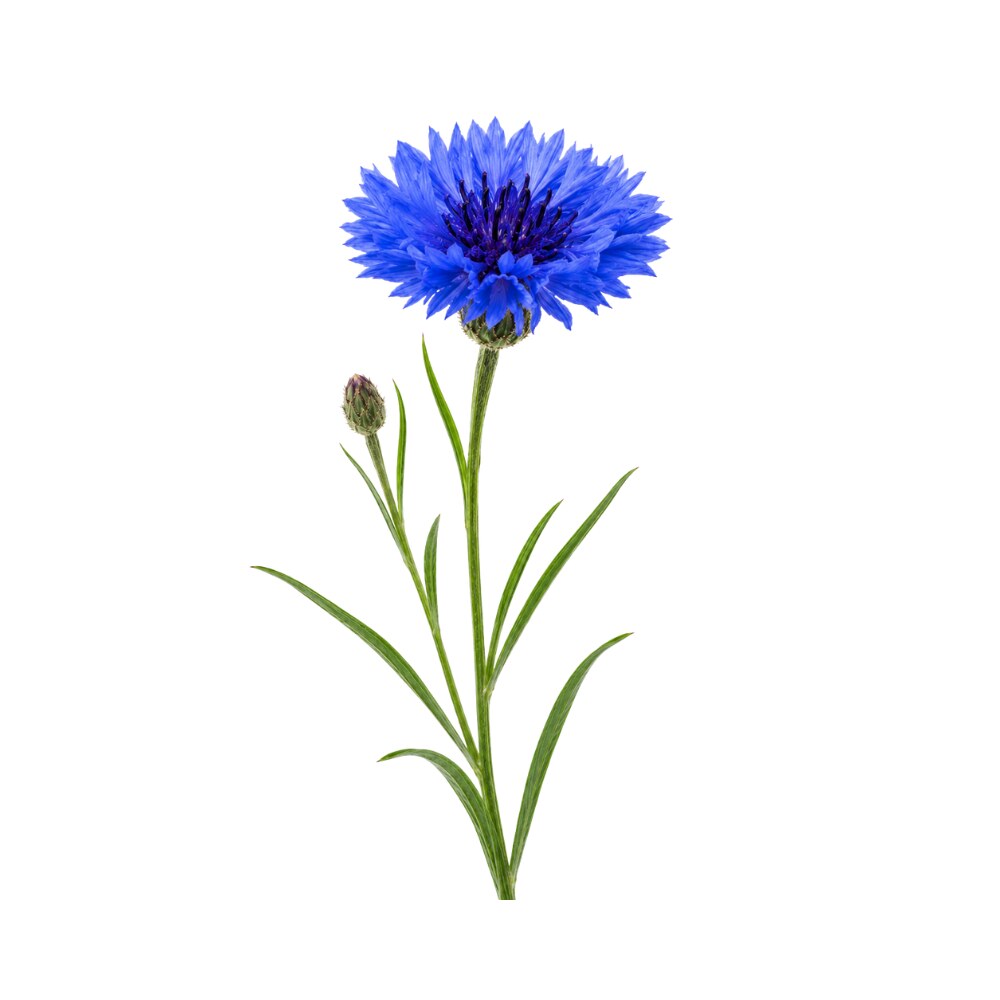
Cornflower (Centaurea cyanus) is an annual wildflower in the daisy family, originally native to Europe and once a common weed of grain fields, hence its name. Its vivid blue flowers are widely grown ornamentally and harvested as an edible decorative flower.
Traditional & Modern Uses
Cornflower petals are used mainly for their bright colour and mild flavour, scattered over salads and desserts and added to herbal tea blends for visual appeal. In traditional herbalism the flowers were used as a gentle astringent and anti-inflammatory, and a cornflower infusion was a folk remedy as a soothing eyewash and for minor eye irritation. It also features in some smoking blends as a flavour and colour herb.
Botany
The cornflower (Centaurea cyanus) is an annual herb in the daisy family (Asteraceae), slender and erect at 30–90 cm on wiry, grey-downy stems. Its signature is the flower head — a compact button of disc florets ringed by enlarged, deeply cut outer florets in an intense, almost electric blue, the trait behind names like bachelor’s button and bluebottle. It is a cool-season annual, germinating readily and completing its life cycle in one season, and the edible blue florets have a long tradition as a garnish and natural dye.
Distribution
Centaurea cyanus is truly native only to the Central and Eastern Mediterranean and the Near East. Its familiar presence across the rest of Europe is not native but archaeophyte: it spread with cereal agriculture over a thousand years ago to become the iconic weed of cornfields. Ironically, that wild cornfield population has since collapsed across Europe under seed-cleaning and herbicides — locally endangered in the very range it seemed to belong to — even as the plant, grown everywhere as an ornamental, has escaped and naturalized (sometimes weedily) across North and South America, southern Africa, Australia and New Zealand.
Growing Conditions
- Hardy cool-season annual (grown across roughly USDA zones 2–11); full sun; easy from seed in open ground.
- Full cultivation detail lives on the companion farm-wiki grow guide for Centaurea cyanus (link to be added once that project’s public URL is confirmed).
Phytochemistry
Cornflower’s defining feature is its blue pigment: a metalloanthocyanin complex called protocyanin, built around the anthocyanins† cyanidin glycosides (chiefly cyanidin-3-succinylglucoside-5-glucoside) partnered with an apigenin-derived flavone and metal ions. Alongside the pigment the capitula carry the flavonoids apigenin, luteolin and quercetin, the phenolic acids caffeic acid and chlorogenic acid, the bitter sesquiterpene lactone cnicin, and a volatile fraction dominated by sesquiterpenes with smaller amounts of chamazulene, limonene and α-pinene. The seeds add a small set of indole/phenylpropenoic-acid amides, of which moschamine is the best characterised — a cyclooxygenase-inhibiting amide rather than a petal pigment. Most published work characterises these compounds qualitatively; few give absolute concentrations for the dried petals.
Constituent Summary
Composition of the flower-heads (capitula); profiles vary with cultivar, growing site and petal colour, and most constituents are reported qualitatively rather than as fixed amounts. † = the cyanidin-based anthocyanins form protocyanin, the characteristic blue pigment marker of the species. No Data = not quantified in the sources consulted.
Flavonoids3 compoundsno data
Phenolic acids2 compoundsno data
Phenylpropenoic acid amides1 compound1 with data
Sesquiterpene lactones1 compoundno data
Sesquiterpenes1 compoundno data
Pharmacology & Research
Cornflower is a lightly studied medicinal plant: the literature runs to a few dozen papers, and almost all of it is preclinical — phytochemical profiling, in vitro antioxidant assays, and a handful of cell-line and animal experiments. There are no registered clinical trials and no human efficacy data for any indication, so every score below reflects test-tube or animal work interpreted for a plant that is drunk as a petal tea or used as a strained eyewash. The most credible signal, and the one that matches the traditional ocular use, is anti-inflammatory: a 1999 study showed that flower-head polysaccharides suppress experimental oedema and interfere with complement 1Reference 1AnimalAnti-inflammatory and immunological effects of Centaurea cyanus flower-heads — animal model / in vivoView study →. The most-replicated activity is antioxidant, though several groups rate cornflower’s capacity as modest relative to other edible flowers 2,3,6Reference 2In vitroChemical study, antioxidant, anti-hypertensive, and cytotoxic/cytoprotective activities of Centaurea cyanus L. petals aqueous extract — in vitroView study →Reference 3In vitroEdible flowers as sources of phenolic compounds with bioactive potential — in vitro comparative studyView study →Reference 6In vitroYogurt with cornflower (Centaurea cyanus L.) petals as a source of antioxidant compounds and dietary fibre — in vitro / food matrixView study →. A recurring caveat threads the whole file — constituent profiles, and the biological readouts that follow, shift markedly with cultivar, petal colour and even herbicide-resistance status 4,7Reference 4In vitroComparative assessment of the phytochemical composition and biological activity of extracts of Centaurea cyanus, C. jacea and C. scabiosa — in vitroView study →Reference 7In vitroHerbicide resistance status impacts the profile of non-anthocyanin polyphenolics and some phytomedical properties of edible cornflower flowers — in vitroView study →, so results from one extract do not transfer cleanly to another.
- Best-supported: anti-inflammatory activity of the flower-head polysaccharide fraction in animal oedema models, the mechanistic basis for the traditional eyewash 1Reference 1AnimalAnti-inflammatory and immunological effects of Centaurea cyanus flower-heads — animal model / in vivoView study →; broadly consistent but modest in vitro antioxidant capacity 2,3,6Reference 2In vitroChemical study, antioxidant, anti-hypertensive, and cytotoxic/cytoprotective activities of Centaurea cyanus L. petals aqueous extract — in vitroView study →Reference 3In vitroEdible flowers as sources of phenolic compounds with bioactive potential — in vitro comparative studyView study →Reference 6In vitroYogurt with cornflower (Centaurea cyanus L.) petals as a source of antioxidant compounds and dietary fibre — in vitro / food matrixView study →.
- Emerging, worth watching: a 2024 in vitro + mouse study in which cornflower water extract blunted steroid-induced muscle wasting via cannabinoid-receptor signalling 8Reference 8In vitroCornflower extract and its active components alleviate dexamethasone-induced muscle wasting by targeting cannabinoid receptors and modulating gut microbiota — in vitro and mouse in vivoView study →.
- Mechanistically thin: antiproliferative and antihypertensive claims rest on single cell-line or in vitro assays 2,10Reference 2In vitroChemical study, antioxidant, anti-hypertensive, and cytotoxic/cytoprotective activities of Centaurea cyanus L. petals aqueous extract — in vitroView study →Reference 10In vitroCentaurea cyanus-extracted 13-O-acetylsolstitialin A decreases Bax/Bcl-2 ratio and cyclin D1/Cdk-4 expression to induce apoptosis and cell-cycle arrest in MCF-7 and MDA-MB-231 breast cancer cell lines — in vitroView study →; antimicrobial activity is inconsistent and often rated low 4,5Reference 4In vitroComparative assessment of the phytochemical composition and biological activity of extracts of Centaurea cyanus, C. jacea and C. scabiosa — in vitroView study →Reference 5In vitroEvaluation of antioxidant capacity and phenolic content in ethanolic extracts of leaves and flowers of some Asteraceae species — in vitroView study →.
- The caveat: no human data, no standardised dose, and phytochemistry that varies strongly with cultivar and petal colour 4,7Reference 4In vitroComparative assessment of the phytochemical composition and biological activity of extracts of Centaurea cyanus, C. jacea and C. scabiosa — in vitroView study →Reference 7In vitroHerbicide resistance status impacts the profile of non-anthocyanin polyphenolics and some phytomedical properties of edible cornflower flowers — in vitroView study → — the whole evidence base is preclinical.
1. Anti-inflammatory
This is the mechanistic basis for cornflower’s oldest medicinal use — the folk eyewash for minor eye irritation. Water-soluble polysaccharides isolated from the flower-heads inhibited carrageenan-, zymosan- and croton-oil-induced oedema in animal models and interfered with the complement cascade, with the active fraction composed mainly of galacturonic acid, arabinose, glucose, rhamnose and galactose 1Reference 1AnimalAnti-inflammatory and immunological effects of Centaurea cyanus flower-heads — animal model / in vivoView study →. Separately, moschamine — a phenylpropenoic acid amide from the seeds — inhibited both cyclooxygenase isoforms (COX-I ~58%, COX-II ~54%) in vitro, giving a second, compound-level anti-inflammatory route 9Reference 9In vitroSynthesis, biological activities and bioavailability of moschamine, a safflomide-type phenylpropenoic acid amide found in Centaurea cyanus — in vitro (COX inhibition, 5-HT1 binding)View study →. The catch is preparation: the animal effect belongs to a purified polysaccharide fraction and the COX effect to a seed compound, neither of which is what an infusion of blue petals mainly delivers.
Gap: No human data, and no study has tested whether a simple petal infusion — the actual traditional eyewash — reproduces the polysaccharide-fraction effect.
2. Antioxidant
Antioxidant capacity is cornflower’s most-measured property, assayed repeatedly by DPPH, FRAP, ABTS and lipid-peroxidation (TBARS) methods across petal extracts, infusions and whole-flower preparations 2,3,6Reference 2In vitroChemical study, antioxidant, anti-hypertensive, and cytotoxic/cytoprotective activities of Centaurea cyanus L. petals aqueous extract — in vitroView study →Reference 3In vitroEdible flowers as sources of phenolic compounds with bioactive potential — in vitro comparative studyView study →Reference 6In vitroYogurt with cornflower (Centaurea cyanus L.) petals as a source of antioxidant compounds and dietary fibre — in vitro / food matrixView study →. The activity tracks the flower’s apigenin-type flavonoid and cyanidin anthocyanin content and is real but generally modest: one comparative study of Centaurea species and another of edible flowers both rated cornflower’s antioxidant potential as low-to-moderate relative to companions such as rose 3,4Reference 3In vitroEdible flowers as sources of phenolic compounds with bioactive potential — in vitro comparative studyView study →Reference 4In vitroComparative assessment of the phytochemical composition and biological activity of extracts of Centaurea cyanus, C. jacea and C. scabiosa — in vitroView study →. Petal colour and cultivar move the numbers substantially — anthocyanin profiles differ between blue, pink and white forms — and herbicide-resistant biotypes carry higher phenolic content and antioxidant activity than susceptible ones, a reminder that “cornflower extract” is not a fixed material 7Reference 7In vitroHerbicide resistance status impacts the profile of non-anthocyanin polyphenolics and some phytomedical properties of edible cornflower flowers — in vitroView study →.
Gap: All evidence is in vitro chemical assays; nothing shows a measurable antioxidant effect in a living system, let alone at intakes reachable from tea or garnish use.
3. Anti-sarcopenic (muscle-wasting)
The most substantive recent study: a 2024 investigation testing cornflower water extract against dexamethasone-induced muscle wasting in both C2C12 myotubes and mice 8Reference 8In vitroCornflower extract and its active components alleviate dexamethasone-induced muscle wasting by targeting cannabinoid receptors and modulating gut microbiota — in vitro and mouse in vivoView study →. The extract reduced oxidative stress, promoted myofibre growth and lifted ATP production in cells, and in vivo it improved grip strength and exercise performance while shifting muscle gene expression toward protein synthesis. Mechanistically the work points to cannabinoid receptors — the constituent graveobioside A inhibited CB1 and upregulated CB2 — plus a gut-microbiome shift, giving a coherent, testable model rather than a bare screening hit.
Gap: A single research group, one animal model of drug-induced (not age-related) wasting, and no human follow-up; promising but unreplicated.
4. Antimicrobial
Results here are genuinely mixed. A comparative Centaurea study found the ethanol extract of C. cyanus flowers to have low antimicrobial activity, well below its congener C. scabiosa 4Reference 4In vitroComparative assessment of the phytochemical composition and biological activity of extracts of Centaurea cyanus, C. jacea and C. scabiosa — in vitroView study →. Against that, a C. cyanus extract loaded into a PVA wound-dressing hydrogel produced a Staphylococcus aureus inhibition zone (16.9 mm) marginally larger than the ampicillin control, and an edible-flower survey found cornflower’s antibacterial capacity moderate 5,11Reference 5In vitroEvaluation of antioxidant capacity and phenolic content in ethanolic extracts of leaves and flowers of some Asteraceae species — in vitroView study →Reference 11In vitroInvestigation of PVA matrix hydrogel loaded with Centaurea cyanus extract for wound-dressing applications — in vitroView study →. Cornflower honey shows antibacterial activity too, but that is driven by hydrogen-peroxide generation typical of honey rather than by flower-specific compounds 13Reference 13In vitroFloral markers of cornflower (Centaurea cyanus) honey and its peroxide antibacterial activity — in vitroView study →.
Gap: Activity is inconsistent across studies and preparations, confined to in vitro assays, and strongest only when the extract is concentrated into a formulation — not at tea strength.
5. Skin-protective (wound / UV)
Two preclinical lines support a topical/cosmeceutical role. Polyphenols from cornflower (as part of an edible-flower-waste blend) boosted the antioxidant activity of a snail-mucus formulation and reduced ROS, lipid peroxidation and glutathione depletion in UVB-exposed keratinocytes 12Reference 12In vitroStandardized extract from wastes of edible flowers and snail mucus ameliorate ultraviolet B-induced damage in keratinocytes — in vitroView study →. In a separate study a cornflower-loaded PVA hydrogel released chlorogenic acid and kaempferol, was non-cytotoxic to skin fibroblasts and produced a ~19% proliferative effect consistent with a wound-healing role 11Reference 11In vitroInvestigation of PVA matrix hydrogel loaded with Centaurea cyanus extract for wound-dressing applications — in vitroView study →. Both are in vitro, formulation-based demonstrations rather than tests of the plant applied on its own.
Gap: No in vivo wound-healing or photoprotection data, and the effects were shown for engineered formulations, not a simple cornflower preparation.
6. Antiproliferative (anticancer)
The cytotoxic signal is entirely compound- and cell-line-level. 13-O-acetylsolstitialin A, a sesquiterpene lactone isolated from C. cyanus, was cytotoxic to MCF-7 and MDA-MB-231 breast-cancer cells, lowering the Bax/Bcl-2 ratio and cyclin D1/Cdk-4 expression to trigger apoptosis and cell-cycle arrest 10Reference 10In vitroCentaurea cyanus-extracted 13-O-acetylsolstitialin A decreases Bax/Bcl-2 ratio and cyclin D1/Cdk-4 expression to induce apoptosis and cell-cycle arrest in MCF-7 and MDA-MB-231 breast cancer cell lines — in vitroView study →. This is a clean mechanistic result for an isolated molecule, but it says little about the whole flower: the compound is a minor constituent, and edible-flower antiproliferative screens rated cornflower among the weaker performers 3Reference 3In vitroEdible flowers as sources of phenolic compounds with bioactive potential — in vitro comparative studyView study →.
Gap: Isolated-compound cell-line data only; no evidence the intact flower or any realistic preparation has anticancer relevance.
7. Antihypertensive
A single optimisation study of C. cyanus petal aqueous extract reported anti-hypertensive activity (enzyme-inhibition assay) alongside antioxidant, anti-haemolytic and cytoprotective effects 2Reference 2In vitroChemical study, antioxidant, anti-hypertensive, and cytotoxic/cytoprotective activities of Centaurea cyanus L. petals aqueous extract — in vitroView study →. It is one in vitro readout in one paper, with no dose-response in a living system and no replication.
Gap: Thinnest of the scored indications — a lone in vitro assay, no in vivo or clinical support.
Mechanisms
| Mechanism | Drives | Key compounds |
|---|---|---|
| Complement interference; oedema suppression | anti-inflammatory (eyewash use) | polysaccharides (pectic — galacturonic acid / arabinose / rhamnose) |
| COX-I / COX-II inhibition; 5-HT1 binding | anti-inflammatory | moschamine |
| Radical scavenging; NF-κB / COX modulation | antioxidantanti-inflammatory | apigenin, luteolin, quercetin |
| Metal-chelating radical scavenging | antioxidantpigment/marker | cyanidin glycosides (protocyanin complex) |
| ROS reduction; keratinocyte protection | antioxidantskin-protective | caffeic acid, chlorogenic acid |
| Bax/Bcl-2 ↓, cell-cycle arrest; bitter tonic | antiproliferative (in vitro) | 13-O-acetylsolstitialin A, cnicin |
Clinical trials
No registered clinical trials of Centaurea cyanus in humans were identified for any indication — the evidence base is entirely preclinical (phytochemistry, in vitro assays and a few animal studies). A ClinicalTrials.gov search for “Centaurea cyanus” and “cornflower” returned no studies; the count below reflects the published experimental literature.
| Completed | Planned | Terminated | Preclinical |
|---|---|---|---|
| 0 | 0 | 0 | ~25(phytochemical + in vitro, a few animal) |
Last checked: July 2026.
Safety & Pregnancy
Cornflower is a low-risk edible flower with no reported systemic toxicity at culinary or tea amounts. The chief documented risk is allergy in people sensitised to the Asteraceae (daisy) family, and dried loose flowers used as an eyewash carry a practical hygiene concern.
- Low-risk edible flower. No reported systemic toxicity at culinary or tea quantities.
- Asteraceae allergy. Can cross-react in people sensitised to the daisy family — ragweed, chamomile, marigold.
- Eyewash hygiene. Dried loose flowers can carry microbial contamination — prepare fresh, strain and handle hygienically, or an eyewash becomes an eye-infection risk.
- Unstudied interactions. No pharmacokinetic, herb–drug or CYP450 data — absence of reports is not evidence of safety.
Full safety & interactions detail
Cornflower is a low-risk edible flower with no reported systemic toxicity at culinary or tea quantities, and it holds no approved medicinal indication with a defined safe dose — there is no EMA/HMPC community herbal monograph and no German Commission E approval for Cyani flos, so the eyewash use is traditional rather than regulator-endorsed. The chief documented risk is allergic reaction in people sensitised to the Asteraceae (daisy) family — a class cross-reactivity that can extend to ragweed, chamomile and marigold rather than a cornflower-specific finding 4Reference 4In vitroComparative assessment of the phytochemical composition and biological activity of extracts of Centaurea cyanus, C. jacea and C. scabiosa — in vitroView study →. Because the flowers are frequently sold dried and loose, microbial load is a practical concern: a survey of family-farm dried herbs including C. cyanus found mesophilic-bacteria and coliform counts exceeding food limits in a meaningful share of samples (mesophilic bacteria in ~29% of samples) 17Reference 17Microbiological and toxicological quality of dried herbs including Centaurea cyanus — analytical surveyView study →, so any material used as an eyewash should be freshly prepared, strained and hygienically handled — an eyewash made from contaminated, unstrained material is an eye-infection risk. The one modern anti-inflammatory finding is mechanistic rather than a safety concern: the seed alkaloid moschamine binds 5-HT1 receptors in vitro 9Reference 9In vitroSynthesis, biological activities and bioavailability of moschamine, a safflomide-type phenylpropenoic acid amide found in Centaurea cyanus — in vitro (COX inhibition, 5-HT1 binding)View study →, but no functional consequence at tea or garnish intakes has been shown.
Scope: no pharmacokinetic, herb–drug interaction or CYP450 study of Centaurea cyanus was found, so interactions are not assessed — absence of reports is not evidence of safety. No reproductive, teratogenicity or lactation data were located either. A brine-shrimp lethality assay of the seed indole alkaloids showed only general low-level toxicity 16Reference 16Indole alkaloids from the seeds of Centaurea cyanus (Asteraceae) — moschamine, centcyamine; brine-shrimp toxicity assayView study →.
No reproductive, developmental or lactation study of cornflower exists, so its safety in pregnancy and breastfeeding is simply not assessed. This is a statement of missing evidence, not a safety clearance: treat culinary petal use as it has traditionally been treated, and avoid concentrated or medicinal preparations without professional advice.
References
- Garbacki, N., Gloaguen, V., Damas, J., Bodart, P., Tits, M., & Angenot, L. (1999). Anti-inflammatory and immunological effects of Centaurea cyanus flower-heads — animal model / in vivo. Journal of Ethnopharmacology, 68(1–3), 235–241. https://pubmed.ncbi.nlm.nih.gov/10624883/
- Escher, G. B., Marques, M. B., do Carmo, M. A. V., et al. (2018). Chemical study, antioxidant, anti-hypertensive, and cytotoxic/cytoprotective activities of Centaurea cyanus L. petals aqueous extract — in vitro. Food and Chemical Toxicology, 118, 439–453. https://pubmed.ncbi.nlm.nih.gov/29787846/
- Pires, T. C. S. P., Barros, L., Santos-Buelga, C., & Ferreira, I. C. F. R. (2018). Edible flowers as sources of phenolic compounds with bioactive potential — in vitro comparative study. Food Research International. https://pubmed.ncbi.nlm.nih.gov/29433250/
- Skowyra, M., Falguera, V., Azman, N. A. M., Segovia, F., & Almajano, M. P. (2021). Comparative assessment of the phytochemical composition and biological activity of extracts of Centaurea cyanus, C. jacea and C. scabiosa — in vitro. Plants (Basel), 10(7), 1279. https://pubmed.ncbi.nlm.nih.gov/34201790/
- Karim, N., et al. (2018). Evaluation of antioxidant capacity and phenolic content in ethanolic extracts of leaves and flowers of some Asteraceae species — in vitro. Recent Patents on Food, Nutrition & Agriculture. https://pubmed.ncbi.nlm.nih.gov/29065850/
- Kucharska, A. Z., et al. (2025). Yogurt with cornflower (Centaurea cyanus L.) petals as a source of antioxidant compounds and dietary fibre — in vitro / food matrix. Journal of Dairy Science. https://pubmed.ncbi.nlm.nih.gov/39662809/
- Wenda-Piesik, A., et al. (2023). Herbicide resistance status impacts the profile of non-anthocyanin polyphenolics and some phytomedical properties of edible cornflower flowers — in vitro. Scientific Reports. https://pubmed.ncbi.nlm.nih.gov/37460793/
- Nguyen, N. B., Le, T. T., Kang, S. W., et al. (2024). Cornflower extract and its active components alleviate dexamethasone-induced muscle wasting by targeting cannabinoid receptors and modulating gut microbiota — in vitro and mouse in vivo. Nutrients, 16(8), 1130. https://pubmed.ncbi.nlm.nih.gov/38674820/
- Sang, S., et al. (2012). Synthesis, biological activities and bioavailability of moschamine, a safflomide-type phenylpropenoic acid amide found in Centaurea cyanus — in vitro (COX inhibition, 5-HT1 binding). Natural Product Research, 26(15), 1372–1378. https://pubmed.ncbi.nlm.nih.gov/21978225/
- Keyvanloo Shahrestanaki, M., Bagheri, M., Ghanadian, M., Aghaei, M., & Jafari, S. M. (2019). Centaurea cyanus-extracted 13-O-acetylsolstitialin A decreases Bax/Bcl-2 ratio and cyclin D1/Cdk-4 expression to induce apoptosis and cell-cycle arrest in MCF-7 and MDA-MB-231 breast cancer cell lines — in vitro. Journal of Cellular Biochemistry, 120(10), 18309–18319. https://pubmed.ncbi.nlm.nih.gov/31161672/
- Yilmaz, H., et al. (2025). Investigation of PVA matrix hydrogel loaded with Centaurea cyanus extract for wound-dressing applications — in vitro. Gels. https://pubmed.ncbi.nlm.nih.gov/40277700/
- Di Sotto, A., et al. (2023). Standardized extract from wastes of edible flowers and snail mucus ameliorate ultraviolet B-induced damage in keratinocytes — in vitro. International Journal of Molecular Sciences. https://pubmed.ncbi.nlm.nih.gov/37373341/
- Truchado, P., et al. (2012). Floral markers of cornflower (Centaurea cyanus) honey and its peroxide antibacterial activity — in vitro. Journal of Agricultural and Food Chemistry. https://pubmed.ncbi.nlm.nih.gov/23140532/
- Takeda, K. (2006). Blue metal complex pigments involved in blue flower colour (protocyanin) — review. Proceedings of the Japan Academy, Series B, 82(4), 142–154. https://pubmed.ncbi.nlm.nih.gov/25792777/
- Shiono, M., Matsugaki, N., & Takeda, K. (2005). Components of protocyanin, a blue pigment from the blue flowers of Centaurea cyanus — structural study. Phytochemistry, 66(15), 1607–1613. https://pubmed.ncbi.nlm.nih.gov/16005311/
- Sarker, S. D., Laird, A., Nahar, L., Kumarasamy, Y., & Jaspars, M. (2001). Indole alkaloids from the seeds of Centaurea cyanus (Asteraceae) — moschamine, centcyamine; brine-shrimp toxicity assay. Phytochemistry, 57(8), 1273–1276. https://pubmed.ncbi.nlm.nih.gov/11454358/
- Vitullo, M., Ripabelli, G., Fanelli, I., Tamburro, M., Delfine, S., & Sammarco, M. L. (2011). Microbiological and toxicological quality of dried herbs including Centaurea cyanus — analytical survey. Letters in Applied Microbiology, 52(6), 573–580. https://pubmed.ncbi.nlm.nih.gov/21375549/