
Materia Medica
Iris
Iris versicolor
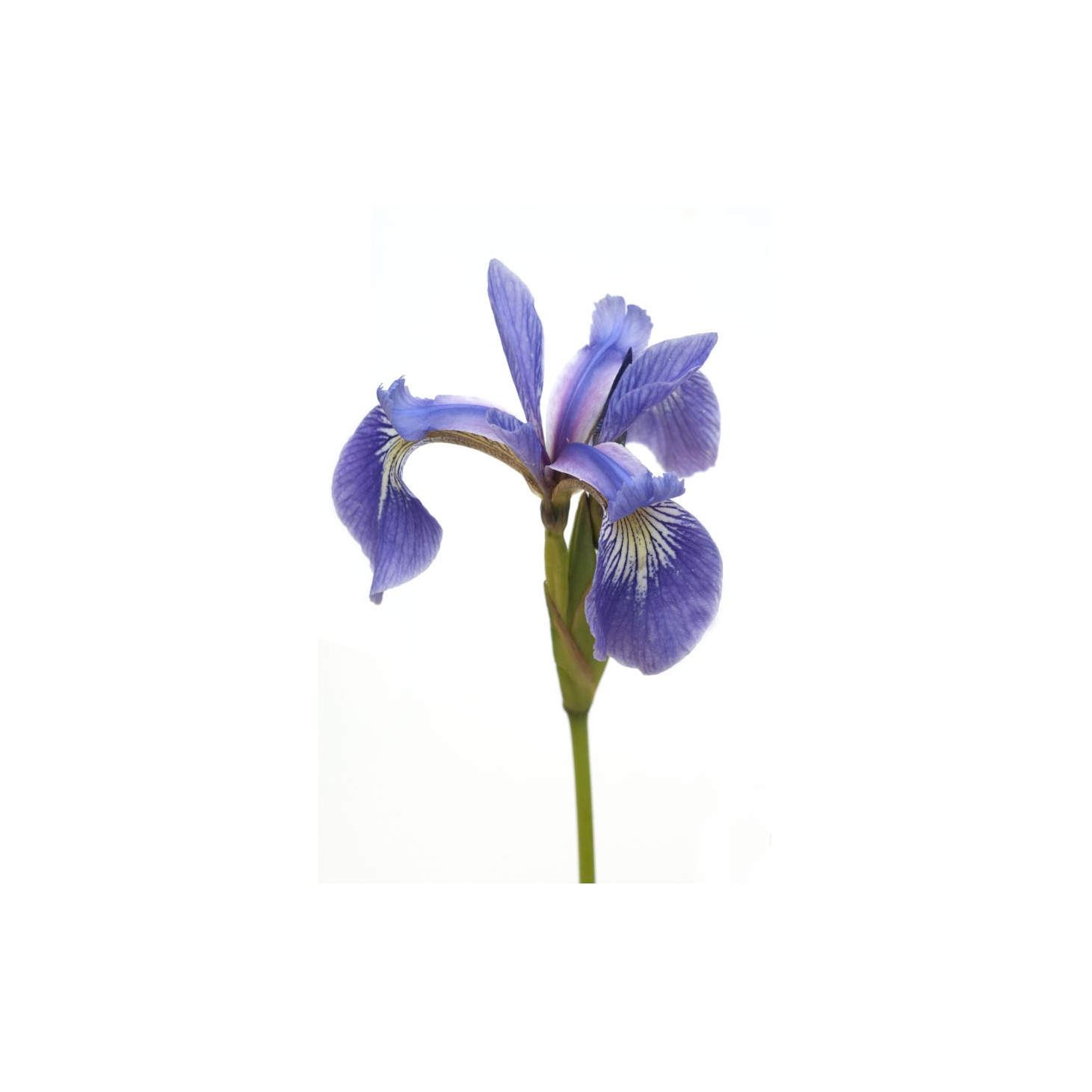
Iris (Iris versicolor), blue flag — a bitter lymphatic and liver herb used for skin conditions, sluggish digestion and detoxification.
What Is Iris?
Iris is a misunderstood herb in many circles. It contains a set of constituents that are known to trigger nausea and vomiting — however, somewhat ironically, iris is also considered useful for treating nausea.
This herb has mild laxative qualities — thought to be due to a combination between its potent bitter constituents stimulating the flow of bile from the liver and gallbladder, and an ability to stimulate the parasympathetic nervous system. It’s especially active on the liver, where it’s used to treat poor digestion, liver dysfunction, and to treat skin conditions.
Other species sometimes used includes Iris caroliniana & Iris virginica.
What Is Iris Used For?
Iris is used to treat skin conditions through the liver by improving elimination pathways and preventing excessive elimination and irritation through the skin. It’s useful for acne, psoriasis, eczema, and rashes.
Other common uses of iris are for urinary tract infection, hypothyroidism, lymphadenopathy, and menstrual irregularities.
Mechanisms
- Thought to stimulate parasympathetic nervous system
- Iridin thought to induce laxative action due to irritating properties on mucus membranes
Botany
Blue flag iris (Iris versicolor) belongs to Iridaceae, the iris family. It is a rhizomatous perennial of wetlands — marsh edges, wet meadows, and pond and stream margins across eastern North America — growing from a thick, creeping rhizome that sends up fans of erect, sword-shaped leaves and, in late spring, tall stalks of showy blue-violet flowers in the unmistakable iris form.
For the herbalist, the part of interest is the rhizome, traded as “blue flag root.” Correct identification matters: fresh blue flag rhizome is acrid and toxic, and irritant when handled or taken in excess. The genus as a whole carries somewhat toxic, acrid rhizomes, so blue flag must be distinguished carefully from ornamental irises and especially from the invasive Eurasian yellow flag (Iris pseudacorus), a yellow-flowered wetland look-alike that is not the medicinal plant.
Distribution
Blue flag iris is a native of eastern North American wetlands, found along marshes, wet meadows, ditches, and the muddy margins of ponds and slow water from the Canadian Maritimes and Manitoba south to Virginia and the upper Midwest. Within that range it spreads by rhizome into colonies wherever the ground stays reliably wet.
Growing Conditions
- A true wetland plant — thrives in constantly moist to wet, humus-rich soil at pond and stream margins, bog gardens and rain gardens.
- Tolerates up to a few inches of shallow standing water over a muddy bottom, making it well suited to pond edges and container water gardens.
- Prefers full sun to part shade; flowering is best in full sun.
- Cold-hardy across a wide range (roughly USDA zones 3–9) and spreads by rhizome to form clumps over time.
- Full cultivation detail lives on the companion farm-wiki grow guide for Iris versicolor (link to be added once that project’s public URL is confirmed).
Phytochemistry
Unlike the perfumery orris-root irises (I. pallida, I. germanica), whose value lies in violet-scented irone ketones, Iris versicolor is an acrid medicinal rhizome and carries no comparable irone fraction. Its characteristic constituent is the isoflavone glycoside iridin (also called irisin/irisine), the compound generally held responsible for the herb’s emetic, purgative and mucous-membrane-irritant action and for much of its low-to-moderate toxicity 1Reference 1The constituents of Iris versicolor — constituent analysis.
The rhizome also yields a pungent oleo-resin (the “acrid resin” of the older literature) that on distillation releases the aldehyde furfural, along with the phytosterol beta-sitosterol, triterpenoids, and the simple aromatic acids salicylic acid and isophthalic acid. Starch, gum and tannins make up the bulk of the inert matter 1Reference 1The constituents of Iris versicolor — constituent analysis. Quantitative data for individual actives in this species is sparse, so figures below are largely qualitative.
Constituent Summary
Constituents of the rhizome; no reliable quantitative assays exist for the medicinal actives of I. versicolor, so amounts are marked No Data. “Irisin/irisine” is a synonym for the isoflavone glycoside iridin (and is unrelated to the human exercise myokine of the same name); its aglycone is irigenin.
Isoflavone1 compoundno data
Sterol1 compoundno data
Triterpene1 compoundno data
Phenolic Acid2 compoundsno data
Pharmacology & Research
Blue flag (Iris versicolor) sits on one of the thinnest evidence bases of any herb still in common materia medica: a PubMed search returns barely a dozen records for the species, most of them on ecology, phytoremediation, taxonomy or homeopathy rather than pharmacology. There is no human clinical trial of any kind, and the herb’s reputation as a bitter hepatic, lymphatic and skin alterative rests almost entirely on nineteenth-century Eclectic and physiomedicalist practice rather than experiment. The only direct modern data on the actual species are a single in vitro study showing its rhizome extract disrupts oral bacterial biofilms 2Reference 2In vitroPhytochemical composition and in vitro biological activity of Iris spp. (Iridaceae): a new source of bioactive constituents for the inhibition of oral bacterial biofilms — in vitroView study →, and two decades-old rat studies of fat metabolism in which iris appeared only as one component of a three-herb mixture 4,5Reference 4AnimalEffect of some medicinal plant preparations on adipose tissue metabolism — rat/in vivoView study →Reference 5AnimalReduction of diet-induced obesity in rats with a herbal formulation — rat/in vivoView study →. Most of what is written about “iris pharmacology” is genus-level inference from chemically related but botanically distinct species — I. germanica, I. tectorum, I. domestica (Belamcanda) — whose isoflavone-rich rhizomes share a family resemblance with blue flag but are not the same plant 3,6,7Reference 3In vitroIridis tectori rhizome alleviates LPS-triggered inflammatory responses through inhibiting NF-κB signaling in macrophages — mouse/in vivo and in vitroView study →Reference 6In vitroIbrahim, S. R. M., et al. (2017). 8-Hydroxyirilone 5-methyl ether and 8-hydroxyirilone, new antioxidant and α-amylase inhibitor isoflavonoids from Iris germanica rhizomes — in vitro. Bioorganic Chemistry, 70, 192–198. https://pubmed.ncbi.nlm.nih.gov/28069265/View study →Reference 7ReviewBelamcandae chinensis rhizome — a review of phytochemistry and bioactivity — reviewView study →, and that species gap is the single most important caveat on this page.
- Best-supported: honestly, nothing reaches “well-supported.” The strongest direct signal is concentration-dependent inhibition of oral biofilm formation by the rhizome extract in vitro 2Reference 2In vitroPhytochemical composition and in vitro biological activity of Iris spp. (Iridaceae): a new source of bioactive constituents for the inhibition of oral bacterial biofilms — in vitroView study → — a laboratory finding in a use the herb is not employed for.
- Emerging, worth watching: anti-inflammatory (NF-κB–suppressing) and antioxidant activity of Iris rhizome isoflavones, demonstrated in related species and plausibly shared by blue flag’s chemistry 3,6Reference 3In vitroIridis tectori rhizome alleviates LPS-triggered inflammatory responses through inhibiting NF-κB signaling in macrophages — mouse/in vivo and in vitroView study →Reference 6In vitroIbrahim, S. R. M., et al. (2017). 8-Hydroxyirilone 5-methyl ether and 8-hydroxyirilone, new antioxidant and α-amylase inhibitor isoflavonoids from Iris germanica rhizomes — in vitro. Bioorganic Chemistry, 70, 192–198. https://pubmed.ncbi.nlm.nih.gov/28069265/View study →.
- Mechanistically thin: the herb’s actual traditional roles — cholagogue/bitter hepatic, lymphatic, skin alterative for acne, eczema and psoriasis — have no experimental backing at all and rest on the acrid, mucous-membrane-irritant nature of its resin and isoflavone glycoside 1Reference 1The constituents of Iris versicolor — constituent analysis.
- The caveat: no human data, no standardised extract, no isolated dose-response for blue flag itself, and a literature dominated by other Iris species. Read every “Iris” result below and ask first: was it this plant?
1. Antimicrobial
The one piece of modern pharmacology performed on blue flag itself is an in vitro screen of 15 methanolic Iris extracts against oral biofilms, in which I. versicolor rhizome inhibited both quorum sensing and bacterial adhesion during biofilm formation in a concentration-dependent way, though it was less effective against already-matured biofilms and was outperformed by I. pallida 2Reference 2In vitroPhytochemical composition and in vitro biological activity of Iris spp. (Iridaceae): a new source of bioactive constituents for the inhibition of oral bacterial biofilms — in vitroView study →. The chemistry driving this was (iso)flavonoid-dominant, with adhesion inhibition correlating to myristic acid content and quorum-sensing inhibition to isoflavonoids; extract cytotoxicity in human fibroblasts was excluded 2Reference 2In vitroPhytochemical composition and in vitro biological activity of Iris spp. (Iridaceae): a new source of bioactive constituents for the inhibition of oral bacterial biofilms — in vitroView study →. This is real, species-specific activity data — but it describes a topical antibiofilm effect relevant to mouthwashes, not the internal bitter-alterative use blue flag actually has, which is why the score is capped despite being the only direct evidence.
Gap: in vitro only, a single study, and an application (oral antisepsis) unrelated to how the herb is traditionally taken — no animal, no clinical, no relevance yet to internal use.
2. Anti-inflammatory
Anti-inflammatory is a listed action for blue flag, but no study has tested I. versicolor for it; the signal is borrowed from a related species. In LPS-stimulated macrophages and endotoxemic mice, an ethanolic rhizome extract of Iris tectorum suppressed nitric oxide, iNOS and inflammatory cytokines by inhibiting NF-κB signalling, an effect attributed to characteristic Iris isoflavones such as tectorigenin and irigenin 3Reference 3In vitroIridis tectori rhizome alleviates LPS-triggered inflammatory responses through inhibiting NF-κB signaling in macrophages — mouse/in vivo and in vitroView study →. Because blue flag’s own rhizome is likewise built on an isoflavone-glycoside scaffold (iridin) 1Reference 1The constituents of Iris versicolor — constituent analysis, the mechanism is chemically plausible for it — but plausibility across a genus is not evidence in the species, and I. tectorum is a distinct plant with a different constituent profile.
Gap: every anti-inflammatory result is from other Iris species; there is no assay, animal model or trial on I. versicolor, so the listed action is inference, not demonstration.
3. Lipolytic / anti-obesity
Two studies from a single Indian research group reported that plant preparations mobilised fat from adipose tissue and reduced diet-induced obesity in rats, with increased energy expenditure and metabolic rate 4,5Reference 4AnimalEffect of some medicinal plant preparations on adipose tissue metabolism — rat/in vivoView study →Reference 5AnimalReduction of diet-induced obesity in rats with a herbal formulation — rat/in vivoView study →. In both, however, Iris versicolor (as “Haimavati”) was only one part of a three-herb formulation alongside Cyperus rotundus and Holoptelea integrifolia, so any lipolytic effect cannot be attributed to iris rather than to its co-ingredients 4,5Reference 4AnimalEffect of some medicinal plant preparations on adipose tissue metabolism — rat/in vivoView study →Reference 5AnimalReduction of diet-induced obesity in rats with a herbal formulation — rat/in vivoView study →. The work is also dated (1988, 1993), uses small animal numbers, and was not replicated by independent groups.
Gap: the active herb is unidentifiable within the mixture, the studies are old and unreplicated, and there is no monotherapy, dose-response or human follow-up.
4. Antioxidant
Blue flag has no antioxidant assay of its own; the claim is an extrapolation from genus chemistry. Isoflavonoids isolated from Iris germanica rhizomes — including irilone and irilone derivatives — showed prominent DPPH radical-scavenging activity in vitro, with IC50 values in the low micromolar range 6Reference 6In vitroIbrahim, S. R. M., et al. (2017). 8-Hydroxyirilone 5-methyl ether and 8-hydroxyirilone, new antioxidant and α-amylase inhibitor isoflavonoids from Iris germanica rhizomes — in vitro. Bioorganic Chemistry, 70, 192–198. https://pubmed.ncbi.nlm.nih.gov/28069265/View study →. Since I. versicolor rhizome carries a broadly comparable isoflavone-glycoside chemistry 1Reference 1The constituents of Iris versicolor — constituent analysis, a similar radical-scavenging capacity is chemically reasonable to hypothesise — but it has never been measured in this species, and the marker isoflavones assayed in I. germanica have not been quantified, or in several cases even confirmed, in blue flag.
Gap: constituent-level inference from a different species, in vitro only; no measurement of antioxidant activity in I. versicolor extract or of the relevant isoflavones’ concentrations in it.
5. Antidiabetic
The weakest of the scored indications: the same I. germanica isoflavonoids that scavenged radicals also inhibited α-amylase in vitro, a mechanism relevant to blunting post-prandial carbohydrate digestion 6Reference 6In vitroIbrahim, S. R. M., et al. (2017). 8-Hydroxyirilone 5-methyl ether and 8-hydroxyirilone, new antioxidant and α-amylase inhibitor isoflavonoids from Iris germanica rhizomes — in vitro. Bioorganic Chemistry, 70, 192–198. https://pubmed.ncbi.nlm.nih.gov/28069265/View study →. This is a single enzyme-inhibition result in a different species, with no cellular, animal or human confirmation and no traditional use of blue flag for blood sugar to lend it context.
Gap: one in vitro enzyme assay, wrong species, no whole-herb or in vivo data, and no traditional rationale — included only for completeness at the bottom of the ranking.
Mechanisms
| Mechanism | Drives | Key compounds |
|---|---|---|
| NF-κB ↓, iNOS/NO ↓ (genus data) | anti-inflammatory | tectorigenin, irigenin |
| Isoflavone radical scavenging (DPPH, genus) | antioxidant | irilone |
| α-amylase inhibition (genus, in vitro) | antidiabetic | irilone derivatives |
| Quorum-sensing & adhesion inhibition | antimicrobial / antibiofilm | isoflavonoids, myristic acid |
| Mucous-membrane & GI irritation → reflex secretion, emesis, purgation | bitter cholagogue / emetic (traditional) | iridin, furfural |
Clinical trials
No registered clinical trials of Iris versicolor were identified on ClinicalTrials.gov, and no human study of any design exists in the literature — the evidence base is entirely preclinical and, for the species itself, almost entirely in vitro or traditional.
| Completed | Planned | Terminated | Preclinical |
|---|---|---|---|
| 0 | 0 | 0 | ~3(species-direct) + genus supporting |
Last checked: July 2026.
Clinical Applications
Iris has recently seen a peak in interest in the past few years, however, is still not a commonly used herb due to the presence of significant side effects. Iris is contraindicated in anything but small doses due to the mucous membrane irritant and nauseating side effects.
In small doses iris is useful for stimulating bile secretion, promoting movement in the bowels, stimulating the pancreas, and treating skin conditions arising from liver congestion.
Dosage
No human dose has ever been established for blue flag. The handful of studies on the species or its genus used laboratory or animal preparations that do not translate to a whole-herb dose, so the figures below are traditional practice, not research-derived.
| Indication | Preparation | Dose | Est. dried-herb equivalent | Source |
|---|---|---|---|---|
| Antimicrobial (antibiofilm) | Methanolic rhizome extract, in vitro | Sub-cytotoxic culture concentrations (no human/animal dose) | — (no in vivo dosing) | 2Reference 2In vitroPhytochemical composition and in vitro biological activity of Iris spp. (Iridaceae): a new source of bioactive constituents for the inhibition of oral bacterial biofilms — in vitroView study → |
| Lipolytic / anti-obesity | 3-herb powder/extract mixture, oral, rats | Mixture dose only; iris fraction not separable | — (mixture; no isolated iris dose) | 4,5Reference 4AnimalEffect of some medicinal plant preparations on adipose tissue metabolism — rat/in vivoView study →Reference 5AnimalReduction of diet-induced obesity in rats with a herbal formulation — rat/in vivoView study → |
No human dose has ever been established for any indication. No marker-standardised extract exists, so no dried-herb equivalent can be back-calculated — all equivalents are ”—”. Do not read these as a recommendation or invent a conversion ratio.
Traditional Dosage
In Western herbal practice blue flag is treated as a low-dose herb, given conservatively because of its emetic and mucous-membrane-irritant nature; the dried rhizome has historically been preferred over the fresh root, which is markedly more acrid.
| System | Preparation | Dose |
|---|---|---|
| Western herbal (Bone, blending liquid herbs) | Liquid extract 1:2 | 20–40 mL per week (low-dose herb) |
| Western herbal / Eclectic | Tincture 1:5 (dried rhizome) | Small doses only — conservative, low-dose use given emetic/irritant risk |
| Western herbal / Eclectic | Dried rhizome (decoction) | Low doses; dried historically preferred over fresh |
Safety & Pregnancy
Blue flag rhizome is acrid and, above small doses, frankly emetic and purgative — a strictly low-dose herb. Its toxicity and drug interactions have never been formally studied, so all guidance rests on constituent chemistry and traditional practice.
- Emetic & purgative. Acrid rhizome — nausea, vomiting, diarrhoea and cramping above small doses; use in low doses only.
- Mucous-membrane irritant. The fresh root can burn the mouth and throat; contraindicated in active IBD or an IBS flare, and in existing diarrhoea.
- Fresh vs dried. The dried rhizome is preferred; the fresh root is considerably more acrid.
- Interactions unstudied. No pharmacokinetic or interaction data exist; additive effects with other laxatives or irritant cathartics are a theoretical concern.
Full safety & interactions detail
Blue flag rhizome is an acrid, mucous-membrane irritant: the fresh root in particular can cause burning of the mouth and throat, nausea, vomiting, diarrhoea and abdominal cramping, and the herb is frankly emetic and purgative at anything above small doses 1Reference 1The constituents of Iris versicolor — constituent analysis. These effects are attributed to its isoflavone glycoside iridin and acrid oleo-resin/furfural fraction 1Reference 1The constituents of Iris versicolor — constituent analysis. It is therefore used only in low doses and is contraindicated where mucous-membrane irritation would worsen a condition (e.g. active IBD or IBS flare). The dried rhizome is preferred over the fresh root, which is considerably more acrid. No controlled study has examined its toxicity, drug interactions or use in specific populations, so all safety guidance here is derived from constituent chemistry and traditional practice rather than trial data.
Herb–drug interactions have not been assessed for I. versicolor — no pharmacokinetic or interaction study exists — so the absence of reported interactions is absence of data, not evidence of safety. As a purgative/irritant, additive effects with other laxatives or irritant cathartics are a theoretical (untested) concern.
Contraindications
- Avoid high doses — the herb is emetic and purgative above small amounts
- Mucous-membrane irritation or inflammatory bowel conditions (IBS, IBD flare)
- Existing diarrhoea
Blue flag has not been studied for reproductive or developmental safety, and no lactation data exist. Given its emetic, purgative and mucous-membrane-irritant activity, traditional sources advise against use in pregnancy and breastfeeding; this is a precautionary position, not a finding of harm from any study.
References
- American Journal of Pharmacy. (1881). The constituents of Iris versicolor — constituent analysis. American Journal of Pharmacy. (Rhizome reported to contain volatile matter/furfural, acrid oleo-resin, the glycoside iridin (irisin), salicylic and isophthalic acids, beta-sitosterol, triterpenoids, starch, gum and tannin.)
- Hoang, L., et al. (2020). Phytochemical composition and in vitro biological activity of Iris spp. (Iridaceae): a new source of bioactive constituents for the inhibition of oral bacterial biofilms — in vitro. Antibiotics (Basel), 9(7), 403. https://pubmed.ncbi.nlm.nih.gov/32664528/
- Guo, Y. L., et al. (2026). Iridis tectori rhizome alleviates LPS-triggered inflammatory responses through inhibiting NF-κB signaling in macrophages — mouse/in vivo and in vitro. Biomedicines, 14(6), 1291. https://pubmed.ncbi.nlm.nih.gov/42351719/
- Bambhole, V. D. (1988). Effect of some medicinal plant preparations on adipose tissue metabolism — rat/in vivo. Ancient Science of Life, 8(2), 117–124. https://pubmed.ncbi.nlm.nih.gov/22557642/
- Bambhole, V. D., & Kamalakar, P. L. (1993). Reduction of diet-induced obesity in rats with a herbal formulation — rat/in vivo. Ancient Science of Life, 13(1–2), 89–96. https://pubmed.ncbi.nlm.nih.gov/22556633/
- Ibrahim, S. R. M., et al. (2017). 8-Hydroxyirilone 5-methyl ether and 8-hydroxyirilone, new antioxidant and α-amylase inhibitor isoflavonoids from Iris germanica rhizomes — in vitro. Bioorganic Chemistry, 70, 192–198. https://pubmed.ncbi.nlm.nih.gov/28069265/
- Woźniak, D., & Matkowski, A. (2015). Belamcandae chinensis rhizome — a review of phytochemistry and bioactivity — review. Fitoterapia, 107, 1–14. https://pubmed.ncbi.nlm.nih.gov/26347953/