Materia Medica
Feverfew
Tanacetum parthenium
Feverfew (Tanacetum parthenium) — a leading herbal preventive for chronic migraine, also used for tension headaches and inflammation.
Feverfew Summary
Feverfew is the most-studied herbal option for chronic migraine prophylaxis, though the clinical evidence is modest and mixed (see Pharmacology & Research below). This condition has many different mechanisms, and is not well understood by medicine even today. There are several major theories as to the pathophysiology of migraine headaches, and feverfew contains phytochemicals proposed to act on several of them.
Despite its name, feverfew is not useful for treating fevers, but has antiallergenic, anti-inflammatory, vasodilating, and antisecretory activities instead.
Indications
- Migraines
- Tension headaches
- Dizziness
- Tinnitus
- Fever
- Nervous debility
- Painful periods
- Sluggish menstrual flow
- Arthritis
- Parasites
- Coughs
- Colds
- Atonic dyspepsia
Contraindications
- Warfarin
- Mouth ulceration
How Is Feverfew Used?
Feverfew’s main use is for migraine headaches, where it excels, especially with recurrent migraines that are characterized by finding relief from applying heat. Feverfew is also useful for female reproductive issues including painful menstruation and sluggish menstrual flow.
Traditional Uses
Western Herbal Medicine
Traditionally feverfew was used as a decoction with sugar or honey to treat coughs, wheezing, and difficulty breathing 23Reference 23Feverfew. http://www.botanical.com/botanical/mgmh/f/feverf10.htmlView study →. It was used as a warm infusion to purge choler, treat colds/flus, fever, cleanse the kidneys, stimulate menstruation, and expel parasitic worms 24Reference 24Principles and Practice of Phytotherapy. It was decocted to treat wheezing, coughs, and difficulty breathing. A cold infusion was used as a tonic, and for opium overdoses.
Topically, the herb was used by bruising and heating with a little oil, and applied for conditions such as wind and colic. The tincture was also used topically to treat pain and swelling from insect and animal bites to offer fast relief 23Reference 23Feverfew. http://www.botanical.com/botanical/mgmh/f/feverf10.htmlView study →. As a poultice it was used to reduce pain and inflammation of the bowel, and for wind or colic conditions 24Reference 24Principles and Practice of Phytotherapy.
It was described by Dioscorides as useful for “all hot inflammations” 8Reference 8Systematic reviewFeverfew (Tanacetum parthenium L.): A systematic reviewView study →,
There was very little reference to feverfews actions on migraine headaches 24Reference 24Principles and Practice of Phytotherapy, despite this being one of the main uses of this plant today.
South American Traditional Medicine
In South America, the Kallaway Indians of the Andes mountains used feverfew for treating conditions such as colic, kidney pain, morning sickness, and stomach aches 8Reference 8Systematic reviewFeverfew (Tanacetum parthenium L.): A systematic reviewView study →. In other areas of South and Central America feverfew was used to support digestion, as a cardiotonic, emmenagogue, antispasmodic, menstrual tonic, treating earaches, and in the form of an enema for worms 21Reference 21Feverfew.
Botany
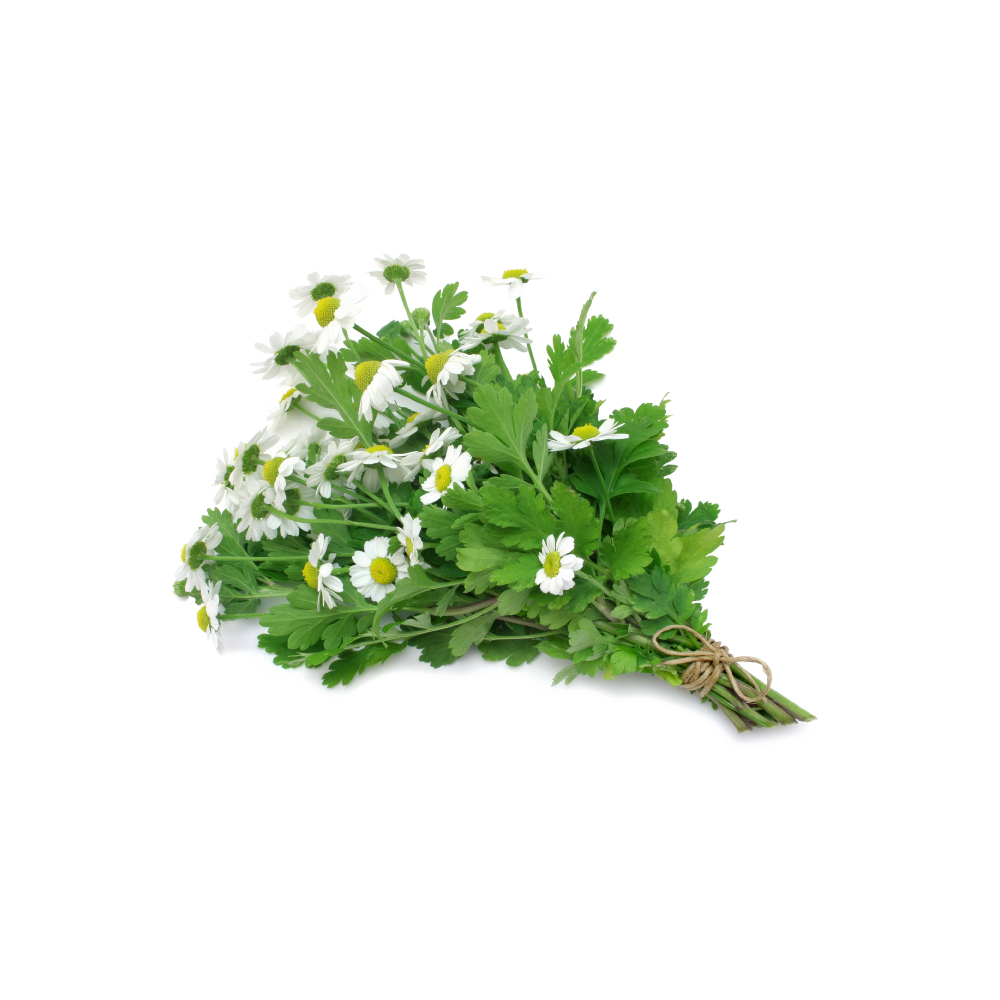
Feverfew is a bushy, strongly aromatic, short-lived herbaceous perennial in the daisy family (Asteraceae), growing 1–2 ft (to ~70 cm) tall with yellow-green, deeply-lobed, pungent leaves. From early summer it produces masses of small daisy flowers — white rays around a flat yellow disc, resembling a miniature chamomile — and self-seeds prolifically. Long classed in Chrysanthemum and Pyrethrum (names still seen in commerce), it is now placed in Tanacetum alongside tansy and the pyrethrum daisy; nearby relatives include the true chamomiles and yarrow.
Distribution
Feverfew is native to the Balkan Peninsula, Anatolia and the Caucasus. Grown for centuries as a medicinal and ornamental herb, it has escaped gardens and naturalized across the rest of Europe and much of North America, plus parts of South America and Australia, colonizing roadsides, fields and waste ground. Its vigorous self-seeding makes it locally weedy in places, but it is not on federal noxious-weed lists and has no conservation concern.
Growing Conditions
- Life cycle: short-lived herbaceous perennial, hardy USDA zones 5–9.
- Light: full sun to part shade.
- Water: moderate; tolerates dry-back and poor soils.
- Habit: self-seeds freely — can become weedy if seedheads aren’t cut.
- Full cultivation detail lives on the companion farm-wiki grow guide for Tanacetum parthenium (link to be added once that project’s public URL is confirmed).
Harvesting, Collection & Preparation
The parthenolide content from feverfew varies greatly depending on the growing conditions. This is important because this is suggested to be one of the main constituents responsible for feverfews ability to reduce the severity of and/or prevent migraine headaches. This is why it’s suggested that a standardized extract of feverfew should be used, containing at least a 0.2% parthenolide content (per 125mg dried feverfew leaf equivalent) 22Reference 22Herbal medications commonly used in the practice of rheumatology: Mechanisms of action, efficacy, and side effects.
The leaves (and sometimes stems) are collected during, or after flowering 24Reference 24Principles and Practice of Phytotherapy.
Pharmacology & Research
Feverfew’s literature is unusually lopsided: one indication — migraine prophylaxis — carries almost all of the human data, while the rest of the herb’s reputation rests on mechanistic and preclinical work. Six double-blind placebo-controlled RCTs (561 patients) have tested feverfew monopreparations for migraine, but their results are mixed and Cochrane rates the overall evidence as low quality 1,2,3,4,5,6Reference 1Systematic reviewFeverfew for preventing migraine — systematic reviewView study →Reference 2RCTEfficacy and safety of 6.25 mg t.i.d. feverfew CO2-extract (MIG-99) in migraine prevention — randomized, double-blind, placebo-controlled studyView study →Reference 3RCTThe efficacy and safety of Tanacetum parthenium (feverfew) in migraine prophylaxis — a double-blind, multicentre, randomized placebo-controlled dose-response studyView study →Reference 4RCTRandomised double-blind placebo-controlled trial of feverfew in migraine preventionView study →Reference 5RCTEfficacy of feverfew as prophylactic treatment of migraine — randomised placebo-controlled trialView study →Reference 6RCTHerbal medicines in migraine prevention — randomized double-blind placebo-controlled crossover trial of a feverfew preparationView study →. Beneath that sit well-mapped molecular mechanisms — the sesquiterpene lactone parthenolide binds and inhibits IKKβ (shutting down NF-κB) and blocks serotonin/granule release from platelets and mast cells 9,10,11,12Reference 9In vitroThe anti-inflammatory natural product parthenolide from the medicinal herb feverfew directly binds to and inhibits IκB kinase — in vitroView study →Reference 10In vitroExtracts of feverfew inhibit granule secretion in blood platelets and polymorphonuclear leucocytes — in vitroView study →Reference 11In vitroFeverfew extracts and parthenolide irreversibly inhibit vascular responses of the rabbit aorta — in vitroView study →Reference 12AnimalThe activity of compounds extracted from feverfew on histamine release from rat mast cells — animal modelView study → — plus a striking but entirely preclinical oncology signal in which isolated parthenolide selectively kills leukaemia stem cells 14,15Reference 14In vitroThe sesquiterpene lactone parthenolide induces apoptosis of human acute myelogenous leukemia stem and progenitor cells — in vitro / animal modelView study →Reference 15In vitroAn orally bioavailable parthenolide analog selectively eradicates acute myelogenous leukemia stem and progenitor cells — in vitro / animal modelView study →. The dominant caveat runs through everything: parthenolide content varies enormously with chemotype, harvest and preparation, so results from one standardised extract do not transfer to another form, and the most dramatic anticancer data are for the isolated molecule or its analogues, not feverfew as it is actually taken.
- Best-supported: migraine prophylaxis — modest reduction in attack frequency in the largest rigorous trial, though results across trials are inconsistent 1,2Reference 1Systematic reviewFeverfew for preventing migraine — systematic reviewView study →Reference 2RCTEfficacy and safety of 6.25 mg t.i.d. feverfew CO2-extract (MIG-99) in migraine prevention — randomized, double-blind, placebo-controlled studyView study →.
- Emerging, worth watching: parthenolide’s selective killing of acute myeloid leukaemia stem cells, and its oral analogue DMAPT — preclinical but replicated 14,15Reference 14In vitroThe sesquiterpene lactone parthenolide induces apoptosis of human acute myelogenous leukemia stem and progenitor cells — in vitro / animal modelView study →Reference 15In vitroAn orally bioavailable parthenolide analog selectively eradicates acute myelogenous leukemia stem and progenitor cells — in vitro / animal modelView study →.
- Mechanistically thin: anti-allergic/antihistamine and topical skin-protective uses rest on animal, cell-line and modified-extract data with no clinical confirmation 12,20Reference 12AnimalThe activity of compounds extracted from feverfew on histamine release from rat mast cells — animal modelView study →Reference 20In vitroA purified feverfew extract protects from oxidative damage by inducing DNA repair in skin cells via a PI3-kinase-dependent Nrf2/ARE pathway — in vitroView study →.
- The caveat: no cross-transferable standardised dose — parthenolide runs from about 0.2% to 1.8% of dried herb, and a negative rheumatoid arthritis trial shows the anti-inflammatory mechanism does not guarantee clinical benefit 17Reference 17RCTFeverfew in rheumatoid arthritis: a double-blind, placebo-controlled study — randomised controlled trialView study →.
1. Migraine prophylaxis
This is the only indication with a real body of human evidence, and it is genuinely mixed. Three small early trials were positive — but two of them enrolled habitual feverfew users who reported prior benefit, so a placebo run-in triggered withdrawal-like worsening in the placebo arm rather than true drug effect 4,5Reference 4RCTRandomised double-blind placebo-controlled trial of feverfew in migraine preventionView study →Reference 5RCTEfficacy of feverfew as prophylactic treatment of migraine — randomised placebo-controlled trialView study →. Two rigorous trials in feverfew-naive patients found no significant benefit 6,3Reference 6RCTHerbal medicines in migraine prevention — randomized double-blind placebo-controlled crossover trial of a feverfew preparationView study →Reference 3RCTThe efficacy and safety of Tanacetum parthenium (feverfew) in migraine prophylaxis — a double-blind, multicentre, randomized placebo-controlled dose-response studyView study →. The pivotal study is a 16-week trial of a stable supercritical-CO₂ extract (parthenolide-standardised, MIG-99 6.25 mg three times daily, n=170) that cut migraine frequency by 1.9 attacks/month versus 1.3 on placebo — a real but small difference of about 0.6 attacks/month, with no benefit on attack intensity or duration 2Reference 2RCTEfficacy and safety of 6.25 mg t.i.d. feverfew CO2-extract (MIG-99) in migraine prevention — randomized, double-blind, placebo-controlled studyView study →. A preceding dose-response trial had identified this dose 3Reference 3RCTThe efficacy and safety of Tanacetum parthenium (feverfew) in migraine prophylaxis — a double-blind, multicentre, randomized placebo-controlled dose-response studyView study →, and a 2015 Cochrane review concluded this adds “some positive evidence” but constitutes low-quality evidence needing confirmation 1Reference 1Systematic reviewFeverfew for preventing migraine — systematic reviewView study →; a 2025 meta-analysis reaches similarly cautious conclusions 7Reference 7Meta-analysisSystematic review and meta-analysis of Tanacetum parthenium: evaluating its efficacy in migraine relief. (2025) — meta-analysis. Natural Product Research. https://pubmed.ncbi.nlm.nih.gov/41422534/View study →.
Gap: No trial has replicated the MIG-99 result at scale; effect size is small, extract-specific, and does not transfer to teas, whole-leaf powder, or other extracts.
2. Anti-inflammatory
Feverfew’s anti-inflammatory activity is mechanistically well-characterised. Parthenolide binds directly to cysteine-179 of IKKβ, inhibiting the IκB kinase complex and thereby blocking NF-κB-driven pro-inflammatory signalling — the effect depends on the α-methylene-γ-lactone moiety shared by the herb’s sesquiterpene lactones 9Reference 9In vitroThe anti-inflammatory natural product parthenolide from the medicinal herb feverfew directly binds to and inhibits IκB kinase — in vitroView study →. It also inhibits prostaglandin biosynthesis and secretory activity in platelets and neutrophils 10Reference 10In vitroExtracts of feverfew inhibit granule secretion in blood platelets and polymorphonuclear leucocytes — in vitroView study →, and the methylated flavonoids apigenin and luteolin contribute their own anti-inflammatory activity 13Reference 13In vitroThe flavonoids of Tanacetum parthenium and T. vulgare and their anti-inflammatory properties — in vitroView study →. The clinical test of this mechanism, however, failed: a double-blind RCT of dried feverfew in 41 women with rheumatoid arthritis found no benefit on any clinical or laboratory measure over six weeks 17Reference 17RCTFeverfew in rheumatoid arthritis: a double-blind, placebo-controlled study — randomised controlled trialView study →.
Gap: Rich in vitro/mechanistic data but a negative human trial in the one inflammatory disease actually tested — mechanism is not efficacy.
3. Anticancer
This is feverfew’s most striking preclinical story, and also its most easily overstated. Parthenolide was shown to induce robust apoptosis in primary human acute myeloid leukaemia (AML) and blast-crisis CML cells while sparing normal blood cells, and to preferentially target leukaemia stem and progenitor cells in a NOD/SCID xenograft model — more selectively than standard cytarabine 14Reference 14In vitroThe sesquiterpene lactone parthenolide induces apoptosis of human acute myelogenous leukemia stem and progenitor cells — in vitro / animal modelView study →. Because native parthenolide has poor bioavailability, an orally available analogue, dimethylamino-parthenolide (DMAPT), was developed and shown to eradicate leukaemia stem cells via oxidative stress, NF-κB inhibition and p53 activation 15Reference 15In vitroAn orally bioavailable parthenolide analog selectively eradicates acute myelogenous leukemia stem and progenitor cells — in vitro / animal modelView study →. The same NF-κB-dependent activity has been reported in colorectal cancer cell lines 16Reference 16In vitrohttps://pubmed.ncbi.nlm.nih.gov/37337926/View study →.
Gap: Entirely preclinical, and it is isolated parthenolide or a synthetic analogue — not feverfew tea, tincture or leaf — that produces these effects; no clinical oncology use is supported.
4. Antiallergic / antihistamine
Feverfew shows antisecretory and mast-cell-stabilising activity in animal models. Parthenolide inhibited histamine release from rat peritoneal mast cells and suppressed passive cutaneous anaphylaxis in mice in a dose-dependent manner, with the mechanism suggested to involve blockade of calcium entry into mast cells 12Reference 12AnimalThe activity of compounds extracted from feverfew on histamine release from rat mast cells — animal modelView study →. Feverfew extracts also inhibit serotonin release and granule secretion from platelets and polymorphonuclear leucocytes, with a pattern distinct from — and in the case of leucocytes more pronounced than — conventional NSAIDs 10Reference 10In vitroExtracts of feverfew inhibit granule secretion in blood platelets and polymorphonuclear leucocytes — in vitroView study →.
Gap: Animal and cell-line data only; no human trials of feverfew for allergy, rhinitis or urticaria.
5. Skin-protective (topical)
A purified feverfew extract activated the Nrf2/ARE antioxidant pathway in skin cells in a PI3-kinase-dependent manner, inducing DNA-repair and detoxification genes and protecting against UV/oxidative damage in vitro 20Reference 20In vitroA purified feverfew extract protects from oxidative damage by inducing DNA repair in skin cells via a PI3-kinase-dependent Nrf2/ARE pathway — in vitroView study →. This is the basis for feverfew’s use in cosmetics — but the ingredient used is a parthenolide-depleted extract, deliberately stripped of the sesquiterpene lactone that drives both the migraine activity and the herb’s allergenicity.
Gap: One in vitro study, on a modified extract that is essentially a different preparation from medicinal feverfew; no clinical dermatology outcomes.
Mechanisms
| Mechanism | Drives | Key compounds |
|---|---|---|
| IKKβ binding → NF-κB ↓ | anti-inflammatoryanticancer | parthenolide |
| Prostaglandin synthesis ↓, COX activity ↓ | anti-inflammatorymigraine | parthenolide, apigenin, luteolin |
| Serotonin & granule release from platelets/PMNs ↓ | migraineantiplatelet | parthenolide (SL fraction) |
| Mast-cell histamine release ↓ (Ca²⁺ entry blockade) | antiallergic | parthenolide |
| Vascular smooth-muscle contractility ↓ | migraine | parthenolide |
| Nrf2/ARE antioxidant pathway ↑ (topical) | skin-protective | polar/lipophilic flavonoid fraction |
Clinical trials
Human trials are essentially confined to migraine prophylaxis — six placebo-controlled RCTs (561 patients) captured by Cochrane — plus one negative rheumatoid-arthritis trial; the extensive parthenolide oncology work remains preclinical with no feverfew-herb clinical trials.
| Completed | Planned | Terminated | Preclinical |
|---|---|---|---|
| 7 | 0 | 0 | ~40+ |
Last checked: July 2026.
Phytochemistry
Feverfew’s therapeutic identity rests on its sesquiterpene lactones, above all the germacranolide parthenolide — the compound to which products are standardised and which accounts for the bulk of the herb’s anti-inflammatory and anti-migraine activity. Parthenolide can make up as much as ~85% of the total sesquiterpene lactone content but is highly variable; standardised extracts target a minimum of 0.2% 22,24Reference 22Herbal medications commonly used in the practice of rheumatology: Mechanisms of action, efficacy, and side effectsReference 24Principles and Practice of Phytotherapy. It is accompanied by a large family of related lactones including costunolide, canin, artecanin, and secotanapartholide A.
The aerial parts also yield a camphor-rich volatile oil, a suite of methylated flavonoids (tanetin, santin, apigenin, luteolin) with their own anti-inflammatory activity, decaffeoylquinic acids, and polyacetylenes 13,25,26,27,28,29Reference 13In vitroThe flavonoids of Tanacetum parthenium and T. vulgare and their anti-inflammatory properties — in vitroView study →Reference 25Composition of the essential oils of Tanacetum argyrophyllum (CReference 26Variations in lipophilic and polar flavonoids in the genus TanacetumReference 27A biologically active lipophilic flavonol from Tanacetum partheniumReference 28Bioactive flavonoids of Tanacetum parthenium revisitedReference 29Anti-inflammatory activity sesquiterpene lactones and related compounds.
Constituent Summary
Parthenolide is given as percent of dried herb; volatile-oil components as percent of the oil (from one Turkish chemotype, ref 25Reference 25Composition of the essential oils of Tanacetum argyrophyllum (C) — both vary greatly with genetics, harvest time and growing conditions. Entries marked No Data are documented qualitatively only 22,24,25Reference 22Herbal medications commonly used in the practice of rheumatology: Mechanisms of action, efficacy, and side effectsReference 24Principles and Practice of PhytotherapyReference 25Composition of the essential oils of Tanacetum argyrophyllum (C.
Sesquiterpene Lactone7 compounds1 with data
Monoterpene5 compounds4 with data
The parthenolide content of feverfew is associated with much of its therapeutic actions, especially in migraine treatment. This chemical however will vary greatly in different plant samples. It’s suggested that it can be improved by harvesting the plant in the afternoon, and after a single water stress event. It’s also noted that varieties with a light green/yellow leaf color yield higher concentrations of parthenolide. 24Reference 24Principles and Practice of Phytotherapy.
Clinical Applications
Feverfew is a reliable treatment for migraine headaches. The effects are not immediate, and require gradual long term use to be effective. For this reason it’s common to use feverfew alongside pharmaceutical painkillers for symptomatic relief with migraines. After gradual use of feverfew the episodes become shorter, less frequent, and less severe.
Feverfew is also useful for its antiallergenic activities due to its ability to inhibit histamine. Again, this is a long term treatment and will not produce effects after a single dose. For this reason immediate symptomatic relief is often combined with pharmaceutical antihistamines in the early stages of treatment.
Dosage
In research, feverfew for migraine has been given either as a stable, parthenolide-standardised concentrated extract titrated to a set dose, or as dried/freeze-dried whole leaf standardised to a minimum parthenolide content. These are research doses, not recommendations.
| Indication | Preparation | Dose | Est. dried-herb equivalent | Source |
|---|---|---|---|---|
| Migraine prophylaxis | Stable supercritical-CO₂ extract (MIG-99) | 6.25 mg three times daily (18.75 mg/day) | — (concentrated extract; no marker % published for back-conversion) | 2,3Reference 2RCTEfficacy and safety of 6.25 mg t.i.d. feverfew CO2-extract (MIG-99) in migraine prevention — randomized, double-blind, placebo-controlled studyView study →Reference 3RCTThe efficacy and safety of Tanacetum parthenium (feverfew) in migraine prophylaxis — a double-blind, multicentre, randomized placebo-controlled dose-response studyView study → |
| Migraine prophylaxis | Dried / freeze-dried leaf, standardised ≥0.2% parthenolide | ~50–125 mg once daily | ~50–125 mg (dose ≈ dried-leaf weight, since these were whole-leaf capsules) | 4,5Reference 4RCTRandomised double-blind placebo-controlled trial of feverfew in migraine preventionView study →Reference 5RCTEfficacy of feverfew as prophylactic treatment of migraine — randomised placebo-controlled trialView study → |
The “Est. dried-herb equivalent” is a rough guide, not a conversion factor. The MIG-99 CO₂ extract is concentrated and no standardisation-marker percentage is published that would allow reliable back-conversion, so it is left ”—”; the whole-leaf capsule doses are already dried-herb weights.
Traditional Dosage
Traditional Western practice uses the whole herb as a liquid extract, fresh chewed leaf, or warm infusion — dosed by feel rather than to a standardised marker.
| System | Preparation | Dose |
|---|---|---|
| Western herbal | Liquid extract (1:5) | 1–3 mL |
| Western herbal | Fresh leaf (chewed) | ~2–3 small leaves daily (note: causes mouth ulceration — largely superseded by capsules) |
| Western herbal | Warm infusion / decoction | traditionally taken to stimulate menstruation and for colds; no standardised dose |
Safety & Pregnancy
Feverfew is generally well tolerated — trial adverse events were limited to mild GI upset and mouth ulcers — but it carries a real antiplatelet/bleeding caution around anticoagulants and a traditional abortifacient reputation that makes it one to avoid in pregnancy.
- Avoid in pregnancy. Traditional emmenagogue and abortifacient with no controlled safety data.
- Bleeding risk. Inhibits platelet serotonin release; may add to aspirin, warfarin or other anticoagulants — stop before surgery.
- Asteraceae allergy. A recognised sensitiser; contraindicated with ragweed, chrysanthemum, daisy or marigold allergy.
- Mouth ulceration. Chewing fresh leaves is a well-documented cause.
- Post-feverfew syndrome. Abrupt withdrawal after long-term use may bring rebound headache and anxiety.
- Otherwise well tolerated. Adverse events in trials were mild and transient.
Full safety & interactions detail
Feverfew is generally well tolerated, with adverse events in trials limited to mild, transient gastrointestinal complaints and mouth ulcers/oral inflammation, and no major safety concerns identified across six controlled migraine trials 1Reference 1Systematic reviewFeverfew for preventing migraine — systematic reviewView study →. Its most consistent hazard is allergy: as an Asteraceae (Compositae) plant rich in the sesquiterpene lactone parthenolide, feverfew is a recognised sensitiser and can cause contact dermatitis, so it is contraindicated in people allergic to ragweed, chrysanthemums, daisies or marigolds 19Reference 19Case reportTwo cases of compositae dermatitis exacerbated by moisturizer containing feverfew — case reportView study →. Because feverfew inhibits platelet serotonin release and granule secretion, it has a theoretical antiplatelet effect and may add to the action of aspirin, warfarin or other anticoagulant/antiplatelet drugs; a case report describes altered coagulation results and vaginal bleeding associated with feverfew use, so it is prudent to discontinue it before surgery 10,18Reference 10In vitroExtracts of feverfew inhibit granule secretion in blood platelets and polymorphonuclear leucocytes — in vitroView study →Reference 18Case reportJournal of Medical Cases. https://pubmed.ncbi.nlm.nih.gov/34434419/View study →. Chewing fresh leaves is a well-documented cause of mouth ulceration, and abrupt discontinuation after long-term use has been described anecdotally as causing rebound headache and anxiety (“post-feverfew syndrome”).
No dedicated human drug-interaction or CYP450 study of feverfew was identified, so the anticoagulant/antiplatelet interaction is inferred from its pharmacology plus a single case report rather than formally measured — absence of reports is not evidence of safety.
Feverfew has a traditional reputation as an emmenagogue and abortifacient — used historically to stimulate menstruation and expel a retained placenta — and no controlled safety data exist for its use in pregnancy, so it should be avoided. Lactation safety has not been studied, so use while breastfeeding is also best avoided.
Synergy
May be synergistic with Gingko biloba for migraine headache.
References
- Wider, B., Pittler, M. H., & Ernst, E. (2015). Feverfew for preventing migraine — systematic review. Cochrane Database of Systematic Reviews. https://pubmed.ncbi.nlm.nih.gov/25892430/
- Diener, H. C., Pfaffenrath, V., Schnitker, J., Friede, M., & Henneicke-von Zepelin, H. H. (2005). Efficacy and safety of 6.25 mg t.i.d. feverfew CO2-extract (MIG-99) in migraine prevention — randomized, double-blind, placebo-controlled study. Cephalalgia. https://pubmed.ncbi.nlm.nih.gov/16232154/
- Pfaffenrath, V., Diener, H. C., Fischer, M., Friede, M., & Henneicke-von Zepelin, H. H. (2002). The efficacy and safety of Tanacetum parthenium (feverfew) in migraine prophylaxis — a double-blind, multicentre, randomized placebo-controlled dose-response study. Cephalalgia. https://pubmed.ncbi.nlm.nih.gov/12230594/
- Murphy, J. J., Heptinstall, S., & Mitchell, J. R. (1988). Randomised double-blind placebo-controlled trial of feverfew in migraine prevention. Lancet. https://pubmed.ncbi.nlm.nih.gov/2899663/
- Johnson, E. S., Kadam, N. P., Hylands, D. M., & Hylands, P. J. (1985). Efficacy of feverfew as prophylactic treatment of migraine — randomised placebo-controlled trial. BMJ. https://pubmed.ncbi.nlm.nih.gov/3929876/
- De Weerdt, C. J., Bootsma, H. P., & Hendriks, H. (1996). Herbal medicines in migraine prevention — randomized double-blind placebo-controlled crossover trial of a feverfew preparation. Phytomedicine. https://pubmed.ncbi.nlm.nih.gov/23195074/
- Systematic review and meta-analysis of Tanacetum parthenium: evaluating its efficacy in migraine relief. (2025) — meta-analysis. Natural Product Research. https://pubmed.ncbi.nlm.nih.gov/41422534/
- Pareek, A., Suthar, M., Rathore, G. S., & Bansal, V. (2011). Feverfew (Tanacetum parthenium L.): A systematic review. Pharmacognosy Reviews. https://doi.org/10.4103/0973-7847.79105
- Kwok, B. H., Koh, B., Ndubuisi, M. I., Elofsson, M., & Crews, C. M. (2001). The anti-inflammatory natural product parthenolide from the medicinal herb feverfew directly binds to and inhibits IκB kinase — in vitro. Chemistry & Biology. https://pubmed.ncbi.nlm.nih.gov/11514225/
- Heptinstall, S., White, A., Williamson, L., & Mitchell, J. R. (1985). Extracts of feverfew inhibit granule secretion in blood platelets and polymorphonuclear leucocytes — in vitro. Lancet. https://pubmed.ncbi.nlm.nih.gov/2860288/
- Barsby, R. W., Salan, U., Knight, D. W., & Hoult, J. R. (1992). Feverfew extracts and parthenolide irreversibly inhibit vascular responses of the rabbit aorta — in vitro. Journal of Pharmacy and Pharmacology. https://pubmed.ncbi.nlm.nih.gov/1360525/
- Hayes, N. A., & Foreman, J. C. (1987). The activity of compounds extracted from feverfew on histamine release from rat mast cells — animal model. Journal of Pharmacy and Pharmacology. https://pubmed.ncbi.nlm.nih.gov/2441022/
- Williams, C. A., Harborne, J. B., Geiger, H., & Hoult, J. R. (1999). The flavonoids of Tanacetum parthenium and T. vulgare and their anti-inflammatory properties — in vitro. Phytochemistry. https://pubmed.ncbi.nlm.nih.gov/10382317/
- Guzman, M. L., Rossi, R. M., Karnischky, L., et al. (2005). The sesquiterpene lactone parthenolide induces apoptosis of human acute myelogenous leukemia stem and progenitor cells — in vitro / animal model. Blood. https://pubmed.ncbi.nlm.nih.gov/15687234/
- Guzman, M. L., Rossi, R. M., Neelakantan, S., et al. (2007). An orally bioavailable parthenolide analog selectively eradicates acute myelogenous leukemia stem and progenitor cells — in vitro / animal model. Blood. https://pubmed.ncbi.nlm.nih.gov/17804695/
- Parthenolide inhibits proliferation and invasion, promotes apoptosis, and reverts cell–cell adhesion loss through downregulation of the TNF-α-activated NF-κB pathway in colorectal cancer cells — in vitro. (2023). https://pubmed.ncbi.nlm.nih.gov/37337926/
- Pattrick, M., Heptinstall, S., & Doherty, M. (1989). Feverfew in rheumatoid arthritis: a double-blind, placebo-controlled study — randomised controlled trial. Annals of the Rheumatic Diseases. https://pubmed.ncbi.nlm.nih.gov/2673080/
- Alteration of coagulation test results and vaginal bleeding associated with the use of feverfew (Tanacetum parthenium) — case report. (2021). Journal of Medical Cases. https://pubmed.ncbi.nlm.nih.gov/34434419/
- Killoran, C. E., Crawford, G. H., & Pedvis-Leftick, A. (2007). Two cases of compositae dermatitis exacerbated by moisturizer containing feverfew — case report. Dermatitis. https://pubmed.ncbi.nlm.nih.gov/18021604/
- Rodriguez, K. J., Wong, H. K., Oddos, T., & Southall, M. (2013). A purified feverfew extract protects from oxidative damage by inducing DNA repair in skin cells via a PI3-kinase-dependent Nrf2/ARE pathway — in vitro. Journal of Dermatological Science. https://pubmed.ncbi.nlm.nih.gov/24035441/
- Chavez M, Chavez P. (1999). Feverfew. Hosp Pharm. 34:436–61.
- Setty AR, Sigal AH. (2005). Herbal medications commonly used in the practice of rheumatology: Mechanisms of action, efficacy, and side effects. Semin Arthritis Rheum. 34:773–84.
- A Modern Herbal. (1931). Feverfew. http://www.botanical.com/botanical/mgmh/f/feverf10.html
- Bone K, Mills S. (2013). Principles and Practice of Phytotherapy. Elsevier Health. (Pg. 566-575)
- Akpulat H, Tepe B, Sokmen A, Daferera D, Polissiou M. (2005). Composition of the essential oils of Tanacetum argyrophyllum (C. Koch) Tvzel. var. argyrophyllum and Tanacetum parthenium (L.) Schultz Bip. (Asteraceae) from Turkey. Biochem Syst Ecol. 33:511–6.
- Williams CA, Harborne JB, Eagles J. (1999). Variations in lipophilic and polar flavonoids in the genus Tanacetum. Phytochemistry. 52:1301–6.
- Williams CA, Hoult JR, Harborne JB, Greenham J, Eagles J. (1995). A biologically active lipophilic flavonol from Tanacetum parthenium. Phytochemistry. 38:267–70.
- Long C, Sauleau P, David B. (2003). Bioactive flavonoids of Tanacetum parthenium revisited. Phytochemistry. 64:567–9.
- Hall I, Lee K, Starnes C, Sumida Y, Wu R, Waddell T. (1979). Anti-inflammatory activity sesquiterpene lactones and related compounds. J Pharm Sci. 68:537–42.