
Materia Medica
Bay Bean
Canavalia rosea
Bay Bean (Canavalia rosea) — a sprawling tropical coastal legume used in coastal folk medicine for rheumatism, wounds and colds, and smoked as a mild tobacco substitute.
What Is Bay Bean?
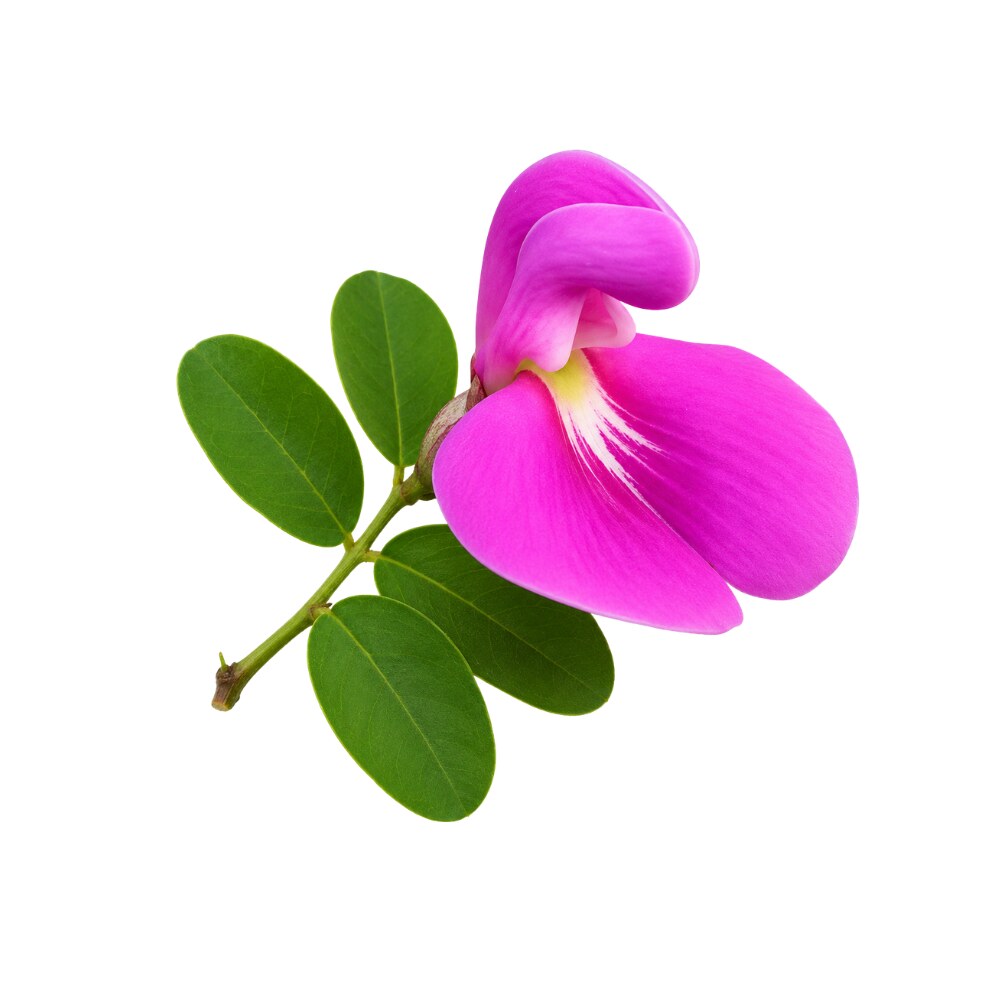
Bay bean (Canavalia rosea, syn. Canavalia maritima) is a sprawling, salt-tolerant legume that grows along tropical and subtropical beaches around the world. Trailing or climbing stems run 2–10 metres over the sand, becoming woody with age, carrying thick fleshy trifoliate leaves and showy pink-purple pea flowers. It is one of the classic “strand” plants of the open coast, frequently found knitting together dune faces alongside beach morning glory 1Reference 1Canavalia rosea.
Its medicinal reputation is almost entirely a folk one. Coastal communities across Australia, Southeast Asia, the Pacific and the Americas have used the root, leaf and seed for rheumatism, wounds, colds and as a purgative 1,2,3Reference 1Canavalia roseaReference 2Pataning dagat / Canavalia rosea (Bay Bean)Reference 3A., Maina, S. In the modern ethnobotanical trade the dried leaf has a second life as a mild smoking herb and tobacco substitute, which is where most of the plant’s contemporary attention — and most of its unverified mythology — comes from.
It is worth being clear at the outset: bay bean is not a well-studied medicine, and the genus carries a genuinely toxic amino acid, L-canavanine. This monograph documents traditional use and the limited available phytochemistry; it is not a recommendation to ingest the plant.
How Is Bay Bean Used?
Traditional preparations are simple decoctions, infusions and poultices. The root is steeped or decocted (and in the Guianas steeped in vinegar) as a diuretic, purgative and gargle; leaf decoctions are taken or applied for rheumatism; and crushed leaves are made into a paste for boils, with the petiole juice dabbed onto thorn punctures 2,3Reference 2Pataning dagat / Canavalia rosea (Bay Bean)Reference 3A., Maina, S. Young pods, seeds and flowers are eaten as food once thoroughly cooked, and the seed is a minor protein source in parts of West Africa 1Reference 1Canavalia rosea.
The modern use is different in kind: the dried leaves are smoked alone or blended into herbal smoking mixtures as a relaxant and marijuana or tobacco substitute, where bay bean is treated as a base or potentiator herb rather than the active. In that context it is usually combined with other smokable herbs such as damiana and mullein, or used in place of tobacco.
Traditional Uses
Aboriginal Australian
Australian Aboriginal groups drank an infusion of the roots for colds and applied the same preparation externally for rheumatism, general aches and pains. The crushed roots were also rubbed over the skin for skin disorders and, in some accounts, for leprosy 1Reference 1Canavalia rosea.
Southeast Asian & Pacific
In the Philippines (where the plant is called pataning-dagat) the juice from the leaf petioles is applied to puncture wounds from thorns and other sharp objects, a decoction of the leaves is used for rheumatism, and a paste of the leaves is applied to boils. Young pods are boiled and eaten. Across the Pacific and Southeast Asian coasts the plant doubles as a food, sand-binder and minor medicine 1,2Reference 1Canavalia roseaReference 2Pataning dagat / Canavalia rosea (Bay Bean).
South American (Guianas)
In the Guianas the root is regarded as diuretic and is noted for a bitter, purgative principle; it is steeped in vinegar and used for gargles. An infusion of the seed is taken as a purgative. The flowers are eaten as a flavouring and young seeds cooked as a pulse 3Reference 3A., Maina, S.
Modern smoking blends
Contemporary ethnobotanical use centres on the dried leaf as a mild relaxant smoked alone or in herbal blends, marketed as a tobacco or cannabis substitute. The dried leaves have also been described, vaguely, as an entheogen used in older rituals 2Reference 2Pataning dagat / Canavalia rosea (Bay Bean). These claims are poorly documented and the smoked effect is mild at best (see Pharmacology and Safety).
Indications
Bay bean’s indications are traditional and largely unsubstantiated by clinical research. Documented folk uses include:
- Rheumatism and general aches (leaf decoction, root wash)
- Colds (root infusion)
- Boils and skin complaints (leaf paste)
- Minor puncture wounds (petiole juice)
- Constipation / as a purgative (root and seed)
- Mild relaxation when smoked (modern use)
Because the active basis for most of these uses is unconfirmed and the plant contains L-canavanine, none of these should be read as an endorsement for internal use.
Botany
Canavalia rosea belongs to the bean family (Fabaceae) and the genus Canavalia, which also contains the jack bean (C. ensiformis) and sword bean (C. gladiata). It is a perennial, mat-forming or climbing herb of the open coast, flowering year-round in the tropics. The pea-like flowers are pink to purple; the pods are thick and leathery, splitting to release several hard, rounded seeds 1Reference 1Canavalia rosea.
The seeds are buoyant and impermeable to water, allowing them to float across oceans and colonise distant beaches — which explains the plant’s near-circumtropical distribution. Like most legumes it fixes atmospheric nitrogen through root-nodule bacteria, and it is valued as a spontaneous dune stabiliser and occasional cover crop 1Reference 1Canavalia rosea. It grows in the same strand community as beach morning glory (Ipomoea pes-caprae), with which it is often photographed.
Distribution
Bay bean occurs natively on tropical and subtropical coasts worldwide — upper beaches, cliffs and dunes across Australia, the Pacific Islands, the Americas, Africa and Southeast Asia. In the continental United States it extends as far north as Dixie County (Gulf coast) and Volusia County (Atlantic coast) in Florida. No invasive or noxious-weed status has been documented; as a native strand species it plays a beneficial dune-stabilizing role wherever it occurs.
Growing Conditions
- Trailing coastal perennial, full sun; highly salt- and drought-tolerant, sandy well-drained soil.
- Roughly USDA zone 9b–12.
- Full cultivation detail lives on the companion farm-wiki grow guide for Canavalia rosea (link to be added once that project’s public URL is confirmed).
Pharmacology & Research
Formal research on bay bean is sparse and almost entirely preclinical. Leaf and seed extracts have shown antibacterial, antioxidant and anti-inflammatory activity in laboratory screening, effects generally attributed to the plant’s triterpenes — ursolic acid, oleanolic acid, betulinic acid and α-amyrin — together with its flavonoids 4,6Reference 4ReviewA review on pharmacological aspects of Canavalia rosea (2022) — antibacterial, anti-inflammatory, antiplasmodial and other reported activities; constituent overview.Reference 6Antibacterial activity and preliminary phytochemical analysis of leaf extract of Canavalia rosea (Sw.) DC. (Beach Bean) — triterpenes (α-amyrin, betulinic/oleanolic/ursolic acids) and flavonoids; antibacterial screening.. A concanavalin-A–type seed lectin (ConM) isolated from C. rosea has shown antifungal activity, inhibiting Candida albicans and Candida tropicalis in vitro 5Reference 5PubMed: 35608680 — ConM seed lectin and its antifungal activity. Review-level summaries also list antiplasmodial and anticancer activity, but these rest on isolated in-vitro reports rather than confirmed pharmacology 4Reference 4ReviewA review on pharmacological aspects of Canavalia rosea (2022) — antibacterial, anti-inflammatory, antiplasmodial and other reported activities; constituent overview..
No controlled study supports the plant’s reputation as a psychoactive smoking herb. The frequently repeated claim that the leaves contain trace tryptamines such as N,N-DMT or 5-MeO-DMT has not been confirmed by chemical analysis and should be regarded as unsubstantiated; where a mild smoked effect is described, the purported principle is usually given as the alkaloid L-betonicine, again without solid analytical support.
At the level of individual constituents, the plant’s documented activity tracks a few well-characterised compounds rather than any single “active principle.” The genus-defining non-protein amino acid L-canavanine is a structural analogue of arginine that the plant stores as a chemical defence; in mammalian systems it is incorporated in place of arginine and interferes with arginine-dependent pathways, while its metabolite L-canaline disrupts polyamine biosynthesis — the basis of the antiproliferative and immunotoxic effects reported for the compound, and the reason canavanine-rich legumes are treated with caution 7Reference 7Seena, S., Sridhar, K. R., et al. Nutritional and antinutritional significance of four unconventional legumes of the genus Canavalia — A comparative study. Food Chemistry — canavanine and antinutritional factors in Canavalia (incl. C. rosea / maritima).. The seed lectin ConM, a concanavalin A–type mannose/glucose-binding protein, is a potent T-cell mitogen whose activity is strongly dose-dependent — activating lymphocytes at low concentrations and turning cytotoxic at high ones — and it is this lectin, rather than a small molecule, that carries the plant’s confirmed antifungal action against Candida albicans and C. tropicalis 5Reference 5PubMed: 35608680 — ConM seed lectin and its antifungal activity. The remaining anti-inflammatory and antibacterial signals are attributed to the pentacyclic triterpenes (ursolic acid, oleanolic acid and betulinic acid) and the flavonoids (quercetin, kaempferol and isorhamnetin) — common legume constituents with broad but non-specific activity in laboratory assays 4,6Reference 4ReviewA review on pharmacological aspects of Canavalia rosea (2022) — antibacterial, anti-inflammatory, antiplasmodial and other reported activities; constituent overview.Reference 6Antibacterial activity and preliminary phytochemical analysis of leaf extract of Canavalia rosea (Sw.) DC. (Beach Bean) — triterpenes (α-amyrin, betulinic/oleanolic/ursolic acids) and flavonoids; antibacterial screening.. None of this constituent-level pharmacology has been tested in the whole plant in humans.
Phytochemistry
The defining chemical feature of bay bean is shared with its whole genus: the non-protein amino acid L-canavanine, a structural analogue of arginine that the plant stores (especially in the seed) as a nitrogen reserve and chemical defence 7Reference 7Seena, S., Sridhar, K. R., et al. Nutritional and antinutritional significance of four unconventional legumes of the genus Canavalia — A comparative study. Food Chemistry — canavanine and antinutritional factors in Canavalia (incl. C. rosea / maritima).. The seed is also a classic source of a mannose/glucose-binding lectin — a concanavalin A–type protein known as ConM — alongside the unusual amino-acid derivatives stizolobin and its methyl ether, characteristic of the strand legumes 5Reference 5PubMed: 35608680 — ConM seed lectin and its antifungal activity.
Beyond the amino acids, screening of the leaf and seed reports a conventional legume profile: flavonoids including quercetin, kaempferol and isorhamnetin; a set of pentacyclic triterpenes (ursolic acid, oleanolic acid, betulinic acid and α-amyrin) that carry most of the documented antibacterial activity; and a background of tannins, saponins, phenolics and cardiac glycosides typical of the family 6Reference 6Antibacterial activity and preliminary phytochemical analysis of leaf extract of Canavalia rosea (Sw.) DC. (Beach Bean) — triterpenes (α-amyrin, betulinic/oleanolic/ursolic acids) and flavonoids; antibacterial screening..
Constituent Summary
Bay bean has not been quantitatively profiled, so amounts below are qualitative; canavanine is concentrated in the seed and is the constituent of toxicological concern. † marks L-canavanine, the genus-characteristic non-protein amino acid.
Amino Acid3 compounds1 with data
Lectin1 compound1 with data
Flavonoid3 compoundsno data
Triterpene4 compounds4 with data
Tannin1 compoundno data
Saponin1 compoundno data
Dosage
There is no established or standardised medicinal dose for bay bean. Traditional use relies on simple decoctions and infusions of root or leaf, and topically on leaf pastes and petiole juice. Because the reputed psychoactivity is unverified and the plant contains a toxic amino acid, no reliable internal dosing exists and none is recommended here.
Safety & Pregnancy
Bay bean’s main hazard is the toxic amino acid L-canavanine, concentrated in the seed, so raw seed should not be eaten. With unverified psychoactivity and no established dose, the plant is best regarded as not established for ingestion.
- Toxic L-canavanine. Concentrated in the seed — do not eat raw seed; food use relies on thorough cooking.
- Avoid in pregnancy & lactation. The genus is canavanine-rich and not established as safe.
- Not established for ingestion. Reputed psychoactivity is unverified; no reliable effect profile or dose exists.
- Possible MAOI interaction. As a precaution against the unconfirmed tryptamine claims, do not combine with MAOIs.
- Smoking risk. Smoking any plant material carries its own respiratory risks.
Full safety & interactions detail
The principal safety concern is L-canavanine, an arginine analogue found throughout the Canavalia genus and concentrated in the seed. In quantity, canavanine can be incorporated into proteins in place of arginine and has been linked to immune disturbances; for this reason the raw seeds in particular should not be eaten, and food use of the plant relies on thorough cooking 7Reference 7Seena, S., Sridhar, K. R., et al. Nutritional and antinutritional significance of four unconventional legumes of the genus Canavalia — A comparative study. Food Chemistry — canavanine and antinutritional factors in Canavalia (incl. C. rosea / maritima)..
Because the claimed tryptamine content is unverified, no reliable effect profile or dose exists, and the plant is best regarded as not established for ingestion. As a precaution against the (unconfirmed) tryptamine claims, do not combine with MAOIs. Smoking any plant material carries its own respiratory risks.
Avoid in pregnancy and lactation. The Canavalia genus is rich in the toxic amino acid L-canavanine, and bay bean has not been established as safe for use during pregnancy or breastfeeding, with no human safety data available.
References
- Fern, K. Canavalia rosea. Tropical Plants Database (Useful Tropical Plants), tropical.theferns.info — botanical description, edible and medicinal uses, Australian Aboriginal use.
- StuartXchange. Pataning dagat / Canavalia rosea (Bay Bean). Philippine Medicinal Plants — petiole juice for puncture wounds, leaf decoction for rheumatism, leaf paste for boils, smoking use.
- DeFilipps, R. A., Maina, S. L., & Crepin, J. Medicinal Plants of the Guianas. Smithsonian Institution — root diuretic/purgative, vinegar gargle, seed purgative.
- A review on pharmacological aspects of Canavalia rosea (2022) — antibacterial, anti-inflammatory, antiplasmodial and other reported activities; constituent overview.
- Lectins ConA and ConM extracted from Canavalia ensiformis (L.) DC and Canavalia rosea (Sw.) DC inhibit planktonic Candida albicans and Candida tropicalis (2022). PubMed: 35608680 — ConM seed lectin and its antifungal activity.
- Antibacterial activity and preliminary phytochemical analysis of leaf extract of Canavalia rosea (Sw.) DC. (Beach Bean) — triterpenes (α-amyrin, betulinic/oleanolic/ursolic acids) and flavonoids; antibacterial screening.
- Seena, S., Sridhar, K. R., et al. Nutritional and antinutritional significance of four unconventional legumes of the genus Canavalia — A comparative study. Food Chemistry — canavanine and antinutritional factors in Canavalia (incl. C. rosea / maritima).