Materia Medica
Blue Lotus Flower
Nymphaea caerulea
Blue Lotus Flower (Nymphaea caerulea) is an Egyptian water lily traditionally infused in wine or brewed as tea for its gentle, calming, mildly euphoric and dream-enhancing effects.
What Is Blue Lotus?
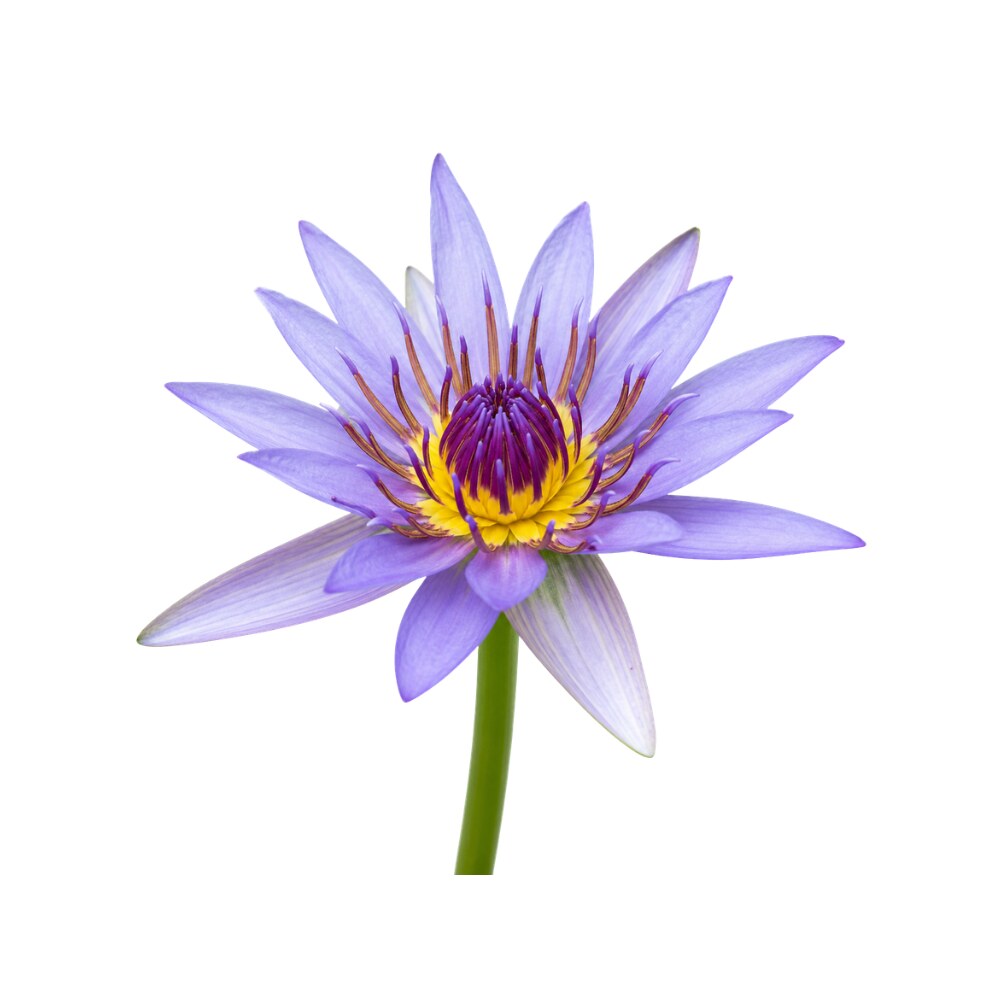
Blue lotus (Nymphaea caerulea) is an aquatic water lily of the Nile and the freshwater ponds of North and East Africa, bearing pale, star-shaped blue flowers that open with the morning sun and close again at dusk. Despite the name it is a water lily, not a true lotus, and shouldn’t be confused with the sacred lotus (Nelumbo nucifera) — the two share one alkaloid but are not interchangeable. The flowers have been used since ancient Egypt for a soft, dreamy relaxation rather than any kind of intoxication.
What makes blue lotus worth knowing is how gentle it is. It’s mildly psychoactive, but in a register completely unlike the classic psychedelics — there are no visuals, no distortions of perception, no “trip.” Instead it leans calming, faintly euphoric, and mood-lifting, with a long folk reputation as an aphrodisiac and a dream herb. The effects are subtle enough that some people barely notice them, and its physical risk is low: there are no reliably documented fatalities, and the worst most people encounter is nausea or drowsiness.
The one caution worth stating up front is about combinations. Because blue lotus is itself relaxing and mildly sedating, it stacks with anything else that slows you down — alcohol most of all, but also sedative or sleep medication. It was traditionally taken in wine, and that pairing is exactly where people are most likely to overshoot into heavy drowsiness. Keep it away from alcohol and other sedatives, and don’t drive after using it (see Cautions & Safety).
Traditional Uses
Few plants are as woven into a culture as blue lotus is into ancient Egypt. It appears throughout Egyptian art, carvings, and tomb hieroglyphs, and its petals were sometimes laid over the mummified pharaohs. Because the flower opens at sunrise and closes at sunset, the Egyptians tied it to the sun god Ra and to the daily cycle of death and rebirth; in their creation mythology, the god Nefertem — and with him the world itself — was said to have risen from a blue lotus blossoming out of the primal waters.
In practice the flowers were most often steeped in wine, producing a gently euphoric, relaxing drink used in social and ceremonial settings, and they were also brewed as a tea. The plant was valued as a relaxant and aphrodisiac and, in folk use, as a mild emetic and pain-reliever. That ceremonial role has largely faded, but the flower has found a second life among people interested in its calming effects and, especially, its reputation for vivid and lucid dreams.
How Much Should I Take?
Blue lotus is forgiving, but potency varies a great deal between products, so it’s worth starting on the low side and adjusting. There’s no single “correct” dose — the method matters as much as the amount.
| Method | Typical amount |
|---|---|
| Tea | 2–5 g dried flowers, steeped ~5–10 min |
| Wine / spirit infusion | 5–10 g soaked in a bottle for days to weeks, then strained |
| Tincture | 1–3 mL |
| Smoked / vaporised | A small pinch of dried flower or resin |
A few practical notes. For tea, use water just off the boil (around 80 °C) and keep the mug covered while it steeps — the flower is rich in fragrant volatile oils, and near-boiling water with a lid preserves both the aroma and the active compounds. It has a pleasant floral taste on its own but takes honey well. The traditional wine infusion is simply dried flowers left to soak in wine (or a neutral spirit like vodka) for several days to a few weeks before straining; the alcohol both extracts and preserves the plant. Smoking or vaping the flower or its concentrated resin gives a faster, stronger onset — and, correspondingly, a higher chance of side effects — so it’s the method to treat with the most caution. Onset is roughly 20–45 minutes by tea, with effects lasting a couple of hours.
How Does Blue Lotus Work?
Blue lotus owes its activity to a pair of aporphine-type alkaloids — nuciferine and aporphine — that act on the brain’s dopamine and serotonin systems. This is a different mechanism from the serotonergic psychedelics, and it’s why the experience is calming and dreamy rather than visionary.
The clearest thread is dopaminergic activity. Aporphine is the parent compound of a family of Nymphaea alkaloids, and in the body it is closely related to apomorphine — a non-selective dopamine-receptor (chiefly D2) agonist used pharmaceutically in Parkinson’s disease and, historically, for erectile dysfunction. That apomorphine-like dopamine action is the most likely basis for blue lotus’s gentle euphoria, its relaxing quality, and its traditional aphrodisiac reputation 4,5Reference 4Differential actions of antiparkinson agents at multiple classes of monoaminergic receptorView study →Reference 5ReviewSubcutaneously administered apomorphine: pharmacokinetics and metabolism — reviewView study →.
Nuciferine, the more abundant alkaloid, fills in the calming side of the picture. In pharmacological screening it behaves much like an atypical antipsychotic, blocking several serotonin (5-HT2) receptors while partially activating dopamine D2 receptors and inhibiting the dopamine transporter 3Reference 3In vitroIn vitro and in vivo characterization of the alkaloid nuciferine — in vitro and mouseView study →. This mixed, modulating profile fits the lived experience well: a settling of mental activity and mood rather than stimulation or hallucination.
Together these alkaloids produce a state that is best described as soporific and mildly euphoric — relaxed, a little dreamy, and inclined toward sleep — which is also thought to be why blue lotus is associated with more vivid and lucid dreaming.
One important caveat: these alkaloids concentrate in the leaves rather than the petals and are highly variable between products — authentic flower material sometimes carries only trace amounts, or none — so how much of this pharmacology a given tea or infusion actually delivers is genuinely uncertain 1,2Reference 1Chemical composition, market survey, and safety assessment of blue lotus (Nymphaea caerulea Savigny) extracts — analytical market surveyView study →Reference 2The blue lotus flower (Nymphaea caerulea) resin used in a new type of electronic cigarette, the rebuildable dripping atomizer — analyticalView study →.
Botany
Blue lotus is a rhizomatous aquatic perennial in the water-lily family (Nymphaeaceae), bearing pale, star-shaped blue flowers that open with the morning sun and close at dusk. Kew’s Plants of the World Online treats this taxon as a variety of the wider-ranging Nymphaea nouchali.
Distribution
The species is native to the Nile and the freshwater ponds and wetlands of North and East Africa, with a native range spanning Egypt south to southern Africa, the southern Arabian Peninsula, and the Comoros. It shows no invasive or weedy reputation and is cultivated as an ornamental water-garden plant well beyond that range.
Growing Conditions
- Aquatic perennial, full sun; rooted in mud with leaves and flowers floating on still or slow-moving fresh water.
- Roughly USDA zone 10-12.
- Full cultivation detail lives on the companion farm-wiki grow guide for Nymphaea caerulea (link to be added once that project’s public URL is confirmed).
Pharmacology & Research
Blue lotus is far better documented as a cultural artefact than as a medicine: the literature is small, almost entirely preclinical, and dominated by analytical chemistry and receptor pharmacology rather than clinical work. No randomised controlled trial of the flower exists, and no human efficacy trial of any kind — the only human data are a small emergency-department case series describing sedation and perceptual disturbance after vaping or drinking blue lotus preparations 8Reference 8Case reportToxicity from blue lotus (Nymphaea caerulea) after ingestion or inhalation: a case seriesView study →. The most credible mechanistic thread is the receptor pharmacology of the aporphine alkaloid nuciferine, characterised in vitro and in mice 3Reference 3In vitroIn vitro and in vivo characterization of the alkaloid nuciferine — in vitro and mouseView study →, but the same analytical surveys that define the plant repeatedly find its signature alkaloids highly variable and often near-absent in authentic flower material 1,2Reference 1Chemical composition, market survey, and safety assessment of blue lotus (Nymphaea caerulea Savigny) extracts — analytical market surveyView study →Reference 2The blue lotus flower (Nymphaea caerulea) resin used in a new type of electronic cigarette, the rebuildable dripping atomizer — analyticalView study → — so any alkaloid-based claim must be read against the preparation actually consumed. Treat everything below as mechanism-and-tradition, not proven therapeutics.
- Best-supported: a genuine but mild sedative/relaxant character, consistent across receptor pharmacology 3Reference 3In vitroIn vitro and in vivo characterization of the alkaloid nuciferine — in vitro and mouseView study →, a human case series 8Reference 8Case reportToxicity from blue lotus (Nymphaea caerulea) after ingestion or inhalation: a case seriesView study →, and long ceremonial use 9,10Reference 9ReviewTranscultural use of narcotic water lilies in ancient Egyptian and Maya drug ritual — reviewView study →Reference 10ReviewNymphaea cults in ancient Egypt and the New World: a lesson in empirical pharmacology — reviewView study →.
- Emerging, worth watching: in vitro antioxidant flavonols isolated from the actual flower 6Reference 6In vitroAntioxidant constituents of Nymphaea caerulea flowers — in vitroView study →, and a single in vitro anti-leukaemic signal 7Reference 7In vitroThe apoptotic property of Nymphaea caerulea flower extract on the acute myeloid leukaemia cell line THP-1 — in vitroView study →.
- Mechanistically thin: the aphrodisiac and dream-enhancing (oneirogenic) reputations rest on constituent-level analogy and tradition, with no direct study of the flower.
- The caveat: the psychoactive alkaloids are inconsistent between products and frequently trace-level or absent in authentic flowers 1,2Reference 1Chemical composition, market survey, and safety assessment of blue lotus (Nymphaea caerulea Savigny) extracts — analytical market surveyView study →Reference 2The blue lotus flower (Nymphaea caerulea) resin used in a new type of electronic cigarette, the rebuildable dripping atomizer — analyticalView study →, so effects and evidence do not transfer cleanly across teas, tinctures, and vaped resins.
1. Sedative & anxiolytic
The signature effect of blue lotus is a soft, sedating relaxation, and it is the best-characterised pharmacologically. Its more abundant alkaloid, nuciferine, was profiled through the NIMH Psychoactive Drug Screening Program and behaves like an aripiprazole-type atypical antipsychotic — antagonist at 5-HT2A/2B/2C, partial agonist at dopamine D2, and a dopamine-transporter inhibitor — and in mice it blocked a serotonergic head-twitch response and substituted for clozapine in drug-discrimination tests 3Reference 3In vitroIn vitro and in vivo characterization of the alkaloid nuciferine — in vitro and mouseView study →. Human evidence is limited to a case series of five patients who developed sedation and perceptual disturbance after vaping or drinking blue lotus preparations, managed with supportive care alone 8Reference 8Case reportToxicity from blue lotus (Nymphaea caerulea) after ingestion or inhalation: a case seriesView study →, alongside its documented ceremonial use as a relaxant drink 9,10Reference 9ReviewTranscultural use of narcotic water lilies in ancient Egyptian and Maya drug ritual — reviewView study →Reference 10ReviewNymphaea cults in ancient Egypt and the New World: a lesson in empirical pharmacology — reviewView study →. There are no controlled anxiety trials, so the “anxiolytic” label is an extrapolation from this calming profile rather than a measured effect.
Gap: the calming mechanism rests on nuciferine, yet market surveys find that alkaloid highly variable and sometimes near-absent in authentic flowers 1,2Reference 1Chemical composition, market survey, and safety assessment of blue lotus (Nymphaea caerulea Savigny) extracts — analytical market surveyView study →Reference 2The blue lotus flower (Nymphaea caerulea) resin used in a new type of electronic cigarette, the rebuildable dripping atomizer — analyticalView study → — so a given tea may carry little of the compound the mechanism depends on, and no trial has measured the effect in humans.
2. Antioxidant
This is the one activity measured directly in the actual plant part people use. A phytochemical study of Nymphaea caerulea flowers isolated twenty constituents and found nine of them — chiefly rhamnosides and glucosides of myricetin, quercetin and kaempferol, plus gallic acid derivatives — active in a radical-scavenging assay, with the ethyl-acetate fraction most potent (IC50 ~0.2 µg/mL), attributed to synergy among the flavonols 6Reference 6In vitroAntioxidant constituents of Nymphaea caerulea flowers — in vitroView study →. Because these flavonols are water-soluble, a flower infusion plausibly delivers them, so the preparation match is reasonable.
Gap: the evidence is purely in vitro (a chemical DPPH-type assay); there is no cell, animal, or human work showing an antioxidant effect in a living system, and no dose has been established.
3. Aphrodisiac & libido
Blue lotus has been used as an aphrodisiac since antiquity 9Reference 9ReviewTranscultural use of narcotic water lilies in ancient Egyptian and Maya drug ritual — reviewView study →, and there is a plausible-sounding mechanism: the flower’s aporphine skeleton is structurally related to apomorphine, a non-selective dopamine (mainly D2) agonist that was developed pharmaceutically for erectile dysfunction, and dopamine signalling is central to sexual desire and arousal 4,5Reference 4Differential actions of antiparkinson agents at multiple classes of monoaminergic receptorView study →Reference 5ReviewSubcutaneously administered apomorphine: pharmacokinetics and metabolism — reviewView study →. But the supporting pharmacology is about the drug apomorphine, not the flower, and a screen of Nymphaeaceae extracts for erectile-dysfunction-relevant PDE5 inhibition found activity in several other Nymphaea species while not testing N. caerulea itself 11Reference 11In vitroPhosphodiesterase 5 and arginase inhibitory activities of extracts from some members of Nelumbonaceae and Nymphaeaceae — in vitroView study →. No study has demonstrated a libido or erectile effect for blue lotus.
Gap: this is constituent-level and cross-species inference — the effect has never been tested in the flower, and apomorphine’s own presence in authentic material is inconsistent 1,2Reference 1Chemical composition, market survey, and safety assessment of blue lotus (Nymphaea caerulea Savigny) extracts — analytical market surveyView study →Reference 2The blue lotus flower (Nymphaea caerulea) resin used in a new type of electronic cigarette, the rebuildable dripping atomizer — analyticalView study →.
4. Anticancer
A 2024 in vitro study tested a hydro-ethanolic whole-flower extract of N. caerulea against the THP-1 acute myeloid leukaemia cell line, with a normal kidney epithelial line as control, and reported cytotoxicity accompanied by upregulation of pro-apoptotic signalling (caspase-3 and caspase-9, Fas/CD95) and shifts in inflammatory cytokines 7Reference 7In vitroThe apoptotic property of Nymphaea caerulea flower extract on the acute myeloid leukaemia cell line THP-1 — in vitroView study →. The authors present it as the first anti-leukaemic evaluation of the species.
Gap: a single cell-line experiment with no in vivo confirmation, no isolation of the responsible compound, and no bearing on how the flower is actually consumed — it establishes a research lead, not an activity.
5. Oneirogenic
The best-known modern use of blue lotus is as an oneirogen — a dream enhancer — with users reporting deeper sleep and more vivid or lucid dreams. Mechanistically this is read as a downstream consequence of the sedative, mood-lifting alkaloid pharmacology 3Reference 3In vitroIn vitro and in vivo characterization of the alkaloid nuciferine — in vitro and mouseView study → easing the transition into sleep, and it aligns with the plant’s long association with dream and ritual states 9,10Reference 9ReviewTranscultural use of narcotic water lilies in ancient Egyptian and Maya drug ritual — reviewView study →Reference 10ReviewNymphaea cults in ancient Egypt and the New World: a lesson in empirical pharmacology — reviewView study →. No study has measured sleep architecture, dream recall, or lucidity after blue lotus.
Gap: the entire indication is experiential and traditional; there is no polysomnography, no dream-diary trial, and no preclinical sleep model — the pharmacology is merely consistent with the reports.
Mechanisms
| Mechanism | Drives | Key compounds |
|---|---|---|
| 5-HT2A/2C antagonism, D2 partial agonism, dopamine-transporter inhibition | sedativeanxiolyticoneirogenic | nuciferine |
| Dopamine D2 (apomorphine-like) agonism | aphrodisiaceuphoria/mood | aporphine, apomorphine |
| Flavonol free-radical scavenging | antioxidant | myricetin, quercetin, kaempferol |
| Pro-apoptotic signalling (caspase-3/9, Fas) in vitro | anticancer | whole-flower extract fraction |
Clinical trials
No registered clinical trials of blue lotus or Nymphaea caerulea were identified — the evidence base is preclinical (chemistry, receptor pharmacology, in vitro assays) and ethnobotanical, with the only human data a five-patient toxicology case series 8Reference 8Case reportToxicity from blue lotus (Nymphaea caerulea) after ingestion or inhalation: a case seriesView study →.
| Completed | Planned | Terminated | Preclinical |
|---|---|---|---|
| 0 | 0 | 0 | ~7 |
Last checked: July 2026.
Phytochemistry
The signature actives are the aporphine-type alkaloids nuciferine and apomorphine, which differentiate genuine Nymphaea caerulea from look-alike water lilies and are credited with its gentle sedative and mood effects. Their levels are highly variable: alkaloids concentrate in the leaves rather than the petals, and analyses have found nuciferine in essentially all “blue lotus” products but apomorphine in only a few, with authentic flower material sometimes carrying only trace amounts 1,2Reference 1Chemical composition, market survey, and safety assessment of blue lotus (Nymphaea caerulea Savigny) extracts — analytical market surveyView study →Reference 2The blue lotus flower (Nymphaea caerulea) resin used in a new type of electronic cigarette, the rebuildable dripping atomizer — analyticalView study →. Alongside the alkaloids the flowers carry a rich flavonol fraction — kaempferol, quercetin, myricetin and their rhamnosides — plus the phytosterols stigmasterol and β-sitosterol 6Reference 6In vitroAntioxidant constituents of Nymphaea caerulea flowers — in vitroView study →.
Constituent Summary
Figures below are for commercial resin/extract samples analysed by LC-MS/MS (ng of alkaloid per g of material); reported alkaloid content varies enormously between samples and is often near zero in authentic flowers. Flavonols are reported qualitatively. † marks the aporphine markers used to distinguish true blue lotus from substitute water lilies.
Isoquinoline alkaloid3 compounds2 with data
Flavonoid6 compoundsno data
Safety & Pregnancy
Blue lotus is a low-risk plant with low toxicity, mild effects and no reliably documented fatalities. The realistic cautions are additive sedation with alcohol and other CNS depressants, and not driving after use.
- Additive sedation. Adds to alcohol, benzodiazepines, opioids and sleep aids — don’t combine; the traditional wine infusion is the classic overshoot.
- Don’t drive. The drowsiness means no driving or operating machinery after use.
- Vaping concentrates. Inhaling the flower or resin hits faster and stronger, with more side effects than tea.
- Legal status varies. Restricted in a few places (e.g. Latvia, Russia, Poland) — check local rules.
- Low toxicity. Mild effects; the most common side effect is nausea, and there are no reliably documented fatalities.
Full safety & interactions detail
Blue lotus is a low-risk plant. It has low toxicity at the modest amounts normally used, no reliably documented fatalities, and its effects are mild. The only human clinical report is a case series of five people who developed sedation and perceptual disturbance after vaping (four) or drinking (one) blue lotus preparations — all recovered with supportive care alone 8Reference 8Case reportToxicity from blue lotus (Nymphaea caerulea) after ingestion or inhalation: a case seriesView study →. The realistic cautions are about combinations and side effects rather than the flower being overwhelming:
- Alcohol and sedatives: because blue lotus is itself relaxing and mildly sedating, it adds to alcohol, benzodiazepines, opioids, sleep aids, and other CNS depressants. The traditional wine infusion is the classic way to overshoot into heavy drowsiness, so treat that pairing with respect and don’t combine the flower with sedative medication. (No formal pharmacokinetic/CYP450 interaction study exists — this is an additive-sedation caution, not a measured drug interaction.)
- Driving and machinery: the same drowsiness means you shouldn’t drive or operate machinery after using it.
- Smoking / vaping concentrates: inhaling the flower or its resin produces faster, stronger effects and a higher chance of side effects than tea; it’s the method most worth approaching cautiously.
The most common side effect is nausea, which tends to ease after the first couple of sessions as tolerance builds; pairing the tea with ginger helps. Larger doses have been reported to cause a faster heart rate, palpitations, dizziness, or digestive upset. Legal status varies — blue lotus is unregulated in most of the world but restricted in a few places (for example Latvia, Russia, and Poland), so check your local rules.
No study has assessed blue lotus safety in pregnancy or lactation. Given its dopaminergic and serotonergic alkaloids and its psychoactivity, and the complete absence of reproductive-safety data, it is best avoided during pregnancy and breastfeeding — a precaution from the absence of data, not from a demonstrated harm.
References
- Dosoky, N. S., Shah, S. A., Dawson, J. T., Banjara, S. S., Poudel, A., Bascoul, C., & Satyal, P. (2023). Chemical composition, market survey, and safety assessment of blue lotus (Nymphaea caerulea Savigny) extracts — analytical market survey. Molecules. https://pubmed.ncbi.nlm.nih.gov/37894493/
- Poklis, J. L., Mulder, H. A., Halquist, M. S., Wolf, C. E., Poklis, A., & Peace, M. R. (2017). The blue lotus flower (Nymphaea caerulea) resin used in a new type of electronic cigarette, the rebuildable dripping atomizer — analytical. Journal of Psychoactive Drugs. https://pubmed.ncbi.nlm.nih.gov/28266899/
- Farrell, M. S., McCorvy, J. D., Huang, X. P., et al. (2016). In vitro and in vivo characterization of the alkaloid nuciferine — in vitro and mouse. PLoS One. https://pubmed.ncbi.nlm.nih.gov/26963248/
- Millan, M. J., Maiofiss, L., Cussac, D., et al. (2002). Differential actions of antiparkinson agents at multiple classes of monoaminergic receptor. I. Binding profiles of 14 drugs at 21 human receptor subtypes — receptor binding. Journal of Pharmacology and Experimental Therapeutics. https://pubmed.ncbi.nlm.nih.gov/12388666/
- LeWitt, P. A. (2004). Subcutaneously administered apomorphine: pharmacokinetics and metabolism — review. Neurology. https://pubmed.ncbi.nlm.nih.gov/15037665/
- Agnihotri, V. K., ElSohly, H. N., Khan, S. I., Smillie, T. J., Khan, I. A., & Walker, L. A. (2008). Antioxidant constituents of Nymphaea caerulea flowers — in vitro. Phytochemistry. https://pubmed.ncbi.nlm.nih.gov/18534639/
- Chatterjee, D., Singh, B., Paira, K., Das, S., et al. (2024). The apoptotic property of Nymphaea caerulea flower extract on the acute myeloid leukaemia cell line THP-1 — in vitro. Asian Pacific Journal of Cancer Prevention. https://pubmed.ncbi.nlm.nih.gov/38285776/
- Schimpf, M., Ulmer, T., Hiller, H., & Barbuto, A. F. (2023). Toxicity from blue lotus (Nymphaea caerulea) after ingestion or inhalation: a case series. Military Medicine. https://pubmed.ncbi.nlm.nih.gov/34345890/
- Emboden, W. A. (1981). Transcultural use of narcotic water lilies in ancient Egyptian and Maya drug ritual — review. Journal of Ethnopharmacology. https://pubmed.ncbi.nlm.nih.gov/7007741/
- Bertol, E., Fineschi, V., Karch, S. B., Mari, F., & Riezzo, I. (2004). Nymphaea cults in ancient Egypt and the New World: a lesson in empirical pharmacology — review. Journal of the Royal Society of Medicine. https://pubmed.ncbi.nlm.nih.gov/14749409/
- Panklai, T., Suphrom, N., Temkitthawon, P., et al. (2023). Phosphodiesterase 5 and arginase inhibitory activities of extracts from some members of Nelumbonaceae and Nymphaeaceae — in vitro. Molecules. https://pubmed.ncbi.nlm.nih.gov/37570790/