Materia Medica
Cascara sagrada
Rhamnus purshiana
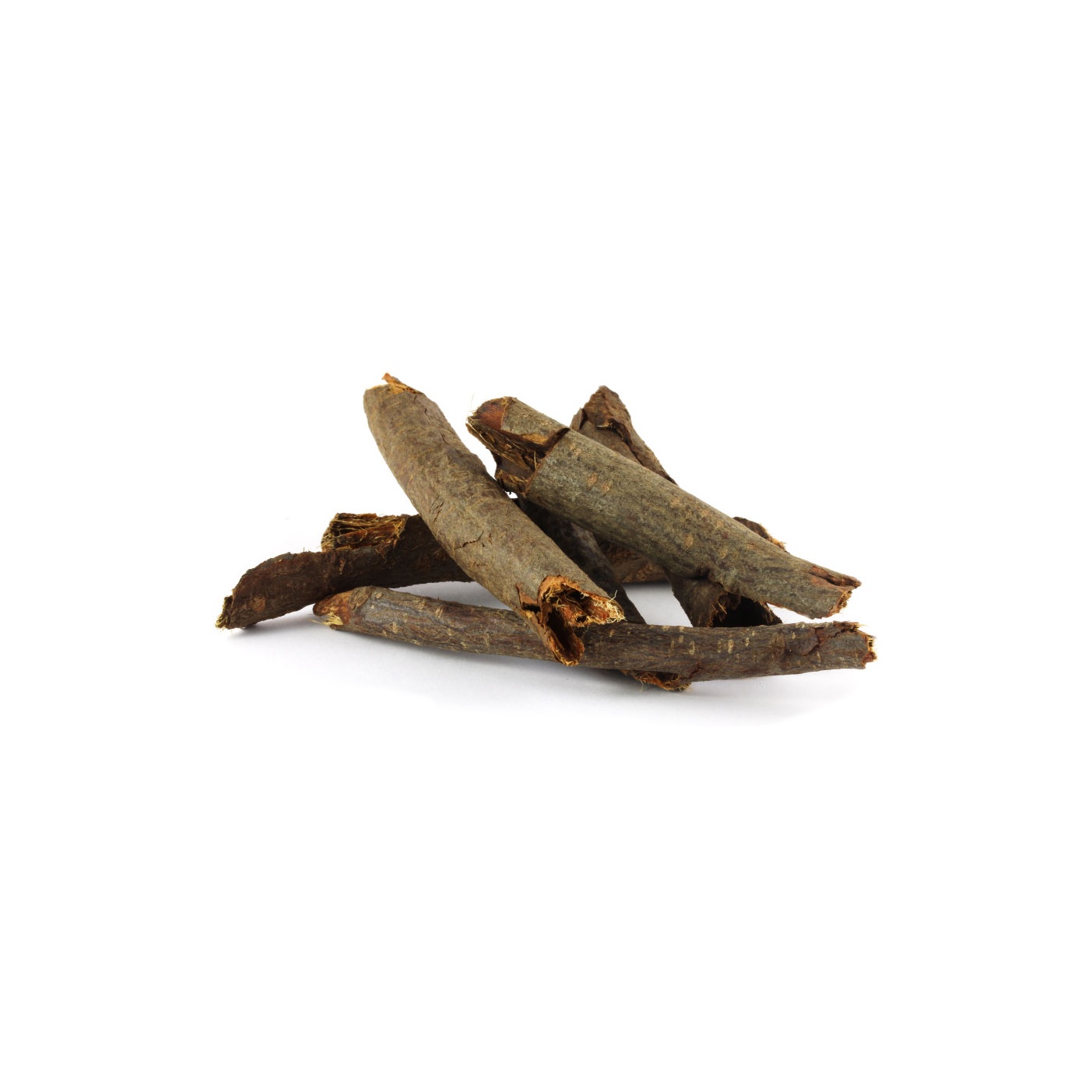
Cascara sagrada (Rhamnus purshiana) — a stimulant laxative bark used short-term for constipation and sluggish bowels.
What Is Cascara Sagrada?
Cascara sagrada is primarily used for constipation.
The aged bark is exceptionally bitter — which stimulates the vagus nerve, liver, and digestive organs. As bile acids and pancreatic secretions begin moving in the gastrointestinal tract, it triggers the gastric mucosa to expand and contract. This is important to help foods move through the digestive tract.
Some of the active compounds in the herb work by irritating the digestive mucosa — causing them to writhe and contract.
This herb needs to be used carefully — high doses can be very uncomfortable and result in serious harm.
What Is Cascara Sagrada Used For?
Cascara sagrada is mainly used as a lower bowel tonic for treating constipation.
Traditional Uses
Traditional use of cascara sagrada included: intestinal tonic, dyspepsia, constipation, digestion related headaches, to loosen stool for conditions such as haemorrhoids, rheumatism, biliary catarrh with jaundice, and chronic liver diseases 18Reference 18A Clinical Guide to Blending Liquid Herbs.
Native Americans used cascara sagrada as a cathartic 18Reference 18A Clinical Guide to Blending Liquid Herbs.
Botany
Cascara sagrada is a deciduous small tree or large shrub of the buckthorn family (Rhamnaceae). West of the Cascades it develops a single trunk and reaches roughly 6–10 m; on tougher sites it stays shrubby. It leafs out in spring, flowers in early summer, and ripens dark berry-like drupes in autumn.
There is a naming wrinkle worth flagging: the plant was long catalogued as Rhamnus purshiana, but current taxonomy (Kew, GBIF) treats Frangula purshiana as the accepted name, grouping cascara with the alder buckthorns rather than the true buckthorns. Both names still circulate in herbal and pharmacopeial literature. It should not be confused with its weedy European relatives Rhamnus cathartica and Frangula alnus, which are invasive in parts of North America — the opposite of cascara’s native, at-risk status.
Distribution
Cascara is native to the Pacific Northwest of North America, from British Columbia south through Washington and Oregon to northern California, reaching east to northern Idaho and Montana. It favours moist bottomlands and lower mountain slopes, often growing alongside red alder, though it is rarely abundant.
It is a native tree, not a weed. The conservation concern runs the other way: because harvesting the bark generally kills the tree, decades of heavy commercial stripping depleted wild stands, and cascara sits on United Plant Savers’ “To Watch” at-risk list — a reason to prefer cultivated or sustainably sourced bark.
Growing Conditions
- Deciduous, cold-hardy tree (roughly USDA zones 4–9); full sun to light woodland shade; a moist-site species.
- Full cultivation detail lives on the companion farm-wiki grow guide for Frangula purshiana (link to be added once that project’s public URL is confirmed).
Harvesting, Collection & Preparation
The bark of cascara sagrada is harvested in spring and early summer. During this time it’s easily peeled from the tree. It’s then dried in the shade. Aged bark (3 years) is generally the preferred product, as the emetic effects lessen over this time and is much less likely to cause issues with griping and emesis 17Reference 17Buckthorn (Californian). https://www.botanical.com/botanical/mgmh/b/buckth80.htmlView study →.
Phytochemistry
The laxative action of cascara is driven by its hydroxyanthracene derivatives (anthranoids), which make up around 8% of the dried bark by mass 2Reference 2ReviewSafety of hydroxyanthracene derivatives for use in food — pharmacopoeial standard and genotoxicity reviewView study →. The signature compounds are the cascarosides — C-glycosylated anthrones unique to this group of plants — which account for roughly 60–70% of the total glycosides; the European Pharmacopoeia requires no less than 8% total hydroxyanthracenes, of which at least 60% are cascarosides (calculated as cascaroside A) 2Reference 2ReviewSafety of hydroxyanthracene derivatives for use in food — pharmacopoeial standard and genotoxicity reviewView study →. The cascarosides occur as the diastereomeric pairs A/B (derived from aloins/barbaloin) and C/D (derived from chrysophanol) 2Reference 2ReviewSafety of hydroxyanthracene derivatives for use in food — pharmacopoeial standard and genotoxicity reviewView study →.
Behind these sit the aglycone anthraquinones emodin, aloe-emodin and chrysophanol, along with their anthrone glycosides. Emodin in particular is the constituent most studied for cascara’s anticancer activity. Astringent tannins are also present and partly offset the bowel-stimulating effect.
Constituent Summary
Figures are share of the dried bark (total hydroxyanthracenes) or share of total glycosides, per the European Pharmacopoeia standard; the remaining aglycones and tannins are qualitative as published figures vary widely with bark age and aging time 2Reference 2ReviewSafety of hydroxyanthracene derivatives for use in food — pharmacopoeial standard and genotoxicity reviewView study →.
Anthraquinone7 compounds7 with data
Tannin1 compoundno data
Pharmacology & Research
Cascara sagrada is one of the better-characterised stimulant (anthranoid) laxatives, but its evidence base is lopsided: the laxative action itself rests on well-mapped pharmacology and pharmacopoeial standardisation rather than modern controlled trials, while the largest published body of primary research on cascara’s constituents concerns the anthraquinone emodin in cancer cell lines — work that is almost entirely in vitro and does not reflect how the bark is used. No placebo-controlled RCT of cascara sagrada as a laxative has been registered or published, and the U.S. FDA reclassified it as not generally recognised as safe and effective for over-the-counter use in 2002 for want of submitted data 3Reference 3Status of certain additional over-the-counter drug category II and III active ingredients (cascara sagrada reclassified as not GRASE)View study →. The same hydroxyanthracene constituents that drive the laxative effect also carry a genotoxicity signal that led the EU to restrict them in food in 2021 2,4Reference 2ReviewSafety of hydroxyanthracene derivatives for use in food — pharmacopoeial standard and genotoxicity reviewView study →Reference 4In vitroPhytotoxicity and cytogenotoxic effects of extracts from the medicinal bark of Rhamnus purshiana DC. — in vitroView study →. Because constituent profile varies widely with bark age and species, results from isolated emodin or from related Rhamnus/Frangula species transfer poorly to the aged bark preparations actually taken.
- Best-supported: short-term relief of constipation via colon-specific stimulation of motility and fluid secretion — a pharmacologically established, pharmacopoeially standardised action, though cascara-specific human trials are essentially absent 1,2Reference 1Meta-analysisAnthraquinone laxatives use and colorectal cancer: systematic review and meta-analysis of observational studiesView study →Reference 2ReviewSafety of hydroxyanthracene derivatives for use in food — pharmacopoeial standard and genotoxicity reviewView study →.
- Emerging, worth watching: emodin’s anti-proliferative and pro-apoptotic activity in cancer cell lines 5,7Reference 5In vitroCytotoxicity of structurally diverse anthranoids and correlation with mechanism of action and side effects — in vitroView study →Reference 7In vitroAntitumor effects and mechanism of novel emodin rhamnoside derivatives against human cancer cells in vitroView study → — mechanistically interesting but preclinical, low-bioavailability, and prep-mismatched.
- Mechanistically thin: antiviral activity, resting on two decades-old in vitro reports 6,16Reference 6In vitroInactivation of enveloped viruses by anthraquinones extracted from plants — in vitroView study →Reference 16In vitroInhibitory effects of anthraquinones and bianthraquinones on Epstein-Barr virus activation — in vitroView study →.
- The caveat: the constituents responsible for the therapeutic effect are also the ones flagged for genotoxicity 2,4Reference 2ReviewSafety of hydroxyanthracene derivatives for use in food — pharmacopoeial standard and genotoxicity reviewView study →Reference 4In vitroPhytotoxicity and cytogenotoxic effects of extracts from the medicinal bark of Rhamnus purshiana DC. — in vitroView study →; this is a herb where efficacy and safety concerns share the same molecules.
1. Laxative
Cascara’s laxative effect is the one indication with a coherent, replicated mechanism. The bark’s C-glycosylated anthrones — the cascarosides, which account for roughly 60–70% of its total glycosides and are the marker the European Pharmacopoeia standardises to (not less than 8% total hydroxyanthracenes) — pass largely unabsorbed through the small intestine and are cleaved by colonic bacteria to active aglycones such as aloe-emodin anthrone 2,13,14Reference 2ReviewSafety of hydroxyanthracene derivatives for use in food — pharmacopoeial standard and genotoxicity reviewView study →Reference 13Untargeted metabolomics for profiling of cascara, senna, rhubarb, and frangula metabolitesView study →Reference 14Isolation of six anthraquinone diglucosides from cascara sagrada bark by high-performance countercurrent chromatographyView study →. These act locally in the large bowel, increasing propulsive motility and net fluid-and-electrolyte secretion through prostaglandin- and nitric-oxide–mediated pathways 1Reference 1Meta-analysisAnthraquinone laxatives use and colorectal cancer: systematic review and meta-analysis of observational studiesView study →. The action is real and pharmacopoeially recognised (WHO, ESCOP, Commission E), but the human evidence is old and cascara-specific: modern trials benchmark other bowel regimens, and a 2022 meta-analysis of anthraquinone laxatives treats the class as a whole rather than cascara individually 1Reference 1Meta-analysisAnthraquinone laxatives use and colorectal cancer: systematic review and meta-analysis of observational studiesView study →. In 2002 the FDA moved cascara from the OTC “generally recognised as safe and effective” category to Category II/III — a regulatory judgement about missing submitted data, not a finding that it fails to work 3Reference 3Status of certain additional over-the-counter drug category II and III active ingredients (cascara sagrada reclassified as not GRASE)View study →.
Gap: no placebo-controlled RCT of cascara sagrada itself for constipation; efficacy is inferred from anthranoid-class pharmacology and traditional use, and the standardised dose is defined chemically rather than clinically.
2. Anticancer
The bark’s most-studied single molecule, the anthraquinone emodin, is structurally similar to the anthracycline chemotherapeutics and shows anti-proliferative, pro-apoptotic (mitochondrial/intrinsic pathway) and anti-angiogenic activity across many cancer cell lines 7Reference 7In vitroAntitumor effects and mechanism of novel emodin rhamnoside derivatives against human cancer cells in vitroView study →. Semi-synthetic emodin glycoside derivatives improve on the parent molecule’s potency and bioavailability in vitro 7Reference 7In vitroAntitumor effects and mechanism of novel emodin rhamnoside derivatives against human cancer cells in vitroView study →. But almost all of this work is cell-line based, emodin’s oral bioavailability is low, and — the decisive caveat — this is not how cascara is used: the bark is taken as a short-course laxative, not as a source of isolated emodin. A 2018 structure–activity analysis places the anthranoids’ cytotoxicity on the same axis as their gut-irritant and genotoxic effects, so “anticancer” and “adverse” are not cleanly separable properties 5Reference 5In vitroCytotoxicity of structurally diverse anthranoids and correlation with mechanism of action and side effects — in vitroView study →. Whole-extract studies further show that isolated-molecule cytotoxicity does not straightforwardly predict what the crude bark does 15Reference 15In vitroHydroxyanthracene derivatives cytotoxicity: a differential evaluation between single molecule and whole plant extract — in vitroView study →.
Gap: no in vivo tumour models with the bark itself and no clinical data; the activity belongs to an isolated constituent at exposures unrelated to laxative dosing, and the responsible molecules are genotoxic 4Reference 4In vitroPhytotoxicity and cytogenotoxic effects of extracts from the medicinal bark of Rhamnus purshiana DC. — in vitroView study →.
Mechanisms
| Mechanism | Drives | Key compounds |
|---|---|---|
| Colonic bacterial hydrolysis of cascarosides → active anthrone aglycones | laxative | aloe-emodin, emodin |
| ↑ propulsive motility + net fluid/electrolyte secretion (prostaglandin, nitric-oxide mediated) | laxative | anthrone aglycones |
| DNA intercalation, mitochondrial (intrinsic) apoptosis, NF-κB ↓ | anticancer (in vitro) | emodin, aloe-emodin |
| Direct binding to and inactivation of the viral envelope | antiviral (in vitro) | emodin, aloe-emodin |
| Topoisomerase interference / genotoxicity (efficacy and safety share the same target) | anticancer signalsafety concern | emodin, aloe-emodin, chrysophanol |
Clinical trials
No registered clinical trials of cascara sagrada for constipation or any other indication were identified (ClinicalTrials.gov hits for “cascara” refer to coffee-cherry pulp or unrelated acronym trials); the efficacy base is pharmacopoeial and mechanistic, and the constituent research is preclinical.
| Completed | Planned | Terminated | Preclinical |
|---|---|---|---|
| 0 | 0 | 0 | ~40 |
Last checked: July 2026.
Dosage
Regulatory guidance frames cascara’s dose by hydroxyanthracene content, not raw bark weight, because bark potency varies with aging — and use is short-term only.
| Indication | Preparation | Dose | Est. dried-herb equivalent | Source |
|---|---|---|---|---|
| Constipation (laxative) | Standardised extract, hydroxyanthracenes as cascaroside A | 20–30 mg hydroxyanthracenes/day (pharmacopoeial daily dose) | ~0.25–0.4 g dried bark (assuming bark ≈ 8% hydroxyanthracenes) | 2Reference 2ReviewSafety of hydroxyanthracene derivatives for use in food — pharmacopoeial standard and genotoxicity reviewView study → |
The dried-herb equivalent is back-converted from the marker dose on the stated assumption that dried bark ≈ 8% hydroxyanthracenes (European Pharmacopoeia minimum) — a guide only, not a recommendation. Cascara is dosed by hydroxyanthracene content precisely because bark potency varies with aging.
Traditional Dosage
| System | Preparation | Dose |
|---|---|---|
| Western herbal | Liquid extract 1:2 | 20–50 mL/week (short courses) |
| Western herbal | Dried aged bark (≥1 yr, decoction/infusion) | ~0.3–1 g as a single evening dose |
Safety & Pregnancy
Cascara is a stimulant (anthranoid) laxative for short-term use only: chronic use brings electrolyte loss, laxative dependence, a genotoxicity signal, and — rarely — liver injury.
- Short-term only. Prolonged use causes potassium loss, laxative dependence and atonic colon — pharmacopoeial bodies cap continuous use at about 1–2 weeks.
- Genotoxicity signal. Its hydroxyanthracene constituents raised EFSA safety concern and are restricted in food across the EU.
- Rare liver injury. Case reports of idiosyncratic cholestatic hepatitis, portal hypertension and acute liver injury.
- Melanosis coli / cancer signal. Chronic use pigments the colonic mucosa and carries a modest, confounded association with colorectal risk.
- Drug interactions. Potassium loss can potentiate cardiac glycosides (digoxin) and interact with antiarrhythmics, diuretics and corticosteroids.
Full safety & interactions detail
Cascara sagrada is a stimulant (anthranoid) laxative for short-term use only — repeated or prolonged use causes electrolyte loss (notably potassium depletion), laxative dependence, and atonic colon, and pharmacopoeial and regulatory bodies limit continuous use to about one to two weeks 2Reference 2ReviewSafety of hydroxyanthracene derivatives for use in food — pharmacopoeial standard and genotoxicity reviewView study →. Its hydroxyanthracene constituents carry a genotoxicity signal: EFSA concluded in 2018 that aloe-emodin, emodin, and structurally related anthranoids raise safety concern, and the EU subsequently restricted these compounds in food 2,4Reference 2ReviewSafety of hydroxyanthracene derivatives for use in food — pharmacopoeial standard and genotoxicity reviewView study →Reference 4In vitroPhytotoxicity and cytogenotoxic effects of extracts from the medicinal bark of Rhamnus purshiana DC. — in vitroView study →. Chronic use pigments the colonic mucosa (melanosis coli), a benign, reversible marker of anthranoid exposure that is nonetheless associated with a higher detection rate of colorectal adenoma 11,12Reference 11ReviewMelanosis coli: a helpful contrast effect or a harmful pigmentation? — reviewView study →Reference 12ObservationalSevere grade of melanosis coli is associated with a higher detection rate of colorectal adenoma — observationalView study →; a 2022 meta-analysis of anthraquinone laxatives found a modest association with colorectal cancer risk that could not be separated from confounding by constipation itself 1Reference 1Meta-analysisAnthraquinone laxatives use and colorectal cancer: systematic review and meta-analysis of observational studiesView study →. Cascara sagrada has caused idiosyncratic cholestatic hepatitis, portal hypertension, and acute liver injury in case reports 8,9,10Reference 8Case reportCascara sagrada-induced intrahepatic cholestasis causing portal hypertension: case report and review of herbal hepatotoxicityView study →Reference 9A case of cholangiocarcinoma identified incidentally after acute liver injury due to cascara sagradaView study →Reference 10Case reportToxic hepatitis following consumption of the herbal medicinal product cascara sagrada — case reportView study →, and the U.S. FDA withdrew its over-the-counter “generally recognised as safe and effective” status in 2002 3Reference 3Status of certain additional over-the-counter drug category II and III active ingredients (cascara sagrada reclassified as not GRASE)View study →. Potassium loss can potentiate cardiac glycosides (e.g. digoxin) and interact with antiarrhythmics, diuretics, and corticosteroids — a class-level pharmacological caution for stimulant laxatives.
Cascara sagrada is contraindicated in pregnancy: stimulant anthranoid laxatives are traditionally avoided for their potential to stimulate the uterus and cause reflex bowel activity, and the genotoxicity concern attached to its hydroxyanthracene constituents reinforces this 2Reference 2ReviewSafety of hydroxyanthracene derivatives for use in food — pharmacopoeial standard and genotoxicity reviewView study →. Anthranoid metabolites can pass into breast milk, so it is generally not recommended during lactation. These are precautionary, class-based positions — cascara sagrada itself has not been formally studied in pregnancy or lactation.
Clinical Applications
Cascara sagrada is mainly used for constipation and as a tonic for poor bowel motility.
Synergy
Suggested synergy with boldo for digestive complaints such as constipation, flatulence, and abdominal fullness 18Reference 18A Clinical Guide to Blending Liquid Herbs.
Combine with rhubarb, boldo, and gentian for dyspepsia 18Reference 18A Clinical Guide to Blending Liquid Herbs.
References
- Lombardi, N., Crescioli, G., Bettiol, A., et al. (2022). Anthraquinone laxatives use and colorectal cancer: systematic review and meta-analysis of observational studies. Phytotherapy Research. https://pubmed.ncbi.nlm.nih.gov/35040201/
- EFSA Panel on Food Additives and Nutrient Sources (ANS). (2018). Safety of hydroxyanthracene derivatives for use in food — pharmacopoeial standard and genotoxicity review. EFSA Journal. https://pubmed.ncbi.nlm.nih.gov/32625659/
- Food and Drug Administration, HHS. (2002). Status of certain additional over-the-counter drug category II and III active ingredients (cascara sagrada reclassified as not GRASE). Federal Register. https://pubmed.ncbi.nlm.nih.gov/12001972/
- Silva Souza, K., et al. (2025). Phytotoxicity and cytogenotoxic effects of extracts from the medicinal bark of Rhamnus purshiana DC. — in vitro. Journal of Toxicology and Environmental Health, Part A. https://pubmed.ncbi.nlm.nih.gov/39964315/
- Demarque, D. P., et al. (2018). Cytotoxicity of structurally diverse anthranoids and correlation with mechanism of action and side effects — in vitro. Journal of Pharmacy & Pharmaceutical Sciences. https://pubmed.ncbi.nlm.nih.gov/30321134/
- Sydiskis, R. J., Owen, D. G., Lohr, J. L., Rosler, K. H., & Blomster, R. N. (1991). Inactivation of enveloped viruses by anthraquinones extracted from plants — in vitro. Antimicrobial Agents and Chemotherapy. https://pubmed.ncbi.nlm.nih.gov/1810179/
- Xing, J. Y., Song, G. P., Deng, J. P., et al. (2015). Antitumor effects and mechanism of novel emodin rhamnoside derivatives against human cancer cells in vitro. PLOS ONE. https://pubmed.ncbi.nlm.nih.gov/26682731/
- Nadir, A., Reddy, D., & Van Thiel, D. H. (2000). Cascara sagrada-induced intrahepatic cholestasis causing portal hypertension: case report and review of herbal hepatotoxicity. American Journal of Gastroenterology. https://pubmed.ncbi.nlm.nih.gov/11151906/
- Nakasone, E. S., & Tokeshi, J. (2015). A case of cholangiocarcinoma identified incidentally after acute liver injury due to cascara sagrada. Hawai’i Journal of Medicine & Public Health. https://pubmed.ncbi.nlm.nih.gov/26114074/
- Jacobsen, C., Semb, S., & Kromann-Andersen, H. (2009). Toxic hepatitis following consumption of the herbal medicinal product cascara sagrada — case report. Ugeskrift for Laeger. https://pubmed.ncbi.nlm.nih.gov/19925744/
- Abu Baker, F., et al. (2018). Melanosis coli: a helpful contrast effect or a harmful pigmentation? — review. Clinical Medicine Insights: Gastroenterology. https://pubmed.ncbi.nlm.nih.gov/30574001/
- Katsumata, R., et al. (2022). Severe grade of melanosis coli is associated with a higher detection rate of colorectal adenoma — observational. Journal of Clinical Biochemistry and Nutrition. https://pubmed.ncbi.nlm.nih.gov/36213792/
- Nezi, P., et al. (2025). Untargeted metabolomics for profiling of cascara, senna, rhubarb, and frangula metabolites. Metabolites. https://pubmed.ncbi.nlm.nih.gov/41441021/
- Rho, T., et al. (2020). Isolation of six anthraquinone diglucosides from cascara sagrada bark by high-performance countercurrent chromatography. Journal of Separation Science. https://pubmed.ncbi.nlm.nih.gov/32876395/
- Tinti, L., et al. (2023). Hydroxyanthracene derivatives cytotoxicity: a differential evaluation between single molecule and whole plant extract — in vitro. Frontiers in Plant Science. https://pubmed.ncbi.nlm.nih.gov/37113593/
- Koyama, J., Morita, I., Tagahara, K., & Hirai, K. (2001). Inhibitory effects of anthraquinones and bianthraquinones on Epstein-Barr virus activation — in vitro. Cancer Letters. https://pubmed.ncbi.nlm.nih.gov/11448529/
- A Modern Herbal (1931). Buckthorn (Californian). https://www.botanical.com/botanical/mgmh/b/buckth80.html
- Bone, K. (2003). A Clinical Guide to Blending Liquid Herbs. Churchill Livingstone.