
Materia Medica
Catnip
Nepeta cataria
Catnip (Nepeta cataria) is a mint-family herb famous for exciting cats but acting as a mild sedative and digestive calmative in humans.
What is Catnip?
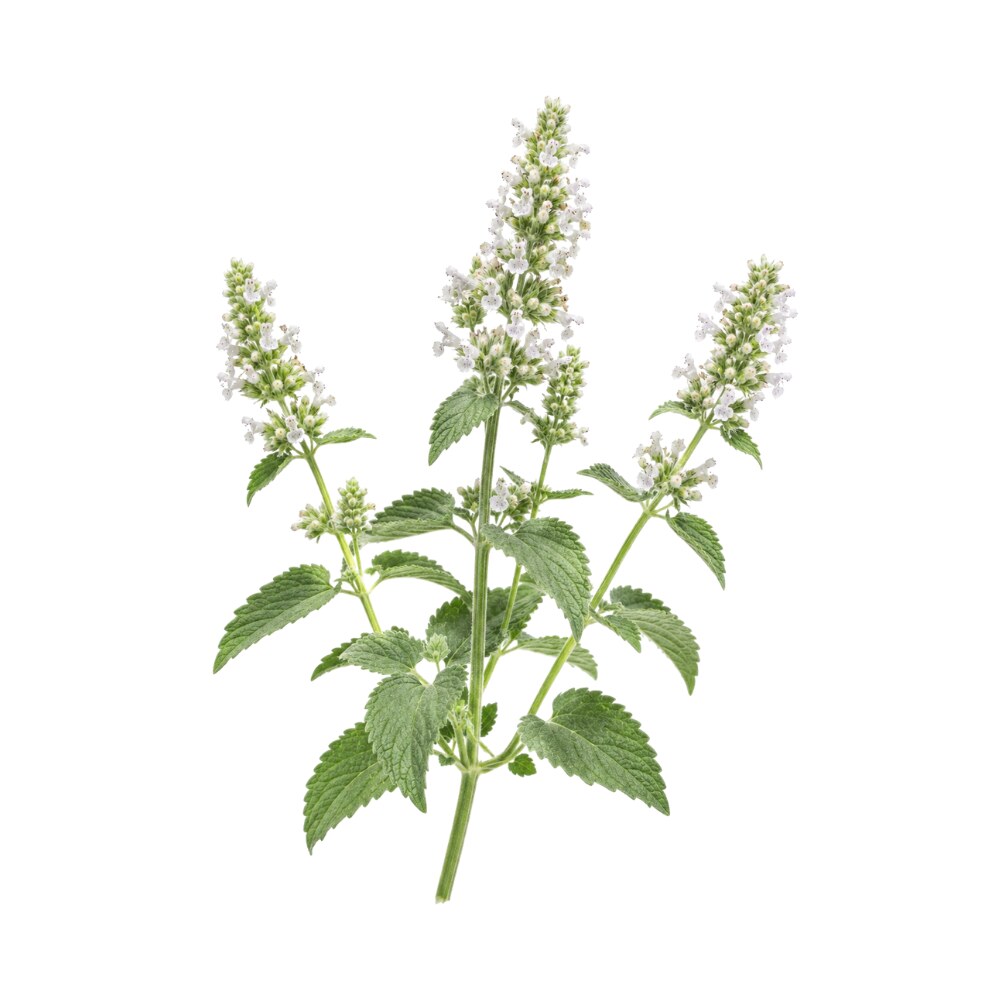
Catnip is an aromatic perennial in the mint family (Nepeta cataria), native to Europe and Asia and widely naturalised, with soft grey-green leaves and spikes of small white flowers. It is best known for the euphoric, playful response it provokes in many cats, but it also has a long history as a gentle herbal remedy for people.
Botany
Catnip is a herbaceous perennial in the mint family (Lamiaceae), forming a spreading 2–3 ft clump of square, downy, gray-green stems and small, purple-spotted white flowers in summer. Its closest relatives are the ornamental catmints (Nepeta × faassenii and kin) — showier garden plants bred for much less of the nepetalactone that excites cats — and it’s easily confused with (but distinct from) Nepeta menthoides, an unrelated Persian species sometimes mixed up with it in sedative research (see Pharmacology & Research, below) 19,21Reference 19ReviewThe genus Nepeta: traditional uses, phytochemicals and pharmacological properties — [review]View study →Reference 21RCTEfficacy of Nepeta menthoides Boiss and Buhse freeze-dried aqueous extract on anxiety of patients with depression: a double-blind randomized controlled clinical trial — [human RCT (different species)]View study →. Notable medicinal and culinary relatives in the wider mint family include lemon balm, peppermint, sage, thyme, oregano and holy basil.
Distribution
Native to Europe, the Middle East, Central Asia and China; long naturalized across southern Canada and most of the continental US, plus other temperate regions worldwide. It self-seeds and spreads readily and is tracked as a regional escape-from-cultivation concern by the Invasive Plant Atlas of the United States, but it is not on the USDA federal noxious weed list — locally weedy rather than formally invasive. No conservation concern; it’s common and widespread.
Growing Conditions
- Life cycle: herbaceous perennial, hardy USDA zones 3–7.
- Light: full sun to part shade.
- Water: dry to medium — notably drought-tolerant once established.
- Habit: low-maintenance, spreads readily by self-seeding.
- Full cultivation detail lives on the companion farm-wiki grow guide for Nepeta cataria (link to be added once that project’s public URL is confirmed — see the review note).
Traditional & Modern Uses
In humans, catnip is used as a calming herbal tea to ease nervous tension, restlessness and mild insomnia, and as a carminative for upset stomach, colic and gas. It has traditionally been given as a diaphoretic to promote sweating during colds and fevers, and to soothe children’s digestive complaints. It is sometimes included in herbal smoking blends for its mild relaxing quality. The intense excitatory effect seen in cats does not occur in people.
Pharmacology & Research
Catnip’s research base is modest in size and skewed heavily toward one application: its essential oil as an arthropod repellent, where the evidence reaches all the way to human field trials and a defined molecular mechanism. Almost everything else — spasmolytic, hepatoprotective, antimicrobial, antioxidant and anti-inflammatory activity — sits at the preclinical tier (isolated tissue, rodent, or in vitro), and the herb’s headline traditional use as a calming sleep tea is the least well supported of all: catnip’s own animal data are contradictory, and the human sedative/anxiety trials often attributed to it were actually run on a different species (Nepeta menthoides). No randomised controlled trial of Nepeta cataria for any human internal indication exists. Results also swing sharply with chemotype — a nepetalactone-rich oil and a 1,8-cineole-rich oil are pharmacologically different plants — so preparation matters throughout.
- Best-supported: insect and tick repellency — catnip essential oil (~92–95% nepetalactone) matched 15% DEET in a human field trial and acts through the TRPA1 irritant receptor 1,2,3Reference 1Evaluating repellence properties of a catnip essential oil-based mosquito repellent using the human landing catch method in Eastern Uganda — [field study, human]View study →Reference 2In vitroThe irritant receptor TRPA1 mediates the mosquito repellent effect of catnip — [in vitro / in vivo mechanism]View study →Reference 3Repellent activity of catmint, Nepeta cataria, and iridoid nepetalactone isomers against Afro-tropical mosquitoes, ixodid ticks and red poultry mites — [WHO topical bioassay]View study →.
- Emerging, worth watching: spasmolytic/bronchodilatory action via calcium-channel and PDE inhibition, which gives the traditional carminative use a real mechanism 9Reference 9Chemical composition and mechanisms underlying the spasmolytic and bronchodilatory properties of the essential oil of Nepeta cataria L. — [isolated-tissue pharmacology]View study →; single-study hepatoprotection in an animal model 10Reference 10AnimalHepatoprotective effect of essential oils of Nepeta cataria L. on acetaminophen-induced liver dysfunction — [animal in vivo]View study →.
- Mechanistically thin: antioxidant, antimicrobial and anti-inflammatory activity rest on in-vitro or constituent-level work; the calming/sedative reputation rests on contradictory rodent data and constituent inference.
- The caveat: almost no human data for any internal use, no standardised dose, and heavy chemotype-driven variability in the oil — a repellent result does not transfer to a cup of tea 16,17Reference 16AnimalBehavioral and toxicological studies of cyclopentanoid monoterpenes from Nepeta cataria — [animal in vivo]View study →Reference 17AnimalBehavioral effects of acute and long-term administration of catnip (Nepeta cataria) in mice — [animal in vivo]View study →.
1. Insect & arthropod repellent
This is the one indication where catnip is backed by human data. In a field trial in Eastern Uganda using the human landing catch method, a lotion with 6% catnip essential oil (>92% nepetalactone) repelled mosquitoes as effectively as 15% DEET, with 2% still highly effective 1Reference 1Evaluating repellence properties of a catnip essential oil-based mosquito repellent using the human landing catch method in Eastern Uganda — [field study, human]View study →. Earlier work established the pattern: a WHO-approved topical bioassay showed activity against the malaria vector Anopheles gambiae, Culex quinquefasciatus, brown ear ticks and red poultry mites 3Reference 3Repellent activity of catmint, Nepeta cataria, and iridoid nepetalactone isomers against Afro-tropical mosquitoes, ixodid ticks and red poultry mites — [WHO topical bioassay]View study →; catnip ranked among the five most effective of 41 oils on human skin (≈8 h protection) 4Reference 4Repellency effect of forty-one essential oils against Aedes, Anopheles, and Culex mosquitoes — [human-skin bioassay]View study →; a Y-tube olfactometer found 2% oil repelled >70% of Aedes aegypti for 1–4 h 5Reference 5In vitroEvaluating repellence properties of catnip essential oil against the mosquito species Aedes aegypti using a Y-tube olfactometer — [in vitro bioassay]View study →; and it deterred >90% of stable flies while matching DEET as a feeding deterrent 6,7Reference 6Efficacy and safety of catnip (Nepeta cataria) as a novel filth fly repellent — [laboratory bioassay + acute toxicity]View study →Reference 7Clinical trialFeeding deterrent effects of catnip oil components compared with two synthetic amides against Aedes aegypti — [comparative bioassay, human volunteers]View study →. The mechanism is defined: nepetalactone activates the conserved irritant receptor TRPA1 in flies and mosquitoes, and TRPA1-mutant insects are no longer repelled — but notably catnip does not activate human TRPA1, which fits its harmlessness to people 2Reference 2In vitroThe irritant receptor TRPA1 mediates the mosquito repellent effect of catnip — [in vitro / in vivo mechanism]View study →. Repellency is chemotype-dependent, tracking nepetalactone-isomer content 8Reference 8In vitroChemical composition matters! The role of nepetalactone isomers in tick repellency — [in vitro / electrophysiology]View study →, and catnip oils vary from nepetalactone-dominant to cineole- or menthone-rich depending on origin and cultivar 18Reference 18Chemical composition of essential oils from Nepeta transcaucasica Grossh. and Nepeta cataria L. cultivated in Bulgaria — [analytical]View study →.
Gap: All efficacy is topical/environmental against arthropods; this says nothing about internal medicinal use, and protection is shorter-lived than long-duration synthetic formulations.
2. Spasmolytic & antispasmodic
This is the strongest mechanistic support for catnip’s traditional carminative and antispasmodic reputation. In isolated rabbit jejunum and guinea-pig trachea, N. cataria essential oil relaxed spontaneous and high-K⁺ contractions and shifted calcium concentration–response curves rightward, indicating calcium-channel blockade, while also potentiating isoprenaline in a papaverine-like pattern that indicates phosphodiesterase (PDE) inhibition 9Reference 9Chemical composition and mechanisms underlying the spasmolytic and bronchodilatory properties of the essential oil of Nepeta cataria L. — [isolated-tissue pharmacology]View study →. The oil studied was a 1,8-cineole/α-pinene-rich chemotype (major components 1,8-cineole ~21%, α-humulene ~14%, α-pinene ~10%, geranyl acetate ~8%) rather than a nepetalactone-dominant one 9Reference 9Chemical composition and mechanisms underlying the spasmolytic and bronchodilatory properties of the essential oil of Nepeta cataria L. — [isolated-tissue pharmacology]View study →. This provides a plausible dual mechanism (Ca²⁺-channel + PDE) for the smooth-muscle relaxant, gut-calming and mild bronchodilatory uses.
Gap: A single ex-vivo study on a specific chemotype, no whole-animal or human confirmation, and the active oil differs in composition from the nepetalactone-rich material sold as catnip.
3. Hepatoprotective
A single animal study found that supercritical-CO₂ essential oil of N. cataria significantly attenuated acetaminophen-induced liver damage in rodents 10Reference 10AnimalHepatoprotective effect of essential oils of Nepeta cataria L. on acetaminophen-induced liver dysfunction — [animal in vivo]View study →. Mechanistically the oil up-regulated Phase II conjugating enzymes (UGTs and SULTs), inhibited CYP2E1 — the enzyme that generates acetaminophen’s toxic intermediate — and appeared to activate the Nrf-2 pathway, together shifting the drug toward harmless metabolism 10Reference 10AnimalHepatoprotective effect of essential oils of Nepeta cataria L. on acetaminophen-induced liver dysfunction — [animal in vivo]View study →.
Gap: One preclinical study, no replication, no human data; the same CYP2E1/UGT/SULT modulation that protects the liver also flags a theoretical drug-metabolism interaction that has not been characterised in people.
4. Antimicrobial
Catnip essential oil shows consistent in-vitro antimicrobial activity, driven mainly by its nepetalactone content. It inhibited common food-borne bacteria and fungi in the composition/activity study already cited on this page 11Reference 11In vitroChemical composition and antimicrobial activities of the essential oil from Nepeta cataria L. against common causes of food-borne infections — [in vitro]View study →, and a 2024 study found activity against a panel of canine skin-infection pathogens including Staphylococcus pseudintermedius, Malassezia pachydermatis and several dermatophytes, with membrane-disruption evidence from electron microscopy and leakage assays 12Reference 12In vitroAntimicrobial effects of catnip (Nepeta cataria L.) essential oil against canine skin infection pathogens — [in vitro]View study →. Broader metabolomic profiling of methanol, ethanol, water, acetone and hexane extracts identified hundreds of metabolites and confirmed antibacterial activity across solvents 13Reference 13In vitroPhytochemical profiling of antimicrobial and potential antioxidant plant: Nepeta cataria — [in vitro (GC/MS, DPPH, ORAC)]View study →.
Gap: All in vitro, all essential oil or concentrated extract, no clinical validation, and the water-infusion (tea) form people actually use was not the tested preparation.
5. Antioxidant
Antioxidant activity is real but modest and entirely in vitro. Bio-guided profiling measured radical-scavenging capacity by DPPH and ORAC assays across multiple N. cataria extracts, attributing activity to its luteolin, quercetin and phenolic content 13Reference 13In vitroPhytochemical profiling of antimicrobial and potential antioxidant plant: Nepeta cataria — [in vitro (GC/MS, DPPH, ORAC)]View study →. A separate study reported ~63% radical scavenging at 5000 µg/mL, though that signal is confounded because the extract was used to synthesise silver nanoparticles rather than tested neat 14Reference 14AnimalSuperior in vivo wound-healing activity of biosynthesized silver nanoparticles with Nepeta cataria (catnip) on excision wound model in rat — [animal in vivo (nanoparticle-confounded)]View study →.
Gap: In-vitro assay activity only, no cellular or in-vivo antioxidant endpoint, and one of the two studies conflates plant antioxidant capacity with nanoparticle formation.
6. Anti-inflammatory
The clearest anti-inflammatory mechanism is at the constituent level. Activity-guided fractionation of N. cataria isolated the caffeoyl phenylethanoid glycosides verbascoside and teupolioside, which directly inhibited calcineurin — a key regulator of T-cell-mediated inflammation — in both its calmodulin-activated and basal states 15Reference 15In vitroDirect inhibition of calcineurin by caffeoyl phenylethanoid glycosides from Teucrium chamaedrys and Nepeta cataria — [in vitro, isolated compounds]View study →. This gives catnip’s traditional use against inflammation a specific molecular rationale (calcineurin is the target of drugs such as ciclosporin), but the work was done on purified compounds in a biochemical assay, not on the herb in a living system.
Gap: Isolated-compound, in-vitro evidence only; no demonstration that a realistic catnip preparation delivers enough of these glycosides to matter in vivo.
7. Sedative & mild CNS
This is catnip’s most famous use in people and its weakest evidence. The animal data are contradictory: an early study found catnip oil and nepetalic acid increased hexobarbital sleeping time in mice, consistent with sedation 16Reference 16AnimalBehavioral and toxicological studies of cyclopentanoid monoterpenes from Nepeta cataria — [animal in vivo]View study →, whereas a later study feeding whole catnip to mice found increased locomotion and rearing, an amphetamine-like stimulant profile, and decreased pentobarbital sleeping time 17Reference 17AnimalBehavioral effects of acute and long-term administration of catnip (Nepeta cataria) in mice — [animal in vivo]View study →. The human insomnia and anxiety RCTs frequently cited for catnip were conducted on Nepeta menthoides, a different Persian species, and cannot be transferred to N. cataria 20,21Reference 20RCTEfficacy of a combination of Melissa officinalis L. and Nepeta menthoides Boiss. & Buhse on insomnia: a triple-blind, randomized placebo-controlled clinical trial — [human RCT (different species)]View study →Reference 21RCTEfficacy of Nepeta menthoides Boiss and Buhse freeze-dried aqueous extract on anxiety of patients with depression: a double-blind randomized controlled clinical trial — [human RCT (different species)]View study →. Consistent with catnip’s mildness in people, its active iridoid does not activate the human TRPA1 receptor that mediates its dramatic effect in insects (and, separately, its excitatory effect in cats does not occur in humans) 2Reference 2In vitroThe irritant receptor TRPA1 mediates the mosquito repellent effect of catnip — [in vitro / in vivo mechanism]View study →.
Gap: No consistent catnip-specific CNS signal, no human data on the actual species, and the sedative reputation rests on traditional use plus constituent inference rather than replicated pharmacology.
Mechanisms
| Mechanism | Drives | Key compounds |
|---|---|---|
| TRPA1 agonism in insects (not human TRPA1); mixed CNS signals | repellentsedative (weak) | nepetalactone, nepetalic acid |
| Ca²⁺-channel blockade + PDE inhibition (papaverine-like) | spasmolyticbronchodilatory | 1,8-cineole, α-pinene, geranyl acetate |
| Smooth-muscle relaxation | spasmolyticanti-inflammatory | caryophyllene, α-humulene |
| Direct calcineurin inhibition (T-cell-mediated) | anti-inflammatoryimmunomodulatory | verbascoside, teupolioside |
| Radical scavenging (DPPH/ORAC) | antioxidant | luteolin, quercetin, rutin |
Clinical trials
No registered clinical trial of Nepeta cataria for any human internal indication was identified. The one human study is a topical repellency field trial of the essential oil 1Reference 1Evaluating repellence properties of a catnip essential oil-based mosquito repellent using the human landing catch method in Eastern Uganda — [field study, human]View study →, not a therapeutic trial — and the insomnia/anxiety RCTs sometimes attributed to catnip were run on a different species, Nepeta menthoides 20,21Reference 20RCTEfficacy of a combination of Melissa officinalis L. and Nepeta menthoides Boiss. & Buhse on insomnia: a triple-blind, randomized placebo-controlled clinical trial — [human RCT (different species)]View study →Reference 21RCTEfficacy of Nepeta menthoides Boiss and Buhse freeze-dried aqueous extract on anxiety of patients with depression: a double-blind randomized controlled clinical trial — [human RCT (different species)]View study →.
| Human (therapeutic) | Human (topical repellent) | Ongoing | Preclinical |
|---|---|---|---|
| 0 | 1 | 0 | ~20+ |
Last checked: July 2026.
Phytochemistry
Catnip is defined by nepetalactone, an iridoid that typically makes up the great majority of the essential oil (its two main isomers together often 70–98%) and is the compound responsible for the response in cats 11,18Reference 11In vitroChemical composition and antimicrobial activities of the essential oil from Nepeta cataria L. against common causes of food-borne infections — [in vitro]View study →Reference 18Chemical composition of essential oils from Nepeta transcaucasica Grossh. and Nepeta cataria L. cultivated in Bulgaria — [analytical]View study →; chemotypes vary widely, however, and some catnip oils are instead cineole- or menthone-dominant with far less nepetalactone. In people, catnip is only traditionally associated with a mild calming effect — this is not clinically established (see Pharmacology & Research). The oil also carries the sesquiterpene caryophyllene and aromatic terpenoids such as citral, citronellol, geraniol and thymol, while the flavonoids luteolin, quercetin and rutin and astringent tannins occur in the leaf 11,18Reference 11In vitroChemical composition and antimicrobial activities of the essential oil from Nepeta cataria L. against common causes of food-borne infections — [in vitro]View study →Reference 18Chemical composition of essential oils from Nepeta transcaucasica Grossh. and Nepeta cataria L. cultivated in Bulgaria — [analytical]View study →, along with the anti-inflammatory phenylpropanoid glycoside verbascoside 15Reference 15In vitroDirect inhibition of calcineurin by caffeoyl phenylethanoid glycosides from Teucrium chamaedrys and Nepeta cataria — [in vitro, isolated compounds]View study → and the triterpene ursolic acid.
Constituent Summary
Figures are the share of catnip essential oil and vary with chemotype, growth stage and origin; flavonoids and tannins are found in the leaf rather than the oil and are listed as No Data. † marks nepetalactone, the iridoid marker whose isomer ratio defines catnip chemotypes and drives the response in cats 11,18Reference 11In vitroChemical composition and antimicrobial activities of the essential oil from Nepeta cataria L. against common causes of food-borne infections — [in vitro]View study →Reference 18Chemical composition of essential oils from Nepeta transcaucasica Grossh. and Nepeta cataria L. cultivated in Bulgaria — [analytical]View study →.
Iridoid2 compounds2 with data
Sesquiterpene1 compound1 with data
Monoterpene4 compounds4 with data
Tannin1 compoundno data
Phenylpropanoid glycoside1 compound1 with data
Triterpene1 compound1 with data
Dosage
No standardised clinical dose exists for catnip — there is no human therapeutic trial to derive one from, and the pharmacological studies use the essential oil rather than the water infusion people actually drink. In traditional practice it is taken as a mild tea of the dried aerial parts, drunk freely for restlessness or an upset stomach; the oil is used topically as an insect repellent, not internally. Because activity varies sharply with chemotype and the tested preparations rarely match the tea, treat any specific figure with caution and regard catnip as a gentle traditional infusion rather than a dosed medicine.
Safety & Pregnancy
Catnip is a low-toxicity herb with a long record of safe use; only very large doses of the tea upset the stomach, and its mild relaxing quality can add to sedatives.
- Adds to sedatives. Its mild relaxing effect may compound drowsiness from sedatives, alcohol or other CNS depressants.
- Very large doses. Excessive tea can cause nausea, vomiting or headache.
- Theoretical metabolism flag. Animal data show CYP2E1 inhibition and Phase II enzyme induction — not characterised in people.
- Low toxicity overall. Long record of safe culinary and medicinal use, backed by animal acute-toxicity data.
Full safety & interactions detail
Catnip is a low-toxicity herb with a long record of safe culinary and medicinal use, and acute-toxicity studies of the essential oil in animals support this (oral LD50 ≈3160 mg/kg in one repellent-safety study, ≈1300 mg/kg in an older study) 6,16Reference 6Efficacy and safety of catnip (Nepeta cataria) as a novel filth fly repellent — [laboratory bioassay + acute toxicity]View study →Reference 16AnimalBehavioral and toxicological studies of cyclopentanoid monoterpenes from Nepeta cataria — [animal in vivo]View study →. Very large doses of the tea can cause nausea, vomiting or headache. Its mild relaxing quality means it may add to the drowsiness of sedatives, alcohol or other CNS depressants, so combine with caution. One animal study found that catnip essential oil inhibited CYP2E1 and induced Phase II (UGT/SULT) drug-metabolising enzymes — a theoretical pharmacokinetic interaction signal that has not been characterised in people, so read it as a flag for study rather than a documented interaction 10Reference 10AnimalHepatoprotective effect of essential oils of Nepeta cataria L. on acetaminophen-induced liver dysfunction — [animal in vivo]View study →. Catnip’s dramatic excitatory effect on cats does not occur in humans 2Reference 2In vitroThe irritant receptor TRPA1 mediates the mosquito repellent effect of catnip — [in vitro / in vivo mechanism]View study →.
Catnip has a long-standing reputation as an emmenagogue / uterine stimulant and is customarily avoided during pregnancy on that basis. This rests on traditional use rather than any modern reproductive-toxicity study, so the avoidance is precautionary rather than evidence of harm, and lactation is likewise unstudied. The sensible line is to avoid medicinal doses in pregnancy and breastfeeding while recognising the caution is traditional, not tested.
References
- Batume C, et al. (2026). Evaluating repellence properties of a catnip essential oil-based mosquito repellent using the human landing catch method in Eastern Uganda — [field study, human]. Scientific Reports. https://pubmed.ncbi.nlm.nih.gov/41832282/
- Melo N, et al. (2021). The irritant receptor TRPA1 mediates the mosquito repellent effect of catnip — [in vitro / in vivo mechanism]. Current Biology. https://pubmed.ncbi.nlm.nih.gov/33667373/
- Birkett MA, et al. (2011). Repellent activity of catmint, Nepeta cataria, and iridoid nepetalactone isomers against Afro-tropical mosquitoes, ixodid ticks and red poultry mites — [WHO topical bioassay]. Phytochemistry. https://pubmed.ncbi.nlm.nih.gov/21056438/
- Amer A, & Mehlhorn H (2006). Repellency effect of forty-one essential oils against Aedes, Anopheles, and Culex mosquitoes — [human-skin bioassay]. Parasitology Research. https://pubmed.ncbi.nlm.nih.gov/16642384/
- Batume C, et al. (2024). Evaluating repellence properties of catnip essential oil against the mosquito species Aedes aegypti using a Y-tube olfactometer — [in vitro bioassay]. Scientific Reports. https://pubmed.ncbi.nlm.nih.gov/38280895/
- Zhu JJ, et al. (2009). Efficacy and safety of catnip (Nepeta cataria) as a novel filth fly repellent — [laboratory bioassay + acute toxicity]. Medical and Veterinary Entomology. https://pubmed.ncbi.nlm.nih.gov/19712151/
- Chauhan KR, et al. (2005). Feeding deterrent effects of catnip oil components compared with two synthetic amides against Aedes aegypti — [comparative bioassay, human volunteers]. Journal of Medical Entomology. https://pubmed.ncbi.nlm.nih.gov/16119554/
- Amiro M, et al. (2026). Chemical composition matters! The role of nepetalactone isomers in tick repellency — [in vitro / electrophysiology]. Journal of Chemical Ecology. https://pubmed.ncbi.nlm.nih.gov/41528609/
- Gilani AH, et al. (2009). Chemical composition and mechanisms underlying the spasmolytic and bronchodilatory properties of the essential oil of Nepeta cataria L. — [isolated-tissue pharmacology]. Journal of Ethnopharmacology. https://pubmed.ncbi.nlm.nih.gov/19041706/
- Tan J, et al. (2019). Hepatoprotective effect of essential oils of Nepeta cataria L. on acetaminophen-induced liver dysfunction — [animal in vivo]. Bioscience Reports. https://pubmed.ncbi.nlm.nih.gov/31337687/
- Zomorodian K, et al. (2012). Chemical composition and antimicrobial activities of the essential oil from Nepeta cataria L. against common causes of food-borne infections — [in vitro]. ISRN Pharmaceutics. https://pubmed.ncbi.nlm.nih.gov/22779012/
- Borlace GN, et al. (2024). Antimicrobial effects of catnip (Nepeta cataria L.) essential oil against canine skin infection pathogens — [in vitro]. Veterinary World. https://pubmed.ncbi.nlm.nih.gov/38680153/
- Nadeem A, et al. (2022). Phytochemical profiling of antimicrobial and potential antioxidant plant: Nepeta cataria — [in vitro (GC/MS, DPPH, ORAC)]. Frontiers in Plant Science. https://pubmed.ncbi.nlm.nih.gov/36226301/
- Sari BR, et al. (2025). Superior in vivo wound-healing activity of biosynthesized silver nanoparticles with Nepeta cataria (catnip) on excision wound model in rat — [animal in vivo (nanoparticle-confounded)]. Biological Trace Element Research. https://pubmed.ncbi.nlm.nih.gov/38865065/
- Prescott TA, et al. (2011). Direct inhibition of calcineurin by caffeoyl phenylethanoid glycosides from Teucrium chamaedrys and Nepeta cataria — [in vitro, isolated compounds]. Journal of Ethnopharmacology. https://pubmed.ncbi.nlm.nih.gov/21843624/
- Harney JW, et al. (1978). Behavioral and toxicological studies of cyclopentanoid monoterpenes from Nepeta cataria — [animal in vivo]. Lloydia. https://pubmed.ncbi.nlm.nih.gov/672466/
- Massoco CO, et al. (1995). Behavioral effects of acute and long-term administration of catnip (Nepeta cataria) in mice — [animal in vivo]. Veterinary and Human Toxicology. https://pubmed.ncbi.nlm.nih.gov/8588288/
- Mollova S, et al. (2023). Chemical composition of essential oils from Nepeta transcaucasica Grossh. and Nepeta cataria L. cultivated in Bulgaria — [analytical]. ACS Omega. https://pubmed.ncbi.nlm.nih.gov/37151483/
- Sharma A, et al. (2021). The genus Nepeta: traditional uses, phytochemicals and pharmacological properties — [review]. Journal of Ethnopharmacology. https://pubmed.ncbi.nlm.nih.gov/33307050/
- Ranjbar M, et al. (2018). Efficacy of a combination of Melissa officinalis L. and Nepeta menthoides Boiss. & Buhse on insomnia: a triple-blind, randomized placebo-controlled clinical trial — [human RCT (different species)]. Journal of Alternative and Complementary Medicine. https://pubmed.ncbi.nlm.nih.gov/29741926/
- Firoozabadi A, et al. (2016). Efficacy of Nepeta menthoides Boiss and Buhse freeze-dried aqueous extract on anxiety of patients with depression: a double-blind randomized controlled clinical trial — [human RCT (different species)]. Iranian Journal of Medical Sciences. https://pubmed.ncbi.nlm.nih.gov/27840470/
- Missouri Botanical Garden Plant Finder — Nepeta cataria — [botanical reference]. https://www.missouribotanicalgarden.org/PlantFinder/PlantFinderDetails.aspx?kempercode=e433
- Invasive Plant Atlas of the United States — catnip: Nepeta cataria — [distribution/weed-status reference]. https://www.invasiveplantatlas.org/subject.html?sub=6078