
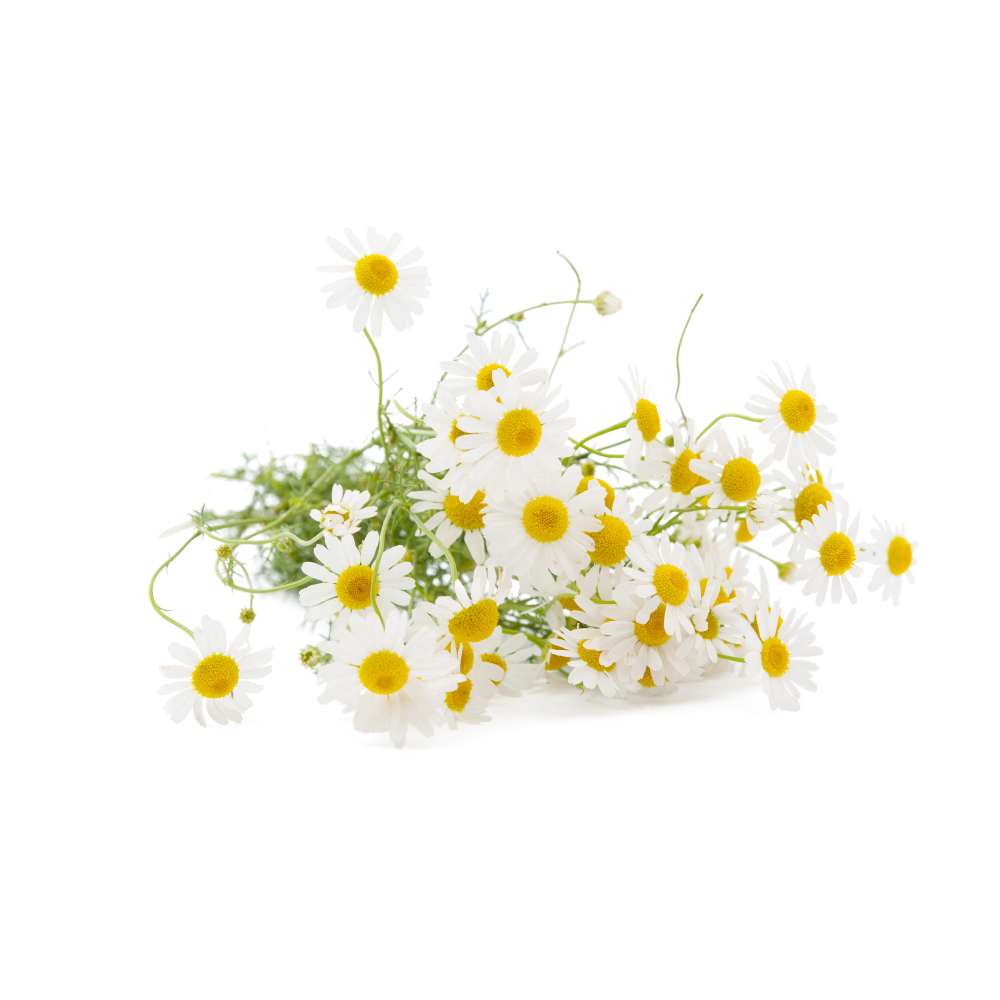
Materia Medica
German Chamomile
Matricaria chamomilla
German chamomile (Matricaria chamomilla) — a gentle, well-rounded herb for sleep, anxiety, digestive upset and irritated skin.
What Is German Chamomile?
German Chamomile is one of the most commonly used medicinal herb species. This is because it has a pleasant flavour and scent, as well as a broad range of medicinal benefits.
This herb can be made into a tea for promoting sleep, relieving anxiety, and soothing digestive complaints. Additionally, chamomile is used topically in the form of an essential oil, strong infusion, or mixed into salves and creams to treat conditions involving the skin such as burns or wounds.
What Is German Chamomile Used For?
German chamomile is a very well-rounded herb, which is likely the reason it’s become so popular all over the world. Unlike many herbs, German chamomile makes a nice cup of tea that can be used as a mild antibacterial for colds and flus, a sedative for insomnia, and as a muscle relaxant.
German chamomile is also useful in topical applications for skin conditions and damage. Common indications include burns, eczema, wounds, boils, bacterial infections, and impetigo.
Traditional Uses
Western Herbal Medicine
Traditionally, Matricaria chamomilla has been used to treat the common cold, bronchitis, gastrointestinal spasms, epilepsy, hypertension, neuralgia, toothache, dysmenorrhea, eczema, impetigo, indigestion, colic, rheumatism, flatulence, diarrhoea, and other digestive disturbances 10,20Reference 10In vitroAntidiarrhoeal, antisecretory and antispasmodic activities of Matricaria chamomilla are mediated predominantly through K⁺-channels activation — animal / in vitro studyView study →Reference 20The Complete Guide to Aromatherapy (2nd ed.) — reference text. Externally the flower heads were used to treat skin disorders 20Reference 20The Complete Guide to Aromatherapy (2nd ed.) — reference text.
Its use was referred to by individuals such as Hippocrates, Galen, and Asclepius and the entire plant including its arial parts, flowers, roots, and volatile oil have all been used medicinally 10Reference 10In vitroAntidiarrhoeal, antisecretory and antispasmodic activities of Matricaria chamomilla are mediated predominantly through K⁺-channels activation — animal / in vitro studyView study →. In modern times, the flowers and volatile oils are generally preferred.
Today, the herb is generally consumed as a tea internally, and its essential oil is mainly used in cosmetics 20Reference 20The Complete Guide to Aromatherapy (2nd ed.) — reference text.
Traditional Chinese Medicine
In TCM, German chamomile is considered to promote the free flow of Qi. This explains the ability for German chamomile to relax the nerves, relieve spasms, and reduce or ease general pain 20Reference 20The Complete Guide to Aromatherapy (2nd ed.) — reference text.
Botany
German chamomile (Matricaria chamomilla) is an annual herb in the daisy family (Asteraceae). It grows quickly from seed into an erect, branched plant with finely divided, feathery leaves and the small white-rayed, yellow-centred flower heads used in tea and for the deep-blue essential oil. A reliable field mark is the flower head’s receptacle — hollow and conical in Matricaria, solid in look-alike mayweeds.
German chamomile shouldn’t be confused with Roman chamomile (Chamaemelum nobile). Although both are daisy-family plants that look similar and are used similarly, they are different species with different chemistry — German is an annual and the main source of chamazulene-rich blue oil, while Roman is a low, mat-forming perennial with a more bitter taste.
Distribution
Matricaria chamomilla is native to Macaronesia, North Africa and temperate Eurasia through to Indo-China — in practice, southern and eastern Europe and western Asia. It favours open, sunny, disturbed ground.
It has been widely introduced and is naturalized across temperate North America and Australia, where it escapes from gardens onto roadsides, waste ground and disturbed meadows; it self-seeds prolifically and can be locally weedy, though it is not an aggressive invader.
Growing Conditions
- Fast-growing annual; full sun; very cold-tolerant, grown as an annual across roughly USDA zones 2–8.
- Full cultivation detail lives on the companion farm-wiki grow guide for Matricaria chamomilla (link to be added once that project’s public URL is confirmed).
Harvesting, Collection & Preparation
The essential oil of german chamomile is obtained by steam distilling the dried flower heads. This essential oil is contained in the highest amounts in the flowers during the beginning of flowering 20Reference 20The Complete Guide to Aromatherapy (2nd ed.) — reference text.
Drying the flowers at 40-45C is suggested to preserve the matricarin the most, and as such will result in the highest quality essential oil 20Reference 20The Complete Guide to Aromatherapy (2nd ed.) — reference text.
Pharmacology & Research
German chamomile is one of the better-studied calming herbs, and the modern literature is substantially richer than a decade of textbook citations suggests. The strongest signal is for anxiety: two dedicated randomised trials of a standardised oral extract show a real, if modest, effect on generalised anxiety disorder 1,2Reference 1RCTA randomized, double-blind, placebo-controlled trial of oral Matricaria recutita (chamomile) extract therapy for generalized anxiety disorder — randomised controlled trialView study →Reference 2RCTLong-term chamomile (Matricaria chamomilla L.) treatment for generalized anxiety disorder: a randomized clinical trialView study →, and chamomile now appears in anxiety network meta-analyses alongside kava and lavender 3Reference 3Meta-analysisMedicinal herbs for the treatment of anxiety: a systematic review and network meta-analysisView study →. Smaller but consistent human evidence is emerging for glycemic control 9Reference 9Meta-analysisThe effect of chamomile consumption on glycemic markers in humans and animals: a systematic review and meta-analysisView study → and for anti-inflammatory endpoints such as oral mucositis 7Reference 7Meta-analysisAnti-inflammatory effect of chamomile from randomized clinical trials: a systematic review and meta-analysisView study →, while the herb’s long-standing digestive and sedative reputation still rests largely on animal and mechanistic work 10,4Reference 10In vitroAntidiarrhoeal, antisecretory and antispasmodic activities of Matricaria chamomilla are mediated predominantly through K⁺-channels activation — animal / in vitro studyView study →Reference 4In vitroPharmacological profile of apigenin, a flavonoid isolated from Matricaria chamomilla — in vitro / animal mechanistic studyView study →. The load-bearing caveat throughout: results are tied to specific preparations — a 1.2%-apigenin capsule, a steam-distilled essential oil, or a water infusion are pharmacologically different products, and an effect shown for one does not transfer to the others.
- Best-supported: mild-to-moderate generalised anxiety disorder, from two randomised trials of a standardised oral extract 1,2Reference 1RCTA randomized, double-blind, placebo-controlled trial of oral Matricaria recutita (chamomile) extract therapy for generalized anxiety disorder — randomised controlled trialView study →Reference 2RCTLong-term chamomile (Matricaria chamomilla L.) treatment for generalized anxiety disorder: a randomized clinical trialView study →; reduction of chemotherapy/radiotherapy oral mucositis severity and pain, from a meta-analysis of randomised trials 7Reference 7Meta-analysisAnti-inflammatory effect of chamomile from randomized clinical trials: a systematic review and meta-analysisView study →.
- Emerging, worth watching: improved fasting glucose and HbA1c in type-2 diabetes (meta-analysis of four small RCTs) 9Reference 9Meta-analysisThe effect of chamomile consumption on glycemic markers in humans and animals: a systematic review and meta-analysisView study →; analgesia for musculoskeletal and menstrual pain 13,14Reference 13Meta-analysisEffect of chamomile on musculoskeletal pain: a systematic review and meta-analysis of randomized controlled trialsView study →Reference 14RCTEffects of chamomile and L-theanine beverage on menstrual pain, symptoms, mood and sleep quality in young women with primary dysmenorrhea: a randomized, double-blind, placebo-controlled studyView study →.
- Mechanistically thin: antimicrobial/antifungal action, which is entirely in-vitro and swings with the essential oil’s α-bisabolol content 17Reference 17In vitroIn vitro antimicrobial activity of essential oil of Thymus schimperi, Matricaria chamomilla, Eucalyptus globulus and Rosmarinus officinalisView study →; the popular “apigenin = GABA sedative” story, which the primary pharmacology actually complicates 4Reference 4In vitroPharmacological profile of apigenin, a flavonoid isolated from Matricaria chamomilla — in vitro / animal mechanistic studyView study →.
- The caveat: almost every positive human result uses a defined extract, oil, or tea — effects do not automatically carry across preparations, and several trials use chamomile inside multi-herb products.
1. Anxiety
This is chamomile’s strongest human indication. A double-blind, placebo-controlled trial randomised 57 outpatients with mild-to-moderate generalised anxiety disorder (GAD) to a standardised chamomile extract (identified as 1.2% apigenin, ~220–1100 mg/day) or placebo for 8 weeks, and found a significantly greater fall in total Hamilton Anxiety (HAM-A) score on chamomile (P = 0.047) 1Reference 1RCTA randomized, double-blind, placebo-controlled trial of oral Matricaria recutita (chamomile) extract therapy for generalized anxiety disorder — randomised controlled trialView study →. A later, larger programme gave open-label chamomile 1500 mg/day (a pharmaceutical-grade 500 mg capsule three times daily) for 12 weeks, then randomised responders to continuation or placebo; chamomile continuation showed fewer and slower relapses, but the difference did not reach statistical significance 2Reference 2RCTLong-term chamomile (Matricaria chamomilla L.) treatment for generalized anxiety disorder: a randomized clinical trialView study →. A Bayesian network meta-analysis of medicinal herbs for anxiety included chamomile among 12 herbs, with the largest and most consistent effects seen for lavender (Silexan) and kava rather than chamomile 3Reference 3Meta-analysisMedicinal herbs for the treatment of anxiety: a systematic review and network meta-analysisView study →. The effect is real but modest, and confined to a specific standardised capsule — not tea.
Gap: No large, definitive efficacy trial; the positive data come from one small RCT and one relapse-prevention study whose primary endpoint was non-significant. Tea and essential-oil forms are untested for GAD.
2. Anti-inflammatory
Anti-inflammatory activity is the best-characterised mechanism in chamomile and now has meta-analytic human support. A 2025 systematic review and meta-analysis of 11 randomised clinical trials found chamomile produced statistically significant reductions in oral mucositis severity and pain, the setting where topical/oral chamomile has been trialled most 7Reference 7Meta-analysisAnti-inflammatory effect of chamomile from randomized clinical trials: a systematic review and meta-analysisView study →. Mechanistically the action is attributed chiefly to the essential-oil sesquiterpenes — chamazulene, formed on steam distillation from the proazulene matricin, and alpha-bisabolol, whose antiphlogistic effect was characterised in classic pharmacology as reducing experimentally induced inflammation 8Reference 8Pharmacological investigations with compounds of chamomile: antiphlogistic effects of (−)-α-bisabolol and bisabolol oxides — animal studyView study → — with the flavone apigenin contributing NF-κB– and COX-linked suppression. The blue colour of the distilled oil comes from chamazulene and is a visual marker of this fraction.
Gap: Most human trials are in a single niche (mouthwash for mucositis); systemic anti-inflammatory benefit from ingested chamomile in conditions like arthritis remains largely preclinical.
3. Glycemic control
A 2024 systematic review and meta-analysis pooling four human RCTs found chamomile consumption significantly lowered fasting blood glucose (SMD −0.65, 95% CI −1.00 to −0.29) and HbA1c (SMD −0.90, 95% CI −1.39 to −0.40), with low heterogeneity for fasting glucose 9Reference 9Meta-analysisThe effect of chamomile consumption on glycemic markers in humans and animals: a systematic review and meta-analysisView study →. The animal arm of the same review showed a clear dose-dependent glucose-lowering effect 9Reference 9Meta-analysisThe effect of chamomile consumption on glycemic markers in humans and animals: a systematic review and meta-analysisView study →. Most human trials used chamomile tea alongside standard diabetes care rather than as monotherapy.
Gap: Only four small human trials, several open-label, with short follow-up; no data on hard endpoints or on whether the effect is clinically meaningful beyond marginal HbA1c change.
4. Antispasmodic & digestive
Chamomile’s traditional use for colic, cramping and diarrhoea has a well-defined animal mechanism. A crude aqueous-methanolic extract produced dose-dependent antidiarrhoeal, antisecretory and antispasmodic effects in mice and relaxed isolated rabbit jejunum, an action mediated predominantly through K⁺-channel activation with a weaker Ca²⁺-antagonist component 10Reference 10In vitroAntidiarrhoeal, antisecretory and antispasmodic activities of Matricaria chamomilla are mediated predominantly through K⁺-channels activation — animal / in vitro studyView study →. In humans the direct evidence is mostly indirect: a systematic review of herbal medicines for paediatric gastrointestinal disorders found promising evidence for a Matricaria chamomilla–containing compound preparation in treating diarrhoea, but chamomile was one component of a multi-herb product 11Reference 11Systematic reviewHerbal medicines for gastrointestinal disorders in children and adolescents: a systematic reviewView study →, and the widely cited functional-dyspepsia benefit comes from the multi-herb preparation STW 5 (Iberogast), not chamomile alone 12Reference 12Meta-analysisMeta-analysis: phytotherapy of functional dyspepsia with the herbal drug preparation STW 5 (Iberogast)View study →.
Gap: No adequately powered trial of chamomile monotherapy (tea or extract) for colic, functional dyspepsia or diarrhoea in humans; the strong mechanistic data are animal/in-vitro.
5. Sleep quality
Two small randomised trials support a mild, transient sleep benefit in different preparations. A trial in 80 postpartum women with poor sleep found two weeks of drinking chamomile tea significantly improved physical-symptom sleep inefficiency and depressive symptoms versus usual care — but the advantage had disappeared by four weeks, indicating an immediate-term effect only 5Reference 5RCTEffects of an intervention with drinking chamomile tea on sleep quality and depression in sleep disturbed postnatal women: a randomized controlled trialView study →. A separate RCT in 80 young adults with insomnia found 15 days of bedtime chamomile essential-oil inhalation significantly reduced Pittsburgh Sleep Quality Index and Insomnia Severity Index scores versus control 6Reference 6RCTEffects of chamomile oil inhalation on sleep quality in young adults with insomnia: a randomized controlled trialView study →. Both are small and short.
Gap: No trial shows durable improvement; effects are short-lived, preparation-specific (tea vs inhaled oil), and unblinded designs limit confidence.
6. Analgesic
A 2025 systematic review and meta-analysis of eight studies concluded chamomile has a potential analgesic effect on musculoskeletal pain versus placebo, with no significant difference from conventional analgesics — but the included studies were significantly heterogeneous 13Reference 13Meta-analysisEffect of chamomile on musculoskeletal pain: a systematic review and meta-analysis of randomized controlled trialsView study →. For menstrual pain, a double-blind RCT of a chamomile-and-L-theanine beverage in young women with primary dysmenorrhea reported large reductions in pain visual-analogue and numerical rating scores (roughly 55–57% versus baseline) 14Reference 14RCTEffects of chamomile and L-theanine beverage on menstrual pain, symptoms, mood and sleep quality in young women with primary dysmenorrhea: a randomized, double-blind, placebo-controlled studyView study →, though the active comparator was a chamomile-flavoured beverage and the combination confounds attribution to chamomile alone.
Gap: High heterogeneity, small samples, and frequent use of combination products; the menstrual-pain signal is confounded by co-administered L-theanine.
7. Skin & wound healing
Topical chamomile has a long dermatological tradition but mixed trial results. A double-blind RCT in 100 breast-cancer patients found a chamomile liposomal gel did not significantly reduce the occurrence of radiation dermatitis versus the same gel without chamomile (dry desquamation 6.0% vs 12.2%, P = 0.32), though self-reported itching was lower in the first weeks 15Reference 15RCTComparison of liposomal gel with and without chamomile to prevent radiation dermatitis in breast cancer patients: a randomized controlled trialView study →. More positively, a 2025 randomised double-blind trial in 72 patients with diabetic neuropathy found topical chamomile oil added to standard gabapentin significantly improved neuropathy indices (Neurothesiometer, MNSI and DN4 scores) versus placebo 16Reference 16RCTTopical chamomile oil as a novel therapeutic intervention for diabetic neuropathy: a randomized double-blind controlled clinical trialView study →. The essential oil’s alpha-bisabolol and chamazulene are the plausible anti-inflammatory actives for skin.
Gap: The best-designed skin trial (radiation dermatitis) was null on its primary outcome; positive results are in different indications and preparations, so topical efficacy is condition- and formulation-dependent.
8. Antimicrobial
Antimicrobial and antifungal activity is real in vitro but unreliable and entirely preclinical. One in-vitro study of the essential oil found very little antimicrobial action and attributed this to low alpha-bisabolol content (4.14% of the oil), contrasting with other samples showing strong antifungal activity at much higher bisabolol levels 17Reference 17In vitroIn vitro antimicrobial activity of essential oil of Thymus schimperi, Matricaria chamomilla, Eucalyptus globulus and Rosmarinus officinalisView study →. This makes α-bisabolol the likely active constituent, and explains why activity swings widely with where and when the plant is grown and how the oil is prepared. There are no human infection trials.
Gap: In-vitro only, with activity dependent on essential-oil chemotype; no clinical evidence that chamomile treats any infection in people.
Mechanisms
| Mechanism | Drives | Key compounds |
|---|---|---|
| NF-κB / prostaglandin–COX inhibition; antiphlogistic in vivo | anti-inflammatoryskin/woundanalgesic | chamazulene, alpha-bisabolol |
| Central benzodiazepine-site binding, GABA-A modulation (complex, not simple agonism); NF-κB suppression | anxietysedationanti-inflammatory | apigenin, apigenin-7-glucoside |
| Conversion to chamazulene on steam distillation | anti-inflammatory (essential-oil forms) | matricin |
| K⁺-channel activation, weak Ca²⁺ antagonism in gut smooth muscle | antispasmodicdigestive | flavonoids, coumarins |
| Improved fasting glucose / HbA1c (human meta-analysis); antioxidant | glycemic control | apigenin, phenolic acids |
Clinical trials
Chamomile is one of the more actively trialled botanicals: ClinicalTrials.gov lists roughly 70 registered studies mentioning chamomile (about 23 specifically for Matricaria chamomilla), spanning anxiety, sleep, oral mucositis, dysmenorrhea and glycemic control — though most individual indications still rest on one or two small trials, several unblinded or using combination products.
| Completed | Planned | Terminated | Preclinical |
|---|---|---|---|
| ~12cited RCTs | — | — | Dozens |
Last checked: July 2026.
Phytochemistry
German chamomile’s activity rests on two complementary fractions. Its blue-tinged essential oil is built around the sesquiterpenes α-bisabolol and chamazulene, the latter formed during steam distillation from the proazulene matricin present in the fresh flower heads 20Reference 20The Complete Guide to Aromatherapy (2nd ed.) — reference text. The water-soluble fraction is dominated by flavone glycosides, chiefly the calming flavone apigenin and its apigenin-7-glucoside, alongside the polyyne en-in-dicycloether, mucilage, coumarins and phenolic acids 17,20Reference 17In vitroIn vitro antimicrobial activity of essential oil of Thymus schimperi, Matricaria chamomilla, Eucalyptus globulus and Rosmarinus officinalisView study →Reference 20The Complete Guide to Aromatherapy (2nd ed.) — reference text. α-Bisabolol content is the main determinant of the oil’s antimicrobial strength and varies widely with provenance and harvest time.
It’s generally accepted that the majority of the anti-inflammatory action belongs to chamazulene and α-bisabolol, while apigenin underlies much of the herb’s mild anxiolytic, GABA-mediated effect.
Constituent Summary
Essential-oil figures are share of the volatile oil from a single steam-distilled sample 17Reference 17In vitroIn vitro antimicrobial activity of essential oil of Thymus schimperi, Matricaria chamomilla, Eucalyptus globulus and Rosmarinus officinalisView study → and shift dramatically with provenance and harvest time (e.g. α-bisabolol has been reported anywhere from ~4% to >50% of oil between samples). Whole-flower amounts are largely qualitative in the cited sources. Chamazulene is largely absent from the fresh flower and forms from matricin on distillation.
Flavonoid3 compounds1 with data
Coumarin1 compound1 with data
Phenolic acid1 compound1 with data
Mucilage1 compound1 with data
Sesquiterpene lactone3 compounds3 with data
Amine1 compound1 with data
Tannin1 compound1 with data
Sesquiterpene6 compounds6 with data
Polyyne1 compound1 with data
Monoterpene3 compounds3 with data
Lipid2 compounds2 with data
Clinical Applications
Chamomile is reliable as a topical anti-inflammatory, and antiseptic for a range of conditions. Internally German Chamomile is useful for conditions involving the central nervous system like insomnia, anxiety, and stress.
Synergy
Possible synergy with lemon balm, liquorice, fennel, and vervain for infant colic.
Dosage
In research, German chamomile is given in several different forms — a standardised oral capsule for anxiety, a water infusion (tea) for sleep and blood-sugar studies, and a topical oil or gel for the skin — and these are not interchangeable. The doses used in the trials cited above:
| Indication | Preparation | Dose | Est. dried-herb equivalent | Source |
|---|---|---|---|---|
| Generalised anxiety | Standardised extract (1.2% apigenin) | ~220–1100 mg/day for 8 weeks | — (no published herb-to-extract ratio) | RCT 1Reference 1RCTA randomized, double-blind, placebo-controlled trial of oral Matricaria recutita (chamomile) extract therapy for generalized anxiety disorder — randomised controlled trialView study → |
| Generalised anxiety (relapse prevention) | Pharmaceutical-grade extract | 1500 mg/day (500 mg × 3) for up to 12 weeks | — (extract; order-of-magnitude only) | RCT 2Reference 2RCTLong-term chamomile (Matricaria chamomilla L.) treatment for generalized anxiety disorder: a randomized clinical trialView study → |
| Sleep — postpartum | Chamomile tea (infusion) | 1 cup daily for 2 weeks | whole flower (tea) | RCT 5Reference 5RCTEffects of an intervention with drinking chamomile tea on sleep quality and depression in sleep disturbed postnatal women: a randomized controlled trialView study → |
| Sleep — insomnia | Essential-oil inhalation | at bedtime for 15 days | n/a (inhaled oil) | RCT 6Reference 6RCTEffects of chamomile oil inhalation on sleep quality in young adults with insomnia: a randomized controlled trialView study → |
| Glycemic control | Chamomile tea (infusion) | with meals, alongside usual diabetes care | whole flower (tea) | Meta-analysis 9Reference 9Meta-analysisThe effect of chamomile consumption on glycemic markers in humans and animals: a systematic review and meta-analysisView study → |
| Primary dysmenorrhea | Chamomile + L-theanine beverage | daily around menstruation | n/a (combination product) | RCT 14Reference 14RCTEffects of chamomile and L-theanine beverage on menstrual pain, symptoms, mood and sleep quality in young women with primary dysmenorrhea: a randomized, double-blind, placebo-controlled studyView study → |
| Diabetic neuropathy | Topical chamomile oil | applied topically, adjunct to gabapentin | n/a (topical) | RCT 16Reference 16RCTTopical chamomile oil as a novel therapeutic intervention for diabetic neuropathy: a randomized double-blind controlled clinical trialView study → |
Chamomile research doses do not convert cleanly to a whole-herb weight: the anxiety trials use standardised or proprietary extracts with no published herb-to-extract ratio, and the tea, inhaled-oil and topical studies are different preparations again. Treat each row as preparation-specific — a guide to what was tested, never a recommendation, and not interchangeable with the traditional doses below.
Traditional Dosage
In Western herbal practice German chamomile is used as the whole flower — a tea, tincture or liquid extract — rather than a standardised isolate. These are traditional preparation ranges, distinct from the research extracts above.
| System | Preparation | Dose |
|---|---|---|
| Western herbal | Dried-flower infusion (tea) | ~2–4 g per cup, up to 3–4× daily |
| Western herbal | 1:2 liquid extract | 20–40 mL / week 21Reference 21A Clinical Guide to Blending Liquid Herbs — reference text |
| Western herbal | Tincture (1:5) | ~3–10 mL, up to 3× daily |
Safety & Pregnancy
German chamomile is very well tolerated, with only mild, self-limiting effects reported in trials. The one caution that matters is Asteraceae (daisy-family) allergy — including rare anaphylaxis, which is why regulators warn against chamomile eye washes.
- Asteraceae allergy. Contact dermatitis and rare anaphylaxis, especially if already sensitised to ragweed, mugwort or feverfew.
- No eye washes. Regulators warn against chamomile eye poultices and washes over allergy and contamination risk.
- Additive & interaction effects. May add to sedatives or alcohol; additive effects with anticoagulant and glucose-lowering drugs are plausible but untested.
- Well tolerated. Pooled trials found only mild, self-limiting gastrointestinal upset and drowsiness.
Full safety & interactions detail
German chamomile is well tolerated. A 2025 systematic review of adverse events pooled 72 trials (2,896 patients receiving chamomile) and found only 65 adverse events across 10 trials — most commonly mild, self-limiting gastrointestinal upset and drowsiness, with no allergic reactions reported in any clinical trial 18Reference 18Systematic reviewChamomile: a systematic review of adverse eventsView study →. The important exception is allergy: chamomile is an Asteraceae (daisy family) plant, and case reports document contact dermatitis and rare anaphylaxis, particularly in people already sensitised to other Asteraceae species such as ragweed, mugwort or feverfew 18Reference 18Systematic reviewChamomile: a systematic review of adverse eventsView study →. Because of this, external use carries real risk in a minority: the European Medicines Agency and ophthalmic guidelines specifically warn against chamomile eye poultices and washes — a common folk remedy — citing potential allergic reactions including life-threatening anaphylaxis, as well as microbial contamination of home-made preparations 19Reference 19ReviewReevaluating the safety of chamomile poultices in ophthalmic care — reviewView study →. Its mild sedative effect means it may add to the drowsiness of sedatives or alcohol, and additive effects with anticoagulant and glucose-lowering drugs are plausible on mechanistic grounds.
No dedicated human drug-interaction studies were identified, so the interaction cautions above are mechanism-based inference rather than tested effects. And the near-absence of allergic reactions in trials does not cancel the documented case-report and regulatory allergy signal — both are real, and the allergy risk is the one to take seriously.
German chamomile has not been formally evaluated for safety in pregnancy or lactation. Chamomile tea is widely consumed as a food and is traditionally considered low-risk in ordinary amounts, but this rests on custom rather than trial data. The concentrated standardised extracts and essential oil used in research are unstudied in pregnancy — treat those as not established and avoid high doses.
References
- Amsterdam JD, et al. (2009). A randomized, double-blind, placebo-controlled trial of oral Matricaria recutita (chamomile) extract therapy for generalized anxiety disorder — randomised controlled trial. Journal of Clinical Psychopharmacology. https://pubmed.ncbi.nlm.nih.gov/19593179/
- Mao JJ, et al. (2016). Long-term chamomile (Matricaria chamomilla L.) treatment for generalized anxiety disorder: a randomized clinical trial. Phytomedicine. https://pubmed.ncbi.nlm.nih.gov/27912875/
- Zhang W, et al. (2022). Medicinal herbs for the treatment of anxiety: a systematic review and network meta-analysis. Pharmacological Research. https://pubmed.ncbi.nlm.nih.gov/35378276/
- Avallone R, et al. (2000). Pharmacological profile of apigenin, a flavonoid isolated from Matricaria chamomilla — in vitro / animal mechanistic study. Biochemical Pharmacology. https://pubmed.ncbi.nlm.nih.gov/10751547/
- Chang SM, Chen CH. (2016). Effects of an intervention with drinking chamomile tea on sleep quality and depression in sleep disturbed postnatal women: a randomized controlled trial. Journal of Advanced Nursing. https://pubmed.ncbi.nlm.nih.gov/26483209/
- Deepa Y, et al. (2025). Effects of chamomile oil inhalation on sleep quality in young adults with insomnia: a randomized controlled trial. International Journal of Psychiatry in Medicine. https://pubmed.ncbi.nlm.nih.gov/39545336/
- Valmy J, et al. (2025). Anti-inflammatory effect of chamomile from randomized clinical trials: a systematic review and meta-analysis. Pharmaceutical Biology. https://pubmed.ncbi.nlm.nih.gov/40665590/
- Jakovlev V, et al. (1979). Pharmacological investigations with compounds of chamomile: antiphlogistic effects of (−)-α-bisabolol and bisabolol oxides — animal study. Planta Medica. https://pubmed.ncbi.nlm.nih.gov/419180/
- Akhgarjand C, et al. (2024). The effect of chamomile consumption on glycemic markers in humans and animals: a systematic review and meta-analysis. Journal of Diabetes and Metabolic Disorders. https://pubmed.ncbi.nlm.nih.gov/38932814/
- Mehmood MH, et al. (2015). Antidiarrhoeal, antisecretory and antispasmodic activities of Matricaria chamomilla are mediated predominantly through K⁺-channels activation — animal / in vitro study. BMC Complementary and Alternative Medicine. https://pubmed.ncbi.nlm.nih.gov/25886126/
- Anheyer D, et al. (2017). Herbal medicines for gastrointestinal disorders in children and adolescents: a systematic review. Pediatrics. https://pubmed.ncbi.nlm.nih.gov/28562281/
- Melzer J, et al. (2004). Meta-analysis: phytotherapy of functional dyspepsia with the herbal drug preparation STW 5 (Iberogast). Alimentary Pharmacology & Therapeutics. https://pubmed.ncbi.nlm.nih.gov/15606389/
- Ahmadi M, et al. (2025). Effect of chamomile on musculoskeletal pain: a systematic review and meta-analysis of randomized controlled trials. Caspian Journal of Internal Medicine. https://pubmed.ncbi.nlm.nih.gov/41394268/
- Soh Z, et al. (2025). Effects of chamomile and L-theanine beverage on menstrual pain, symptoms, mood and sleep quality in young women with primary dysmenorrhea: a randomized, double-blind, placebo-controlled study. Journal of Food and Drug Analysis. https://pubmed.ncbi.nlm.nih.gov/41525193/
- Meneses AG, et al. (2025). Comparison of liposomal gel with and without chamomile to prevent radiation dermatitis in breast cancer patients: a randomized controlled trial. Strahlentherapie und Onkologie. https://pubmed.ncbi.nlm.nih.gov/39283344/
- Amiri M, et al. (2025). Topical chamomile oil as a novel therapeutic intervention for diabetic neuropathy: a randomized double-blind controlled clinical trial. Explore. https://pubmed.ncbi.nlm.nih.gov/40440968/
- Mekonnen A, et al. (2016). In vitro antimicrobial activity of essential oil of Thymus schimperi, Matricaria chamomilla, Eucalyptus globulus and Rosmarinus officinalis. International Journal of Microbiology. https://pubmed.ncbi.nlm.nih.gov/26880928/
- Ostovar M, et al. (2025). Chamomile: a systematic review of adverse events. Complementary Therapies in Medicine. https://pubmed.ncbi.nlm.nih.gov/40374153/
- Rák T, et al. (2025). Reevaluating the safety of chamomile poultices in ophthalmic care — review. Frontiers in Pharmacology. https://pubmed.ncbi.nlm.nih.gov/40421213/
- Battaglia, S. (2003). The Complete Guide to Aromatherapy (2nd ed.) — reference text. Brisbane: The International Centre of Holistic Aromatherapy (pp. 179–180).
- Bone, K. (2003). A Clinical Guide to Blending Liquid Herbs — reference text. Edinburgh: Churchill Livingstone (pp. 137–141).