
Materia Medica
Manuka
Leptospermum scoparium
Manuka (Leptospermum scoparium) — a New Zealand myrtle whose leaf essential oil carries potent, chemotype-dependent antibacterial, antifungal and antiviral activity, and the source plant of methylglyoxal-rich manuka honey.
What Is Manuka?
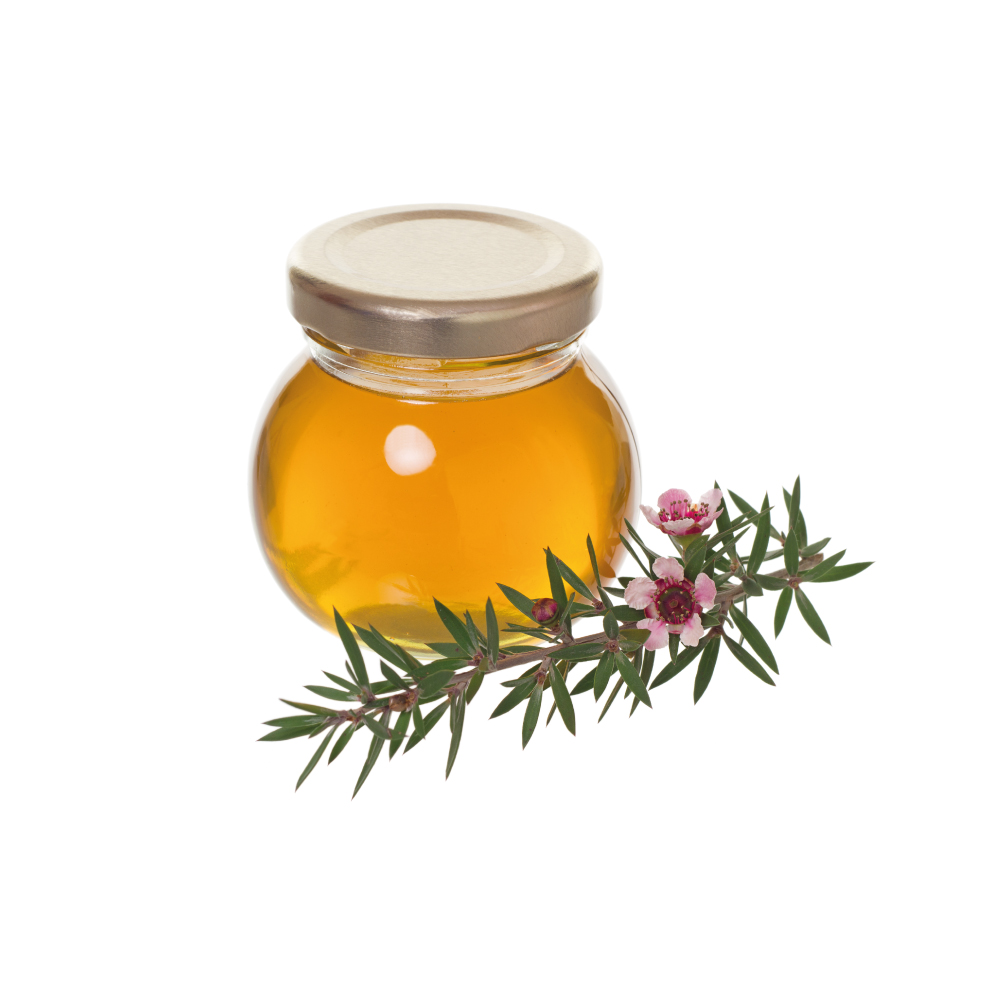
Manuka (Leptospermum scoparium) is a hardy shrub or small tree in the myrtle family (Myrtaceae), native to New Zealand and southeast Australia. It is held in high regard in Māori medicine, where the leaves, bark and gum were used as traditional remedies. The plant yields two quite different medicines that are easy to conflate: a steam-distilled leaf essential oil and manuka honey, which bees make from its nectar but which carries a different active chemistry.
Manuka is best known worldwide through the honey, graded by its non-peroxide antibacterial strength (the Unique Manuka Factor, UMF) — an activity that comes from methylglyoxal in the honey, not from the plant tissue 11,25Reference 11Systematic reviewClinical significance of manuka and medical-grade honey for antibiotic-resistant infections: a systematic review [systematic review]View study →Reference 25Identification and quantification of methylglyoxal as the dominant antibacterial constituent of Manuka (Leptospermum scoparium) honeys from New ZealandView study →. The leaf oil is a separate story: its antibacterial, antifungal and antiviral activity is real but almost entirely in vitro, strongest against Gram-positive bacteria, and traces to a fraction of β-triketones (chiefly leptospermone) 1,4Reference 1ReviewMānuka Oil — A Review of Antimicrobial and Other Medicinal Properties [review]View study →Reference 4In vitroA comparative study of the in vitro antimicrobial activity of tea tree oils with special reference to the activity of β-triketones [in vitro]View study →.
A defining caveat runs through the oil literature: manuka oil is extraordinarily chemotype-dependent. The amount of triketone varies enormously with where the plant was grown, so a result from a high-triketone East Cape oil does not transfer to a sesquiterpene-rich South Island oil — and neither transfers to the honey 2,3Reference 2In vitroChemical, physical and antimicrobial properties of essential oils of Leptospermum scoparium and Kunzea ericoides [in vitro]View study →Reference 3In vitroEssential oils from New Zealand manuka: triketone and other chemotypes of Leptospermum scoparium [in vitro]View study →.
A common myth, corrected. Manuka is sometimes described as the “female” and kānuka the “male” of one tree. That is botanically wrong: manuka (Leptospermum scoparium) and kānuka (Kunzea ericoides) are two different species in two different genera, distinguished in the field by feel — manuka leaves are prickly, kānuka soft.
Traditional & Modern Uses
In Māori and Western folk practice manuka has been used both internally and topically. Internally, leaf infusions and decoctions were taken for gastrointestinal complaints (diarrhoea, colic, dysentery), urinary conditions, fevers and colds — uses that rest on traditional and textbook documentation rather than clinical trials. Topically and as a vapour, the leaf and oil were applied for wounds, skin infections and inflammation, and gargled for oral hygiene. These are best read as ethnobotanical uses, not evidence-based indications.
The modern evidence sits mostly with manuka honey as a topical agent. Medical-grade honey dressings have been trialled for wound care and burns, with modest and uncertain benefit 9,10Reference 9Systematic reviewHoney as a topical treatment for wounds [systematic review]View study →Reference 10Systematic reviewAntiseptics for burns [systematic review]View study →, and the honey has been tested — largely without success — for radiation-induced oral mucositis 14,15Reference 14RCTA double-blind, placebo-controlled, randomised trial of active manuka honey and standard oral care for radiation-induced oral mucositis [randomised controlled trial]View study →Reference 15RCTA randomized placebo-controlled trial of manuka honey for radiation-induced oral mucositis [randomised controlled trial]View study → and, more encouragingly, for plaque and gingivitis 16Reference 16RCTThe effects of manuka honey on plaque and gingivitis: a pilot study [randomised controlled trial]View study →. The essential oil, by contrast, has no completed human trials; its antibacterial, antifungal, antiviral and antiparasitic activity is documented in vitro and in animal/veterinary models.
Manuka honey is standardised by phenol/methylglyoxal content and expressed as a UMF value. Higher-UMF honeys show stronger in-vitro activity against resistant organisms including MRSA, but this is dose- and strain-dependent laboratory activity, not a guaranteed clinical kill-threshold 11Reference 11Systematic reviewClinical significance of manuka and medical-grade honey for antibiotic-resistant infections: a systematic review [systematic review]View study →.
Botany & Varieties
Manuka is a member of the Myrtaceae (myrtle) family — a large group of aromatic, essential-oil-rich trees and shrubs that also includes tea tree (Melaleuca alternifolia), eucalyptus, clove and its close New Zealand relative kānuka (Kunzea ericoides). It is an evergreen shrub to small tree with small, prickly leaves and abundant white to pink five-petalled flowers.
The single most practical botanical fact about manuka is its chemotype variation. Steam-distilled oils fall into recognisably different chemical forms depending on provenance 2,3Reference 2In vitroChemical, physical and antimicrobial properties of essential oils of Leptospermum scoparium and Kunzea ericoides [in vitro]View study →Reference 3In vitroEssential oils from New Zealand manuka: triketone and other chemotypes of Leptospermum scoparium [in vitro]View study →:
- East Cape “triketone” chemotype — high in β-triketones (leptospermone and relatives, often 20–33% of the oil); this is the antimicrobially active form.
- Far-north chemotype — rich in pinene, low in triketones.
- South Island chemotype — dominated by sesquiterpene hydrocarbons (up to ~65% of the oil), low in triketones.
Because commercial “manuka oil” can be any of these, antimicrobial performance is not interchangeable between products.
Habitat & Distribution
Manuka is native to New Zealand and southeast Australia (including Tasmania), where it is a common pioneer of scrubland, forest margins and regenerating cleared land. New Zealand is the centre of both wild stands and commercial production, and the plant’s chemotype tracks region — the high-triketone material is associated with the East Cape of the North Island 3Reference 3In vitroEssential oils from New Zealand manuka: triketone and other chemotypes of Leptospermum scoparium [in vitro]View study →. It is hardy and adaptable, tolerating poor soils and exposed sites, which is why it colonises disturbed ground readily.
Phytochemistry
Manuka’s medicine is largely an essential-oil story, and that oil is dominated by two fractions 1,2,3Reference 1ReviewMānuka Oil — A Review of Antimicrobial and Other Medicinal Properties [review]View study →Reference 2In vitroChemical, physical and antimicrobial properties of essential oils of Leptospermum scoparium and Kunzea ericoides [in vitro]View study →Reference 3In vitroEssential oils from New Zealand manuka: triketone and other chemotypes of Leptospermum scoparium [in vitro]View study →. The first is a set of cyclic β-triketones — chiefly leptospermone, with isoleptospermone and flavesone — which together account for roughly 20% of the oil (often 20–33% in the prized East Cape “triketone” chemotype) and carry the bulk of its antibacterial and antifungal punch. The second is a heavy load of sesquiterpene hydrocarbons (≥60% of the oil), led by trans-calamenene (mean ~12.5%) alongside cadinene- and copaene-type compounds.
Bioassay-guided fractionation of the foliage has isolated further antibacterial phloroglucinols beyond the classical three — notably the nortriketone grandiflorone 5,7Reference 5In vitroNortriketones: antimicrobial trimethylated acylphloroglucinols from mānuka (Leptospermum scoparium) [in vitro]View study →Reference 7In vitroTLC-bioautography-guided isolation and assessment of antibacterial compounds from manuka (Leptospermum scoparium) [in vitro]View study →. Manuka oil is highly chemotype-dependent: a far-north form is rich in pinene, the East Cape form is high-triketone, and South Island plants run high in sesquiterpenes (up to ~65%). Minor citronellal and astringent tannins round out the leaf.
It is worth separating the oil from the famous honey. Manuka honey is a separate product whose non-peroxide antibacterial activity comes from methylglyoxal (MGO), formed from nectar-derived dihydroxyacetone as the honey matures — graded by the Unique Manuka Factor (UMF) 11,25Reference 11Systematic reviewClinical significance of manuka and medical-grade honey for antibiotic-resistant infections: a systematic review [systematic review]View study →Reference 25Identification and quantification of methylglyoxal as the dominant antibacterial constituent of Manuka (Leptospermum scoparium) honeys from New ZealandView study →. MGO is a honey constituent, not a constituent of the plant tissue, so it is not tabled below.
Constituent Summary
Figures are share of the steam-distilled essential oil (mass %), pooled from GC studies of New Zealand oils; values vary widely by chemotype and region. Whole-oil yield from the leaf is ~0.2–1%.
Triketone4 compounds4 with data
Sesquiterpenes2 compounds2 with data
Monoterpenes1 compoundno data
Tannins1 compoundno data
Pharmacology & Research
Manuka’s research base splits cleanly into two products that are easy to conflate: the steam-distilled leaf essential oil and manuka honey, which the bees make from the nectar but which carries a different active chemistry. The oil literature is almost entirely preclinical — in vitro assays and a handful of animal or veterinary models showing antibacterial, antifungal, antiviral and acaricidal activity that traces largely to its β-triketones (leptospermone and relatives) 1,2,3,4Reference 1ReviewMānuka Oil — A Review of Antimicrobial and Other Medicinal Properties [review]View study →Reference 2In vitroChemical, physical and antimicrobial properties of essential oils of Leptospermum scoparium and Kunzea ericoides [in vitro]View study →Reference 3In vitroEssential oils from New Zealand manuka: triketone and other chemotypes of Leptospermum scoparium [in vitro]View study →Reference 4In vitroA comparative study of the in vitro antimicrobial activity of tea tree oils with special reference to the activity of β-triketones [in vitro]View study →. The honey, by contrast, is where the human trials sit: several randomised controlled trials and Cochrane reviews cover topical wound care, radiation-induced oral mucositis and gingivitis, with mixed-to-modest results 9,10,14Reference 9Systematic reviewHoney as a topical treatment for wounds [systematic review]View study →Reference 10Systematic reviewAntiseptics for burns [systematic review]View study →Reference 14RCTA double-blind, placebo-controlled, randomised trial of active manuka honey and standard oral care for radiation-induced oral mucositis [randomised controlled trial]View study →. The single largest caveat runs through everything below — manuka oil is extraordinarily chemotype-dependent, so an antimicrobial result from a high-triketone East Cape oil does not transfer to a sesquiterpene-rich South Island oil, and neither transfers to the honey 2,3Reference 2In vitroChemical, physical and antimicrobial properties of essential oils of Leptospermum scoparium and Kunzea ericoides [in vitro]View study →Reference 3In vitroEssential oils from New Zealand manuka: triketone and other chemotypes of Leptospermum scoparium [in vitro]View study →.
- Best-supported: broad-spectrum antibacterial activity of the triketone-rich oil in vitro, especially against Gram-positive organisms including Staphylococcus 1,4,7Reference 1ReviewMānuka Oil — A Review of Antimicrobial and Other Medicinal Properties [review]View study →Reference 4In vitroA comparative study of the in vitro antimicrobial activity of tea tree oils with special reference to the activity of β-triketones [in vitro]View study →Reference 7In vitroTLC-bioautography-guided isolation and assessment of antibacterial compounds from manuka (Leptospermum scoparium) [in vitro]View study →; and topical wound care with manuka honey, backed by human RCTs and Cochrane reviews 9,10Reference 9Systematic reviewHoney as a topical treatment for wounds [systematic review]View study →Reference 10Systematic reviewAntiseptics for burns [systematic review]View study →.
- Emerging, worth watching: β-triketones as antiparasitic/acaricidal agents (scabies mites, ticks, dust mites) and as insecticides — an active preclinical frontier 19,21,22Reference 19In vitroNammunige, N. A., Agnew-Francis, K. A., Fernando, D. D., et al. (2025). β-Triketones from Leptospermum scoparium (mānuka) oil show potential as scabicides [in vitro]. Phytomedicine. https://pubmed.ncbi.nlm.nih.gov/39752786/View study →Reference 21In vitroAcaricidal activity of triketone analogues derived from Leptospermum scoparium oil against house-dust and stored-food mites [in vitro]View study →Reference 22In vitroAcaricidal activity of the essential oils from Leptospermum scoparium, Origanum vulgare and Litsea cubeba on Rhipicephalus microplus [in vitro]View study →.
- Mechanistically thin: systemic/internal use of the herb for gastrointestinal, urinary or anxiety complaints rests on traditional use, not trials; the anti-inflammatory claim is largely constituent-level.
- The caveat: almost all oil data is in vitro; there is no standardised internal preparation or dose, and chemotype variation is enormous. Honey and oil are different medicines and their evidence does not cross over.
1. Antibacterial
This is the strongest and most-replicated activity, but it belongs to the essential oil, not an internal herb preparation. Across GC-characterised New Zealand oils, antibacterial potency tracks the β-triketone fraction — chiefly leptospermone with isoleptospermone and flavesone — and is consistently strongest against Gram-positive bacteria, including Staphylococcus aureus and MRSA, with weaker activity against Gram-negatives 1,2,4Reference 1ReviewMānuka Oil — A Review of Antimicrobial and Other Medicinal Properties [review]View study →Reference 2In vitroChemical, physical and antimicrobial properties of essential oils of Leptospermum scoparium and Kunzea ericoides [in vitro]View study →Reference 4In vitroA comparative study of the in vitro antimicrobial activity of tea tree oils with special reference to the activity of β-triketones [in vitro]View study →. Bioassay-guided fractionation repeatedly isolates the triketones (and the related grandiflorone and other nortriketones) as the active principles 5,7Reference 5In vitroNortriketones: antimicrobial trimethylated acylphloroglucinols from mānuka (Leptospermum scoparium) [in vitro]View study →Reference 7In vitroTLC-bioautography-guided isolation and assessment of antibacterial compounds from manuka (Leptospermum scoparium) [in vitro]View study →, and isolated leptospermone alone shows measurable antibacterial activity 6Reference 6In vitroAntimicrobial activities of leptospermone isolated from Leptospermum scoparium [in vitro]View study →. Veterinary work extends this to Gram-negative canine ear pathogens when the oil is paired with a permeabiliser (Tris-EDTA) 8Reference 8In vitroIn vitro antibacterial activity of the manuka essential oil from Leptospermum scoparium combined with Tris-EDTA against Gram-negative bacterial isolates from dogs with otitis externa [in vitro]View study →. Note this is separate from manuka honey’s antibacterial action, which comes from methylglyoxal, not the plant 11Reference 11Systematic reviewClinical significance of manuka and medical-grade honey for antibiotic-resistant infections: a systematic review [systematic review]View study →.
Gap: every result is in vitro or veterinary — there are no human clinical trials of the oil as an internal or systemic antibacterial, and MICs vary widely with chemotype.
2. Wound healing
The clearest human evidence for anything “manuka” is topical manuka honey in wound care — but this is the honey, a distinct product, not the leaf or oil. A Cochrane review of honey for wounds found it may shorten healing of partial-thickness burns and infected post-operative wounds versus some comparators, while evidence for other wound types was of low certainty 9Reference 9Systematic reviewHoney as a topical treatment for wounds [systematic review]View study →. A separate Cochrane review of antiseptics for burns likewise found honey among the better-supported options but flagged low-to-moderate certainty overall 10Reference 10Systematic reviewAntiseptics for burns [systematic review]View study →. A small randomised trial of manuka honey on blepharoplasty (eyelid) wounds found no meaningful cosmetic or healing advantage over petrolatum 12Reference 12RCTEffect of manuka honey on eyelid wound healing: a randomized controlled trial [randomised controlled trial]View study →, illustrating that positive signals are inconsistent. Mechanistically the honey combines osmotic drawing, low pH and methylglyoxal-driven antibacterial action 11Reference 11Systematic reviewClinical significance of manuka and medical-grade honey for antibiotic-resistant infections: a systematic review [systematic review]View study →.
Gap: the evidence is for medical-grade honey dressings, not the herb; certainty is low, trials are heterogeneous, and null results (e.g. eyelid wounds) exist.
3. Antifungal
The oil shows reproducible in vitro antifungal activity, again chemotype-dependent. Constituent-oriented comparisons of Myrtaceae “tea-tree” oils found manuka oil and its isolated β-triketone complex gave the best inhibition of dermatophytes among the group 4Reference 4In vitroA comparative study of the in vitro antimicrobial activity of tea tree oils with special reference to the activity of β-triketones [in vitro]View study →, and isolated leptospermone inhibits fungal growth directly 6Reference 6In vitroAntimicrobial activities of leptospermone isolated from Leptospermum scoparium [in vitro]View study →. Reviews collate activity against Candida, Trichophyton and other dermatophytes, though potency is inconsistent across oil samples 1Reference 1ReviewMānuka Oil — A Review of Antimicrobial and Other Medicinal Properties [review]View study →. Only some chemotypes carry strong antifungal punch — the high-triketone East Cape form is the relevant one 3Reference 3In vitroEssential oils from New Zealand manuka: triketone and other chemotypes of Leptospermum scoparium [in vitro]View study →.
Gap: in vitro only; no human antifungal trials, and results are highly sensitive to oil composition.
4. Antiparasitic
An active and fast-growing preclinical frontier. The β-triketones are HPPD inhibitors, and this maps onto parasiticidal effects: manuka oil and isolated β-triketones show miticidal and ovicidal activity against the scabies mite Sarcoptes scabiei in vitro, positioning them as candidate scabicides 19,20Reference 19In vitroNammunige, N. A., Agnew-Francis, K. A., Fernando, D. D., et al. (2025). β-Triketones from Leptospermum scoparium (mānuka) oil show potential as scabicides [in vitro]. Phytomedicine. https://pubmed.ncbi.nlm.nih.gov/39752786/View study →Reference 20In vitroInvestigating the antibacterial properties of prospective scabicides [in vitro]View study →. Triketone analogues derived from the oil are acaricidal against house-dust and stored-food mites, out-performing benchmark agents in some assays 21Reference 21In vitroAcaricidal activity of triketone analogues derived from Leptospermum scoparium oil against house-dust and stored-food mites [in vitro]View study →, and whole-oil fractions kill cattle-tick (Rhipicephalus microplus) larvae and adults 22Reference 22In vitroAcaricidal activity of the essential oils from Leptospermum scoparium, Origanum vulgare and Litsea cubeba on Rhipicephalus microplus [in vitro]View study →. The same leptospermone chemistry drives insecticidal activity against Aedes aegypti mosquitoes via rapid knockdown 23Reference 23AnimalMode of toxicity of the β-triketone leptospermone to Aedes aegypti mosquitoes [animal model]View study →.
Gap: entirely in vitro/ex vivo or arthropod-model work — no clinical scabies or ectoparasite trials in humans yet, though the scabicide programme is the most likely to reach one.
5. Oral mucositis
Manuka honey has been tested for radiation-induced oral mucositis in head-and-neck cancer, and the better-powered trials are largely negative. A double-blind placebo-controlled RCT (n=131) of active manuka honey versus standard oral care found no significant reduction in mucositis severity 14Reference 14RCTA double-blind, placebo-controlled, randomised trial of active manuka honey and standard oral care for radiation-induced oral mucositis [randomised controlled trial]View study →, and a subsequent randomised placebo-controlled trial reached similar null conclusions, partly limited by poor tolerability of the honey during radiotherapy 15Reference 15RCTA randomized placebo-controlled trial of manuka honey for radiation-induced oral mucositis [randomised controlled trial]View study →. Systematic reviews of honey in this setting remain inconclusive and do not support it as standard care.
Gap: the two strongest trials are null; this is honey, not the herb, and tolerability during radiotherapy is a practical problem.
7. Gingivitis
Small human trials of manuka honey for oral hygiene show modest benefit. A pilot RCT found chewing/applying a manuka honey product reduced plaque and gingival bleeding scores versus control 16Reference 16RCTThe effects of manuka honey on plaque and gingivitis: a pilot study [randomised controlled trial]View study →, and a randomised field trial reported manuka-honey mouthwash improved plaque and gingival indices comparably to other honeys, though generally below chlorhexidine. A systematic review of honey in periodontal disease found positive but low-certainty antimicrobial and clinical signals 17Reference 17Systematic reviewAntimicrobial activity of honey in periodontal disease: a systematic review [systematic review]View study →.
Gap: small, heterogeneous honey trials; the herb/oil is not what was tested, and effects trail standard chlorhexidine.
8. Anti-inflammatory
The weakest of the scored indications. Anti-inflammatory activity is asserted in reviews of the oil and inferred from its constituents 1Reference 1ReviewMānuka Oil — A Review of Antimicrobial and Other Medicinal Properties [review]View study →, and honey-based models show anti-inflammatory effects — but those test honey, not the leaf oil. The nearest human signal is a small clinical study in which topical manuka honey reduced atopic dermatitis lesion severity, attributed partly to immunoregulatory and anti-staphylococcal activity 13Reference 13Clinical trialHoney is potentially effective in the treatment of atopic dermatitis: clinical and mechanistic studies [clinical trial]View study →; again, this is the honey, not the herb, and it is not a dedicated trial of manuka as an anti-inflammatory.
Gap: constituent-level and honey-model inference only; no direct evidence for the herb as an anti-inflammatory.
Mechanisms
| Mechanism | Drives | Key compounds |
|---|---|---|
| β-triketone membrane/phloroglucinol antibacterial action | antibacterialantifungal | leptospermone, flavesone, grandiflorone |
| HPPD (4-hydroxyphenylpyruvate dioxygenase) inhibition | acaricidalinsecticidalantiparasitic | leptospermone, isoleptospermone |
| Direct virucidal action on free virus (envelope) | antiviral (HSV) | β-triketone fraction |
| Tyrosinase inhibition (non-competitive) 24Reference 24In vitroLeptospermone acts as a predominantly non-competitive β-triketone inhibitor of tyrosinase [in vitro]View study → | pigmentation / cosmetic | leptospermone |
| Osmotic + low-pH + methylglyoxal glycation (honey only) | wound antibacterialwound healing | methylglyoxal |
Clinical trials
Human trials exist only for manuka honey (topical wound care, oral mucositis, gingivitis) — the leaf and essential oil have no completed human trials and their evidence base is entirely preclinical.
| Completed | Planned | Terminated | Preclinical |
|---|---|---|---|
| ~6(honey) | — | 0 | ~50+ |
Last checked: July 2026.
Dosage
There is no established internal dose for the manuka leaf or essential oil — the oil is a concentrated, chemotype-variable product used topically or aromatically (diluted), and its antibacterial/antifungal/antiviral evidence is entirely in vitro 1,4,18Reference 1ReviewMānuka Oil — A Review of Antimicrobial and Other Medicinal Properties [review]View study →Reference 4In vitroA comparative study of the in vitro antimicrobial activity of tea tree oils with special reference to the activity of β-triketones [in vitro]View study →Reference 18In vitroVirucidal activity of a β-triketone-rich essential oil of Leptospermum scoparium (manuka oil) against HSV-1 and HSV-2 in cell culture [in vitro]View study →. The human dosing that exists is for manuka honey applied topically, not the herb, so the doses below cannot be back-converted to a dried-herb equivalent.
| Indication | Preparation | Dose | Est. dried-herb equivalent | Source |
|---|---|---|---|---|
| Wound care / burns | Medical-grade / manuka honey dressing (topical) | Applied to wound, dressing changed per protocol | — (honey, not herb) | 9,10Reference 9Systematic reviewHoney as a topical treatment for wounds [systematic review]View study →Reference 10Systematic reviewAntiseptics for burns [systematic review]View study → |
| Radiation oral mucositis | Active manuka honey (oral, topical to mucosa) | ~20 mL applied 3–4×/day during radiotherapy | — (honey) | 14,15Reference 14RCTA double-blind, placebo-controlled, randomised trial of active manuka honey and standard oral care for radiation-induced oral mucositis [randomised controlled trial]View study →Reference 15RCTA randomized placebo-controlled trial of manuka honey for radiation-induced oral mucositis [randomised controlled trial]View study → |
| Gingivitis / plaque | Manuka honey product / mouthwash | Applied to gums or used as a rinse | — (honey) | 16Reference 16RCTThe effects of manuka honey on plaque and gingivitis: a pilot study [randomised controlled trial]View study → |
| Antibacterial / antifungal / antiviral (oil) | Essential oil, topical / in vitro | No established human dose; in-vitro MICs only | — (no internal dose) | 1,4,18Reference 1ReviewMānuka Oil — A Review of Antimicrobial and Other Medicinal Properties [review]View study →Reference 4In vitroA comparative study of the in vitro antimicrobial activity of tea tree oils with special reference to the activity of β-triketones [in vitro]View study →Reference 18In vitroVirucidal activity of a β-triketone-rich essential oil of Leptospermum scoparium (manuka oil) against HSV-1 and HSV-2 in cell culture [in vitro]View study → |
The entries above are manuka honey (topical) or in-vitro oil work; no marker-standardised internal preparation of the leaf or oil has been studied, so a dried-herb equivalent cannot be estimated.
Traditional Dosage
Traditional use is of the whole leaf as an infusion, decoction or topical preparation, and (separately) of the honey. The Western liquid-extract figure carried on this page is not backed by a located primary source and should be treated as indicative only.
| System | Preparation | Dose |
|---|---|---|
| Western herbal (as on page) | 1:2 liquid extract | 20–65 mL/week |
| Māori / NZ traditional | Leaf infusion / decoction; topical poultice; inhaled vapour | Not quantified in primary sources |
Safety & Pregnancy
Manuka leaf and honey are well tolerated with a long food and topical record; the essential oil is a concentrated, chemotype-variable product for diluted topical or aromatic use only.
- Essential oil — external only. Concentrated and chemotype-variable; use diluted, topically or aromatically, never undiluted internally.
- Contact allergy possible. A Myrtaceae relative of tea tree, so topical sensitivity can occur in susceptible people.
- Honey caveats. High fermentable-sugar load matters for blood-glucose management, and honey should never be given to infants under one year (botulism risk).
- Interactions unstudied. No drug-interaction or CYP450 studies — interactions are not assessed rather than ruled out.
- Well tolerated. Leaf and honey have a long record of food and topical use with no serious documented adverse effects 11Reference 11Systematic reviewClinical significance of manuka and medical-grade honey for antibiotic-resistant infections: a systematic review [systematic review]View study →.
Full safety & interactions detail
Manuka is generally well tolerated: the leaf and manuka honey have a long record of food and topical use, and no serious adverse effects are documented in the clinical literature 11Reference 11Systematic reviewClinical significance of manuka and medical-grade honey for antibiotic-resistant infections: a systematic review [systematic review]View study →. The essential oil should be treated like any potent essential oil — it is for topical or aromatic use, diluted, and not for undiluted internal consumption; its composition (and therefore its irritancy) varies enormously by chemotype 2,3Reference 2In vitroChemical, physical and antimicrobial properties of essential oils of Leptospermum scoparium and Kunzea ericoides [in vitro]View study →Reference 3In vitroEssential oils from New Zealand manuka: triketone and other chemotypes of Leptospermum scoparium [in vitro]View study →. As a Myrtaceae species related to tea tree, topical contact allergy is plausible in sensitive individuals, though manuka-specific allergy reports are sparse. Manuka honey used as a wound dressing was, in one radiotherapy trial, poorly tolerated by mouth 15Reference 15RCTA randomized placebo-controlled trial of manuka honey for radiation-induced oral mucositis [randomised controlled trial]View study →, and its high fermentable-sugar content is a consideration for people managing blood glucose. As with all honey, it should not be given to infants under one year (botulism risk). Formal drug-interaction and cytochrome-P450 studies have not been conducted, so interactions are not assessed rather than established as absent.
The page’s traditional caution — take away from food, as astringent tannins may impede mineral absorption — is reasonable, but the broader claim that long-term use is safe rests on food-and-honey experience, not on trials of the leaf or oil.
Not specifically researched. No controlled studies have assessed manuka leaf, oil or honey in pregnancy or lactation. Manuka honey eaten as a food carries no specific concern, but the concentrated essential oil has not been evaluated and internal use during pregnancy cannot be considered established as safe. Absence of harm reports is not evidence of safety.
References
- Mathew, C., Tesfaye, W., Rasmussen, P., et al. (2020). Mānuka Oil — A Review of Antimicrobial and Other Medicinal Properties [review]. Pharmaceuticals (Basel). https://pubmed.ncbi.nlm.nih.gov/33114724/
- Porter, N. G., & Wilkins, A. L. (1999). Chemical, physical and antimicrobial properties of essential oils of Leptospermum scoparium and Kunzea ericoides [in vitro]. Phytochemistry. https://pubmed.ncbi.nlm.nih.gov/9933953/
- Douglas, M. H., van Klink, J. W., Smallfield, B. M., et al. (2004). Essential oils from New Zealand manuka: triketone and other chemotypes of Leptospermum scoparium [in vitro]. Phytochemistry. https://pubmed.ncbi.nlm.nih.gov/15184010/
- Christoph, F., Kaulfers, P. M., & Stahl-Biskup, E. (2000). A comparative study of the in vitro antimicrobial activity of tea tree oils with special reference to the activity of β-triketones [in vitro]. Planta Medica. https://pubmed.ncbi.nlm.nih.gov/10985085/
- Killeen, D. P., Larsen, L., Dayan, F. E., et al. (2016). Nortriketones: antimicrobial trimethylated acylphloroglucinols from mānuka (Leptospermum scoparium) [in vitro]. Journal of Natural Products. https://pubmed.ncbi.nlm.nih.gov/26731565/
- Jeong, E. Y., Lee, M. J., & Lee, H. S. (2018). Antimicrobial activities of leptospermone isolated from Leptospermum scoparium [in vitro]. Food Science and Biotechnology. https://pubmed.ncbi.nlm.nih.gov/30319866/
- Xu, W., Shi, D., Chen, K., et al. (2024). TLC-bioautography-guided isolation and assessment of antibacterial compounds from manuka (Leptospermum scoparium) [in vitro]. Molecules. https://pubmed.ncbi.nlm.nih.gov/38338460/
- Song, S. Y., Hyun, J. E., Kang, J. H., et al. (2020). In vitro antibacterial activity of the manuka essential oil from Leptospermum scoparium combined with Tris-EDTA against Gram-negative bacterial isolates from dogs with otitis externa [in vitro]. Veterinary Dermatology. https://pubmed.ncbi.nlm.nih.gov/31729809/
- Jull, A. B., Cullum, N., Dumville, J. C., et al. (2015). Honey as a topical treatment for wounds [systematic review]. Cochrane Database of Systematic Reviews. https://pubmed.ncbi.nlm.nih.gov/25742878/
- Norman, G., Christie, J., Liu, Z., et al. (2017). Antiseptics for burns [systematic review]. Cochrane Database of Systematic Reviews. https://pubmed.ncbi.nlm.nih.gov/28700086/
- Nolan, V. C., Harrison, J., Wright, J. E. E., et al. (2020). Clinical significance of manuka and medical-grade honey for antibiotic-resistant infections: a systematic review [systematic review]. Antibiotics (Basel). https://pubmed.ncbi.nlm.nih.gov/33142845/
- Malhotra, R., Ziahosseini, K., Poitelea, C., et al. (2017). Effect of manuka honey on eyelid wound healing: a randomized controlled trial [randomised controlled trial]. Ophthalmic Plastic & Reconstructive Surgery. https://pubmed.ncbi.nlm.nih.gov/27429228/
- Alangari, A. A., Morris, K., Lwaleed, B. A., et al. (2017). Honey is potentially effective in the treatment of atopic dermatitis: clinical and mechanistic studies [clinical trial]. Immunity, Inflammation and Disease. https://pubmed.ncbi.nlm.nih.gov/28474502/
- Bardy, J., Molassiotis, A., Ryder, W. D., et al. (2012). A double-blind, placebo-controlled, randomised trial of active manuka honey and standard oral care for radiation-induced oral mucositis [randomised controlled trial]. British Journal of Oral and Maxillofacial Surgery. https://pubmed.ncbi.nlm.nih.gov/21636188/
- Hawley, P., Hovan, A., McGahan, C. E., et al. (2014). A randomized placebo-controlled trial of manuka honey for radiation-induced oral mucositis [randomised controlled trial]. Supportive Care in Cancer. https://pubmed.ncbi.nlm.nih.gov/24221577/
- English, H. K., Pack, A. R., & Molan, P. C. (2004). The effects of manuka honey on plaque and gingivitis: a pilot study [randomised controlled trial]. Journal of the International Academy of Periodontology. https://pubmed.ncbi.nlm.nih.gov/15125017/
- Hbibi, A., Sikkou, K., Khedid, K., et al. (2020). Antimicrobial activity of honey in periodontal disease: a systematic review [systematic review]. Journal of Antimicrobial Chemotherapy. https://pubmed.ncbi.nlm.nih.gov/31977042/
- Reichling, J., Koch, C., Stahl-Biskup, E., et al. (2005). Virucidal activity of a β-triketone-rich essential oil of Leptospermum scoparium (manuka oil) against HSV-1 and HSV-2 in cell culture [in vitro]. Planta Medica. https://pubmed.ncbi.nlm.nih.gov/16395648/
- Nammunige, N. A., Agnew-Francis, K. A., Fernando, D. D., et al. (2025). β-Triketones from Leptospermum scoparium (mānuka) oil show potential as scabicides [in vitro]. Phytomedicine. https://pubmed.ncbi.nlm.nih.gov/39752786/
- Taylor, S., Walther, D., Fernando, D. D., et al. (2022). Investigating the antibacterial properties of prospective scabicides [in vitro]. Biomedicines. https://pubmed.ncbi.nlm.nih.gov/36552044/
- Jeong, E. Y., Kim, M. G., & Lee, H. S. (2009). Acaricidal activity of triketone analogues derived from Leptospermum scoparium oil against house-dust and stored-food mites [in vitro]. Pest Management Science. https://pubmed.ncbi.nlm.nih.gov/19051215/
- Duque, L. S., Marchesini, P., Monteiro, C., et al. (2021). Acaricidal activity of the essential oils from Leptospermum scoparium, Origanum vulgare and Litsea cubeba on Rhipicephalus microplus [in vitro]. Veterinary Parasitology. https://pubmed.ncbi.nlm.nih.gov/34735845/
- McComic, S. E., Chen, R., Mishra, S., et al. (2025). Mode of toxicity of the β-triketone leptospermone to Aedes aegypti mosquitoes [animal model]. Pesticide Biochemistry and Physiology. https://pubmed.ncbi.nlm.nih.gov/40262858/
- Lee, N. H., Munkhtur, E., & Lee, H. S. (2026). Leptospermone acts as a predominantly non-competitive β-triketone inhibitor of tyrosinase [in vitro]. Scientific Reports. https://pubmed.ncbi.nlm.nih.gov/42020490/
- Mavric, E., Wittmann, S., Barth, G., & Henle, T. (2008). Identification and quantification of methylglyoxal as the dominant antibacterial constituent of Manuka (Leptospermum scoparium) honeys from New Zealand. Molecular Nutrition & Food Research. https://pubmed.ncbi.nlm.nih.gov/18210383/