Materia Medica
Walnut
Juglans nigra
Black walnut (Juglans nigra) — an astringent, antiparasitic tree whose green hulls are used for worms, fungal and skin infections.
What Is Black Walnut?
Walnut is an extremely versatile tree. It’s best known for its dark and decorative wood, often used as flooring, furniture, and for the stocks of guns and knives.
The green seed husks are boiled to make a yellow dye, and the nut makes a delicious and highly nutritious meal. The oil from this nut is useful as a polish for wood and as a mixer for paint. It’s also been used as lamp oil and for cooking purposes.
The medicinal content of the wood is strong, offering powerful astringent activity, and purgative action. The strongest medicinal uses of this tree, however, are in its seed husks, especially while green and unripe.
The chemicals contained in these unripe husks, particularly the chemical juglone, is a powerful destroyer of worms and other parasites. When applied as a salve or balm it’s useful for reducing sweating of the hands and feet, and can be used to treat fungal and parasitic infections on the skin such as athlete’s foot or ringworm.
The anti-parasitic action works if employed in the garden as a strong infusion of the husks or leaves as well to destroy worms or other insects and won’t injure the grass. In the wild, it’s been found that no insects will touch the leaves or bark of this plant.
What Is Black Walnut Used For?
All parts of the tree are antimicrobial, and are used to treat bacterial, and parasitic infections. The green seed husks of Juglans nigra are highly astringent, and are used to astringe the skin and digestive tract to reduce gut permeability or treat hyperhydrosis. The seed husks are also potent anti-parasitics and are useful in combination for removing parasites from the gastrointestinal tract.
Traditional Uses
Culpepper suggests its bark is a great astringent, stating that it “doth bind and dry very much”. He also states that the older, more bitter leaves are useful for killing broad-worms in the stomach. The nuts, and leaves are suggested for poison, snakebites, or dog bites. 4Reference 4Phenolic profile in the quality control of walnut (Juglans regia L.) leaves.
He also suggests the green husks, boiled with honey is a great remedy for sore throats and inflammations of the mouth and stomach. 4Reference 4Phenolic profile in the quality control of walnut (Juglans regia L.) leaves.
In Iran, walnut is often used as an extract and its hydrosol to control blood sugar 2,3Reference 2AnimalThe effect of hydro alcoholic extract of Juglans regia leaves in streptozotocin-nicotinamide induced diabetic ratsReference 3The hypoglycemic effect of Juglans regia leaves aqueous extract in diabetic patients: A first human trialView study →.
In southern Morocco, the leaves are used in the treatment of hypertension and diabetes 11Reference 11A. Tahraoui, J. El-Hilaly, Z. H. Israili, and B. Lyoussi, (2007). “Ethnopharmacological survey of plants used in the traditional treatment of hypertension and diabetes in south-eastern Morocco (Errachidia province),” Journal of Ethnopharmacology, vol. 110, no. 1, pp. 105–117.
Traditional Chinese Medicine
(Walnut kernel)
Pinyin
Hu Tao Ren
Taste
Sweet 22Reference 22An illustrated Chinese materia medica
Energy
Warm 22Reference 22An illustrated Chinese materia medica
Channels
Kidney, lung, large intestines 22Reference 22An illustrated Chinese materia medica
Actions
Tonifies kidneys, warms the lungs, moistens the intestines 22Reference 22An illustrated Chinese materia medica
Indications
Coughs and asthma due to deficiency-cold, constipation due to dry intestines 22Reference 22An illustrated Chinese materia medica
Cautions & Safety
Do not use with excess fire due to yin deficiency, coughs due to phlegm heat and with loose stools 22Reference 22An illustrated Chinese materia medica
Botany
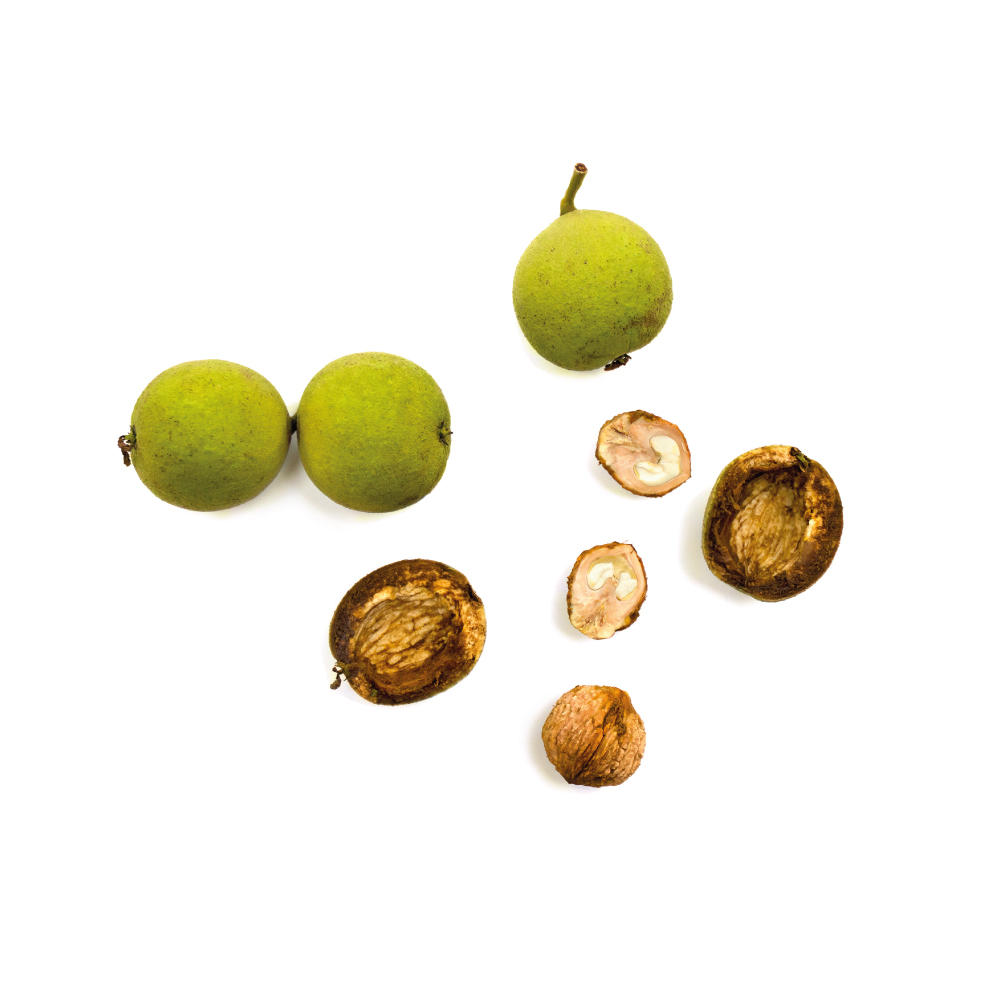
The black walnut, Juglans nigra, is a big North American hardwood tree of the walnut family (Juglandaceae) — a family of aromatic, catkin-bearing trees of roughly ten genera that also holds the pecan and hickories (Carya) — and for the herbalist the useful material comes not from the kitchen nut but from the tree’s outer parts. The prized medicinal is the green husk (hull) — the thick, fleshy, fragrant coat around the developing nut, gathered while still green — along with the leaf and bark. These are the traditional antiparasitic and antifungal preparations.
It helps to keep the walnuts straight. The black walnut (J. nigra) is the native American species whose green hull is the classic parasite remedy; the English or Persian walnut (J. regia) is the culinary orchard tree of Eurasia, used somewhat differently in herbal practice; and butternut (J. cinerea) is a close North American relative. When a formula or tincture calls for “green walnut hull” in the American tradition, it is J. nigra that is usually meant.
The tree carries the family’s calling cards: pinnate compound leaves of many toothed leaflets, separate male catkins and female flowers on the same tree, and round green fruit each hiding one hard, ridged nut inside a heavy husk. Its defining trait, though, is chemical — black walnut is a textbook allelopathic plant, its roots exuding juglone, a compound that suppresses the growth of many neighbouring plants and is thought to underlie much of the hull and leaf’s biological activity. That same juglone-rich chemistry is why the green hull, not the meat of the nut, is the herbalist’s part of interest.
Distribution
Black walnut grows wild across eastern and central North America, from the northeastern states and southern Ontario west toward the Dakotas and south to Florida and Texas. It is a tree of rich, moist woodlands, river valleys and open uplands, and is widely planted well beyond its native ground for its nuts and valuable timber.
Growing Conditions
- A large, long-lived deciduous tree (often 75–100 ft), so give it plenty of open space and full sun.
- Prefers deep, rich, moist but well-drained soil, as found in bottomlands and stream valleys.
- Cold-hardy across roughly USDA zones 4–9.
- Strongly allelopathic: its roots release juglone, which stunts or kills many sensitive plants (tomatoes, peppers, blueberries, rhododendrons and more) within and beyond its drip line — do not plant these nearby.
- Full cultivation detail lives on the companion farm-wiki grow guide for Juglans nigra (link to be added once that project’s public URL is confirmed).
Pharmacology & Medical Research
Diabetes
Juglans regia (English walnut) extracts were shown in an experimental study to significantly reduce blood glucose, glycosylated hemoglobin, LDL, triglycerides, and total cholesterol, as well as significantly increase insulin and HDL levels 1,3Reference 1Chemical Composition and the Effect of Walnut Hydrosol in Glycemic Control of Type 1 Diabetic PatientsView study →Reference 3The hypoglycemic effect of Juglans regia leaves aqueous extract in diabetic patients: A first human trialView study →. The mechanism of action is suggested to be through stimulation of the beta-cells of the pancreas to release insulin, increase in the sensitivity of the cells to insulin, or interfere with dietary carbohydrate absorption 1,8,9Reference 1Chemical Composition and the Effect of Walnut Hydrosol in Glycemic Control of Type 1 Diabetic PatientsView study →Reference 8In vitroWalnut leaf extract inhibits PTP1B and enhances glucose-uptake in vitroReference 9AnimalAntihyperglycemic effect of carvacrol in combination with rosiglitazone in high-fat diet-induced type 2 diabetic C57BL/6J mice.
If the first suggestion is true (stimulates the beta-cells of the pancreas to secrete insulin), then this action will not work on those with type 1 diabetes, as this condition means that most of the insulin-secreting beta-cells are absent. Since the majority of the study on this herb in this area are conducted on type 2 diabetic models, it’s hard to understand how this will affect those lacking beta cells.
Other studies have found similar results 10Reference 10AnimalPharmacological and Genotoxic Properties of Polyphenolic Extracts ofCedrela odorataL. andJuglans regiaLView study →.
Cancer
The leaves of the walnut tree contain a high amount of cancer-fighting polyphenols. These chemicals are well known to possess antioxidant and anti-inflammatory actions, both of which have a direct benefit in treating or preventing cancer cell lines 1Reference 1Chemical Composition and the Effect of Walnut Hydrosol in Glycemic Control of Type 1 Diabetic PatientsView study →.
Walnut hull extracts were found to contain a chemical called ellagitannins, which possess anti-cancer benefits, as well as anti-inflammatory actions 1,4Reference 1Chemical Composition and the Effect of Walnut Hydrosol in Glycemic Control of Type 1 Diabetic PatientsView study →Reference 4Phenolic profile in the quality control of walnut (Juglans regia L.) leaves.
As a bi-product of the walnut oil industry, a large amount of protein is left behind. Part of this protein has been found to possess significant apoptotic actions on cancer cells (MCF-7 cells). The whole protein itself was not responsible for this action, but rather the hydrolysates released via enzymatic processes. Such enzymes that can release these hydrolysates from the chain include pepsin, papain, trypsin, neutral protease, and alkaline protease. Papain-derived hydrolysates were noted to have the most pronounced effect in this regard. The mechanism of action was found to be through the induction of apoptosis and autophagy of the cancer cells and was suggested to offer other immunomodulatory actions as well. 18Reference 18Isolation of a novel bio-peptide from walnut residual protein inducing apoptosis and autophagy on cancer cellsView study →.
It’s currently unclear whether this hydrolysate is produced in the stomach and upper intestines from the pepsin contained within these tissues, or if this will need to be hydrolyzed in a lab with commercial enzymes. More research is required.
Other extracts containing triterpene components taken from the green husk of Juglans manshurica were also found to possess anti-cancer activity on hepatic cancer cell lines in vitro (Hep-G2 Cancer cells) 20Reference 20Cytotoxicity of Triterpenes from Green Walnut Husks of Juglans mandshurica Maxim in HepG-2 Cancer CellsView study →.
Antimicrobial
A Juglans regia bark extract was shown to possess significant antibacterial actions against E. coli and methicillin-resistant S. aureus bacteria but had little to no effect on gram-negative bacteria 21Reference 21Synergistic Antimicrobial Activity of Camellia sinensis and Juglans regia against Multidrug-Resistant BacteriaView study →. This suggests a powerful bactericidal activity of the bark extract of Juglans regia on the gram-positive bacterium, regardless of drug resistance to other antimicrobials, and particularly on Staphylococcus strains.
Hepatoprotective
Fibrogenesis of the liver is characterized as an increase in extracellular matrix proteins such as collagen, which are mainly produced in the hepatic stellate cells. This buildup of proteins will lead to a degradation of the hepatic function, and can ultimately lead to death. This reversible condition is an early stage of the more severe and generally non-reversible cirrhosis 12Reference 12AnimalThe ethanolic extract of Juglans sinensis leaves and twigs attenuates CCl 4 -induced hepatic oxidative stress in ratsView study →. Therefore, reducing the activation of these hepatic stellate cells can result in a reduction or prevention of these damaging extracellular matrix protein buildup.
Hepatic stellate cell activation can occur from viral causes such as with HCV, or from drug or other toxic substances that will increase reactive oxygen species in the liver, or cause injury to the parenchymal hepatocytes 12Reference 12AnimalThe ethanolic extract of Juglans sinensis leaves and twigs attenuates CCl 4 -induced hepatic oxidative stress in ratsView study →.
The leaves and twigs of Juglans sinensis are known to contain the chemicals oleanene and ursane triterpenes and flavonoids, which have been found to possess therapeutic benefits towards this hepatic fibrosis in both in vitro and in vivo models 12,13,14,15,16Reference 12AnimalThe ethanolic extract of Juglans sinensis leaves and twigs attenuates CCl 4 -induced hepatic oxidative stress in ratsView study →Reference 13AnimalAntioxidant and protective effect of an oleanolic acid-enriched extract of A. deliciosa root on carbon tetrachloride induced rat liver injuryReference 14Antiproliferative activity of triterpenoids from Eclipta prostrata on hepatic stellate cellsReference 15Hepatoprotective activity of liposomal flavonoid against arsenite-induced liver fibrosisReference 16AnimalHsian-tsao (Mesona procumbens Heml.) prevents against rat liver fibrosis induced by CCl (4) via inhibition of hepatic stellate cells activation.
Another study was done investigating the specific effects of an ethanolic extract of the leaves and twigs of Juglans sinensis on liver injury in vivo. This study found that the extract was able to significantly reverse the pathological parameters associated with this type of liver injury. 12Reference 12AnimalThe ethanolic extract of Juglans sinensis leaves and twigs attenuates CCl 4 -induced hepatic oxidative stress in ratsView study →.
Other studies have found that the flavonoids contained within Juglans sinensis suppress reactive oxygen species generation by inhibiting some of the enzymatic activity involved with this free radical production 17Reference 17Flavonoids: Prospective drug candidates.
Hypotensive
Part of the protein portion of the walnut fruit has been found to inhibit the activity of the angiotensin I-converting enzyme (ACE), which has significant activity on the cardiovascular system, namely blood pressure 19Reference 19Purification and identification of an ACE inhibitory peptide from walnut protein.
The perfect ratio of n-6 to n-3 polyunsaturated fatty acids are well known to exert positive effects on the cardiovascular function, including blood pressure regulation as well 18Reference 18Isolation of a novel bio-peptide from walnut residual protein inducing apoptosis and autophagy on cancer cellsView study →.
Nutritive
The fruit of the walnut tree (AKA a walnut) provides high nutritional value. The nut contains a perfect balance of n-6 and n-3 polyunsaturated fatty acids, which has been determined to be a 4:1 ratio, respectively 18Reference 18Isolation of a novel bio-peptide from walnut residual protein inducing apoptosis and autophagy on cancer cellsView study →.
Phytochemistry
Walnut’s signature compound is juglone (5-hydroxy-1,4-naphthoquinone), the antiparasitic and antimicrobial pigment most concentrated in the green, unripe hulls. The astringent and antioxidant actions come from a heavy phenolic load — ellagitannins, ellagic acid, gallic acid and other tannins — while the aromatic leaf oil supplies terpenoids and the kernel a polyunsaturated fixed oil rich in linoleic and α-linolenic acids 1,4,7,18Reference 1Chemical Composition and the Effect of Walnut Hydrosol in Glycemic Control of Type 1 Diabetic PatientsView study →Reference 4Phenolic profile in the quality control of walnut (Juglans regia L.) leavesReference 7Headspace analysis of volatile compounds in leaves from the Juglandaceae (walnut) familyReference 18Isolation of a novel bio-peptide from walnut residual protein inducing apoptosis and autophagy on cancer cellsView study →.
Constituent Summary
Figures are approximate and vary by species, plant part, ripeness and origin (see “Amount” — leaf-oil components are share of the oil; kernel fatty acids are share of the fixed oil; juglone and tannins are share of the named tissue). Juglone is highest in green hulls and lowest in mature kernels. Kernel oil makes up roughly 54–72% of the seed 23Reference 23Kernel oil content and oil composition in walnut (Juglans regia L.) accessions from north-eastern ItalyView study →.
Quinone1 compound1 with data
Phenolic1 compoundno data
Flavonoid1 compoundno data
Lipid5 compounds5 with data
Monoterpene6 compoundsno data
Sesquiterpene3 compoundsno data
Triterpene2 compoundsno data
The original constituent breakdown by plant part is retained below.
Leaves
- Polyphenols
- Volatile oils:
- β-pinene 7Reference 7Headspace analysis of volatile compounds in leaves from the Juglandaceae (walnut) family
- β-caryophyllene 7Reference 7Headspace analysis of volatile compounds in leaves from the Juglandaceae (walnut) family
- α-pinene 7Reference 7Headspace analysis of volatile compounds in leaves from the Juglandaceae (walnut) family
- Germacrene-D 7Reference 7Headspace analysis of volatile compounds in leaves from the Juglandaceae (walnut) family
- Limonene 7Reference 7Headspace analysis of volatile compounds in leaves from the Juglandaceae (walnut) family
- Homoveratrole 1Reference 1Chemical Composition and the Effect of Walnut Hydrosol in Glycemic Control of Type 1 Diabetic PatientsView study →
- Piperitone 1Reference 1Chemical Composition and the Effect of Walnut Hydrosol in Glycemic Control of Type 1 Diabetic PatientsView study →
- Thymol 1Reference 1Chemical Composition and the Effect of Walnut Hydrosol in Glycemic Control of Type 1 Diabetic PatientsView study →
- Carvacrol 1Reference 1Chemical Composition and the Effect of Walnut Hydrosol in Glycemic Control of Type 1 Diabetic PatientsView study →
- Eugenol 1Reference 1Chemical Composition and the Effect of Walnut Hydrosol in Glycemic Control of Type 1 Diabetic PatientsView study →
- γ-eudesmol 1Reference 1Chemical Composition and the Effect of Walnut Hydrosol in Glycemic Control of Type 1 Diabetic PatientsView study →
- Nonadecane 1Reference 1Chemical Composition and the Effect of Walnut Hydrosol in Glycemic Control of Type 1 Diabetic PatientsView study →
Nut/Husks
- Juglone (5-hydroxy-1, 4-naphthoquinone) (highest in green or unripe husks)
- Oil
- Mucilage
- Albumin
- Minerals
- Cellulose
Bark
- Tannins (10%)
- Flavonoids Organic acids Volatile oils
Clinical Applications
Walnut has a wide range of uses therapeutically. The main use for the green seed husk extracts is as an astringent and anti-parasitic for the gastrointestinal tract and the skin.
The leaves and bark of various species are useful as a hepatoprotective, to lower blood pressure, regulate blood glucose and lower cholesterol and triglycerides, all of which are closely related.
There is an increasing number of trials running with walnut as an adjunctive treatment for cancer.
Safety & Pregnancy
Black walnut (Juglans nigra) is the safer species to use, and it is best kept to short courses; the green-hull preparations are also traditionally avoided in pregnancy and lactation.
- Choose the right species. Juglans regia’s toxicity is fairly high — roughly 100× the antimicrobial dose — so use the safer black walnut (J. nigra) instead. 21Reference 21Synergistic Antimicrobial Activity of Camellia sinensis and Juglans regia against Multidrug-Resistant BacteriaView study →
- Liver & kidney load. Juglone and tannins can stress the liver and kidneys — limit to short courses.
- Toxic to pets. Extremely dangerous to dogs and horses, especially the green seed husks, due to the high juglone content.
- Avoid in pregnancy & lactation. Green-hull preparations are traditionally avoided while pregnant or breastfeeding.
- Not for tree-nut allergy or young children. Avoid with tree-nut allergy and in children under 12.
Full safety & interactions detail
The toxicity of Juglans regia is fairly high, suggested to be 100 times higher than the dose needed to produce antimicrobial actions 21Reference 21Synergistic Antimicrobial Activity of Camellia sinensis and Juglans regia against Multidrug-Resistant BacteriaView study →. Avoid this species and opt for the safer Juglans nigra (black walnut) instead.
Walnut is extremely dangerous to dogs and horses, especially the green seed husks of Juglans nigra due to the high juglone content.
Walnut, particularly the green-hull preparations, is traditionally avoided during pregnancy and lactation. Its safety in these settings has not been formally established, so it is best not used while pregnant or breastfeeding.
Synergy
For griping mix with ginger.
For skin eruptions mix with dandelion root.
May have synergy with wormwood for its similar actions against parasitic infections.
References
- Moravej, H., Salehi, A., Razavi, Z., Moein, M. R., Etemadfard, H., Karami, F., & Ghahremani, F. (2016). Chemical Composition and the Effect of Walnut Hydrosol in Glycemic Control of Type 1 Diabetic Patients. Int J Endocrinol Metab, 14(1). doi:10.5812/ijem.34726
- Mohammadi J, Delaviz H, Malekzadeh JM, Roozbehi A. (2012). The effect of hydro alcoholic extract of Juglans regia leaves in streptozotocin-nicotinamide induced diabetic rats. Pak J Pharm Sci. 2(25):407–11.
- Hosseini S, Huseini HF, Larijani B, Mohammad K, Najmizadeh A, Nourijelyani K, et al. (2014). The hypoglycemic effect of Juglans regia leaves aqueous extract in diabetic patients: A first human trial. Daru. 22(1):19. doi: 10.1186/2008-2231-22-19.
- Amaral JS, Seabra RM, Andrade PB, Valentao P, Pereira JA, Ferreres F. (2004). Phenolic profile in the quality control of walnut (Juglans regia L.) leaves. Food Chem Toxicol. 88(3):373–9.
- Culpeper, N. (1995). Culpeper’s complete herbal: A book of natural remedies for ancient ills. Ware, Denmark: Wordsworth Editions.
- A Modern Herbal. (1931). Walnut. Retrieved from http://www.botanical.com/botanical/mgmh/w/walnut06.html
- Farag MA. (2008). Headspace analysis of volatile compounds in leaves from the Juglandaceae (walnut) family. J Essent Oil Res. 20(4):323–7.
- Pitschmann A, Zehl M, Atanasov AG, Dirsch VM, Heiss E, Glasl S. (2014). Walnut leaf extract inhibits PTP1B and enhances glucose-uptake in vitro. J Ethnopharm. 152(3):599–602.
- Ezhumalai M, Radhiga T, Pugalendi KV. (2014). Antihyperglycemic effect of carvacrol in combination with rosiglitazone in high-fat diet-induced type 2 diabetic C57BL/6J mice. Mol Cell Biochem. (385):23–31.
- Almonte-Flores, D. C., Paniagua-Castro, N., Escalona-Cardoso, G., & Rosales-Castro, M. (2015). Pharmacological and Genotoxic Properties of Polyphenolic Extracts ofCedrela odorataL. andJuglans regiaL. Barks in Rodents. Evidence-Based Complementary and Alternative Medicine, 2015, 1-8. doi:10.1155/2015/187346
- A. Tahraoui, J. El-Hilaly, Z. H. Israili, and B. Lyoussi, (2007). “Ethnopharmacological survey of plants used in the traditional treatment of hypertension and diabetes in south-eastern Morocco (Errachidia province),” Journal of Ethnopharmacology, vol. 110, no. 1, pp. 105–117
- Kim, Y., Yang, H., & Sung, S. (2015). The ethanolic extract of Juglans sinensis leaves and twigs attenuates CCl 4 -induced hepatic oxidative stress in rats. Pharmacognosy Magazine,11(43), 533. doi:10.4103/0973-1296.160463
- Bai X, Qiu A, Guan J, Shi Z. (2007). Antioxidant and protective effect of an oleanolic acid-enriched extract of A. deliciosa root on carbon tetrachloride induced rat liver injury. Asia Pac J Clin Nutr. 16(Suppl 1):169–73.
- Lee MK, Ha NR, Yang H, Sung SH, Kim GH, Kim YC. (2008). Antiproliferative activity of triterpenoids from Eclipta prostrata on hepatic stellate cells. Phytomedicine. 15:775–80.
- Mandal AK, Das S, Basu MK, Chakrabarti RN, Das N. (2007). Hepatoprotective activity of liposomal flavonoid against arsenite-induced liver fibrosis. J Pharmacol Exp Ther. 320:994–1001.
- Shyu MH, Kao TC, Yen GC. (2008). Hsian-tsao (Mesona procumbens Heml.) prevents against rat liver fibrosis induced by CCl (4) via inhibition of hepatic stellate cells activation. Food Chem Toxicol. 46:3707–13.
- Cazarolli LH, Zanatta L, Alberton EH, Figueiredo MS, Folador P, Damazio RG, et al. (2008). Flavonoids: Prospective drug candidates. Mini Rev Med Chem. 8:1429–40.
- Ma, S., Huang, D., Zhai, M., Yang, L., Peng, S., Chen, C., Xu, M. (2015). Isolation of a novel bio-peptide from walnut residual protein inducing apoptosis and autophagy on cancer cells. BMC Complementary and Alternative Medicine, 15(1). doi:10.1186/s12906-015-0940-9
- Liu M, Du M, Zhang Y, Xu W, Wang C, Wang K, et al. (2013). Purification and identification of an ACE inhibitory peptide from walnut protein. J Agric Food Chem. 61(17):4097–100.
- Zhou, Y., Yang, B., Liu, Z., Jiang, Y., Liu, Y., Fu, L., … Kuang, H. (2015). Cytotoxicity of Triterpenes from Green Walnut Husks of Juglans mandshurica Maxim in HepG-2 Cancer Cells. Molecules, 20(10), 19252-19262. doi:10.3390/molecules201019252
- Farooqui, A., Khan, A., Borghetto, I., Kazmi, S. U., Rubino, S., & Paglietti, B. (2015). Synergistic Antimicrobial Activity of Camellia sinensis and Juglans regia against Multidrug-Resistant Bacteria. PLOS ONE, 10(2), e0118431. doi:10.1371/journal.pone.0118431
- Wu, J. N. (2005). An illustrated Chinese materia medica. New York: Oxford University Press. (Pg. 364-365).
- Poggetti, L., Ferfuia, C., Chiabà, C., Testolin, R., & Baldini, M. (2018). Kernel oil content and oil composition in walnut (Juglans regia L.) accessions from north-eastern Italy. Journal of the Science of Food and Agriculture, 98(3), 955-962. doi:10.1002/jsfa.8542
- Cosmulescu, S. N., Trandafir, I., Achim, G., & Baciu, A. (2011). Juglone Content in Leaf and Green Husk of Five Walnut (Juglans regia L.) Cultivars. Notulae Botanicae Horti Agrobotanici Cluj-Napoca, 39(1), 237-240. doi:10.15835/nbha3915728