
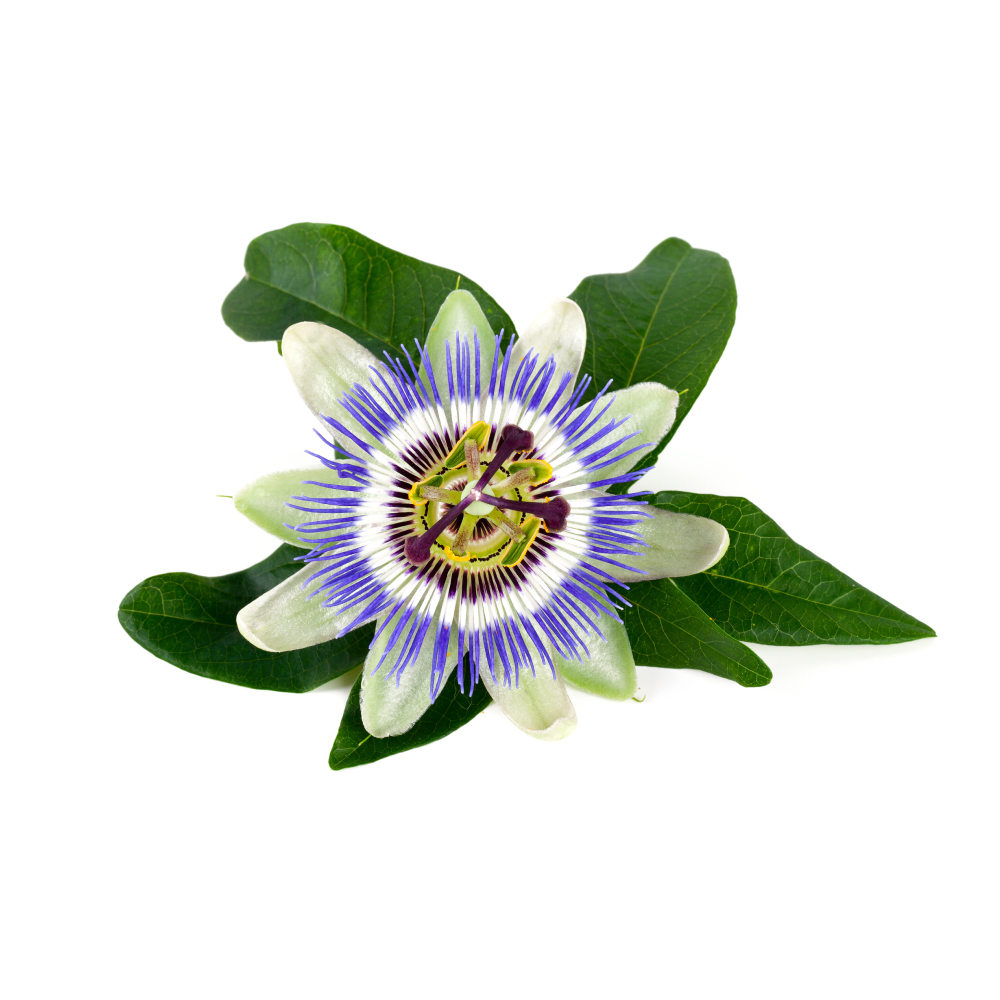
Materia Medica
Passionflower
Passiflora incarnata
Passionflower (Passiflora incarnata) — a calming nervine best supported for anxiety (including pre-operative and dental settings) and sleep, whose older reputation for muscle tension and blood pressure rests on trace alkaloids and on other Passiflora species.
What Is Passionflower?
Passionflower (Passiflora incarnata) is a climbing vine in the Passifloraceae family, native to the southeastern United States — not the tropical passion-fruit crop it is often confused with. Its aerial parts (leaves and stems, sometimes with the flowers) are the part used medicinally, dried for teas, tinctures and standardised extracts.
Its enduring reputation is as a gentle nervine — a calming herb for anxiety, restlessness and disturbed sleep — and this is also where the human evidence is strongest: small randomised trials support its use for situational anxiety (before surgery and dental work) and for subjective sleep quality. Its older billing as a muscle relaxant and mild blood-pressure remedy is attributed to trace β-carboline (“harmane”) alkaloids, but these occur at such low levels in P. incarnata (roughly 0.005–0.012%) that their contribution from ordinary preparations is doubtful.
A recurring source of confusion runs through the literature: findings from other Passiflora species — P. edulis (the antioxidant passion fruit), P. foetida (analgesic) and purified chrysin — are frequently reported as if they were properties of P. incarnata. The antioxidant and urinary-tract reputation of the fruit in particular belongs to P. edulis, a food crop, not to the medicinal herb.
Traditional & Modern Uses
Passionflower has a deep ethnobotanical record. Prehistoric use of P. incarnata in North America dates to the Late Archaic period, where it appears to have been a minor food plant rather than a staple 32Reference 32Clinical trialPassiflora incarnata L.: ethnopharmacology, clinical application, safety and evaluation of clinical trials — reviewView study →. The Cherokee used the root as a tea tonic and pounded it into topical poultices for boils and inflammation, and nineteenth-century North American practice used the leaf infusion as a sedative for headaches, neuralgia and general pain 39Reference 39The Healing Power of Rainforest Herbs.
Over the last two centuries it became established across Canada, Europe and the United States as a mild tranquiliser and anxiolytic, and has also been used traditionally for colic, dysmenorrhoea, insomnia, neuralgia, seizures and muscle spasm 32Reference 32Clinical trialPassiflora incarnata L.: ethnopharmacology, clinical application, safety and evaluation of clinical trials — reviewView study →. The genus name and the “passion flower” epithet come from sixteenth- and seventeenth-century European missionaries, who read the flower’s structure as a symbol of the Passion of Christ 40Reference 40Passiflora: Passionflowers of the World.
Modern regulatory and review bodies treat it as a traditional calming herb rather than a proven drug: P. incarnata aerial parts carry a European Medicines Agency (EMA/HMPC) herbal monograph and appear in several pharmacopoeias for the relief of mild stress and sleep disturbance 14Reference 14ReviewHerbal medicinal products from Passiflora for anxiety: an unexploited potential — reviewView study →. Systematic reviews of its use in neuropsychiatric disorders 13Reference 13Systematic reviewPassiflora incarnata in neuropsychiatric disorders — a systematic reviewView study → and of herbal supplements for anxiety 9Reference 9Systematic reviewNutritional and herbal supplements for anxiety and anxiety-related disorders: systematic reviewView study → reach the same measured conclusion — a plausible, well-tolerated anxiolytic whose trial base is still small.
Botany & Varieties
Passiflora is the largest genus in the Passifloraceae, with roughly 500 species plus several hundred horticultural hybrids 40Reference 40Passiflora: Passionflowers of the World. The great majority are Central and South American — Colombia alone holds more than 100 species — and P. incarnata is one of the few temperate, North American members 40Reference 40Passiflora: Passionflowers of the World.
Passionflowers are evergreen climbing vines that ascend neighbouring vegetation by coiling tendrils, and are prized ornamentally for their intricate flowers. The medicinal species should be kept distinct from its relatives: P. edulis (passion fruit) is a pantropical food crop and P. foetida a mostly annual tropical species, and it is these — not P. incarnata — that supply much of the “passionflower” data on antioxidant and analgesic activity 32Reference 32Clinical trialPassiflora incarnata L.: ethnopharmacology, clinical application, safety and evaluation of clinical trials — reviewView study →.
Habitat & Distribution
P. incarnata is native to the southeastern United States, favouring temperate zones, where it produces fragrant 6–8 cm flowers; it is naturalised and cultivated more widely. The broader genus is concentrated in the warm regions of the Americas, with scattered species reaching Southeast Asia and Australia 40Reference 40Passiflora: Passionflowers of the World. Commercially, P. incarnata is the most important medicinal Passiflora and is grown at scale in the United States, Brazil, India and elsewhere 40Reference 40Passiflora: Passionflowers of the World.
Harvesting & Preparation
When passionflower is grown for its antifungal or antibacterial activity, deliberately wounding the living leaves hours to days before harvest raises the levels of the defensive “passicol” principle 24Reference 24In vitroPassicol, an antibacterial and antifungal agent produced by Passiflora plant species — in vitroView study →. Preparation and species choice also shape the chemistry: flavonoid and alkaloid content vary several-fold with chemotype, plant part and whether the plant is field- or greenhouse-grown, and antioxidant capacity differs markedly between species 25Reference 25In vitroAssessment of total phenolic, antioxidant, and antibacterial activities of Passiflora species — in vitroView study → — so a result obtained with one standardised extract does not transfer cleanly to a tea or a whole-herb powder.
Phytochemistry
The activity of Passiflora incarnata is anchored by its flavonoid C-glycosides — chiefly vitexin, isovitexin, orientin, isoorientin and schaftoside — which serve as the pharmacopoeial markers and make up the bulk of the ~2.5% total flavonoid fraction of the dried aerial parts 32Reference 32Clinical trialPassiflora incarnata L.: ethnopharmacology, clinical application, safety and evaluation of clinical trials — reviewView study →. Layered on top are trace indole (“harmane”) β-carboline alkaloids such as harmane, harmine and harmaline, plus the γ-pyrone maltol, implicated in the herb’s sedative character 39Reference 39The Healing Power of Rainforest Herbs.
The flavonoid chrysin — also abundant in propolis and honey — is a partial agonist at the benzodiazepine site of the GABAA receptor, and both chrysin and apigenin show anxiolytic-type behaviour in animal models 27,28Reference 27AnimalBehavioural characterisation of the flavonoids apigenin and chrysin — animal modelView study →Reference 28AnimalEvaluation of the anxiolytic effects of chrysin, a Passiflora incarnata extract, in the laboratory rat — animal modelView study →. A phytochemically characterised whole extract likewise produces anxiolytic effects through the GABAergic system in animals 20Reference 20AnimalAnxiolytic activity of a phytochemically characterized Passiflora incarnata extract is mediated via the GABAergic system — animal modelView study →, consistent with the herb’s clinical profile.
Constituent Summary
Figures are % of dry herb (P. incarnata); flavonoid and alkaloid levels vary widely with chemotype, plant part and cultivation (greenhouse vs. field), so treat them as representative rather than fixed.
Phenolic2 compounds1 with data
Flavonoid C-glycoside5 compoundsno data
Flavonoid1 compoundno data
Indole alkaloid2 compounds2 with data
Other Constituents
Beyond the marker flavonoids and trace alkaloids, P. incarnata contains additional flavonoids (apigenin, kaempferol, quercetin, vicenin, lucenin, saponarin), cyclopassiflosides (triterpene saponins), the coumarin scopoletin, phytosterols (β-sitosterol, stigmasterol), free fatty acids (linoleic, linolenic, palmitic, oleic and myristic), maltol and trace serotonin, together with cyanogenic glycosides such as gynocardin that serve in plant defence and diminish as the leaves age 32,39Reference 32Clinical trialPassiflora incarnata L.: ethnopharmacology, clinical application, safety and evaluation of clinical trials — reviewView study →Reference 39The Healing Power of Rainforest Herbs. Roughly 294 volatile compounds have been catalogued across Passiflora fruit and aerial extracts, though these belong largely to the fruit-bearing species 32Reference 32Clinical trialPassiflora incarnata L.: ethnopharmacology, clinical application, safety and evaluation of clinical trials — reviewView study →.
Pharmacology & Research
Passionflower (Passiflora incarnata) is one of the better-studied calming herbs, but the evidence is lopsided: several small human randomised trials support its use for anxiety and sleep, while most of the remaining indications rest on animal models, in-vitro work, or studies of the isolated flavonoid chrysin rather than the whole herb. A recurring problem in the literature — and in older monographs — is species and preparation drift: findings from P. edulis, P. foetida and purified chrysin are frequently reported as if they were properties of P. incarnata aerial parts, the part actually used medicinally. Genuine human data cluster around two uses: situational (pre-operative and dental) anxiety, where multiple randomised trials are positive, and subjective sleep quality. A 2007 Cochrane review and a 2022 network meta-analysis both temper the enthusiasm, judging the anxiety evidence real but methodologically thin. Flavonoid content varies several-fold with chemotype, plant part and cultivation, so effects seen with one standardised extract do not transfer cleanly to a tea or a whole-herb powder.
- Best-supported: situational anxiety (pre-operative and dental settings, multiple positive RCTs) 2,3,5,6Reference 2RCTPreoperative oral Passiflora incarnata reduces anxiety in ambulatory surgery patients: a double-blind, placebo-controlled study — randomised, placebo-controlledView study →Reference 3RCTPassiflora incarnata Linneaus as an anxiolytic before spinal anesthesia — randomised, placebo-controlledView study →Reference 5RCTEffects of Passiflora incarnata on salivary biomarkers and anxiety in patients undergoing third molar extraction surgery — randomised, placebo-controlledView study →Reference 6RCTAssessment of Passiflora incarnata L for conscious sedation during extraction of mandibular third molars — randomised, double-blind crossoverView study → and subjective/objective sleep quality 10,11,12Reference 10RCTA double-blind, placebo-controlled investigation of the effects of Passiflora incarnata (passionflower) herbal tea on subjective sleep quality — randomised, placebo-controlledView study →Reference 11RCTEffects of Passiflora incarnata Linnaeus on polysomnographic sleep parameters in subjects with insomnia disorder — randomised, placebo-controlledView study →Reference 12RCTRandomized, double-blind, placebo-controlled clinical study of Passiflora incarnata in participants with stress and sleep problems — randomised, placebo-controlledView study →.
- Emerging, worth watching: substance-withdrawal adjunct (one human RCT plus animal work) 15,16Reference 15RCTPassionflower in the treatment of opiates withdrawal: a double-blind randomized controlled trial — randomisedView study →Reference 16AnimalSintocalmy, a Passiflora incarnata based herbal, attenuates morphine withdrawal in mice — animal modelView study → and ADHD/menopausal symptoms (single small trials only) 33Reference 33Systematic reviewHerbal medicines in children with attention deficit hyperactivity disorder (ADHD): a systematic reviewView study →.
- Mechanistically thin: antidepressant, anticancer, cardio- and neuroprotective claims rest largely on isolated chrysin in rodents and cell lines, not on the herb as taken 26,29,30Reference 26In vitroChemopreventive and therapeutic potential of chrysin in cancer: mechanistic perspectives — review (in vitro / animal)View study →Reference 29AnimalChronic unpredictable mild stress decreases BDNF and NGF levels and Na⁺,K⁺-ATPase activity in the hippocampus and prefrontal cortex of mice: antidepressant effect of chrysin — animal modelView study →Reference 30AnimalChrysin protects against focal cerebral ischemia/reperfusion injury in mice through attenuation of oxidative stress and inflammation — animal modelView study →.
- The caveat: most human trials are small, use proprietary extracts, and much preclinical data comes from other Passiflora species — the anxiolytic effect is real but the standardised dose and preparation are not settled.
1. Anxiety
Anxiety is the indication with the most direct human evidence. A pilot double-blind RCT (n=36) found a P. incarnata extract (45 drops/day) as effective as oxazepam 30 mg/day for generalised anxiety disorder over four weeks, with less impairment of job performance 1Reference 1RCTPassionflower in the treatment of generalized anxiety: a pilot double-blind randomized controlled trial with oxazepam — randomisedView study →. The stronger body of work is in situational anxiety: pre-operative RCTs report that oral P. incarnata (500 mg) lowers anxiety before ambulatory and spinal-anaesthesia surgery without sedation or delayed recovery 2,3Reference 2RCTPreoperative oral Passiflora incarnata reduces anxiety in ambulatory surgery patients: a double-blind, placebo-controlled study — randomised, placebo-controlledView study →Reference 3RCTPassiflora incarnata Linneaus as an anxiolytic before spinal anesthesia — randomised, placebo-controlledView study →, and several dental-extraction trials find it comparable to midazolam for peri-operative anxiety 4,5,6Reference 4RCTEffects of passiflora incarnata and midazolam for control of anxiety in patients undergoing dental extraction — randomised, double-blind crossoverView study →Reference 5RCTEffects of Passiflora incarnata on salivary biomarkers and anxiety in patients undergoing third molar extraction surgery — randomised, placebo-controlledView study →Reference 6RCTAssessment of Passiflora incarnata L for conscious sedation during extraction of mandibular third molars — randomised, double-blind crossoverView study →. A 2007 Cochrane review concluded the trials were too few and too small to draw firm conclusions 7Reference 7Systematic reviewPassiflora for anxiety disorder — systematic review (Cochrane)View study →, and a 2022 Bayesian network meta-analysis of anxiety herbs did not rank passionflower among the clearly efficacious agents 8Reference 8Meta-analysisMedicinal herbs for the treatment of anxiety: a systematic review and network meta-analysis — systematic reviewView study →. The plausible mechanism is modulation of GABAA signalling (see Mechanisms) 18,19Reference 18In vitroPassiflora incarnata L. (Passionflower) extracts elicit GABA currents in hippocampal neurons in vitro, and show anxiogenic and anticonvulsant effects in vivo — in vitro / animal modelView study →Reference 19In vitroModulation of the γ-aminobutyric acid (GABA) system by Passiflora incarnata L. — in vitroView study →. Effects are consistent in direction but the extracts and doses differ across trials.
Gap: Trials are small, mostly single-centre, and use different proprietary extracts — no large, standardised-dose RCT confirms an effect for chronic generalised anxiety.
2. Sleep & insomnia
Three small human RCTs support a short-term sleep benefit. A low-dose P. incarnata tea improved subjective sleep quality versus placebo in healthy adults with mild sleep fluctuations (n=41) 10Reference 10RCTA double-blind, placebo-controlled investigation of the effects of Passiflora incarnata (passionflower) herbal tea on subjective sleep quality — randomised, placebo-controlledView study →. A double-blind trial in diagnosed insomnia (n=110) found a P. incarnata extract significantly increased total sleep time on polysomnography after two weeks, though sleep efficiency and wake-after-sleep-onset did not separate from placebo 11Reference 11RCTEffects of Passiflora incarnata Linnaeus on polysomnographic sleep parameters in subjects with insomnia disorder — randomised, placebo-controlledView study →. A 2024 placebo-controlled trial (n=65) of a standardised extract reported reduced perceived stress and increased total sleep time with no adverse effects 12Reference 12RCTRandomized, double-blind, placebo-controlled clinical study of Passiflora incarnata in participants with stress and sleep problems — randomised, placebo-controlledView study →. Effects are modest and short-term.
Gap: Objective (polysomnographic) improvements are limited to total sleep time in one study; longer trials and consistent dosing are lacking.
3. Substance-withdrawal adjunct
A double-blind RCT (n=65) found that adding P. incarnata extract to clonidine during outpatient opiate detoxification improved the mental/psychological symptoms of withdrawal (anxiety, irritability, agitation) that clonidine alone manages poorly 15Reference 15RCTPassionflower in the treatment of opiates withdrawal: a double-blind randomized controlled trial — randomisedView study →. Mechanistic support comes from a mouse morphine-withdrawal model in which a commercial P. incarnata extract attenuated naloxone-precipitated jumping and modulated glial markers 16Reference 16AnimalSintocalmy, a Passiflora incarnata based herbal, attenuates morphine withdrawal in mice — animal modelView study →. There is also a registered but unpublished trial in benzodiazepine withdrawal.
Gap: Only one human trial, in combination with clonidine — the herb’s independent contribution and any use in benzodiazepine tapering remain untested in published data.
4. Anticonvulsant
In mice, a P. incarnata hydroalcoholic extract delayed seizure onset, shortened seizure duration and reduced mortality, with the effect linked to GABAergic and opioid systems 17Reference 17AnimalAnticonvulsant effects of aerial parts of Passiflora incarnata extract in mice: involvement of benzodiazepine and opioid receptors — animal modelView study →. Whole-plant extracts elicit GABA currents in hippocampal neurons in vitro and show anticonvulsant effects in vivo that vary with extraction method 18Reference 18In vitroPassiflora incarnata L. (Passionflower) extracts elicit GABA currents in hippocampal neurons in vitro, and show anxiogenic and anticonvulsant effects in vivo — in vitro / animal modelView study →. A registered trial in partial epilepsy was withdrawn before completion.
Gap: Entirely preclinical — no human anticonvulsant data, and the anticonvulsant/anxiogenic balance shifts with how the extract is prepared.
5. Antioxidant
Infusions and extracts of several Passiflora species show antioxidant capacity comparable to or exceeding green tea, driven by flavonoid C-glycosides such as vitexin, isovitexin and orientin 25Reference 25In vitroAssessment of total phenolic, antioxidant, and antibacterial activities of Passiflora species — in vitroView study →. Species and plant part matter: leaf and stem extracts of P. maliformis and P. quadrangularis out-perform others on total phenolics and radical scavenging 25Reference 25In vitroAssessment of total phenolic, antioxidant, and antibacterial activities of Passiflora species — in vitroView study →, and P. incarnata is not the strongest antioxidant performer among the genus. Results are in-vitro assays (DPPH, FRAP, total phenolic content), not clinical endpoints.
Gap: No human antioxidant-status data; the strongest activity is in species other than the medicinal P. incarnata.
6. Antispasmodic & hypotensive
The traditional smooth-muscle-relaxant and mild blood-pressure-lowering reputation is attributed to the harmala (β-carboline) alkaloids. Harmaline and related harmala alkaloids inhibit voltage-gated calcium channels in vascular and intestinal smooth muscle, preventing contraction 22Reference 22In vitroInhibition of calcium channels by harmaline and other harmala alkaloids in vascular and intestinal smooth muscles — in vitroView study →. The important caveat is quantitative: harmane and harmine occur only in trace amounts in P. incarnata (roughly 0.005–0.012%), so whether they reach pharmacologically relevant concentrations from ordinary preparations is doubtful.
Gap: Mechanism shown only in isolated animal tissue at concentrations far above what trace alkaloid levels in the herb would deliver; no human cardiovascular trial.
7. Antidepressant
Antidepressant claims rest almost entirely on the isolated flavonoid chrysin, not the whole herb. In a chronic-unpredictable-mild-stress mouse model, chrysin reversed behavioural despair, normalised corticosterone, upregulated BDNF and NGF, and preserved Na⁺/K⁺-ATPase activity in the hippocampus and prefrontal cortex, with effects comparable to fluoxetine 29Reference 29AnimalChronic unpredictable mild stress decreases BDNF and NGF levels and Na⁺,K⁺-ATPase activity in the hippocampus and prefrontal cortex of mice: antidepressant effect of chrysin — animal modelView study →. Chrysin is present in passionflower but also in propolis and honey, and the doses used in these studies far exceed what the herb provides.
Gap: No study of P. incarnata itself for depression; the evidence is constituent-level in rodents.
8. Antimicrobial
“Passicol”, an antibacterial and antifungal principle isolated from Passiflora species, shows activity against Gram-positive but not Gram-negative bacteria in vitro 24Reference 24In vitroPassicol, an antibacterial and antifungal agent produced by Passiflora plant species — in vitroView study →. The seeds contain antifungal proteins and peptides. Antifungal activity increases when living plant tissue is wounded before harvest 24Reference 24In vitroPassicol, an antibacterial and antifungal agent produced by Passiflora plant species — in vitroView study →. These are laboratory findings, largely in species other than P. incarnata, with no clinical anti-infective data.
Gap: In-vitro only, mostly non-incarnata species; no evidence of systemic antimicrobial effect from the herb as used.
9. Analgesic & anti-inflammatory
Frequently cited analgesic and anti-inflammatory data come from P. foetida, a different species: an ethanol leaf extract (200 mg/kg) was reported comparable to morphine in a mouse pain model, and (100 mg/kg) showed acute anti-inflammatory activity 23Reference 23AnimalAnalgesic and anti-inflammatory activities of Passiflora foetida L. — animal modelView study →. Traditional use of P. incarnata root as a topical anti-inflammatory and analgesic is documented but not clinically tested.
Gap: The strongest preclinical analgesic data are from P. foetida, not P. incarnata — the species substitution is rarely made explicit.
10. Antitussive
A single 2002 study reported that a methanol leaf extract of P. incarnata suppressed cough in mice comparably to codeine 21Reference 21AnimalAntitussive activity of the methanol extract of Passiflora incarnata leaves — animal modelView study →. The effect may relate to the antispasmodic activity of the harmala alkaloids, but it has not been replicated or tested in humans.
Gap: One animal study, never replicated; no human antitussive data.
11. Neuroprotective
Neuroprotective claims again rest on isolated constituents. Chrysin reduced infarct volume and neurological deficit in a mouse cerebral ischaemia/reperfusion model through anti-inflammatory and antioxidant actions 30Reference 30AnimalChrysin protects against focal cerebral ischemia/reperfusion injury in mice through attenuation of oxidative stress and inflammation — animal modelView study →, and maltol protected rodent retinal neurons against oxidative stress 31Reference 31In vitroThe neuroprotective effect of maltol against oxidative stress on rat retinal neuronal cells — in vitro / animal modelView study →. Both are single-constituent studies at pharmacological doses.
Gap: No whole-herb neuroprotection data; findings are constituent-level in acute rodent injury models.
12. Anticancer (chemoprotective)
This is the weakest-supported claim relative to how prominently older monographs feature it. All of it concerns isolated chrysin, which shows pro-apoptotic and anti-proliferative activity across many cancer cell lines and some rodent models 26Reference 26In vitroChemopreventive and therapeutic potential of chrysin in cancer: mechanistic perspectives — review (in vitro / animal)View study →. None of this involves P. incarnata extract, and no human data exist. Presenting passionflower as a cancer therapy on the basis of purified-chrysin cell-line work substantially overstates the evidence.
Gap: Entirely isolated-chrysin, in-vitro/rodent; there is no basis to claim an anticancer effect for the herb.
Mechanisms
| Mechanism | Drives | Key compounds |
|---|---|---|
| GABAA modulation — ↑ GABA currents, benzodiazepine-site partial agonism | anxiolyticsedativeanticonvulsant | endogenous GABA, chrysin, apigenin |
| HPA-axis / neurotrophin modulation — ↓ corticosterone, ↑ BDNF & NGF | antidepressant | chrysin |
| Voltage-gated Ca²⁺-channel inhibition in smooth muscle | antispasmodichypotensive | harmane, harmaline, harmine |
| Free-radical scavenging via flavonoid C-glycosides | antioxidantneuroprotective | vitexin, isovitexin, orientin |
| Membrane disruption of Gram-positive bacteria and fungi | antimicrobial | passicol, Pe-AFP1 |
Clinical trials
A modest number of small registered and published human trials exist — concentrated on anxiety (including pre-operative and dental settings) and sleep — but there is no large, definitive RCT. Of 13 trials on ClinicalTrials.gov, 6 are completed, 2 were withdrawn (climacteric syndrome; partial epilepsy) and 5 carry an unknown/unverified status.
| Completed | Unknown status | Withdrawn | Preclinical |
|---|---|---|---|
| 6 | 5 | 2 | ~40+ |
Last checked: July 2026.
Dosage
In trials, passionflower is given mostly as proprietary standardised extracts dosed by product weight rather than to a marker compound, so most of the research doses below cannot be back-converted to a whole-herb amount. These are research doses, not recommendations.
| Indication | Preparation | Dose | Est. dried-herb equivalent | Source |
|---|---|---|---|---|
| Generalised anxiety | Liquid extract (proprietary) | 45 drops/day, 4 wk | — (proprietary; no marker %) | 1Reference 1RCTPassionflower in the treatment of generalized anxiety: a pilot double-blind randomized controlled trial with oxazepam — randomisedView study → |
| Pre-operative anxiety | Oral extract | 500 mg, 90 min pre-op | — | 2Reference 2RCTPreoperative oral Passiflora incarnata reduces anxiety in ambulatory surgery patients: a double-blind, placebo-controlled study — randomised, placebo-controlledView study → |
| Dental anxiety | Oral tablet/extract | 260 mg pre-op | — | 4Reference 4RCTEffects of passiflora incarnata and midazolam for control of anxiety in patients undergoing dental extraction — randomised, double-blind crossoverView study → |
| Sleep quality | Herbal tea infusion | ~2 g dried herb/cup, nightly | ~2 g dried aerial parts | 10Reference 10RCTA double-blind, placebo-controlled investigation of the effects of Passiflora incarnata (passionflower) herbal tea on subjective sleep quality — randomised, placebo-controlledView study → |
| Insomnia | Standardised extract | nightly for 2 wk (dose per product) | — | 11Reference 11RCTEffects of Passiflora incarnata Linnaeus on polysomnographic sleep parameters in subjects with insomnia disorder — randomised, placebo-controlledView study → |
Only the tea trial 10Reference 10RCTA double-blind, placebo-controlled investigation of the effects of Passiflora incarnata (passionflower) herbal tea on subjective sleep quality — randomised, placebo-controlledView study → states a whole-herb amount (~2 g infused); the extract trials report proprietary-product milligrams with no marker-compound percentage, so a whole-herb equivalent would be invented and is left ”—”. This column is a guide, not a conversion factor.
Traditional Dosage
Traditional Western herbal practice uses the dried aerial parts as a tea, tincture or liquid extract.
| System | Preparation | Dose |
|---|---|---|
| Western herbal | Liquid extract 1:2 | 15–40 mL/week |
| Western herbal | Dried herb infusion | 2–4 g, up to 3×/day |
| Western herbal | Tincture 1:5 | 3–6 mL, up to 3×/day |
Safety & Pregnancy
Passionflower is generally well tolerated, but its main risk is additive sedation with benzodiazepines, alcohol and other CNS depressants; a single case report also links therapeutic doses to QTc prolongation and arrhythmia.
- Additive sedation. May potentiate benzodiazepines, barbiturates, alcohol and other CNS depressants — a valerian case report describes deepened sedation.
- Rare cardiac event. A single case report documented QTc prolongation and non-sustained ventricular tachycardia at therapeutic doses.
- Avoid in pregnancy. Not established as safe — an animal developmental signal and an adverse human case series (see below).
- Discontinue before surgery. Prudent to stop, and to avoid alcohol and driving, until you know how it affects you.
- Interactions unassessed. No human CYP450 studies — interactions beyond additive sedation are not assessed rather than proven absent.
Full safety & interactions detail
Passionflower is generally well tolerated at customary doses, and P. incarnata is classified GRAS (generally recognised as safe) for food use in the United States — a food-use status that does not certify therapeutic-dose safety 32Reference 32Clinical trialPassiflora incarnata L.: ethnopharmacology, clinical application, safety and evaluation of clinical trials — reviewView study →. The most consistent concern is additive sedation: it may potentiate benzodiazepines, barbiturates and other CNS depressants, and a case report describes deepened sedation and altered lorazepam handling when passionflower was combined with valerian 37Reference 37Case reportInteractions of Valeriana officinalis L. and Passiflora incarnata L. in a patient treated with lorazepam — case reportView study →. Reported adverse effects are usually mild (drowsiness, dizziness, nausea), but a single case report documented severe nausea, vomiting, drowsiness, QTc prolongation and non-sustained ventricular tachycardia at therapeutic doses, requiring hospital monitoring 36Reference 36Case reportToxicity of Passiflora incarnata L. — case reportView study →. Because of its sedative action, users should avoid combining it with alcohol or driving until they know how it affects them, and it is prudent to discontinue before surgery unless supervised. No systematic human CYP450 or pharmacokinetic interaction studies have been performed, so interactions beyond additive sedation are not assessed rather than established as absent.
Avoid — not established as safe. P. incarnata extract was not teratogenic in animal studies, but a rat developmental study found disrupted sexual behaviour in male offspring after gestational and lactational exposure (300 mg/kg) 35Reference 35AnimalDevelopmental exposure to Passiflora incarnata induces behavioural alterations in the male progeny — animal modelView study →, and a human case series of five pregnant psychiatric patients reported adverse pregnancy outcomes — including one neonatal death, premature membrane rupture, meconium aspiration and persistent pulmonary hypertension — though causality was not established and no birth defects were seen 34Reference 34ObservationalPregnancy outcomes in psychiatric patients treated with Passiflora incarnata — observational case seriesView study →. With no controlled human safety data, passionflower is best avoided in pregnancy; safety during lactation has not been studied.
Synergy
Passionflower is traditionally combined with other calming herbs — valerian, hops, lemon balm and St John’s wort — in sleep and anxiety formulas 40Reference 40Passiflora: Passionflowers of the World. These pairings are traditional practice rather than trial-tested combinations; note that pairing it with valerian has been linked to excess sedation in a case report (see Safety) 37Reference 37Case reportInteractions of Valeriana officinalis L. and Passiflora incarnata L. in a patient treated with lorazepam — case reportView study →, so additive CNS effects should be expected rather than assumed benign.
References
- Akhondzadeh, S., Naghavi, H. R., Vazirian, M., et al. (2001). Passionflower in the treatment of generalized anxiety: a pilot double-blind randomized controlled trial with oxazepam — randomised. J Clin Pharm Ther. https://pubmed.ncbi.nlm.nih.gov/11679026/
- Movafegh, A., Alizadeh, R., Hajimohamadi, F., et al. (2008). Preoperative oral Passiflora incarnata reduces anxiety in ambulatory surgery patients: a double-blind, placebo-controlled study — randomised, placebo-controlled. Anesth Analg. https://pubmed.ncbi.nlm.nih.gov/18499602/
- Aslanargun, P., Cuvas, O., Dikmen, B., et al. (2012). Passiflora incarnata Linneaus as an anxiolytic before spinal anesthesia — randomised, placebo-controlled. J Anesth. https://pubmed.ncbi.nlm.nih.gov/22048283/
- Dantas, L. P., de Oliveira-Ribeiro, A., et al. (2017). Effects of passiflora incarnata and midazolam for control of anxiety in patients undergoing dental extraction — randomised, double-blind crossover. Med Oral Patol Oral Cir Bucal. https://pubmed.ncbi.nlm.nih.gov/27918731/
- Lima Neto, T. J., et al. (2025). Effects of Passiflora incarnata on salivary biomarkers and anxiety in patients undergoing third molar extraction surgery — randomised, placebo-controlled. Sci Rep. https://pubmed.ncbi.nlm.nih.gov/41381570/
- Rocha, R. G., et al. (2021). Assessment of Passiflora incarnata L for conscious sedation during extraction of mandibular third molars — randomised, double-blind crossover. Quintessence Int. https://pubmed.ncbi.nlm.nih.gov/34076379/
- Miyasaka, L. S., Atallah, A. N., Soares, B. G. (2007). Passiflora for anxiety disorder — systematic review (Cochrane). Cochrane Database Syst Rev. https://pubmed.ncbi.nlm.nih.gov/17253512/
- Zhang, W., et al. (2022). Medicinal herbs for the treatment of anxiety: a systematic review and network meta-analysis — systematic review. Pharmacol Res. https://pubmed.ncbi.nlm.nih.gov/35378276/
- Lakhan, S. E., Vieira, K. F. (2010). Nutritional and herbal supplements for anxiety and anxiety-related disorders: systematic review. Nutr J. https://pubmed.ncbi.nlm.nih.gov/20929532/
- Ngan, A., Conduit, R. (2011). A double-blind, placebo-controlled investigation of the effects of Passiflora incarnata (passionflower) herbal tea on subjective sleep quality — randomised, placebo-controlled. Phytother Res. https://pubmed.ncbi.nlm.nih.gov/21294203/
- Lee, J., Jung, H. Y., Lee, S. I., et al. (2020). Effects of Passiflora incarnata Linnaeus on polysomnographic sleep parameters in subjects with insomnia disorder — randomised, placebo-controlled. Int Clin Psychopharmacol. https://pubmed.ncbi.nlm.nih.gov/31714321/
- Kumar, A., et al. (2024). Randomized, double-blind, placebo-controlled clinical study of Passiflora incarnata in participants with stress and sleep problems — randomised, placebo-controlled. Cureus. https://pubmed.ncbi.nlm.nih.gov/38646244/
- Janda, K., Wojtkowska, K., et al. (2020). Passiflora incarnata in neuropsychiatric disorders — a systematic review. Nutrients. https://pubmed.ncbi.nlm.nih.gov/33352740/
- da Fonseca, L. R., et al. (2020). Herbal medicinal products from Passiflora for anxiety: an unexploited potential — review. ScientificWorldJournal. https://pubmed.ncbi.nlm.nih.gov/32765195/
- Akhondzadeh, S., Kashani, L., Mobaseri, M., et al. (2001). Passionflower in the treatment of opiates withdrawal: a double-blind randomized controlled trial — randomised. J Clin Pharm Ther. https://pubmed.ncbi.nlm.nih.gov/11679027/
- Aman, U., et al. (2021). Sintocalmy, a Passiflora incarnata based herbal, attenuates morphine withdrawal in mice — animal model. Neurochem Res. https://pubmed.ncbi.nlm.nih.gov/33544325/
- Nassiri-Asl, M., Shariati-Rad, S., Zamansoltani, F. (2007). Anticonvulsant effects of aerial parts of Passiflora incarnata extract in mice: involvement of benzodiazepine and opioid receptors — animal model. BMC Complement Altern Med. https://pubmed.ncbi.nlm.nih.gov/17686156/
- Elsas, S. M., Rossi, D. J., Raber, J., et al. (2010). Passiflora incarnata L. (Passionflower) extracts elicit GABA currents in hippocampal neurons in vitro, and show anxiogenic and anticonvulsant effects in vivo — in vitro / animal model. Phytomedicine. https://pubmed.ncbi.nlm.nih.gov/20382514/
- Appel, K., Rose, T., Fiebich, B., et al. (2011). Modulation of the γ-aminobutyric acid (GABA) system by Passiflora incarnata L. — in vitro. Phytother Res. https://pubmed.ncbi.nlm.nih.gov/21089181/
- Grundmann, O., Wang, J., McGregor, G. P., Butterweck, V. (2008). Anxiolytic activity of a phytochemically characterized Passiflora incarnata extract is mediated via the GABAergic system — animal model. Planta Med. https://pubmed.ncbi.nlm.nih.gov/19006051/
- Dhawan, K., Sharma, A. (2002). Antitussive activity of the methanol extract of Passiflora incarnata leaves — animal model. Fitoterapia. https://pubmed.ncbi.nlm.nih.gov/12165335/
- Karaki, H., Kishimoto, T., Ozaki, H., et al. (1986). Inhibition of calcium channels by harmaline and other harmala alkaloids in vascular and intestinal smooth muscles — in vitro. Br J Pharmacol. https://pubmed.ncbi.nlm.nih.gov/3779216/
- Sasikala, V., Saravanan, S., Parimelazhagan, T. (2011). Analgesic and anti-inflammatory activities of Passiflora foetida L. — animal model. Asian Pac J Trop Med. https://pubmed.ncbi.nlm.nih.gov/21914535/
- Nicolls, J. M., Birner, J., Forsell, P. (1973). Passicol, an antibacterial and antifungal agent produced by Passiflora plant species — in vitro. Antimicrob Agents Chemother. https://pubmed.ncbi.nlm.nih.gov/4790567/
- Ramaiya, S. D., Bujang, J. S., Zakaria, M. H. (2014). Assessment of total phenolic, antioxidant, and antibacterial activities of Passiflora species — in vitro. ScientificWorldJournal. https://pubmed.ncbi.nlm.nih.gov/25028673/
- Kasala, E. R., Bodduluru, L. N., Madana, R. M., et al. (2015). Chemopreventive and therapeutic potential of chrysin in cancer: mechanistic perspectives — review (in vitro / animal). Toxicol Lett. https://pubmed.ncbi.nlm.nih.gov/25596314/
- Zanoli, P., Avallone, R., Baraldi, M. (2000). Behavioural characterisation of the flavonoids apigenin and chrysin — animal model. Fitoterapia. https://pubmed.ncbi.nlm.nih.gov/10930722/
- Brown, E., Hurd, N. S., McCall, S., Ceremuga, T. E. (2007). Evaluation of the anxiolytic effects of chrysin, a Passiflora incarnata extract, in the laboratory rat — animal model. AANA J. https://pubmed.ncbi.nlm.nih.gov/17966676/
- Filho, C. B., Jesse, C. R., Donato, F., et al. (2015). Chronic unpredictable mild stress decreases BDNF and NGF levels and Na⁺,K⁺-ATPase activity in the hippocampus and prefrontal cortex of mice: antidepressant effect of chrysin — animal model. Neuroscience. https://pubmed.ncbi.nlm.nih.gov/25592430/
- Yao, Y., Chen, L., Xiao, J., et al. (2014). Chrysin protects against focal cerebral ischemia/reperfusion injury in mice through attenuation of oxidative stress and inflammation — animal model. Int J Mol Sci. https://pubmed.ncbi.nlm.nih.gov/25402649/
- Song, Y., Hong, S., Iizuka, Y., et al. (2015). The neuroprotective effect of maltol against oxidative stress on rat retinal neuronal cells — in vitro / animal model. Korean J Ophthalmol. https://pubmed.ncbi.nlm.nih.gov/25646062/
- Miroddi, M., Calapai, G., Navarra, M., et al. (2013). Passiflora incarnata L.: ethnopharmacology, clinical application, safety and evaluation of clinical trials — review. J Ethnopharmacol. https://pubmed.ncbi.nlm.nih.gov/24140586/
- Anheyer, D., Lauche, R., Schumann, D., et al. (2017). Herbal medicines in children with attention deficit hyperactivity disorder (ADHD): a systematic review. Complement Ther Med. https://pubmed.ncbi.nlm.nih.gov/28137522/
- Ozturk, Z., Kalayci, C. C. (2018). Pregnancy outcomes in psychiatric patients treated with Passiflora incarnata — observational case series. Complement Ther Med. https://pubmed.ncbi.nlm.nih.gov/29458926/
- de Castro, P. C. F., Hoshino, A., da Silva, J. C., Mendes, F. R. (2013). Developmental exposure to Passiflora incarnata induces behavioural alterations in the male progeny — animal model. Reprod Fertil Dev. https://pubmed.ncbi.nlm.nih.gov/22958428/
- Fisher, A. A., Purcell, P., Le Couteur, D. G. (2000). Toxicity of Passiflora incarnata L. — case report. J Toxicol Clin Toxicol. https://pubmed.ncbi.nlm.nih.gov/10696928/
- Carrasco, M. C., Vallejo, J. R., Pardo-de-Santayana, M., et al. (2009). Interactions of Valeriana officinalis L. and Passiflora incarnata L. in a patient treated with lorazepam — case report. Phytother Res. https://pubmed.ncbi.nlm.nih.gov/19441067/
- Rehwald, A., Sticher, O., Meier, B. (1995). Trace analysis of harman alkaloids in Passiflora incarnata by reversed-phase high-performance liquid chromatography. Phytochemical Analysis, 6(2), 96–100.
- Taylor, L. (2005). The Healing Power of Rainforest Herbs. Square One Publishers.
- Ulmer, T., & MacDougal, J. M. (2004). Passiflora: Passionflowers of the World. Timber Press.