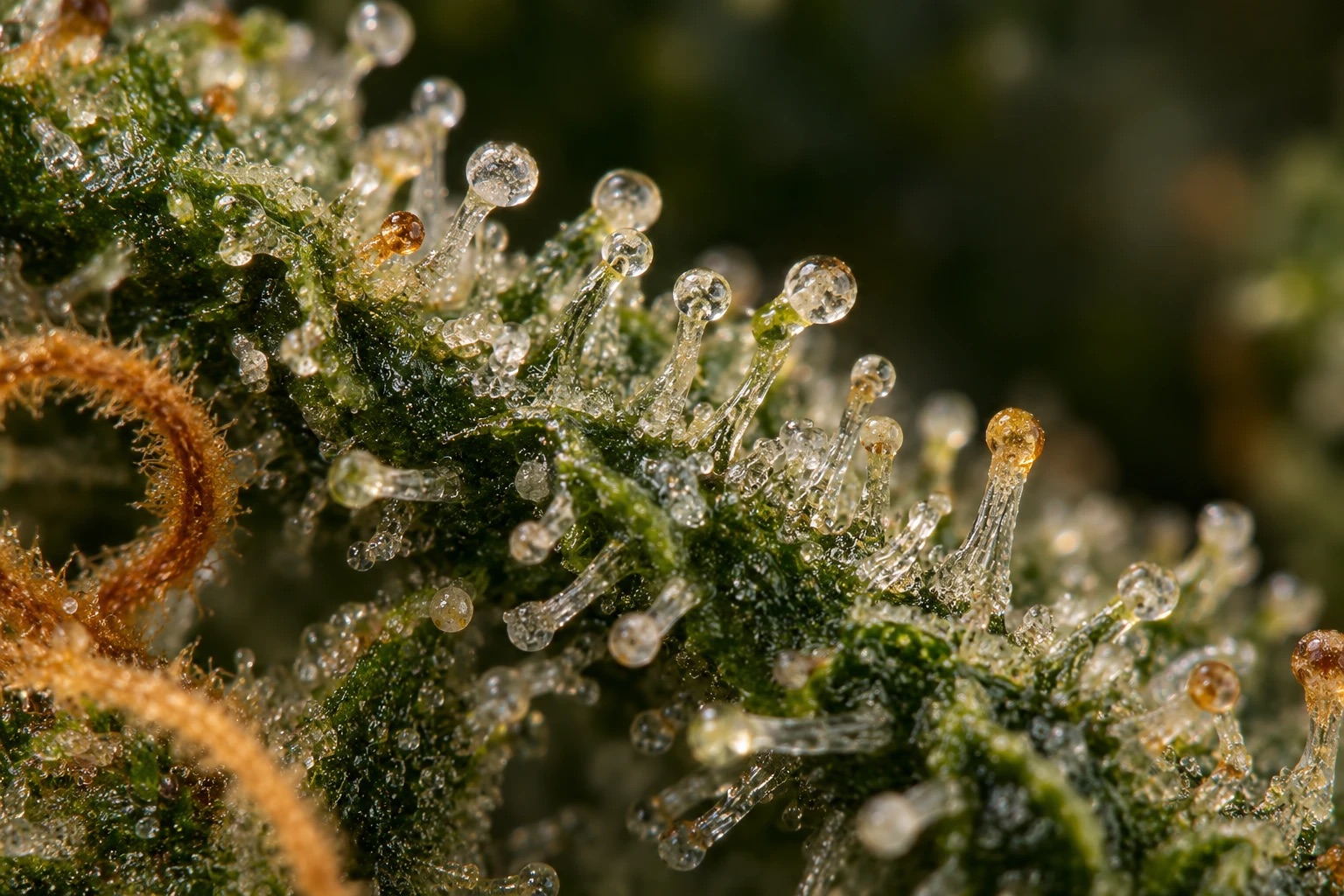
The cannabis plant makes several hundred distinct compounds 3Reference 3Chemistry, metabolism, and toxicology of cannabis: clinical implications — but the one almost everyone is asking about is THC (Δ9-tetrahydrocannabinol), the molecule responsible for the “high.”
What actually happens to THC once it’s in you is more interesting than the folklore suggests. The same dose can hit in seconds or in hours; it can feel sharp and brief or slow and heavy; and it can show up on a drug test weeks after the effects wore off. All of that comes down to metabolism — how the body absorbs THC, switches it on, parks it in fat, and eventually clears it.
This guide walks through that whole journey, and clears up a few things the older internet gets wrong along the way — including which metabolite actually gets you high.
- THC starts life in the plant as an inactive acid (THCA). Heat converts it to active Δ9-THC — metabolism begins before it ever reaches your body.
- The liver turns THC into 11-OH-THC, which is itself psychoactive (roughly as strong as THC) — not an “off switch.” Only the next metabolite, THC-COOH, is inactive.
- Route changes everything. Inhaled THC peaks in minutes; edibles peak in hours and produce far more 11-OH-THC — which is why they feel different and stronger.
- THC is fat-soluble, so it stores in body fat and leaks back out for days. That’s why it lingers on drug tests long after the effects are gone.
What Is a Cannabinoid?
Every one of us is born with an endocannabinoid system (ECS) — a signalling network the body uses to keep things in balance. It has a hand in mood, memory, pain, appetite, sleep, immune activity, and body temperature 3Reference 3Chemistry, metabolism, and toxicology of cannabis: clinical implications12Reference 12The diverse CB1 and CB2 receptor pharmacology of three plant cannabinoids: Δ9-tetrahydrocannabinol, cannabidiol and Δ9-tetrahydrocannabivarin. It runs on the body’s own “endocannabinoids,” chiefly anandamide and 2-AG 12Reference 12The diverse CB1 and CB2 receptor pharmacology of three plant cannabinoids: Δ9-tetrahydrocannabinol, cannabidiol and Δ9-tetrahydrocannabivarin.
THC works because it’s shaped enough like those natural signals to plug into the same receptors. There are two main ones:
- CB1 receptors sit mostly in the brain and nervous system. This is where THC produces its psychoactive effects — the changes in mood, memory, perception, appetite, and pain 3Reference 3Chemistry, metabolism, and toxicology of cannabis: clinical implications12Reference 12The diverse CB1 and CB2 receptor pharmacology of three plant cannabinoids: Δ9-tetrahydrocannabinol, cannabidiol and Δ9-tetrahydrocannabivarin.
- CB2 receptors sit mainly in peripheral and immune tissue, such as the spleen and immune cells 3Reference 3Chemistry, metabolism, and toxicology of cannabis: clinical implications12Reference 12The diverse CB1 and CB2 receptor pharmacology of three plant cannabinoids: Δ9-tetrahydrocannabinol, cannabidiol and Δ9-tetrahydrocannabivarin.
One important nuance: THC is a partial agonist at both receptors 12Reference 12The diverse CB1 and CB2 receptor pharmacology of three plant cannabinoids: Δ9-tetrahydrocannabinol, cannabidiol and Δ9-tetrahydrocannabivarin — it nudges them rather than flooring the accelerator. That partial, indirect action is part of why cannabis effects are so dose- and person-dependent.
The Pathway: From Raw Plant to Excreted Waste
THC’s transformation happens in a clear sequence of steps. Only two of the molecules in this chain are psychoactive — and it’s a common mistake to point at the wrong ones.
Step 1 — Decarboxylation: Metabolism Starts Outside the Body
In the living plant, THC doesn’t exist in its active form at all. It’s stored as THCA (Δ9-tetrahydrocannabinolic acid), which is not intoxicating. Applying heat drives off its carboxyl group as carbon dioxide — a reaction called decarboxylation — converting it into active Δ9-THC 11Reference 11Decarboxylation study of acidic cannabinoids: a novel approach using ultra-high-performance supercritical fluid chromatography/photodiode array-mass spectrometry.
This is why raw cannabis doesn’t get you high, but smoked, vaped, or baked cannabis does. Combustion and vaporisation are hot enough to do it essentially instantly; gentle baking works too, just more slowly. Lab kinetics give a sense of the trade-off: THCA converts in roughly 30 minutes at 110 °C, ~9 minutes at 130 °C, and ~6 minutes at 145 °C — hotter is faster 11Reference 11Decarboxylation study of acidic cannabinoids: a novel approach using ultra-high-performance supercritical fluid chromatography/photodiode array-mass spectrometry.
Step 2 — The Metabolite That Also Gets You High: 11-OH-THC
Here’s the correction the old internet needs. Once Δ9-THC reaches the liver, enzymes hydroxylate it into 11-OH-THC (11-hydroxy-THC) — and this metabolite is psychoactive in its own right, roughly equipotent with THC itself in humans 1Reference 1Pharmacokinetics and pharmacodynamics of cannabinoids2Reference 2Human cannabinoid pharmacokinetics5Reference 5Clinical pharmacodynamics of cannabinoidsView study →6Reference 6Perez-Reyes M, Timmons MC, Lipton MA, Davis KH, Wall ME. Intravenous injection in man of Δ9-tetrahydrocannabinol and 11-OH-Δ9-tetrahydrocannabinol. Science. 1972;177(4049):633–635.. It’s not the body switching THC off; it’s the body making a second active molecule.
It’s only the next step that deactivates things: 11-OH-THC is oxidised further into THC-COOH (11-nor-9-carboxy-THC), which is inactive 1Reference 1Pharmacokinetics and pharmacodynamics of cannabinoids2Reference 2Human cannabinoid pharmacokinetics. THC-COOH is then tagged with a sugar group (glucuronidation, by UGT enzymes) to make it water-soluble enough to excrete 10Reference 10Characterization of human hepatic and extrahepatic UDP-glucuronosyltransferase enzymes involved in the metabolism of classic cannabinoids.
So the chain is: inactive acid → active THC → active 11-OH-THC → inactive THC-COOH → excreted conjugate. Two active molecules, not one — which matters enormously once we compare routes.
Inhaled vs Oral: Why the Same Drug Feels So Different
Most people notice that smoking and edibles are almost different experiences. That isn’t in your head — it’s pharmacokinetics.
| Inhaled (smoked / vaped) | Oral (edibles / oil) | |
|---|---|---|
| In the blood | Within seconds 2Reference 2Human cannabinoid pharmacokinetics | After digestion |
| Peak level | ~3–10 min 2Reference 2Human cannabinoid pharmacokinetics3Reference 3Chemistry, metabolism, and toxicology of cannabis: clinical implications | ~1–3 h (up to 4–6 h for edibles) 2Reference 2Human cannabinoid pharmacokinetics3Reference 3Chemistry, metabolism, and toxicology of cannabis: clinical implications |
| Effects peak | ~10–30 min 2Reference 2Human cannabinoid pharmacokinetics | ~1–3 h |
| Duration | ~2–4 hours | ~4–8+ hours 2Reference 2Human cannabinoid pharmacokinetics |
| Bioavailability | ~10–35% (highly variable) 1Reference 1Pharmacokinetics and pharmacodynamics of cannabinoids2Reference 2Human cannabinoid pharmacokinetics | Only ~4–12% 1Reference 1Pharmacokinetics and pharmacodynamics of cannabinoids3Reference 3Chemistry, metabolism, and toxicology of cannabis: clinical implications |
| 11-OH-THC formed | Low (~10% of THC) 2Reference 2Human cannabinoid pharmacokinetics | High (more 11-OH-THC than THC) 2Reference 2Human cannabinoid pharmacokinetics4Reference 4Schwilke EW, Schwope DM, Karschner EL, et al. Δ9-THC, 11-OH-THC, and 11-nor-9-carboxy-THC plasma pharmacokinetics during and after continuous high-dose oral THC. Clin Chem. 2009;55(6):1177–1187. PMID 19833841. |
1. Inhalation
When you smoke or vaporise, Δ9-THC crosses the lungs and appears in the blood within seconds, peaking in about 3–10 minutes 2Reference 2Human cannabinoid pharmacokinetics3Reference 3Chemistry, metabolism, and toxicology of cannabis: clinical implications. Effects build a little behind that plasma peak, maxing out around 10–30 minutes 2Reference 2Human cannabinoid pharmacokinetics, then taper over a couple of hours. Because THC is absorbed straight into circulation, it mostly bypasses the liver’s first pass — so relatively little 11-OH-THC is made (only about 10% of the THC level) 2Reference 2Human cannabinoid pharmacokinetics. Fast, sharp, and comparatively short.
2. Oral Ingestion
Eat THC and the story changes. It has to survive the stomach, be absorbed through the gut, and travel to the liver before it reaches the rest of the body. That’s slower — effects can take 1–2 hours (sometimes longer) to arrive, but they’re steadier and last longer 2Reference 2Human cannabinoid pharmacokinetics3Reference 3Chemistry, metabolism, and toxicology of cannabis: clinical implications.
The catch is that first liver pass. On the way through, a large fraction of THC is converted to 11-OH-THC — so much that oral doses can produce more 11-OH-THC than THC itself 2Reference 2Human cannabinoid pharmacokinetics4Reference 4Schwilke EW, Schwope DM, Karschner EL, et al. Δ9-THC, 11-OH-THC, and 11-nor-9-carboxy-THC plasma pharmacokinetics during and after continuous high-dose oral THC. Clin Chem. 2009;55(6):1177–1187. PMID 19833841.. Since 11-OH-THC is fully psychoactive, edibles deliver a different blend of active molecules than smoking does. That — not some mythical “stronger THC” — is the real reason edibles feel more intense and more body-heavy, and why they’re so easy to overdo. The trade-off for that potency is a much lower overall bioavailability (~4–12%), because first-pass metabolism also destroys a big share of the dose 1Reference 1Pharmacokinetics and pharmacodynamics of cannabinoids3Reference 3Chemistry, metabolism, and toxicology of cannabis: clinical implications.
Why THC Lingers: Stored in Your Fat
THC is strongly fat-soluble (lipophilic). The moment blood levels are high, it diffuses out of the blood and into fatty tissue throughout the body — and into the brain, itself a fatty organ. Its volume of distribution is large (on the order of ~10 L/kg) precisely because so much leaves the blood to sit in tissue 2Reference 2Human cannabinoid pharmacokinetics3Reference 3Chemistry, metabolism, and toxicology of cannabis: clinical implications.
Then the process runs in reverse. As blood THC falls, the drug slowly diffuses back out of fat into circulation, to be metabolised bit by bit. This slow release is why THC’s elimination half-life is so long and so variable — measured in days, and longer the more regularly someone uses:
It’s also the source of a persistent myth. THC being “in your system” for weeks does not mean you’re impaired for weeks — the effects are long gone. What lingers is mostly the inactive metabolite THC-COOH, slowly trickling out of fat stores. (A small note: THC circulates almost entirely in blood plasma, where it is ~95–99% bound to lipoproteins — not, as older articles claim, “90% protein-bound.” The 90% figure refers to something else: the split of THC between plasma and red blood cells 2Reference 2Human cannabinoid pharmacokinetics3Reference 3Chemistry, metabolism, and toxicology of cannabis: clinical implications.)
The Liver’s Role — And Drug Interactions
The heavy lifting of metabolism happens in the liver, through cytochrome P450 enzymes. Two matter most:
- CYP2C9 is the main enzyme that hydroxylates THC into active 11-OH-THC 7Reference 7Cytochrome P450 enzymes involved in the metabolism of tetrahydrocannabinols and cannabinol by human hepatic microsomes.
- CYP3A4 handles oxidation at other positions on the molecule 7Reference 7Cytochrome P450 enzymes involved in the metabolism of tetrahydrocannabinols and cannabinol by human hepatic microsomes.
Because those enzymes are the bottleneck, genetics and co-medications can shift how you respond. People carrying the low-activity CYP2C9*3 variant clear THC more slowly — one study found roughly 3× higher THC exposure and a trend toward greater sedation 9Reference 9Interindividual variation in the pharmacokinetics of Δ9-tetrahydrocannabinol as related to genetic polymorphisms in CYP2C9. And in principle, strong CYP3A4/2C9 inhibitors (e.g. ketoconazole) can raise THC levels while inducers (e.g. rifampin) lower them — though the clinical size of these interactions in everyday use isn’t fully established, so this is worth awareness rather than alarm 8Reference 8Systematic reviewExogenous cannabinoids as substrates, inhibitors, and inducers of human drug metabolizing enzymes: a systematic review.
(For contrast: alcohol is handled by an entirely different enzyme family — alcohol dehydrogenase — not the P450 system.)
Excretion: How THC Finally Leaves
Once THC is fully broken down and made water-soluble, it’s excreted two ways. The larger share — roughly 65–80% — leaves in the stool, and about 20–35% in the urine 1Reference 1Pharmacokinetics and pharmacodynamics of cannabinoids3Reference 3Chemistry, metabolism, and toxicology of cannabis: clinical implications. The predominant form differs by route: 11-OH-THC dominates in feces, while THC-COOH (as its glucuronide) dominates in urine 2Reference 2Human cannabinoid pharmacokinetics3Reference 3Chemistry, metabolism, and toxicology of cannabis: clinical implications. That urinary THC-COOH-glucuronide is exactly what a standard drug test looks for — which is why tests detect past use, not current intoxication.
- Edibles are easy to over-do. Onset can take 1–2 hours; taking “another one” too soon is the classic path to an unpleasantly strong experience. Wait before redosing.
- Impairment ≠ detection. You can fail a drug test long after effects have worn off — but you can also be genuinely impaired well before any test would confirm it. Never drive under the influence.
- Regular use extends everything. Half-life and detection windows stretch out substantially in frequent users as fat stores build up.
- Interactions & individual variation are real. Genetics (CYP2C9), other medications, liver health, and body composition all change how you process THC.
- This is general education about metabolism, not medical advice. Cannabis is legally restricted in many places — know your local law.
Which metabolite actually gets you high?
Why do edibles feel stronger than smoking?
How long does THC stay in your system?
Does exercise “burn off” stored THC faster?
Is raw cannabis psychoactive?
The Bottom Line
THC’s effects are shaped less by the plant than by your own metabolism. Heat activates it; the liver both sustains the high (via active 11-OH-THC) and eventually ends it (via inactive THC-COOH); your fat stores stretch the timeline; and the route you choose decides whether all of that unfolds in minutes or hours. Understanding that chain explains almost every practical question people have — why edibles creep up on you, why the high fades long before a drug test clears, and why the same dose lands so differently from one person to the next.
References
- Grotenhermen F. Pharmacokinetics and pharmacodynamics of cannabinoids. Clin Pharmacokinet. 2003;42(4):327–360. PMID 12648025.
- Huestis MA. Human cannabinoid pharmacokinetics. Chem Biodivers. 2007;4(8):1770–1804. PMID 17712819.
- Sharma P, Murthy P, Bharath MMS. Chemistry, metabolism, and toxicology of cannabis: clinical implications. Iran J Psychiatry. 2012;7(4):149–156. PMID 23408483.
- Schwilke EW, Schwope DM, Karschner EL, et al. Δ9-THC, 11-OH-THC, and 11-nor-9-carboxy-THC plasma pharmacokinetics during and after continuous high-dose oral THC. Clin Chem. 2009;55(6):1177–1187. PMID 19833841.
- Grotenhermen F. Clinical pharmacodynamics of cannabinoids. J Cannabis Ther. 2004;4(1):29–78. DOI 10.1300/J175v04n01_03.
- Perez-Reyes M, Timmons MC, Lipton MA, Davis KH, Wall ME. Intravenous injection in man of Δ9-tetrahydrocannabinol and 11-OH-Δ9-tetrahydrocannabinol. Science. 1972;177(4049):633–635.
- Watanabe K, Yamaori S, Funahashi T, Kimura T, Yamamoto I. Cytochrome P450 enzymes involved in the metabolism of tetrahydrocannabinols and cannabinol by human hepatic microsomes. Life Sci. 2007;80(15):1415–1419. PMID 17303175.
- Stout SM, Cimino NM. Exogenous cannabinoids as substrates, inhibitors, and inducers of human drug metabolizing enzymes: a systematic review. Drug Metab Rev. 2014;46(1):86–95. PMID 24160757.
- Sachse-Seeboth C, Pfeil J, Sehrt D, et al. Interindividual variation in the pharmacokinetics of Δ9-tetrahydrocannabinol as related to genetic polymorphisms in CYP2C9. Clin Pharmacol Ther. 2009;85(3):273–276. PMID 19005461.
- Mazur A, Lichti CF, Prather PL, et al. Characterization of human hepatic and extrahepatic UDP-glucuronosyltransferase enzymes involved in the metabolism of classic cannabinoids. Drug Metab Dispos. 2009;37(7):1496–1504. PMID 19339377.
- Wang M, Wang YH, Avula B, et al. Decarboxylation study of acidic cannabinoids: a novel approach using ultra-high-performance supercritical fluid chromatography/photodiode array-mass spectrometry. Cannabis Cannabinoid Res. 2016;1(1):262–271. PMID 28861498.
- Pertwee RG. The diverse CB1 and CB2 receptor pharmacology of three plant cannabinoids: Δ9-tetrahydrocannabinol, cannabidiol and Δ9-tetrahydrocannabivarin. Br J Pharmacol. 2008;153(2):199–215. PMID 17828291.
Clinical herbalist and the writer behind The Sunlight Experiment — an evidence-based pharmacopoeia of herbs, supplements, and the chemistry behind them.