Bromantane
A synthetic Russian adamantane "actoprotector" — a mild stimulant-anxiolytic studied for asthenia, working by boosting dopamine synthesis rather than by blocking reuptake.

Bromantane at a Glance
Bromantane (brand name Ladasten) is a synthetic adamantane derivative that Russian pharmacology classes as an “actoprotector” — a synthetic adaptogen intended to sustain mental and physical performance under stress without the crash of a classical stimulant 7,
It is fully synthetic with no dietary source, and it is an approved prescription medicine in Russia only — everywhere else it is an unregulated research chemical.
What makes it pharmacologically unusual is that it is not a reuptake blocker in the amphetamine sense. It is only a weak dopamine-transporter inhibitor; its main action is to increase the production of dopamine by switching on transcription of the tyrosine hydroxylase gene. That distinction is not academic — it is why the drug behaves like a slow modulator rather than a stimulant, with effects that build over days and outlast the dosing.
The honest bottom line: there is genuine controlled human evidence for asthenia — including a 728-patient multicentre trial — but essentially all of it is Russian-language, single-region and industry-adjacent, with no independent Western replication. It is also WADA-banned, which is the most concrete risk for anyone competing.
What It’s Used For
Ranked by how well the evidence holds up:
- Asthenia and neurasthenia — the flagship use, with a placebo-controlled RCT plus a 728-patient multicentre trial reporting 76–91% responders.
- Anxiety — a real anxiolytic component, but measured inside the asthenia trials rather than in a dedicated anxiety study.
- Cognitive performance under fatigue — improves performance in tired people, and notably does nothing in untired ones.
- Physical performance — the defining actoprotector claim, resting almost entirely on animal work.
- Parkinson’s non-motor symptoms and depression — a single small trial and preclinical data respectively.
Be sceptical of the general “nootropic” framing. The one study that tested untired healthy men found bromantane did not change their subjective state or core performance 6Reference 6The neuro- and psychophysiological effects of bromantane (healthy operators, EEG)View study → — the benefit is specific to a depleted state, not a general cognitive upgrade. The ergogenic reputation is similar: it comes from animal work and, circularly, from the drug’s own doping ban.
How It Works
Bromantane’s mechanism is the most interesting thing about it, and it explains its odd time course.
Rather than blocking dopamine reuptake, it increases dopamine synthesis at the level of gene expression. It raises transcription of tyrosine hydroxylase — the rate-limiting enzyme of dopamine production — partly through CpG demethylation of the TH gene promoter and reduced HDAC1, and it also induces DOPA-decarboxylase 9,
It does inhibit the dopamine transporter, but only weakly: IC₅₀ ≈ 3.56 µM, against roughly 29 nM for the Russian stimulant sidnocarb 11Reference 11Role of the brain dopaminergic and serotoninergic systems in psychopharmacological effects of ladasten and sydnocarbView study →. It has no direct agonism or antagonism at D1, D2, D3, 5-HT1A or 5-HT2A receptors — its dopaminergic effect is entirely upstream 11Reference 11Role of the brain dopaminergic and serotoninergic systems in psychopharmacological effects of ladasten and sydnocarbView study →, with only modest region-specific shifts in serotonin turnover 12Reference 12AnimalThe effect of bromantane on the dopamin- and serotoninergic systems of the rat brainView study →.
The anxiolytic half comes from elsewhere: bromantane normalises stress-reduced binding at the benzodiazepine site of the GABA-A receptor, in the same direction as reference anxiolytics 13Reference 13AnimalAnalysis of the binding capacity of the benzodiazepine site of the GABA-A receptor in mice pretreated with anxiolytics (afobazole, ladasten, noopept)View study →. It also induces BDNF and NGF via ERK/MAPK signalling 14Reference 14Mechanisms of action of ladasten: activation of gene expression for neurotrophins (BDNF, NGF) and mitogen-activated kinasesView study →.
The practical consequence is the important part. TH mRNA roughly doubles 1.5–2 hours after a dose, but the clinical effect appears around day 3 and keeps building — then persists for about a month after the drug is stopped 2,
Pharmacology & Research
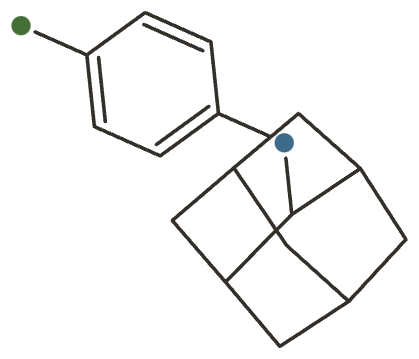
Bromantane (brand name Ladasten; N-(2-adamantyl)-N-(4-bromophenyl)amine) is a synthetic adamantane derivative classed by Russian pharmacology as an actoprotector — a synthetic adaptogen intended to improve mental and physical performance under stress without the crash of a classical stimulant 7Reference 7ReviewThe pharmacology of actoprotectors: practical application for improvement of mental and physical performance — reviewView study →.
Its unusual profile is a combination of mild psychostimulant and anxiolytic actions, and its flagship use is asthenia (chronic fatigue-like states). Mechanistically it is not a reuptake blocker in the amphetamine sense: it is a weak dopamine-transporter inhibitor that acts mainly by up-regulating de novo dopamine synthesis through transcription of the tyrosine hydroxylase gene, including via CpG demethylation of the TH promoter 8,
The decision-relevant caveats are unusual: nearly all human efficacy data are Russian-language, single-region, and industry-adjacent, with essentially no independent Western replication; it is an approved prescription medicine in Russia only, an unapproved research chemical everywhere else, and a WADA-prohibited substance in sport.
Support is an experimental score I’m building — a composite weighted by study type (human > animal > in vitro > review) and study volume. It’s a beta: a fast way to rank strength of evidence at a glance, not a validated metric. Each application links down to its write-up.
This is the strongest use. A randomised, blinded, placebo-controlled trial in neurasthenia (28-day monotherapy plus a 1-week placebo tail) found ladasten superior to placebo in the rate and degree of asthenic-symptom reduction, combining psychostimulant and anxiolytic actions, with no withdrawal syndrome — arguing against addictive potential 1Reference 1RCTLadasten, the new drug with psychostimulant and anxiolytic actions in treatment of neurasthenia (results of the comparative clinical study with placebo) — randomised controlled trialView study →.
A phase II pilot reached the same conclusion 3Reference 3Clinical trialPilot clinical trial of ladasten — phase II clinical trialView study →, and a 28-centre multicenter study of 728 patients with asthenic disorders (psychoautonomic syndrome) at 50–100 mg/day for 28 days reported 76.0% responders on CGI-S and 90.8% on CGI-I, with effect appearing by day 3, persisting a month after withdrawal, and adverse effects in only ~3% (discontinuation 0.8%, no serious events) 2Reference 2Clinical trialTreatment of asthenic disorders in patients with psychoautonomic syndrome: multicenter study on efficacy and safety of ladasten (728 patients) — multicenter clinical trialView study →.
A single-dose (15 mg) crossover in neurasthenic patients confirmed tolerability comparable to placebo 4Reference 4RCTSelf-evaluation of single test doses and objective indices of ladasten vs. placebo efficacy in neurasthenic patients — randomised controlled trialView study →.
Gap: every trial is Russian-language, from a single national research community, and none has been independently replicated in a Western setting — so effect sizes are hard to audit at source.
The anxiolytic action is not a separate program but a documented component of the same asthenia trials, where ladasten’s therapeutic profile is described as a combination of stimulant and anxiolytic effects 1,
Gap: no dedicated, placebo-controlled anxiety-disorder RCT in humans; the human anxiolytic read comes bundled inside the asthenia endpoints rather than from a primary anxiety trial.
In healthy volunteers, a single 100 mg dose did not cause behavioural toxicity and improved psychophysiological parameters specifically in a state of mental fatigue, with more pronounced effects in stress-labile individuals 5Reference 5Effect of ladasten on the psychophysiological parameters of healthy volunteersView study →. An EEG/psychophysiology study in 10 healthy operators found bromantane optimised functional state and reduced tremor useful for precise motor performance in tired men, while not altering subjective state or core performance in untired men 6Reference 6The neuro- and psychophysiological effects of bromantane (healthy operators, EEG)View study →.
Gap: samples are tiny, the benefit is confined to the fatigued/depleted state rather than general cognitive enhancement, and there is no sustained-dosing cognition trial.
As an actoprotector, bromantane’s defining claim is enhancing physical work capacity without raising oxygen consumption or heat production 7Reference 7ReviewThe pharmacology of actoprotectors: practical application for improvement of mental and physical performance — reviewView study →. Animal studies report increased physical work capacity 23Reference 23The effect of bromantane on the physical work capacity of laboratory animalsView study →, and the mechanism (dopaminergic drive plus thermoprotection) is class-consistent 7Reference 7ReviewThe pharmacology of actoprotectors: practical application for improvement of mental and physical performance — reviewView study →.
Gap: the human ergogenic evidence is essentially absent from accessible literature — the physical-performance case rests on animal data and the actoprotector rationale, not controlled trials in people.
A randomised controlled trial examined ladasten for the non-motor symptoms (fatigue, asthenia) of Parkinson’s disease 19Reference 19RCTLadasten in the management of non-motor symptoms of Parkinson’s disease — randomised controlled trialView study → — mechanistically plausible given the drug’s dopamine-synthesis-promoting action.
Gap: this is a single small trial with no accessible English abstract or independent replication; it should be read as exploratory, not established.
Interest here is preclinical and anti-inflammatory. In a mouse LPS depression-like model, ladasten reduced elevated pro-inflammatory cytokines (TNF-α, IL-6) and prevented behavioural disturbance more effectively than imipramine 15Reference 15AnimalEffect of ladasten on cytokine markers of inflammation (TNF-α, IL-6) and behavior of mice with experimental depression-like syndromeView study →, and it normalised stress-induced shifts in T-lymphocyte subpopulations in an anxious-depressive model 15Reference 15AnimalEffect of ladasten on cytokine markers of inflammation (TNF-α, IL-6) and behavior of mice with experimental depression-like syndromeView study →.
Gap: entirely animal-model data with no human antidepressant trials; the authors themselves frame it as a hypothesis for future adjuvant use.
Mechanisms
| Target / pathway | Effect | Relevant to |
|---|---|---|
| Tyrosine hydroxylase (TH) gene transcription | ↑ mRNA/protein (via CpG promoter demethylation, ↓HDAC1) → ↑ de novo dopamine synthesis 9, | Astheniacognitionphysical performance |
| DOPA-decarboxylase (DDC) expression | ↑ → supports dopamine biosynthesis 9Reference 9AnimalLadasten induces the expression of genes regulating dopamine biosynthesis in various structures of rat brainView study → | Astheniacognition |
| Dopamine transporter (DAT) | Weak reuptake inhibition (IC₅₀ ≈ 3.56 µM — far weaker than sidnocarb ≈ 29 nM) 11Reference 11Role of the brain dopaminergic and serotoninergic systems in psychopharmacological effects of ladasten and sydnocarbView study → | Stimulant tone without amphetamine-like potency |
| Dopamine D1/D5-dependent hippocampal LTP | Converts short- to long-term potentiation (protein-synthesis dependent) 8Reference 8AnimalThe effects of ladasten on dopaminergic neurotransmission and hippocampal synaptic plasticity in ratsView study → | Learning/memorycognition |
| GABA-A benzodiazepine site | Normalises stress-reduced binding 13Reference 13AnimalAnalysis of the binding capacity of the benzodiazepine site of the GABA-A receptor in mice pretreated with anxiolytics (afobazole, ladasten, noopept)View study → | Anxiolytic effect |
| BDNF / NGF, ERK1/2 (MAPK) signalling | ↑ neurotrophin gene expression 14Reference 14Mechanisms of action of ladasten: activation of gene expression for neurotrophins (BDNF, NGF) and mitogen-activated kinasesView study → | Neuroplasticitymood/adjuvant |
| Pro-inflammatory cytokines (TNF-α, IL-6) | ↓ in inflammatory challenge 15Reference 15AnimalEffect of ladasten on cytokine markers of inflammation (TNF-α, IL-6) and behavior of mice with experimental depression-like syndromeView study → | Depression (preclinical)immunomodulation |
| Serotonergic system | Modest region-specific shifts in 5-HT/5-HIAA (no direct receptor binding) 12Reference 12AnimalThe effect of bromantane on the dopamin- and serotoninergic systems of the rat brainView study → | Secondary/modulatory |
Note: ladasten shows no direct agonism/antagonism at D1/D2/D3 or 5-HT1A/5-HT2A receptors in vitro — its dopaminergic action is upstream, at the level of synthesis and gene expression 11Reference 11Role of the brain dopaminergic and serotoninergic systems in psychopharmacological effects of ladasten and sydnocarbView study →.
Pharmacokinetics
Bromantane is orally active (human doses 50–100 mg/day; animal mechanistic work at 50 mg/kg p.o.). Its most distinctive PK-PD feature is a slow, genomic mode of action: TH mRNA roughly doubles 1.5–2 h after a single dose, dopamine and L-DOPA accumulate over hours, and — in the large clinical trial — the antiasthenic effect built from day 3 and persisted for a month after the drug was stopped 2,
Clinical trials
Registered/published human trials are almost exclusively Russian, conducted in the 2000s–2010s around the drug’s development and Russian approval; there is little industry or academic trial activity in English-language registries, and the compound is effectively off the Western clinical radar. Beyond the asthenia and Parkinson’s work, the indexed corpus also includes an exploratory trial in irritable bowel syndrome with associated asthenia 20Reference 20Clinical trialProspects for using ladasten preparations in patients with irritable bowel syndrome — clinical trialView study → — which is better read as another application of the fatigue indication than as a gastrointestinal one. The counts below are approximate, based on the PubMed-indexed corpus.
| Completed | Planned | Terminated | Preclinical |
|---|---|---|---|
| ~6(asthenia, neurasthenia, Parkinson non-motor, IBS) | 0known | 0known | ~40+ |
Last checked: August 2026.
Dietary Sources
Bromantane is a fully synthetic molecule with no dietary source — it does not occur in food and cannot be obtained from diet. It is a member of the adamantane (“diamondoid”) drug family, related to memantine and amantadine, and is manufactured synthetically: the core is an N-(2-adamantyl)-N-(para-bromophenyl)amine, typically assembled by coupling a 2-adamantyl group to a 4-bromoaniline (reductive-amination chemistry). There is therefore no “eat more of X” alternative to supplementation, and no food-versus-supplement bioavailability trade-off to weigh.
Dosage
Bromantane is not a nutrient, so it has no RDA/AI and no Tolerable Upper Intake Level. The only human dosing evidence comes from Russian clinical trials in asthenia:
| Context | Amount | Notes |
|---|---|---|
| Asthenia / neurasthenia (28-day courses) | 50–100 mg/day | Range used in the RCT and 728-patient multicenter trial 1, |
| Single-dose test / acute studies | 15–100 mg | Self-evaluation crossover used 15 mg 4Reference 4RCTSelf-evaluation of single test doses and objective indices of ladasten vs. placebo efficacy in neurasthenic patients — randomised controlled trialView study →; healthy-volunteer psychophysiology used 100 mg 5Reference 5Effect of ladasten on the psychophysiological parameters of healthy volunteersView study → |
Practical notes: the effect is slow-onset and cumulative — in the large trial the antiasthenic benefit appeared around day 3 and continued to build, then persisted for about a month after stopping 2Reference 2Clinical trialTreatment of asthenic disorders in patients with psychoautonomic syndrome: multicenter study on efficacy and safety of ladasten (728 patients) — multicenter clinical trialView study →. This is a drug that works over days, not a same-hour stimulant, so escalating the dose chasing an acute “kick” runs contrary to how it was studied. These are doses studied in research, not a personal recommendation, and outside Russia the compound is an unapproved research chemical whose real content and purity are unverified.
Safety
Bromantane’s acute toxicity is genuinely low; its real risks are regulatory and contextual rather than pharmacological.
- Low acute toxicity in animals. A wide gap between behaviourally active doses (30–300 mg/kg) and suppressive/toxic ones (600–9,600 mg/kg) 16,
17Reference 16An acute toxicity study of bromantaneView study →Reference 17Toxic effect of single treatment with bromantane on neurological status of experimental animalsView study → . - No withdrawal syndrome. Stopping after 28-day courses produced none, arguing against physical dependence 1,
2Reference 1RCTLadasten, the new drug with psychostimulant and anxiolytic actions in treatment of neurasthenia (results of the comparative clinical study with placebo) — randomised controlled trialView study →Reference 2Clinical trialTreatment of asthenic disorders in patients with psychoautonomic syndrome: multicenter study on efficacy and safety of ladasten (728 patients) — multicenter clinical trialView study → . - ~3% adverse-event rate in the 728-patient trial, 0.8% discontinuation, no serious events 2Reference 2Clinical trialTreatment of asthenic disorders in patients with psychoautonomic syndrome: multicenter study on efficacy and safety of ladasten (728 patients) — multicenter clinical trialView study →.
- WADA-prohibited and implicated in doping cases 18Reference 18Bromontan, a new doping agent — letterView study → — a competition-ending finding for any athlete.
- A prescription medicine in Russia only. Everywhere else it is an unregulated research chemical of unverified identity and purity.
- Interactions unstudied. Plausible caution with other dopaminergic or stimulant drugs; no dedicated human interaction studies exist.
Full Safety & Interactions Detail
In animals, single-dose bromantane has low acute toxicity, with a wide gap between behaviourally active doses (30–300 mg/kg, stimulating) and suppressive/toxic doses (600–9,600 mg/kg) 16,
Toxic-range effects in animals were driven by cholinergic actions and included mydriasis, altered respiration, and hypothermia 16,
In the 728-patient human trial, adverse effects occurred in only ~3% of patients, discontinuation in 0.8%, with no serious adverse events reported, and — importantly — no withdrawal syndrome after stopping, arguing against physical dependence 1,
The real safety issues are not acute toxicity but context:
- it is a prescription medicine in Russia only and an unregulated research chemical elsewhere, so purchased material has unverified identity and purity;
- it is a WADA-prohibited substance and has featured in doping cases — a concrete, verifiable risk for any competitive athlete 18Reference 18Bromontan, a new doping agent — letterView study →;
- as a dopaminergic agent, plausible caution applies with other dopaminergic or stimulant drugs, though specific human drug-interaction studies are lacking.
Scope disclosure. Interactions assessed? Partially — mechanistic plausibility with dopaminergic/stimulant drugs is noted, but no dedicated human drug-interaction studies were found. Pregnancy/lactation assessed? No human data — animal reproductive studies exist but human safety is not established. Upper limit established? No. Long-term human safety of bromantane is genuinely not characterized.
Avoid. Human safety in pregnancy and lactation has not been established in accessible literature. Some Russian reproductive-toxicity animal studies exist but do not substitute for human data, and there is no basis to consider bromantane safe during pregnancy or breastfeeding. It should not be used.
Mechanistic and class relatives: bemitil (bemethyl), the other principal actoprotector 7Reference 7ReviewThe pharmacology of actoprotectors: practical application for improvement of mental and physical performance — reviewView study →; sidnocarb (sydnocarb), the Russian psychostimulant used as comparator in several of the mechanistic studies and a far stronger DAT inhibitor 11Reference 11Role of the brain dopaminergic and serotoninergic systems in psychopharmacological effects of ladasten and sydnocarbView study →; amantadine and memantine, the clinically used adamantane-family drugs sharing the diamondoid scaffold 8Reference 8AnimalThe effects of ladasten on dopaminergic neurotransmission and hippocampal synaptic plasticity in ratsView study →; and afobazole and noopept, the Russian anxiolytic/nootropic agents studied in the same GABA-A benzodiazepine-site work 13Reference 13AnimalAnalysis of the binding capacity of the benzodiazepine site of the GABA-A receptor in mice pretreated with anxiolytics (afobazole, ladasten, noopept)View study →.
References
- Neznamov GG, Siuniakov SA, et al. (2009). Ladasten, the new drug with psychostimulant and anxiolytic actions in treatment of neurasthenia (results of the comparative clinical study with placebo) — randomised controlled trial. Zhurnal Nevrologii i Psikhiatrii imeni S.S. Korsakova. https://pubmed.ncbi.nlm.nih.gov/19491814/
- Voznesenskaia TG, et al. (2010). Treatment of asthenic disorders in patients with psychoautonomic syndrome: multicenter study on efficacy and safety of ladasten (728 patients) — multicenter clinical trial. Zhurnal Nevrologii i Psikhiatrii imeni S.S. Korsakova. https://pubmed.ncbi.nlm.nih.gov/21322821/
- Siuniakov SA, et al. (2006). Pilot clinical trial of ladasten — phase II clinical trial. Eksperimental’naia i Klinicheskaia Farmakologiia. https://pubmed.ncbi.nlm.nih.gov/16995430/
- Mametova LE, et al. (2011). Self-evaluation of single test doses and objective indices of ladasten vs. placebo efficacy in neurasthenic patients — randomised controlled trial. Eksperimental’naia i Klinicheskaia Farmakologiia. https://pubmed.ncbi.nlm.nih.gov/22288153/
- Bogdan NG, Kolotilinskaia NV, Iarkova MA, et al. (2009). Effect of ladasten on the psychophysiological parameters of healthy volunteers. Eksperimental’naia i Klinicheskaia Farmakologiia. https://pubmed.ncbi.nlm.nih.gov/19642584/
- Viatleva OA, Barchukov VG, Morozov IS, et al. (2000). The neuro- and psychophysiological effects of bromantane (healthy operators, EEG). Voen Med Zh. https://pubmed.ncbi.nlm.nih.gov/10998997/
- Oliynyk S, Oh S. (2012). The pharmacology of actoprotectors: practical application for improvement of mental and physical performance — review. Biomolecules & Therapeutics. https://pubmed.ncbi.nlm.nih.gov/24009833/
- Mikhaylova M, Vakhitova JV, Yamidanov RS, et al. (2007). The effects of ladasten on dopaminergic neurotransmission and hippocampal synaptic plasticity in rats. Neuropharmacology. https://pubmed.ncbi.nlm.nih.gov/17854844/
- Vakhitova IuV, Iamidanov RS, Seredinin SB, et al. (2004). Ladasten induces the expression of genes regulating dopamine biosynthesis in various structures of rat brain. Eksp Klin Farmakol. https://pubmed.ncbi.nlm.nih.gov/15500036/
- Vakhitova IuV, Sadovnikov SV, Iamidanov RS, et al. (2006). Cytosine demethylation in the tyrosine hydroxylase gene promoter in rat hypothalamus under the aminoadamantane derivative ladasten. Genetika. https://pubmed.ncbi.nlm.nih.gov/16915929/
- Zimin IA, Abaimov DA, Budygin EA, et al. (2010). Role of the brain dopaminergic and serotoninergic systems in psychopharmacological effects of ladasten and sydnocarb. Eksperimental’naia i Klinicheskaia Farmakologiia. https://pubmed.ncbi.nlm.nih.gov/20369592/
- Kudrin VS, Sergeeva SA, Krasnykh LM, et al. (1995). The effect of bromantane on the dopamin- and serotoninergic systems of the rat brain. Eksperimental’naia i Klinicheskaia Farmakologiia. https://pubmed.ncbi.nlm.nih.gov/7580761/
- Iarkova MA, et al. (2011). Analysis of the binding capacity of the benzodiazepine site of the GABA-A receptor in mice pretreated with anxiolytics (afobazole, ladasten, noopept). Eksperimental’naia i Klinicheskaia Farmakologiia. https://pubmed.ncbi.nlm.nih.gov/22232906/
- Salimgareeva MKh, Yamidanov RS, Vakhitova YV, et al. (2012). Mechanisms of action of ladasten: activation of gene expression for neurotrophins (BDNF, NGF) and mitogen-activated kinases. Bulletin of Experimental Biology and Medicine. https://pubmed.ncbi.nlm.nih.gov/22803074/
- Tallerova AV, et al. (2011). Effect of ladasten on cytokine markers of inflammation (TNF-α, IL-6) and behavior of mice with experimental depression-like syndrome. Bulletin of Experimental Biology and Medicine. https://pubmed.ncbi.nlm.nih.gov/22803040/
- Bugaeva LI, Verovskiĭ VE, Iezhitsa IN, et al. (2000). An acute toxicity study of bromantane. Eksperimental’naia i Klinicheskaia Farmakologiia. https://pubmed.ncbi.nlm.nih.gov/10763112/
- Iezhitsa IN, Spasov AA, Bugaeva LI, et al. (2002). Toxic effect of single treatment with bromantane on neurological status of experimental animals. Bulletin of Experimental Biology and Medicine. https://pubmed.ncbi.nlm.nih.gov/12124651/
- Burnat P, Payen A. (1997). Bromontan, a new doping agent — letter. Lancet. https://pubmed.ncbi.nlm.nih.gov/9314900/
- Sarycheva TN, Rybak VA, Kurushina OV, et al. (2011). Ladasten in the management of non-motor symptoms of Parkinson’s disease — randomised controlled trial. Zhurnal Nevrologii i Psikhiatrii imeni S.S. Korsakova. https://pubmed.ncbi.nlm.nih.gov/21434470/
- Uspenskiĭ IuP, Fominykh IuA (2010). Prospects for using ladasten preparations in patients with irritable bowel syndrome — clinical trial. Eksperimental’naia i Klinicheskaia Gastroenterologiia. https://pubmed.ncbi.nlm.nih.gov/21434378/
- Levina MN, et al. (2005). Psychotropic effects of sidnocarb and ladasten in inbred mice with different reaction to emotional stress. Bulletin of Experimental Biology and Medicine. https://pubmed.ncbi.nlm.nih.gov/16027847/
- Todorova V, Ivanov K, Delattre C, et al. (2021). Plant adaptogens — history and future perspectives — systematic review. Nutrients. https://pubmed.ncbi.nlm.nih.gov/34445021/
- Morozov IS, Kleĭmenova NN (1998). The effect of bromantane on the physical work capacity of laboratory animals. Eksperimental’naia i Klinicheskaia Farmakologiia. https://pubmed.ncbi.nlm.nih.gov/9929819/
For half-lives, timing and stacking across the nootropics on this site, see the Nootropic Dosage Guide.