

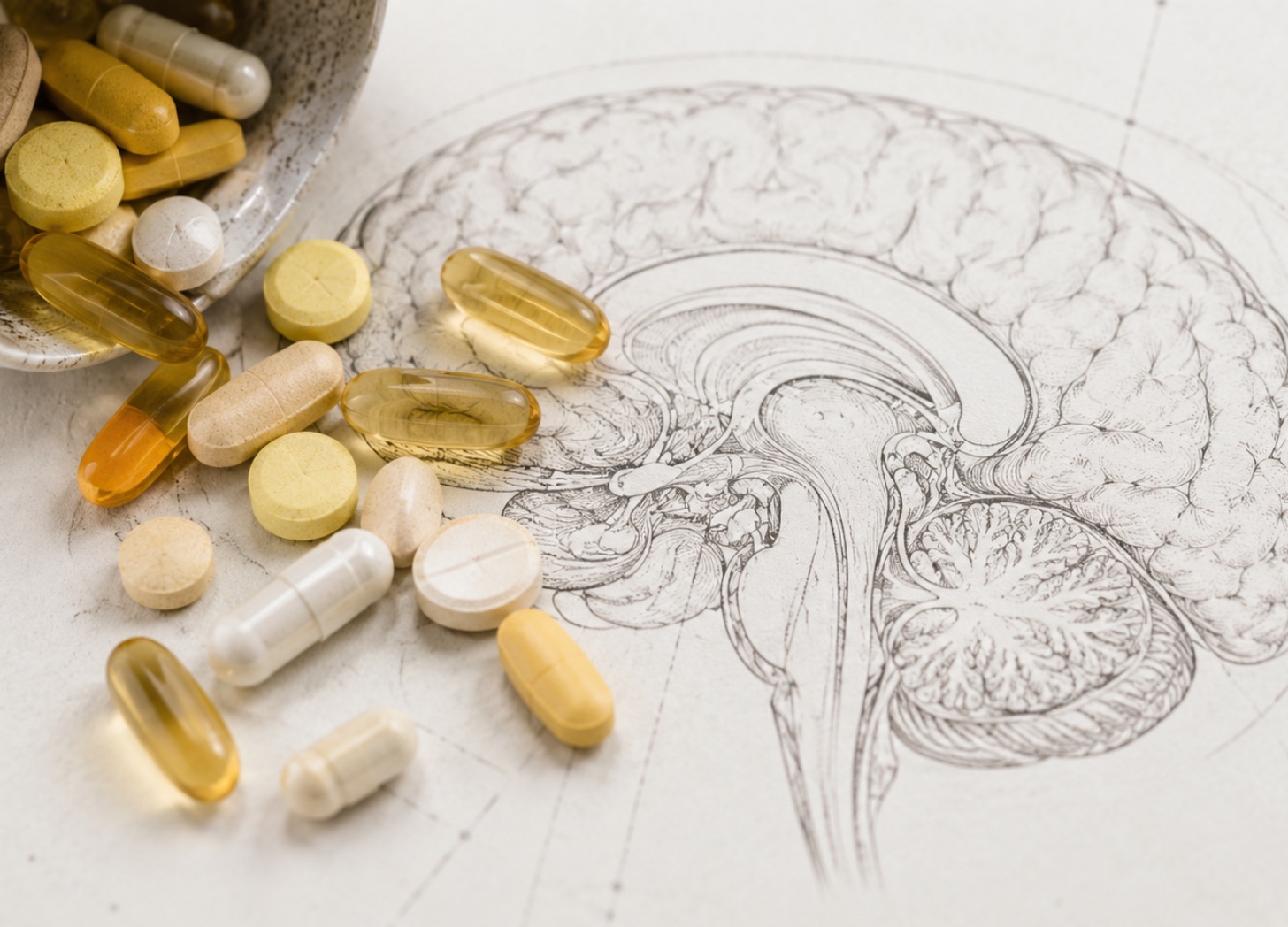
We’ve all seen vitamin ads telling us they’ll make us healthier than ever before.
That we can boost our immune system, improve concentration, and prevent heart disease… somehow.
This sounds great, but how can these vitamins do all this?
Or the better question is — can they do what they’ve been promised to do?
Poor health reporting has made it hard to tell which supplements are legit and which ones are a waste of your money. This article looks specifically at what B vitamins do for cognitive health: which ones actually matter, why, and — the part most B-complex marketing skips — what happens when you take extra on top of a diet that’s already adequate.
- All eight B vitamins are essential cofactors for energy metabolism, but only three — B6, B9 and B12 — have a direct, well-mapped role in neurotransmitter synthesis, myelin maintenance and homocysteine control.
- Correcting a genuine deficiency in any of the three reliably improves the neurological symptoms it caused — that part of the story is solid.
- Taking extra on top of an already-adequate diet is a different claim, and the trial record for that is much weaker: homocysteine drops, but large trials mostly don’t show a cognitive payoff from that drop.
- A summary table below ranks all eight B vitamins by their actual cognitive relevance, and a plan for the research gaps worth closing follows at the end.
What Are B Vitamins?
B vitamins consist of a carbon chain (like nearly all things in the human body) and an amine group — a nitrogen-containing structure. Nitrogen’s unusual bonding properties let it form the chemical structures that make B vitamins useful as cofactors and coenzymes throughout the body 1Reference 1ReviewB Vitamins and the Brain: Mechanisms, Dose and Efficacy — A Review.
In practice, this means they act like tools that enzymes need in order to build proteins and other molecules — including neurotransmitters.
B Vitamins Are Diverse
One of the most interesting things about B vitamins is how different they are from one another.
They aren’t grouped by any structural resemblance (beyond the shared amine group), but by their shared water solubility and their shared job description as coenzymes and cofactors.
Look at the structural gap between vitamin B3 and B12: both act as coenzymes, yet B12 is more than 10 times the size of B3 and vastly more complex.
How B Vitamins Affect The Brain
All eight B vitamins are necessary cofactors for producing energy from carbohydrates, lipids, and proteins. Without that machinery running, the brain can’t function — that’s the baseline reason B vitamins matter for cognition, and it’s true of the whole B-complex, not just the “famous three.”
It’s also why severe deficiency in any B vitamin can produce a cognitive picture, not just B6/B9/B12: uncorrected thiamine (B1) deficiency causes Wernicke-Korsakoff syndrome — confusion, memory loss, and confabulation, most often seen in chronic alcohol use — and severe niacin (B3) deficiency causes pellagra, classically remembered by “the three D’s”: dermatitis, diarrhea, and dementia.
Those are deficiency diseases, though — dramatic, but rare outside of alcohol use disorder, malabsorption, or severe malnutrition in a food-secure country. For everyday brain function in someone eating reasonably, three B vitamins do the specific, ongoing work: B6, B9 (folate), and B12 (cobalamin). Between energy production and those three vitamins’ more targeted roles, this is why B vitamins are relevant to brain health at all.
B Vitamins At A Glance: Cognitive Relevance
Before going deep on the big three, here’s how all eight B vitamins stack up. “Deficiency-only” means the vitamin matters for cognition when you’re short on it, but taking extra on top of adequate intake hasn’t been shown to do anything for a healthy brain.
| B Vitamin | Also Known As | Main Cognitive-Relevant Role | Evidence For A Cognitive Effect |
|---|---|---|---|
| B1 | Thiamine | Neuronal energy metabolism; severe deficiency causes Wernicke-Korsakoff syndrome (confusion, amnesia) | Deficiency-only — well established, mostly in alcohol use disorder |
| B2 | Riboflavin | FAD cofactor for energy metabolism; supports the MTHFR enzyme in the folate cycle | Deficiency-only; separate evidence for migraine prevention, not general cognition |
| B3 | Niacin | NAD+/NADP+ precursor for cellular energy; severe deficiency (pellagra) causes dementia-like symptoms | Deficiency-only — no trial support for a cognitive benefit from extra niacin |
| B5 | Pantothenic acid | Coenzyme A synthesis — general metabolic cofactor, no brain-specific role identified | No dedicated cognitive evidence either way; deficiency is very rare |
| B6 | Pyridoxine | Cofactor for neurotransmitter synthesis (serotonin, dopamine, GABA) and homocysteine clearance | Deficiency correction is proven; extra-dose cognitive benefit is not — see below |
| B7 | Biotin | Carboxylase cofactor for fat, carbohydrate and protein metabolism | No established cognitive role; deficiency is rare and not primarily neurocognitive |
| B9 | Folate | DNA synthesis, methylation, homocysteine clearance, hippocampal and neuronal maintenance | Deficiency correction is proven; one positive RCT in low-folate elderly adults — see below |
| B12 | Cobalamin | Homocysteine clearance, myelin maintenance, red-blood-cell oxygen delivery | Deficiency correction is proven; brain-atrophy signal only in high-homocysteine MCI — see below |
B1, B2, B3, B5 and B7 are covered here as part of the complex rather than as standalone compounds. More on that gap at the end.
B6 (Pyridoxine)
Vitamin B6 is actually a family of six interconvertible compounds (pyridoxine, pyridoxal, pyridoxamine and their phosphates), whose active coenzyme form, pyridoxal 5’-phosphate (PLP), is a cofactor for well over 140 enzymes — the large majority of them in amino-acid metabolism 2Reference 2Vitamin B6.
Amino acids build every protein in the body, including enzymes and most neurotransmitters. That list includes homocysteine, an amino-acid byproduct linked to cardiovascular disease and cognitive disorders like Alzheimer’s disease when it runs high 3Reference 3Plasma homocysteine as a risk factor for dementia and Alzheimer’s disease. B6 works with B9 and B12 to clear it, converting it into the harmless metabolite cysteine — more on that partnership in the next section.
The most direct route from B6 to cognitive function is neurotransmitter synthesis. Because B6 is required at multiple steps of amino-acid conversion, it acts as a rate-limiting factor: when B6 is low, neurotransmitter production slows down with it 2Reference 2Vitamin B6.
Think of it like building a house (the neurotransmitter) from a truckload of bricks (amino acids) and a bag of mortar (B6). Plenty of bricks show up, but if the mortar runs out, the crew stops — and you’re left with a pile of bricks and a half-finished house. Low neurotransmitter output shows up clinically as depression, anxiety, and brain fog — which is why B6 turns up in so many nootropic formulas aimed at neurotransmitter health, less as a “smart drug” in its own right and more as the mortar the other ingredients need.
A quick honesty check: homocysteine and cognitive decline really are linked, and B-vitamin supplementation reliably lowers homocysteine — but the jump from “B vitamins lower homocysteine” to “B vitamins prevent dementia” hasn’t held up. Meta-analyses pooling more than 20,000 people across multiple randomized trials found that lowering homocysteine this way does not produce a significant improvement in cognitive test scores or reduce dementia risk in the general population 9,
B9 (Folate) & B12 (Cobalamin)
B9 and B12 are closely linked in maintaining brain health, both running through the folate-methionine cycle.
If B12 runs low, folate becomes “functionally” deficient — there’s enough of it in the body, but it’s stuck in a form the body can’t use. Without enough B12 to keep the folate-methionine cycle turning, folate gets trapped as methyltetrahydrofolate 6Reference 6Vitamin B12, folic acid, and the nervous system. When that happens, DNA synthesis suffers, neurons stop functioning optimally, the protective myelin sheath around nerves can degrade, and the hippocampus — the brain’s memory-consolidation hub — can begin to shrink.
B9 (Folate)
Folate is the coenzyme backbone of one-carbon metabolism: the pathway that builds DNA and RNA, matures red blood cells (a shortfall causes megaloblastic anemia), and — together with B12 — clears homocysteine. Its evidence base is unusually clean at one end and unusually oversold at the other.
The clean end: periconceptional folic acid supplementation is one of the best-proven interventions in preventive medicine — a landmark RCT found it cut recurrent neural-tube defects by roughly 72% 4Reference 4Prevention of neural tube defects: results of the Medical Research Council Vitamin Study. The oversold end: the “lower your homocysteine, protect your brain” story that drove a decade of B-complex marketing has mostly collapsed under large trials — with one specific exception. The Dutch FACIT trial gave 818 older adults with elevated homocysteine and low-normal folate (in an unfortified setting) 800 mcg/day folic acid for three years, and it improved memory and processing speed versus placebo 5Reference 5RCTEffect of 3-year folic acid supplementation on cognitive function in older adults in the FACIT trial: a randomised, double blind, controlled trial. That’s a genuine positive result — but it’s one trial, in a low-folate, unfortified population; trials in folate-replete elders haven’t shown the same benefit, and folic acid hasn’t been shown to prevent dementia generally. More detail, including the stroke-prevention and depression-adjunct evidence, is on the B9 monograph.
B12 (Cobalamin)
Vitamin B12 is required for red blood cell production and DNA/RNA synthesis, and it’s especially important for maintaining the myelin sheath — the insulation around nerve fibers that stops an electrical signal from leaking to neighboring nerves. In multiple sclerosis, myelin damage is central to the disease; B12-related myelin degradation can also cause its own peripheral neuropathy, and even short of that, it can measurably affect cognitive ability.
The best-run trial evidence here is the VITACOG study: 266 older adults with mild cognitive impairment were given a B-vitamin combination (folic acid, B12, and B6) for two years. It lowered homocysteine by about 30%, slowed whole-brain atrophy, and — specifically in the subgroup with elevated baseline homocysteine — stabilized memory and executive function 7Reference 7Homocysteine-lowering by B vitamins slows the rate of accelerated brain atrophy in mild cognitive impairment (VITACOG). A follow-up imaging analysis found up to a seven-fold reduction in atrophy of the Alzheimer-vulnerable gray-matter regions, again confined to the high-homocysteine group 8Reference 8Preventing Alzheimer’s disease-related gray matter atrophy by B-vitamin treatment.
That’s a real, mechanistically coherent result — but it’s one trial program, in a specific subgroup, and it hasn’t been replicated at scale: a meta-analysis of 11 trials in 22,000 people found homocysteine-lowering had no effect on cognitive aging overall 9Reference 9Meta-analysisEffects of homocysteine lowering with B vitamins on cognitive aging: meta-analysis of 11 trials with cognitive data on 22,000 individuals, and a broader synthesis found any cognitive signal from B-vitamin supplementation tracked with folate status specifically, not B12 11Reference 11Meta-analysisB vitamins and prevention of cognitive decline and incident dementia: a systematic review and meta-analysis. The honest summary: B12 correction is one of the more reliably effective interventions in nutrition when someone is actually deficient 12Reference 12Systematic reviewOral vitamin B12 versus intramuscular vitamin B12 for vitamin B12 deficiency — the “boosts memory in a healthy adult” version of the claim doesn’t hold up. Full detail is on the B12 monograph.
Put together: B9 and B12 both drive DNA/RNA production and red-cell formation — and since red cells deliver oxygen, low counts can themselves impair cognitive efficiency. When either vitamin runs short, DNA and RNA production drops, blood-cell production falls, nerve sheaths degrade, and cognitive function suffers. A B12 deficiency compounds the problem by trapping folate in an unusable form on top of everything else. For the broader dementia picture beyond nutrients, see our Alzheimer’s disease overview.
How To Get B Vitamins From Food
B vitamins are mainly produced by plants and microbes, and used the same way there as in the human body — as cofactors and coenzymes. Interestingly, humans (and other mammals) have lost the ability to synthesize B vitamins over evolutionary time, almost certainly because they’re so reliably available in the food supply.
Most plant foods offer some B vitamins, with one major exception. Vitamin B12 is produced only by bacteria and archaea — not by plants — so reliable dietary sources are essentially all animal-derived: meat, fish, eggs, and dairy. The bacteria in our own gut produce a small amount daily, boostable with a high-fiber diet, but not enough to rely on. Fortified plant milks, nutritional yeast, and some fortified cereals are the main options for people avoiding animal products. Processed foods generally offer less of all B vitamins, which is why “enriched” flour exists — B vitamins added back in during processing.
For the two other cognition-relevant B vitamins:
- B6 (pyridoxine) is widely distributed, which makes outright deficiency uncommon on a varied diet. Good sources: chickpeas, poultry, fish (salmon, tuna), potatoes and other starchy vegetables, fortified cereals, bananas, and beef liver.
- B9 (folate) comes mainly from leafy greens (spinach, kale, romaine), legumes (lentils, black beans, chickpeas), asparagus, avocado, citrus fruit, and fortified grains and flours — folic acid, the synthetic form, is added to bread and cereal by law in a number of countries specifically to prevent neural-tube defects in pregnancy.
Who’s Actually At Risk Of Deficiency?
- Vegans and strict vegetarians — B12 is the vitamin to watch, since there’s no reliable unfortified plant source. Supplementation or fortified foods are the standard recommendation.
- Older adults — stomach acid declines with age, and B12 has to be split from food protein by stomach acid before it can be absorbed, so a meaningful share of people over 50 absorb food-bound B12 poorly even while eating enough of it.
- People on certain medications — long-term metformin use (for type 2 diabetes) is associated with lower B12 levels; proton-pump inhibitors and other acid-reducing drugs can impair B12 absorption for the same reason as aging; some anticonvulsants can lower folate.
- Pregnant people — folate needs rise substantially in pregnancy, which is why folic acid supplementation before and during early pregnancy is a standard public-health recommendation to reduce neural-tube defects.
- People with malabsorption conditions (Crohn’s disease, celiac disease, prior gastric bypass surgery) — anything that disrupts small-intestine absorption or removes stomach tissue can blunt B12 and folate uptake regardless of diet.
If you fall into one of these groups, a B-complex or a targeted B12/folate supplement is a reasonable, low-risk way to close the gap. That’s a very different claim from “extra B vitamins sharpen a healthy brain” — and the two shouldn’t get conflated, which is exactly what most B-complex marketing does.
The Benefits (And Limits) Of Supplementing B Vitamins For Cognition
Now that the mechanisms are on the table, it’s worth being precise about what supplementing B6, B9 and B12 can and can’t realistically be expected to do.
- Proven
- Promising
- Shaky
- Unsupported
Deficiency is bad for your brain — that part is proven. “More is better” for a brain that already has enough is not — and that’s the part most of the marketing leaves out.
The take-home
Where the evidence is genuinely solid: correcting an actual deficiency in B6, B9, or B12 improves the neurological and cognitive symptoms that deficiency caused. Where the evidence is weak: giving extra B vitamins to someone who isn’t deficient, hoping to boost memory or prevent dementia, hasn’t been reliably shown to work in large randomized trials 9,
How Much B Vitamin Should I Take?
Many nootropic formulas aimed at memory, focus, and mental clarity include one or more of the B vitamins — B6 especially, given its rate-limiting role in neurotransmitter synthesis. A well-formulated nootropic stack combined with a balanced diet is a reasonable way to make sure you’re covered; see our guide to plant-based cognitive enhancers for how B vitamins typically fit alongside herbal nootropics in a stack.
Although B6, B9, and B12 get most of the attention for cognition, don’t write off the other five — they still run the energy metabolism your brain depends on. If your diet includes a healthy mix of meat, vegetables, and polyunsaturated fats, you likely don’t need to worry about B-vitamin intake at all.
People with poor dietary variety, or on medications that inhibit B-vitamin absorption, may genuinely need to supplement. For that group, a B-complex — a supplement containing all eight B vitamins rather than focusing on just one — is usually the sensible choice, since the risk factors for deficiency (poor diet, malabsorption, certain drugs) rarely affect just one B vitamin in isolation.
A Research Gap Worth Closing
Two things stood out while pulling this together that are worth flagging for a future research pass:
- B1, B2, B3, B5 and B7 don’t have real cognition write-ups yet. B1 and B3 have thin, draft monographs focused on general energy metabolism, and B2, B5, B7 don’t exist on the site at all. Given that thiamine deficiency (Wernicke-Korsakoff) and niacin deficiency (pellagra dementia) are two of the clearest deficiency-cognition links in all of nutrition, that’s an odd gap — a dedicated research pass on B1’s role in alcohol-related cognitive impairment, and B2’s emerging MTHFR/migraine angle, would round out the B-complex properly.
- The MTHFR variant shows up repeatedly in the B9/B12 methylation literature, and it is the whole rationale for L-methylfolate over folic acid. A short, standalone explainer — what MTHFR does, who should actually care, and where the evidence for “test your MTHFR status” stands versus the genetic-testing-company hype — would be a natural piece to commission, and would give this article somewhere better to link than a passing mention.
References
- Kennedy, D. O. (2016). B Vitamins and the Brain: Mechanisms, Dose and Efficacy — A Review. Nutrients, 8(2), 68. Link
- Dakshinamurti, S., & Dakshinamurti, K. (2013). Vitamin B6. In Zempleni, J., Suttie, J.W., Gregory, J.F. III, Stover, P.J. (Eds.), Handbook of Vitamins (5th ed.). CRC Press.
- Seshadri, S., Beiser, A., Selhub, J., et al. (2002). Plasma homocysteine as a risk factor for dementia and Alzheimer’s disease. New England Journal of Medicine, 346(7), 476-483. Link
- MRC Vitamin Study Research Group. (1991). Prevention of neural tube defects: results of the Medical Research Council Vitamin Study. Lancet. Link
- Durga, J., van Boxtel, M. P., Schouten, E. G., et al. (2007). Effect of 3-year folic acid supplementation on cognitive function in older adults in the FACIT trial: a randomised, double blind, controlled trial. Lancet. Link
- Reynolds, E. (2006). Vitamin B12, folic acid, and the nervous system. Lancet Neurology, 5(11), 949-960. Link
- Smith, A. D., Smith, S. M., de Jager, C. A., et al. (2010). Homocysteine-lowering by B vitamins slows the rate of accelerated brain atrophy in mild cognitive impairment (VITACOG). PLoS One. Link
- Douaud, G., Refsum, H., de Jager, C. A., et al. (2013). Preventing Alzheimer’s disease-related gray matter atrophy by B-vitamin treatment. Proceedings of the National Academy of Sciences. Link
- Clarke, R., Bennett, D., Parish, S., et al.; B-Vitamin Treatment Trialists’ Collaboration. (2014). Effects of homocysteine lowering with B vitamins on cognitive aging: meta-analysis of 11 trials with cognitive data on 22,000 individuals. American Journal of Clinical Nutrition, 100(2), 657-666. Link
- Efficacy of B Vitamin Supplementation on Global Cognitive Function in Older Adults: A Systematic Review and Meta-analysis. (2023). Neurobiology of Aging. Link
- Wang, Z., Zhu, W., Xing, Y., Jia, J., & Tang, Y. (2022). B vitamins and prevention of cognitive decline and incident dementia: a systematic review and meta-analysis. Nutrition Reviews. Link
- Wang, H., Li, L., Qin, L. L., Song, Y., Vidal-Alaball, J., & Liu, T. H. (2018). Oral vitamin B12 versus intramuscular vitamin B12 for vitamin B12 deficiency. Cochrane Database of Systematic Reviews. Link
For half-lives, timing and stacking across the nootropics on this site, see the Nootropic Dosage Guide.
Clinical herbalist and the writer behind The Sunlight Experiment — an evidence-based pharmacopoeia of herbs, supplements, and the chemistry behind them.


