
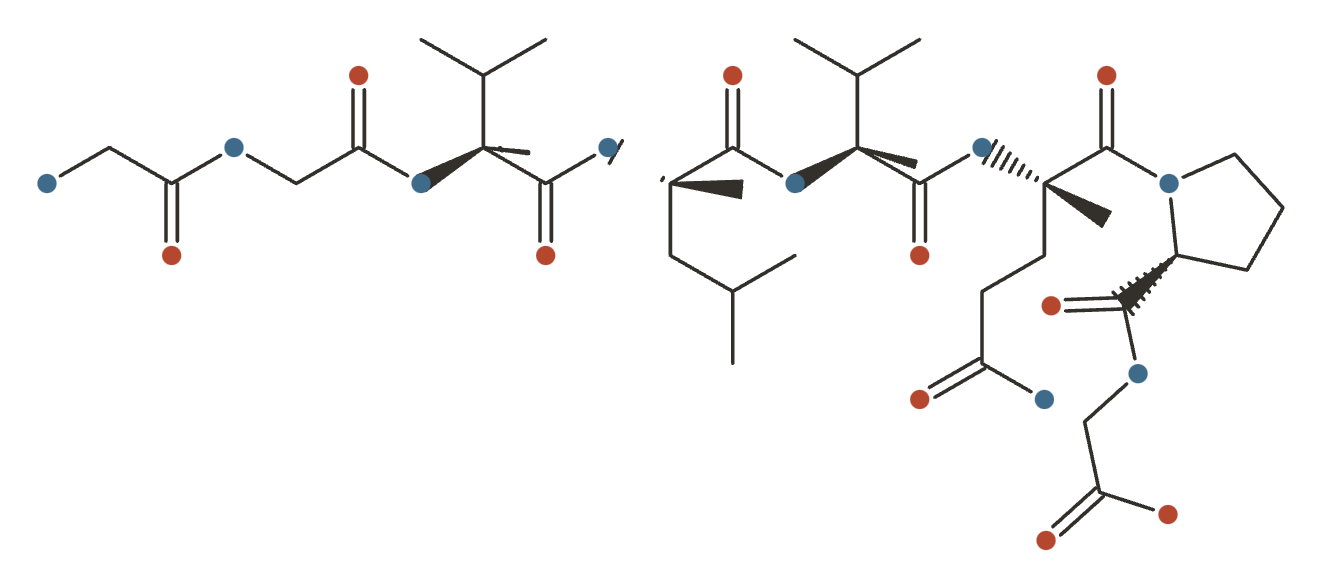

Larazotide at a Glance
Larazotide is an octapeptide designed to act only inside the gut — it is not absorbed, which is unusual and deliberate. It blocks zonulin, the signal that loosens the tight junctions between intestinal cells, and was developed to keep the barrier closed in celiac disease so gluten fragments could not cross. It progressed further than almost any peptide in this category, reaching phase 3, where it did not meet its primary endpoint. It is investigational and unapproved.
History & Development
Larazotide got further than any other drug for celiac disease, and then stopped - not because it did not work, but because the trial could not prove that it did at any feasible size.
| First described | Entered clinical trials in the mid-2000s, as AT-1001 4Reference 4RCTLarazotide acetate for persistent symptoms of celiac disease despite a gluten-free diet: a randomized controlled trial — human (RCT, phase 2b)View study → |
| Discovered / synthesised by | Not established in the sources consulted for this section |
| Institution | Developed by Alba Therapeutics, later 9 Meters Biopharma 4, |
| Origin | De-novo synthetic octapeptide, designed as a zonulin antagonist |
| Key patent | Not established in the sources consulted for this section |
| Assignee | 9 Meters Biopharma |
| Development status | Discontinued at Phase 3 - CeDLara trial stopped 21 June 2022 after interim analysis 19Reference 19Phase 3 study of larazotide acetate to treat celiac disease discontinued. https://www.beyondceliac.org/research-news/phase-3-study-discontinued/View study → |
Discovery
The idea behind larazotide is that celiac disease begins with a barrier failure. Zonulin regulates the tight junctions between intestinal epithelial cells; when it signals, the junctions loosen and molecules that should stay in the gut lumen - including gluten peptides - can cross into the tissue beneath, where the immune reaction happens.
Larazotide is an octapeptide designed to block that signal and keep the junctions closed. Two design choices define it: it is oral, and it is gut-restricted - deliberately not absorbed, so it acts only on the epithelium it passes over and has essentially no systemic exposure. That is unusual and it is a genuine safety advantage.
It entered clinical trials as AT-1001 more than fifteen years ago, making it the first drug candidate for celiac disease to reach human testing at all 4Reference 4RCTLarazotide acetate for persistent symptoms of celiac disease despite a gluten-free diet: a randomized controlled trial — human (RCT, phase 2b)View study →. A Phase 2 study in 342 adults already on a gluten-free diet found that the 0.5 mg dose significantly reduced persistent symptoms - and notably, the lowest dose outperformed higher ones 4Reference 4RCTLarazotide acetate for persistent symptoms of celiac disease despite a gluten-free diet: a randomized controlled trial — human (RCT, phase 2b)View study →.
Development & ownership
Development began at Alba Therapeutics and later moved to 9 Meters Biopharma, which took the compound into Phase 3 in 2020 - the first celiac drug ever to get there 19Reference 19Phase 3 study of larazotide acetate to treat celiac disease discontinued. https://www.beyondceliac.org/research-news/phase-3-study-discontinued/View study →.
The CeDLara trial did not meet its primary endpoint. On 21 June 2022, 9 Meters announced discontinuation, and the stated reason is worth quoting precisely: an interim analysis found that the sample size needed to demonstrate a significant difference from placebo was too large to support continuing the trial 19Reference 19Phase 3 study of larazotide acetate to treat celiac disease discontinued. https://www.beyondceliac.org/research-news/phase-3-study-discontinued/View study →. That is not the same as a drug that does nothing - it is a drug whose effect, if real, is too small to prove at a practical trial size.
How it reached the market
It did not. Larazotide has never been approved anywhere and is not sold as a supplement or research chemical in any meaningful volume - unlike most compounds here, its story ends with the programme rather than continuing into grey-market supply. Celiac disease still has no approved drug treatment; a gluten-free diet remains the only management.
What It's Used For
Larazotide (larazotide acetate; AT-1001, INN-202) is a synthetic eight-amino-acid peptide — Gly-Gly-Val-Leu-Val-Gln-Pro-Gly — whose sequence derives from a fragment of the Vibrio cholerae zonula occludens toxin (ZOT). It acts as a zonulin antagonist: it blocks the signaling that pulls intestinal tight junctions open, reducing the paracellular (“leaky gut”) permeability that lets gliadin peptides and other macromolecules cross the epithelium. The route story is the inverse of almost every other peptide here. Most research peptides must be injected because the gut would destroy them; larazotide is taken orally precisely because it is not absorbed — it is designed to work in the lumen, on the apical face of the epithelium, and reaches negligible plasma concentrations. Non-absorption is the feature, not a limitation, and it reframes the entire safety and dosing picture below. Larazotide also has more human data behind it than most compounds in this category — several completed randomized controlled trials in celiac disease, including a positive phase 2b — but the decisive fact is what happened next: the confirmatory phase 3 celiac trial (CeDLara, NCT03569007) was stopped in June 2022 after an interim analysis found continuation unjustifiable, and larazotide has never been approved by any regulator, for any indication, anywhere.
Support is an experimental score I’m building — a composite weighted by study type (human > animal > in vitro > review) and study volume. It’s a beta: a fast way to rank strength of evidence at a glance, not a validated metric. Each application links down to its write-up.
The flagship indication and the only one with a substantial human trial program, all in adults with biopsy-confirmed celiac disease. A phase 1 proof-of-concept study found single oral doses of AT-1001 blunted the gluten-induced rise in intestinal permeability and reduced symptoms 1Reference 1RCTThe safety, tolerance, pharmacokinetic and pharmacodynamic effects of single doses of AT-1001 in coeliac disease subjects: a proof of concept study — human (RCT, phase 1)View study →.
A six-week gluten-challenge RCT then reported that larazotide limited symptoms and blunted the rise in anti-transglutaminase antibodies 2Reference 2RCTA randomized, double-blind study of larazotide acetate to prevent the activation of celiac disease during gluten challenge — human (RCT)View study →, and a larger challenge RCT (n=184) found the 1 mg dose reduced Gastrointestinal Symptom Rating Scale scores versus placebo — though the lactulose/mannitol permeability biomarker itself did not separate from placebo 3Reference 3RCTLarazotide acetate in patients with coeliac disease undergoing a gluten challenge: a randomised placebo-controlled study — human (RCT)View study →.
The pivotal phase 2b trial (NCT01396213, n=342 adults with persistent symptoms despite a gluten-free diet) met its primary endpoint at the 0.5 mg dose, with higher doses no better than placebo — a non-monotonic dose response the sponsor attributed to peptide self-aggregation at higher concentrations 4Reference 4RCTLarazotide acetate for persistent symptoms of celiac disease despite a gluten-free diet: a randomized controlled trial — human (RCT, phase 2b)View study →.
A 2022 systematic review and meta-analysis (4 RCTs, 626 patients) confirmed symptomatic benefit in the gluten-challenge setting but found no effect on the permeability ratio and no clear benefit in the gluten-free-diet subgroup 5Reference 5Meta-analysisLarazotide acetate for treatment of celiac disease: a systematic review and meta-analysis of randomized controlled trials — human (meta-analysis, 4 RCTs)View study →.
Then the program ended. The confirmatory phase 3 CeDLara trial (NCT03569007), sponsored by 9 Meters Biopharma, was discontinued in June 2022 after an interim analysis: the sponsor announced that the number of patients required to demonstrate a statistically significant difference from placebo had grown too large to justify continuing — a futility stop, not a safety signal. The ClinicalTrials.gov record lists the trial as Terminated with the reason “Trial terminated by Sponsor,” an actual enrollment of 307, and a completion date of 2022-07-21. No confirmatory efficacy was ever demonstrated.
Gap: The best human evidence of any peptide in this category, and it still failed the only trial that counted. The positive signal is confined to earlier, smaller trials and specific symptom endpoints; the permeability biomarker was inconsistent; and there is no approved use.
The rationale is mechanistically specific: SARS-CoV-2 appears to persist in the gut after acute infection, and its spike antigen is thought to reach the circulation through zonulin-mediated tight-junction opening, driving the hyperinflammation of multisystem inflammatory syndrome in children (MIS-C). A gut-restricted zonulin antagonist should block that leak at source 6,
An open-label case series of four children (ages 3–17) reported that adjuvant oral larazotide (10 µg/kg four times daily, capped at 500 µg/dose, for 21 days) drove circulating spike antigen to undetectable levels and shortened time to resolution of gastrointestinal symptoms versus historical controls 7Reference 7Case reportZonulin antagonist, larazotide (AT1001), as an adjuvant treatment for multisystem inflammatory syndrome in children: a case series — human (case series, n=4)View study →.
A subsequent phase 2a randomized, double-blind, placebo-controlled trial (NCT05022303, Massachusetts General Hospital) enrolled only 12 children (median age 5.7 years) before being terminated early — the registry gives the reason as “Decline in MISC cases,” not a safety or efficacy problem. In that trial larazotide was well tolerated with no drug-related adverse events, and the investigators reported faster spike-antigen clearance and augmented recovery 6Reference 6RCTViral spike antigen clearance and augmented recovery in children with post-COVID multisystem inflammatory syndrome treated with larazotide — human (RCT, phase 2a, n=12)View study →.
All of this is human data, and n=12 is nowhere near confirmatory.
A phase 2a Long COVID trial (NCT05747534, also Massachusetts General Hospital, n=107 enrolled) is listed as active but not recruiting, with an estimated completion of September 2026 and no results posted. It is a next-lap watch item, not evidence.
Gap: One underpowered phase 2a RCT (n=12) plus a four-patient case series, both from the same research group, terminated for lack of cases rather than completed to power. A coherent mechanism with a promising signal — not established efficacy.
A spread of preclinical work tests larazotide as a general intestinal-barrier protectant, and the signal is reasonably consistent across species and injury models. In ex-vivo porcine jejunum, 1 µM larazotide accelerated recovery from ischemic injury and restored claudin-4 localization at the tight junction 8Reference 8Larazotide acetate induces recovery of ischemia-injured porcine jejunum via repair of tight junctions — ex vivo (porcine)View study →.
In rats, it reduced intestinal and liver damage in a thioacetamide acute-liver-failure model 9Reference 9AnimalEffects of larazotide acetate, a tight junction regulator, on the liver and intestinal damage in acute liver failure in rats — animal (rat)View study →, and lowered intestinal permeability and bacterial translocation in an acute-pancreatitis model 10Reference 10AnimalAmeliorative effects of larazotide acetate on intestinal permeability and bacterial translocation in acute pancreatitis model in rats — animal (rat)View study →.
In mice, larazotide delivered from a sustained-release hyaluronic-acid hydrogel reduced disease activity in DSS-induced colitis 11Reference 11In vitroAntibacterial hyaluronic acid hydrogel with sustained release of larazotide as effective colitis treatment — animal (mouse, DSS colitis) / in vitroView study →, protected the intestinal mucosal barrier from anoxia/reoxygenation injury 12Reference 12In vitroLarazotide acetate protects the intestinal mucosal barrier from anoxia/reoxygenation injury via various cellular mechanisms — in vitro / animalView study →, and prevented non-alcoholic fatty liver disease in a diet-induced model 13Reference 13AnimalPreventive effects of larazotide acetate (AT-1001) on non-alcoholic fatty liver diseases (NAFLD) in a mouse model — animal (mouse)View study →.
Mechanistic in-vitro and mouse work confirms it regulates epithelial tight junctions directly 18Reference 18In vitroLarazotide acetate regulates epithelial tight junctions in vitro and in vivo — in vitro / animal (mouse)View study →.
Every one of these is an animal or ex-vivo result. There are no registered human trials in inflammatory bowel disease, pancreatitis, liver disease, or generic intestinal hyperpermeability.
Gap: Entirely animal and ex-vivo. An animal result is not a human result, and the “leaky gut” marketing that rests on this literature has no human outcome data behind it at all.
The newest and thinnest strand. In cultured human keratinocyte monolayers, larazotide — acting here as a protease-activated receptor 2 (PAR2) antagonist rather than through zonulin — mitigated histamine-induced disruption of the epidermal tight-junction barrier, raising transepithelial electrical resistance and lowering permeability, which the authors propose as a possible topical adjunct in atopic dermatitis 14Reference 14In vitroThe PAR2 antagonist larazotide can mitigate acute histamine-stimulated epithelial barrier disruption in keratinocytes: a potential adjunct treatment for atopic dermatitis — in vitro (human keratinocytes)View study →.
This is a single in-vitro study, in cell culture, and the authors are explicit that whether the peptide penetrates the outer epidermis at all is unknown.
Gap: In-vitro keratinocyte data only — no animal model, no human study, and unresolved skin penetration. A mechanistic hypothesis, not a therapy.
Mechanisms
| Target / pathway | Effect | Relevant to |
|---|---|---|
| Zonulin pathway (zonulin receptor) | Antagonist — blocks zonulin-driven tight-junction opening 17Reference 17ReviewThe therapeutic use of the zonulin inhibitor AT-1001 (larazotide) for a variety of acute and chronic inflammatory diseases — reviewView study → | CeliacMIS-Call barrier applications |
| Tight-junction proteins (ZO-1, occludin, claudins) | Promotes redistribution and reassembly; closes junctions | Barrier restoration generally |
| Actin cytoskeleton / myosin light chain kinase | Reduces MLCK-driven actin tension at the junction | Barrier restoration |
| Paracellular macromolecule transit (gliadin peptides) | Reduced passage across the epithelium | Celiac disease |
| Systemic antigen leak (SARS-CoV-2 spike) | Reduced circulating spike antigen (pediatric, n small) | MIS-C |
| Protease-activated receptor 2 (PAR2) | Antagonist (keratinocytes) | Skin barrier / atopic dermatitis (in vitro) |
Pharmacokinetics
Larazotide is given orally and is gut-restricted — this is the single most decision-relevant fact on the page. It is designed to act on the luminal side of the intestinal epithelium and reaches negligible systemic concentrations, which is exactly why an oral route works for a peptide that would otherwise be irrelevant by mouth. The corollary matters just as much: there is no meaningful systemic exposure to speak of, so plasma half-life, clearance, and volume of distribution are not the operative pharmacology. Local luminal concentration, site of release, and stability in the gut are.
As an octapeptide it is degraded in the intestine by brush-border aminopeptidases into fragments. Not all fragments are inert — one, lacking both N-terminal glycines, can antagonize the parent peptide, which is part of the rationale for delayed-release formulations and D-amino-acid analogues 16Reference 16ReviewLarazotide acetate: a pharmacological peptide approach to tight junction regulation — reviewView study →. A delayed-release formulation designed to deliver drug to the duodenum and proximal jejunum — the site of celiac injury — was characterized in a porcine model, giving peak luminal concentrations in the low-micromolar range roughly an hour after dosing 15Reference 15AnimalIn vivo assessment of a delayed release formulation of larazotide acetate indicated for celiac disease using a porcine model — animal (porcine, formulation PK)View study →. Clinically it was dosed before meals: three times daily in the celiac trials, four times daily in the MIS-C and Long COVID trials. No verified human bioavailability or half-life figure exists, and none is expected to be informative for a compound whose intended pharmacology is entirely local.
Clinical & regulatory status
Larazotide is an unapproved investigational drug. It has never been approved by the FDA, EMA, TGA, PMDA, or any other regulator, for any indication, and it is not a dietary supplement or a prescription medicine.
The development history runs Alba Therapeutics (the originator, which licensed the intellectual property onward) → Innovate Biopharmaceuticals → 9 Meters Biopharma, which held it as its lead celiac program. After the phase 3 CeDLara termination in June 2022, 9 Meters deprioritized larazotide and pivoted to other assets; the company ceased operations and filed for Chapter 7 bankruptcy in July 2023. Where the larazotide rights sit today is not clearly documented in public sources — treat current ownership as unknown, not as “abandoned.”
Registered clinical activity has since shifted entirely to investigator-sponsored work at Massachusetts General Hospital: the phase 2a MIS-C trial (NCT05022303, terminated early at n=12, results published 2025) and a phase 2a Long COVID trial (NCT05747534, n=107, active/not recruiting, estimated completion September 2026, no results posted).
A naming trap worth knowing: the code “AT1001” also designates migalastat (Galafold), Amicus Therapeutics’ approved Fabry-disease drug — a completely unrelated small molecule. The many Fabry “AT1001” trials on ClinicalTrials.gov are not larazotide, and migalastat’s approvals say nothing about larazotide’s status. Vendor copy occasionally conflates the two.
There are no approved indications and no registered trials of any kind supporting the generic “leaky gut” and gut-repair uses under which larazotide is marketed on the research-chemical market.
| Completed | Ongoing | Terminated | Preclinical |
|---|---|---|---|
| ~8(celiac phase 1/2 + healthy-volunteer phase 1) | 1(Long COVID phase 2a) | 2(celiac phase 3 CeDLara; MIS-C phase 2a) | ~15+(in vitro, rodent, porcine) |
Last checked: July 2026.
Sourcing, Route & Legal Status
Regulatory status. Larazotide is an investigational drug that has never been approved anywhere, by any regulator, for any indication. It is not a dietary supplement, not a prescription medicine, and not a compound with a legal consumer market. Its most advanced test — the phase 3 CeDLara celiac trial (NCT03569007) — was discontinued by the sponsor in June 2022 following an interim analysis that found the trial could not realistically demonstrate a significant difference from placebo; the registry lists it simply as “Terminated / Trial terminated by Sponsor,” and the futility framing comes from 9 Meters’ own June 2022 announcement, not from the registry record. Anything sold to consumers as “larazotide” is therefore an unapproved research chemical, typically labeled “for research use only / not for human consumption.” It is not a scheduled or controlled substance, but “not scheduled” is not “approved” — marketing it for human use is unlawful in most Western jurisdictions.
How it’s supplied & administered — the route is the story. Larazotide is a small synthetic octapeptide (Gly-Gly-Val-Leu-Val-Gln-Pro-Gly) supplied as lyophilized powder or in oral capsule/solution form. Unlike essentially every other research peptide, the intended route is oral — and it works orally because the peptide is gut-restricted and barely absorbed, acting locally in the intestinal lumen rather than entering the bloodstream. There is no reconstitution for injection, no injection-site risk, and no sterile-technique burden — the entire injection-safety discussion that dominates other peptide pages simply does not apply here. What replaces it is formulation: because activity depends on delivering intact peptide to the duodenum and proximal jejunum, release characteristics matter far more than they would for an injected compound, and a generic capsule of raw powder is not equivalent to the delayed-release formulation used in trials. In trials it was taken before meals — three times daily for celiac, four times daily for MIS-C.
Sourcing reality (this is a safety issue, not a footnote). Larazotide sold outside a clinical trial comes from unregulated vendors with no manufacturing oversight. Identity, correct sequence, purity, degradation state, and absence of contaminants cannot be assumed and cannot be assessed by eye; a peptide this short is also cheap to counterfeit or under-dose. Third-party certificates of analysis — mass-spec identity and HPLC purity — are the minimum a buyer would need to know what they actually have, and even a clean COA does not make an unapproved drug safe or effective for an indication that failed in trials. No vendors are recommended or linked here.
Safety
Larazotide barely leaves the gut, and its trial record is correspondingly quiet — adverse events tracked placebo, and the phase 3 was stopped for futility rather than harm. The real exposure is to the product, not the pharmacology: an unapproved drug bought from unregulated vendors.
- Well tolerated in trials. Adverse-event rates comparable to placebo across the celiac studies, and no drug-related events in the pediatric MIS-C trial.
- The phase 3 trial was stopped for futility, not for harm. The failure was efficacy.
- Contraindicated by default in pregnancy and breastfeeding. Not assessed — see the box below.
- An unapproved investigational drug from unregulated vendors. Identity, purity and degradation state can’t be assessed by eye, and a peptide this short is cheap to counterfeit.
- No long-term safety data. Trials ran weeks to months, and chronically manipulating the intestinal barrier outside a monitored trial is unstudied.
- Interactions are unknown, not none. Nothing has been tested, in either direction.
Full Safety & Interactions Detail
Overall posture. Larazotide’s safety record in trials is genuinely reassuring as far as it goes, which is further than most compounds in this category. Across phase 1, phase 2, and the phase 2b celiac studies it was generally well tolerated, with adverse-event rates comparable to placebo at doses from roughly 0.25 mg to 8 mg 1,
What that does and does not establish. Trials ran weeks to months (celiac studies up to roughly 24 weeks; MIS-C for 21 days plus follow-up). There is no long-term human safety data, no data in unsupervized use, and no data at all on unregulated research-market product. “Low adverse-event signal in short trials” is not “safe for chronic self-administration.”
Dose-limiting and route-specific risks. No distinctive dose-limiting toxicity emerged in the doses tested; the 0.5 mg dose was both the effective and the well-tolerated one, and higher doses were less effective rather than more toxic. Because the route is oral, the dominant practical risks are product risks rather than drug risks: misidentified or impure vendor material, degradation, and contamination. There is a theoretical mechanistic caution worth naming as such — a compound that deliberately modulates intestinal tight-junction permeability is altering a barrier that regulates what enters the body, and the long-term consequences of chronically manipulating that barrier outside a monitored trial have not been studied.
Interactions. Not formally assessed. In principle, minimal systemic absorption makes classical pharmacokinetic drug–drug interactions unlikely, and there is a plausible argument that altering intestinal permeability could affect absorption of co-administered oral drugs — but neither has been tested. Treat interactions as unknown, not as “none.”
Who should avoid it. Anyone pregnant, breastfeeding, or trying to conceive; children outside a supervised trial; and anyone unwilling to accept an unapproved investigational drug of unverified identity and purity, taken for an indication where the confirmatory trial failed.
Scope disclosure (honesty, not a claim):
- Human data? Yes, unusually — multiple celiac RCTs including a positive phase 2b, plus a small pediatric MIS-C phase 2a RCT. But the confirmatory phase 3 was stopped for futility, and there is no approved use.
- Interactions assessed? No. Low systemic absorption makes pharmacokinetic interactions unlikely in principle; nothing has been tested.
- Pregnancy/lactation assessed? No — no human or animal reproductive data located.
- Long-term safety established? No. Trials ran weeks to months; there is no long-term or research-market safety data.
Never imply safety from silence. Where larazotide has not been studied — interactions, pregnancy, chronic use, and unregulated product quality — the correct statement is “not assessed,” not “safe.”
Not assessed / not established. There are no human pregnancy or lactation data for larazotide, and no reproductive-toxicity data in the accessible literature. Minimal systemic absorption is a plausible reason to expect low fetal exposure, but that is an inference from pharmacology, not a finding. Treat as contraindicated by default in pregnancy and breastfeeding.
Dosage
There is no established human dose for larazotide, and none is recommended here. It is an unapproved investigational drug with no approved indication anywhere, and every figure below is data reported for context, not a personal recommendation.
In the celiac program, larazotide was given orally before meals, three times daily, across a tested range of roughly 0.25 mg to 8 mg per dose. The 0.5 mg dose was the one that met the primary endpoint in the phase 2b trial, and — importantly — higher doses performed no better than placebo, a non-monotonic dose–response attributed to peptide self-aggregation 4Reference 4RCTLarazotide acetate for persistent symptoms of celiac disease despite a gluten-free diet: a randomized controlled trial — human (RCT, phase 2b)View study →. More is explicitly not better here. In the pediatric MIS-C trials the dose was weight-based: 10 µg/kg four times daily, capped at 500 µg per dose, for 21 days 6,
Two caveats do real work. First, the trial material was a delayed-release formulation engineered to release in the duodenum and proximal jejunum 15Reference 15AnimalIn vivo assessment of a delayed release formulation of larazotide acetate indicated for celiac disease using a porcine model — animal (porcine, formulation PK)View study →; raw powder in a generic capsule is not pharmacologically equivalent, so a “0.5 mg dose” of vendor material is not the trial dose in any meaningful sense. Second, the dose that produced the phase 2b signal is the same dose that failed to confirm in phase 3 — reproducing the number does not reproduce a demonstrated benefit. This entry is informational only.
References
- Paterson BM, Lammers KM, Arrieta MC, Fasano A, Meddings JB. (2007). The safety, tolerance, pharmacokinetic and pharmacodynamic effects of single doses of AT-1001 in coeliac disease subjects: a proof of concept study — human (RCT, phase 1). Alimentary Pharmacology & Therapeutics. https://pubmed.ncbi.nlm.nih.gov/17697209/
- Leffler DA, Kelly CP, Abdallah HZ, et al. (2012). A randomized, double-blind study of larazotide acetate to prevent the activation of celiac disease during gluten challenge — human (RCT). American Journal of Gastroenterology. https://pubmed.ncbi.nlm.nih.gov/22825365/
- Kelly CP, Green PH, Murray JA, et al. (2013). Larazotide acetate in patients with coeliac disease undergoing a gluten challenge: a randomised placebo-controlled study — human (RCT). Alimentary Pharmacology & Therapeutics. https://pubmed.ncbi.nlm.nih.gov/23163616/
- Leffler DA, Kelly CP, Green PH, et al. (2015). Larazotide acetate for persistent symptoms of celiac disease despite a gluten-free diet: a randomized controlled trial — human (RCT, phase 2b). Gastroenterology. https://pubmed.ncbi.nlm.nih.gov/25683116/
- Hoilat GJ, Altowairqi AK, Ayas MF, et al. (2022). Larazotide acetate for treatment of celiac disease: a systematic review and meta-analysis of randomized controlled trials — human (meta-analysis, 4 RCTs). Clinics and Research in Hepatology and Gastroenterology. https://pubmed.ncbi.nlm.nih.gov/34339872/
- Yonker LM, Kane AS, Swank Z, et al. (2025). Viral spike antigen clearance and augmented recovery in children with post-COVID multisystem inflammatory syndrome treated with larazotide — human (RCT, phase 2a, n=12). Science Translational Medicine. https://pubmed.ncbi.nlm.nih.gov/40737433/
- Yonker LM, Swank Z, Gilboa T, et al. (2022). Zonulin antagonist, larazotide (AT1001), as an adjuvant treatment for multisystem inflammatory syndrome in children: a case series — human (case series, n=4). Critical Care Explorations. https://pubmed.ncbi.nlm.nih.gov/35211683/
- Slifer ZM, Krishnan BR, Madan J, Blikslager AT. (2021). Larazotide acetate induces recovery of ischemia-injured porcine jejunum via repair of tight junctions — ex vivo (porcine). PLoS One. https://pubmed.ncbi.nlm.nih.gov/33886649/
- Caliskan AR, Gul M, Yilmaz I, et al. (2021). Effects of larazotide acetate, a tight junction regulator, on the liver and intestinal damage in acute liver failure in rats — animal (rat). Human & Experimental Toxicology. https://pubmed.ncbi.nlm.nih.gov/34791921/
- Karahan D, Harputluoglu MMM, Gul M, et al. (2024). Ameliorative effects of larazotide acetate on intestinal permeability and bacterial translocation in acute pancreatitis model in rats — animal (rat). Digestive Diseases and Sciences. https://pubmed.ncbi.nlm.nih.gov/38441784/
- Yu F, et al. (2025). Antibacterial hyaluronic acid hydrogel with sustained release of larazotide as effective colitis treatment — animal (mouse, DSS colitis) / in vitro. Journal of Controlled Release. https://pubmed.ncbi.nlm.nih.gov/40915363/
- Kim J, et al. (2025). Larazotide acetate protects the intestinal mucosal barrier from anoxia/reoxygenation injury via various cellular mechanisms — in vitro / animal. Biomedicines. https://pubmed.ncbi.nlm.nih.gov/41153766/
- Huang YC, et al. (2026). Preventive effects of larazotide acetate (AT-1001) on non-alcoholic fatty liver diseases (NAFLD) in a mouse model — animal (mouse). Pediatrics and Neonatology. https://pubmed.ncbi.nlm.nih.gov/40562584/
- Glinka DM, et al. (2025). The PAR2 antagonist larazotide can mitigate acute histamine-stimulated epithelial barrier disruption in keratinocytes: a potential adjunct treatment for atopic dermatitis — in vitro (human keratinocytes). JID Innovations. https://pubmed.ncbi.nlm.nih.gov/40330848/
- Enomoto H, Yeatts J, Carbajal L, et al. (2021). In vivo assessment of a delayed release formulation of larazotide acetate indicated for celiac disease using a porcine model — animal (porcine, formulation PK). PLoS One. https://pubmed.ncbi.nlm.nih.gov/33844694/
- Slifer ZM, Krishnan BR, Madan J, Blikslager AT. (2021). Larazotide acetate: a pharmacological peptide approach to tight junction regulation — review. American Journal of Physiology — Gastrointestinal and Liver Physiology. https://pubmed.ncbi.nlm.nih.gov/33881350/
- Troisi J, Venutolo G, Terracciano C, et al. (2021). The therapeutic use of the zonulin inhibitor AT-1001 (larazotide) for a variety of acute and chronic inflammatory diseases — review. Current Medicinal Chemistry. https://pubmed.ncbi.nlm.nih.gov/33397225/
- Gopalakrishnan S, Durai M, Kitchens K, et al. (2012). Larazotide acetate regulates epithelial tight junctions in vitro and in vivo — in vitro / animal (mouse). Peptides. https://pubmed.ncbi.nlm.nih.gov/22401908/
- Beyond Celiac (2022). Phase 3 study of larazotide acetate to treat celiac disease discontinued. https://www.beyondceliac.org/research-news/phase-3-study-discontinued/



