

Sources · 1
Where Does It Come From?
Concentration
Content by Source
Concentrations not reported. No percent-dry-weight or mg/g figures have been published for this compound in its source plants.
Collagen peptides at a Glance
Collagen is the most abundant protein in the body and the structural material of skin, tendon, ligament, cartilage and bone — a rope-like triple helix built from an unusually repetitive amino-acid sequence, heavy in glycine, proline and hydroxyproline. Collagen peptides are that protein taken from animal hide, bone or fish skin and enzymatically chopped into fragments small enough to absorb.
The marketing logic is straightforward and, taken at face value, wrong: eat collagen, get collagen. Digestion does not work that way. Swallowed collagen is broken down like any other protein, and the amino acids go into a common pool the body draws on for whatever it happens to be building. There is no delivery mechanism that routes ingested collagen to your face.
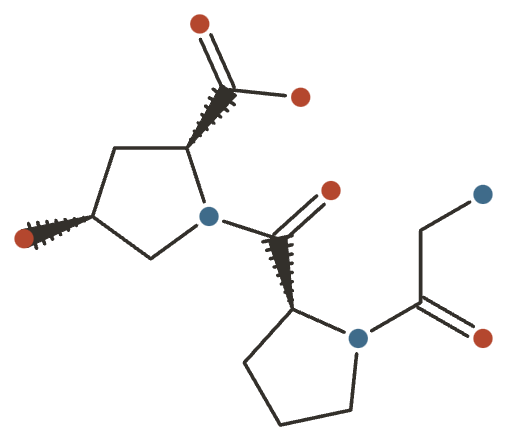
The more interesting hypothesis — and the one the research actually rests on — is that hydrolysis leaves behind specific bioactive di- and tripeptides, notably proline-hydroxyproline, which survive absorption intact, appear in blood, and may act as signals rather than raw material: telling fibroblasts and chondrocytes to increase their own collagen output. That is plausible and partly demonstrated in mechanistic work.
What makes the case unusual is that the evidence problem is not “thin” but structural. The trials exist, there are many of them, and the pooled result is positive — until you separate them by who paid.
What It’s Used For
- Knee osteoarthritis pain — the better-supported of the two main consumer claims, though every underlying trial is high risk of bias.
- Activity-related joint pain (athletes) — consistent RCT support, mostly manufacturer-linked.
- Body composition with resistance training — an adjunct-to-training effect, from one research group using one branded product.
- Tendon adaptation — greater tendon cross-sectional area, without matching gains in stiffness or strength.
- Bone mineral density — a single 12-month RCT in postmenopausal women.
- Skin aging (hydration, elasticity, wrinkles) — the largest use, and the one with the funding problem.
Hair and nails are heavily marketed and have no strong citable trial base — treat them as unproven. And the single most useful thing to carry away: when an effect survives only in industry-funded trials, the honest reading is that the effect is uncertain, not that it is proven and the sceptics are being difficult.
How It Works
Native collagen is too large and too tightly wound to absorb. Hydrolysis — enzymatic digestion during manufacture — cuts it into peptides typically a few thousand daltons, which is what makes the product different from gelatin or bone broth in kind rather than just in convenience.
Once swallowed, most of that is digested to free amino acids, and here the composition does matter a little: collagen is roughly a third glycine, plus large amounts of proline and hydroxyproline. Glycine in particular is used at a rate that arguably exceeds what the body comfortably synthesises, so there is a real nutritional argument for collagen as a glycine source independent of any signalling story.
The signalling story is the more specific claim. A fraction of collagen peptides survive digestion as intact di- and tripeptides — proline-hydroxyproline and hydroxyproline-glycine most notably — and these have been measured in human blood after ingestion. In laboratory work they act as chemoattractants for fibroblasts and appear to stimulate synthesis of collagen and hyaluronic acid. If the clinical effects are real, this is the most likely reason: not supplying bricks, but sending a message that collagen turnover is happening and should be matched.
Two practical caveats follow. Collagen is an incomplete protein — it contains no tryptophan and is low in several other essentials — so it cannot substitute for dietary protein. And there is nothing about the mechanism that would direct the effect to a particular tissue, which is why claims specific to one body part deserve more scepticism than claims about collagen turnover in general.
The full trial record is in Pharmacology & Research below.
Pharmacology & Research
Collagen peptides (hydrolyzed collagen, collagen hydrolysate) are an animal-derived structural protein enzymatically cut into short fragments — an incomplete dietary protein rich in glycine, proline and hydroxyproline, plus a small fraction of intact bioactive di- and tripeptides. There is no collagen deficiency state short of protein malnutrition or scurvy, so this is “extra on top of adequacy,” not deficiency correction — the relevant question is whether the supplement outperforms simply eating enough complete protein and vitamin C. The evidence problem here is unusual: trials are numerous and pooled results are often positive, but the signal is structurally confounded by industry funding and by a near-monopoly of positive trials from a small cluster of manufacturer-linked research groups using specific branded “bioactive collagen peptide” products. Form and dose matter mechanistically — tripeptide-enriched hydrolysates reach higher plasma peptide levels than generic ones — but no dietary-collagen product is a complete protein, and none has a mechanism that would route it to a chosen tissue.
Support is an experimental score I’m building — a composite weighted by study type (human > animal > in vitro > review) and study volume. It’s a beta: a fast way to rank strength of evidence at a glance, not a validated metric. Each application links down to its write-up.
A 2023 meta-analysis pooled 4 RCTs totalling 507 patients with knee osteoarthritis and found a statistically significant reduction in pain versus placebo, with no significant excess of adverse events. The authors rated the evidence moderate quality and noted that all four trials carried a high risk of bias on the Cochrane ROB 2.0 tool 1Reference 1Meta-analysisAnalgesic efficacy of collagen peptide in knee osteoarthritis: a meta-analysis of randomised controlled trials — meta-analysisView study →.
Doses in the underlying trials sit at the higher end of the studied range, often 10 g/day of hydrolysate. This is the better-supported of the two headline consumer claims, but “moderate quality on a small, high-risk-of-bias base” is the correct framing — not settled.
Gap: a small number of trials, all high risk of bias; the effect size is real but the certainty is limited, and osteoarthritis pain is a symptomatic rather than structural endpoint here.
Three RCTs from the same research group report that 15 g/day of specific collagen peptides added to a 12-week resistance-training programme improves body composition beyond training alone. In sarcopenic elderly men (n=53), the collagen group gained more fat-free mass (+4.2 vs +2.9 kg) and lost more fat mass, with greater quadriceps strength gains 4Reference 4RCTCollagen peptide supplementation in combination with resistance training improves body composition and increases muscle strength in elderly sarcopenic men — randomised controlled trialView study →.
A parallel trial in premenopausal women (n=77) reported greater increases in fat-free mass and leg and grip strength 5Reference 5RCTSpecific collagen peptides in combination with resistance training improve body composition and regional muscle strength in premenopausal women — randomized controlled trialView study →.
A third trial in middle-aged untrained men (n=97) replicated the body-composition benefit and, notably, included a whey-protein comparator arm 6Reference 6RCTThe influence of specific bioactive collagen peptides on body composition and muscle strength in middle-aged, untrained men — randomized controlled trialView study →.
The effect is real in these trials but is an adjunct-to-training effect, not a standalone one — and collagen is an incomplete protein, so a complete protein such as whey is the more conventional choice for a muscle-protein-synthesis goal.
Gap: all three trials come from a single research group using the same branded product, and collagen’s amino-acid profile (no tryptophan) makes the mechanism for a muscle-anabolic edge over complete protein unclear.
A 14-week randomised, placebo-controlled trial in 40 healthy young men found that 5 g/day of specific collagen peptides combined with high-load resistance training produced a significantly greater increase in Achilles tendon cross-sectional area (+11.0% vs +4.7%) and muscle thickness (+7.3% vs +2.7%) than training plus placebo — though tendon stiffness and strength gains did not differ between groups 9Reference 9RCTEffects of specific collagen peptide supplementation combined with resistance training on Achilles tendon properties — randomized controlled trialView study →.
A separate pilot in chronic mid-portion Achilles tendinopathy combined collagen peptides with calf-strengthening exercise and reported symptom improvement 10Reference 10RCTOral supplementation of specific collagen peptides combined with calf-strengthening exercises enhances function and reduces pain in Achilles tendinopathy patients — randomized controlled trialView study →.
Mechanistic support comes from the finding that vitamin-C-enriched gelatin taken before intermittent activity raises blood collagen-synthesis markers 13Reference 13RCTVitamin C-enriched gelatin supplementation before intermittent activity augments collagen synthesis — randomized controlled trialView study →.
Gap: small samples, a morphological endpoint (cross-sectional area) without matching functional gains in stiffness or strength, and again clustered in manufacturer-adjacent research.
A 12-month randomised, double-blind, placebo-controlled trial in 131 postmenopausal women with age-related low BMD found that 5 g/day of specific collagen peptides significantly increased BMD at the spine and femoral neck versus placebo, alongside a favourable shift in bone-turnover markers — P1NP up, CTX-1 down 7Reference 7RCTSpecific collagen peptides improve bone mineral density and bone markers in postmenopausal women — randomized controlled studyView study →.
A separate 12-month study found that adding 5 g of collagen peptides to calcium and vitamin D improved volumetric BMD and bone geometry at the tibia beyond calcium and vitamin D alone in osteopenic women 11Reference 11RCTEffect of calcium and vitamin D supplementation with and without collagen peptides on volumetric and areal bone mineral density in postmenopausal women with osteopenia — randomized controlled trialView study →.
Promising, but resting on very few trials from overlapping groups.
Gap: BMD is a surrogate for fracture risk, not fracture risk itself; a single primary RCT, manufacturer-linked, with no long-term fracture-outcome data.
This is the largest consumer use and the one with the clearest funding problem. A 2025 systematic review and meta-analysis of 23 RCTs (1,474 participants) found that, pooled across all trials, collagen supplements significantly improved skin hydration, elasticity and wrinkles — but the subgroup analysis is the story. In trials not funded by pharmaceutical or supplement companies the effect disappeared, and in high-quality studies there was no significant effect in any category, while the benefit concentrated in low-quality, industry-funded trials. The authors concluded there is currently no clinical evidence supporting collagen to prevent or treat skin aging 8Reference 8Meta-analysisEffects of collagen supplements on skin aging — systematic review and meta-analysis of randomized controlled trialsView study →.
Earlier meta-analyses that did not stratify by funding reported favourable pooled results 12Reference 12Meta-analysisEffects of hydrolyzed collagen supplementation on skin aging — systematic review and meta-analysisView study →, and individual manufacturer trials report significant elasticity gains at 2.5–5 g/day 14Reference 14RCTOral supplementation of specific collagen peptides has beneficial effects on human skin physiology — double-blind, placebo-controlled studyView study → — precisely the trials the 2025 analysis flags as funding-dependent.
Gap: the pooled positive result is an artefact of industry-funded, low-quality trials; the effect does not survive in independent or high-quality data. Treat skin claims as unproven.
Mechanisms
| Target / pathway | Effect | Relevant to |
|---|---|---|
| Amino-acid pool (glycine, proline, hydroxyproline) | Supplies substrate for endogenous collagen synthesis, given adequate vitamin C | All applications; the “raw material” hypothesis |
| Bioactive di-/tripeptides (Pro-Hyp, Gly-Pro-Hyp) | Survive digestion, appear in plasma, act as fibroblast chemoattractants and stimulate collagen and hyaluronic-acid synthesis in vitro | Skinjointtendon — the “signalling” hypothesis |
| Chondrocytes | Possible stimulation of extracellular-matrix synthesis (preclinical and biomarker studies) | Osteoarthritisjoint pain |
| Osteoblast/osteoclast balance | Shift toward formation (P1NP ↑) over resorption (CTX-1 ↓) in one RCT | Bone mineral density |
Pharmacokinetics
Native collagen is too large and too tightly wound to absorb; hydrolysis cuts it into peptides of a
few thousand daltons, most of which are then digested to free amino acids. A small fraction survives
as intact di- and tripeptides — most notably prolyl-hydroxyproline (Pro-Hyp) and
glycyl-prolyl-hydroxyproline — which have been measured in human plasma and urine after ingestion,
peaking roughly 1–2 hours post-dose 15,
Tripeptide-enriched hydrolysates reach higher plasma peptide concentrations than generic collagen
peptides, and delivery is dose-dependent 15,
As an incomplete protein lacking tryptophan, collagen cannot substitute for dietary protein regardless of dose.
Clinical trials
Registered and published trial activity is substantial — well over a thousand human trials mention collagen hydrolysate or peptides — but the efficacy literature is dominated by a small number of manufacturer-linked groups using branded “specific bioactive collagen peptide” products. As a cheap, off-patent food ingredient with many competing brands, most trials are industry-sponsored product studies rather than independent investigator-led ones, which is the root of the funding-confounding problem.
| Completed | Planned | Terminated | Preclinical |
|---|---|---|---|
| Many(dozens of efficacy RCTs; 4–23 per pooled analysis) | Ongoing | — | Hundreds(in vitro + rodent) |
Last checked: August 2026.
Dietary Sources
Collagen is not an essential nutrient: the body synthesises it given adequate protein, vitamin C — a required cofactor for the cross-linking enzymes — and the constituent amino acids. There is no deficiency state short of general protein malnutrition or scurvy. Dietary collagen comes from the connective parts of animals that modern eating tends to skip: skin, tendon, cartilage and bone.
| Food source | What it supplies | Notes |
|---|---|---|
| Bone broth / slow-cooked cuts | Gelatin (denatured collagen) | The traditional analogue of the supplement; content varies enormously with preparation, and it is not hydrolysed to the same peptide sizes |
| Chicken skin, fish skin | Gelatin | Fish skin is the raw material for “marine collagen” |
| Tendon, cartilage, tough cuts | Native collagen | Requires long moist cooking to become digestible gelatin |
| Glycine-rich whole diet + vitamin C | Substrate for endogenous synthesis | The body makes its own collagen; this is the baseline the supplement competes against |
Worth noting as context for the whole product category: the raw material is a by-product of the meat and fish industries, which is why an ostensibly premium supplement is cheap to make. Collagen is a protein rather than a micronutrient, so there is no RDA and no Tolerable Upper Intake Level for it.
Dosage
These are doses studied in research, not a personal recommendation.
- Studied range: roughly 2.5–15 g/day. Skin trials cluster around 2.5–10 g/day; joint and
osteoarthritis trials often sit at the higher end, up to ~10 g/day of hydrolysate; body-composition
trials used 15 g/day alongside resistance training 1,
4, .8Reference 1Meta-analysisAnalgesic efficacy of collagen peptide in knee osteoarthritis: a meta-analysis of randomised controlled trials — meta-analysisView study →Reference 4RCTCollagen peptide supplementation in combination with resistance training improves body composition and increases muscle strength in elderly sarcopenic men — randomised controlled trialView study →Reference 8Meta-analysisEffects of collagen supplements on skin aging — systematic review and meta-analysis of randomized controlled trialsView study → - Duration: trials typically run 8–24 weeks, with the bone trials at 12 months. Any effect is slow, matching the pace of connective-tissue turnover.
- Form: tripeptide-enriched hydrolysates deliver more bioactive peptide to plasma than generic
collagen peptides 15,
16Reference 15Clinical trialAbsorption and urinary excretion of peptides after collagen tripeptide ingestion in humans — clinical trialView study →Reference 16AnimalAbsorption and effectiveness of orally administered low molecular weight collagen hydrolysate in ratsView study → , but “specific” or “bioactive” collagen peptide branding is largely a manufacturer designation. Type designations (I, II, III) are used to market products for specific tissues — type II for cartilage, I and III for skin — but once hydrolysed and digested, the mechanistic basis for that targeting is weak. - Vitamin C pairing is a genuine biochemical relationship — it is a cofactor for collagen synthesis 13Reference 13RCTVitamin C-enriched gelatin supplementation before intermittent activity augments collagen synthesis — randomized controlled trialView study → — not merely a bundling tactic.
- Not a protein replacement: collagen lacks tryptophan and is low in several other essential amino acids, so it should not be counted as a sole protein source. This matters most for older adults and anyone with marginal protein intake.
Safety
Collagen peptides are a food-grade protein, so the safety considerations are about sourcing and allergy rather than pharmacology.
- Generally well tolerated. Adverse-event rates were similar to placebo in the knee-osteoarthritis meta-analysis 1Reference 1Meta-analysisAnalgesic efficacy of collagen peptide in knee osteoarthritis: a meta-analysis of randomised controlled trials — meta-analysisView study →; mild GI complaints (fullness, an unpleasant aftertaste) are the usual reports.
- Marine collagen is a fish allergen. Anyone with a fish allergy should avoid it. Source also determines halal, kosher and beef-avoidant suitability.
- There is no vegan collagen. Products marketed that way supply precursors, not collagen.
- Displacing complete protein with collagen is a net loss — it lacks tryptophan. Relevant for older adults and low-protein diets.
- Renal consideration. High intakes add to the overall protein load, which matters in significant kidney impairment.
- No upper limit is set — collagen is a food protein, not a micronutrient.
Full Safety & Interactions Detail
- Tolerability: generally well tolerated, with adverse-event rates similar to placebo in the knee-osteoarthritis meta-analysis 1Reference 1Meta-analysisAnalgesic efficacy of collagen peptide in knee osteoarthritis: a meta-analysis of randomised controlled trials — meta-analysisView study →. Mild gastrointestinal complaints — fullness, an unpleasant aftertaste — are the usual reports.
- Allergen source: collagen is derived from bovine hide and bone, porcine skin, fish skin and scales, or chicken cartilage. Marine collagen is a fish allergen and should be avoided by anyone with a fish allergy. Source also determines halal, kosher and beef-avoidant suitability, and there is no vegan collagen — products marketed that way supply precursors rather than collagen.
- Nutritional caveat: displacing complete protein with collagen is a net loss, because it lacks tryptophan. This is most relevant for older adults and anyone on a low-protein diet.
- Renal: high intakes add to the overall protein load, a consideration in significant kidney impairment.
Scope disclosure. Interactions were not assessed — no pharmacological interaction is mechanistically expected from a dietary protein, but no formal interaction review was conducted. Pregnancy and lactation were not formally assessed. No Upper Limit exists, since collagen is a food protein rather than a micronutrient, and absence of a UL does not imply that unlimited intake is studied or safe. Where something was not studied, it is marked “not assessed,” not “safe.”
Not established. Collagen peptides are a food-grade protein and dietary-level intake raises no specific mechanistic concern, but supplemental doses have not been studied in pregnancy or lactation and no formal safety assessment exists. Sourcing and quality control are the more practical considerations, since these are animal-derived products with variable oversight. Discuss with a qualified healthcare practitioner before use.
References
- Lin CR, Tsai SHL, Huang KY, et al. (2023). Analgesic efficacy of collagen peptide in knee osteoarthritis: a meta-analysis of randomised controlled trials — meta-analysis. Journal of Orthopaedic Surgery and Research. https://pubmed.ncbi.nlm.nih.gov/37717022/
- Clark KL, Sebastianelli W, Flechsenhar KR, et al. (2008). 24-week study on the use of collagen hydrolysate as a dietary supplement in athletes with activity-related joint pain — randomized controlled trial. Current Medical Research and Opinion. https://pubmed.ncbi.nlm.nih.gov/18416885/
- Zdzieblik D, Oesser S, Gollhofer A, König D (2017). Improvement of activity-related knee joint discomfort following supplementation of specific collagen peptides — randomized controlled trial. Applied Physiology, Nutrition, and Metabolism. https://pubmed.ncbi.nlm.nih.gov/28177710/
- Zdzieblik D, Oesser S, Baumstark MW, et al. (2015). Collagen peptide supplementation in combination with resistance training improves body composition and increases muscle strength in elderly sarcopenic men — randomised controlled trial. British Journal of Nutrition. https://pubmed.ncbi.nlm.nih.gov/26353786/
- Jendricke P, Centner C, Zdzieblik D, et al. (2019). Specific collagen peptides in combination with resistance training improve body composition and regional muscle strength in premenopausal women — randomized controlled trial. Nutrients. https://pubmed.ncbi.nlm.nih.gov/31010031/
- Zdzieblik D, Jendricke P, Oesser S, et al. (2021). The influence of specific bioactive collagen peptides on body composition and muscle strength in middle-aged, untrained men — randomized controlled trial. International Journal of Environmental Research and Public Health. https://pubmed.ncbi.nlm.nih.gov/33946565/
- König D, Oesser S, Scharla S, et al. (2018). Specific collagen peptides improve bone mineral density and bone markers in postmenopausal women — randomized controlled study. Nutrients. https://pubmed.ncbi.nlm.nih.gov/29337906/
- Myung SK, Park Y (2025). Effects of collagen supplements on skin aging — systematic review and meta-analysis of randomized controlled trials. The American Journal of Medicine. https://pubmed.ncbi.nlm.nih.gov/40324552/
- Jerger S, Centner C, Lauber B, et al. (2022). Effects of specific collagen peptide supplementation combined with resistance training on Achilles tendon properties — randomized controlled trial. Scandinavian Journal of Medicine & Science in Sports. https://pubmed.ncbi.nlm.nih.gov/35403756/
- Praet SFE, Purdam CR, Welvaert M, et al. (2019). Oral supplementation of specific collagen peptides combined with calf-strengthening exercises enhances function and reduces pain in Achilles tendinopathy patients — randomized controlled trial. Nutrients. https://pubmed.ncbi.nlm.nih.gov/30609761/
- Lampropoulou-Adamidou K, Trovas G, Triantafyllopoulos IK, et al. (2022). Effect of calcium and vitamin D supplementation with and without collagen peptides on volumetric and areal bone mineral density in postmenopausal women with osteopenia — randomized controlled trial. Journal of Clinical Densitometry. https://pubmed.ncbi.nlm.nih.gov/34980546/
- de Miranda RB, Weimer P, Rossi RC (2021). Effects of hydrolyzed collagen supplementation on skin aging — systematic review and meta-analysis. International Journal of Dermatology. https://pubmed.ncbi.nlm.nih.gov/33742704/
- Shaw G, Lee-Barthel A, Ross ML, et al. (2017). Vitamin C-enriched gelatin supplementation before intermittent activity augments collagen synthesis — randomized controlled trial. American Journal of Clinical Nutrition. https://pubmed.ncbi.nlm.nih.gov/27852613/
- Proksch E, Segger D, Degwert J, et al. (2014). Oral supplementation of specific collagen peptides has beneficial effects on human skin physiology — double-blind, placebo-controlled study. Skin Pharmacology and Physiology. https://pubmed.ncbi.nlm.nih.gov/23949208/
- Yamamoto S, Deguchi K, Onuma M, et al. (2016). Absorption and urinary excretion of peptides after collagen tripeptide ingestion in humans — clinical trial. Biological and Pharmaceutical Bulletin. https://pubmed.ncbi.nlm.nih.gov/26934933/
- Watanabe-Kamiyama M, Shimizu M, Kamiyama S, et al. (2010). Absorption and effectiveness of orally administered low molecular weight collagen hydrolysate in rats. Journal of Agricultural and Food Chemistry. https://pubmed.ncbi.nlm.nih.gov/19957932/



