
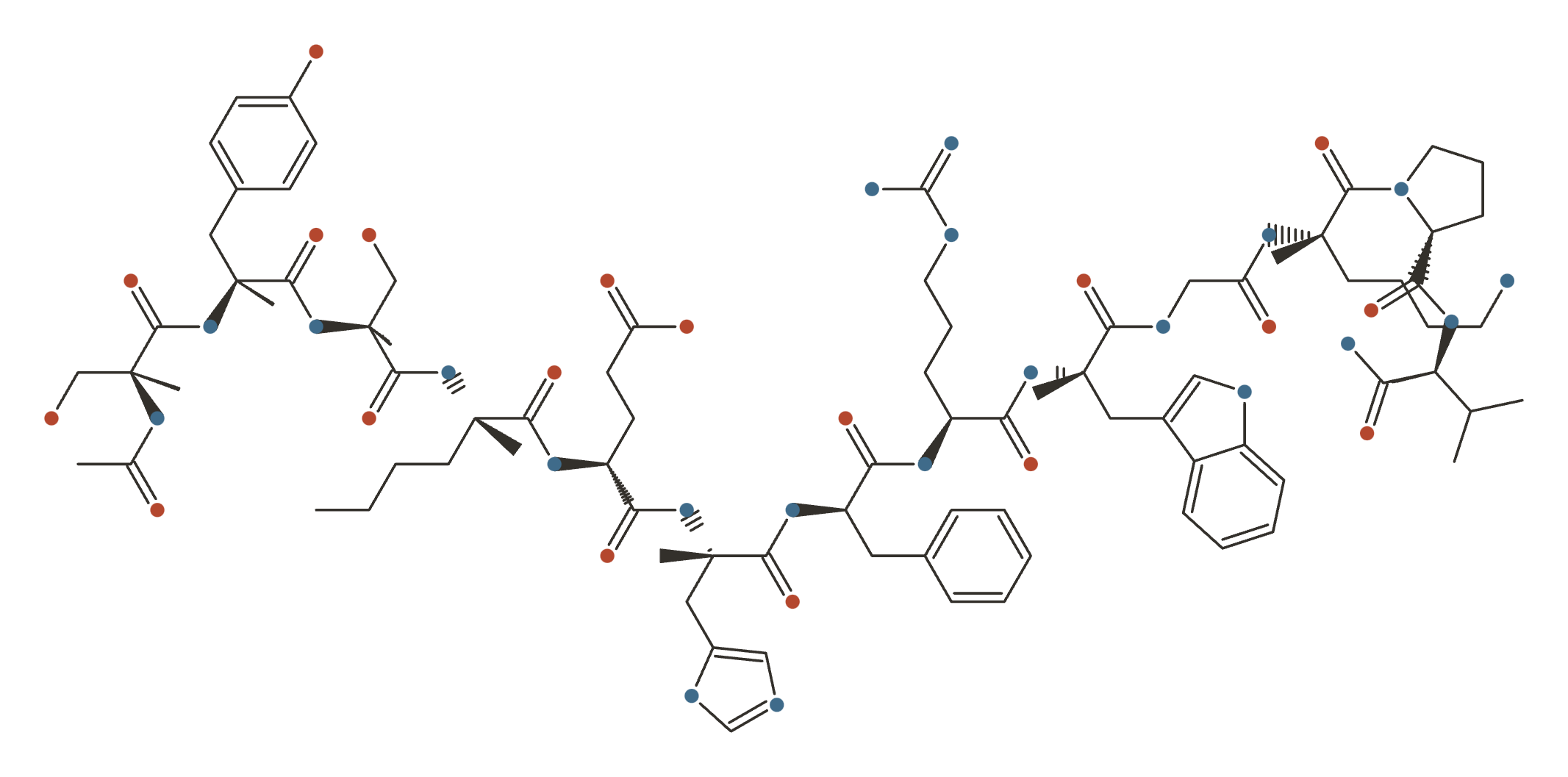
Melanotan I (Afamelanotide)
An α-MSH analogue approved as a subcutaneous implant (Scenesse) for erythropoietic protoporphyria — distinct from the unapproved tanning peptide melanotan-II.

Melanotan I (Afamelanotide) at a Glance
Melanotan-I (afamelanotide) is a linear α-MSH analogue and the approved member of this pair. It is licensed as Scenesse, a subcutaneous implant that provides photoprotection for people with erythropoietic protoporphyria — a rare condition in which sunlight causes severe pain. Its selectivity for the MC1 receptor makes it a much narrower drug than melanotan-II: it drives pigmentation without the broad melanocortin effects that make the unapproved analogue notorious.
History & Development
Melanotan-I began as a laboratory tool for studying pigment biology at the University of Arizona, and the idea behind it was cancer prevention: if fair skin could be made to tan without ultraviolet light, the tan might protect against melanoma.
| First described | 1980, as [Nle4, D-Phe7]-alpha-MSH 18Reference 18Sawyer, T. K., Sanfilippo, P. J., Hruby, V. J., Engel, M. H., Heward, C. B., Burnett, J. B., & Hadley, M. E. (1980). 4-Norleucine, 7-D-phenylalanine-alpha-melanocyte-stimulating hormone: a highly potent alpha-melanotropin with ultralong biological activity. Proceedings of the National Academy of Sciences, 77(10), 5754-5758. https://pubmed.ncbi.nlm.nih.gov/6777774/View study → |
| Discovered / synthesised by | T. K. Sawyer, V. J. Hruby, M. E. Hadley and colleagues 18Reference 18Sawyer, T. K., Sanfilippo, P. J., Hruby, V. J., Engel, M. H., Heward, C. B., Burnett, J. B., & Hadley, M. E. (1980). 4-Norleucine, 7-D-phenylalanine-alpha-melanocyte-stimulating hormone: a highly potent alpha-melanotropin with ultralong biological activity. Proceedings of the National Academy of Sciences, 77(10), 5754-5758. https://pubmed.ncbi.nlm.nih.gov/6777774/View study → |
| Institution | University of Arizona, Departments of Pharmacology and Chemistry 18, |
| Origin | Synthetic analogue of the endogenous hormone alpha-MSH |
| Key patent | Not established in the sources consulted for this section |
| Assignee | n/a |
| Development status | Approved - EMA 2014 and FDA 2019 as Scenesse (afamelanotide) for erythropoietic protoporphyria |
Discovery
The problem the Arizona group set out to solve was practical. Alpha-MSH, the hormone that drives melanin production, is degraded within minutes in the body, which made it almost impossible to study in a living animal. In a 1980 paper in PNAS, Sawyer, Hruby, Hadley and colleagues reported a synthetic analogue with two substitutions - norleucine at position 4 and D-phenylalanine at position 7 - which resisted enzymatic breakdown and proved 26 times as potent as alpha-MSH with markedly prolonged activity 18Reference 18Sawyer, T. K., Sanfilippo, P. J., Hruby, V. J., Engel, M. H., Heward, C. B., Burnett, J. B., & Hadley, M. E. (1980). 4-Norleucine, 7-D-phenylalanine-alpha-melanocyte-stimulating hormone: a highly potent alpha-melanotropin with ultralong biological activity. Proceedings of the National Academy of Sciences, 77(10), 5754-5758. https://pubmed.ncbi.nlm.nih.gov/6777774/View study →.
That compound, [Nle4, D-Phe7]-alpha-MSH, is the molecule now called afamelanotide, or Melanotan-I. It was created as a molecular probe for melanotropin receptors, not as a drug 18Reference 18Sawyer, T. K., Sanfilippo, P. J., Hruby, V. J., Engel, M. H., Heward, C. B., Burnett, J. B., & Hadley, M. E. (1980). 4-Norleucine, 7-D-phenylalanine-alpha-melanocyte-stimulating hormone: a highly potent alpha-melanotropin with ultralong biological activity. Proceedings of the National Academy of Sciences, 77(10), 5754-5758. https://pubmed.ncbi.nlm.nih.gov/6777774/View study →.
The therapeutic idea followed from the tool. Researchers at Arizona - including the dermatologist Norman Levine alongside Hadley and Hruby - reasoned that inducing the natural tanning response pharmacologically could protect fair-skinned people from ultraviolet damage without sun exposure 19Reference 19UA-developed synthetic hormones speed a tanView study →.
Development & ownership
Melanotan-I is the member of this family that completed a regulatory path, and it did so for an indication far removed from cosmetic tanning. As afamelanotide, delivered as a subcutaneous implant under the trade name Scenesse, it was authorised by the EMA in 2014 and approved by the FDA in 2019 for erythropoietic protoporphyria - a rare inherited disorder in which sunlight causes severe pain.
That indication reflects what the molecule actually does well: it is selective for the MC1 receptor, so it drives pigmentation without the broad melanocortin effects that made its sibling melanotan-II notorious. The specific patent and assignee were not established in the sources consulted for this section.
How it reached the market
Two separate routes exist and they should not be confused. The approved product is a controlled implant administered by a clinician for a diagnosed rare disease. Separately, injectable “Melanotan-I” is sold on the grey market as a tanning agent - unapproved, unregulated, and not the same product as Scenesse in either form or oversight.
What It's Used For
Melanotan I — afamelanotide, marketed as Scenesse — is a synthetic 13-amino-acid analogue of α-melanocyte-stimulating hormone (α-MSH: Ac-Ser-Tyr-Ser-Nle-Glu-His-D-Phe-Arg-Trp-Gly-Lys-Pro-Val-NH₂). Two substitutions — norleucine at position 4 and D-phenylalanine at position 7 — make it resistant to enzymatic breakdown and far more potent and longer-acting than natural α-MSH at the melanocortin-1 receptor (MC1R), the switch that shifts melanocytes toward brown-black eumelanin. Unlike almost everything else in this collection, afamelanotide is not an unapproved research chemical: it is a regulator-reviewed prescription drug, authorized by the EMA in 2014 and the FDA in 2019 as a controlled-release subcutaneous implant to reduce phototoxicity in adults with erythropoietic protoporphyria (EPP) — a rare inherited photodermatosis. That approval rests on multicenter, double-blind, placebo-controlled human trials, a stronger evidence base than most peptides ever accumulate. But it covers one indication, one population, one formulation, and it transfers to nothing else. Beyond EPP the picture thins fast into small phase II trials and pilot studies, and the delivery reality is decisive: afamelanotide is orally inactive — no detectable plasma drug after oral dosing — and works only when injected or implanted.
A note on names. “Melanotan I” and “melanotan II” are different molecules. Melanotan I / afamelanotide is a linear α-MSH analogue and an approved drug. Melanotan-II is a shorter, cyclic, broader melanocortin agonist, never approved anywhere, sold gray-market as a tanning/libido agent and carrying its own sexual-arousal and priapism problems. Nothing here transfers to melanotan-II. Equally, the injectable powder sold online as “Melanotan 1” is unlicensed material of unverified identity — not the licensed Scenesse implant.
Support is an experimental score I’m building — a composite weighted by study type (human > animal > in vitro > review) and study volume. It’s a beta: a fast way to rank strength of evidence at a glance, not a validated metric. Each application links down to its write-up.
Human — the approved indication and the only approval-grade evidence here. EPP is a rare inherited porphyria in which protoporphyrin IX accumulates in skin and, on light exposure, causes excruciating phototoxic pain long before any visible burn. Two multicenter randomized, double-blind, placebo-controlled trials in adults (European n=74, US n=94) of a 16 mg subcutaneous afamelanotide implant every 60 days found longer pain-free direct-sunlight exposure versus placebo — US: median 69.4 vs 40.8 hours over 6 months (P=0.04); European: 6.0 vs 0.8 hours over 9 months (P=0.005) — with improved quality of life and an acceptable adverse-event profile 1Reference 1RCTAfamelanotide for erythropoietic protoporphyria — human (RCT, multicentre, placebo-controlled)View study →. An earlier open-label human study (n=5, 20 mg implant) 13Reference 13Clinical trialMitigating photosensitivity of erythropoietic protoporphyria patients by an agonistic analog of α-melanocyte-stimulating hormone — human (clinical trial, n=5)View study → and a systematic review of EPP/X-linked protoporphyria photosensitivity treatments 2Reference 2Systematic reviewExperimental and approved treatments for skin photosensitivity in erythropoietic protoporphyria or X-linked protoporphyria — systematic reviewView study → reach concordant conclusions: afamelanotide is one of very few interventions with controlled evidence of benefit in this disease.
Gap: benefit is measured largely on patient-reported pain-free time — susceptible to weather and behavior variation — rather than a hard biomarker, and the effect extends tolerated light exposure modestly rather than curing photosensitivity. Note also what this does not establish: it is evidence for a specific implant, in adults with EPP, under clinical supervision. It says nothing about cosmetic use.
Human, but small and short-term. This is the oldest and most-replicated effect: afamelanotide darkens normal skin by driving eumelanin synthesis. Small controlled trials in healthy volunteers — starting with a 1991 randomized placebo-controlled study in 28 men 6Reference 6RCTInduction of skin tanning by subcutaneous administration of a potent synthetic melanotropin — human (RCT)View study → — repeatedly show subcutaneous dosing (typically ~0.16 mg/kg/day cycles) increases reflectance-measured melanin density, with the largest relative gains in the fairest, lowest-baseline skin 8Reference 8RCTBarnetson RS, Ooi TK, Zhuang L, et al. (2006). [Nle4-D-Phe7]-α-melanocyte-stimulating hormone significantly increased pigmentation and decreased UV damage in fair-skinned Caucasian volunteers — human (RCT). Journal of Investigative Dermatology. https://pubmed.ncbi.nlm.nih.gov/16763547/View study →. Mechanistic human work confirms the pigment is genuine eumelanin (HPLC-quantified PTCA up to ~98% higher in forearm skin) 9Reference 9Clinical trialIncreased eumelanin expression and tanning is induced by a superpotent melanotropin [Nle4-D-Phe7]-α-MSH in humans — human (clinical trial)View study →, that it appears even in carriers of loss-of-function MC1R “red-hair” variants 7Reference 7RCTEffect of MELANOTAN, [Nle4, D-Phe7]-α-MSH, on melanin synthesis in humans with MC1R variant alleles — human (RCT)View study →, and that the induced melanin reduced UV-B sunburn cells by >50% and thymine-dimer formation by 59% in fair-skinned volunteers 8Reference 8RCTBarnetson RS, Ooi TK, Zhuang L, et al. (2006). [Nle4-D-Phe7]-α-melanocyte-stimulating hormone significantly increased pigmentation and decreased UV damage in fair-skinned Caucasian volunteers — human (RCT). Journal of Investigative Dermatology. https://pubmed.ncbi.nlm.nih.gov/16763547/View study →. A phase I study combined the peptide with solar UV to show enhanced, longer-lasting tanning versus sun alone 14Reference 14RCTEffects of a superpotent melanotropic peptide in combination with solar UV radiation on tanning of the skin — human (phase I RCT)View study →.
Gap: these are all small (single-digit to ~65-subject) short-term human studies measuring pigmentation and acute UV-damage markers — not skin-cancer incidence and not long-term safety. “Photoprotection” here means measurable reductions in acute sunburn markers; it is not evidence that afamelanotide prevents skin cancer. There is no approved cosmetic-tanning indication anywhere, and the gray-market injectables sold for that purpose are not the studied drug.
Human — the most active non-EPP indication. Two randomized multicenter trials tested 16 mg afamelanotide implants added to narrowband UV-B (NB-UVB) phototherapy. The combination produced superior and faster repigmentation than NB-UVB alone, most clearly on the face and upper extremities, in patients with skin phototypes III–VI 3Reference 3RCTAfamelanotide and narrowband UV-B phototherapy for the treatment of vitiligo — human (RCT, multicentre)View study →; a randomized trial in Asian patients with nonsegmental vitiligo reported concordant benefit 4Reference 4RCTAfamelanotide implants and narrow-band ultraviolet B phototherapy for nonsegmental vitiligo in Asians — human (RCT)View study →. A 2024 systematic review of systemic therapies for vitiligo lists afamelanotide among the treatments with supportive controlled data 15Reference 15Systematic reviewSystemic oral or injectable therapies for vitiligo — systematic reviewView study →. A phase III trial comparing Scenesse plus NB-UVB against comparators (NCT06109649) is active but not recruiting, with results not yet published.
Gap: consistent but modest in scale, and always as an add-on to phototherapy rather than a standalone treatment; repigmentation is uneven (better on face and limbs, poor on hands and feet). Vitiligo is not an approved indication — the confirmatory phase III has not reported.
Human trial activity, thin published human results. The sponsor (Clinuvel) ran a phase III program in polymorphic light eruption — the most common photodermatosis — using the same 16 mg implant approved for EPP; two registered trials are recorded as completed on ClinicalTrials.gov (NCT00472901 and NCT04704713). The rationale is identical to EPP: raise constitutive eumelanin and so raise the threshold for a light-triggered eruption, a mechanism the photodermatosis review literature treats as a plausible extension 2Reference 2Systematic reviewExperimental and approved treatments for skin photosensitivity in erythropoietic protoporphyria or X-linked protoporphyria — systematic reviewView study →.
Gap: despite a completed phase III program, mature peer-reviewed efficacy outcomes in PLE are largely absent from the public literature, and PLE is not an approved indication. This application is scored on registry activity, not published results — an honest but weak basis, and it would move sharply in either direction once outcomes appear.
Human, n=5. A single phase II study gave one 16 mg implant to five patients with solar urticaria and measured melanin density and monochromated light testing. Melanin rose and stayed elevated to day 60; the minimum urticarial dose increased at several wavelengths, and weal area fell significantly across 300–600 nm at day 60 5Reference 5Systemic photoprotection in solar urticaria with α-melanocyte-stimulating hormone analogue [Nle4-D-Phe7]-α-MSH — human (phase II, n=5)View study →. A registered phase II pilot corresponds to this work (NCT00859534, completed).
Gap: human, but tiny, uncontrolled, and measuring physiologic photoprovocation endpoints rather than real-world flare frequency or quality of life. Hypothesis-generating, not confirmatory.
Human, n=3. The rationale here is anti-inflammatory rather than pigmentary — α-MSH has documented anti-inflammatory activity across the melanocortin class. An open-label phase II pilot gave 16 mg afamelanotide to three patients with mild-to-moderate facial acne; total and inflammatory lesion counts and Dermatology Life Quality Index improved by day 56, with only transient fatigue reported 11Reference 11Beneficial effects of the melanocortin analogue Nle4-D-Phe7-α-MSH in acne vulgaris — human (open-label phase II pilot, n=3)View study →. A registered phase II study (NCT04943159) is recorded as completed.
Gap: n=3, open-label, no control group — this is a case series, not a trial, and the published signal remains pilot-grade despite the completed registration. The popular framing of afamelanotide as an “anti-inflammatory peptide” rests almost entirely on this plus mechanism.
Human, n=6 — the most speculative application here. A phase IIa open-label proof-of-concept enrolled six acute ischemic stroke patients ineligible for revascularization, giving 16 mg implants on days 0 and 1 (repeated on days 7/8 if not recovered). It was primarily a feasibility and safety study: afamelanotide was well tolerated (one fatal recurrent stroke judged unrelated), and exploratory signals — median NIHSS falling from 6 to 2, perfusion-lesion volumes shrinking on MRI — were encouraging but uncontrolled 10Reference 10A feasibility and safety study of afamelanotide in acute stroke patients — human (open-label phase IIa, n=6)View study →. The registered phase II record (NCT04962503) is complete.
Gap: n=6, open-label, no placebo, feasibility design. Encouraging tolerability and provocative imaging cannot establish neuroprotective efficacy, and no controlled stroke trial has reported. Genuinely early.
In vitro plus a human pilot of two patients. The rationale is antioxidant: in lesion-derived keratinocytes from Hailey-Hailey disease (a rare acantholytic blistering disorder), afamelanotide upregulated the redox transcription factor Nrf2 and restored proliferative capacity in vitro; a paired open-label pilot then treated two patients, both reporting Short Form-36 quality-of-life improvement after the first implant 12Reference 12In vitroEfficacy of the melanocortin analogue Nle4-D-Phe7-α-melanocyte-stimulating hormone in the treatment of patients with Hailey-Hailey disease — in vitro + human (open-label pilot, n=2)View study →.
Gap: cell-culture mechanism plus an n=2 uncontrolled pilot — the weakest tier here, mechanism plus anecdote, and scored as such.
Mechanisms
| Target / pathway | Effect | Relevant to |
|---|---|---|
| Melanocortin-1 receptor (MC1R) on melanocytes | Agonist → ↑ cAMP → ↑ tyrosinase → shift toward eumelanin synthesis | EPPtanning/photoprotectionvitiligoPLEsolar urticaria |
| Epidermal eumelanin (brown-black pigment) | ↑ eumelanin content; broadband UV-visible absorption and scatter | Photoprotection; ↓ sunburn cells↓ thymine dimers (human) |
| α-MSH anti-inflammatory signaling | ↓ pro-inflammatory cytokine activity (melanocortin class effect) | Acne (rationale)stroke (neuroinflammation hypothesis) |
| Nrf2 / antioxidant response | Upregulation of redox-sensitive transcription factor in keratinocytes | Hailey-Hailey disease (in vitro) |
| MC1R on non-melanocyte tissue (neural, immune) | Putative cytoprotective / anti-inflammatory action | Stroke neuroprotection (hypothesis only) |
Pharmacokinetics
Route is the whole story. In a human three-route crossover study, subcutaneous afamelanotide was completely bioavailable relative to intravenous dosing, while oral dosing produced no detectable plasma drug at all — the peptide is destroyed in the gut, so there is no oral form and never will be 16Reference 16RCTSkin pigmentation and pharmacokinetics of melanotan-I in humans — human (randomised crossover PK)View study →. After a subcutaneous bolus the free peptide clears quickly (β-phase half-life ~0.8–1.7 h, clearance ~0.12–0.19 L/kg/h, under 4% recovered renally), but the pharmacodynamic effect long outlasts the drug because it works by inducing melanin, which persists: tanning peaks about a week after dosing and remains visible around three weeks later 6,
The approved product sidesteps the short half-life entirely with a 16 mg controlled-release biodegradable implant — a poly(lactide-co-glycolide) rod inserted subcutaneously and releasing drug over several days, repeated roughly every 60 days. Long-term immunogenicity is low: no anti-drug antibodies developed in 23 of 26 EPP patients dosed for up to six years 17Reference 17Evaluation of the immunogenicity of the synthetic α-melanocyte-stimulating hormone analogue afamelanotide in erythropoietic protoporphyria patients — human (long-term, n=26)View study →. A dedicated implant pharmacokinetic study in EPP patients (NCT06388642) is registered as completed in 2025, with results not yet published. Research-grade lyophilized powder — a different thing from the licensed implant — requires reconstitution and cold storage, and its release kinetics after self-injection bear no relationship to the implant’s.
Clinical & regulatory status
Afamelanotide is an approved prescription medicine: EMA marketing authorization (2014) and FDA approval (2019) as Scenesse, a 16 mg subcutaneous implant, indicated to increase pain-free light exposure in adults with a clinical history of phototoxicity from erythropoietic protoporphyria. It is administered by a healthcare professional. It is not an approved dietary supplement, not an over-the-counter tanning product, and not approved for vitiligo, PLE, acne, stroke, or any cosmetic purpose — those remain investigational or unstudied.
The registered-trial landscape is unusually substantial for a peptide. Per ClinicalTrials.gov (searched for afamelanotide / melanotan-1 / Scenesse / CUV1647), completed records include the EPP registration program, two phase III polymorphic-light-eruption trials (NCT00472901, NCT04704713), the solar-urticaria pilot (NCT00859534), the acne phase II (NCT04943159), the acute-stroke proof-of-concept (NCT04962503), a variegate-porphyria phase II (NCT05854784) and an EPP implant PK study (NCT06388642). One phase III vitiligo trial is active, not recruiting (NCT06109649). Four records — two xeroderma pigmentosum (NCT05370235, NCT05159752), one vitiligo (NCT05210582), one organ-transplant actinic keratosis (NCT00829192) — carry status “unknown” because their last update lapsed; that is not the same as terminated, and they should be re-checked rather than assumed dead.
| Completed | Ongoing | Terminated | Preclinical |
|---|---|---|---|
| 18 | 1(+4 status-unknown) | 0 | Extensive(decades of α-MSH / MC1R work) |
Last checked: July 2026.
Sourcing, Route & Legal Status
Regulatory status — an approved medicine with a narrow indication. This is the single most important fact on the page, and the one most often blurred. Afamelanotide is a genuine, regulator-reviewed drug: EMA authorization (2014) and FDA approval (2019) as Scenesse, a 16 mg subcutaneous controlled-release implant, indicated only to increase pain-free light exposure in adults with a history of EPP phototoxicity. It is prescription-only and clinician-administered. That approval does not validate cosmetic tanning, does not extend to vitiligo or acne, and does not transfer to a different formulation used by a different route without oversight. An approval covers one indication, one population, one product.
How it’s supplied & administered. The licensed product is a sterile bioerodible poly(lactide-co-glycolide) implant (a rod roughly 1.7 cm long) inserted subcutaneously above the iliac crest by a healthcare professional, releasing drug over several days and repeated approximately every 60 days during high-light seasons. The route is subcutaneous because the peptide is orally inactive — human pharmacokinetics show no detectable drug after oral dosing 16Reference 16RCTSkin pigmentation and pharmacokinetics of melanotan-I in humans — human (randomised crossover PK)View study →, so any oral “melanotan” product is pharmacologically inert regardless of its label. Research-grade lyophilized afamelanotide powder, sold separately from the licensed implant, requires reconstitution in sterile diluent, cold storage, and subcutaneous injection.
Sourcing reality — this is a safety issue, not a footnote. A large gray market sells injectable “Melanotan 1” / “MT-1” powder online for cosmetic tanning. This is not the licensed Scenesse implant, and the implant’s evidence does not transfer to it. It is produced by unregulated vendors with no manufacturing oversight: identity, sequence, purity, peptide content, and endotoxin/sterility are all unverified, and self-reconstitution plus self-injection add contamination and dosing error on top. The formulation differs (bolus injection versus days-long controlled release), the route kinetics differ, and there is no clinical supervision — which matters most for the one thing this drug’s mechanism demands, namely monitoring of pigmented lesions. Third-party certificates of analysis (independent HPLC identity/purity and endotoxin testing) are the minimum a buyer could ask for, and even a clean COA does not turn an unlicensed tanning injectable into an approved drug used for a specific disease. Documented harms from gray-market tanning-peptide use exist in the case-report literature. No vendors are recommended or linked here.
Safety
As a supervised prescription implant, afamelanotide is well characterized and generally well tolerated — but the open question is what sustained melanocyte stimulation does over years, and that question falls hardest on people self-injecting unlicensed tanning powder with no dermatologic follow-up at all.
- Well tolerated as the licensed implant. Implant-site reactions, headache, nausea and fatigue; low immunogenicity over up to six years of dosing.
- Gray-market “Melanotan 1” powder is not the licensed implant. Identity, purity, sterility and endotoxin are unverified, and the implant’s evidence does not transfer to it.
- Pigmented lesions need monitoring. Existing naevi commonly darken, which can mask change that matters; long-term melanoma and skin-cancer risk is not established either way.
- Contraindicated in pregnancy and breastfeeding absent specialist advice. See the box below.
- Interactions not systematically assessed. The label carries general caution rather than a characterized interaction set.
- Induced pigmentation plus deliberate UV exposure is the failure mode. A tan that feels protective invites more sun, not less.
Full Safety & Interactions Detail
Overall posture. In the EPP registration trials afamelanotide was generally well tolerated; reported adverse events included implant-site reactions, headache, nausea and fatigue 1Reference 1RCTAfamelanotide for erythropoietic protoporphyria — human (RCT, multicentre, placebo-controlled)View study →. Long-term immunogenicity was low — no anti-drug antibodies in 23 of 26 patients dosed for up to six years 17Reference 17Evaluation of the immunogenicity of the synthetic α-melanocyte-stimulating hormone analogue afamelanotide in erythropoietic protoporphyria patients — human (long-term, n=26)View study →. This is a better-characterized safety picture than any other peptide here, but it is a picture of the implant, in supervised EPP patients, not of self-injected powder used for tanning.
The dose-limiting concern is pharmacodynamic, not acutely toxic. Because the drug drives melanocyte activity and darkens skin, monitoring of pigmented lesions and nevi is prudent and it should be used under dermatologic supervision. Existing naevi commonly darken, which can mask or mimic change in a lesion that matters. Long-term melanoma and non-melanoma skin-cancer risk from sustained melanocyte stimulation has not been established either way — the trials were not sized or long enough to answer it. That caution applies with far more force to someone self-injecting an unlicensed look-alike for cosmetic tanning, who by definition has no dermatologic follow-up at all, and who may also be more sun-exposed because the tan feels protective.
Route-specific risks. For the licensed implant: implant-site reactions and the minor procedural risks of subcutaneous insertion. For gray-market powder: non-sterile technique, contamination, endotoxin exposure, injection-site infection, and dosing error from self-mixed concentrations. Gray-market melanotan use has produced documented case-report harms in the dermatology literature — including reports of changing or eruptive naevi and melanoma diagnosed during or after use. Those are case reports, not a quantified risk, and they cannot establish causation; they are noted because they are the only real-world data on the unlicensed use.
Interactions. No formal drug-interaction program is available; the prescribing information carries general caution rather than a characterized interaction set. Treat interactions as not systematically assessed. A mechanism-level caution rather than a demonstrated interaction: concurrent phototherapy is a studied combination in vitiligo 3,
Who should avoid it. Anyone pregnant, breastfeeding or trying to conceive; anyone with a personal or family history of melanoma or dysplastic naevus syndrome without specialist advice; anyone who would use it in place of dermatologic surveillance; and anyone acquiring unlicensed injectable material of unverified identity. Because it is a prescription implant where it is approved at all, self-administration is off-label by definition.
Scope disclosure (honesty, not a claim):
- Human data? Yes — approval-grade randomized placebo-controlled trials in EPP, plus multiple small human trials in tanning/photoprotection, vitiligo and other photodermatoses. Strong for a peptide, but concentrated in one rare disease and one formulation.
- Interactions assessed? No. No formal drug-interaction studies of note; the label carries general prescribing caution rather than a characterized interaction set.
- Pregnancy/lactation assessed? No — not established, and not a labeled finding.
- Long-term safety established? Partially. Up to ~6 years of repeat dosing in EPP patients showed low immunogenicity and acceptable tolerability, but long-term melanoma/skin-cancer risk from sustained melanocyte stimulation is not established, and there is no long-term safety data at all for cosmetic-tanning use with unlicensed material.
Never imply safety from silence. Where afamelanotide has not been studied — interactions, pregnancy, long-term carcinogenicity, gray-market product purity — the correct statement is “not assessed,” not “safe.”
Not established. Afamelanotide has not been shown to be safe in pregnancy or lactation; the approved use is a rare-disease indication in adults and pregnancy safety is not a labeled finding. Treat as contraindicated in pregnancy and breastfeeding absent specialist advice.
Dosage
The only established dose is a prescribing regimen for a rare disease, and it is reported here as data, not as a recommendation. The approved regimen is one 16 mg controlled-release implant inserted subcutaneously by a healthcare professional approximately every 60 days, for adults with erythropoietic protoporphyria, typically during high-light seasons. That figure belongs to a clinician-inserted implant; it is not a number anyone can act on at home, because the delivery system — not just the milligram amount — is what makes it work.
There is no established dose for self-administration, and none is recommended here. Historical human tanning studies used subcutaneous cycles of roughly 0.16 mg/kg/day 6,
References
- Langendonk JG, Balwani M, Anderson KE, et al. (2015). Afamelanotide for erythropoietic protoporphyria — human (RCT, multicentre, placebo-controlled). New England Journal of Medicine. https://pubmed.ncbi.nlm.nih.gov/26132941/
- Heerfordt IM, Lerche CM, Wulf HC, et al. (2023). Experimental and approved treatments for skin photosensitivity in erythropoietic protoporphyria or X-linked protoporphyria — systematic review. Biomedicine & Pharmacotherapy. https://pubmed.ncbi.nlm.nih.gov/36525819/
- Lim HW, Grimes PE, Agbai O, et al. (2015). Afamelanotide and narrowband UV-B phototherapy for the treatment of vitiligo — human (RCT, multicentre). JAMA Dermatology. https://pubmed.ncbi.nlm.nih.gov/25230094/
- Toh JJH, Chuah SY, Jhingan A, et al. (2020). Afamelanotide implants and narrow-band ultraviolet B phototherapy for nonsegmental vitiligo in Asians — human (RCT). Journal of the American Academy of Dermatology. https://pubmed.ncbi.nlm.nih.gov/31987791/
- Haylett AK, Nie Z, Brownrigg M, et al. (2011). Systemic photoprotection in solar urticaria with α-melanocyte-stimulating hormone analogue [Nle4-D-Phe7]-α-MSH — human (phase II, n=5). British Journal of Dermatology. https://pubmed.ncbi.nlm.nih.gov/20969564/
- Levine N, Sheftel SN, Eytan T, et al. (1991). Induction of skin tanning by subcutaneous administration of a potent synthetic melanotropin — human (RCT). JAMA. https://pubmed.ncbi.nlm.nih.gov/1658407/
- Fitzgerald LM, Fryer JL, Dwyer T, et al. (2006). Effect of MELANOTAN, [Nle4, D-Phe7]-α-MSH, on melanin synthesis in humans with MC1R variant alleles — human (RCT). Peptides. https://pubmed.ncbi.nlm.nih.gov/16293341/
- Barnetson RS, Ooi TK, Zhuang L, et al. (2006). [Nle4-D-Phe7]-α-melanocyte-stimulating hormone significantly increased pigmentation and decreased UV damage in fair-skinned Caucasian volunteers — human (RCT). Journal of Investigative Dermatology. https://pubmed.ncbi.nlm.nih.gov/16763547/
- Dorr RT, Dvorakova K, Brooks C, et al. (2000). Increased eumelanin expression and tanning is induced by a superpotent melanotropin [Nle4-D-Phe7]-α-MSH in humans — human (clinical trial). Photochemistry and Photobiology. https://pubmed.ncbi.nlm.nih.gov/11045725/
- Stanislaus V, Kam A, Murphy L, et al. (2023). A feasibility and safety study of afamelanotide in acute stroke patients — human (open-label phase IIa, n=6). BMC Neurology. https://pubmed.ncbi.nlm.nih.gov/37496004/
- Böhm M, Ehrchen J, Luger TA. (2014). Beneficial effects of the melanocortin analogue Nle4-D-Phe7-α-MSH in acne vulgaris — human (open-label phase II pilot, n=3). Journal of the European Academy of Dermatology and Venereology. https://pubmed.ncbi.nlm.nih.gov/22845050/
- Biolcati G, Aurizi C, Barbieri L, et al. (2014). Efficacy of the melanocortin analogue Nle4-D-Phe7-α-melanocyte-stimulating hormone in the treatment of patients with Hailey-Hailey disease — in vitro + human (open-label pilot, n=2). Clinical and Experimental Dermatology. https://pubmed.ncbi.nlm.nih.gov/24256215/
- Harms JH, Lautenschlager S, Minder CE, Minder EI. (2009). Mitigating photosensitivity of erythropoietic protoporphyria patients by an agonistic analog of α-melanocyte-stimulating hormone — human (clinical trial, n=5). Photochemistry and Photobiology. https://pubmed.ncbi.nlm.nih.gov/19656325/
- Dorr RT, Ertl G, Levine N, et al. (2004). Effects of a superpotent melanotropic peptide in combination with solar UV radiation on tanning of the skin — human (phase I RCT). Archives of Dermatology. https://pubmed.ncbi.nlm.nih.gov/15262693/
- Jafarzadeh A, Pour Mohammad A, Keramati H, et al. (2024). Systemic oral or injectable therapies for vitiligo — systematic review. Skin Research and Technology. https://pubmed.ncbi.nlm.nih.gov/38454597/
- Ugwu SO, Blanchard J, Dorr RT, et al. (1997). Skin pigmentation and pharmacokinetics of melanotan-I in humans — human (randomised crossover PK). Biopharmaceutics & Drug Disposition. https://pubmed.ncbi.nlm.nih.gov/9113347/
- Lengweiler S, Kreim S, Barman-Aksözen J, et al. (2015). Evaluation of the immunogenicity of the synthetic α-melanocyte-stimulating hormone analogue afamelanotide in erythropoietic protoporphyria patients — human (long-term, n=26). Skin Pharmacology and Physiology. https://pubmed.ncbi.nlm.nih.gov/25402764/
- Sawyer, T. K., Sanfilippo, P. J., Hruby, V. J., Engel, M. H., Heward, C. B., Burnett, J. B., & Hadley, M. E. (1980). 4-Norleucine, 7-D-phenylalanine-alpha-melanocyte-stimulating hormone: a highly potent alpha-melanotropin with ultralong biological activity. Proceedings of the National Academy of Sciences, 77(10), 5754-5758. https://pubmed.ncbi.nlm.nih.gov/6777774/
- Arizona Daily Star. UA-developed synthetic hormones speed a tan. https://tucson.com/news/local/education/college/ua-developed-synthetic-hormones-speed-a-tan/article_1aa2c79c-a216-5579-aead-7d012f7e02da.html



