
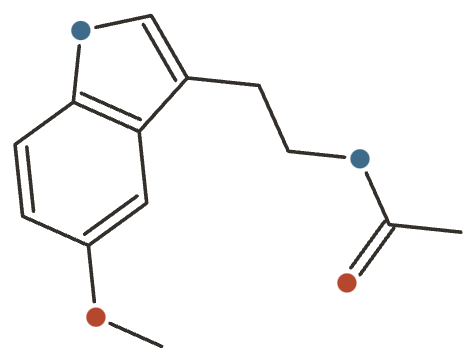

Melatonin at a Glance
Melatonin is a hormone, not a nutrient. The pineal gland makes it on a daily rhythm — output rises a couple of hours before habitual bedtime, peaks in the middle of the night, and collapses at dawn — and its job is to tell the rest of the body what time it is. Light hitting the eye, especially blue-shifted light, shuts production down. That is the mechanism in one sentence: melatonin is the body’s darkness signal.
Which makes the most useful thing to understand about it that it is a clock drug, not a sleeping pill. It does not sedate. It nudges the timing of the sleep–wake cycle, and the size of that nudge depends far more on when it is taken than on how much. This is why the usual supplement instinct — didn’t work, take more — fails here, and why 0.5 mg at the right hour routinely beats 10 mg at the wrong one.
The gap between that and how melatonin is sold is wide. It is stocked in 5, 10, even 20 mg doses, many multiples of anything the pineal gland produces, and marketed as a general sleep aid. Where it genuinely earns its keep is misalignment — jet lag, shift work, a sleep phase that has drifted late — rather than lying awake with a normally-timed clock.
What It’s Used For
- Circadian phase-shifting (DSPD) — a sleep phase that has drifted late. The clearest rationale, and the use the chronobiotic mechanism actually predicts. The timing of the dose is the active ingredient.
- Jet lag — the best-supported travel use, strongest crossing five or more time zones eastward.
- Falling asleep faster — real in meta-analysis but small: shorter sleep-onset latency and modestly better sleep quality, on the order of minutes rather than a transformation.
- Sleep in older adults — endogenous production declines with age, which makes this the group with the most plausible case for replacing something that has genuinely dropped. Prolonged-release forms are what the trials used.
- Sleep in neurodevelopmental disorders — the best-evidenced paediatric use, in autism and ADHD, and one that belongs with a clinician.
- Preoperative anxiety — a single acute dose before surgery, roughly comparable to midazolam in pooled analysis.
- Migraine prophylaxis — 3 mg nightly, a consistent but thinly replicated signal.
- Nocturnal blood pressure — small, controlled-release only, and inconsistent across populations.
- Delirium prevention — heavy trial activity, inconsistent results; a good lesson in mechanism not translating.
- Shift-work sleep — low-quality evidence for about 24 extra minutes of daytime sleep.
Two things it is bought for and is poor at. It is not a hypnotic for chronic insomnia — if the clock is correctly timed and you simply cannot sleep, melatonin has little to add. And more is not better: high over-the-counter doses buy next-day grogginess and vivid dreams without improving the phase shift, which saturates at low doses.
How It Works
Melatonin acts on two receptors, MT1 and MT2, concentrated in the suprachiasmatic nucleus — the hypothalamic pacemaker that keeps every peripheral clock in the body synchronised. Binding there does two separable things: it damps the SCN’s wake-promoting drive, which is the mild sleepiness people notice, and it shifts the phase of the clock itself, which is the effect that actually matters. An evening dose advances the clock earlier; a morning dose delays it later. The same amount, taken twelve hours apart, produces opposite results.
Downstream it lowers core body temperature slightly — itself part of the normal sleep-onset cascade rather than a side effect.
The pharmacokinetics account for most of the practical advice. Immediate-release melatonin peaks fast and clears fast, with a half-life under an hour, so a standard tablet is a brief pulse rather than overnight coverage and is poorly suited to middle-of-the-night waking. It is heavily metabolised on first pass through the liver, which is why oral bioavailability is low and varies a lot between people. And because the receptors saturate readily, the dose–response curve flattens early: past roughly 1 mg you are mostly buying side effects. One supporting detail with real consequences — melatonin is among the least reliably labelled products on the shelf, with independent testing repeatedly finding content well off the stated dose 13Reference 13Melatonin natural health products and supplements: presence of serotonin and significant variability of melatonin contentView study →.
The full trial record is in Pharmacology & Research below.
Pharmacology & Research
Melatonin (N-acetyl-5-methoxytryptamine) is an endogenous indoleamine hormone secreted by the pineal gland on a daily rhythm, not a nutrient — so almost none of its evidence concerns correcting a deficiency, and the relevant question is what a supraphysiological evening dose does to an already-functioning clock. Its best-characterised action is chronobiotic: acting at MT1/MT2 receptors in the suprachiasmatic nucleus, it shifts the phase of the circadian pacemaker, which is why timing of the dose matters far more than the amount. As a sleep aid it has a real but small effect — meta-analyses show it shortens sleep-onset latency by minutes, not a transformation — and it is consistently better understood as a timing signal than as a hypnotic for chronic insomnia. Two caveats run through the whole literature: the receptors saturate at low doses (roughly 0.3–1 mg), so the 5–10 mg products on the shelf mostly buy side effects, and independent testing has repeatedly found that the melatonin content of commercial products departs substantially from the label.
Support is an experimental score I’m building — a composite weighted by study type (human > animal > in vitro > review) and study volume. It’s a beta: a fast way to rank strength of evidence at a glance, not a validated metric. Each application links down to its write-up.
Melatonin’s clearest use follows directly from its mechanism as a darkness signal. A meta-analysis of randomised trials in delayed sleep-phase disorder (DSPD) found that appropriately timed evening melatonin advanced sleep onset and endogenous rhythm markers (dim-light melatonin onset), with doses in the 0.3–5 mg range and no clear dose–response above ~0.3 mg 5Reference 5Meta-analysisThe use of exogenous melatonin in delayed sleep phase disorder: a meta-analysisView study →.
The phase shift is bidirectional and timing-dependent: an evening dose advances the clock earlier, a morning dose delays it. This is the application the chronobiotic pharmacology actually predicts, and where sub-milligram physiological doses perform as well as larger ones 3,
The same receptor mechanism underlies the prescription MT1/MT2 agonists (ramelteon, tasimelteon) used for insomnia and non-24-hour sleep–wake disorder.
Gap: optimal dose and exact timing relative to each person’s own melatonin onset are not standardised, and self-managing a circadian disorder is better done with a clinician than by trial and error.
The Cochrane systematic review of randomised trials concluded that melatonin is effective for preventing or reducing jet lag when taken close to the target bedtime at destination, with the benefit most evident crossing five or more time zones and travelling eastward 3Reference 3Systematic reviewMelatonin for the prevention and treatment of jet lag — systematic reviewView study →.
Doses of 0.5–5 mg were similarly effective, with higher doses no better and sometimes more soporific. As with all its circadian uses, the schedule — which way you are flying and when you dose — is the active ingredient, not the milligram count.
Gap: individual trials are older and heterogeneous in design; the effect on objective daytime performance (versus subjective jet-lag ratings) is less firmly established.
Across several meta-analyses of randomised trials in primary sleep disorders, exogenous melatonin modestly shortened sleep-onset latency, increased total sleep time and improved subjective sleep quality — all statistically significant but small, on the order of a few minutes’ reduction in latency 1,
The effect is genuine but far smaller than prescription hypnotics, and melatonin does not maintain sleep across the night in immediate-release form. It is a mild sleep-onset aid, not a sedative for chronic insomnia 4Reference 4Meta-analysisEvidence for the efficacy of melatonin in the treatment of primary adult sleep disorders — meta-analysisView study →.
Gap: absolute effect sizes are small and of uncertain clinical significance for people with normally-timed clocks who simply cannot fall asleep.
This is the paediatric use with the most support. A systematic review and meta-analysis of randomised trials in children with neurodevelopmental disorders (predominantly autism spectrum disorder and ADHD) found that melatonin significantly reduced sleep-onset latency and increased total sleep time versus placebo, with a favourable short-term tolerability profile 7Reference 7Meta-analysisMelatonin for the management of sleep problems in children with neurodevelopmental disorders — systematic review and meta-analysisView study →.
Effect sizes were modest (tens of minutes) and formulations included both immediate- and prolonged-release. Paediatric melatonin use has grown very quickly, and even here it is best initiated and monitored by a clinician rather than self-selected 7Reference 7Meta-analysisMelatonin for the management of sleep problems in children with neurodevelopmental disorders — systematic review and meta-analysisView study →.
Gap: long-term developmental safety data are limited, and trials are short; use in typically-developing children without a diagnosed sleep disorder is not supported by this evidence.
Endogenous melatonin output declines with age, giving older adults the most plausible “replacement” rationale. A 6-month randomised placebo-controlled trial of prolonged-release melatonin (2 mg) in adults over 55 with primary insomnia found improvements in sleep quality and morning alertness, with benefit greatest in those with lower endogenous melatonin and greater age, and no rebound or withdrawal on discontinuation 6Reference 6RCTNightly treatment of primary insomnia with prolonged release melatonin for 6 months — randomized placebo-controlled trialView study →.
Prolonged-release formulations are designed to mimic the overnight profile that immediate-release tablets cannot.
Gap: the benefit is partly repletion-dependent (tied to low baseline output and older age), so it should not be generalised to younger replete adults; effect sizes remain modest.
A Cochrane systematic review found that melatonin given before surgery reduced preoperative anxiety compared with placebo and was, in pooled analysis, roughly comparable to the standard benzodiazepine midazolam, though trials were heterogeneous and evidence for postoperative anxiety was weaker 11Reference 11Systematic reviewMelatonin for pre- and postoperative anxiety in adults — systematic reviewView study →. This is a distinct, short-duration use where a single acute dose is the intervention rather than nightly circadian management.
Gap: trials vary widely in dose, timing and anxiety scales, and the comparison with midazolam carries wide confidence intervals; this is a peri-operative clinical setting, not a self-care use.
Small randomised trials and a systematic review suggest that melatonin (commonly 3 mg at night) may reduce migraine frequency, in some studies performing comparably to amitriptyline with fewer side effects 8Reference 8Meta-analysisEndogenous melatonin levels and therapeutic use of exogenous melatonin in migraine — systematic review and meta-analysisView study →. The signal is consistent with melatonin’s role in circadian regulation of headache, but the trial base is small and replication is limited.
Gap: few and small RCTs, variable outcome definitions, and limited independent replication keep this in the emerging category rather than the established one.
A meta-analysis of randomised trials found that controlled-release (but not immediate-release) melatonin produced a small reduction in nighttime systolic and diastolic blood pressure in some populations 9Reference 9Meta-analysisEffect of melatonin on nocturnal blood pressure: meta-analysis of randomized controlled trialsView study →. Later trials have been mixed — for example, high-dose sustained-release melatonin did not lower nocturnal BP in one crossover study — so the effect appears small, formulation-specific and population-dependent.
Gap: effect is modest, seen mainly with controlled-release forms, and inconsistent across populations; not a substitute for antihypertensive therapy.
Despite strong biological plausibility (disrupted sleep–wake cycles drive delirium) and heavy trial activity, the evidence is inconsistent. Several meta-analyses report reduced delirium incidence in hospitalised patients 10Reference 10Meta-analysisMelatonin for delirium prevention in hospitalized patients — systematic review and meta-analysisView study →, but the largest ICU randomised trial (Pro-MEDIC) was null, and pooled estimates are heterogeneous and sensitive to setting (medical/surgical wards versus intensive care).
Gap: results conflict between ward and ICU populations and between individual trials; this is a well-evidenced example of promising mechanism not translating into a reliable effect.
A Cochrane review of pharmacological interventions for shift-work sleep found low-quality evidence that melatonin taken after a night shift increased daytime sleep length by a small amount (roughly 24 minutes across studies) but did not clearly improve sleep onset 12Reference 12Systematic reviewPharmacological interventions for sleepiness and sleep disturbances caused by shift work — systematic reviewView study →. The direction is consistent with its circadian action, but the certainty of evidence is low.
Gap: low-quality evidence, small effect on sleep duration only, and no clear benefit for alertness during the shift itself.
Mechanisms
| Target / pathway | Effect | Relevant to |
|---|---|---|
| MT1 receptor (SCN) | Agonism → damps wake-promoting drive; mild sleepiness | Sleep-onset latencysleep in older adults |
| MT2 receptor (SCN) | Agonism → phase-shifts the circadian pacemaker (evening advance / morning delay) | Circadian phase-shiftingjet lagDSPDshift work |
| Core body temperature | Small reduction, part of the normal sleep-onset cascade | Sleep onset |
| Antioxidant / free-radical scavenging | Direct and indirect; upregulates antioxidant enzymes | Proposed basis for migrainedeliriumvascular effects (mechanisticnot proven clinically) |
| CYP1A2 (hepatic) | Substrate — governs clearance and drug interactions | Pharmacokineticsinteractions |
Pharmacokinetics
Oral melatonin is absorbed quickly but undergoes extensive first-pass hepatic metabolism (primarily via CYP1A2), so oral bioavailability is low (commonly cited around 15%) and highly variable between individuals. Immediate-release melatonin reaches peak plasma concentration in roughly 30–60 minutes and has an elimination half-life under an hour (~40–60 min), which makes a standard tablet a brief pulse suited to sleep onset and phase-shifting but poorly suited to maintaining sleep across the night or to middle-of-the-night waking. Prolonged- and controlled-release formulations extend the profile to better mimic the endogenous overnight curve, and are the forms used in most older-adult and blood-pressure trials 6,
Clinical trials
Melatonin is off-patent, inexpensive and heavily investigated, so trial activity is unusually large for a supplement — hundreds of completed randomised trials across sleep, circadian, peri-operative, neurological and critical-care indications, with active registrations continuing (particularly in delirium prevention and paediatric sleep). Because it is off-patent, most trials are investigator- or public-funded rather than industry-driven, and many are small.
| Completed | Planned | Terminated | Preclinical |
|---|---|---|---|
| Hundreds(100+ RCTs) | Dozens ongoing | Several | Very extensive (~thousands) |
Last checked: August 2026.
Dietary Sources
Melatonin is endogenous — the pineal gland synthesises it from serotonin (and ultimately dietary tryptophan) on a daily rhythm — so there is no dietary requirement and no nutritional deficiency state. The single biggest lever on your own melatonin is not food but light: evening light (especially blue-shifted) suppresses production, and morning light advances the whole rhythm.
Small amounts of melatonin do occur naturally in foods, but at quantities far below studied supplemental doses:
| Food | Approx. melatonin content | Note |
|---|---|---|
| Tart (Montmorency) cherries | ~13 ng/g (highest common source) | Basis for tart-cherry sleep products |
| Pistachios | Reported among the higher nut sources | Trace, variable |
| Walnuts | ~3.5 ng/g | Trace |
| Certain grains (rice, oats, barley) | Trace | Reduced by refining |
| Some mushrooms, tomatoes, grapes | Trace | Variable |
Even the richest dietary sources supply nanogram-to-microgram amounts, whereas a typical supplement delivers 0.5–5 milligrams — thousands of times more. Tart-cherry products are marketed on their melatonin content, but the plausible sleep signal from whole foods is small. For deficiency in the ordinary sense there is nothing to correct; the relevant intervention is either light management or a defined supplemental dose 2Reference 2Melatonin — Health Professional Fact SheetView study →.
Intake & Dosage
These are doses studied in research, not a personal recommendation.
- No RDA/AI or Upper Limit: melatonin is a hormone, not a nutrient, so there is no recommended dietary intake and no established Tolerable Upper Intake Level. “No UL” means one has not been set — it does not mean any dose is safe.
- Studied range: roughly 0.5–5 mg, taken before the desired sleep or phase-shift time. Physiological/low doses (0.3–1 mg) are often as effective as higher doses for circadian purposes 3,
5Reference 3Systematic reviewMelatonin for the prevention and treatment of jet lag — systematic reviewView study →Reference 5Meta-analysisThe use of exogenous melatonin in delayed sleep phase disorder: a meta-analysisView study → . - Lower is usually enough: MT1/MT2 receptors saturate early, so beyond ~1 mg extra milligrams add side effects — grogginess, vivid dreams — rather than a larger effect.
- Timing is the active variable: evening dosing advances the clock, morning dosing delays it. For jet lag, the direction of travel decides the schedule 3Reference 3Systematic reviewMelatonin for the prevention and treatment of jet lag — systematic reviewView study →.
- Formulation matters: immediate-release clears within a couple of hours, making it a sleep-onset and phase tool rather than overnight coverage. Prolonged- and controlled-release forms better mimic the overnight profile and are what most older-adult and blood-pressure trials used 6,
9Reference 6RCTNightly treatment of primary insomnia with prolonged release melatonin for 6 months — randomized placebo-controlled trialView study →Reference 9Meta-analysisEffect of melatonin on nocturnal blood pressure: meta-analysis of randomized controlled trialsView study → . - Label accuracy is a genuine issue: independent testing has repeatedly found measured content well off the stated dose, so a “5 mg” tablet is an approximation 13Reference 13Melatonin natural health products and supplements: presence of serotonin and significant variability of melatonin contentView study →.
Optimal dose and timing are not firmly established, and self-selecting a schedule for a circadian disorder is worth doing with a clinician.
Safety
Melatonin has a benign short-term profile. Its risks are mostly about what it is — a hormone, taken at supraphysiological doses, with thin long-term data — rather than acute toxicity.
- Well tolerated short-term. The common complaints are next-day grogginess, headache and vivid dreams, all dose-related.
- It is a hormone, not a nutrient. Long-term and developmental data are limited — a different position from a well-characterised vitamin.
- Additive with sedatives. Stacks with alcohol, benzodiazepines, z-drugs, sedating antihistamines and other CNS depressants.
- CYP1A2 substrate. Strong inhibitors of that enzyme — fluvoxamine especially — can raise exposure considerably.
- Product potency is unreliable. Independent testing has repeatedly found content well off the label, and some products also contained serotonin 13Reference 13Melatonin natural health products and supplements: presence of serotonin and significant variability of melatonin contentView study →.
- Not established in pregnancy, lactation or children. Paediatric use in particular should be clinician-guided — see the box below.
Full Safety & Interactions Detail
Short-term melatonin is generally well tolerated. Reported effects are dose-dependent and include next-morning grogginess or “hangover,” headache, vivid or disturbing dreams, and mild dizziness — all more common at the 5–10 mg doses sold over the counter than at the sub-milligram doses that suffice for circadian shifting.
- Interactions: the most plausible are additive sedation — alcohol, benzodiazepines, z-drugs, sedating antihistamines and other CNS depressants. Melatonin is metabolised substantially by CYP1A2, so strong inhibitors of that enzyme (e.g. fluvoxamine) can raise exposure considerably. Anticoagulant and antihypertensive interactions have been raised but are less well characterised.
- Who should be cautious: anyone on sedatives or anticoagulants, people with autoimmune conditions (melatonin is immunomodulatory and the data are thin), and children — paediatric melatonin use has grown quickly and belongs with a clinician rather than in the supplement aisle 7Reference 7Meta-analysisMelatonin for the management of sleep problems in children with neurodevelopmental disorders — systematic review and meta-analysisView study →.
- Product quality: independent testing found melatonin content departing substantially from the stated dose across commercial products, with some also containing serotonin — a reason to prefer third-party-tested brands 13Reference 13Melatonin natural health products and supplements: presence of serotonin and significant variability of melatonin contentView study →.
- Long-term use is the real unknown. Most trials are short. Taking a hormone nightly for years has not been well studied, and that uncertainty is the honest headline rather than any demonstrated harm.
Scope disclosure. Interactions were assessed: CNS depressants and sedatives (additive), CYP1A2 inhibitors (raise exposure), and the less-characterised anticoagulant and antihypertensive signals. Pregnancy and lactation were assessed — not established, and supplemental doses have not been evaluated for safety. No Upper Limit has been set, which means intake has not been formally bounded, not that any dose is safe. Safety is not implied by the absence of reports: where melatonin has not been studied — long-term use, pregnancy, children — the correct statement is “not assessed,” not “safe.”
Not established — avoid supplemental doses. Endogenous melatonin crosses the placenta and appears in breast milk, and it has a role in fetal circadian development, but supplemental doses have not been evaluated for fetal or infant safety in adequate human trials. Absence of evidence is not reassurance here: this is a hormone taken at many times physiological levels. Pregnant or breastfeeding people should not use melatonin without discussing it with a qualified practitioner.
References
- Ferracioli-Oda E, Qawasmi A, Bloch MH (2013). Meta-analysis: melatonin for the treatment of primary sleep disorders — meta-analysis. PLoS ONE. https://pubmed.ncbi.nlm.nih.gov/23691095/
- National Institutes of Health, Office of Dietary Supplements. Melatonin — Health Professional Fact Sheet. https://ods.od.nih.gov/factsheets/Melatonin-HealthProfessional/
- Herxheimer A, Petrie KJ (2002). Melatonin for the prevention and treatment of jet lag — systematic review. Cochrane Database of Systematic Reviews. https://pubmed.ncbi.nlm.nih.gov/11279722/
- Auld F, Maschauer EL, Morrison I, Skene DJ, Riha RL (2017). Evidence for the efficacy of melatonin in the treatment of primary adult sleep disorders — meta-analysis. Sleep Medicine Reviews. https://pubmed.ncbi.nlm.nih.gov/28648359/
- van Geijlswijk IM, Korzilius HPLM, Smits MG (2010). The use of exogenous melatonin in delayed sleep phase disorder: a meta-analysis. Sleep. https://pubmed.ncbi.nlm.nih.gov/21120122/
- Wade AG, Crawford G, Ford I, et al. (2011). Nightly treatment of primary insomnia with prolonged release melatonin for 6 months — randomized placebo-controlled trial. BMC Medicine. https://pubmed.ncbi.nlm.nih.gov/20712869/
- Abdelgadir IS, Gordon MA, Akobeng AK (2018). Melatonin for the management of sleep problems in children with neurodevelopmental disorders — systematic review and meta-analysis. Archives of Disease in Childhood. https://pubmed.ncbi.nlm.nih.gov/29720494/
- Liampas I, Siokas V, Brotis A, et al. (2020). Endogenous melatonin levels and therapeutic use of exogenous melatonin in migraine — systematic review and meta-analysis. Headache. https://pubmed.ncbi.nlm.nih.gov/32352572/
- Grossman E, Laudon M, Zisapel N (2011). Effect of melatonin on nocturnal blood pressure: meta-analysis of randomized controlled trials. Vascular Health and Risk Management. https://pubmed.ncbi.nlm.nih.gov/21966222/
- Khaing K, Nair BR (2021). Melatonin for delirium prevention in hospitalized patients — systematic review and meta-analysis. Journal of Psychiatric Research. https://pubmed.ncbi.nlm.nih.gov/33348252/
- Hansen MV, Halladin NL, Rosenberg J, Gögenur I, Møller AM (2015). Melatonin for pre- and postoperative anxiety in adults — systematic review. Cochrane Database of Systematic Reviews. https://pubmed.ncbi.nlm.nih.gov/25856551/
- Liira J, Verbeek JH, Costa G, et al. (2014). Pharmacological interventions for sleepiness and sleep disturbances caused by shift work — systematic review. Cochrane Database of Systematic Reviews. https://pubmed.ncbi.nlm.nih.gov/25113164/
- Erland LAE, Saxena PK (2017). Melatonin natural health products and supplements: presence of serotonin and significant variability of melatonin content. Journal of Clinical Sleep Medicine. https://pubmed.ncbi.nlm.nih.gov/27855744/
- Brzezinski A, Vangel MG, Wurtman RJ, et al. (2005). Effects of exogenous melatonin on sleep: a meta-analysis. Sleep Medicine Reviews. https://pubmed.ncbi.nlm.nih.gov/15649737/



