
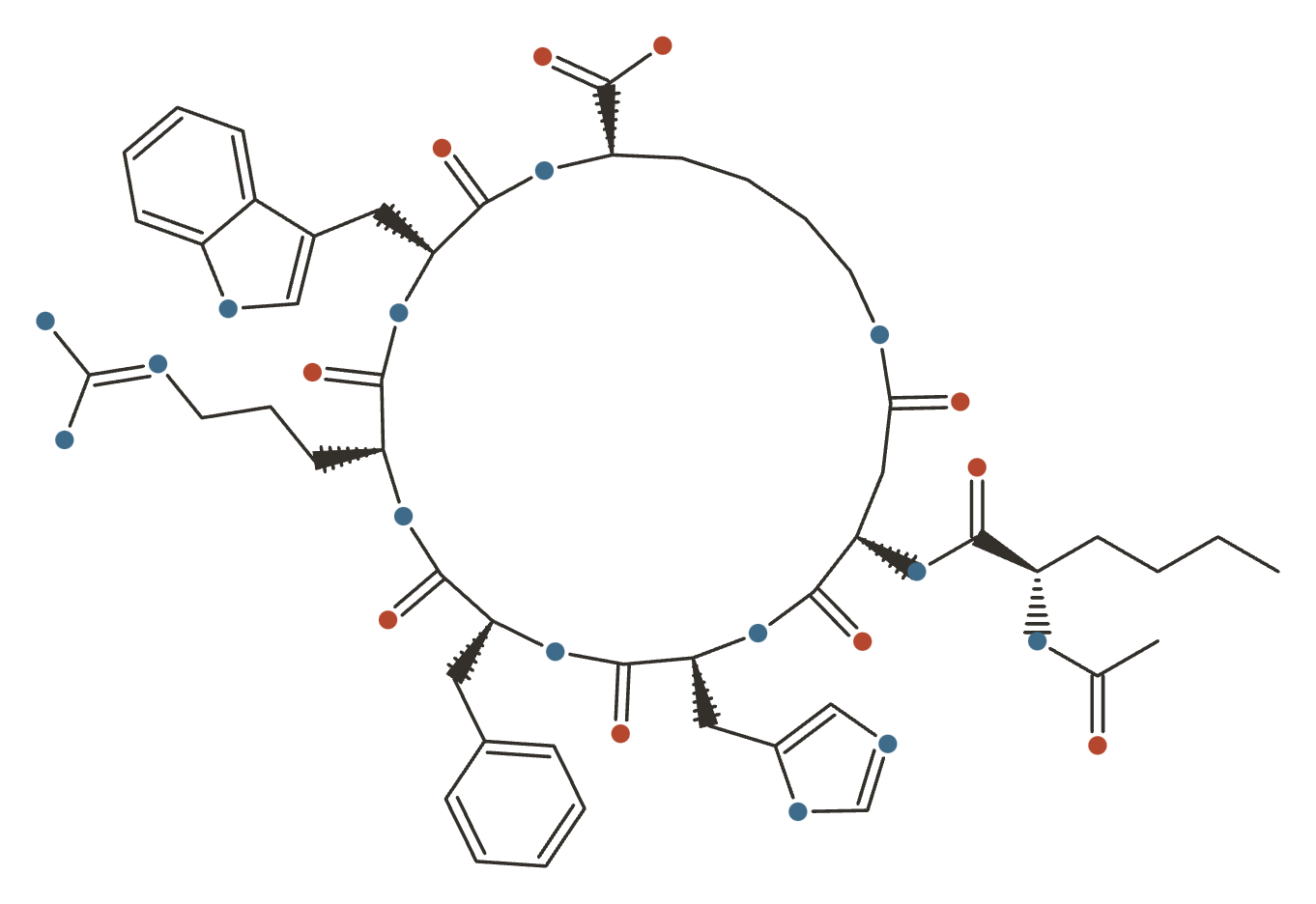
PT-141 (Bremelanotide)
Bremelanotide (Vyleesi), a melanocortin-agonist peptide FDA-approved as an on-demand injection for hypoactive sexual desire disorder in premenopausal women.

PT-141 (Bremelanotide) at a Glance
PT-141 (bremelanotide) is a melanocortin-receptor agonist that acts in the brain rather than on blood vessels, which makes it mechanistically unlike the PDE5 inhibitors used for erectile dysfunction — it targets desire rather than the vascular response. It is FDA-approved as Vyleesi, an on-demand subcutaneous injection for hypoactive sexual desire disorder in premenopausal women. It originated as a byproduct of research into melanotan-II, when the sexual effects seen in early tanning studies turned out to be the more developable property.
History & Development
PT-141 exists because of an unexpected observation in a tanning study: the compound being tested for pigmentation kept producing sexual arousal, and that side effect became a drug.
| First described | Derived from melanotan-II, itself descended from the 1980 alpha-MSH analogue work 24Reference 24Sawyer, T. K., Sanfilippo, P. J., Hruby, V. J., Engel, M. H., Heward, C. B., Burnett, J. B., & Hadley, M. E. (1980). 4-Norleucine, 7-D-phenylalanine-alpha-melanocyte-stimulating hormone: a highly potent alpha-melanotropin with ultralong biological activity. Proceedings of the National Academy of Sciences, 77(10), 5754-5758. https://pubmed.ncbi.nlm.nih.gov/6777774/View study → |
| Discovered / synthesised by | Developed by Palatin Technologies from the University of Arizona melanocortin programme 24, |
| Institution | Palatin Technologies; originating chemistry from the University of Arizona 24, |
| Origin | Synthetic melanocortin-receptor agonist; active metabolite of melanotan-II |
| Key patent | US 7,307,063, “Melanocortin metallopeptides for treatment of sexual dysfunction” 26Reference 26Melanocortin metallopeptides for treatment of sexual dysfunctionView study → |
| Assignee | Palatin Technologies |
| Development status | Approved - FDA, 21 June 2019, as Vyleesi for acquired generalized HSDD in premenopausal women |
Discovery
The lineage starts with the University of Arizona melanocortin programme, whose 1980 PNAS paper described the superpotent alpha-MSH analogue that all of these compounds descend from 24Reference 24Sawyer, T. K., Sanfilippo, P. J., Hruby, V. J., Engel, M. H., Heward, C. B., Burnett, J. B., & Hadley, M. E. (1980). 4-Norleucine, 7-D-phenylalanine-alpha-melanocyte-stimulating hormone: a highly potent alpha-melanotropin with ultralong biological activity. Proceedings of the National Academy of Sciences, 77(10), 5754-5758. https://pubmed.ncbi.nlm.nih.gov/6777774/View study →. Its cyclic successor, melanotan-II, was being tested as a sunless-tanning and chemoprevention agent when male subjects reported spontaneous erections and increased sexual arousal 25Reference 25UA-developed synthetic hormones speed a tanView study →.
That finding was the drug. Bremelanotide is essentially the active metabolite of melanotan-II, and developing it meant pursuing the effect that the tanning programme had treated as an adverse event.
What makes it pharmacologically distinctive followed from this origin: it acts on melanocortin receptors in the central nervous system rather than on blood vessels, so it addresses desire rather than the vascular response that PDE5 inhibitors target. That is why it was developed for women, and for a desire disorder, rather than as another erectile-dysfunction drug.
Development & ownership
Palatin Technologies took the compound forward, with patent protection including US 7,307,063, “Melanocortin metallopeptides for treatment of sexual dysfunction” 26Reference 26Melanocortin metallopeptides for treatment of sexual dysfunctionView study →. Development partnered with AMAG Pharmaceuticals for commercialisation.
An earlier intranasal formulation was discontinued after blood-pressure increases were observed, and the programme was reworked as a subcutaneous on-demand injection - the form that succeeded. The FDA approved it as Vyleesi on 21 June 2019 for acquired, generalized hypoactive sexual desire disorder in premenopausal women.
How it reached the market
PT-141 is available both ways, which is unusual. The approved product is a prescription autoinjector used on demand ahead of anticipated activity. Separately, “PT-141” is sold widely as an unapproved research chemical in lyophilised form for self-injection by both sexes - outside the approved indication, the approved population and any dose oversight.
What It's Used For
PT-141 (bremelanotide) is a synthetic cyclic seven-amino-acid melanocortin-receptor agonist — Ac-Nle-cyclo[Asp-His-D-Phe-Arg-Trp-Lys]-OH — and the free-acid metabolite of the tanning peptide melanotan II. Unlike PDE5 inhibitors, which act on penile vasculature, it works centrally on melanocortin (chiefly MC4R) pathways that gate sexual desire and arousal 16,
Its evidence posture is unusual for a compound sold as a “research peptide”: one indication — acquired, generalized hypoactive sexual desire disorder (HSDD) in premenopausal women — is backed by two large phase 3 RCTs and carries a June 2019 FDA approval under the brand name Vyleesi 1,
That approval is real, and it is also narrow. Every other use — male erectile dysfunction, general “libido enhancement,” fat loss — rests on older, smaller, or discontinued human work, or on preclinical data, even though the gray-market peptide is sold broadly for all of them. Route is load-bearing: it is a subcutaneous injection because the cyclic peptide’s oral bioavailability is negligible 18Reference 18Ultra-sensitive quantification of the therapeutic cyclic peptide bremelanotide utilizing UHPLC-MS/MS for evaluation of its oral plasma pharmacokinetics — analytical / PKView study →.
Support is an experimental score I’m building — a composite weighted by study type (human > animal > in vitro > review) and study volume. It’s a beta: a fast way to rank strength of evidence at a glance, not a validated metric. Each application links down to its write-up.
The approved indication, and the only one on approval-grade evidence. Two identically designed phase 3, randomized, double-blind, placebo-controlled trials in humans — the RECONNECT program (studies 301/302, NCT02333071 / NCT02338960), 1,267 premenopausal women, mean age 39 — tested bremelanotide 1.75 mg subcutaneously as needed over 24 weeks. Both met their coprimary endpoints: statistically significant increases in the Female Sexual Function Index desire domain (integrated +0.35, P<.001) and reductions in desire-related distress (integrated −0.33, P<.001) versus placebo 1Reference 1RCTBremelanotide for the Treatment of Hypoactive Sexual Desire Disorder: Two Randomized Phase 3 Trials — human (RCT)View study →.
A phase 2b dose-finding trial and its responder analyses established the 1.75 mg dose 3,
The persistent caveat is effect size: the changes are small on the scales used, nausea was common, and independent re-analyses argue the benefit is clinically marginal and the chosen outcomes questionable 9,
Both readings are true at once — the drug beat placebo, and it beat it by a little.
Gap: The human RCT evidence is approval-grade but confined to premenopausal women with acquired, generalized HSDD. Benefit is modest and disputed, and nothing here extends to postmenopausal women or to men.
The compound’s original target, and a discontinued one. Early human phase 1/2 studies of intranasal and subcutaneous PT-141 showed centrally mediated erectile responses with acceptable short-term safety and pharmacokinetics 13,
A randomized “salvage of sildenafil failures” study reported a positive clinical result in 33.5% on bremelanotide versus 8.5% on placebo 11Reference 11RCTSalvage of sildenafil failures with bremelanotide: a randomized, double-blind, placebo controlled study — human (RCT; see reference 12)View study →.
Two cautions dominate and must travel with those numbers: the intranasal ED program was discontinued (blood-pressure increases pushed development toward subcutaneous dosing and the female indication), and that pivotal salvage trial carries a 2023 journal Expression of Concern 12Reference 12RCTExpression of Concern: Salvage of Sildenafil Failures With Bremelanotide: A Randomized, Double-Blind, Placebo Controlled Study — editorial noticeView study → — a formal flag on the reliability of its data, not a retraction, but enough that it should not be quoted as settled. A 2026 opinion review revisits whether bremelanotide should be considered for men, without adding new trial evidence 21Reference 21ReviewShould Bremelanotide Be Considered for the Treatment of Sexual Arousal and Desire Disorders in Men? — review / opinionView study →.
Gap: Human trials exist but are old, small, and from an abandoned development track, and the key salvage study is formally flagged. There is no approved use in men and no current approval-grade male trial.
Melanocortin-4 signaling regulates appetite and energy balance, so a weight effect is mechanistically expected rather than surprising. Two short phase 1 human randomized controlled trials in obese women found bremelanotide produced a significantly greater 16-day weight reduction than placebo (least-squares mean difference −1.3 kg; P<.0001), with caloric intake down roughly 400 kcal/day 17Reference 17RCTEffect of bremelanotide on body weight of obese women: data from two phase 1 randomized controlled trials — human (RCT, phase 1)View study →.
A phase 2 study co-administering bremelanotide with an experimental agent in obesity is ongoing (NCT06565611, active, not recruiting). The data are genuinely human and genuinely randomized, but they are 16 days long in a small sample, and this is not a marketed use.
Gap: Only 16-day phase 1 data. There is no durable weight-loss or long-term safety evidence, and the ongoing phase 2 is a combination study, not bremelanotide monotherapy — so it will not cleanly attribute any effect to this peptide.
A single in-vitro study reported that bremelanotide reduced survivin expression and induced cell death in glioblastoma cell lines at concentrations non-toxic to normal human cells, with the effect blocked by an MC3R/MC4R antagonist 20Reference 20In vitroMelanocortin Receptor Agonist Bremelanotide Induces Cell Death and Growth Inhibition in Glioblastoma Cells via Suppression of Survivin Expression — in vitroView study →. That is a mechanistically interesting cell-culture observation and nothing more.
Gap: In-vitro only — no animal model and no human data of any kind. Listed for completeness; it is not a basis for any use.
Mechanisms
| Target / pathway | Effect | Relevant to |
|---|---|---|
| Melanocortin-4 receptor (MC4R), CNS | Agonist — activates hypothalamic and limbic circuits governing sexual desire and arousal 23Reference 23ReviewThe neurobiology of bremelanotide for the treatment of hypoactive sexual desire disorder in premenopausal women — review (mechanism)View study → | Female HSDDmale ED |
| Melanocortin-4 receptor (MC4R), hypothalamus | Agonist — suppresses appetite and energy intake 17Reference 17RCTEffect of bremelanotide on body weight of obese women: data from two phase 1 randomized controlled trials — human (RCT, phase 1)View study → | Weight loss / obesity |
| Melanocortin-3 receptor (MC3R) | Agonist (non-selective); contributes to central and metabolic effects 20Reference 20In vitroMelanocortin Receptor Agonist Bremelanotide Induces Cell Death and Growth Inhibition in Glioblastoma Cells via Suppression of Survivin Expression — in vitroView study → | Sexual functionmetabolic |
| Melanocortin-1 receptor (MC1R), melanocytes | Agonist — melanogenesis, producing focal hyperpigmentation with repeat dosing 5Reference 5Safety Profile of Bremelanotide Across the Clinical Development Program — human (pooled safety analysis)View study → | Adverse effect (skin darkening) |
| Central sympathetic / cardiovascular | Transient rise in blood pressure and fall in heart rate after each dose 6Reference 6RCTUsefulness of ambulatory blood pressure monitoring to assess the melanocortin receptor agonist bremelanotide — human (randomised pharmacodynamic study)View study → | Dose-limiting safety |
| Limbic / hypothalamic sexual-motivation circuitry (animal) | Alters sexual-motivation behavior in female Syrian hamsters — the main non-human mechanism model 22Reference 22Female Syrian hamster analyses of bremelanotide, a US FDA approved drug for the treatment of female sexual dysfunction — animal (hamster)View study → | Mechanism support (animal) |
Pharmacokinetics
Bremelanotide is given subcutaneously; the marketed Vyleesi product is a 1.75 mg / 0.3 mL single-use prefilled autoinjector delivered to the abdomen or thigh. The cyclic heptapeptide has negligible oral bioavailability, which is precisely why oral and intranasal routes were not carried into the approved product 18Reference 18Ultra-sensitive quantification of the therapeutic cyclic peptide bremelanotide utilizing UHPLC-MS/MS for evaluation of its oral plasma pharmacokinetics — analytical / PKView study →. After subcutaneous dosing, peak plasma concentration is reached at roughly 1 hour and the elimination half-life is short — about 2.7 hours after a single dose. It is cleared by peptide hydrolysis with renal and faecal elimination, and the label advises against use in significant renal impairment. Experimental delivery work reinforces the route constraint rather than relieving it: an ultra-sensitive UHPLC-MS/MS study was needed simply to quantify oral plasma exposure 18Reference 18Ultra-sensitive quantification of the therapeutic cyclic peptide bremelanotide utilizing UHPLC-MS/MS for evaluation of its oral plasma pharmacokinetics — analytical / PKView study →, and a biodegradable transbuccal “suction patch” reported roughly 26% relative bioavailability in dogs 19Reference 19A biodegradable suction patch for sustainable transbuccal peptide delivery — animal (dog, delivery study)View study → — preclinical delivery engineering, not an available non-injected human product. For gray-market lyophilized powder, reconstitution (typically with bacteriostatic water) and cold storage are required, and neither potency nor sterility is verifiable by the end user.
Clinical & regulatory status
Bremelanotide is an FDA-approved prescription drug — Vyleesi, approved 21 June 2019, developed by Palatin Technologies with AMAG Pharmaceuticals — for acquired, generalized HSDD in premenopausal women 7,
| Completed | Ongoing | Terminated | Preclinical |
|---|---|---|---|
| 9(registered) | 1(phase 2, obesity) | 0 | Dozens(rodent / in vitro) |
Last checked: July 2026.
Sourcing, Route & Legal Status
Regulatory status. Bremelanotide is an FDA-approved prescription drug, marketed as Vyleesi, approved 21 June 2019 for acquired, generalized HSDD in premenopausal women 7Reference 7ReviewBremelanotide: First Approval — regulatory reviewView study →. That approval covers one indication in one population — it is not a general endorsement of the molecule, and it does not transfer to any other use. It is not approved by the EMA (the European application was withdrawn), and it has no approved indication in men, for erectile dysfunction, for tanning, or for weight loss. Anything sold as “PT-141” for those purposes is either off-label prescribing or an unapproved research chemical in that context. It is not a scheduled or controlled substance in the US, but “not scheduled” is not “approved,” and marketing it for human use outside the approved indication is unlawful in most Western jurisdictions.
How it’s supplied & administered. The approved product is a single-use prefilled autoinjector delivering 1.75 mg in 0.3 mL subcutaneously (abdomen or thigh), taken on demand at least 45 minutes before anticipated sexual activity, with a labeled ceiling of one dose per 24 hours and eight per month. The subcutaneous route is not a stylistic choice: the cyclic peptide’s oral bioavailability is negligible 18Reference 18Ultra-sensitive quantification of the therapeutic cyclic peptide bremelanotide utilizing UHPLC-MS/MS for evaluation of its oral plasma pharmacokinetics — analytical / PKView study →, so an oral “PT-141” cannot deliver meaningful systemic exposure regardless of what the label claims. Gray-market material is instead sold as lyophilized powder requiring user reconstitution — typically with bacteriostatic water — followed by refrigerated storage; reconstituted peptide is chemically less stable and has a short shelf life.
Sourcing reality (this is a safety issue, not a footnote). Outside the regulated autoinjector, PT-141 is sold widely by unregulated peptide vendors labeled “for research use only / not for human consumption.” These products carry the standard research-peptide risks: no manufacturing oversight, unverified purity and peptide content, possible mislabeling or under-/over-concentration, bacterial endotoxin, and sterility or dosing errors introduced by the end user during reconstitution. A vendor certificate of analysis is only as good as the third-party lab behind it, and can be falsified. The decisive point is that gray-market powder is not the same regulated entity as Vyleesi even when the molecule is nominally identical — the approval attaches to a manufactured, tested product, not to a sequence. No vendors are recommended or linked here.
Safety
Bremelanotide has two dose-limiting effects that are different in kind — nausea is why people stop, and the transient blood-pressure rise is why the label restricts who may take it at all. It is a prescription drug, and gray-market powder carries risks the approved autoinjector does not.
- Contraindicated in uncontrolled hypertension or known cardiovascular disease. Each dose transiently raises blood pressure and lowers heart rate.
- Avoid in pregnancy. The label advises discontinuing if pregnancy is suspected — see the box below.
- Not for use in significant renal or hepatic impairment.
- Nausea is the tolerability limit. The most common complaint in the pivotal trials, and enough to make some participants discontinue.
- Slows gastric emptying. Can reduce absorption of oral drugs taken with it, notably oral naltrexone.
- Focal hyperpigmentation with repeated dosing. Darkening of the face, gums or breasts via MC1R-driven melanogenesis.
Full Safety & Interactions Detail
Adverse effects. In the pivotal trials the most common treatment-emergent effects were nausea, flushing, headache, and injection-site reactions, each occurring in at least 10% of participants; nausea was the most common complaint and led some participants to discontinue 1,
Dose-limiting effects. Two, and they are different in kind: nausea (tolerability, the reason people stop) and the blood-pressure rise (cardiovascular, the reason the label restricts who may take it).
Interactions. The blood-pressure effect is the basis of the main caution — it should not be combined with anything for which a transient pressor response is dangerous. Bremelanotide also slows gastric emptying, so it can reduce the rate and extent of absorption of concomitantly taken oral drugs; the label specifically warns that it may significantly decrease exposure to oral naltrexone, potentially causing naltrexone to fail. A dedicated ethanol-interaction study was conducted in the development program. Broader drug-interaction screening for off-label or community use has not been done.
Who should avoid it. It is contraindicated in uncontrolled hypertension or known cardiovascular disease, and is not for use in significant renal or hepatic impairment. The label advises stopping if there is no benefit after about eight weeks. It has not been studied or approved in postmenopausal women or in men, and anyone unwilling to accept an unregulated product of unverified purity should not use gray-market material.
Injection-specific risks. Injection-site reactions are common even with the regulated autoinjector. Gray-market lyophilized powder adds sterility failure, contamination, endotoxin exposure, and dosing error from self-mixed concentrations — risks that do not apply to the approved product.
Scope disclosure (honesty, not a claim):
- Human data? Yes for the approved indication — two phase 3 RCTs plus a 52-week open-label extension in premenopausal HSDD. Thin and older for male ED; phase 1 only for weight loss; none for general community “libido” dosing.
- Interactions assessed? Partly — oral-drug absorption (naltrexone) and alcohol were assessed in the approval program. Broad interaction screening for off-label use was not done.
- Pregnancy/lactation assessed? Partly — the label advises against use in pregnancy, and a lactation pharmacokinetic study was run, but safety in both is not established.
- Long-term safety established? No beyond the ~52-week open-label extension in HSDD 2Reference 2Long-Term Safety and Efficacy of Bremelanotide for Hypoactive Sexual Desire Disorder — human (52-week open-label extension)View study →. There is no long-term safety data for off-label or chronic use.
Never imply safety from silence. Where bremelanotide has not been studied — off-label libido dosing, chronic use, male metabolic use, gray-market product purity — the correct statement is “not assessed,” not “safe.”
Avoid in pregnancy; not established in lactation. The label advises discontinuing if pregnancy is suspected, and there is no established safety in pregnancy. A phase 4 lactation study (NCT06867835) measured drug concentrations in lactating women, but breastfeeding safety is not established on that basis.
Dosage
The only established dose is the approved prescribing regimen for one indication, and it is reproduced here as data, not as a recommendation. For acquired, generalized HSDD in premenopausal women, Vyleesi is 1.75 mg subcutaneously as needed, injected into the abdomen or thigh at least 45 minutes before anticipated sexual activity, with a labeled maximum of one dose per 24 hours and eight doses per month; the label advises discontinuing if there is no benefit after roughly eight weeks. That regimen came out of the phase 2b dose-finding work and was carried into the phase 3 trials 1,
There is no established dose for any other use. Male erectile dysfunction, general arousal enhancement, and fat loss have no approved or validated dosing — the male-ED trials used a discontinued intranasal formulation and different amounts 14,
References
- Kingsberg SA, et al. (2019). Bremelanotide for the Treatment of Hypoactive Sexual Desire Disorder: Two Randomized Phase 3 Trials — human (RCT). Obstetrics & Gynecology. https://pubmed.ncbi.nlm.nih.gov/31599840/
- Simon JA, et al. (2019). Long-Term Safety and Efficacy of Bremelanotide for Hypoactive Sexual Desire Disorder — human (52-week open-label extension). Obstetrics & Gynecology. https://pubmed.ncbi.nlm.nih.gov/31599847/
- Clayton AH, et al. (2016). Bremelanotide for female sexual dysfunctions in premenopausal women: a randomized, placebo-controlled dose-finding trial — human (RCT, phase 2b). Women’s Health (London). https://pubmed.ncbi.nlm.nih.gov/27181790/
- Althof S, et al. (2019). Responder Analyses from a Phase 2b Dose-Ranging Study of Bremelanotide — human (RCT, secondary analysis). Journal of Sexual Medicine. https://pubmed.ncbi.nlm.nih.gov/31277966/
- Clayton AH, et al. (2022). Safety Profile of Bremelanotide Across the Clinical Development Program — human (pooled safety analysis). Journal of Women’s Health. https://pubmed.ncbi.nlm.nih.gov/35147466/
- White WB, et al. (2017). Usefulness of ambulatory blood pressure monitoring to assess the melanocortin receptor agonist bremelanotide — human (randomised pharmacodynamic study). Journal of Hypertension. https://pubmed.ncbi.nlm.nih.gov/27977473/
- Dhillon S, Keam SJ. (2019). Bremelanotide: First Approval — regulatory review. Drugs. https://pubmed.ncbi.nlm.nih.gov/31429064/
- (2019). Bremelanotide (Vyleesi) for hypoactive sexual desire disorder — review. The Medical Letter on Drugs and Therapeutics. https://pubmed.ncbi.nlm.nih.gov/31381550/
- Spielmans GI. (2021). Re-Analyzing Phase III Bremelanotide Trials for “Hypoactive Sexual Desire Disorder” in Women — re-analysis / critique. Journal of Sex Research. https://pubmed.ncbi.nlm.nih.gov/33678061/
- Spielmans GI. (2024). Small Effects, Questionable Outcomes: Bremelanotide for Hypoactive Sexual Desire Disorder — critical analysis. Journal of Sex Research. https://pubmed.ncbi.nlm.nih.gov/36809187/
- Safarinejad MR, Hosseini SY. (2008). Salvage of sildenafil failures with bremelanotide: a randomized, double-blind, placebo controlled study — human (RCT; see reference 12). Journal of Urology. https://pubmed.ncbi.nlm.nih.gov/18206919/
- Safarinejad MR, Hosseini SY (2023). Expression of Concern: Salvage of Sildenafil Failures With Bremelanotide: A Randomized, Double-Blind, Placebo Controlled Study — editorial notice. Journal of Urology. https://pubmed.ncbi.nlm.nih.gov/36626345/
- Rosen RC, et al. (2004). Evaluation of the safety, pharmacokinetics and pharmacodynamic effects of subcutaneously administered PT-141 — human (clinical trial). International Journal of Impotence Research. https://pubmed.ncbi.nlm.nih.gov/14999221/
- Diamond LE, et al. (2004). Double-blind, placebo-controlled evaluation of the safety, pharmacokinetic properties and pharmacodynamic effects of intranasal PT-141 — human (clinical trial). International Journal of Impotence Research. https://pubmed.ncbi.nlm.nih.gov/14963471/
- Diamond LE, et al. (2005). Co-administration of low doses of intranasal PT-141, a melanocortin receptor agonist, and sildenafil to men with erectile dysfunction — human (clinical trial). Urology. https://pubmed.ncbi.nlm.nih.gov/15833522/
- Molinoff PB, et al. (2003). PT-141: a melanocortin agonist for the treatment of sexual dysfunction — early clinical review. Annals of the New York Academy of Sciences. https://pubmed.ncbi.nlm.nih.gov/12851303/
- Spana C, et al. (2022). Effect of bremelanotide on body weight of obese women: data from two phase 1 randomized controlled trials — human (RCT, phase 1). Diabetes, Obesity and Metabolism. https://pubmed.ncbi.nlm.nih.gov/35170192/
- Sauter M, et al. (2020). Ultra-sensitive quantification of the therapeutic cyclic peptide bremelanotide utilizing UHPLC-MS/MS for evaluation of its oral plasma pharmacokinetics — analytical / PK. Journal of Pharmaceutical and Biomedical Analysis. https://pubmed.ncbi.nlm.nih.gov/32353679/
- Krupke H, et al. (2025). A biodegradable suction patch for sustainable transbuccal peptide delivery — animal (dog, delivery study). Journal of Controlled Release. https://pubmed.ncbi.nlm.nih.gov/40513668/
- Suzuki S, et al. (2024). Melanocortin Receptor Agonist Bremelanotide Induces Cell Death and Growth Inhibition in Glioblastoma Cells via Suppression of Survivin Expression — in vitro. Anticancer Research. https://pubmed.ncbi.nlm.nih.gov/39197897/
- Pfaus JG, et al. (2026). Should Bremelanotide Be Considered for the Treatment of Sexual Arousal and Desire Disorders in Men? — review / opinion. Journal of Clinical Psychopharmacology. https://pubmed.ncbi.nlm.nih.gov/41960633/
- Borland JM, et al. (2025). Female Syrian hamster analyses of bremelanotide, a US FDA approved drug for the treatment of female sexual dysfunction — animal (hamster). Neuropharmacology. https://pubmed.ncbi.nlm.nih.gov/39793696/
- Pfaus JG, et al. (2022). The neurobiology of bremelanotide for the treatment of hypoactive sexual desire disorder in premenopausal women — review (mechanism). CNS Spectrums. https://pubmed.ncbi.nlm.nih.gov/33455598/
- Sawyer, T. K., Sanfilippo, P. J., Hruby, V. J., Engel, M. H., Heward, C. B., Burnett, J. B., & Hadley, M. E. (1980). 4-Norleucine, 7-D-phenylalanine-alpha-melanocyte-stimulating hormone: a highly potent alpha-melanotropin with ultralong biological activity. Proceedings of the National Academy of Sciences, 77(10), 5754-5758. https://pubmed.ncbi.nlm.nih.gov/6777774/
- Arizona Daily Star. UA-developed synthetic hormones speed a tan. https://tucson.com/news/local/education/college/ua-developed-synthetic-hormones-speed-a-tan/article_1aa2c79c-a216-5579-aead-7d012f7e02da.html
- US Patent 7,307,063. Melanocortin metallopeptides for treatment of sexual dysfunction. https://image-ppubs.uspto.gov/dirsearch-public/print/downloadPdf/7307063



