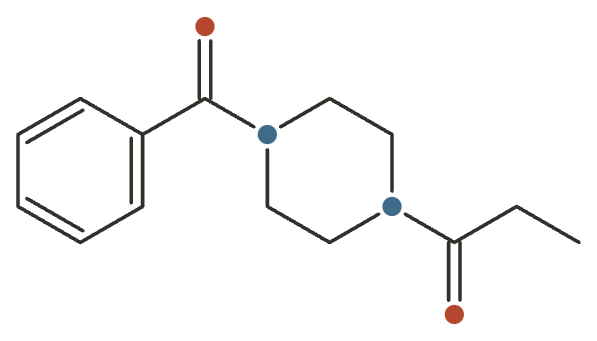
Sunifiram
Sunifiram (DM-235) is a synthetic piperazine cognition-enhancer studied only in animals; there are no human trials and it is not an approved supplement or drug.

Sunifiram at a Glance
Sunifiram, also written DM-235, is a small synthetic molecule developed by an Italian academic medicinal-chemistry group as a cognition-enhancer. It is a piperazine — a simplified structural relative of the older nootropic piracetam — and it draws attention because it is extraordinarily potent in animal memory tests, active in rodents at microgram-per-kilogram doses roughly a thousand times lower than piracetam’s.
It is not something you eat or make in your body. There is no natural source: sunifiram is produced entirely by chemical synthesis, and it was never developed into an approved medicine. Because the original chemists chose not to patent it, it drifted out of the lab and now circulates online as an unregulated research chemical.
There is no sunifiram deficiency to correct. Every reported effect is an extra imposed on a normal — or experimentally damaged — nervous system, and the strongest findings are the rescue of drug- or lesion-induced memory deficits in rodents, not enhancement of a healthy brain. The animal data are genuinely interesting and mechanistically coherent, but the entire evidence base is preclinical: no human trials, no human dosing, no human safety data. Sunifiram is best understood as an unstudied compound in people, not a proven cognitive enhancer.
What It’s Used For
Sunifiram has no approved medical use. The list below reflects what has actually been studied — all of it in rodents and cell preparations.
- Memory protection in amnesia models — reverses drug-induced amnesia in mice and rats across several chemical models. The most replicated finding, but animal-only, and about rescuing a deficit rather than boosting normal memory.
- Cognition in a neurodegeneration model — restored memory and synaptic plasticity in a single rodent model of Alzheimer’s-like damage. Mechanistically detailed, but from one lab and one study.
Be sceptical of the online framing of sunifiram as a proven smart drug for healthy people. There is not a single human study of memory, focus, learning or mood, so any claim about what it does in a person is extrapolation from mice. Claims of specific human doses, safe use, or long-term benefit have no evidence behind them at all.
How It Works
Sunifiram works on the brain’s main excitatory glutamate signalling system, and it does so indirectly —
in standard binding assays it shows no measurable affinity for the major brain receptors or ion
channels, so it is not a simple key-in-a-lock drug. The current model, built mostly from mouse
hippocampal slice work, is that sunifiram stimulates the glycine co-agonist site of the NMDA
receptor, one of the switches that gates long-term potentiation — the strengthening of synapses that
underlies learning 5Reference 5Novel nootropic drug sunifiram enhances hippocampal synaptic efficacy via the glycine-binding site of the NMDA receptor — electrophysiologyView study →. This sets off an internal cascade, activating the enzymes CaMKII and PKCα and
the Src-family kinases, which in turn phosphorylate and potentiate AMPA receptors, the workhorses
of fast excitatory transmission 5,
One wrinkle explains why results can look inconsistent, and why more is not better: in slice experiments sunifiram’s effect on long-term potentiation follows a bell-shaped dose-response, peaking around 10 nM and falling off at higher concentrations 5Reference 5Novel nootropic drug sunifiram enhances hippocampal synaptic efficacy via the glycine-binding site of the NMDA receptor — electrophysiologyView study →. Effects that depend on hitting a narrow concentration window are notoriously hard to reproduce and translate.
The framing that matters most is that this is enhancement, not repletion. There is no bodily
requirement for sunifiram and no deficiency it fixes. In the animal studies the clearest effects are
the reversal of induced impairments — amnesia caused by scopolamine and other drugs, or memory loss
from a brain lesion — rather than improvement in intact, healthy animals 1,
Pharmacology & Research
Sunifiram (DM-235) is a synthetic piperazine cognition-enhancer, functionally described as ampakine-like, first characterised in the early 2000s. The evidence posture is unusual: the compound is pharmacologically well-studied but clinically unstudied — a coherent, multi-paper preclinical mechanism exists, yet there are no human trials of any kind. Because sunifiram corrects no deficiency, every effect is an addition to normal physiology, and the strongest signals come from rescuing induced deficits in rodents rather than enhancing healthy cognition. There is no human pharmacokinetic or bioavailability data, so nothing here can be translated into a dose, an effect size, or a safety margin for people.
Support is an experimental score I’m building — a composite weighted by study type (human > animal > in vitro > review) and study volume. It’s a beta: a fast way to rank strength of evidence at a glance, not a validated metric. Because every sunifiram application is preclinical, all scores sit in the lowest band by design. Each application links down to its write-up.
Sunifiram’s original characterisation showed it prevented scopolamine-induced amnesia in the mouse passive-avoidance test after either injection (0.001–0.1 mg/kg) or oral dosing (0.01–1.0 mg/kg), with an anti-amnesic effect comparable to established nootropics — piracetam at 30–100 mg/kg, aniracetam at 100 mg/kg — but at roughly 1,000-fold lower doses 1Reference 1AnimalDM235 (sunifiram): a novel nootropic with potential as a cognitive enhancer — mouse and ratView study →.
It also blocked amnesia induced by mecamylamine, baclofen and clonidine, and prevented scopolamine-induced impairment in the rat Morris water maze; at effective doses it did not impair motor coordination or spontaneous activity 1Reference 1AnimalDM235 (sunifiram): a novel nootropic with potential as a cognitive enhancer — mouse and ratView study →.
A second study showed the effect is abolished by the AMPA-receptor antagonist NBQX, and that sunifiram reverses NBQX-induced amnesia, tying it to AMPA-mediated glutamatergic transmission 2Reference 2In vitroAMPA-receptor activation is involved in the antiamnesic effect of DM 232 (unifiram) and DM 235 (sunifiram) — mouse and in vitroView study →.
A later review confirmed potent, replicable cognition-enhancing activity across rodent paradigms alongside increased cortical acetylcholine release 4Reference 4ReviewPharmacological characterization of DM232 (unifiram) and DM235 (sunifiram), new potent cognition enhancers — reviewView study →.
Gap: every result is animal, largely from one research lineage, and measures protection against artificially induced amnesia. There is no evidence it improves memory in healthy animals, let alone in people, and no human dose can be inferred from the microgram-per-kilogram rodent range.
In olfactory-bulbectomised mice — a rodent model with hippocampus-dependent memory loss used to mimic aspects of Alzheimer’s disease — oral sunifiram at 0.01–1.0 mg/kg once daily for 7–12 days improved spatial memory and short-term recognition memory, and restored hippocampal long-term potentiation 6Reference 6AnimalNovel nootropic drug sunifiram improves cognitive deficits via CaM kinase II and protein kinase C activation in olfactory bulbectomized mice — animal studyView study →.
The benefit was accompanied by restored phosphorylation of CaMKIIα, the AMPA-receptor subunit GluR1, PKCα and the NMDA-receptor subunit NR1, and was blocked by an NMDA-receptor glycine-site antagonist, pinpointing the glycine co-agonist site as the trigger 5,
A companion hippocampal-slice study mapped the same pathway electrophysiologically, with a bell-shaped potentiation dose-response peaking near 10 nM 5Reference 5Novel nootropic drug sunifiram enhances hippocampal synaptic efficacy via the glycine-binding site of the NMDA receptor — electrophysiologyView study →.
Notably, sunifiram improved memory but did not improve depressive-type behaviour in the same mice 6Reference 6AnimalNovel nootropic drug sunifiram improves cognitive deficits via CaM kinase II and protein kinase C activation in olfactory bulbectomized mice — animal studyView study →.
Gap: a single disease-model study from one laboratory, unreplicated, in animals. It demonstrates a mechanism and a rescue effect in a lesion model, not efficacy in human cognitive decline.
Mechanisms
| Target / pathway | Effect | Relevant to |
|---|---|---|
| NMDA receptor, glycine co-agonist site | Stimulated (functional co-agonism) | Long-term potentiationmemory rescue |
| AMPA receptor and AMPA-mediated transmission | Potentiated indirectly | Synaptic plasticityanti-amnesia |
| CaMKIIα → GluR1 | Phosphorylation ↑ | Long-term potentiationmemory |
| PKCα → NR1 | Phosphorylation ↑ | Long-term potentiationmemory |
| Src-family kinase | Activity ↑ | Long-term potentiation |
| Cortical acetylcholine release | Increased | Attentionmemory |
| Major CNS receptors and channels (binding) | No measurable affinity | Explains the indirectfunctional action |
Pharmacokinetics
There is no human pharmacokinetic data for sunifiram: absorption, bioavailability, metabolism, half-life and food effects are all unknown in people. In rodents it is active both orally and by injection at very low doses, roughly 0.001–1 mg/kg, and its potency is estimated at about four orders of magnitude greater than piracetam 1,
Clinical trials
There is no registered human trial activity for sunifiram. A ClinicalTrials.gov search for “sunifiram” and “DM-235” returns zero studies, and no human clinical publications exist in PubMed. Because the compound is unpatented there has been essentially no industry incentive to fund clinical development — the original chemists have publicly noted that it reached consumer websites instead of the clinic 8Reference 8Unifi nootropics from the lab to the web: a story of academic (and industrial) shortcomings — commentaryView study →.
| Completed | Planned / recruiting | Terminated | Preclinical |
|---|---|---|---|
| 0 | 0 | 0 | ~20 |
Last checked: August 2026.
Dietary Sources
Sunifiram has no dietary source. It does not occur in food, plants or the human body — it is a purely synthetic molecule, created by molecular simplification of a bicyclic nootropic scaffold into a smaller piperazine, and produced only by chemical synthesis in a laboratory 3Reference 3Molecular simplification of 1,4-diazabicyclo[4.3.0]nonan-9-ones gives piperazine derivatives that maintain high nootropic activity — medicinal chemistryView study →. There is therefore no dietary route to it, and no natural-versus-supplement comparison to make.
Dosage
There is no established human dose for sunifiram, and none can be recommended. The figures circulated on vendor and forum sites are extrapolated from animal studies and anecdote, not derived from any human pharmacokinetic or dose-finding work.
For context only, the doses studied in research were in rodents: roughly 0.001–0.1 mg/kg by injection
and 0.01–1.0 mg/kg orally in mice, with the compound reported to be about 1,000-fold more potent than
piracetam in those models 1,
Safety
Sunifiram’s safety profile in humans is unstudied, not clean. Absence of reported harms reflects absence of research, not evidence of safety.
- Not an approved drug or supplement. Sunifiram circulates only as an unregulated research chemical, so manufacturing quality, purity and dose accuracy are not guaranteed.
- No human safety data of any kind. Toxicity, organ effects, drug interactions and long-term consequences are entirely uncharacterised.
- Effect follows an inverted-U in animals. Higher doses do not mean stronger effects; the active window in rodent studies is narrow, so self-experimentation has no rational dosing basis.
- Pregnancy and lactation not assessed. No reproductive or developmental data exist in any species.
- No motor or sedative impairment at effective doses in rodents. Rota-rod and hole-board testing showed no coordination or spontaneous-activity deficits — an animal-only finding, not a human safety claim.
Full Safety & Interactions Detail
Adverse effects in humans are unknown because no human study or systematic surveillance exists. In rodents, effective anti-amnesic doses did not impair motor coordination or spontaneous activity, and did not modify the induction of anaesthesia beyond shortening pentobarbitone hypnosis 1Reference 1AnimalDM235 (sunifiram): a novel nootropic with potential as a cognitive enhancer — mouse and ratView study → — but these are narrow behavioural readouts in animals, and say nothing about human organ toxicity, cardiovascular effects or chronic exposure.
Because sunifiram acts on glutamatergic signalling, there is a mechanistic — though entirely untested — concern about excitatory over-activation, and about interaction with drugs or conditions that lower seizure threshold or modulate glutamate. None of this has been studied, and drug-interaction data do not exist for any class.
Two structural cautions are worth stating plainly. First, in structure-activity work on this chemical series, small modifications produced analogues with the opposite, amnesia-inducing activity — underscoring that “sunifiram-like” research chemicals are not interchangeable, and that mislabelled or impure product carries real, unpredictable risk 7Reference 7Structure-activity relationship studies on unifiram (DM232) and sunifiram (DM235), two novel and potent cognition-enhancing drugsView study →.
Second, the compound’s own developers have publicly described its migration from the lab to the web as a failure of oversight, precisely because long-term toxicity was never characterised 8Reference 8Unifi nootropics from the lab to the web: a story of academic (and industrial) shortcomings — commentaryView study →.
Independent of sunifiram specifically, reviews of cognitive enhancers in healthy people conclude that benefits are uncertain and temporary, while stimulant-type mechanisms can carry cardiovascular, neurological and dependence risks 9Reference 9ReviewBenefits and harms of ‘smart drugs’ (nootropics) in healthy individuals — reviewView study →.
Scope disclosure. Interactions assessed? No — no human interaction data for any drug class; only a mechanistic glutamatergic concern. Pregnancy/lactation assessed? No — no data in any species. Upper limit established? No — no human toxicology, no NOAEL, no established safe dose.
Not established. There are no reproductive, developmental or lactation data for sunifiram in humans or animals, and no way to assess its transfer into milk or its effects on a fetus or nursing infant. Given the complete absence of safety data and its status as an unregulated research chemical, sunifiram should not be used during pregnancy or breastfeeding.
References
- Ghelardini C, Galeotti N, Gualtieri F, et al. (2002). DM235 (sunifiram): a novel nootropic with potential as a cognitive enhancer — mouse and rat. Naunyn-Schmiedeberg’s Archives of Pharmacology. https://pubmed.ncbi.nlm.nih.gov/12070754/
- Galeotti N, Ghelardini C, Pittaluga A, et al. (2003). AMPA-receptor activation is involved in the antiamnesic effect of DM 232 (unifiram) and DM 235 (sunifiram) — mouse and in vitro. Naunyn-Schmiedeberg’s Archives of Pharmacology. https://pubmed.ncbi.nlm.nih.gov/14600801/
- Manetti D, Ghelardini C, Bartolini A, et al. (2000). Molecular simplification of 1,4-diazabicyclo[4.3.0]nonan-9-ones gives piperazine derivatives that maintain high nootropic activity — medicinal chemistry. Journal of Medicinal Chemistry. https://pubmed.ncbi.nlm.nih.gov/11087574/
- Romanelli MN, Galeotti N, Ghelardini C, et al. (2006). Pharmacological characterization of DM232 (unifiram) and DM235 (sunifiram), new potent cognition enhancers — review. CNS Drug Reviews. https://pubmed.ncbi.nlm.nih.gov/16834757/
- Moriguchi S, Tanaka T, Narahashi T, et al. (2013). Novel nootropic drug sunifiram enhances hippocampal synaptic efficacy via the glycine-binding site of the NMDA receptor — electrophysiology. Hippocampus. https://pubmed.ncbi.nlm.nih.gov/23733502/
- Moriguchi S, Tanaka T, Narahashi T, Fukunaga K (2013). Novel nootropic drug sunifiram improves cognitive deficits via CaM kinase II and protein kinase C activation in olfactory bulbectomized mice — animal study. Behavioural Brain Research. https://pubmed.ncbi.nlm.nih.gov/23295391/
- Scapecchi S, Martini E, Manetti D, et al. (2004). Structure-activity relationship studies on unifiram (DM232) and sunifiram (DM235), two novel and potent cognition-enhancing drugs. Bioorganic & Medicinal Chemistry. https://pubmed.ncbi.nlm.nih.gov/14697772/
- Gualtieri F (2016). Unifi nootropics from the lab to the web: a story of academic (and industrial) shortcomings — commentary. Journal of Enzyme Inhibition and Medicinal Chemistry. https://pubmed.ncbi.nlm.nih.gov/25831025/
- Napoletano F, Schifano F, Corkery JM, et al. (2022). Benefits and harms of ‘smart drugs’ (nootropics) in healthy individuals — review. Drugs. https://pubmed.ncbi.nlm.nih.gov/35366192/
For half-lives, timing and stacking across the nootropics on this site, see the Nootropic Dosage Guide.