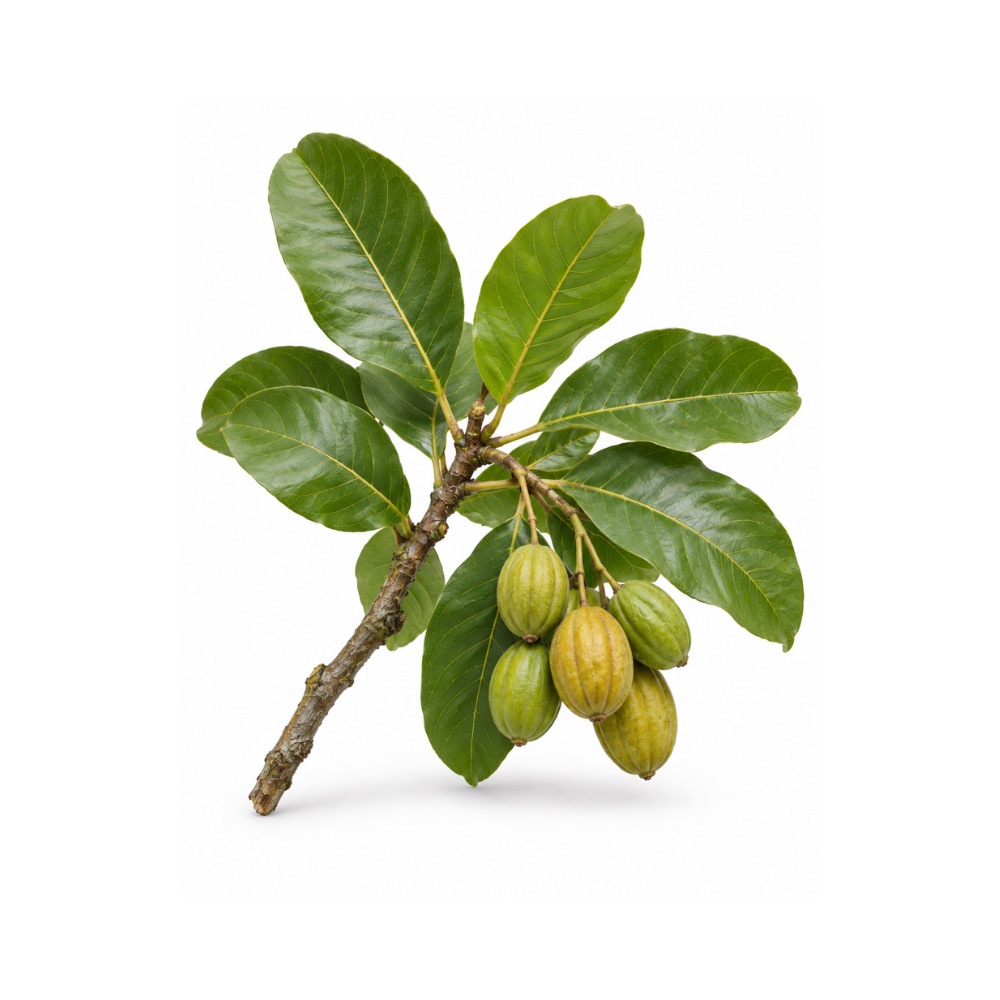
Arjuna
Terminalia arjuna
Plant Family
Pictured: Arjuna
White mangrove / terminalia family
Tropical trees and shrubs dominated by the genus Terminalia, exceptionally rich in hydrolysable tannins and the source of two cornerstone Ayurvedic remedies.
2 Herbs // 2 Constituents // 6 Notable Members
Overview
Around 14 genera and 500 species of tropical trees, shrubs and lianas, most of them in Combretum and Terminalia. Several species are true mangroves; others are dominant canopy trees of dry savanna and monsoon forest. Medicinally the family is effectively the genus Terminalia, whose bark and fruit are among the most heavily used plant drugs in South Asia.
Shared Traits
In Practice
Two Terminalias carry the family here, and between them they cover two very different systems.
Arjuna (T. arjuna) is the cardiovascular one — its bark has been used in Ayurveda for heart complaints for well over a thousand years, and it is one of the better-studied traditional cardiac herbs. Clinical work in chronic stable angina and heart failure reports improvements in symptoms and in some ejection-fraction and exercise-tolerance measures, though trials are generally small and methodologically uneven. The proposed mechanisms — antioxidant protection of myocardium, mild inotropic and lipid effects — sit on tannins, triterpenoid glycosides (arjunolic acid, arjunetin) and flavonoids.
Haritaki (T. chebula) is the digestive and rejuvenative one, and by reputation the single most important herb in Ayurveda — one of the three fruits of triphala, alongside bibhitaki (T. bellirica, also Combretaceae) and amla. It is a gentle laxative and gut tonic, with an unusually broad in-vitro antimicrobial and antiviral literature built on its ellagitannins — chebulinic and chebulagic acid, punicalagin. As always, the gap between an ellagitannin inhibiting a virus in cell culture and a fruit decoction doing anything comparable in a person is wide, and the human data does not yet close it.
The family’s whole medicinal character follows from its tannin load. Astringency is the through line: tightening tissue, drying secretions, binding proteins. That is also the family’s main practical limitation — heavy tannin intake impairs iron absorption and can irritate the stomach on an empty one, and tannins bind many drugs and alkaloids in the gut, so spacing doses away from medication is sensible.
Materia Medica
The 2 monographs in the database whose Combretaceae membership is recorded on the herb itself — so this list keeps itself current as new herbs land.
Phytochemistry
Hydrolysable tannins are the family signature and are present at exceptional concentrations — chebulinic acid, chebulagic acid, corilagin, punicalagin, terflavins. Alongside them: triterpenoid saponins of the arjunolic/arjungenin series, ellagic and gallic acid, and flavonoid glycosides. Several species are commercially exploited for tanning on this basis alone.
Compounds recorded in two or more of the 2 herbs above — the chemistry this family holds in common, grouped by class. A further 32 appear in only one member and are listed on that herb's own page.
Beyond the Database
Notable members without a monograph yet.
Keep Exploring