Parkinson’s disease is what happens when the brain loses the cells that make dopamine, a signalling molecule the body relies on to produce smooth, controlled movement. As those cells die, dopamine drops, and the classic symptoms appear: a resting tremor, slowed movement, stiff muscles, and — later — trouble with balance.
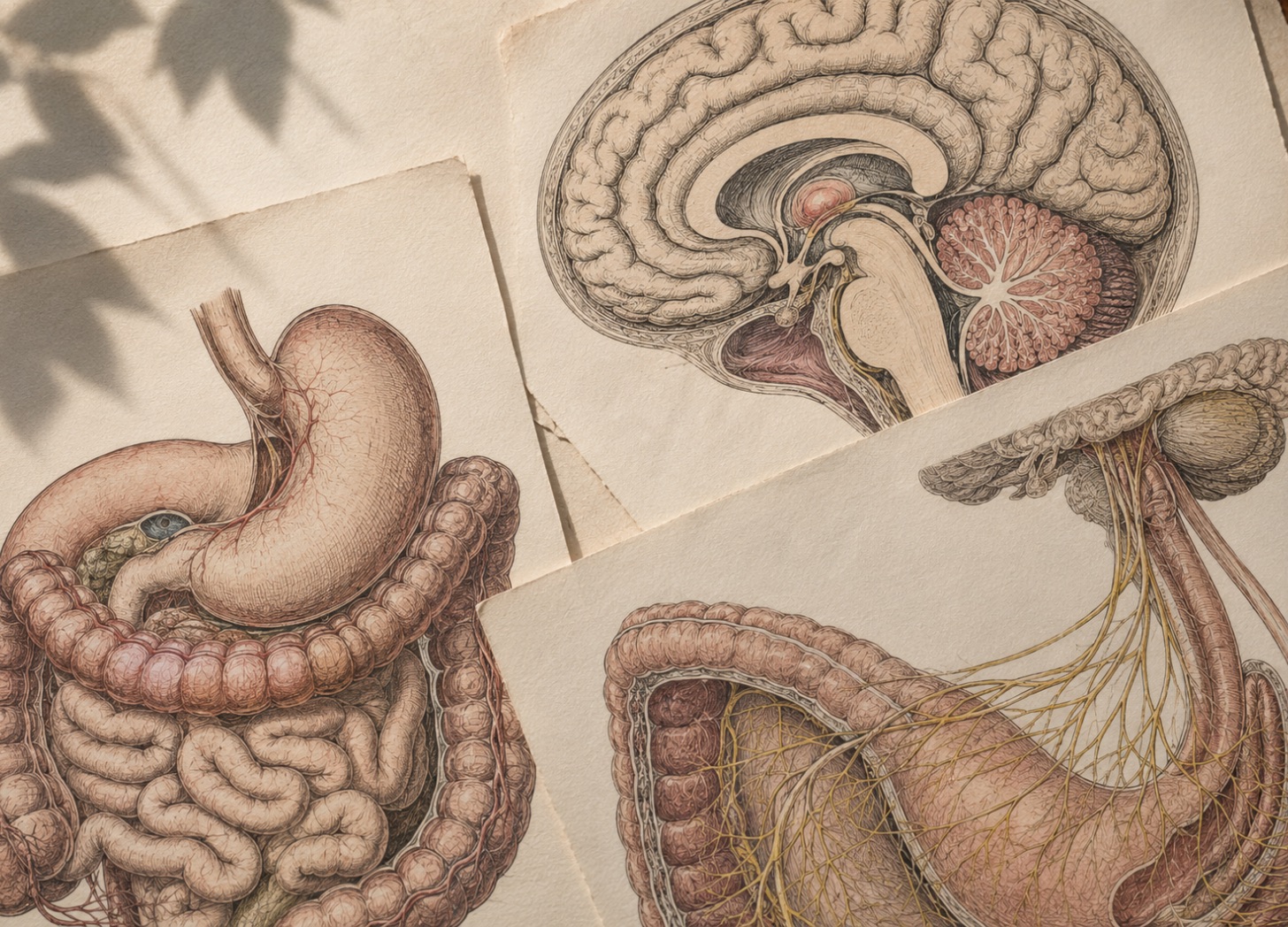
For most of the last century, the story stopped at the brain. But one of the most intriguing ideas in modern neurology asks a different question: what if, for some people, Parkinson’s doesn’t start in the brain at all — but in the gut?
This post walks through that hypothesis honestly: the real evidence for it, the studies that have been over-hyped, and where the science actually stands today.
- Parkinson’s is caused by the death of dopamine-making neurons in a small midbrain region called the substantia nigra, driven by clumps of a misfolded protein, α-synuclein 1Reference 1Parkinson DiseaseView study →.
- That same misfolded protein shows up in the nerves of the gut — sometimes years before any brain symptoms — and in mice it can physically travel up the vagus nerve into the brain 3Reference 3AnimalLuk KC, Kehm V, Carroll J, et al. Pathological α-synuclein transmission initiates Parkinson-like neurodegeneration in nontransgenic mice. Science. 2012;338(6109):949–953. PMID: 23161999.6Reference 6Transneuronal propagation of pathologic α-synuclein from the gut to the brain models Parkinson’s disease.
- Several human clues line up: people who had the vagus nerve cut have lower Parkinson’s risk 8Reference 8Vagotomy and subsequent risk of Parkinson’s disease9Reference 9ObservationalVagotomy and Parkinson disease: a Swedish register-based matched-cohort study, and chronic constipation can precede the diagnosis by a decade or more 12Reference 12Frequency of bowel movements and the future risk of Parkinson’s disease.
- But the honest picture is “one route, not the cause.” The current model splits Parkinson’s into gut-first (“body-first”) and brain-first subtypes 14Reference 14Brain-first versus gut-first Parkinson’s disease: a hypothesis15Reference 15ObservationalBrain-first versus body-first Parkinson’s disease: a multimodal imaging case-control study. The gut story fits some patients, not all.
- No gut treatment is proven to modify the disease yet. The single best-evidenced thing you can do for Parkinson’s is vigorous exercise 16Reference 16RCTEffect of high-intensity treadmill exercise on motor symptoms in patients with de novo Parkinson disease: a phase 2 randomized clinical trial (SPARX). Curcumin and probiotics are far more preliminary than the internet suggests.
What Parkinson’s Actually Is
First, a correction to a common misconception (including in an older version of this post). The neurons that die in Parkinson’s aren’t spread vaguely “around the basal ganglia” — they’re concentrated in a specific, tiny midbrain structure called the substantia nigra pars compacta, which sends dopamine to a region called the striatum to keep movement fluid 1Reference 1Parkinson DiseaseView study →.
The pathological signature is a protein called α-synuclein. Normally it does useful work at the junctions between neurons. In Parkinson’s it misfolds and clumps together into deposits called Lewy bodies inside the neurons — and those clumps are toxic. As they accumulate, the dopamine neurons falter and die 1Reference 1Parkinson DiseaseView study →.
By the time the first tremor appears, the damage is already advanced: an estimated 50–80% of those dopamine neurons are already gone 1Reference 1Parkinson DiseaseView study →. That’s a big part of why the disease is so hard to catch early.
Why Is Parkinson’s So Hard to Diagnose?
For decades, Parkinson’s has been a clinical diagnosis — a neurologist watching how you move — because there was no reliable marker in the blood, and by the time brain scans show anything, the disease is well underway.
That’s beginning to change. Researchers developed an α-synuclein seed amplification assay (SAA) — a test that detects the misfolded protein itself in spinal fluid by watching a tiny “seed” of it template new clumps in a test tube. In a landmark 2023 study it distinguished people with Parkinson’s from healthy controls with about 88% sensitivity and 96% specificity, and — strikingly — flagged 86% of high-risk people who had warning signs but no motor diagnosis yet 2Reference 2ObservationalAssessment of heterogeneity among participants in the Parkinson’s Progression Markers Initiative cohort using α-synuclein seed amplification: a cross-sectional study. It still requires a spinal tap, and a less invasive skin-biopsy version is emerging, but for the first time we can detect the actual culprit molecule rather than just its downstream effects.
The Gut Connection
Here’s where the story gets interesting — and it hinges on how α-synuclein spreads.
Misfolded α-synuclein behaves in a prion-like way. That doesn’t mean Parkinson’s is contagious — it isn’t. It means a misfolded “seed” can act as a template, coaxing normal α-synuclein next to it to misfold too, so the pathology propagates from neuron to neuron. When researchers injected synthetic α-synuclein fibrils into the brains of healthy mice, the misfolding spread outward, killed substantia nigra neurons, and produced Parkinson-like motor problems 3Reference 3AnimalLuk KC, Kehm V, Carroll J, et al. Pathological α-synuclein transmission initiates Parkinson-like neurodegeneration in nontransgenic mice. Science. 2012;338(6109):949–953. PMID: 23161999..
Now — where does the first seed form? Back in 2006, Braak’s group found α-synuclein deposits in the nerve networks of the stomach wall (the same enteric nerves that run your gut) in people with Parkinson’s 5Reference 5Gastric alpha-synuclein immunoreactive inclusions in Meissner’s and Auerbach’s plexuses in cases staged for Parkinson’s disease-related brain pathology. Braak had already proposed a striking idea: that the brain pathology climbs a predictable ladder, appearing first in the brainstem’s vagus nerve hub and the olfactory (smell) system before it ever reaches the midbrain — a “dual-hit” that may enter through the nose and the gut 4Reference 4Staging of brain pathology related to sporadic Parkinson’s disease.
The mouse experiment that made headlines took this literally. A 2019 study at Johns Hopkins (often mis-attributed online to Caltech) injected α-synuclein fibrils into the gut wall of mice and watched the pathology climb, step by step, up the vagus nerve into the brainstem and onward toward the substantia nigra — with the mice developing movement and behaviour changes along the way. The clincher: cutting the vagus nerve, or removing the α-synuclein gene, stopped the spread entirely 6Reference 6Transneuronal propagation of pathologic α-synuclein from the gut to the brain models Parkinson’s disease.
A separate, equally important study — this one genuinely from Caltech (Mazmanian’s lab, 2016) — came at it from the microbe side. In mice engineered to overproduce α-synuclein, the gut bacteria themselves were required for the motor symptoms and brain inflammation to develop. Germ-free mice were protected; and transplanting gut bacteria from human Parkinson’s patients made the mice worse than bacteria from healthy donors 7Reference 7Gut microbiota regulate motor deficits and neuroinflammation in a model of Parkinson’s disease. So the microbiome — not just the nerves — seems to be part of the picture.
The Clues Line Up (In Humans, Too)
The mouse work is striking, but it’s still mice. What makes the gut hypothesis genuinely compelling is that independent lines of human evidence point the same way:
- Cutting the vagus nerve lowers the risk. People who had a full truncal vagotomy — an old ulcer surgery that severs the main vagus trunk — went on to develop Parkinson’s at a reduced rate, an effect that strengthened with years of follow-up. Tellingly, selective vagotomies (which spare most of the nerve) didn’t show the same protection 8Reference 8Vagotomy and subsequent risk of Parkinson’s disease9Reference 9ObservationalVagotomy and Parkinson disease: a Swedish register-based matched-cohort study.
- The appendix may be a reservoir. The appendix turns out to store aggregated α-synuclein, and in a large registry study, people who’d had it removed decades earlier had a lower and later risk of Parkinson’s 10Reference 10The vermiform appendix impacts the risk of developing Parkinson’s disease. (This one is genuinely contested — other analyses have found mixed results, and healthy appendixes carry α-synuclein too — so hold it loosely.)
- The gut microbiome is measurably different. Parkinson’s patients carry a different balance of gut bacteria than healthy people — notably far less of a family called Prevotellaceae — and the pattern tracks with symptom type 11Reference 11Gut microbiota are related to Parkinson’s disease and clinical phenotype. (Association only; the disease and its medications can reshape the microbiome, so cause and effect aren’t settled.)
- Constipation comes first. In a 24-year study of nearly 7,000 men, those with sluggish bowels were markedly more likely to develop Parkinson’s years later 12Reference 12Frequency of bowel movements and the future risk of Parkinson’s disease. Constipation, loss of smell, and a sleep disorder called REM sleep behaviour disorder are now recognised as some of the earliest warning signs — often arriving long before any tremor 13Reference 13Advances in markers of prodromal Parkinson disease.
”Gut-First” vs “Brain-First”: The Honest Picture
So — is Parkinson’s caused by poor gut health? The honest 2020s answer is: for some people, the gut may be where it starts. For others, it isn’t.
The leading framework, from Per Borghammer’s group, splits the disease into two patterns 14Reference 14Brain-first versus gut-first Parkinson’s disease: a hypothesis15Reference 15ObservationalBrain-first versus body-first Parkinson’s disease: a multimodal imaging case-control study:
- Body-first Parkinson’s — α-synuclein pathology begins in the gut and peripheral nerves and climbs into the brain (the route in the diagram above). These patients often have that prodromal signature — constipation, REM sleep behaviour disorder, autonomic issues — before the dopamine loss.
- Brain-first Parkinson’s — the pathology begins in the brain and spreads outward, with gut involvement coming later or not at all.
This is why the gut hypothesis is both real and frequently overstated. It’s a genuine origin for a subset of cases — not a single universal cause. The gut is one door into the disease, not the only one.
What This Means for Treatment & Prevention
It’s tempting to jump from “the gut is involved” to “fix your gut and prevent Parkinson’s.” The science doesn’t support that leap yet. Here’s the honest, evidence-ranked state of play.
Exercise — The One Proven Lever
If you take one thing from this article, take this. Vigorous aerobic exercise is the best-evidenced intervention in Parkinson’s. In the SPARX randomised trial, people with newly diagnosed Parkinson’s who did high-intensity treadmill exercise (4× a week) held their motor scores steady over six months, while those getting usual care got worse 16Reference 16RCTEffect of high-intensity treadmill exercise on motor symptoms in patients with de novo Parkinson disease: a phase 2 randomized clinical trial (SPARX). No supplement in this article comes close to that.
The Gut & Microbiome — Promising, Not Proven
This is the frontier, but keep expectations honest:
- Probiotics have real randomised-trial evidence — for constipation in Parkinson’s, a genuinely useful symptom to treat 17Reference 17RCTProbiotics and prebiotic fiber for constipation associated with Parkinson disease: an RCT. They have not been shown to slow the disease.
- Faecal microbiota transplant (FMT) is experimental. One small 2024 trial found a single transplant modestly improved motor scores at a year — but it was tiny, single-centre, and its own authors call it preliminary and in need of replication 18Reference 18RCTSafety and efficacy of faecal microbiota transplantation in patients with mild to moderate Parkinson’s disease (GUT-PARFECT): a double-blind, placebo-controlled, randomised, phase 2 trial. It is not a proven treatment.
The bottom line: no microbiome therapy is yet proven to change the course of Parkinson’s. Nurturing gut health (fibre, whole foods, movement) is sensible and low-risk — just don’t sell it as a cure.
Curcumin & “Nerve-Protecting” Herbs — Preclinical Only
The older version of this post pointed to curcumin (from turmeric) as something that “directly addresses the synuclein fibers.” That overstates it. It’s true that curcumin inhibits α-synuclein aggregation in cell and animal models 19Reference 19Curcumin inhibits aggregation of α-synuclein — a legitimately interesting mechanism. But curcumin is very poorly absorbed, and no clinical trial has shown it treats or prevents Parkinson’s in people. File it as a promising laboratory lead, not a therapy.
A Curious Aside — Coffee
Large population studies consistently find that coffee and caffeine drinkers develop Parkinson’s at lower rates 20Reference 20ObservationalThe epidemiology of Parkinson’s disease: risk factors and prevention. It’s observational — so it can’t prove cause — but it’s a real and repeated signal, and a nice reminder that the gut–brain relationship in this disease runs in more directions than one.
So is Parkinson’s caused by poor gut health?
What actually dies in the brain?
Can improving my gut health prevent or cure it?
Does turmeric/curcumin treat Parkinson’s?
What’s genuinely worth doing?
Why does constipation matter here?
For more on the condition itself, see our guide to Parkinson’s disease, and for the gut symptom that so often comes first, constipation.
References
- StatPearls. Parkinson Disease. StatPearls Publishing; NCBI Bookshelf NBK470193. https://www.ncbi.nlm.nih.gov/books/NBK470193/
- Siderowf A, Concha-Marambio L, Lafontant D-E, et al. Assessment of heterogeneity among participants in the Parkinson’s Progression Markers Initiative cohort using α-synuclein seed amplification: a cross-sectional study. Lancet Neurol. 2023;22(5):407–417. PMID: 37059509.
- Luk KC, Kehm V, Carroll J, et al. Pathological α-synuclein transmission initiates Parkinson-like neurodegeneration in nontransgenic mice. Science. 2012;338(6109):949–953. PMID: 23161999.
- Braak H, Del Tredici K, Rüb U, de Vos RAI, Jansen Steur ENH, Braak E. Staging of brain pathology related to sporadic Parkinson’s disease. Neurobiol Aging. 2003;24(2):197–211. PMID: 12498954.
- Braak H, de Vos RAI, Bohl J, Del Tredici K. Gastric alpha-synuclein immunoreactive inclusions in Meissner’s and Auerbach’s plexuses in cases staged for Parkinson’s disease-related brain pathology. Neurosci Lett. 2006;396(1):67–72. PMID: 16330147.
- Kim S, Kwon S-H, Kam T-I, et al. Transneuronal propagation of pathologic α-synuclein from the gut to the brain models Parkinson’s disease. Neuron. 2019;103(4):627–641.e7. PMID: 31255487. (Johns Hopkins University.)
- Sampson TR, Debelius JW, Thron T, et al. Gut microbiota regulate motor deficits and neuroinflammation in a model of Parkinson’s disease. Cell. 2016;167(6):1469–1480.e12. PMID: 27912057. (Caltech.)
- Svensson E, Horváth-Puhó E, Thomsen RW, et al. Vagotomy and subsequent risk of Parkinson’s disease. Ann Neurol. 2015;78(4):522–529. PMID: 26031848.
- Liu B, Fang F, Pedersen NL, et al. Vagotomy and Parkinson disease: a Swedish register-based matched-cohort study. Neurology. 2017;88(21):1996–2002. PMID: 28446653.
- Killinger BA, Madaj Z, Sikora JW, et al. The vermiform appendix impacts the risk of developing Parkinson’s disease. Sci Transl Med. 2018;10(465):eaar5280. PMID: 30381408.
- Scheperjans F, Aho V, Pereira PAB, et al. Gut microbiota are related to Parkinson’s disease and clinical phenotype. Mov Disord. 2015;30(3):350–358. PMID: 25476529.
- Abbott RD, Petrovitch H, White LR, et al. Frequency of bowel movements and the future risk of Parkinson’s disease. Neurology. 2001;57(3):456–462. PMID: 11502913.
- Postuma RB, Berg D. Advances in markers of prodromal Parkinson disease. Nat Rev Neurol. 2016;12(11):622–634. PMID: 27786242.
- Borghammer P, Van Den Berge N. Brain-first versus gut-first Parkinson’s disease: a hypothesis. J Parkinsons Dis. 2019;9(s2):S281–S295. PMID: 31498132.
- Horsager J, Andersen KB, Knudsen K, et al. Brain-first versus body-first Parkinson’s disease: a multimodal imaging case-control study. Brain. 2020;143(10):3077–3088. PMID: 32830221.
- Schenkman M, Moore CG, Kohrt WM, et al. Effect of high-intensity treadmill exercise on motor symptoms in patients with de novo Parkinson disease: a phase 2 randomized clinical trial (SPARX). JAMA Neurol. 2018;75(2):219–226. PMID: 29228079.
- Barichella M, Pacchetti C, Bolliri C, et al. Probiotics and prebiotic fiber for constipation associated with Parkinson disease: an RCT. Neurology. 2016;87(12):1274–1280. PMID: 27543643.
- Bruggeman A, Vandendriessche C, Hamerlinck H, et al. Safety and efficacy of faecal microbiota transplantation in patients with mild to moderate Parkinson’s disease (GUT-PARFECT): a double-blind, placebo-controlled, randomised, phase 2 trial. eClinicalMedicine. 2024;71:102563. PMID: 38686220.
- Pandey N, Strider J, Nolan WC, Yan SX, Galvin JE. Curcumin inhibits aggregation of α-synuclein. Acta Neuropathol. 2008;115(4):479–489. PMID: 18189141.
- Ascherio A, Schwarzschild MA. The epidemiology of Parkinson’s disease: risk factors and prevention. Lancet Neurol. 2016;15(12):1257–1272. PMID: 27751556.
For half-lives, timing and stacking across the nootropics on this site, see the Nootropic Dosage Guide.
Clinical herbalist and the writer behind The Sunlight Experiment — an evidence-based pharmacopoeia of herbs, supplements, and the chemistry behind them.