Our brains can be divided into regions, each with its own specialty. Some, like the hippocampus, are highly specialised — this one is where new memories are made, and, remarkably, where we assemble our picture of the future.
Think of the brain as an office. There’s an accountant, a marketing team, a CEO, a receptionist — each with their own job, all working together. In that office, the hippocampus is the archivist: it takes the raw material of a day and turns it into a memory you can pull off the shelf later. It’s small, it sits deep in the brain, and without it you couldn’t lay down a single new memory of your life.
- The hippocampus is where new conscious memories are formed. It doesn’t hold your memories forever — over time it hands them off to the rest of the cortex for long-term storage. Damage it, and old memories survive but new ones can’t be made 1Reference 1Loss of recent memory after bilateral hippocampal lesions2Reference 2Retrograde amnesia and memory consolidation: a neurobiological perspective.
- The same structure that remembers the past helps you imagine the future. It builds coherent mental scenes — which is why people with hippocampal damage struggle to picture a plausible tomorrow 4Reference 4Medial temporal lobe contributions to episodic future thinking: scene construction or future projection? Cereb Cortex5Reference 5Patients with hippocampal amnesia cannot imagine new experiences6Reference 6Schacter DL, Addis DR. The cognitive neuroscience of constructive memory: remembering the past and imagining the future. Philos Trans R Soc Lond B Biol Sci. 2007;362(1481):773–786. doi:10.1098/rstb.2007.2087.View study →.
- It runs on place. The hippocampus contains “place cells” that map where you are — a discovery that won the 2014 Nobel Prize — and memory leans heavily on this spatial scaffold 7Reference 7AnimalThe hippocampus as a spatial map: preliminary evidence from unit activity in the freely-moving ratView study →9Reference 9Hafting T, Fyhn M, Molden S, Moser M-B, Moser EI. Microstructure of a spatial map in the entorhinal cortex. Nature. 2005;436(7052):801–806. PMID: 15965463.10Reference 10The Nobel Prize in Physiology or Medicine 2014 — John O’Keefe, May-Britt Moser, Edvard I. Moser. NobelPrize.org. https://www.nobelprize.org/prizes/medicine/2014/View study →.
- It’s fragile: it’s hit first in Alzheimer’s 15Reference 15Neuropathological stageing of Alzheimer-related changesView study → and is sensitive to chronic stress 18Reference 18Functional actions of corticosteroids in the hippocampus19Reference 19The neuroendocrinology of stress and aging: the glucocorticoid cascade hypothesis.
- The best-evidenced way to protect it is unglamorous: aerobic exercise actually grew hippocampal volume in a randomised trial 16Reference 16Exercise training increases size of hippocampus and improves memory, and the memory-palace technique measurably boosts recall 21Reference 21Routes to remembering: the brains behind superior memory22Reference 22Mnemonic training reshapes brain networks to support superior memory.
Where Is the Hippocampus?
The hippocampus sits deep in the medial temporal lobe, forming part of the limbic system — the older, inner brain that handles smell, emotion, instinct, and memory. You actually have two, one curled into each hemisphere.
Look closely and it isn’t a single blob but a small assembly line of subfields — the dentate gyrus, the CA3, CA2 and CA1 fields (CA is short for cornu ammonis, “ram’s horn”), and the subiculum. Its main doorway to the rest of the brain is the neighbouring entorhinal cortex, which feeds experience in and carries the finished memory back out.
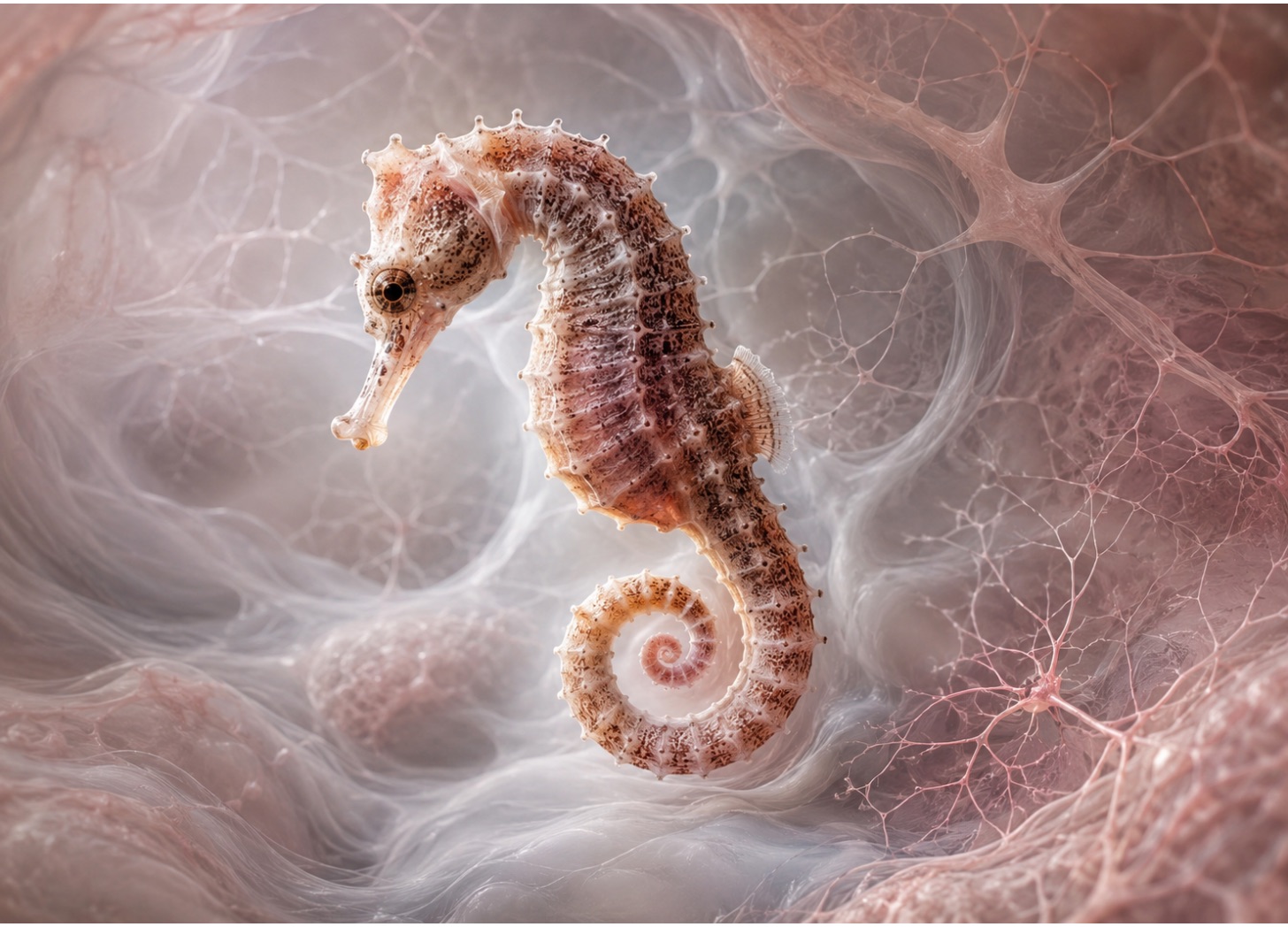
It takes its name from its shape. “Hippocampus” is Greek — hippos (“horse”) plus kampos (“sea monster”) — and it’s also the word for seahorse (the seahorse genus is literally Hippocampus). The 16th-century anatomist Giulio Cesare Aranzio thought the curled structure looked like the little fish, and the name stuck. (A small correction to the internet, including an older version of this very post: horse in Latin is equus — the “horse” in hippocampus is Greek.)
Those subfields aren’t decoration — they form a one-way loop called the trisynaptic circuit, the route a memory travels as it’s being written:
The Hippocampus & Memory
Almost everything we know about what the hippocampus does began with one patient.
In 1953, a man known for decades only as H.M. (Henry Molaison, named publicly after his death in 2008) had large parts of both hippocampi removed to stop severe epilepsy. The seizures eased — but H.M. was left unable to form any new conscious memory. He could hold a conversation, then forget it minutes later. Yet his childhood memories were intact, his IQ was normal, and he could still learn new motor skills like mirror-drawing — even while insisting he’d never done it before 1Reference 1Loss of recent memory after bilateral hippocampal lesions.
That single case cracked the field open. It showed the hippocampus is required to form new declarative memories (the facts and events you can consciously recall) but is not where old memories are ultimately kept, and isn’t needed for skill learning at all.
This is the modern picture of what the hippocampus is: not the hard drive, but the scribe. New experiences are written here first; then, gradually — a process called systems consolidation — they’re transferred out to the wider cortex for permanent storage, until the memory no longer needs the hippocampus to survive 2Reference 2Retrograde amnesia and memory consolidation: a neurobiological perspective. It’s why damage tends to erase recent memories while sparing distant ones: the old ones had already moved out.
A lot of that transfer happens while you sleep. During deep sleep the hippocampus fires off bursts called sharp-wave ripples, replaying the day’s experiences at high speed and handing them over to the cortex to file away — one reason a bad night’s sleep is a bad night for memory 3Reference 3Hippocampal sharp wave-ripple: a cognitive biomarker for episodic memory and planningView study →17Reference 17The memory function of sleep.
Remembering the Future
Here’s the strange part. The structure that reconstructs your past is also the one that imagines your future.
For a long time this looked like two separate jobs. It turns out to be one. When you picture next week’s meeting or a beach you’ve never visited, you’re not retrieving it — you’re constructing a scene, recombining fragments of real past experience into something new 6Reference 6Schacter DL, Addis DR. The cognitive neuroscience of constructive memory: remembering the past and imagining the future. Philos Trans R Soc Lond B Biol Sci. 2007;362(1481):773–786. doi:10.1098/rstb.2007.2087.View study →. The hippocampus is the scene-builder.
The evidence is striking: patients with hippocampal damage don’t just lose their past — asked to imagine a new experience, they produce fragmented, spatially incoherent scraps rather than a coherent scene 5Reference 5Patients with hippocampal amnesia cannot imagine new experiences. And a brain-imaging study from the Boston University / VA Boston memory group (Palombo and colleagues) sharpened the point: hippocampal activity didn’t track when an event was (past vs. future) so much as whether a scene had to be built at all 4Reference 4Medial temporal lobe contributions to episodic future thinking: scene construction or future projection? Cereb Cortex. The hippocampus isn’t a time machine so much as a scene generator — which is why it serves memory and imagination equally.
So the older version of this post had the spirit right, even if the mechanism is subtler than “mental time travel”: this one structure lets you both revisit where you’ve been and rehearse where you’re going.
Why Memory Runs on Place
There’s a reason so much of this circles back to location. The hippocampus is built around space.
In 1971, John O’Keefe found neurons in the rat hippocampus that fired only when the animal was in a specific place — “place cells,” a literal internal map of the environment 7Reference 7AnimalThe hippocampus as a spatial map: preliminary evidence from unit activity in the freely-moving ratView study →, soon formalised as the influential “cognitive map” theory of the hippocampus 8Reference 8The Hippocampus as a Cognitive Map. Decades later, May-Britt and Edvard Moser found grid cells in the entorhinal cortex that lay a repeating coordinate lattice over space, like the gridlines on a map 9Reference 9Hafting T, Fyhn M, Molden S, Moser M-B, Moser EI. Microstructure of a spatial map in the entorhinal cortex. Nature. 2005;436(7052):801–806. PMID: 15965463.. The three shared the 2014 Nobel Prize in Physiology or Medicine for uncovering the brain’s “inner GPS” 10Reference 10The Nobel Prize in Physiology or Medicine 2014 — John O’Keefe, May-Britt Moser, Edvard I. Moser. NobelPrize.org. https://www.nobelprize.org/prizes/medicine/2014/View study →.
This spatial machinery is the scaffold episodic memory is built on. It’s not that every memory is filed as map coordinates — but the hippocampus binds experiences to a context, a where and a when, and that’s a big part of why vivid memories so often come with a strong sense of place. It’s also the key that unlocks the memory tricks further down this page.
The Neurogenesis Question
Can the adult human hippocampus grow new neurons? This is one of neuroscience’s genuinely unsettled arguments, and it’s worth being honest about.
Several landmark studies say yes: new neurons were reported in the adult human dentate gyrus in 1998 11Reference 11Neurogenesis in the adult human hippocampusView study →, carbon-dating work later estimated on the order of ~700 new neurons added per day 12Reference 12Dynamics of hippocampal neurogenesis in adult humansView study →, and a 2018 study found the process persisting into old age 13Reference 13Human hippocampal neurogenesis persists throughout aging. But that same year, another high-profile paper looked and found new-neuron production dropping to undetectable levels in adults 14Reference 14Sorrells SF, Paredes MF, Cebrian-Silla A, et al. Human hippocampal neurogenesis drops sharply in children to undetectable levels in adults. Nature. 2018;555(7696):377–381. doi:10.1038/nature25975.View study →. The two 2018 results flatly contradict each other, largely over how the tissue was preserved and what counts as proof of a young neuron.
So: adult hippocampal neurogenesis is plausible and supported by strong studies, but not settled. Be sceptical of any product or program that promises to “regrow your hippocampus” — the science it’s leaning on is still being argued over.
Alzheimer’s Disease & the Hippocampus
Because the hippocampus does so much and sits under such constant load, it’s also one of the most vulnerable structures in the brain — and in Alzheimer’s disease, it’s among the first places to fail.
The disease’s tau pathology follows a stereotyped path: it characteristically begins in the entorhinal cortex — the hippocampus’s own gateway — then spreads into the hippocampus before reaching the wider cortex, a progression mapped by Braak staging 15Reference 15Neuropathological stageing of Alzheimer-related changesView study →. Shrinkage (atrophy) of the hippocampus on an MRI scan is now one of the earliest and most reliable imaging markers of the disease.
This is exactly why the first symptoms look the way they do. Disorientation, getting lost in familiar places, losing the thread of a spatial layout, and — most of all — an inability to form new memories (where you left the keys, the name of someone you just met) while older memories stay vivid. Those are the fingerprints of a hippocampus in trouble. (For more, see our guides to Alzheimer’s disease and dementia.)
Supporting a Healthy Hippocampus
There’s no supplement that “boosts” the hippocampus. But a handful of ordinary habits have real evidence behind them — and they’re worth ranking honestly, strongest first.
1. Move — Aerobic Exercise Is the Standout
This is the one intervention that shows up in a proper randomised trial. When Erickson and colleagues put older adults through a year of moderate aerobic exercise (mostly walking), their anterior hippocampus actually grew by about 2% — effectively reversing one to two years of age-related shrinkage — while a stretching control group continued to lose volume. Spatial memory improved alongside it 16Reference 16Exercise training increases size of hippocampus and improves memory. The likely mechanism is BDNF, a growth factor exercise raises that supports neurons in the hippocampus.
No pill in this article comes close to that result. If you do one thing on this list, move your body most days.
2. Protect Your Sleep
Memory consolidation isn’t optional downtime — it’s when the hippocampus does half its job. The deep, slow-wave stages of sleep are when the day’s memories get replayed and shipped off to long-term storage; cut sleep short and both consolidation and the next day’s ability to form new memories suffer 17Reference 17The memory function of sleep. Sleep is not a luxury for a healthy memory; it’s part of the machinery.
3. Manage Chronic Stress
The hippocampus is dense with receptors for cortisol, the main stress hormone — so it’s directly in the firing line of chronic stress 18Reference 18Functional actions of corticosteroids in the hippocampus. In animal studies, prolonged high cortisol causes neurons in the CA3 field to retract their branches and suppresses new-neuron formation, and researchers like Sapolsky and McEwen built the influential case that sustained stress wears the structure down 19Reference 19The neuroendocrinology of stress and aging: the glucocorticoid cascade hypothesis20Reference 20Physiology and neurobiology of stress and adaptation: central role of the brainView study →.
Honest caveat: the strongest “stress shrinks the hippocampus” data are from animals, and the human evidence (smaller hippocampi in PTSD, depression, and Cushing’s syndrome) is correlational — cause and effect are still debated. But the practical takeaway is sound: chronic stress is plausibly bad for this structure, and lowering it is sensible.
You don’t need anything elaborate. A few quiet, undistracted minutes a day — a cup of tea without your phone, a walk, drawing, breathing — is a legitimate form of stress reduction. The goal is simply to spend less of your life with the stress system stuck on.
4. Train It — The Memory Palace Actually Works
This is the pay-off of everything above about place. Because the hippocampus is a spatial machine, the most powerful memory technique ever devised hijacks that spatial talent: the method of loci, or “memory palace” — placing what you want to remember along an imagined walk through a familiar location.
And it’s not folklore. When researchers scanned world-class memory champions, they had ordinary brains and ordinary IQs — what set them apart was that they used spatial, navigational strategies (the method of loci) and recruited the hippocampus while memorising 21Reference 21Routes to remembering: the brains behind superior memory. Better still, Dresler and colleagues took people who’d never trained their memory, gave them six weeks of memory-palace practice, and roughly doubled how many words they could recall — with brain-connectivity changes shifting toward those of the champions, still measurable months later 22Reference 22Mnemonic training reshapes brain networks to support superior memory.
Your brain also rebuilds itself around this kind of use: London taxi drivers, who memorise the city’s entire street map, have enlarged posterior hippocampi that grow with years on the job 23Reference 23Navigation-related structural change in the hippocampi of taxi drivers. Use the spatial system, and it responds.
5. Feed It Well (With Honest Expectations)
Oxidative stress genuinely contributes to hippocampal ageing — but the popular leap from there to “take antioxidant supplements” doesn’t hold up. High-dose vitamin E, for instance, failed to slow cognitive decline in a three-year trial 24Reference 24Vitamin E and donepezil for the treatment of mild cognitive impairment. Isolated antioxidant pills have been a repeated disappointment.
What has some support is the whole diet. A produce- and fish-heavy pattern like the MIND diet is associated with slower cognitive decline 25Reference 25MIND diet slows cognitive decline with aging — though that’s observational, so treat it as encouraging, not proven. Cocoa flavanols are the most interesting lead: a small study found three months of a high-flavanol diet increased blood flow specifically in the hippocampus’s dentate gyrus and improved memory 26Reference 26Enhancing dentate gyrus function with dietary flavanols improves cognition in older adults — but a much larger 2023 trial missed its main memory target, with benefit showing up only in people who started with a poor diet 27Reference 27Dietary flavanols restore hippocampal-dependent memory in older adults with lower diet quality and lower habitual flavanol consumption. A blueberry pilot pointed the same direction but was tiny 28Reference 28Blueberry supplementation improves memory in older adults.
Everyday sources of these polyphenols — a daily cup of yerba maté, coffee, or cacao — are a pleasant, low-risk habit, and their caffeine reliably sharpens short-term alertness. Just keep the framing honest: the alertness is real and immediate; long-term “brain protection” from these drinks rests on observational data, not proof. Enjoy them for what they are, and put your real effort into the exercise, sleep, and stress items above.
What does the hippocampus actually do?
If my hippocampus were damaged, would I lose all my memories?
Why is it the first thing to go in Alzheimer’s?
Can you really grow new brain cells there?
What’s the single best thing I can do for it?
Does the “memory palace” trick actually work?
References
- Scoville WB, Milner B. Loss of recent memory after bilateral hippocampal lesions. J Neurol Neurosurg Psychiatry. 1957;20(1):11–21. PMID: 13406589.
- Squire LR, Alvarez P. Retrograde amnesia and memory consolidation: a neurobiological perspective. Curr Opin Neurobiol. 1995;5(2):169–177. PMID: 7620304.
- Buzsáki G. Hippocampal sharp wave-ripple: a cognitive biomarker for episodic memory and planning. Hippocampus. 2015;25(10):1073–1188. doi:10.1002/hipo.22488.
- Palombo DJ, Hayes SM, Peterson KM, Keane MM, Verfaellie M. Medial temporal lobe contributions to episodic future thinking: scene construction or future projection? Cereb Cortex. 2018;28(2):447–458 (published online Dec 2016). PMID: 27913433.
- Hassabis D, Kumaran D, Vann SD, Maguire EA. Patients with hippocampal amnesia cannot imagine new experiences. PNAS. 2007;104(5):1726–1731. PMID: 17229836.
- Schacter DL, Addis DR. The cognitive neuroscience of constructive memory: remembering the past and imagining the future. Philos Trans R Soc Lond B Biol Sci. 2007;362(1481):773–786. doi:10.1098/rstb.2007.2087.
- O’Keefe J, Dostrovsky J. The hippocampus as a spatial map: preliminary evidence from unit activity in the freely-moving rat. Brain Res. 1971;34(1):171–175. doi:10.1016/0006-8993(71)90358-1.
- O’Keefe J, Nadel L. The Hippocampus as a Cognitive Map. Oxford: Oxford University Press; 1978.
- Hafting T, Fyhn M, Molden S, Moser M-B, Moser EI. Microstructure of a spatial map in the entorhinal cortex. Nature. 2005;436(7052):801–806. PMID: 15965463.
- The Nobel Prize in Physiology or Medicine 2014 — John O’Keefe, May-Britt Moser, Edvard I. Moser. NobelPrize.org. https://www.nobelprize.org/prizes/medicine/2014/
- Eriksson PS, Perfilieva E, Björk-Eriksson T, et al. Neurogenesis in the adult human hippocampus. Nat Med. 1998;4(11):1313–1317. doi:10.1038/3305.
- Spalding KL, Bergmann O, Alkass K, et al. Dynamics of hippocampal neurogenesis in adult humans. Cell. 2013;153(6):1219–1227. doi:10.1016/j.cell.2013.05.002.
- Boldrini M, Fulmore CA, Tartt AN, et al. Human hippocampal neurogenesis persists throughout aging. Cell Stem Cell. 2018;22(4):589–599. PMID: 29625071.
- Sorrells SF, Paredes MF, Cebrian-Silla A, et al. Human hippocampal neurogenesis drops sharply in children to undetectable levels in adults. Nature. 2018;555(7696):377–381. doi:10.1038/nature25975.
- Braak H, Braak E. Neuropathological stageing of Alzheimer-related changes. Acta Neuropathol. 1991;82(4):239–259. doi:10.1007/BF00308809.
- Erickson KI, Voss MW, Prakash RS, et al. Exercise training increases size of hippocampus and improves memory. PNAS. 2011;108(7):3017–3022. PMID: 21282661.
- Diekelmann S, Born J. The memory function of sleep. Nat Rev Neurosci. 2010;11(2):114–126. PMID: 20046194.
- Joëls M. Functional actions of corticosteroids in the hippocampus. Eur J Pharmacol. 2008;583(2-3):312–321. PMID: 18275953.
- Sapolsky RM, Krey LC, McEwen BS. The neuroendocrinology of stress and aging: the glucocorticoid cascade hypothesis. Endocr Rev. 1986;7(3):284–301. PMID: 3527687.
- McEwen BS. Physiology and neurobiology of stress and adaptation: central role of the brain. Physiol Rev. 2007;87(3):873–904. doi:10.1152/physrev.00041.2006.
- Maguire EA, Valentine ER, Wilding JM, Kapur N. Routes to remembering: the brains behind superior memory. Nat Neurosci. 2003;6(1):90–95. PMID: 12483214.
- Dresler M, Shirer WR, Konrad BN, et al. Mnemonic training reshapes brain networks to support superior memory. Neuron. 2017;93(5):1227–1235.e6. PMID: 28279356.
- Maguire EA, Gadian DG, Johnsrude IS, et al. Navigation-related structural change in the hippocampi of taxi drivers. PNAS. 2000;97(8):4398–4403. PMID: 10716738.
- Petersen RC, Thomas RG, Grundman M, et al. Vitamin E and donepezil for the treatment of mild cognitive impairment. N Engl J Med. 2005;352(23):2379–2388. PMID: 15829527.
- Morris MC, Tangney CC, Wang Y, et al. MIND diet slows cognitive decline with aging. Alzheimers Dement. 2015;11(9):1015–1022. PMID: 26086182.
- Brickman AM, Khan UA, Provenzano FA, et al. Enhancing dentate gyrus function with dietary flavanols improves cognition in older adults. Nat Neurosci. 2014;17(12):1798–1803. PMID: 25344629.
- Brickman AM, Yeung LK, Alschuler DM, et al. Dietary flavanols restore hippocampal-dependent memory in older adults with lower diet quality and lower habitual flavanol consumption. PNAS. 2023;120(23):e2216932120. PMID: 37252983.
- Krikorian R, Shidler MD, Nash TA, et al. Blueberry supplementation improves memory in older adults. J Agric Food Chem. 2010;58(7):3996–4000. PMID: 20047325.
For half-lives, timing and stacking across the nootropics on this site, see the Nootropic Dosage Guide.
Clinical herbalist and the writer behind The Sunlight Experiment — an evidence-based pharmacopoeia of herbs, supplements, and the chemistry behind them.